

The end of the day can be a natural time for reflection.
After work, responsibilities, conversations, decisions, and countless thoughts, many adults want something quieter before going to sleep. A peaceful story can provide a gentle transition between the activity of the day and the stillness of the night.
Christian bedtime stories for adults can add another meaningful dimension to that experience.
These stories can draw inspiration from biblical themes such as faith, forgiveness, hope, compassion, patience, courage, gratitude, trust, and God’s presence. Rather than focusing only on dramatic biblical events, Christian bedtime storytelling can explore the emotional experiences that make Scripture meaningful to adults living in the modern world.
The goal is not necessarily to provide answers to every problem.
Sometimes a Christian bedtime story simply gives the reader a few quiet minutes to reflect on faith and remember that difficult circumstances are not the entirety of life.
What Are Christian Bedtime Stories for Adults?
Christian bedtime stories for adults are peaceful narratives designed around Christian values, biblical themes, spiritual reflection, or lessons inspired by Scripture.
They can take several forms.
Some stories can retell or imaginatively expand upon familiar biblical settings while remaining respectful of the biblical account. Others can be completely original fictional stories featuring ordinary people who encounter situations involving faith, forgiveness, generosity, patience, or hope.
For example, an original story might follow:
- A person waiting patiently for an uncertain opportunity.
- A family learning to forgive one another.
- A traveler finding comfort during a difficult journey.
- A neighbor quietly helping someone in need.
- Someone rediscovering gratitude after a difficult season.
- A person learning to trust God while facing an uncertain future.
- A community coming together after hardship.
These stories can provide an atmosphere of calm while encouraging spiritual reflection.
Christian Bedtime Stories for Adults
The Lamp That Stayed Lit

Theme: Faith During Uncertainty
Daniel noticed the lamp for the first time on a Tuesday evening.
It had been raining since late afternoon, the kind of steady rain that softened the sounds of the town and turned the streets into long ribbons of reflected light. Daniel had spent most of the day indoors, moving between his kitchen table and the small desk in his bedroom, refreshing his email more times than he wanted to admit.
He was waiting for an answer.
A job application.
One application among many, perhaps, but this one felt different.
The position was close to his home. The salary was enough to cover the bills. The company seemed stable. More importantly, the work suited the skills he had spent years developing.
If he received the job, perhaps things would finally settle down.
If he did not, Daniel wasn’t sure what he would do next.
He had lost his previous job three weeks earlier.
The news had arrived suddenly. There had been no dramatic warning, no argument with his manager, no obvious mistake on his part. The company was reducing its staff, and Daniel’s name had been included on the list.
He had smiled politely when they told him.
He had thanked them for the opportunity.
He had walked to his car.
Then he had sat behind the steering wheel for almost twenty minutes without starting the engine.
At home, he had told his wife, Emily, that everything would be all right.
He wanted to believe it.
But now, three weeks later, uncertainty had begun to settle into the corners of his mind.
That evening, after dinner, Daniel told Emily he needed some fresh air.
He put on his jacket and walked toward the old church at the end of Willow Street.
He had passed the church hundreds of times.
It was a modest stone building with narrow windows, a wooden door, and a small bell tower. During the day, it looked almost ordinary.
At night, however, something about it always seemed peaceful.
Daniel walked slowly through the rain.
When he reached the church, he noticed a small lamp glowing beside the entrance.
It wasn’t bright.
It wasn’t decorative.
It was simply a warm yellow light beneath a little metal covering.
Daniel stopped beneath the awning.
He looked through the dark windows.
The church appeared empty.
He checked the time.
9:43 p.m.
He wondered why anyone had left the lamp on.
Then he continued walking.
The next evening, the lamp was still there.
And the evening after that.
Daniel began noticing it every night.
Sometimes he saw it while walking.
Sometimes he deliberately passed by the church.
He never went inside.
He simply looked at the lamp.
There was something comforting about seeing that small circle of light in the darkness.
One Friday evening, Daniel stood beneath the awning for several minutes.
The rain had stopped.
The pavement was wet, and the clouds had begun breaking apart above the rooftops.
Daniel looked at the lamp.
“Why are you still on?” he whispered.
A voice behind him answered.
“Because someone might need to see it.”
Daniel turned.
An elderly man stood near the church door holding an umbrella.
Daniel recognized him vaguely.
He had seen the man at church on Sundays, usually sitting near the back.
“Good evening,” Daniel said.
“Good evening.”
The man smiled.
“My name is Arthur.”
“Daniel.”
Arthur glanced at the lamp.
“Beautiful little thing, isn’t it?”
Daniel nodded.
“I’ve been wondering about it.”
Arthur smiled again.
“Most people don’t notice.”
“Why do you leave it on?”
Arthur looked toward the empty street.
“Years ago, the pastor started keeping it lit after evening services. He said the church should never look completely closed.”
Daniel waited.
Arthur continued.
“Not because the building is always open. Sometimes it isn’t. But because a person walking past might be having a difficult night. Seeing a little light can remind them that they aren’t completely alone.”
Daniel looked at the lamp again.
“Does it really help?”
Arthur shrugged gently.
“I don’t know.”
Then he smiled.
“But I suppose we don’t always get to know what good comes from a small act.”
The words stayed with Daniel.
That night, Daniel returned home and sat quietly beside Emily.
She was reading on the sofa.
“How was your walk?” she asked.
“Good.”
“Did you go by the church?”
Daniel smiled.
“Yes.”
“You’re becoming friends with that church.”
He laughed softly.
“Maybe.”
Emily closed her book.
“Any news?”
Daniel shook his head.
“No.”
Emily reached across and held his hand.
“Then we’ll wait.”
Daniel looked at her.
“I hate waiting.”
“I know.”
“I keep thinking I should be doing something.”
“You are doing something.”
“What?”
“You’re waiting.”
Daniel smiled.
“That doesn’t feel productive.”
Emily squeezed his hand.
“Maybe not. But sometimes waiting is part of trusting.”
Daniel looked down.
He had heard those words many times.
Trust God.
Have faith.
Pray.
Be patient.
He understood them in theory.
But uncertainty had a way of making familiar words feel difficult.
It was easy to say you trusted God when everything was going according to plan.
It was harder when you didn’t know whether next month’s bills could be paid.
That night, Daniel went to bed but couldn’t sleep.
His mind wandered through possibilities.
What if the job rejected him?
What if he couldn’t find another position?
What if they had to use their savings?
What if something else went wrong?
He turned toward the window.
The town was quiet.
Then he remembered the lamp.
A small light.
Nothing had changed because it was there.
The rain hadn’t stopped because of it.
The darkness hadn’t disappeared.
But the lamp remained.
Daniel closed his eyes.
“Lord,” he whispered, “I don’t know what happens next.”
He paused.
For once, he didn’t try to finish the prayer with an answer.
“I don’t know what happens next. But please help me take care of what I can take care of today.”
The room was silent.
Daniel breathed slowly.
“Help me trust You with tomorrow.”
He didn’t suddenly feel completely peaceful.
His worries didn’t disappear.
But they seemed a little less enormous.
The next morning, Daniel made a list.
Instead of checking his email every fifteen minutes, he decided to send three applications before lunch.
He updated his résumé.
He contacted an old colleague.
He reviewed his monthly expenses with Emily.
They decided which things they could postpone and which ones mattered most.
Daniel called his bank to discuss his options.
He prayed.
Then he went for a walk.
The lamp was still glowing.
Days passed.
No answer came from the company.
Daniel continued applying for jobs.
Some companies never responded.
One sent a polite rejection.
Another offered an interview and then canceled it.
A third position looked promising until Daniel discovered that the salary was far below what they needed.
Some mornings, he felt hopeful.
Other mornings, he woke with a heavy feeling in his chest.
But each evening, when he passed the church, the lamp was there.
Sometimes Arthur was nearby.
Sometimes he wasn’t.
One evening, Daniel found him sitting on a bench outside the church.
“Still waiting?” Arthur asked.
Daniel laughed.
“Still waiting.”
“How’s it going?”
“Some days better than others.”
Arthur nodded.
“That’s normal.”
Daniel sat beside him.
“I thought faith meant I wouldn’t be afraid.”
Arthur looked at him thoughtfully.
“No.”
Daniel waited.
“I think faith means you can be afraid and still keep walking.”
Daniel considered that.
“I’ve been trying to make myself stop worrying.”
“Has that worked?”
Daniel laughed.
“No.”
“Then perhaps stop trying to control the worry.”
“What should I do instead?”
“Give it to God.”
Daniel looked at the church.
“Every night?”
“Every night.”
“What if it comes back?”
Arthur smiled.
“Then give it back again.”
The simplicity of the answer touched Daniel.
There was no grand promise.
No guarantee that tomorrow would bring the job.
No assurance that every problem would disappear.
Just the invitation to trust again.
And again.
And again.
Two weeks later, Daniel received a phone call.
It wasn’t from the company he had been waiting for.
It was from an organization where he had submitted an application almost a month earlier.
They wanted to interview him.
The position wasn’t exactly what he had imagined.
The office was farther away.
The salary was slightly lower.
But the work was meaningful.
Daniel accepted the interview.
Over the next several days, he went through two rounds.
Then three.
At the end of the final interview, the hiring manager said they would make a decision the following week.
Daniel walked back to his car.
For the first time in months, he felt something unfamiliar.
Not certainty.
Hope.
But he was careful with it.
He had learned that hope didn’t mean pretending everything was guaranteed.
Hope meant being willing to believe that tomorrow could hold something he couldn’t yet see.
That evening, Daniel walked past the church.
The lamp was glowing.
Arthur was standing beside the door.
“Good news?” Arthur asked.
“Maybe.”
Arthur smiled.
“Maybe is a beautiful word.”
Daniel laughed.
“I used to hate that word.”
“Why?”
“Because it means you don’t know.”
Arthur nodded.
“And now?”
Daniel looked at the lamp.
“Now I think maybe means there’s still room for God to work.”
Arthur said nothing.
He simply smiled.
The following Monday morning, Daniel received the call.
He had been offered the job.
It wasn’t the exact position he had originally wanted.
But it was good work.
The company was growing.
The manager seemed kind.
There was room to learn.
And the salary, while not perfect, was enough for Daniel and Emily to move forward carefully.
Daniel accepted.
That evening, he walked to the church.
Arthur was there.
“I got the job,” Daniel said.
Arthur shook his hand.
“I’m glad.”
Daniel looked at the lamp.
“You know, I thought that lamp was going to lead me to some kind of answer.”
Arthur smiled.
“And did it?”
“Not really.”
“What did it do?”
Daniel thought for a moment.
“It reminded me that I didn’t have to know the answer.”
Arthur nodded.
“Sometimes that’s enough.”
Daniel stood quietly beneath the warm light.
He thought about the past several weeks.
The unanswered emails.
The rejection letters.
The sleepless nights.
The prayers whispered in darkness.
The conversations with Emily.
The lists he had made.
The calls he had made.
The doors that had closed.
And finally, the door that opened.
He understood something he had not understood before.
God had not removed uncertainty from his life.
He had walked with Daniel through it.
There had been no dramatic miracle.
No voice from heaven.
No sudden solution that arrived before Daniel had to do anything.
Instead, there had been small things.
A wife holding his hand.
An old man offering a few words of wisdom.
The courage to send another application.
The discipline to take care of today’s responsibilities.
The willingness to pray when he had no answers.
And a little lamp beside an old church.
Daniel looked at it one more time.
“I think I understand now,” he said.
Arthur raised an eyebrow.
“Understand what?”
“Why the lamp stays lit.”
Arthur smiled.
“Tell me.”
Daniel looked down the quiet street.
“Because darkness doesn’t always need to disappear before someone can find their way.”
Arthur nodded slowly.
“That’s a good thought.”
Daniel smiled.
He turned toward home.
The night was cool.
The streets were quiet.
Above him, the clouds had cleared enough for a few stars to appear.
Daniel walked slowly, no longer trying to solve tomorrow.
Tomorrow would come when it came.
There would be new responsibilities.
New uncertainties.
New decisions.
Perhaps there would be difficult days again.
But he knew something now.
He didn’t have to carry every possible tomorrow at once.
He could pray tonight.
He could do what was needed tomorrow morning.
He could take one faithful step.
Then another.
And when darkness came, he could remember that God’s presence did not depend on how clearly he could see the road ahead.
Sometimes faith was not a bright sunrise.
Sometimes it was simply a small lamp glowing in the darkness.
A reminder that the night was not the whole story.
And so Daniel went home.
Emily was waiting for him.
“How was your walk?” she asked.
Daniel smiled.
“Peaceful.”
“Did you see the lamp?”
“Yes.”
He took her hand.
“It was still lit.”
That night, Daniel slept deeply.
For the first time in many weeks, he didn’t need to know what tomorrow would bring.
He had done what he could.
He had prayed.
He had trusted.
And he had learned that faith did not always mean seeing the whole road.
Sometimes faith simply meant taking the next step while trusting that God was already there.
Outside the window, the town grew quiet.
And at the little church on Willow Street, a single lamp continued to shine.
Not brightly enough to illuminate the entire town.
Not strongly enough to erase the darkness.
Just brightly enough for someone passing by to know that a light was still there.
And sometimes, that was enough.
The Empty Chair at Sunday Dinner

Theme: Forgiveness
Every Sunday evening, Margaret set the table for three.
She lived alone in a small house at the edge of town, where the streets became quieter as they approached the fields. Her house had a blue front door, white curtains, and a kitchen window that looked toward an old maple tree.
There was nothing unusual about her Sunday dinner.
She usually prepared something simple.
Roast chicken.
Potatoes.
Green beans.
Sometimes a pie.
She would light a small candle on the table, put on quiet music, and sit down with her meal.
But there was always one strange detail.
She set three places.
One for herself.
One for her daughter, Claire.
And one for her younger brother, Thomas.
Claire lived several hours away and visited when she could.
Thomas had not sat at that table in twelve years.
The empty chair remained.
Margaret never explained it.
When neighbors asked, she simply smiled.
When Claire asked, Margaret said, “It’s just a chair.”
But it wasn’t.
Margaret knew exactly what it meant.
Twelve years earlier, she and Thomas had stopped speaking after their mother’s funeral.
It had started with something small.
At least, that was how Margaret remembered it.
Their mother had left the family home to both of them.
Margaret wanted to sell it.
Thomas wanted to keep it.
Then came an argument.
Then another.
Old disappointments surfaced.
Words were spoken that neither of them could take back.
Thomas accused Margaret of caring more about money than family.
Margaret told Thomas that he had always expected other people to clean up his mistakes.
The argument ended with Thomas walking out.
Margaret expected him to call.
He didn’t.
She waited three days.
Then a week.
Then a month.
Eventually, months became years.
Neither apologized.
Neither reached out.
And slowly, silence became normal.
At first, Margaret told herself she was protecting her peace.
Later, she admitted that she had simply become accustomed to being angry.
The strange thing about resentment was that it did not always feel like anger.
Sometimes it felt like memory.
Sometimes it felt like pride.
Sometimes it felt like a story she repeated so often that she no longer questioned whether every part of it was fair.
Margaret was a Christian.
She attended church every Sunday morning.
She prayed.
She read Scripture.
She volunteered at the church pantry twice a month.
And yet there was one prayer she avoided.
“Lord, help me forgive Thomas.”
She was afraid to say it.
Because saying it would mean admitting that she was still holding something.
One Sunday evening, Margaret sat at the table and looked at the empty chair.
The candle flame moved gently.
She folded her hands.
“Lord,” she whispered, “I don’t know what forgiveness is supposed to look like anymore.”
She looked down.
“I don’t know if I can forget what happened.”
The room remained quiet.
Margaret continued.
“And I don’t know if he even wants my forgiveness.”
She took a breath.
“Maybe I don’t know what I’m asking for.”
Then she prayed the simplest prayer she could.
“Please show me what to do next.”
The next morning, Margaret went to the grocery store.
While she was walking through the produce section, she saw a familiar face.
For a moment, she thought she was mistaken.
Then the man turned.
Thomas.
Her brother.
Older now.
His hair had turned gray.
He looked thinner than she remembered.
He was holding a basket containing bread, apples, and a carton of milk.
Their eyes met.
Neither spoke.
Margaret felt her heart beating quickly.
Thomas looked away.
Then he looked back.
“Margaret?”
She nodded.
“Thomas.”
They stood several feet apart.
Twelve years of silence seemed to stand between them.
Finally, Thomas said, “How have you been?”
Margaret almost laughed.
It was such an ordinary question.
How have you been?
As if twelve years could be answered in a sentence.
“I’m all right,” she said.
Thomas nodded.
“Good.”
Another silence.
Then he said, “I’m glad I ran into you.”
Margaret looked at him.
“Are you?”
He smiled sadly.
“Yes.”
Neither knew what to say after that.
A store announcement came over the speakers.
Someone pushed a shopping cart between them.
Life continued around them as if nothing important had happened.
Finally, Thomas said, “I should go.”
Margaret nodded.
“Yes.”
He walked away.
Margaret watched him disappear around the corner.
She finished her shopping, returned home, and put the groceries away.
That evening, she stood in the kitchen for a long time.
She thought about the encounter.
She thought about the old argument.
She thought about their mother.
She thought about the words she had spoken.
Then she thought about the empty chair.
For the first time in years, Margaret wondered whether it had been waiting for Thomas.
Or whether it had been waiting for her heart to change.
The following Sunday, she set the table as usual.
Three places.
She almost removed the third plate.
Instead, she left it.
During dinner, she kept thinking about Thomas.
Afterward, she washed the dishes.
Then she sat down with a cup of tea.
She opened her Bible.
She read slowly.
The words about forgiveness were familiar.
Perhaps too familiar.
She had heard sermons about forgiveness.
She had told friends that forgiveness was important.
But now she understood something.
Forgiveness did not mean pretending the past had never happened.
It did not mean saying that hurtful words were acceptable.
It did not mean immediately trusting someone who had broken your trust.
And it did not mean forcing a relationship back into its old shape.
Maybe forgiveness simply meant refusing to keep feeding the anger.
Margaret closed the Bible.
She picked up her phone.
She found Thomas’s number.
She had kept it all these years.
She stared at it.
Then she put the phone down.
Five minutes later, she picked it up again.
She typed:
“Thomas, it was good to see you yesterday. I hope you’re doing well.”
She stared at the message.
It felt painfully small.
After twelve years, shouldn’t forgiveness begin with something more profound?
Then she remembered her prayer.
Show me what to do next.
Not everything.
Just the next thing.
Margaret pressed send.
The reply came the next morning.
“Good to see you too. I’m doing okay. Thank you.”
That was all.
Margaret smiled.
It wasn’t reconciliation.
But it was a beginning.
Over the next several weeks, they exchanged occasional messages.
Nothing serious at first.
Thomas asked about Claire.
Margaret asked about his work.
They talked about the weather.
They talked about their mother’s garden.
One afternoon, Thomas sent a photograph of an old rose bush.
It had grown beside the house where they had lived as children.
Margaret stared at the photograph.
“I remember that,” she wrote.
“So do I,” Thomas replied.
Then he added:
“Mom loved those roses.”
Margaret’s eyes filled with tears.
For years, she had remembered their mother mostly through the funeral.
Now, for the first time in a long time, she remembered her alive.
Wearing an old gardening hat.
Standing beside those roses.
Calling the children inside for dinner.
Margaret wrote:
“She did.”
There was a pause.
Then Thomas replied:
“I miss her.”
Margaret put down the phone.
She had missed her too.
But she had never allowed herself to say it to Thomas.
That evening, she prayed.
“Thank You, Lord.”
She didn’t ask for anything else.
She simply gave thanks.
A month passed.
Then Thomas called.
Margaret almost didn’t answer.
When she did, neither spoke for several seconds.
Finally, Thomas said, “I was wondering if you’d have coffee with me.”
Margaret looked out the window.
“Yes.”
They met at a quiet café the following Saturday.
Thomas arrived first.
He stood when Margaret entered.
They sat across from each other.
At first, they talked about ordinary things.
Work.
The town.
Claire.
Then Thomas said, “I owe you an apology.”
Margaret looked down.
He continued.
“I’ve thought about that day a lot.”
Margaret swallowed.
“So have I.”
“I said things I shouldn’t have said.”
“Me too.”
Thomas looked surprised.
Margaret smiled sadly.
“I wasn’t innocent.”
Neither spoke for a moment.
Then Thomas said, “I was angry.”
“So was I.”
“I thought you were trying to take everything.”
“I thought you were trying to control everything.”
Thomas smiled faintly.
“Maybe we were both wrong.”
“Maybe.”
They did not solve twelve years that afternoon.
They did something more modest.
They told the truth.
They admitted their anger.
They acknowledged their pride.
They spoke about their mother.
They remembered the house.
They even laughed once.
When they left the café, Margaret hugged Thomas.
It was brief and awkward.
But it was real.
Thomas said, “Can we do this again?”
Margaret smiled.
“Yes.”
Their relationship did not suddenly become perfect.
There were still difficult memories.
There were still subjects they avoided.
Trust returned slowly.
Sometimes Margaret worried that one disagreement might bring everything back.
But she began learning something important.
Forgiveness was not the same as forgetting.
Forgiveness was a decision to stop making the old wound the center of every new conversation.
It was choosing to leave room for another person’s growth.
It was also accepting that healing could take time.
Several months later, Thomas came to Margaret’s house for Sunday dinner.
Margaret stood in the kitchen preparing roast chicken.
She heard the doorbell.
Her hands trembled slightly.
She opened the door.
Thomas stood outside holding a pie.
“I didn’t know what to bring.”
Margaret smiled.
“You brought dessert.”
“Is that acceptable?”
“Very.”
He stepped inside.
For a moment, they simply looked at each other.
Then Thomas noticed the dining table.
Three places had been set.
He looked at Margaret.
“You still set three?”
Margaret nodded.
“I always have.”
Thomas looked at the empty chair.
Then he slowly pulled it back.
“I suppose I should finally sit in it.”
Margaret laughed.
“That might be a good idea.”
They sat down.
Claire joined them by video call from her home, laughing when she saw her uncle at the table.
The dinner was not perfect.
Thomas spilled water.
Margaret burned the vegetables.
Claire told an embarrassing childhood story about both of them.
They laughed.
Later, after Claire ended the call, Margaret and Thomas sat quietly with their coffee.
The house felt different.
Not because anything magical had happened.
The walls were the same.
The table was the same.
The old clock still ticked in the hallway.
But the empty chair was no longer empty.
Margaret looked at her brother.
“Do you ever think about that day?”
Thomas nodded.
“Sometimes.”
“So do I.”
“I’m sorry.”
Margaret reached across the table.
“I forgive you.”
Thomas looked at her.
Then he nodded.
“Thank you.”
After he left that evening, Margaret stood alone in the kitchen.
She looked at the three plates.
For twelve years, she had believed forgiveness would require her to erase the past.
Now she understood that it required something different.
She had to stop allowing the past to decide everything about the future.
She still remembered.
She still wished some words had never been spoken.
She still wished their mother had lived long enough to see them sitting together again.
But she no longer needed to rewrite the past.
She could simply stop carrying it into every tomorrow.
Margaret washed the dishes.
Then she turned off the kitchen light.
Before going to bed, she knelt beside her bed.
“Lord,” she whispered, “thank You for giving me another chance.”
She paused.
“And thank You for reminding me that forgiveness can begin with one small step.”
Outside, the wind moved softly through the maple tree.
The house was quiet.
The dining room table had been cleared.
The three chairs stood beneath the gentle light.
None of them looked remarkable.
But one of them had carried twelve years of silence.
And now it carried something else.
Possibility.
Margaret climbed into bed.
She closed her eyes.
For the first time in many years, she did not wonder whether the past could have been different.
She simply thanked God for the future still waiting to be lived.
And somewhere between the last thought of the day and the first quiet moment of sleep, Margaret felt the peace she had been searching for.
Not the peace of a perfect life.
Not the peace of forgetting.
But the deeper peace that comes when a person finally places an old burden into God’s hands.
The empty chair had never been able to repair a broken relationship.
Only people could do that.
And even then, only slowly.
But perhaps the chair had served its purpose.
It had reminded Margaret that forgiveness leaves room.
Room for humility.
Room for apology.
Room for boundaries.
Room for healing.
And sometimes, room for someone to come home.
The Man Who Waited by the Window

Theme: Patience and Waiting
Samuel had become very good at waiting.
He waited for emails.
He waited for phone calls.
He waited for the sound of his phone vibrating on the wooden table beside his bed.
Most of all, he waited for one particular message.
For nearly four months, Samuel had been waiting to hear whether he had been accepted for a position that could change his life.
The job was with a respected company in the city.
It offered a better salary than his previous work.
It came with opportunities for advancement.
There was even a possibility that, after several years, Samuel could move into a management position.
When he had first applied, he had been confident.
He had spent weeks preparing his application.
He had rewritten his résumé.
He had carefully answered every question.
He had prayed before pressing the submit button.
Then he had been invited for an interview.
The interview went well.
At least, Samuel thought it had.
The hiring manager had smiled.
They had discussed his experience.
They had talked about the company.
At the end, the manager had said, “We’ll be in touch.”
Samuel had gone home believing the answer would come within a few days.
A few days became two weeks.
Two weeks became a month.
A month became three.
And eventually, Samuel stopped telling people how long he had been waiting.
His sister stopped asking.
His friends stopped asking.
Even his mother learned to say, “Whatever God has planned will come in the right time.”
Samuel knew she meant well.
But some mornings, those words were difficult to hear.
He wanted the answer now.
He wanted certainty.
He wanted to know whether he should continue waiting or begin looking in another direction.
But the company had not rejected him.
They had not accepted him either.
His application seemed to exist somewhere between yes and no.
So Samuel waited.
His apartment had one large window overlooking the street.
From that window, he could see the bakery across the road, the small park beside the library, and the old brick house next door.
The house belonged to Mrs. Bennett.
She was an elderly woman who lived alone.
Samuel had known her only by sight.
She had silver hair, a slow walk, and a habit of watering the plants along her front steps every morning.
They occasionally exchanged greetings.
“Good morning.”
“Good morning.”
Nothing more.
Until one cold November morning, Samuel noticed something unusual.
Mrs. Bennett was standing beside her front door trying to lift a large box.
She pulled.
The box didn’t move.
She tried again.
Samuel watched from his window.
He hesitated.
He had work to do.
Or rather, he had job applications to send.
He had planned to spend the morning updating his résumé and checking his email.
But he kept looking through the window.
Mrs. Bennett tried again.
Samuel put on his coat.
He crossed the street.
“Good morning, Mrs. Bennett.”
She turned.
“Oh, Samuel. Good morning.”
“Can I help you with that?”
She looked at the box.
“If you wouldn’t mind.”
Samuel lifted it easily.
“Where should I put it?”
“In the hallway, please.”
He carried it inside.
The house smelled faintly of cinnamon and old books.
Mrs. Bennett pointed toward the hallway.
“Just there.”
Samuel placed the box down.
“Anything else?”
She shook her head.
“No. You’ve already done enough.”
“It was nothing.”
She smiled.
“People often say that when they’ve done something kind.”
Samuel laughed.
“I suppose that’s true.”
He returned to his apartment.
Five minutes later, his phone remained silent.
No email.
No call.
Nothing.
Samuel sat at his desk.
He looked at his résumé.
Then he looked through the window.
Mrs. Bennett was standing outside again.
He wondered whether she needed help with something else.
He smiled at himself.
“Samuel,” he said quietly, “you have become very easily distracted.”
He returned to his work.
But something had changed.
The next morning, he saw Mrs. Bennett carrying a basket of laundry.
He crossed the street.
“Need help?”
She smiled.
“Perhaps I do.”
He carried the basket inside.
The day after that, he noticed that one of her porch lights had stopped working.
He replaced the bulb.
A week later, he helped move a small cabinet.
Then he fixed a loose handle on a kitchen drawer.
None of it took long.
Sometimes it took five minutes.
Sometimes twenty.
But slowly, Samuel became part of Mrs. Bennett’s ordinary routine.
They began talking.
She told him she had lived in the house for thirty-eight years.
Her husband, William, had died eight years earlier.
They had never had children.
“He was a teacher,” she said one afternoon.
“What did he teach?”
“History.”
Samuel smiled.
“My favorite subject.”
“Then you would have liked him.”
“Was he a good teacher?”
She looked toward an old photograph on the mantel.
“The best.”
Samuel noticed that she smiled differently when she talked about her husband.
There was sadness there.
But also gratitude.
One afternoon, Mrs. Bennett asked Samuel to sit down for tea.
He almost refused.
He had planned to check his email.
But then he remembered that he had checked it four times in the previous hour.
So he sat.
Mrs. Bennett poured tea into two small cups.
“You’re waiting for something,” she said.
Samuel looked at her.
“What?”
“Whatever it is, you’ve been waiting for it since I met you.”
Samuel laughed.
“Is it that obvious?”
“To an old woman, perhaps.”
He told her about the job.
She listened without interrupting.
When he finished, she nodded.
“That’s a long time to wait.”
“It is.”
“Do you want the job?”
“Very much.”
“Why?”
Samuel thought.
“Because it would change things.”
“How?”
“I’d have financial stability. I’d have a career again. I’d be able to plan my future.”
Mrs. Bennett nodded.
“All good reasons.”
Samuel looked at his tea.
“I’m just tired of not knowing.”
Mrs. Bennett smiled.
“Most people are.”
“How do you wait without becoming frustrated?”
She looked toward the window.
“I don’t know that you ever completely learn.”
Samuel smiled.
“That’s encouraging.”
She laughed.
“No, listen.”
She placed her cup on the table.
“When William died, I thought the rest of my life would simply be a long period of waiting for heaven.”
Samuel said nothing.
“But then I realized something.”
“What?”
“I was still alive.”
Samuel looked at her.
She continued.
“God had not finished with my ordinary days.”
She pointed toward the window.
“I had neighbors.”
She pointed toward the kitchen.
“I had meals to prepare.”
Then she touched the photograph of her husband.
“I had memories to be grateful for.”
She looked at Samuel.
“I thought waiting meant life had stopped.”
“What changed?”
“I learned that waiting and living can happen at the same time.”
Samuel carried those words home.
That night, he stood beside his window.
The street was quiet.
A few lights glowed in the houses.
The bakery had closed.
The park was empty.
Samuel thought about his own life.
He had been treating the past four months as if they didn’t count.
As if his real life would begin when the company finally answered.
He would travel when he got the job.
He would make plans when he got the job.
He would feel secure when he got the job.
He would be happy when he got the job.
Everything had been postponed.
He realized how much of his present life he had been refusing to live.
The next morning, Samuel opened his Bible before checking his email.
He read slowly.
Then he prayed.
“Lord, I don’t know how long this will take.”
He paused.
“I still want this opportunity.”
Another pause.
“But help me not waste today waiting for tomorrow.”
It was a simple prayer.
But it changed the way he looked at the day.
He made breakfast.
He went for a walk.
He sent two job applications.
He helped Mrs. Bennett carry groceries inside.
He called his mother.
He cooked dinner instead of ordering food.
That evening, he read a book he had been postponing for months.
Nothing extraordinary happened.
And somehow, the day felt full.
The weeks continued.
Samuel still checked his email.
He still hoped.
But he stopped refreshing his inbox every few minutes.
He began helping Mrs. Bennett more regularly.
On Mondays, he carried her groceries.
On Wednesdays, they drank tea.
On Fridays, he helped her with small repairs around the house.
One afternoon, Mrs. Bennett showed him the garden behind her house.
It had become overgrown.
“We should do something about this,” Samuel said.
“Who is we?”
Samuel smiled.
“We.”
So they began.
They pulled weeds.
They trimmed branches.
They planted winter flowers.
Samuel discovered that Mrs. Bennett knew more about gardening than anyone he had ever met.
“Plants teach patience,” she told him.
“What do you mean?”
“You can’t pull a flower out of the ground to check whether the roots are growing.”
Samuel laughed.
“That sounds like something I would do.”
“I know.”
They worked together in the cold afternoon.
When they finished, Mrs. Bennett stood back and looked at the garden.
“It doesn’t look like much yet.”
“It will.”
“How do you know?”
Samuel smiled.
“I suppose I don’t.”
Mrs. Bennett nodded.
“Exactly.”
That evening, Samuel returned home.
He stood beside his window.
The garden looked small from there.
But he could see the newly planted flowers.
He thought about roots.
Invisible work.
Growth that happened beneath the surface.
Perhaps waiting was like that.
Maybe not every season of life was supposed to produce visible results.
Some seasons were about roots.
Character.
Patience.
Prayer.
Compassion.
Learning to notice people.
Learning to become grateful.
Learning to trust God without knowing the timetable.
Three more weeks passed.
Then, one Thursday afternoon, Samuel’s phone rang.
He looked at the screen.
The number was unfamiliar.
His heart began beating faster.
He answered.
“Hello?”
“May I speak with Samuel?”
“Yes.”
“This is Daniel from Westbridge Solutions.”
Samuel sat down.
“We’ve completed our hiring process.”
Samuel closed his eyes.
“We’d like to offer you the position.”
For several seconds, Samuel couldn’t speak.
Then he smiled.
“Thank you.”
The call lasted several minutes.
They discussed the salary.
The starting date.
The paperwork.
When Samuel hung up, he remained seated.
He had imagined this moment hundreds of times.
Sometimes he had imagined shouting.
Sometimes calling his mother immediately.
Sometimes running outside.
Instead, he simply sat quietly.
Then he looked through the window.
Mrs. Bennett was outside.
She was watering the garden.
Samuel crossed the street.
She looked up.
“You heard?”
Samuel laughed.
“I got the job.”
Mrs. Bennett smiled.
“I knew you would.”
“You didn’t know.”
“No.”
She continued watering the flowers.
“I simply knew that whatever happened, you would be all right.”
Samuel stood beside her.
“I spent so much time waiting.”
“I know.”
“And then I realized I was waiting for my life to begin.”
Mrs. Bennett nodded.
“Many people do that.”
Samuel looked at the garden.
“I don’t think I want to do that anymore.”
“You don’t have to.”
He looked at her.
“Thank you.”
“For what?”
“For giving me something to do while I waited.”
She smiled.
“I think God gave you something to do.”
Samuel looked toward the sky.
The afternoon clouds were beginning to clear.
“Maybe He did.”
His new job began two weeks later.
Samuel was nervous on his first morning.
He stood in front of the mirror adjusting his tie.
He checked his bag.
He checked his phone.
Then he stopped.
For months, he had imagined the day when he would finally leave his apartment for work again.
Now it had arrived.
Before leaving, he prayed.
“Thank You, Lord.”
He paused.
“And please help me remember what I learned while I was waiting.”
He crossed the street before going to work.
Mrs. Bennett was sitting on her porch.
“First day?”
Samuel nodded.
She handed him a small paper bag.
“What’s this?”
“Breakfast.”
“You didn’t have to do that.”
“I know.”
Samuel smiled.
He took the bag.
“Thank you.”
She waved as he walked away.
The new job was demanding.
Samuel had much to learn.
Some days were difficult.
Some evenings he returned home exhausted.
But he found himself thinking differently about time.
When something went wrong, he remembered the months he had spent waiting.
When a promotion was delayed, he remembered the garden.
When he felt impatient, he remembered Mrs. Bennett’s words.
Waiting and living can happen at the same time.
One year later, Samuel stood beside the same window.
The view had changed very little.
The bakery was still across the street.
The library was still beside the park.
Mrs. Bennett’s house was still there.
But the garden was beautiful.
Flowers filled the beds.
The old wooden fence had been repaired.
A small bench sat beneath the tree.
Samuel had helped build it.
Mrs. Bennett sat there every afternoon.
Samuel often joined her.
One evening, she looked at him.
“You still look out that window.”
Samuel smiled.
“Yes.”
“What are you waiting for now?”
He thought about it.
There were always things to wait for.
A holiday.
A promotion.
A phone call.
A future plan.
An answer to a prayer.
But he no longer saw waiting as an empty room.
“I’m not sure,” he said.
Mrs. Bennett smiled.
“That’s probably a good thing.”
Samuel laughed.
Then he looked toward the fading sunlight.
“I suppose I’m just living.”
Mrs. Bennett nodded.
“Good.”
The two sat quietly.
The evening air was cool.
The street grew peaceful.
A few birds settled into the trees.
Samuel thought about how easily he had once believed that his life was on hold.
He had measured his days by an unanswered email.
He had forgotten that God could work in ordinary moments.
He had wanted a destination.
Instead, God had given him neighbors.
He had wanted an answer.
God had given him patience.
He had wanted certainty.
God had taught him trust.
He had wanted his future immediately.
God had shown him the value of today.
Samuel looked at Mrs. Bennett.
“Can I ask you something?”
“Of course.”
“Do you think God makes us wait?”
She considered the question.
“Sometimes.”
“Why?”
“I don’t know.”
Samuel smiled.
“That’s not very helpful.”
She laughed.
“No, but it’s honest.”
Then she became quiet.
“I think sometimes God allows us to wait because there are things He wants to grow in us that cannot be hurried.”
Samuel looked at the garden.
“Like roots.”
“Exactly.”
They sat in silence.
The sun disappeared behind the trees.
One by one, lights came on in the houses.
Samuel thought about the prayer he had made months earlier.
Help me not waste today waiting for tomorrow.
He realized that the prayer had been answered.
Not by making the waiting disappear.
But by teaching him how to live inside it.
The answer had been hidden in ordinary days.
A box carried across the street.
A broken light bulb.
A basket of groceries.
A cup of tea.
A garden.
A conversation.
A friendship.
A prayer.
None of these things had been part of Samuel’s original plan.
Yet they had changed him.
Perhaps that was one of the quiet ways God worked.
Not always through dramatic events.
Sometimes through the small responsibilities placed directly in front of us.
Sometimes through people we almost overlook.
Sometimes through seasons we wish would end.
And sometimes through waiting.
Samuel stood.
“It’s getting cold.”
Mrs. Bennett smiled.
“Then we should go inside.”
They walked toward the house.
Samuel opened the door for her.
Before entering, she turned.
“You know, Samuel, I think you were waiting by the window for the wrong reason.”
He smiled.
“What do you mean?”
“You thought you were watching for your future.”
She looked toward the quiet street.
“But perhaps you were learning to see what God had already placed in front of you.”
Samuel looked back at the window.
The glass reflected the warm light from inside the house.
He smiled.
“Maybe you’re right.”
That night, Samuel returned to his apartment.
He stood beside his own window one last time.
The city was quiet.
He could see the garden across the street.
The flowers were barely visible in the darkness.
But Samuel knew they were there.
Growing quietly.
Rooted beneath the soil.
He closed the curtains.
Then he knelt beside his bed.
“Lord, thank You for today.”
He thought about all the things he had once wanted God to hurry.
The job.
The future.
The answers.
He smiled.
“Teach me to be patient with what I cannot control.”
He took a slow breath.
“And help me be faithful with what You have already placed in my hands.”
Then he went to bed.
For the first time, Samuel understood that waiting did not mean standing still.
A person could wait and still grow.
Wait and still serve.
Wait and still love.
Wait and still pray.
Wait and still live.
And sometimes, when the answer finally came, the greatest gift was not the answer itself.
It was the person God had shaped while they were waiting for it.
Outside, the town settled into sleep.
Across the street, Mrs. Bennett’s garden rested beneath the moonlight.
Under the soil, roots continued growing where no one could see them.
And in the quiet of the night, Samuel slept peacefully, trusting that whatever tomorrow brought, he did not need to arrive there all at once.
Tomorrow would come.
For tonight, today was enough.
The Bread on the Doorstep
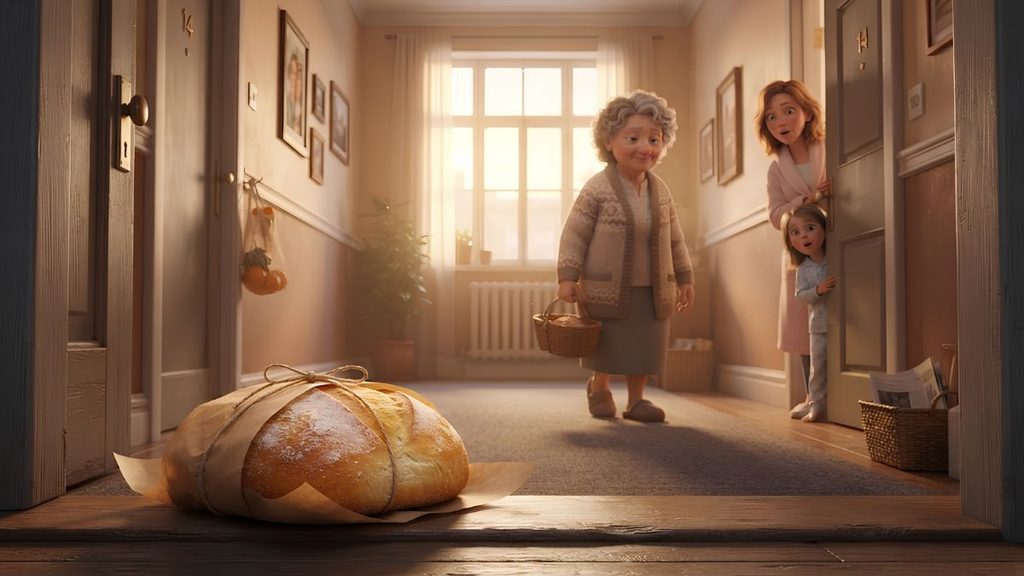
Theme: Compassion
Every Thursday morning, before most people in the Willow Creek Apartments had opened their curtains, Clara Bennett was already awake.
The sky outside her kitchen window was usually still gray.
The streetlights remained on, casting pale circles of light across the wet pavement. Somewhere in the distance, a delivery truck would rumble down the road, and occasionally Clara could hear the soft cry of a bird beginning its day.
She liked those quiet hours.
They reminded her that the world did not always have to hurry.
Clara would tie her old blue apron around her waist, switch on the small lamp above the kitchen counter, and begin making bread.
She had been baking since she was a little girl.
Her mother had taught her first, showing her how to mix flour, yeast, salt, and warm water without measuring everything too precisely.
“Listen to the dough,” her mother used to say.
Clara had laughed at the idea.
But years later, she understood.
Some things could not be rushed.
The dough needed time to rest.
The yeast needed time to work.
And sometimes people needed the same thing.
Time.
Patience.
Someone who believed they were worth waiting for.
Clara lived alone in apartment 2A.
She was sixty-one and had never married. She had worked most of her life at a small neighborhood bakery, first as an assistant and eventually as the person everyone trusted with the morning bread.
She knew how to make cinnamon rolls that disappeared before noon.
She knew how to bake soft dinner rolls that stayed warm for hours.
But her favorite thing to make was a simple loaf of country bread.
There was nothing impressive about it.
It had a golden crust, a soft center, and a warm smell that seemed to make even an ordinary kitchen feel like home.
One Thursday morning, Clara placed a loaf in the oven.
While she waited, she looked toward the window.
Across the courtyard stood apartment 3B.
A young woman named Rachel had moved there several months earlier with her seven-year-old daughter, Lily.
Clara had met them only briefly.
Rachel was quiet and polite.
Lily was quieter.
The little girl often carried a purple backpack and kept her eyes on the floor whenever she passed someone in the hallway.
Clara had learned from small conversations with other residents that Rachel was raising Lily alone.
She worked at a medical office several miles away and often returned home late.
Some evenings Clara would see her carrying grocery bags in one hand and holding Lily’s hand with the other.
There was always too much for one person to carry.
One rainy Thursday, Clara noticed something that troubled her.
She had been returning from the laundry room when she saw Rachel standing outside the apartment entrance, looking through her purse.
Rachel checked one pocket.
Then another.
She looked at her phone.
She sighed.
Lily stood beside her.
“Mom, are we having dinner?”
Rachel smiled quickly.
“Of course, sweetheart.”
But her smile did not reach her eyes.
Clara said nothing.
She simply walked past them.
That evening, she thought about the moment again and again.
She thought about the extra loaf sitting in her kitchen.
She thought about the teachings she had heard since childhood about giving without expecting recognition.
She thought about how easy it was to talk about compassion and how much harder it sometimes was to practice it.
Then she prayed.
“Lord, show me what I can do.”
The answer did not arrive dramatically.
There was no voice.
No sudden revelation.
Only a simple thought.
Bake another loaf.
So she did.
The following Thursday morning, Clara wrapped a fresh loaf in brown paper.
She carried it quietly down the stairs.
Apartment 3B was on the other side of the building.
Clara placed the bread beside Rachel’s door.
She paused for a moment.
Then she walked away.
She did not knock.
She did not leave a note.
She did not want Rachel to feel embarrassed.
When Clara returned upstairs, she felt strangely peaceful.
Later that morning, she heard Lily laughing in the hallway.
Clara opened her door.
Lily was standing outside apartment 3B holding the empty brown paper.
She looked at Clara.
“Did you know who left it?”
Clara smiled.
“No.”
Lily looked suspicious.
“Someone did.”
“I’m sure they did.”
“Mom says we should thank them.”
“That’s kind of your mother.”
Lily nodded.
Then she ran down the hallway.
Clara closed her door.
She never mentioned the bread.
The next Thursday, she baked another loaf.
And the Thursday after that.
Soon, it became a quiet tradition.
Every Thursday morning, before seven o’clock, there was a loaf of fresh bread outside apartment 3B.
Sometimes it was plain country bread.
Sometimes it was oat bread.
Once Clara made a loaf with raisins and cinnamon.
Lily loved that one.
Rachel never found out who was leaving it.
She asked the building manager.
She asked a neighbor.
She even left a small handwritten note beside the door one week.
Thank you, whoever you are. You have no idea what this means to us.
Clara found the note that morning.
She stood there for several seconds.
Then she folded it carefully and put it in her apron pocket.
She did not take the bread away.
She simply whispered,
“Thank You, Lord.”
Weeks passed.
Then something unexpected happened.
People began noticing.
Mrs. Alvarez from apartment 1C was the first.
She had seen Clara carrying something downstairs one Thursday morning.
She did not say anything.
The following week, she quietly placed a small bag of oranges beside Rachel’s door.
Clara found it when she came down with her bread.
She looked at the oranges.
Then she smiled.
She carried nothing away.
The next Thursday, there was bread, oranges, and a carton of milk.
The Thursday after that, someone added a package of pasta.
Then came canned soup.
A small bag of rice.
A child’s winter hat.
A box of cereal.
Nobody announced anything.
Nobody created a committee.
Nobody stood in the lobby and made speeches about helping one another.
People simply began leaving things.
It was almost as though the building had remembered something it had forgotten.
They were neighbors.
Not strangers living behind separate doors.
Neighbors.
Rachel was overwhelmed.
One Saturday afternoon, she found Clara in the laundry room.
“Excuse me,” Rachel said.
Clara turned around.
“Yes?”
Rachel held a small basket.
“I wanted to ask you something.”
“Of course.”
Rachel hesitated.
“Do you know who has been leaving things outside our door?”
Clara smiled gently.
“I’ve seen some of them.”
Rachel looked at her carefully.
“Was it you?”
Clara did not answer immediately.
Then she nodded.
“Some of it.”
Rachel’s eyes filled with tears.
“I don’t know how to thank you.”
“You don’t have to.”
“But you don’t understand.”
“I might not understand everything.”
Rachel looked down.
“I was embarrassed.”
Clara stepped closer.
“About what?”
“Needing help.”
Clara’s expression softened.
“Rachel, there is nothing shameful about needing help.”
Rachel wiped her eyes.
“I’ve always thought I should be able to handle everything myself.”
“Most of us think that.”
“And then one day you realize you can’t.”
Clara nodded.
“That’s when you discover why God puts people around us.”
Rachel looked at her.
Clara continued quietly.
“We aren’t meant to carry everything alone.”
For a moment, neither woman spoke.
Then Lily appeared in the doorway.
“Mom!”
Rachel turned.
“What is it?”
“I made something.”
Lily held out a drawing.
It showed a row of apartment buildings beneath a bright yellow sun.
Several people stood outside.
At the center was a large loaf of bread.
Clara laughed softly.
“That’s beautiful.”
Lily looked at her seriously.
“It’s our bread.”
Clara smiled.
“Yes. It is.”
From that day forward, Clara and Rachel became friends.
But the bread continued.
Because it was no longer just Clara’s bread.
It belonged to the whole building.
Every Thursday morning, the little collection appeared outside apartment 3B.
And slowly, something else changed.
People began speaking to each other.
Mrs. Alvarez started sharing her homemade soup.
David from apartment 4A repaired a broken cabinet in Rachel’s kitchen.
A retired teacher named Margaret offered to help Lily with her reading.
Someone left a bag of children’s clothes.
Another neighbor brought a pair of nearly new shoes.
Nobody kept track.
Nobody asked what anything was worth.
The residents simply gave what they could.
Then, one winter morning, Clara woke up with a terrible pain in her back.
She tried to stand.
She could not.
She sat on the edge of her bed and waited.
For the first time in years, she was afraid.
She had been planning to work that morning.
She had bills to pay.
The heating system in her apartment had been making strange noises.
Her refrigerator was beginning to fail.
And now she could barely move.
She called her doctor and was told to rest.
The problem was not serious, but she would need several weeks to recover.
That Thursday, Clara did not bake.
For the first time in nearly a year, there was no bread outside apartment 3B.
Rachel noticed immediately.
She looked down the hallway.
Nothing.
She waited until afternoon.
Still nothing.
She knocked on Clara’s door.
“Clara?”
No answer.
Rachel knocked again.
“Are you okay?”
Finally, Clara opened the door.
She was leaning against the frame.
“Hello.”
Rachel looked concerned.
“What happened?”
“Nothing terrible. My back decided to remind me that I’m not twenty anymore.”
Rachel smiled despite herself.
“Can I help?”
“You should be helping yourself.”
Rachel shook her head.
“That’s not how this works.”
Clara smiled.
“What do you mean?”
Rachel stepped inside.
“You taught me that.”
Over the next few days, something remarkable happened.
Mrs. Alvarez brought soup.
David repaired the loose railing outside Clara’s apartment.
Margaret brought groceries.
Someone paid for the medicine Clara needed.
Lily left a drawing on Clara’s table.
It showed an old woman sitting in a chair beside a loaf of bread.
Underneath, Lily had written:
People need people.
Clara stared at the words for a long time.
Then she began to cry.
Rachel sat beside her.
“You okay?”
Clara nodded.
“I’m just grateful.”
“For what?”
Clara looked around the room.
“For all of this.”
Rachel smiled.
“Maybe this is what the bread was supposed to do.”
Clara looked at her.
“What do you mean?”
“You thought you were feeding us.”
Rachel paused.
“But you were teaching all of us how to feed each other.”
Clara looked toward the window.
Snow had begun falling outside.
Soft flakes drifted past the glass.
She remembered the first Thursday.
One loaf.
One doorstep.
One quiet act that nobody was supposed to notice.
Yet somehow, that small act had traveled from one apartment to another.
It had crossed hallways.
It had opened conversations.
It had softened pride.
It had reminded people that kindness did not have to be loud to be powerful.
Weeks later, Clara was well enough to return to her kitchen.
She woke early on a Thursday morning.
She tied her blue apron around her waist.
She measured the flour.
Added the yeast.
Poured in the water.
Then she paused.
For a moment, she simply stood there.
She thought about all the people who had helped her.
She thought about Rachel.
She thought about Lily.
She thought about how God sometimes answered prayers in unexpected ways.
She had once prayed for a way to help someone.
She had never imagined that the answer would eventually help her too.
The bread finished baking just after sunrise.
Clara carried the warm loaf downstairs.
But this time, she did not walk directly to apartment 3B.
She stopped in the lobby.
There was a small wooden table near the entrance.
On it sat several baskets.
A handwritten sign hung above them:
Take what you need. Leave what you can.
Clara smiled.
She placed the loaf on the table.
A few minutes later, Rachel came downstairs.
She was carrying a jar of homemade jam.
Lily followed behind her with a small basket of muffins.
Mrs. Alvarez arrived with soup.
David brought canned vegetables.
Margaret brought books.
Soon the little table was full.
Clara stood nearby watching everyone.
Lily took her hand.
“Grandma Clara?”
Clara laughed.
“I’m not your grandmother.”
“I know.”
Lily smiled.
“But you feel like one.”
Clara squeezed her hand.
Outside, the morning light slowly filled the windows.
The building was waking.
Doors opened.
Footsteps moved through the hallways.
People greeted one another.
Someone laughed.
Someone carried groceries upstairs.
Someone stopped to leave a bag on the little table.
It was an ordinary morning.
There was nothing dramatic about it.
No great miracle anyone could photograph.
No announcement.
No applause.
Only people choosing, in small ways, to care for one another.
Clara looked at the bread on the table.
She remembered how everything had started.
One loaf.
One doorstep.
One quiet act of compassion.
And she understood something she had spent years learning.
Sometimes faith does not ask us to solve someone’s entire life.
Sometimes it simply asks us to notice.
To listen.
To give what we can.
To leave a little kindness at someone’s doorstep.
And sometimes, when we do that, God takes the smallest offering and carries it farther than we ever imagined.
That evening, Clara sat beside her kitchen window with a cup of tea.
The snow had stopped.
The streets were quiet.
She closed her eyes and prayed.
“Lord, thank You for reminding me that love grows when it is shared.”
She sat quietly for a moment.
Then she smiled.
Tomorrow was Friday.
But Thursday would come again.
And somewhere in Willow Creek Apartments, someone would need a little help.
Someone would have something to give.
Someone would open a door.
Someone would leave a loaf of bread.
And someone else would discover that they were not alone.
Clara looked out at the peaceful night.
Her heart felt full.
Not because she had given everything.
But because she had finally understood that compassion was never meant to end with one person.
It was meant to travel.
From hand to hand.
From heart to heart.
From one doorstep to another.
And sometimes, all it needed to begin was a warm loaf of bread.
The Road Beyond the Hill

Theme: Trusting God
Michael had spent his entire life in the same town.
He knew its streets by heart.
He knew which bakery opened earliest, which corner flooded after heavy rain, which church bell rang slightly slower than the others, and which bench in the town square received the afternoon sunlight.
He knew the people too.
Mrs. Carter, who sold flowers near the market.
Mr. Wilson, who repaired watches in a tiny shop beside the post office.
The twins who ran the grocery store.
The old couple who walked every evening beneath the elm trees.
Michael had watched children grow into adults.
He had attended weddings, funerals, birthdays, church dinners, harvest festivals, and countless ordinary afternoons.
For most of his life, he had been comfortable with the thought that he would die in the same place where he had been born.
But life has a way of changing even the plans we believe are permanent.
Michael was forty-two when the change began.
He worked as a carpenter.
His father had taught him the trade, and after his father died, Michael had continued working from the small workshop behind his house.
For twenty years, he had built tables, repaired doors, made bookshelves, restored old furniture, and occasionally constructed entire rooms for people in town.
He knew the smell of freshly cut wood better than almost anything.
But over the years, fewer people needed his work.
Large furniture stores had arrived in nearby cities.
Younger families were moving away.
The town was becoming quieter.
One autumn morning, Michael received a letter.
It was from a construction company in a city several hours away.
They had seen photographs of his work.
They wanted him to join their restoration division.
The salary was better than anything he had earned before.
The work sounded meaningful.
They were restoring old houses and historic buildings.
There was only one problem.
Michael would have to leave.
At first, he laughed.
He thought the letter was almost ridiculous.
Then he read it again.
And again.
That evening, he placed it on the kitchen table.
His coffee became cold beside it.
For several days, he said nothing to anyone.
Eventually, he told his friend Thomas.
“You should go,” Thomas said.
Michael looked at him.
“Just like that?”
“Not just like that. But yes.”
“What if I fail?”
“You might.”
Michael frowned.
Thomas smiled.
“You might also succeed.”
Michael looked away.
“That’s not very comforting.”
“It’s honest.”
Michael knew Thomas was right.
Still, honesty did not make the decision easier.
Every night, Michael prayed.
But his prayers were different from what they should have been.
“Lord, tell me what will happen.”
“Lord, show me whether this is the right decision.”
“Lord, make sure everything works out.”
He wanted God to give him a map.
Not a direction.
A map.
He wanted to know where he would live.
Whether he would make friends.
Whether the job would last.
Whether he would be happy.
Whether the city would accept him.
Whether he would regret leaving.
He wanted to know the entire journey before taking the first step.
Eventually, Michael accepted the job.
His departure was set for a Monday morning.
The weekend before he left, people came to say goodbye.
Mrs. Carter brought him a small plant.
Thomas helped him load the last boxes into his old car.
The pastor from his church stopped by.
“I’ll miss seeing you every Sunday,” the pastor said.
Michael smiled.
“I’ll still be going to church.”
“I know.”
The pastor paused.
“You’re frightened.”
Michael laughed softly.
“That obvious?”
“Only to someone who has been frightened too.”
Michael looked at him.
The pastor continued.
“Trusting God does not mean you never feel afraid.”
“Then what does it mean?”
“It means fear doesn’t get to make every decision.”
Michael remembered those words.
Monday morning arrived.
He locked his workshop.
Checked the windows.
Checked them again.
Then he sat in his car.
The town looked exactly as it always had.
That somehow made leaving harder.
He drove past the bakery.
Past the church.
Past the grocery store.
Past the square.
At the edge of town stood a large hill.
The road climbed over it before disappearing into the countryside.
Michael had driven that road hundreds of times.
But never with the intention of not coming back.
He reached the top.
Then he stopped.
He turned off the engine.
For several minutes, he simply stared ahead.
The road stretched toward the horizon.
Beyond it was everything he did not know.
Michael’s stomach tightened.
“What am I doing?”
He started the engine again.
Then he turned around.
He drove back toward town.
He told himself he would think about it for another day.
But when he reached his house, he felt ashamed.
He unpacked one box.
Then another.
He sat in the kitchen.
His father’s old clock ticked on the wall.
By evening, Michael had convinced himself that leaving had been foolish.
He called the company.
“I’m sorry,” he said.
There was a pause.
“Are you certain?”
Michael looked toward the window.
“No.”
The word surprised him.
He was not certain.
He was afraid.
Those were not the same thing.
He ended the call.
The next morning, he woke before sunrise.
He packed again.
He drove out of town.
This time, he reached the hill.
He stopped again.
And again he turned back.
For three days, Michael repeated the same pattern.
Leave.
Drive.
Reach the hill.
Become afraid.
Turn around.
Each time, he found a new reason.
The road was too long.
The city was too unfamiliar.
The job might disappear.
He might become lonely.
He might regret leaving his home.
He might discover that he had misunderstood God’s direction.
By Thursday evening, Michael was exhausted.
He decided to make one final attempt.
But this time, he would not drive all the way to the city.
He would simply follow the road until he felt tired.
A few hours later, darkness began falling.
Rain started tapping against the windshield.
Michael noticed a small wooden sign beside the road.
Riverside Inn.
He turned onto a narrow lane.
The inn was small.
Only six rooms.
A warm light glowed above the entrance.
Inside, an elderly woman sat behind a wooden desk.
“Do you have a room?” Michael asked.
She smiled.
“I do.”
Michael paid and carried his bag upstairs.
The room was simple.
A bed.
A chair.
A small table.
A lamp beside the window.
Rain tapped softly against the glass.
Michael sat on the bed.
He felt tired in a way sleep alone could not fix.
He had spent days trying to calculate his future.
He had considered every possible outcome.
Every risk.
Every possibility.
Every reason to stay.
Every reason to go.
Yet he still knew nothing.
Michael opened the drawer beside the bed.
There was a small Bible inside.
He picked it up.
He almost put it back.
Instead, he held it in his hands.
Then he prayed.
Not the prayer he had been praying all week.
This time, he said something different.
“Lord, I don’t know what happens next.”
He stopped.
The rain continued.
“I don’t know if I’m making the right choice.”
He swallowed.
“I don’t know if this will work.”
Another pause.
“But I am tired of pretending that I can know everything before I move.”
His eyes filled with tears.
“Please forgive me for thinking trust means certainty.”
He looked toward the dark window.
“Give me enough courage for the next step.”
That was all.
No elaborate prayer.
No demand for a sign.
No request for a guarantee.
Just the next step.
Michael sat quietly.
For the first time in days, his mind became still.
Nothing outside had changed.
The road was still uncertain.
The city was still unfamiliar.
The job could still fail.
He could still become lonely.
He could still make mistakes.
But something inside him had changed.
He realized that perhaps faith was not knowing that everything would turn out well.
Perhaps faith was believing that even when things did not turn out exactly as expected, God would still be there.
Michael slept deeply that night.
The next morning, sunlight came through the curtains.
The rain had stopped.
He packed his bag.
Before leaving, he went downstairs.
The elderly woman behind the desk was watering a plant.
“Good morning,” she said.
“Good morning.”
She looked at him.
“Traveling far?”
“I think so.”
She smiled.
“That’s good.”
Michael laughed.
“You don’t seem worried.”
“About what?”
“About where I’m going.”
The woman shrugged.
“Most roads are longer when you spend too much time staring at them.”
Michael smiled.
“That’s true.”
She handed him his room key receipt.
Then she said something he would remember for years.
“You don’t need to see the whole road to know whether to take the next step.”
Michael thanked her.
Outside, the morning air was cool.
He placed his bag in the car.
Then he stood for a moment beside the driver’s door.
He could still turn around.
He knew that.
Nothing forced him to continue.
But this time, he did not ask himself whether he could guarantee success.
He asked a smaller question.
“Can I take the next step?”
The answer was yes.
So he got into the car.
He drove.
The road climbed toward the hill.
Michael felt fear again.
But he kept driving.
He reached the top.
The town behind him became smaller.
He looked at it in the rearview mirror.
He thought about his father’s workshop.
The church.
The bakery.
The people he loved.
He felt sadness.
Leaving did not suddenly become easy.
But sadness was not the same as a wrong decision.
He turned his eyes toward the road ahead.
Then he drove down the other side of the hill.
For the first hour, he kept expecting something terrible to happen.
Nothing did.
The road continued.
Fields appeared.
Then forests.
Then small villages.
Then unfamiliar signs.
Michael stopped for coffee at a roadside café.
He spoke to a farmer.
He helped an elderly man carry a box to his truck.
He passed a church with an open door.
At noon, he stopped beside a quiet lake.
He ate a sandwich and watched the water.
He realized something.
He had spent so much time worrying about the destination that he had forgotten there was a journey.
Not everything had to be solved today.
He only needed to continue.
The city eventually appeared in the distance.
It was larger than he expected.
The buildings were taller.
The streets were busier.
Michael felt nervous again.
But he also felt something else.
Hope.
The construction company was located in an old brick building near the center of the city.
Michael parked outside.
He sat in the car for several minutes.
Then he whispered,
“Lord, I’m here.”
He walked inside.
The job was not perfect.
Neither was the city.
There were difficult days.
There were mistakes.
There were evenings when Michael missed home so much that he considered returning.
But he kept taking the next step.
He learned new techniques.
He met people.
He restored old houses.
He discovered quiet cafés.
He joined a small church.
He even began helping young apprentices learn carpentry.
Months later, he received a letter from Thomas.
How are you?
Michael smiled.
He wrote back.
Still learning. Still uncertain. But I’m okay.
He paused.
Then added:
I thought trusting God meant knowing where I was going. Now I think it means knowing who I am walking with.
Years passed.
Michael eventually returned to his hometown to visit.
The hill was still there.
The road was still there.
The bakery had a new owner.
The grocery store had been renovated.
His old workshop looked smaller than he remembered.
He stood outside it for a long time.
Then he smiled.
He realized he had not needed to abandon his past.
He had simply needed to stop being afraid of his future.
That evening, Michael drove back toward the city.
As the sun began setting, the familiar hill appeared ahead.
He reached the top.
For a moment, he stopped.
The road stretched before him.
Still uncertain.
Still unfinished.
Still disappearing beyond the horizon.
Michael smiled.
He knew now that life would always contain roads he could not see the end of.
There would always be decisions without guarantees.
There would always be prayers without immediate answers.
There would always be moments when turning back felt easier than continuing.
But he also knew something else.
God had never asked him to see the entire road.
Only to walk it faithfully.
Michael took his foot off the brake.
The car began moving downhill.
The evening light softened across the fields.
And with each mile, he felt a quiet peace settle over him.
Not the peace of certainty.
Something deeper.
The peace of trust.
He whispered one final prayer.
“Lord, I don’t need to know everything that comes next.”
He looked toward the road ahead.
“Just help me take the next faithful step.”
And then he kept driving.
The Garden That Bloomed Late

Theme: Hope
Eleanor first saw the garden on a cold morning in January.
She had not expected to love it.
In fact, when the lawyer handed her the keys to her grandmother’s old house, Eleanor had wondered whether she would ever visit again.
The house stood at the edge of a small village, surrounded by fields and a few tall oak trees.
It had belonged to her grandmother, Margaret, for nearly fifty years.
Eleanor had spent many childhood summers there.
She remembered the creak of the wooden stairs.
The blue curtains in the kitchen.
The little brass bell beside the front door.
And, most of all, the garden.
When Eleanor was a child, the garden had seemed enormous.
There had been roses climbing along the stone wall, lavender beside the path, daisies scattered through the grass, and bright flowers whose names Eleanor had never learned.
Her grandmother had known every plant.
She could look at a leaf and tell Eleanor what it needed.
“Plants are patient,” Margaret used to say.
“People could learn something from them.”
Eleanor had smiled whenever she heard it.
As a child, she thought gardens simply grew.
She did not understand how much care happened beneath the surface.
Now, standing in the garden years later, Eleanor could hardly believe it was the same place.
The roses were gone.
The lavender had disappeared beneath weeds.
The stone path was cracked.
Dead leaves covered the ground.
The wooden bench where her grandmother used to sit had turned gray with age.
Winter had stripped the trees bare.
Everything looked abandoned.
Eleanor stood in the middle of it with her hands in her coat pockets.
Her grandmother had been gone for six months.
The grief still felt strange.
Some days Eleanor could think about her calmly.
Other days, she would hear an old song or smell freshly baked bread and suddenly feel as though Margaret had only just left the room.
Eleanor had moved back to the village temporarily to sort through the house.
She planned to sell it.
That was the sensible thing.
The roof needed repairs.
The kitchen was outdated.
The garden was a disaster.
There was no reason to keep a place that required so much work.
But before leaving that first afternoon, Eleanor noticed something.
Near the back wall was a small wooden marker.
The paint had faded almost completely.
She brushed away some dirt with her glove.
There were two words carved into the wood.
Hope grows.
Eleanor stared at them.
She remembered her grandmother saying those words.
Not once.
Many times.
When a plant failed.
When a storm destroyed flowers.
When Eleanor was impatient for summer.
“Hope grows,” Margaret would say.
“You just can’t always see it.”
Eleanor smiled sadly.
Then she went inside.
She intended to return the following week.
Instead, she stayed.
It started with the garden.
Eleanor told herself she was only cleaning it so the property would look better when she eventually sold the house.
But after one afternoon became several, she stopped thinking about selling.
She began thinking about growing.
The first thing she did was clear the weeds.
It took three days.
Her hands became sore.
Her back ached.
She found old gardening tools beneath the shed.
Some were rusted.
Others were still usable.
At the bottom of a wooden drawer, she found one of her grandmother’s notebooks.
Inside were pages filled with handwriting.
Plant names.
Dates.
Weather observations.
Notes about seeds.
Little reminders.
Eleanor turned the pages slowly.
On one page, her grandmother had written:
Do not dig up the seeds just because you cannot see them.
Eleanor laughed.
Then she became quiet.
She knew her grandmother had been talking about gardening.
But somehow the words felt larger than that.
Eleanor planted several seeds.
She watered them.
She waited.
Nothing happened.
A week passed.
Then two.
Still nothing.
She began checking the soil every morning.
Nothing.
She searched gardening books.
She watched videos.
She asked questions at the local garden center.
The advice was always the same.
“Give it time.”
Time.
Eleanor was beginning to dislike that word.
She had spent the previous year hearing it.
People had told her that grief needed time.
That healing needed time.
That difficult decisions needed time.
Now the garden needed time too.
She wanted something to happen.
Anything.
A green leaf.
A flower.
A sign that her work mattered.
But winter remained stubborn.
February arrived.
Then March.
One afternoon, Eleanor sat on the old bench.
She looked at the empty garden.
“Grandmother,” she whispered, “what am I supposed to do with this?”
There was no answer.
Only wind moving through the bare branches.
Eleanor lowered her head.
“I don’t know if I can do this.”
She was not talking only about the garden.
She was talking about everything.
Her grandmother’s death.
Her uncertain future.
The loneliness she had been carrying.
The feeling that everyone else seemed to know where they were going while she was standing still.
She closed her eyes.
Then she prayed.
“God, I know You are here.”
Her voice trembled.
“But I don’t understand what You’re doing.”
She looked at the ground.
“I don’t even know what I’m hoping for anymore.”
She sat there quietly.
Then she remembered something her grandmother had once told her.
“You don’t have to understand the whole season to trust the Gardener.”
Eleanor opened her eyes.
She smiled through her tears.
Perhaps that was enough for today.
So she kept working.
Spring arrived slowly.
The first warm days brought rain.
The rain softened the earth.
Eleanor planted more seeds.
She repaired the stone path.
She painted the old bench.
She cleaned the greenhouse.
She even restored the little wooden marker.
Hope grows.
She painted the words again.
Then she stepped back.
For the first time, the garden looked almost hopeful.
But still, very little grew.
One morning, Eleanor became frustrated.
She had spent months caring for the garden.
She had spent money on seeds.
She had pulled weeds until her hands were covered in scratches.
She had watered.
Pruned.
Composted.
Waited.
And yet the garden remained mostly bare.
She sat on the kitchen floor and cried.
“I give up.”
She said it aloud.
“I can’t keep doing this.”
That evening, she packed a suitcase.
She decided she would return to the city.
She would sell the house.
She would stop trying to bring something back that seemed determined to remain dead.
The next morning, she walked into the garden one last time.
The sun was just beginning to rise.
Birds were singing from the trees.
Eleanor stood beside the old stone wall.
Then she noticed something.
A tiny green shoot.
She bent down.
She was almost afraid to touch it.
It was small.
Barely visible.
She looked around.
There was another.
And another.
Near the old lavender bed, several tiny leaves were pushing through the soil.
Eleanor knelt down.
She stared at them.
Then she laughed.
A real laugh.
The kind she had not heard from herself in months.
“You were here.”
She whispered.
“You were growing.”
She sat in the dirt.
Tears rolled down her cheeks.
Not tears of sadness this time.
At least not entirely.
She suddenly understood what her grandmother’s notebook had been trying to tell her.
Growth had been happening all along.
She simply could not see it.
The seeds had been underground.
Roots had been forming.
The soil had been changing.
Nothing had been visible.
But that did not mean nothing was happening.
Eleanor thought about her own life.
Perhaps grief was like that.
Perhaps healing was too.
Maybe there were seasons when a person felt as though nothing inside them was changing.
Yet beneath the surface, something could still be taking root.
A little courage.
A little faith.
A little strength.
A little hope.
Not everything God was doing could be seen immediately.
Eleanor stayed in the garden for a long time.
She decided not to leave.
She unpacked her suitcase.
The following weeks brought more changes.
Small white flowers appeared beside the path.
The lavender returned.
One rose bush produced a single green branch.
Then another.
The garden did not suddenly become perfect.
Some plants failed.
Others grew in unexpected places.
Several flowers Eleanor had planted never appeared at all.
But something was happening.
The garden was coming alive.
And so was Eleanor.
She began spending mornings outside.
She drank coffee beside the old bench.
She read her grandmother’s notebook.
She learned the names of flowers.
She began talking to neighbors.
One afternoon, a little boy from the village stopped at the gate.
“Can I see your garden?”
Eleanor smiled.
“Of course.”
He walked carefully along the path.
“Are those roses?”
“Not yet.”
“When will they grow?”
Eleanor looked at the small rose bush.
“I don’t know.”
The boy frowned.
“How do you know they will?”
Eleanor thought for a moment.
“I don’t.”
He looked disappointed.
Then Eleanor smiled.
“But I can keep caring for them.”
The boy nodded.
That answer seemed to satisfy him.
He came back the next day.
And the day after that.
Eventually, other neighbors began visiting too.
An elderly woman brought seeds.
A young couple offered to repair the fence.
Someone donated a small birdbath.
The garden slowly became a place where people gathered.
Eleanor had never planned it.
She had only wanted to restore her grandmother’s garden.
But perhaps some things grow beyond their original purpose.
One warm evening in June, Eleanor sat beneath the old apple tree.
The garden was filled with color.
Not perfect color.
Not arranged like a photograph.
But living color.
Flowers leaned toward the sunlight.
Bees moved from blossom to blossom.
Birds drank from the birdbath.
The air smelled of soil and roses.
Eleanor held her grandmother’s notebook in her lap.
She turned to the last page.
There was only one sentence.
When you cannot see what God is doing, keep tending the garden.
Eleanor closed the notebook.
She looked toward the sky.
“Thank You,” she whispered.
She finally understood.
Hope was not always a feeling.
Sometimes hope was an action.
It was planting another seed when the previous one had failed.
It was watering the soil when nothing seemed to change.
It was getting up after disappointment.
It was praying when answers did not come quickly.
It was believing that hidden work still mattered.
Hope did not promise that every seed would bloom.
It simply made room for tomorrow.
Years later, people in the village still called it Margaret’s garden.
Eleanor never corrected them.
Her grandmother had planted most of its original flowers.
But Eleanor had learned how to care for them.
Every spring, the garden bloomed.
Sometimes early.
Sometimes late.
And every year, Eleanor noticed something different.
One year, the roses were magnificent.
Another year, the lavender struggled.
One spring was unusually cold.
Another was filled with rain.
But the garden always reminded her of the same truth.
Nothing grows according to our schedule.
Some flowers appear quickly.
Others take years.
Some seeds remain hidden through an entire winter before deciding it is time.
And perhaps people are not so different.
Eleanor eventually became an older woman herself.
Children who had once visited the garden grew up and brought their own children.
The little boy who had asked about the roses became a young man who studied horticulture.
The old garden continued welcoming people.
And every spring, Eleanor would stand beside the wooden marker.
Hope grows.
The words had weathered many years.
She never repainted them again.
She liked them as they were.
Faded.
A little worn.
Still readable.
One evening, near the end of her life, Eleanor sat on the bench beneath the apple tree.
The sun was setting.
The garden was quiet.
She could hear the evening birds.
She could smell the flowers.
She thought about the first winter when she had arrived.
Everything had looked dead.
She had nearly given up.
But beneath the cold soil, life had been waiting.
She smiled.
Then she prayed.
“Lord, thank You for teaching me to wait.”
She looked toward the flowers.
“Thank You for the seasons when I couldn’t see anything happening.”
A gentle breeze moved through the garden.
Eleanor closed her eyes.
“And thank You for reminding me that hidden does not mean forgotten.”
She remained there until the sky turned gold.
She did not need to see what tomorrow would bring.
She had learned something more important.
God’s timing was not always the timing she would have chosen.
But that did not mean He was absent.
Sometimes He was working quietly.
Sometimes beneath the surface.
Sometimes in places no one could see.
Sometimes in the silence.
Sometimes in the waiting.
And sometimes, after a long winter, a tiny flower would appear.
Not because nothing had been happening.
But because something had been growing all along.
Eleanor opened her eyes.
A small white flower moved gently in the evening breeze.
She smiled.
The garden had bloomed late.
But it had bloomed.
And somehow, so had she.
Why Christian Bedtime Stories Can Be Meaningful for Adults
Adults often carry responsibilities that children do not.
Work, finances, family relationships, personal decisions, uncertainty, and long-term goals can make it difficult to mentally switch off at night.
Christian storytelling can create a slower space for reflection.
Instead of focusing entirely on problems, readers can consider ideas such as:
What am I grateful for today?
Where have I experienced kindness?
What am I still learning to trust God with?
Is there someone I need to forgive?
What gives me hope for tomorrow?
These questions do not need immediate answers.
The bedtime setting can simply provide an opportunity to sit quietly with them.
Biblical Themes That Work Well in Bedtime Stories
Christian stories can explore a wide variety of themes. Some are particularly suited to nighttime reading because they naturally encourage calm reflection.
1. Faith During Uncertainty
Uncertainty is part of almost every adult life.
A person may not know what will happen with their career, finances, relationships, family, or future plans.
Biblical narratives frequently include people who had to move forward without knowing exactly what would happen next.
A Christian bedtime story can explore this experience without making uncertainty disappear.
Instead, the story can focus on learning to trust God one step at a time.
The message can be gentle:
You may not know what tomorrow holds, but you do not have to face tomorrow all at once.
2. Trusting God
Trust is closely connected with faith.
Many adults understand intellectually that they should trust God, yet actually doing so can be difficult when circumstances feel uncertain.
A story can explore the difference between wanting complete control and learning to release some of that control.
The character might begin the story anxious about an unresolved situation.
Nothing changes immediately.
But their perspective changes.
They begin praying.
They become more patient.
They notice small blessings.
They learn to take the next responsible step rather than trying to predict every possible outcome.
This makes trust feel like an ongoing process rather than a single dramatic decision.
3. Patience and Waiting
Waiting is one of the most relatable Christian themes.
People wait for opportunities, answers, healing, reconciliation, changes in circumstances, and new beginnings.
A bedtime story can slow the experience of waiting down.
Instead of treating waiting as wasted time, the story can explore what a person learns during that period.
Perhaps the character develops patience.
Perhaps they discover a new purpose.
Maybe they become more attentive to other people.
Or perhaps they realize that not every answer arrives according to their preferred schedule.
The story can encourage patience without promising that every desired outcome will happen.
4. Hope
Hope is naturally suited to Christian bedtime storytelling.
The night can sometimes make worries feel larger.
A hopeful Christian story can provide a reminder that today’s circumstances are not necessarily the final chapter.
Hope does not require pretending that everything is easy.
A character can acknowledge disappointment, grief, uncertainty, or fear while still believing that God remains present.
This creates a more emotionally honest form of Christian storytelling.
Hope can exist alongside difficulty.
5. Forgiveness
Forgiveness is another powerful biblical theme.
Adult relationships can become complicated.
Family members may carry old disagreements.
Friends may drift apart.
People may regret things they said or did years earlier.
A Christian bedtime story can explore forgiveness without treating it as a simple emotional switch.
Forgiveness may involve humility.
It may involve acknowledging wrongdoing.
It may involve boundaries.
It may involve rebuilding trust gradually.
And sometimes forgiveness may mean releasing resentment even when a relationship cannot immediately return to what it once was.
This emotional nuance can make Christian stories more meaningful for adult readers.
6. Compassion
Jesus’ teachings place significant emphasis on compassion and care for others.
Christian bedtime stories can explore what compassion looks like in ordinary life.
A character might help an elderly neighbor.
Someone might quietly provide food for a struggling family.
A stranger could offer assistance during a difficult journey.
A community might come together to help someone rebuild after hardship.
The acts do not have to be dramatic.
Often, small kindnesses make the most peaceful stories.
The Importance of Gentle Storytelling
Christian bedtime stories should ideally feel comforting rather than overwhelming.
The purpose is not to create fear or anxiety before sleep.
Stories can still address serious subjects, but they should provide emotional space for reflection.
A gentle ending might show a character:
- Praying quietly
- Forgiving someone
- Returning home
- Sharing a meal
- Watching the sunrise
- Helping a neighbor
- Reading Scripture
- Feeling grateful
- Choosing hope
- Trusting God with tomorrow
The conclusion can leave the reader with a sense of peace.
Christian Bedtime Stories and Adult Spiritual Reflection
Adults may approach Christian stories differently from children.
They may be thinking about questions of purpose, responsibility, mortality, relationships, forgiveness, faith, and personal growth.
For this reason, adult Christian bedtime stories can explore emotional complexity.
A character can have doubts without abandoning faith.
They can feel frustrated while still praying.
They can experience grief while discovering hope.
They can struggle to forgive while gradually becoming willing to release resentment.
This makes the stories feel more authentic.
Faith does not have to be portrayed as the absence of difficult emotions.
Instead, Christian storytelling can show faith existing alongside those emotions.
How to Create a Peaceful Christian Bedtime Routine
Christian bedtime stories can become part of a simple nighttime routine.
A reader might begin by turning off unnecessary notifications and lowering the lights.
A few quiet minutes of prayer can follow.
Then they can read a short Christian story.
Afterward, they might reflect on one thing they are grateful for.
A simple routine could look like this:
- Slow down: Put away work and other demanding tasks.
- Create a peaceful environment: Dim the lights and make the room comfortable.
- Pray: Spend a few moments speaking to God.
- Read: Choose a gentle Christian bedtime story.
- Reflect: Consider the story’s central message.
- Release the day: Allow unfinished matters to wait until tomorrow.
The purpose is not to create a complicated ritual.
It is simply to create a transition from activity to rest.
Choosing the Right Christian Bedtime Story
Different stories may suit different evenings.
If you are feeling uncertain, a story about faith and trust may feel appropriate.
If you are struggling with a relationship, a story about forgiveness or reconciliation may encourage reflection.
If you have experienced disappointment, a story about hope may be comforting.
If you are feeling lonely, a story about community and compassion may provide warmth.
If the day went well, a story about gratitude may provide a peaceful conclusion.
The most suitable story is often the one that meets you where you are emotionally.
Christian Bedtime Stories Can Encourage Hopeful Thinking
One of the strengths of Christian storytelling is its ability to place ordinary experiences within a larger perspective.
A difficult day is still difficult.
A disappointment is still disappointing.
A relationship problem may take time to resolve.
But a Christian perspective can encourage readers to consider that today’s difficulty is not necessarily the whole story.
Faith can create room for patience.
Hope can create room for tomorrow.
Gratitude can create room for peace.
And compassion can remind people that they are part of something larger than their individual concerns.
Final Thoughts
Christian bedtime stories for adults can provide more than entertainment.
They can create a quiet space for reflection at the end of the day.
Through themes such as faith, trust, patience, forgiveness, compassion, gratitude, courage, family, and hope, these stories can connect biblical values with the experiences adults encounter in everyday life.
The most effective stories do not need to be dramatic.
A quiet conversation can be meaningful.
A simple act of kindness can carry a powerful message.
A character choosing forgiveness can represent significant emotional growth.
A person sitting peacefully in prayer can communicate deep faith without many words.
And sometimes the most comforting ending is simply the recognition that tomorrow is another day.
For adults who want to combine peaceful nighttime reading with Christian reflection, these stories can become a meaningful part of an evening routine.
They offer a chance to slow down, remember what matters, appreciate the blessings of the day, and approach tomorrow with renewed faith and hope.