

Romantic bedtime stories for adults offer a gentle way to slow down at the end of the day. Unlike intense romance novels built around dramatic conflict, these stories can focus on affection, companionship, emotional intimacy, shared memories, and the small moments that make relationships meaningful.
For many adults, nighttime is when the day’s responsibilities finally become quiet. A calming romantic story can complement that transition by creating a warm emotional atmosphere without demanding too much mental energy.
The best romantic bedtime stories do not necessarily need dramatic declarations of love. Sometimes a shared cup of tea, an evening walk, a familiar conversation, or a thoughtful gesture can communicate more than a grand romantic speech.
What Are Romantic Bedtime Stories for Adults?
Romantic bedtime stories for adults are fictional narratives centered around love, companionship, attraction, emotional connection, or relationships, written with a relaxing nighttime atmosphere.
They can explore different stages of love, including:
- First meetings
- New relationships
- Established partnerships
- Marriage
- Long-distance relationships
- Second chances
- Reconnecting after many years
- Romantic memories
- Everyday companionship
- Growing older together
The defining feature is not simply romance.
It is the way romance is presented.
A bedtime-friendly romantic story generally benefits from a slower pace, peaceful settings, emotionally reassuring characters, and a satisfying ending.
Instead of constant conflict, the narrative can give readers time to enjoy conversations, surroundings, memories, routines, and subtle emotional changes.
Romantic Bedtime Stories for Adults to Read
1. The Bookshop Window at Closing Time

Type: First Meeting | Books & Quiet Attraction
Nora Ellis had walked past the little bookshop almost every evening for nearly six months before she ever stepped inside.
It stood on the corner of Willow Street and Mason Lane, squeezed between a florist and a narrow café whose windows were usually fogged by early evening. The bookshop was not large. Its painted sign simply read The Lantern Bookshop, with a small golden lamp beneath the words.
Nora liked the window most.
There was always something different displayed there.
Sometimes it was a stack of old novels beside a vase of flowers. Sometimes a collection of travel books surrounded a small globe. During autumn, the owner had arranged books beneath fallen orange leaves. In December, he had placed tiny paper stars between the shelves.
Nora had never thought much about the person who arranged the window.
She simply enjoyed looking at it.
Her life had become predictable in recent years. She worked at an architectural firm, usually leaving the office shortly after six. She walked home rather than taking the bus whenever the weather was pleasant. On the way, she passed the bakery, the florist, the café, and finally the bookshop.
It was a comfortable routine.
She liked comfortable routines.
That particular Thursday evening, however, the weather changed.
Rain began falling just as Nora left work.
At first it was a light drizzle.
By the time she reached Willow Street, it had become steady.
Nora pulled her coat tighter and hurried beneath the awnings.
When she reached the bookshop, she noticed something unusual.
The front door was still open.
Behind it, a man was attempting to carry three cardboard boxes at once.
He managed the first two steps.
Then one box slipped.
A collection of books scattered across the pavement.
Nora stopped.
The man stared at the books.
Then he looked at the rain.
Then at the books again.
He sighed.
Nora smiled despite herself.
“Need some help?”
The man looked up.
He appeared to be in his early thirties, with dark hair that had become slightly damp from the rain and a pair of glasses resting low on his nose.
“If you don’t mind,” he said. “I seem to have overestimated my ability to carry three boxes simultaneously.”
Nora stepped beneath the awning.
“You were ambitious.”
“I was.”
She picked up a book from the pavement.
It was an old hardcover novel with a faded green cover.
The man took it from her.
“Thank you.”
“You’re welcome.”
She picked up another.
“And perhaps next time,” she said, “try two boxes.”
He laughed.
“I’ll consider it.”
They carried the books inside.
The shop smelled of paper, wood, and something faintly sweet.
Nora had passed the window hundreds of times, but she had never realized how warm the shop felt from the inside.
There were narrow wooden shelves everywhere.
A small ladder leaned against one wall.
A desk stood near the back beside a brass reading lamp.
The man placed the books on the counter.
“I’m Ethan,” he said.
“Nora.”
“Do you live nearby?”
“About fifteen minutes away.”
“I’ve probably seen you walking past.”
Nora looked at him.
“You recognize me?”
“I recognize the yellow scarf.”
She glanced down at it.
“I wear it often.”
“I noticed.”
There was nothing particularly romantic about the statement.
Yet Nora found herself smiling.
She looked around the shop.
“I’ve been meaning to come in.”
“Then the rain has excellent timing.”
She nodded toward the books.
“Are these new?”
“Secondhand. A collection arrived this morning.”
Ethan opened one of the boxes.
“Mostly novels.”
Nora leaned closer.
She liked novels.
More specifically, she liked novels that moved slowly.
Stories about people who noticed things.
People who walked through unfamiliar towns.
People who sat in cafés and watched the rain.
She had always preferred those books to stories filled with constant excitement.
Ethan pulled out a novel.
“I think you’d like this.”
Nora raised an eyebrow.
“You don’t know what I like.”
“No.”
He turned the book over.
“But you looked at the shelves before you looked at the decorations.”
“Is that significant?”
“For a bookseller, yes.”
Nora laughed.
“All right. What do you recommend?”
Ethan considered the question seriously.
Then he walked toward a shelf near the window.
He pulled out a slim, blue-covered novel.
“This one.”
Nora accepted it.
“What is it about?”
“A woman who takes a train to a town she’s never visited.”
“That sounds suspiciously like something I’d enjoy.”
“I thought so.”
She looked at the back cover.
The rain continued tapping against the window.
For some reason, neither of them seemed in a hurry.
Eventually Nora bought the book.
As Ethan placed it in a paper bag, he said, “Let me know what you think.”
“I will.”
She stepped outside.
“Nora?”
She turned.
“Be careful with that one.”
“Why?”
“It’s the kind of book that makes people miss places they’ve never been.”
She smiled.
“I’ll take the risk.”
Then she walked home.
Nora read the book that weekend.
She finished it on Sunday afternoon.
It was exactly the sort of book she liked.
Quiet.
Thoughtful.
A little melancholy.
By Monday evening, she had decided that she owed Ethan an opinion.
She stopped at the bookshop after work.
The golden lamp beneath the sign was glowing.
When she opened the door, a jazz record was playing quietly somewhere behind the counter.
Ethan looked up.
“Well?”
Nora held up the book.
“You were right.”
“I usually am.”
“Don’t ruin the moment.”
He smiled.
She returned the book.
“Thank you.”
“You can keep it.”
“No. I finished it.”
“That’s not what I meant.”
Nora looked at him.
He shrugged.
“You can keep it if you liked it.”
She considered this.
“Then I’ll keep it.”
“Good.”
She noticed the record player.
“Do you always play jazz?”
“Before opening and after closing.”
“Why?”
“It makes the shop feel less empty.”
Nora glanced around.
“It doesn’t seem empty.”
Ethan smiled.
“That’s because you’re here.”
It was the first thing he said that sounded even slightly like flirting.
Nora pretended not to notice.
She looked toward the window instead.
After that, she began visiting the shop regularly.
At first, she came once a week.
Then twice.
Sometimes she bought a book.
Sometimes she didn’t.
Ethan began putting aside books he thought she might enjoy.
Nora started doing the same for him.
She discovered that he loved travel writing but disliked biographies.
He discovered that she liked mysteries but hated stories where the ending depended on a coincidence.
She learned that he opened the shop at eight every morning.
He learned that Nora drank coffee without sugar.
They spoke about books.
Then music.
Then food.
Then childhood memories.
Then places they wanted to visit.
The conversations became longer without either of them deliberately making them longer.
One evening, Nora arrived just before closing.
“I’m sorry,” she said. “Am I too late?”
Ethan looked at the clock.
“Technically.”
“Then I’ll leave.”
“Technically,” he repeated, “I haven’t locked the door yet.”
Nora smiled.
She walked inside.
The shop was unusually quiet.
Ethan was preparing to turn off the lamps.
“Do you ever get tired of being here?” Nora asked.
“Sometimes.”
“Why stay?”
He thought for a moment.
“My father owned a bookshop.”
Nora hadn’t known.
“He retired five years ago. I took this place over.”
“Was it always this shop?”
“No. He worked two streets away.”
Ethan turned off one of the lamps.
“My father believed books should be allowed to wait for people.”
Nora smiled.
“What does that mean?”
“He said you can’t force someone to be ready for a particular story.”
The shop became darker.
Only the lamp near the counter remained on.
Nora looked around.
“I think I understand that.”
They stood quietly for a moment.
Then Ethan said, “There’s a café still open around the corner.”
Nora looked at him.
“Are you asking me for coffee?”
“I’m asking if you want coffee.”
“That’s a very careful question.”
“I’m a careful person.”
She smiled.
“Yes.”
The café was almost empty.
They sat beside the window.
Outside, the streets were wet from an earlier rain.
They talked for two hours.
Not about anything particularly important.
Nora told him about the house where she grew up.
Ethan told her about the first book he remembered loving.
She told him she had once wanted to become a writer.
He looked surprised.
“You never told me that.”
“I don’t tell many people.”
“Why did you stop?”
Nora looked down at her cup.
“I decided I wasn’t very good.”
Ethan was quiet.
Then he said, “That’s not necessarily the same thing as not being meant to do it.”
She looked at him.
“You always talk like that?”
“Only after coffee.”
She laughed.
When they finally left the café, it was almost midnight.
At the corner, they stopped.
“Goodnight, Nora.”
“Goodnight, Ethan.”
Neither moved.
Then Nora smiled.
“I’ll see you tomorrow.”
“You probably will.”
She walked home feeling lighter than she had in a long time.
Their relationship did not change overnight.
There was no dramatic confession.
No sudden declaration.
Instead, things became slightly different.
Ethan began saving the last cinnamon roll from the bakery next door because he knew Nora liked them.
Nora began bringing him books she discovered at other shops.
Sometimes they walked home together.
Sometimes they sat in the bookshop after closing and listened to music.
Once, they spent nearly an hour arguing about whether a particular novel had a satisfying ending.
Another evening, Ethan showed Nora how to make coffee using an old brass coffee maker.
She made it terribly.
They both drank it anyway.
“You don’t have to pretend it’s good,” Ethan said.
“I’m not pretending.”
“Nora.”
“It’s terrible.”
They laughed.
The little moments accumulated.
Neither of them noticed exactly when friendship became affection.
Perhaps it happened gradually.
Perhaps it had been happening from the beginning.
One winter evening, Nora arrived at the shop carrying two books.
“I found something for you.”
Ethan opened the first.
It was a travel book about a coastal village.
“Why this?”
“You said once that you wanted to visit somewhere where nobody knew you.”
He smiled.
“That sounds familiar.”
She handed him the second book.
It was a blank notebook.
He opened it.
On the first page, Nora had written:
For the stories you haven’t written yet.
Ethan looked at her.
“This is dangerous.”
“Why?”
“Now I might actually have to write.”
“Good.”
He closed the notebook.
“Thank you.”
Spring arrived slowly.
The rain became warmer.
Flowers appeared outside the shop.
Nora began spending Saturday mornings there.
Sometimes she read by the window while Ethan worked.
They didn’t always talk.
That was one of the things Nora liked most.
Silence between two people could feel uncomfortable.
With Ethan, it didn’t.
One Saturday afternoon, he placed a cup of coffee beside her.
“No sugar,” he said.
“Thank you.”
She looked up.
“You’re becoming predictable.”
“So are you.”
“How?”
“You always choose the chair near the window.”
She glanced at the chair.
“Maybe I like the view.”
“Maybe.”
“What do you think?”
Ethan leaned against the shelf.
“I think you like seeing people walk past.”
“Why?”
“Because you like stories.”
Nora smiled.
“Maybe I do.”
Outside, people moved along the street.
A woman carried flowers.
A man hurried toward the station.
A child held his mother’s hand.
An elderly couple walked slowly beneath one umbrella.
Nora watched them.
Then she looked at Ethan.
“Do you ever wonder about the people who walk past?”
“All the time.”
“What do you imagine?”
“That some of them are carrying stories they haven’t told anyone.”
Nora nodded.
“I think everyone is.”
Ethan looked at her.
“Maybe.”
Months passed.
The bookshop remained the same.
The golden lamp still glowed beneath the sign.
The window still changed every few weeks.
But Nora no longer thought of the shop as somewhere she passed on her way home.
It had become part of her life.
One evening, just before closing, she stood beside the window.
Ethan was locking the front door.
“Ready?” he asked.
“Almost.”
She looked at the reflection in the glass.
She could see herself.
She could see Ethan behind her.
The shelves.
The lamp.
The warm light.
The rain beginning outside.
“Do you remember the first night I came here?” she asked.
“The boxes.”
“The boxes.”
“You rescued me.”
“I rescued the books.”
“Same thing.”
She laughed.
Then she turned toward him.
“I never told you something.”
“What?”
“I was going to walk past that night.”
“I know.”
“What?”
“You told me.”
“I did?”
“Months ago.”
Nora smiled.
“I guess I forgot.”
Ethan picked up his coat.
“Good thing you stopped.”
She looked at him.
“Good thing you dropped the books.”
He smiled.
“I’ll never admit I did it on purpose.”
They stepped outside together.
The rain was gentle.
Ethan opened an umbrella.
Nora moved beneath it.
They began walking down Willow Street.
There was no need to hurry.
The city was quiet.
The bookshop’s golden lamp remained visible behind them.
Nora looked back once.
She thought about how strange life could be.
Sometimes a person entered your life through something completely ordinary.
A book.
A rainy evening.
A few scattered pages on a pavement.
A conversation that lasted longer than expected.
And sometimes, without noticing exactly when it happened, you began looking forward to seeing that person again.
Not because they had changed your entire life.
But because ordinary life felt a little better when they were part of it.
Ethan glanced at her.
“What are you smiling about?”
“Nothing.”
“That’s suspicious.”
Nora laughed softly.
“I was just thinking about a book.”
“Which one?”
She looked ahead.
“The one I haven’t read yet.”
Ethan smiled.
“Then we’ll have to find it.”
And together they continued down the quiet, rain-washed street, beneath the umbrella they now shared, while the evening settled gently around them.
Core themes: first meetings, books, gradual attraction, quiet romance, emotional connection.
2. The Table by the Window

Type: Married Couple | Anniversary & Rediscovery
James Bennett had always believed that important anniversaries were supposed to be memorable.
There should be flowers.
There should be reservations made weeks in advance.
There should be photographs taken somewhere beautiful, followed by a dinner that lasted long enough for the restaurant staff to wonder whether the couple had forgotten to leave.
At least, that was how anniversaries had looked in magazines.
Their twenty-second anniversary arrived on an ordinary Tuesday.
James noticed the date when he opened his phone that morning.
He stared at it for a moment.
Then he smiled.
Twenty-two years.
He walked into the kitchen, where Olivia was standing beside the kettle.
“Happy anniversary,” he said.
Olivia turned around.
“Happy anniversary.”
They kissed briefly.
The kettle clicked.
Neither had made any plans.
Their children were grown and living in different cities. Work had been busy. The previous weekend had disappeared into errands, laundry, grocery shopping, and a leaking tap that James had spent two hours trying to repair.
The anniversary had somehow arrived without ceremony.
Olivia poured two cups of tea.
“Do you know what I was thinking?” she asked.
James looked at her.
“That I should have bought flowers?”
She laughed.
“No.”
“Then I have no idea.”
“What if we went to the café?”
James knew immediately which café she meant.
“The old one?”
“The very old one.”
He smiled.
“I thought it closed.”
“It did for a while. Then someone reopened it.”
“When?”
“Last year.”
James leaned against the counter.
“Do you want to go tonight?”
Olivia nodded.
“I do.”
The café stood on a quiet street about twenty minutes from their home.
They had not been there in more than twenty years.
James remembered the first time they had gone there.
It had been a Saturday morning.
They had been dating for only a few weeks.
Olivia had suggested breakfast because neither of them had enough money for anything more ambitious.
James had arrived ten minutes early.
Olivia had arrived twelve minutes late.
She had apologized so many times that James eventually told her she was allowed to be late again if she promised to keep talking.
She had laughed.
They had ordered toast, eggs, and coffee.
They had spent nearly three hours at one small table beside the window.
Neither of them had realized then that they were beginning a life together.
They were simply two young people who enjoyed one another’s company.
Twenty-two years later, James parked outside the same café.
He looked at the building.
The sign was different.
The windows were larger.
The old blue door had been replaced.
But the narrow brick walls were still there.
Olivia stood beside him.
“Are you nervous?” she asked.
“No.”
“You are.”
“Maybe a little.”
She smiled.
“Me too.”
They walked inside.
The café was warmer than James remembered.
There were wooden tables, small lamps, shelves filled with plants, and a long counter near the kitchen.
A young server greeted them.
“Table for two?”
Olivia smiled.
“Do you still have the table by the window?”
The server looked surprised.
“I think so.”
She led them toward the back.
And there it was.
The table.
A little smaller than James remembered.
Or perhaps they were simply older now.
The chairs had changed.
The walls had been repainted.
But the window was exactly where it had always been.
James pulled out Olivia’s chair.
She sat down.
For a moment, neither spoke.
Then James said, “Twenty-two years.”
Olivia looked around.
“It doesn’t feel that long.”
“It doesn’t feel short either.”
She smiled.
“No.”
They ordered coffee first.
Neither looked at the menu for long.
“Eggs?” James asked.
“Eggs.”
“Toast?”
“Definitely.”
“Some things haven’t changed.”
Olivia laughed.
“Some things never will.”
Their breakfast arrived.
James took a sip of coffee.
“Do you remember what you ordered the first time?”
“Of course.”
“Really?”
“Eggs, toast, coffee.”
“That’s what I ordered.”
“I know.”
He looked at her.
“You remember?”
“I remember everything about that morning.”
James smiled.
“I don’t.”
Olivia raised an eyebrow.
“You don’t remember?”
“I remember you being late.”
She laughed.
“I wasn’t that late.”
“Twelve minutes.”
“You counted?”
“Apparently.”
She shook her head.
“That’s very romantic.”
“I was waiting.”
“Still romantic.”
They laughed together.
Then the conversation drifted toward the past.
They remembered their first apartment.
It had been small enough that James could stand in the kitchen and touch the living-room wall without leaving the counter.
The heating worked only when it wanted to.
The bathroom window didn’t close properly.
Their sofa had been secondhand.
Their dining table had been given to them by Olivia’s aunt.
They had considered themselves fortunate.
“Do you remember the winter the pipes froze?” Olivia asked.
James groaned.
“I remember.”
“You tried to fix them.”
“I did fix them.”
“You made them worse.”
“For approximately forty minutes.”
“Two hours.”
“Forty minutes.”
Olivia smiled.
“You’ve always been optimistic about time.”
James laughed.
They remembered the years when money had been tight.
There had been evenings when they cooked one simple meal and convinced themselves they preferred it that way.
They remembered postponing vacations.
They remembered saving for a better car.
They remembered counting coins before going grocery shopping.
Yet those memories no longer felt heavy.
They had become part of their shared history.
“We worried about everything,” James said.
“We did.”
“And somehow we got through it.”
Olivia reached across the table.
Her fingers rested beside his hand.
“We got through it together.”
James looked at her.
That sentence seemed to contain more than the words themselves.
Together.
It was such an ordinary word.
Yet twenty-two years had given it weight.
Their food disappeared slowly.
The café became busier.
People came in for coffee.
A young couple sat two tables away.
An older man read a newspaper near the counter.
Someone behind them laughed loudly.
James watched the light move across the floor.
“I remember sitting here and thinking you were beautiful,” he said.
Olivia smiled.
“You never told me.”
“I thought you knew.”
“I didn’t.”
“I thought everyone knew.”
She laughed softly.
“I was nervous that morning.”
“You didn’t seem nervous.”
“I was.”
“Why?”
Olivia looked out the window.
“Because I liked you.”
James smiled.
“You could have told me.”
“I didn’t know if you liked me.”
“I invited you to breakfast.”
“That isn’t proof.”
“What did you think it was?”
“Breakfast.”
James laughed.
“Twenty-two years later, I’m glad you accepted.”
“So am I.”
They sat quietly.
There was no need to fill the silence.
After breakfast, they didn’t leave.
Instead, they ordered another coffee.
James glanced at the clock.
“We’ve been here nearly three hours.”
Olivia smiled.
“That sounds familiar.”
It did.
Twenty-two years earlier, they had also stayed long after breakfast was finished.
They had talked about places they wanted to visit.
Careers they wanted to build.
The kind of home they imagined.
The people they hoped they would become.
Some dreams had happened.
Others had changed.
A few had disappeared completely.
And some had turned into things neither of them had expected.
James had once imagined traveling constantly.
Instead, work and family had kept them closer to home.
Olivia had once wanted to learn another language.
She never had.
James had once wanted to restore an old house.
He eventually became very happy repairing small things around the home they already had.
Their lives had not followed the plans they made at twenty-eight.
But perhaps that was normal.
People didn’t simply arrive at the future they imagined.
They built something along the way.
Sometimes accidentally.
Sometimes imperfectly.
Sometimes without realizing what they were building.
“Do you remember our first argument?” Olivia asked.
James smiled.
“The restaurant?”
“No.”
“The holiday?”
“No.”
“The blue curtains?”
Olivia laughed.
“The curtains.”
They had argued for nearly an hour over whether their new apartment needed blue curtains.
James had thought they were too expensive.
Olivia had thought the room looked empty without them.
Eventually, they bought the curtains.
They kept them for seven years.
“We were ridiculous,” James said.
“We still are.”
“True.”
They remembered other arguments.
Some seemed funny now.
Others had been difficult.
There had been misunderstandings.
Long days.
Exhaustion.
Times when one of them had spoken without thinking.
Times when silence had lasted too long.
Marriage, they realized, wasn’t simply a collection of beautiful moments.
It was also thousands of ordinary decisions to stay patient.
To apologize.
To listen.
To try again.
To remember that the person sitting across from you was not your opponent.
They were the person with whom you were building a life.
James squeezed Olivia’s hand.
“I’m glad we learned some of that.”
“Eventually.”
“Very eventually.”
She laughed.
The afternoon light began to soften.
Olivia looked through the window.
“Do you know what I remember most?”
“What?”
“Not the big things.”
James waited.
“I remember ordinary evenings.”
She continued.
“Coming home from work and finding you already making dinner.”
James smiled.
“You hated my cooking.”
“I hated your first attempt.”
“Important distinction.”
“I remember watching television when the children were small and falling asleep halfway through.”
James nodded.
“I remember the mornings when everyone was late.”
“The school lunches.”
“The lost shoes.”
“The birthday cakes.”
“The terrible family photographs.”
“The holiday where the car broke down.”
They both laughed.
“That wasn’t funny.”
“It is now.”
James looked around the café.
The young couple nearby were talking quietly.
The older man had folded his newspaper.
Outside, people walked along the street carrying shopping bags.
Nothing remarkable was happening.
Yet James suddenly understood something.
Their marriage had not been built from remarkable moments.
It had been built from this.
Breakfasts.
Arguments.
Bills.
Birthdays.
Long drives.
Quiet evenings.
Illnesses.
Celebrations.
Grocery shopping.
Forgotten appointments.
Shared jokes.
Coffee.
Thousands upon thousands of ordinary days.
The ordinary days had been the real story.
Eventually, Olivia checked the time.
“We should go.”
James nodded.
Neither moved immediately.
He looked at the table.
“Twenty-two years ago, I didn’t know we’d be sitting here again.”
“Neither did I.”
“If you could tell that younger version of yourself something, what would you say?”
Olivia thought about it.
“Don’t worry so much.”
James smiled.
“That’s all?”
“Maybe.”
She looked at him.
“Things won’t happen exactly the way you expect. Some years will be difficult. Some will be wonderful. You’ll make mistakes. You’ll change. He’ll change.”
She paused.
“But keep choosing each other.”
James was quiet.
Then he said, “I’d tell myself the same thing.”
They stood.
James paid the bill.
Outside, the evening had begun.
The streetlights were coming on.
The air was cool.
Olivia slipped her arm through his.
They walked slowly toward the car.
After a few steps, James stopped.
“What?”
Olivia looked at him.
He smiled.
“I was just thinking.”
“About what?”
“The table.”
She smiled.
“We should come back.”
“Next year?”
“Maybe sooner.”
“Tuesday?”
She laughed.
“Why not?”
They continued walking.
At home, they didn’t exchange gifts.
There were no photographs.
No expensive dinner.
No elaborate celebration.
Instead, they made tea.
Olivia found an old photograph album.
James sat beside her on the sofa.
They opened it.
There they were.
Twenty-two years younger.
Smiling beside the same café window.
James stared at the photograph.
“I look ridiculous.”
“You look young.”
“So do you.”
“I was young.”
He looked at her.
“So was I.”
They turned another page.
There were photographs from their first apartment.
Their wedding.
Their first family holiday.
The children as babies.
Birthdays.
Christmas mornings.
Ordinary afternoons.
Some photographs were badly framed.
Some were blurry.
Some captured people looking away from the camera.
James liked those best.
They felt real.
Eventually, Olivia rested her head against his shoulder.
The house became quiet.
James closed the album.
“Happy anniversary.”
Olivia smiled.
“Happy anniversary.”
He kissed her forehead.
Outside, the evening settled over the neighborhood.
There was nothing extraordinary about the night.
And perhaps that was exactly what made it beautiful.
After twenty-two years, James and Olivia no longer needed grand gestures to prove that they loved one another.
They had proof everywhere.
In the old photographs.
In the familiar kitchen.
In the cup of tea waiting beside the sofa.
In the way Olivia knew when James was tired.
In the way James still remembered how she liked her coffee.
In the small repairs.
The shared jokes.
The quiet apologies.
The mornings.
The evenings.
The ordinary days.
Their love had never been one enormous moment.
It had been thousands of small ones.
And somewhere among all those ordinary moments, without either of them noticing exactly when it happened, they had built a life.
A life that was imperfect.
A life that had changed.
A life that was theirs.
James looked at Olivia.
“Do you know what I think?”
“What?”
“I think we should go back to that café again.”
She smiled.
“I think we should.”
“Maybe next Tuesday.”
“Definitely next Tuesday.”
And as they sat together in the quiet room, James realized that after twenty-two years, the most romantic thing about their marriage was not that they still remembered their first breakfast.
It was that they were still making plans for the next one.
Core themes: marriage, anniversaries, memories, long-term love, companionship.
3. The Coat Left on the Chair

Type: Love Through Small Gestures | Everyday Affection
Clara Morgan often came home after everyone else had gone to sleep.
Her work at the publishing company was not supposed to be particularly demanding. At least, that was what she had told Daniel when she accepted the position.
“It’s mostly editing,” she had said.
Daniel had smiled.
“You like books.”
“I do.”
“So you’ll enjoy it.”
For the first few months, he had been right.
Then deadlines arrived.
One project became three.
Three became five.
Soon, Clara found herself staying late several evenings a week, surrounded by manuscripts, emails, notes, and cups of coffee that went cold before she remembered they were there.
She never enjoyed coming home late.
She simply became accustomed to it.
Their apartment was on the third floor of an old brick building on a quiet street.
It wasn’t large.
There was a narrow hallway, a small kitchen, a living room with two comfortable chairs, and a bedroom overlooking the courtyard.
Clara and Daniel had lived there for seven years.
Over time, they had filled it with ordinary things.
Books.
Photographs.
Plants.
A clock that ran slightly fast.
A lamp beside the sofa.
A wooden chair near the window.
And, draped over the back of that chair, Clara’s favorite cardigan.
The cardigan was soft, slightly oversized, and several years old.
Daniel had bought it for her during a weekend trip.
Clara had initially thought the color was too plain.
Eventually, she wore it constantly.
Daniel called it “the official uniform of being comfortable.”
Clara called it “the only thing in this house that understands winter.”
They both knew she would wear it whenever she was tired.
Daniel noticed everything.
He noticed when Clara had worked too late.
He noticed when she was hungry but too tired to cook.
He noticed when she had forgotten to bring an umbrella.
But he rarely made a big deal about any of it.
Instead, he developed a quiet habit.
Whenever Clara was expected home late, he would leave her cardigan over the back of the living-room chair.
He would make tea.
And he would switch on the small lamp beside the sofa.
That was all.
He never left notes.
He never sent messages saying, I’ve made tea for you.
He simply did it.
At first, Clara didn’t notice.
She would come home around ten or eleven, sometimes later.
She would unlock the door quietly.
Daniel would usually already be asleep.
The apartment would be dark except for the small lamp.
Her cardigan would be waiting on the chair.
She would put it on.
Then she would drink the tea Daniel had left covered beside the kettle.
Sometimes the tea was still warm.
Sometimes it had cooled.
Either way, she drank it.
The first time she consciously noticed the cardigan, she had been particularly tired.
It was nearly midnight.
She had spent the entire evening correcting the same chapter because a colleague had accidentally saved the wrong version of a document.
Clara had been irritated.
Then exhausted.
Then simply numb.
She opened the apartment door.
The hallway was dark.
She stepped inside.
The small lamp was glowing.
Her cardigan was on the chair.
She stood there for a moment.
Something about it made her smile.
She picked it up and put it around her shoulders.
The apartment suddenly felt warmer.
She walked into the kitchen.
A cup sat beside the kettle.
There was a little note beneath it.
Clara picked it up.
For a moment, she expected something romantic.
Instead, it said:
“Don’t forget to drink it before it gets completely cold.”
She laughed quietly.
She carried the tea to the sofa.
Then she sat beneath the lamp.
For the first time that evening, she stopped thinking about work.
The habit continued.
Cardigan.
Tea.
Lamp.
Three small things.
Daniel never discussed them.
Clara never asked.
Yet she began looking forward to them.
Some evenings, she would enter the apartment already tired and immediately look toward the chair.
There it was.
Her cardigan.
Sometimes folded.
Sometimes simply draped over the back.
Once, Daniel had accidentally placed it upside down.
Clara took a photograph and sent it to him.
“Your cardigan arrangement requires further training.”
He replied:
“I am an artist. You cannot restrict my creative process.”
She smiled.
Another evening, she came home to find the cardigan folded neatly with a small chocolate bar on top.
She picked it up.
Daniel had left another note.
“Emergency chocolate. Use responsibly.”
She wrote back:
“Too late.”
His reply arrived immediately.
“I knew I couldn’t trust you.”
These small exchanges became part of their evenings.
Neither of them thought much about them.
They simply happened.
Years earlier, Clara had believed love would be obvious.
She had imagined flowers.
Surprises.
Long letters.
Romantic dinners.
She had believed that love announced itself.
But living with Daniel taught her something different.
Love could be almost invisible.
It could be remembering which mug someone preferred.
It could be buying the bread they liked without being asked.
It could be charging their phone when the battery was nearly empty.
It could be turning the hallway light on because you knew they were coming home late.
It could be leaving a cardigan on a chair.
None of these things would make a dramatic story.
But together, they made a home.
One Friday evening, Clara came home early.
Daniel was surprised.
“You’re home.”
“Don’t sound so shocked.”
“I’ve forgotten what you look like before ten.”
She laughed.
“I finished early.”
Daniel looked at her.
“Are you all right?”
“Yes.”
“Really?”
“Really.”
He smiled.
“Good.”
Clara took off her coat.
Then she noticed something.
Her cardigan was already on the chair.
She looked at Daniel.
“Why is this here?”
He shrugged.
“You’re going to want it later.”
“It’s not even cold.”
“You’ll be cold.”
“How do you know?”
“Because you always say you’re not cold before you become cold.”
Clara laughed.
“That’s not true.”
“It is.”
She sat down.
Twenty minutes later, she reached for the cardigan.
Daniel looked over.
He didn’t say anything.
Neither did she.
But Clara smiled.
Their routines continued for years.
Sometimes life was easy.
Sometimes it wasn’t.
There were difficult weeks.
Arguments.
Unexpected expenses.
Family problems.
Long working days.
There were evenings when one of them needed silence.
There were mornings when neither had slept enough.
They were not a perfect couple.
They occasionally misunderstood each other.
Sometimes they became impatient.
Sometimes an apology took longer than it should have.
But underneath all of it was something steady.
They kept noticing one another.
That mattered.
One autumn, Daniel had to travel for work.
It was only for four days.
He had made the trip before.
Clara wasn’t worried.
On the first evening, she came home at her usual time.
She opened the door.
The apartment was dark.
She turned on the hallway light.
Then she looked toward the living room.
The chair was empty.
No cardigan.
No lamp.
Clara stood still.
For some reason, the absence surprised her.
She walked into the kitchen.
There was no cup waiting beside the kettle.
She opened the cupboard.
Made tea herself.
Then she sat down.
The apartment felt strangely different.
Nothing was wrong.
Everything was exactly where it should have been.
The sofa.
The books.
The plants.
The clock.
The chair.
Yet something was missing.
Clara wrapped herself in the cardigan herself.
She switched on the lamp.
Then she smiled.
She realized how much she had come to associate those three things with Daniel.
The cardigan wasn’t simply clothing.
The tea wasn’t simply tea.
The lamp wasn’t simply a lamp.
Together, they had become a quiet message.
Someone knows you’re coming home.
That night, Clara understood how much that message meant.
She called Daniel.
He answered after a few rings.
“Hi.”
“Hi.”
“Everything okay?”
“Yes.”
There was a pause.
“I just wanted to hear your voice.”
Daniel smiled.
“I’ll be home Thursday.”
“I know.”
“Did you eat?”
“Yes.”
“Properly?”
“Mostly.”
“Clara.”
“I had dinner.”
“What did you have?”
She laughed.
“Why are you interrogating me?”
“Because someone has to.”
They talked for twenty minutes.
Nothing important.
Nothing dramatic.
He told her about the hotel.
She told him about a strange email from work.
They discussed the weather.
Then they said goodnight.
Clara put down the phone.
She looked at the empty chair.
Then she smiled.
On Thursday evening, Daniel came home.
Clara heard his key in the lock.
She walked into the hallway.
He opened the door.
“Hi.”
“Hi.”
He dropped his bag.
Clara hugged him.
They stayed that way for a few seconds.
Then Daniel said, “I missed you.”
“I missed you too.”
He stepped inside.
Clara noticed he looked tired.
Without saying anything, she took his coat.
She placed it over the chair.
Then she went into the kitchen.
She put water on to boil.
Daniel watched her.
“What are you doing?”
“Making tea.”
“For me?”
“Obviously.”
He smiled.
She brought him his favorite mug.
Then she noticed the book he had been reading before leaving.
She found it on the shelf.
She placed it beside his chair.
Daniel looked at the book.
Then at her.
“You’ve been paying attention.”
Clara smiled.
“I live here.”
He laughed.
“Fair enough.”
That evening, they sat together in the living room.
The small lamp was glowing.
Daniel held his tea.
Clara wore her cardigan.
Neither had much to say.
They didn’t need to.
The room was quiet.
Outside, rain began tapping against the windows.
Daniel opened his book.
Clara picked up hers.
After several minutes, she looked across at him.
“Daniel?”
“Hmm?”
“Do you remember when you started leaving my cardigan here?”
He thought for a moment.
“Not exactly.”
“Why did you do it?”
He closed his book.
“You always came home tired.”
Clara waited.
“And you were always cold.”
“I wasn’t always cold.”
“You were.”
She smiled.
“So that’s the reason?”
“Mostly.”
“Mostly?”
Daniel shrugged.
“I wanted you to have something warm when you came home.”
Clara looked at him.
It was such a simple answer.
No grand speech.
No carefully prepared declaration.
Just something warm waiting for someone he loved.
She reached across the space between their chairs.
Daniel took her hand.
“I noticed,” she said.
“I know.”
“You knew?”
“You started leaving my book beside my chair.”
Clara laughed.
“So you noticed too.”
“Of course.”
They sat quietly again.
Years later, Clara would remember that conversation.
Not because it had been particularly romantic.
But because it had explained so much.
They had spent years communicating in small ways.
A cardigan.
A cup of tea.
A lamp.
A book.
An extra blanket.
A message asking whether the other had eaten.
A hand reaching across the sofa.
None of these things looked significant on their own.
Together, they formed a language.
A language that said:
I noticed.
I remembered.
I thought of you.
You are not alone.
I knew you would be tired.
I knew you would be cold.
I knew you would come home.
The following winter, Clara came home late again.
It had been a difficult day.
She unlocked the door.
The apartment was quiet.
She stepped inside.
And there it was.
The cardigan.
The tea.
The lamp.
Exactly as always.
Clara stood in the hallway and smiled.
She realized that home was not simply the place where she lived.
It was the place where someone knew what she needed before she asked.
She put on the cardigan.
She carried the tea to the sofa.
Daniel was already asleep in the bedroom.
Clara turned down the lamp slightly.
Then she looked at the chair.
Tomorrow morning, she decided, she would leave something there for him.
Perhaps his favorite book.
Perhaps his scarf.
Perhaps nothing more than a cup of tea.
She smiled.
It didn’t have to be romantic.
It only had to say:
I noticed you.
And sometimes, Clara thought, that was what love really was.
Not grand promises.
Not perfect days.
Not constant excitement.
Just two people moving through ordinary life and quietly making it easier for each other.
Outside, the rain continued falling.
Inside, the little lamp remained on.
And when Daniel woke the next morning, he found his favorite book waiting beside his chair, his scarf neatly folded on top of it, and a cup of tea warming his hands before he had even asked.
He smiled.
He didn’t need to say anything.
Neither did Clara.
They had already learned how to speak without words.
Core themes: everyday love, thoughtful gestures, companionship, home, mature romance.
4. The Two Time Zones Between Us

Type: Long-Distance Romance | Letters & Night Calls
Sophie Turner had always thought distance was measured in miles.
Then Lucas Martin moved to Vancouver.
Before that, distance had seemed simple. A train journey could be measured in hours. A flight could be measured in tickets and departure times. Even a long drive had an ending that could be seen on a map.
But Vancouver was different.
When Sophie was preparing for bed in Edinburgh, Lucas was beginning his workday on the other side of the world.
Their days no longer overlapped in the way they once had.
There were mornings when Sophie woke to a message from Lucas that had arrived while she slept.
There were evenings when Lucas was too busy to call.
Sometimes Sophie would look at her phone at midnight and realize that Lucas was still sitting at his desk thousands of miles away.
At first, neither of them knew how to make the distance feel smaller.
They simply missed each other.
Lucas had accepted the temporary assignment six months earlier.
It was supposed to last for only a year.
“One year,” he had told Sophie when they first discussed it.
“We can manage one year.”
Sophie had smiled.
“Of course we can.”
They had both believed it.
They had already been together for several years.
They knew each other’s routines.
Lucas knew that Sophie liked to read for twenty minutes before sleeping, even if she claimed she was too tired.
Sophie knew that Lucas always made coffee before checking his email.
She knew he preferred quiet mornings.
He knew she liked opening the bedroom window slightly before going to sleep, even during cooler weather.
They knew the little details that accumulate when two people share ordinary life.
The difficult part was that those details suddenly had to cross an ocean.
During the first few weeks, they tried to maintain their old routine.
It didn’t work.
They attempted video calls in the evening.
But evening in Edinburgh was afternoon in Vancouver.
Sometimes Lucas was still working.
Sometimes Sophie was already exhausted.
On weekends, they tried again.
But there were errands.
Laundry.
Shopping.
Friends.
Unexpected plans.
The more they tried to make every conversation important, the more difficult the relationship seemed to become.
One evening, Sophie called Lucas.
It was nearly midnight for her.
“Are you still working?” she asked.
“Just finishing.”
“You sound tired.”
“So do you.”
“I am.”
There was a pause.
Neither knew what to say.
Finally, Lucas said, “We don’t have to talk tonight.”
Sophie smiled sadly.
“I know.”
“I mean it.”
“I know.”
They said goodnight.
Sophie put her phone down.
She felt disappointed.
Then, a few seconds later, her phone vibrated.
A voice message from Lucas.
She pressed play.
His voice was quiet.
“Sleep well. I’ll talk to you tomorrow.”
It was less than ten seconds.
Yet Sophie smiled.
The next night, she sent one back.
“Good morning. Don’t forget your coffee.”
Lucas listened to it while walking into his office.
He smiled.
Then he sent another.
“Good night. Don’t stay up reading.”
That became their new routine.
Short voice messages.
Nothing elaborate.
Nothing carefully planned.
Sophie sent hers before going to sleep.
Lucas replied when he woke.
Some messages lasted ten seconds.
Others lasted a minute.
Occasionally, one of them forgot.
Occasionally, work became too busy.
But the messages continued.
They became little bridges between their days.
After a while, they began sharing photographs.
It started accidentally.
One morning, Lucas sent Sophie a photograph of his coffee.
It was sitting beside his laptop.
The Vancouver morning was gray outside the window.
Under the photograph he wrote:
“Not Edinburgh rain, but acceptable.”
Sophie laughed.
She replied with a photograph of her own coffee.
Behind it was a book.
“Better coffee.”
Lucas responded:
“Debatable.”
The next day, Sophie sent a photograph of the street outside her apartment.
It had been raining.
The pavement reflected the lights of passing cars.
Lucas sent back a photograph of a quiet Vancouver street.
Then came breakfast tables.
Books.
Clouds.
Trees.
A bakery window.
A sunset.
A pair of shoes left beside the door.
A bowl of soup.
A train station.
A desk covered in papers.
A small plant Lucas had bought for his apartment.
None of the photographs were particularly interesting.
That was precisely why they mattered.
They were pieces of ordinary life.
One evening, Sophie sent Lucas a photograph of her bedside table.
There was a cup of tea.
A book.
Her reading glasses.
And the small lamp she always switched on before bed.
Lucas replied almost immediately.
“Looks like you’re ready.”
Sophie wrote:
“Almost.”
Then she added:
“Your turn.”
Several minutes later, Lucas sent a photograph.
His apartment was quiet.
A book lay open on the sofa.
His work bag was on the floor.
A mug sat on the table.
Through the window, the city was beginning to darken.
Sophie stared at the picture.
She knew that room.
Not because she had spent much time there.
But because Lucas had described it so often that she could imagine it.
The small sofa.
The narrow kitchen.
The window facing the street.
The lamp beside the chair.
She felt strangely close to him.
Then she realized something.
They were not talking about their lives as much as they used to.
They were showing them.
The photographs continued.
Soon, they became part of their daily rhythm.
Sophie would send a photograph of the first light outside her window.
Lucas would send one of the coffee shop near his office.
She would show him the book she was reading.
He would photograph the sandwich he had bought for lunch.
She would send a picture of a dog she had seen in the park.
He would send one of a squirrel that had somehow become a regular visitor outside his apartment.
Their conversations became lighter.
More ordinary.
More comfortable.
They no longer felt pressure to make every call meaningful.
Sometimes they simply shared what they were doing.
And somehow, that made the distance easier.
One Thursday evening, Sophie was preparing for bed when Lucas sent a message.
“Are you awake?”
She looked at the time.
It was 10:48 p.m.
She replied:
“Yes.”
His answer came quickly.
“I’m still at home. Meeting got cancelled.”
Sophie checked the time in Vancouver.
For once, their schedules had accidentally aligned.
She called him.
He answered.
His face appeared on the screen.
For a moment, neither spoke.
Then Lucas smiled.
“Hello.”
“Hello.”
“This is strange.”
“What?”
“You’re awake when I’m awake.”
Sophie laughed.
“Usually one of us is half asleep.”
“Or both.”
They talked.
At first, they caught up on everything that had happened that week.
Then they ran out of things to say.
Neither ended the call.
Lucas made tea.
Sophie turned off the main light in her bedroom.
They remained connected.
After a while, Sophie picked up her book.
Lucas did the same.
“You can read,” he said.
“You can work.”
“I’m not working.”
“Then what are you doing?”
“Reading.”
She smiled.
“All right.”
They both became quiet.
For several minutes, neither spoke.
Sophie turned pages.
Lucas occasionally looked up from his book.
Rain tapped against Sophie’s window.
In Vancouver, Lucas’s apartment was silent.
Eventually, Sophie whispered:
“Are you still there?”
“Yes.”
“Good.”
She returned to her book.
Something about the silence felt comforting.
They didn’t need to entertain each other.
They didn’t need to discuss their future.
They didn’t need to reassure each other every five minutes.
They were simply there.
Two people living in different places.
Two homes.
Two clocks.
One quiet evening.
That night, Sophie understood something.
She had been thinking about distance incorrectly.
She had assumed closeness meant sharing the same physical space.
But here they were.
Lucas was thousands of miles away.
Yet she could hear the occasional sound of his kettle.
She could see the lamp beside his chair.
She knew he had a book open in front of him.
She knew he was drinking tea.
He knew she was sitting beside her bedroom window.
He knew the rain was falling outside.
They weren’t together in the traditional sense.
But they were sharing a moment.
And perhaps that mattered too.
As the months passed, their routine became almost effortless.
They stopped worrying about perfect schedules.
They accepted that some days would be busy.
Some days would be quiet.
Some days would contain long conversations.
Others would contain only a photograph and a goodnight message.
The important thing was continuing to reach toward each other.
One evening, Lucas sent Sophie a photograph of a sunset.
The sky above Vancouver was filled with soft orange and pink light.
Sophie replied with a photograph of Edinburgh.
Her sky was dark.
Only a few windows across the street were illuminated.
Lucas wrote:
“Same evening.”
Sophie looked at both photographs.
Same evening.
Different skies.
Different clocks.
Yet somehow the same moment.
She smiled.
Their final months apart became easier.
Not because they missed each other less.
They missed each other deeply.
But the uncertainty had disappeared.
They knew how to remain present.
They knew that affection didn’t require constant conversation.
They knew that a photograph of breakfast could sometimes say more than a long message.
They knew that a short voice recording could turn an ordinary morning into something warmer.
They knew that sometimes the best conversation was no conversation at all.
When Lucas finally returned to Edinburgh, Sophie waited at the station.
She saw him before he saw her.
He was standing near the entrance with his suitcase.
For a second, she simply watched him.
Then Lucas looked up.
Their eyes met.
He smiled.
Sophie walked toward him.
Neither said anything particularly clever.
She simply hugged him.
Lucas held her tightly.
“I missed you,” he whispered.
“I know.”
They stayed there for another moment.
Then Lucas stepped back.
“You look tired.”
“So do you.”
He laughed.
“Some things haven’t changed.”
“No.”
They walked home together.
That evening, they made dinner.
Nothing special.
Pasta.
Salad.
Tea afterward.
They talked about the journey.
They discussed work.
They complained about the weather.
They argued playfully about which city had better coffee.
Eventually, Sophie went upstairs.
She turned on the small lamp beside her bed.
Lucas followed a few minutes later.
He looked at the lamp.
“The same one.”
“Of course.”
He smiled.
Sophie placed her book on the bedside table.
Lucas looked at it.
“You still read before bed.”
“You still drink tea too late.”
“That’s true.”
They laughed.
Then they settled into bed.
For the first time in months, there was no screen between them.
No time difference.
No waiting for a message.
No calculating whether the other person was awake.
They were simply in the same room.
Later that night, Sophie woke briefly.
The room was dark.
Lucas was sleeping beside her.
She looked at the clock.
For the first time in a year, she didn’t have to calculate what time it was in Vancouver.
She smiled.
Then she closed her eyes.
Before falling asleep, she thought about all the ordinary things they had shared while apart.
Coffee.
Rain.
Books.
Sunsets.
Breakfast.
Quiet rooms.
Short messages.
Long silences.
Photographs of things that seemed too ordinary to photograph.
She realized those things had carried them through the distance.
Their relationship had not survived because they had somehow defeated the miles between them.
The miles had remained.
What changed was that they learned how to live across them.
They had discovered that love could exist in small spaces.
In a ten-second voice message.
In a photograph of a cup of coffee.
In a book read simultaneously from different homes.
In a quiet call where neither person needed to speak.
In the simple promise to remain present.
Two time zones had separated them.
But thousands of small attempts had connected them.
And sometimes, Sophie thought, that was what love asked for.
Not that two people always be together.
Only that, wherever they were, they kept finding little ways to say:
I’m here.
Core themes: long-distance love, patience, communication, nighttime conversations, emotional intimacy.
5. The House Where We Almost Met

Type: Second Chance | Missed Opportunity & New Beginning
Rebecca Moore had forgotten how quiet her hometown could be.
She noticed it on her first evening back.
The streets were familiar but smaller than she remembered. The shops seemed closer together. The old trees along the main road had grown wider, their branches reaching over rooftops that had once seemed enormous to her.
She had returned for a simple reason.
Her older sister, Emily, had decided to renovate their family’s old house before putting it on the market, and she needed help.
“You always were better at sorting things,” Emily had said over the phone.
Rebecca had laughed.
“I was better at avoiding things.”
“That too.”
So Rebecca had packed two suitcases, taken a train north, and arrived with the intention of staying for a few weeks.
She had not expected the attic.
And she certainly had not expected Thomas Grant.
The house had been empty for nearly two years.
Their parents had moved to a smaller apartment after the children had grown up, leaving the old family home behind.
Rebecca had not visited often.
There were too many memories in the house.
The kitchen still had the same wooden cabinets.
The hallway still had the mark where Rebecca had once crashed her bicycle into the wall.
The staircase still creaked on the fourth step.
Emily had already begun clearing the downstairs rooms when Rebecca volunteered to deal with the attic.
“Anything you want to keep, put aside,” Emily told her.
“And everything else?”
“Be ruthless.”
Rebecca climbed the narrow stairs.
Dust floated through the afternoon sunlight.
Old boxes filled the room.
There were schoolbooks, Christmas decorations, photographs, broken lamps, childhood toys, and things neither sister could remember owning.
Rebecca opened one box after another.
Then she found a stack of photographs.
The first few were ordinary.
Family birthdays.
School events.
Holiday gatherings.
Then she found photographs from a summer festival.
She sat on the attic floor.
The festival had been held every July.
Rebecca remembered it.
There had been food stalls, music, games, handmade crafts, and long strings of lights across the town square.
She began turning the photographs over.
Then she stopped.
There he was.
Thomas Grant.
He was standing near a wooden stall, smiling at someone outside the frame.
Rebecca stared at the photograph.
She remembered him immediately.
Thomas had been two years ahead of her at school.
They had never officially been together.
They had never even called what they had a friendship.
But they had talked.
Often.
They had walked home together sometimes.
They had sat beside each other during a few school events.
They had shared books.
They had once spent an entire afternoon discussing what they would do after graduation.
Rebecca had liked him.
She had known that.
What she had not known was whether he felt the same.
Then, at eighteen, Rebecca had left town.
University.
A new city.
A new life.
She had assumed the question would eventually disappear.
It hadn’t.
Not completely.
Rebecca looked at the photograph again.
She remembered the summer before she left.
She remembered Thomas standing beside the old fountain in the town square.
She remembered him saying:
“I need to tell you something.”
Then someone had called his name.
He had turned away.
The moment had never returned.
A week later, Rebecca left.
Years passed.
She occasionally wondered about him.
She imagined different versions of what might have happened.
Perhaps he had wanted to tell her he loved her.
Perhaps he had wanted to say goodbye.
Perhaps he had simply wanted to return a book.
Memory was unreliable.
Especially after twenty years.
Rebecca placed the photograph on the floor beside her.
Then she noticed writing on the back.
It was faded.
But she could still read it.
Summer Festival, July 2006.
Nothing else.
She smiled.
Then she put the photograph into the box she intended to keep.
She did not think about Thomas again that day.
At least, she tried not to.
The next morning, Rebecca went into town for coffee.
She had forgotten how many people seemed to know each other.
At the café, the woman behind the counter recognized her.
“Rebecca?”
Rebecca looked up.
“Yes?”
“It’s Margaret Moore’s daughter, isn’t it?”
Rebecca smiled.
“Yes.”
“I knew it.”
They talked for several minutes.
Then the woman asked what Rebecca was doing back in town.
“Helping my sister with the house.”
“Ah. The old Moore place.”
Rebecca nodded.
Before she could say anything else, the woman mentioned a woodworking studio.
“Thomas Grant has his workshop just around the corner now.”
Rebecca froze.
“Thomas Grant?”
“Yes.”
The woman smiled.
“You remember him?”
Rebecca laughed softly.
“Of course.”
“He’s doing beautiful work.”
Rebecca thanked her and left.
She walked slowly through the town.
She had no reason to visit the studio.
She told herself that several times.
Yet when she reached the corner, she saw it.
A small wooden sign.
GRANT WOODWORKING
The front window displayed handmade chairs, shelves, bowls, and small tables.
Rebecca stood across the street.
Then she laughed at herself.
Twenty years had passed.
She was standing outside a woodworking studio like a teenager afraid to knock on a classroom door.
She turned around.
Then she turned back.
Finally, she crossed the street.
The bell above the studio door rang.
Thomas looked up.
For a second, neither spoke.
He was older.
Of course he was.
His hair had begun to gray at the temples.
There were small lines around his eyes.
But Rebecca recognized his smile immediately.
“Rebecca?”
She smiled.
“Hi, Thomas.”
He stared at her for another second.
Then he laughed.
“I don’t believe it.”
“Neither do I.”
He came around the counter.
They shook hands.
Then, realizing how strange that felt, they both laughed again.
“You look exactly the same,” Thomas said.
Rebecca raised an eyebrow.
“That is objectively untrue.”
“I meant…”
“I know.”
He smiled.
“How long have you been back?”
“A few days.”
“And you found my place.”
“I was nearby.”
It was not exactly a lie.
They talked for several minutes.
About the house.
About Emily.
About the town.
About work.
Thomas explained that he had returned to woodworking after years of working in construction.
Rebecca told him about her career.
They discovered that neither had married.
Neither had children.
Neither had lived the life the other might have imagined.
Their paths had simply moved in different directions.
Before Rebecca left, Thomas said:
“It was good to see you.”
She smiled.
“It was good to see you too.”
Outside, she realized she was smiling.
The following week, they met for coffee.
Neither called it a date.
They simply called it coffee.
Thomas arrived first.
Rebecca arrived five minutes late.
“Sorry.”
“I’ve been waiting exactly five minutes.”
“So you’re keeping track?”
“I make furniture. Precision is important.”
She laughed.
The conversation was easier this time.
They talked about school.
About old teachers.
About people they had known.
They discovered that they remembered some events completely differently.
Rebecca remembered Thomas as confident.
Thomas remembered himself as painfully shy.
Thomas remembered Rebecca as someone who always knew what she wanted.
Rebecca laughed when he said it.
“I had absolutely no idea what I was doing.”
“Apparently you hid it well.”
They talked until the café began preparing to close.
Outside, evening had settled over the town.
They walked together for a while.
Neither hurried.
Their meetings became regular.
Sometimes coffee.
Sometimes a walk.
Sometimes Rebecca visited Thomas’s studio.
He showed her how he shaped a piece of wood.
She watched the careful movements of his hands.
“You’ve always been patient,” she said.
Thomas smiled.
“I wasn’t always.”
“Maybe you learned.”
“Maybe.”
She looked around the studio.
It smelled of cedar and varnish.
Sunlight entered through the high windows.
Finished furniture stood along the walls.
“I like it here,” Rebecca said.
“So do I.”
“You built this?”
“Most of it.”
She nodded.
There was something peaceful about seeing the life he had created.
It wasn’t the life she had imagined for him.
It was better.
It was real.
One evening, Rebecca finally asked the question that had stayed with her for twenty years.
They were walking beside the river.
The sun was beginning to disappear behind the trees.
“Thomas?”
“Hmm?”
“Do you remember the summer before I left?”
He looked at her.
“Yes.”
“The festival.”
“I remember.”
“You were going to tell me something.”
Thomas smiled faintly.
“I wondered when you’d ask.”
Rebecca stopped walking.
“You remember?”
“Of course.”
“What were you going to say?”
Thomas looked toward the river.
“I was going to ask you to stay.”
Rebecca said nothing.
“I knew you were leaving,” he continued. “I knew you’d already made your plans. But I thought maybe…”
He stopped.
“Maybe what?”
“Maybe you’d consider staying for a while.”
Rebecca looked at him.
“I would have.”
Thomas smiled sadly.
“I didn’t know that.”
“I didn’t know you wanted me to.”
“I thought it was obvious.”
Rebecca laughed.
“It wasn’t.”
They both stood quietly.
For years, Rebecca had wondered about that unfinished moment.
Now she finally knew.
But instead of feeling angry about the lost opportunity, she felt strangely peaceful.
The mystery was gone.
Thomas had wanted her to stay.
She had wanted him to ask.
Neither had known.
That was all.
They continued walking.
After a while, Thomas said:
“We were young.”
“Very.”
“We thought every decision was permanent.”
Rebecca nodded.
“We didn’t understand how many chances life gives people.”
“Or how many different forms they can take.”
She looked at him.
“Are you saying this is a second chance?”
Thomas smiled.
“I’m saying I don’t know.”
Rebecca laughed.
“That’s fair.”
“Maybe we shouldn’t give it a name.”
“I like that.”
They kept walking.
The renovation of the family house took longer than expected.
Rebecca stayed longer too.
What had been planned as a few weeks became two months.
Then three.
Her sister noticed.
One morning, Emily found Rebecca drinking coffee at the kitchen table.
“You’re still here.”
Rebecca smiled.
“Apparently.”
Emily sat opposite her.
“Is there someone?”
Rebecca looked surprised.
“What?”
“You’re smiling differently.”
Rebecca laughed.
“That’s ridiculous.”
Emily smiled.
“Is it?”
Rebecca didn’t answer.
She didn’t need to.
By early autumn, the house was nearly ready.
The attic had been cleared.
Most of the old things had been donated.
A few boxes remained.
Rebecca kept the photograph from the summer festival.
She placed it in a simple wooden frame.
Thomas made the frame himself.
When he gave it to her, he said:
“I thought you might want this.”
Rebecca looked at it.
The photograph showed two young people standing near the festival lights.
Neither was looking at the camera.
They were looking at each other.
Rebecca smiled.
“I remember that evening.”
“So do I.”
She touched the edge of the frame.
“Do you regret not asking me to stay?”
Thomas considered the question.
“No.”
She looked at him.
“Really?”
“I regret not asking.”
He smiled.
“But I don’t regret the life I had.”
Rebecca nodded.
“Neither do I.”
That was the important part.
They weren’t trying to erase twenty years.
They weren’t pretending their younger selves had made the wrong choices.
Those years had shaped them.
They had become the people sitting together now because of all the things that had happened in between.
The second chance wasn’t a doorway back into the past.
It was a doorway into something new.
On Rebecca’s final evening in the house, she and Thomas walked through town.
The streets were quiet.
The festival lights had long since been taken down.
The fountain still stood in the square.
They stopped beside it.
“This is where you were going to ask me,” Rebecca said.
Thomas smiled.
“I was.”
“And then someone called you.”
“I remember.”
“Twenty years.”
“Apparently.”
She looked at him.
“What if you had asked?”
Thomas thought about it.
“I don’t know.”
“Me neither.”
They both laughed.
Then Thomas reached for her hand.
Rebecca took it.
There was no dramatic declaration.
No promise that the past would somehow be rewritten.
There was only the quiet understanding that life had given them another opportunity.
Not to become eighteen again.
Not to recover a life they never lived.
But to discover whether two people who had once almost met at the right moment could meet properly now.
They walked home slowly.
The old house waited at the end of the street.
Tomorrow, Rebecca would begin packing.
But she no longer felt that she was simply leaving.
She was carrying something with her.
Not a missed opportunity.
Not regret.
A beginning.
That night, Rebecca placed the framed photograph on the bedside table.
The young Thomas and Rebecca smiled from another summer.
She looked at them for a long time.
Then she thought about how strange life could be.
Sometimes two people could stand only a few steps apart and still miss each other completely.
Sometimes a conversation could remain unfinished for twenty years.
And sometimes, when neither person expected it, life could quietly bring them back to the same town, the same streets, the same memories.
Not to repeat the past.
But to write another page.
Rebecca turned off the lamp.
Her phone lit up.
A message from Thomas.
“Coffee tomorrow?”
She smiled.
She typed:
“Yes.”
Then she placed the phone beside the photograph.
Outside, the town was quiet.
The house was still.
And somewhere beyond the window, another day was waiting.
This time, Rebecca didn’t wonder what might have been.
She was beginning to wonder what might be.
Core themes: second chances, missed opportunities, maturity, reconnection, new beginnings.
6. The Photograph Between the Pages

Type: Romantic Nostalgia | Old Memories & Lasting Affection
Daniel Carter had always liked old books.
Not valuable books, necessarily. He had little interest in first editions or rare collections displayed behind glass. He preferred books that had already belonged to someone else.
There was something comforting about them.
A secondhand book carried evidence of another life. A folded corner might reveal where someone had stopped reading. A faded pencil mark could suggest that a particular sentence had once meant something to another person. Sometimes there was a receipt between the pages, or a handwritten name on the inside cover.
Daniel liked those small traces.
They made books feel less like objects and more like quiet witnesses.
On a rainy Saturday afternoon, he wandered into a neighborhood bookshop he had never visited before.
The shop was narrow and warm, with wooden shelves reaching almost to the ceiling. A small bell hung above the entrance, and somewhere near the back, an old radiator made occasional clicking sounds.
Daniel spent nearly an hour browsing.
He eventually found an old novel with a faded green cover.
He had read it years earlier but no longer owned a copy.
He bought it for a few pounds and carried it home beneath his coat.
He had no idea that the book was about to return someone from his past to his life.
That evening, Daniel made tea and settled into his favorite chair.
Rain tapped softly against the window.
He opened the book.
Several pages in, something slipped from between the chapters and landed on the carpet.
Daniel bent down.
It was a photograph.
He picked it up carefully.
The photograph was old and slightly faded.
It showed a young man and woman standing beside a lake.
The woman was smiling toward the camera.
The man was looking at her.
Daniel stared at the photograph.
He knew her.
For several seconds, he couldn’t quite understand why.
Then the years seemed to collapse.
Emma.
Her name came back with surprising clarity.
Emma had been twenty-three when Daniel had known her.
He had been twenty-four.
They had met through mutual friends and gradually become inseparable.
They spent one summer exploring the city together.
They went to inexpensive restaurants.
They walked through parks.
They visited museums on free-entry days.
They once took a train to a lake simply because neither had anything better to do.
That was where the photograph had been taken.
Daniel turned it over.
There was handwriting on the back.
Lake Windermere, August 1994.
Below the date was a single sentence.
“We should remember this day.”
Daniel sat back in his chair.
He hadn’t thought about Emma in years.
Not properly.
There had been no dramatic ending.
No betrayal.
No great argument.
Their relationship had simply reached a point where their lives began pulling them in different directions.
Daniel accepted a job in another city.
Emma stayed.
At first, they promised to visit.
Then the visits became less frequent.
Letters became occasional.
Phone calls became shorter.
Eventually, there was silence.
Life continued.
Daniel married briefly in his thirties, divorced several years later, changed careers, moved twice, and built a quiet life.
Emma became a memory.
A beautiful one.
But still a memory.
Until that photograph.
For several days, Daniel kept it on his desk.
He told himself he was simply deciding what to do with it.
But the truth was simpler.
He was afraid to look for Emma.
Finding someone after thirty years was not as simple as searching for a name.
What would he say?
Hello.
I found your photograph inside a book.
It sounded ridiculous.
He wondered whether she had married.
Whether she had children.
Whether she had moved away.
Whether she remembered him.
Most of all, he wondered whether contacting her would disturb something that had been peacefully left in the past.
On Thursday evening, Daniel searched for her.
He found several people with the same name.
Then one profile caught his attention.
Emma Lewis.
Same city.
Same approximate age.
The photograph showed a woman with silver beginning to appear in her hair.
Daniel stared at the screen.
He couldn’t be certain.
But he thought it was her.
He closed the laptop.
Then opened it again.
He typed a message.
Deleted it.
Typed another.
Deleted that too.
Finally, he wrote:
“Emma, this may be unexpected. I recently bought an old book and found a photograph of us from the summer of 1994 inside it. I thought you might like to know I still remember that day. I hope you’re well.”
He read it three times.
Then he sent it.
The reply arrived the next morning.
Daniel?
He smiled.
A second message followed.
I wondered if that was really you.
Then:
And yes, I remember the photograph.
Daniel leaned back in his chair.
For the first time in years, he felt twenty-four again.
Not because he had become young.
But because an old part of himself had suddenly become visible.
They exchanged messages for several days.
They spoke about ordinary things first.
Work.
The city.
Books.
Restaurants.
The weather.
Eventually, Emma suggested meeting.
They chose a quiet café on a Tuesday afternoon.
Daniel arrived early.
He sat near the window.
When Emma entered, he recognized her immediately.
Not because she looked the same.
She didn’t.
Neither did he.
But there was something familiar in the way she looked around the room before seeing him.
She smiled.
“Hi.”
Daniel stood.
“Hi.”
They hugged briefly.
Then both laughed.
“This is strange,” Emma said.
“Very.”
“I wasn’t sure you’d actually come.”
“I wasn’t sure you’d actually reply.”
She smiled.
“Fair enough.”
They sat down.
For the first few minutes, the conversation felt careful.
They were strangers who knew too much about each other’s younger selves.
Emma asked about Daniel’s work.
Daniel asked about hers.
They discussed where they lived.
They talked about mutual friends.
Some were still nearby.
Others had moved across the country.
A few had died.
The realization made them quieter.
Thirty years had happened.
Neither could pretend otherwise.
Eventually, Daniel took the photograph from his coat pocket.
Emma looked at it.
“You kept it.”
“I only found it last week.”
She smiled.
“I remember that day.”
“So do I.”
“We had no idea someone was taking the photograph.”
“I remember that too.”
Emma laughed.
“We spent the entire afternoon arguing about whether we should rent a boat.”
“And we didn’t.”
“We couldn’t afford it.”
“We were very responsible.”
“We were extremely boring.”
They laughed.
The tension disappeared.
They began remembering.
Not just the lake.
The tiny apartment Daniel had rented.
The terrible pasta he once tried to cook.
The bookstore where Emma worked for six months.
The old cinema they visited every Sunday.
A rainy evening when they shared an umbrella that was far too small.
A song they used to hear everywhere.
The memories came easily.
But then Emma said something that surprised him.
“I don’t miss being twenty-three.”
Daniel smiled.
“Neither do I.”
“I miss parts of it.”
“That’s different.”
“Very different.”
She looked at the photograph.
“I think we remember people differently from how they actually were.”
Daniel nodded.
“We remember the feeling.”
“Exactly.”
There was something comforting about that.
They weren’t trying to recover their youth.
They were simply visiting it.
After the café, they walked through the neighborhood.
Emma pointed out buildings that hadn’t existed when they were young.
Daniel showed her a bookstore he had recently discovered.
They talked about the lives they had built.
Emma had never married.
She had spent years working in education and eventually opened a small tutoring center.
Daniel told her about his divorce.
Neither asked for unnecessary details.
They understood that the past was not a mystery that needed solving.
It was simply part of the story.
At the end of the afternoon, Emma said:
“I’d like to see you again.”
Daniel smiled.
“I’d like that.”
They began meeting once a week.
Sometimes they had coffee.
Sometimes they walked.
Sometimes they visited places neither had seen before.
Their relationship didn’t suddenly become romantic.
There was no dramatic realization.
Instead, something quieter happened.
They became comfortable.
Emma learned that Daniel still read before bed.
Daniel learned that Emma watered her plants excessively.
She teased him about his obsession with old books.
He teased her about naming every plant in her apartment.
They laughed easily.
And slowly, the affection that had once belonged to their youth began taking a different shape.
It was older now.
Calmer.
Less concerned with possibility and more aware of reality.
One Saturday morning, Emma invited Daniel to her home.
She had found something.
When he arrived, she handed him a small box.
Inside were old photographs.
Daniel looked through them.
There they were.
A summer picnic.
A train station.
A rainy street.
A birthday dinner.
An old Christmas party.
He laughed.
“I had forgotten this.”
Emma smiled.
“You forgot everything.”
“I remembered the important things.”
“Apparently.”
They sat on the floor surrounded by photographs.
At some point, Daniel found himself looking at one picture for a long time.
It showed Emma laughing while holding a paper cup.
She looked completely unguarded.
“I loved you,” Daniel said quietly.
Emma looked at him.
“I know.”
“I don’t think I ever said it properly.”
“You didn’t.”
He smiled.
“Why didn’t you?”
Emma considered the question.
“I suppose we thought there would always be more time.”
Daniel nodded.
That was the strange thing about being young.
Time seemed endless.
A missed afternoon felt insignificant.
A postponed conversation could happen next week.
A goodbye never felt permanent.
Only later did people understand that some moments had been carrying more weight than they realized.
The photograph remained between them.
Not as proof of something unfinished.
But as evidence that the life they had once shared had been real.
One evening, several months after their first meeting, Daniel brought the old novel to Emma’s apartment.
He opened it to the page where he had found the photograph.
“I think you should have it.”
Emma looked surprised.
“Are you sure?”
“Yes.”
She held the photograph carefully.
“What will you keep?”
“The book.”
“Just the book?”
Daniel smiled.
“The photograph did what it needed to do.”
“What did it do?”
“It brought you back.”
Emma looked at him.
For a moment, neither spoke.
Then she smiled.
“That’s a good reason.”
She placed the photograph inside a small frame.
Daniel watched her.
There was no need for either of them to say what came next.
They had already said enough.
Months later, they returned to the lake.
It was early autumn.
The trees were turning gold.
The water was calm.
They found the same general area where the photograph had been taken.
Neither tried to recreate the old picture.
They simply sat on a bench overlooking the water.
Emma brought sandwiches.
Daniel brought coffee.
“You know,” she said, “I used to think if we ever met again, we’d have to talk about everything.”
“We don’t?”
“No.”
She looked across the lake.
“Some things don’t need explaining.”
Daniel nodded.
They sat quietly.
The silence wasn’t awkward.
It was comfortable.
After a while, Emma reached for his hand.
Daniel held it.
They watched the water move gently toward the shore.
Thirty years earlier, they had stood there believing life was just beginning.
Now they understood that beginnings could happen more than once.
Not because the past had been erased.
But because people could change, grow, lose their way, and still find something meaningful waiting beyond an old memory.
That evening, Daniel returned home and placed the green-covered novel on his bedside table.
The photograph was no longer inside it.
Emma had it now.
But the book remained valuable to him.
It had carried a forgotten memory into his life at exactly the right moment.
Daniel turned off the light.
Before going to sleep, he thought about the photograph.
Once, it had represented something he had lost.
Now it represented something else.
A reminder that love could belong to the past without becoming meaningless.
A reminder that memories did not always ask to be repeated.
And sometimes, unexpectedly, a memory could open a door.
Not back to where you had been.
But toward somewhere you had never imagined going.
Daniel smiled in the darkness.
Tomorrow, Emma would call.
They would probably argue about which café had the best coffee.
She would probably win.
And for the first time in many years, Daniel looked forward to an ordinary tomorrow.
Core themes: nostalgia, lost love, memories, maturity, affection, second beginnings.
7. The Last Train to Bellwood
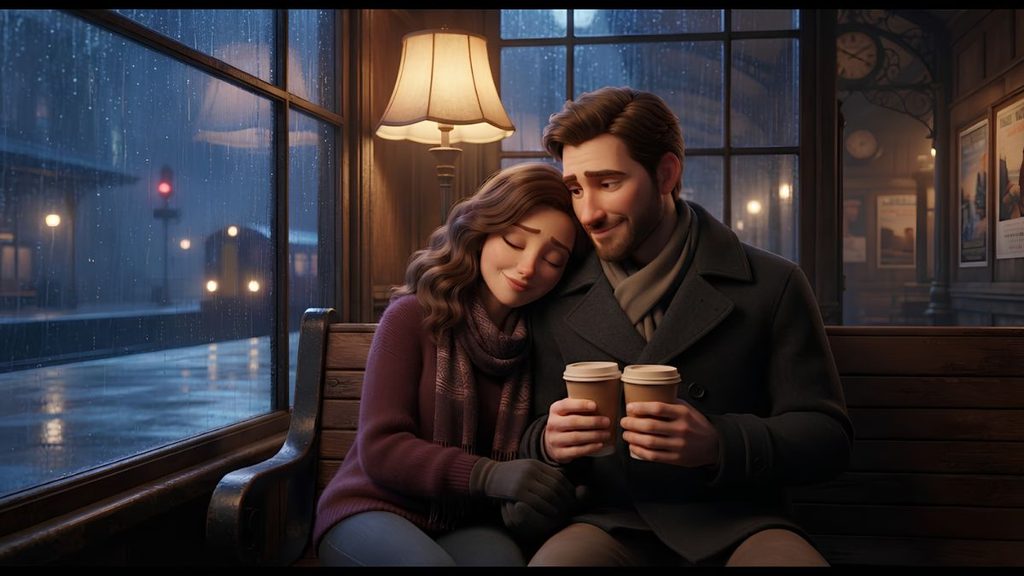
Type: First Meeting | Night Travel & Gentle Romance
Emily Harris had always been good at leaving work on time.
Not because she particularly wanted to go home early, but because she liked the small sense of order it gave her.
At 5:30, she closed her laptop.
At 5:40, she answered the last email.
At 5:50, she packed her bag.
And by 6:05, she was usually walking toward the station.
That evening, however, everything went wrong.
A report needed correcting.
Then a colleague discovered a missing figure.
Then Emily noticed an error in a document she had already sent.
By the time she finally shut down her computer, it was nearly ten o’clock.
She hurried through the quiet office building, stepped outside, and discovered that the rain had started.
“Perfect,” she murmured.
She pulled her coat around herself and walked quickly toward the station.
The usual evening crowds were gone.
The platforms were almost empty.
Emily checked the electronic board.
Her train had departed twelve minutes earlier.
She stared at the screen.
“Of course.”
She considered taking a taxi.
Then she noticed something at the bottom of the board.
Bellwood — 11:47 p.m.
The final train of the night.
Emily had never taken it before.
She had heard of Bellwood, a small town beyond the city, but had never had any reason to go there.
She checked her phone.
There were no urgent messages.
No one was waiting for her.
So she bought a ticket.
And waited.
The train arrived shortly before midnight.
It was older than the trains Emily usually took.
The lights inside were warm rather than bright, and the seats were covered in dark blue fabric.
There were perhaps six passengers scattered throughout the carriage.
Emily chose a seat beside the window.
Across the aisle sat a man with a small suitcase.
He looked to be around her age.
Beside him was an old camera with a worn leather strap.
The train began moving.
Emily watched the station disappear behind them.
The city lights gradually became fewer.
Then, almost without warning, darkness surrounded the train.
She leaned against the window.
For the first time all day, nobody needed anything from her.
She breathed out slowly.
The man across the aisle opened his suitcase.
He seemed to be searching for something.
Then the train moved around a bend.
The suitcase tipped.
A stack of photographs slid onto the floor.
“Oh.”
The man quickly leaned down.
“I’m sorry.”
Emily bent down too.
“Here.”
She picked up several photographs.
There were dozens of them.
Images of old bridges.
Empty roads.
Fields beneath evening skies.
A railway crossing.
A small village church.
A wooden footbridge over a stream.
Emily handed them back.
“You have quite a collection.”
The man smiled.
“I suppose I do.”
He looked at one photograph before placing it carefully into the suitcase.
“My name’s Oliver.”
“Emily.”
“Nice to meet you, Emily.”
“You too.”
The conversation might have ended there.
Instead, Emily looked at another photograph.
It showed a tiny railway station surrounded by trees.
“Where is that?”
“About twenty miles from here.”
“Does the station still exist?”
“Technically.”
“Technically?”
Oliver laughed.
“The station building does. The trains stopped years ago.”
Emily smiled.
“You photograph abandoned places?”
“Not exactly.”
“What do you photograph?”
Oliver thought about it.
“Places people stop noticing.”
Emily looked at him.
“That’s an unusual answer.”
“I’ve had time to think about it.”
“Are you a photographer?”
“Part-time.”
“What do you do the rest of the time?”
“I repair old buildings.”
Emily glanced at the photographs again.
“That explains the buildings.”
“And the camera?”
“That explains the photographs.”
She laughed.
Oliver smiled.
The train continued through the darkness.
They began talking more easily.
Emily told him she worked in an office in the city.
Oliver told her he traveled frequently for restoration projects.
He had recently spent several months helping repair an old railway building.
“Is that why you’re going to Bellwood?”
“Yes.”
“Work?”
“Partly.”
“What else?”
Oliver hesitated.
“I’m looking for a place.”
“A place?”
“A house, actually.”
Emily smiled.
“That sounds mysterious.”
“It isn’t.”
He explained that he wanted to leave the city.
He had spent years living in a small apartment and working long hours.
Recently, he had begun thinking about finding an old house somewhere quieter.
“Somewhere I can hear birds instead of traffic,” he said.
Emily looked out the window.
“I understand that.”
“Do you?”
“Maybe more than I thought.”
She told him about her routine.
The office.
The station.
The crowded trains.
The habit of eating dinner while checking email.
She laughed when she realized how dull it sounded.
Oliver didn’t think it sounded dull.
“It sounds busy.”
“Busy is sometimes just another word for distracted.”
Oliver looked at her.
“That’s a good observation.”
Emily shrugged.
“I’ve had a long day.”
The train slowed as it approached a small station.
Emily looked outside.
There was almost nothing to see.
A platform.
A bench.
A single lamp.
Beyond it, darkness.
The train stopped.
The conductor announced that they would be waiting for several minutes because of a signal problem.
Oliver stood.
“Want some fresh air?”
Emily looked toward the platform.
It was cold outside.
But something about the quiet made her curious.
“Sure.”
They stepped onto the platform.
The air smelled of rain and wet earth.
There was no traffic.
No city noise.
No conversations.
Only the soft ticking of the cooling train and the distant sound of wind through trees.
Emily looked upward.
The clouds had begun to separate.
Stars appeared between them.
“I haven’t seen that many stars in years,” she said.
Oliver smiled.
“You probably have.”
“What?”
“You just haven’t looked.”
She laughed.
“Fair enough.”
They stood beside the train.
For several minutes, neither spoke.
It was an easy silence.
Emily realized she couldn’t remember the last time she had stood somewhere without checking the time.
Eventually, she said:
“Do you always photograph ordinary places?”
“Mostly.”
“Why?”
Oliver looked toward the dark fields beyond the station.
“Because ordinary places disappear quietly.”
Emily waited.
He continued.
“A beautiful building gets protected. A famous landscape gets photographed. A historic street gets preserved.”
He looked at the old station.
“But places like this can disappear and nobody notices.”
Emily understood.
She looked at the empty platform differently.
It no longer seemed empty.
It seemed temporary.
The train whistle sounded.
They returned to their seats.
The journey continued.
Emily felt strangely reluctant to return to her earlier silence.
Oliver took out another photograph.
This one showed a narrow road disappearing into a forest.
“Where is this?”
“Near Bellwood.”
“It looks peaceful.”
“It is.”
“How do you know?”
“I stood there for three hours.”
“Three hours?”
“Waiting for the light.”
Emily smiled.
“That sounds incredibly boring.”
“It was.”
“And you enjoyed it?”
“Very much.”
She laughed.
Oliver looked pleased.
“That’s the problem with modern life,” he said. “We assume something has to be interesting before we give it our attention.”
Emily looked at him.
“Maybe that’s why I liked this train.”
“Why?”
“Nothing is happening.”
Oliver smiled.
“Exactly.”
The hours passed gently.
They talked about books they had read.
Places they wanted to visit.
Meals they remembered.
Childhood holidays.
The strange things people collect.
Emily told Oliver that she had once wanted to learn photography.
“What happened?”
“Nothing.”
“Nothing?”
“I bought a camera.”
“What happened to it?”
“It’s probably somewhere in my parents’ attic.”
Oliver laughed.
“That sounds like a photographer’s graveyard.”
“Maybe.”
She looked at his camera.
“Do you ever photograph people?”
“Rarely.”
“Why?”
“People know when they’re being photographed.”
“Buildings don’t?”
“Buildings don’t become self-conscious.”
Emily smiled.
“That’s true.”
“Although some buildings have terrible posture.”
She laughed so loudly that another passenger looked over.
Emily covered her mouth.
“Sorry.”
Oliver grinned.
“That was worth it.”
Near two in the morning, Emily realized she was tired.
But she didn’t want to sleep.
Outside the window, the countryside passed in fragments.
A farmhouse.
A distant light.
A line of trees.
A bridge.
Then darkness again.
Oliver was looking through his photographs.
Emily watched him.
“Do you ever photograph the same place twice?”
“Sometimes.”
“Why?”
“Because it changes.”
She thought about that.
“The place changes?”
“Sometimes.”
“And sometimes?”
Oliver looked at her.
“Sometimes I do.”
Emily smiled.
She understood.
When Bellwood finally appeared, it was nearly three in the morning.
The station was small.
A few lamps illuminated the platform.
Beyond the tracks stood a row of trees.
Emily stepped down from the train.
She felt as though she had traveled much farther than the actual distance.
Oliver stood beside her.
“Well,” he said.
“Well.”
Neither moved.
Emily suddenly realized that she didn’t want the conversation to end.
Oliver seemed to feel the same.
He reached into his coat and took out his phone.
“Would you like to exchange numbers?”
Emily smiled.
“I was wondering when you’d ask.”
They exchanged numbers.
Oliver looked at the screen.
“I’ll send you that photograph of the forest.”
“Only if you send me directions.”
“Why?”
“I want to see it.”
He smiled.
“I know a better place.”
Emily raised an eyebrow.
“Is that an invitation?”
“Yes.”
She smiled.
“Then I suppose I’ll have to accept.”
The train gave a final whistle.
Emily walked toward the station exit.
She turned once.
Oliver was still standing on the platform.
He lifted his hand.
She waved.
Then she disappeared into the quiet town.
The following week passed normally.
Work became busy again.
Meetings.
Emails.
Deadlines.
Train journeys.
Yet something had changed.
Every evening, Emily noticed things she previously ignored.
A tree reflected in an office window.
A small bakery hidden on a side street.
A man reading on a station bench.
The color of the sky after rain.
She began taking photographs with her phone.
Nothing impressive.
Just ordinary things.
On Friday evening, her phone buzzed.
A message from Oliver.
I found another quiet place.
A photograph followed.
It showed a narrow path beside a lake.
The evening light reflected across the water.
Then another message appeared.
Saturday afternoon. If you’re free.
Emily looked at the photograph.
She smiled.
She typed:
I’m free.
Then she paused.
She added:
And this time, I’m bringing a camera.
Oliver replied almost immediately.
Good. I’ll show you how to use it.
Emily laughed.
For years, she had thought meaningful moments would announce themselves.
She imagined they would arrive with celebrations, important decisions, dramatic changes.
Instead, one had arrived after a missed train.
It had begun with photographs scattered across an empty carriage.
It had continued beside a quiet railway platform beneath a sky full of stars.
And now it was waiting somewhere beside a lake.
Emily put her phone away.
Outside her window, evening had settled over the city.
For once, she didn’t rush to turn on the television or open her laptop.
She simply stood there.
She looked at the sky.
And noticed it.
Core themes: first meetings, night travel, quiet conversation, unexpected romance, shared curiosity.
Why Romance Works Well for Bedtime Reading
Romance naturally creates opportunities for emotional warmth.
A character remembering someone’s favorite drink, waiting for a partner after work, preparing breakfast, or walking home together can create a sense of comfort.
These moments can make a story feel intimate without becoming overwhelming.
Romantic bedtime stories can also give readers a temporary escape from ordinary responsibilities.
For a few minutes, attention can move away from work, unfinished tasks, and tomorrow’s schedule toward a fictional relationship and its quieter moments.
The goal is not to solve every problem before the story ends.
Instead, the story can create a peaceful emotional landing point for the night.
Gentle Romance vs Dramatic Romance
Not every romantic story is suitable for bedtime.
Some romance narratives rely heavily on arguments, jealousy, betrayal, suspense, or dramatic misunderstandings.
Those elements can be entertaining, but they may not create the calm atmosphere many readers want before sleeping.
Gentle romantic storytelling takes a different approach.
The conflict, if there is any, tends to remain manageable.
A couple might disagree about where to spend a weekend.
Two people might be nervous about expressing their feelings.
Former friends might be uncertain about reconnecting.
Partners might need to discuss an important decision.
The story can still contain emotional depth without making the reader feel tense.
Common Settings for Romantic Bedtime Stories
The setting can strongly influence the mood of a romantic story.
A Quiet Café
Cafés are ideal for gentle romance.
Two characters might meet repeatedly over several weeks.
At first, they exchange only brief greetings.
Eventually, conversations become longer.
One person remembers the other’s usual order.
A familiar table becomes associated with their relationship.
The romance grows naturally from routine.
A Rainy Evening
Rain creates an instantly cozy atmosphere.
Two people might share an umbrella.
They could become stranded in a café.
A couple might spend the evening cooking while rain falls outside.
The weather becomes part of the emotional atmosphere without needing to drive the plot.
A Small Town
Small towns provide opportunities for recurring encounters.
Characters may meet at a bakery, library, market, train station, or neighborhood park.
Because the setting is familiar, the story can focus more heavily on the relationship.
A Night Train
A nighttime train journey provides a naturally slow setting.
Two strangers might find themselves sharing a compartment.
They talk quietly while lights pass outside the window.
They discuss books, places they have visited, memories, and future plans.
The journey can become a metaphor for discovering someone gradually.
A Shared Home
Romance can become especially meaningful when characters already live together.
The story can focus on ordinary domestic life.
One person prepares coffee.
The other opens the curtains.
They cook dinner.
They fold laundry together.
They talk before going to sleep.
These details demonstrate that long-term love can be found in routine.
The Role of Conversation
Conversation is especially important in romantic bedtime stories.
Because these stories tend to move slowly, dialogue can reveal character and deepen emotional connection.
Characters might discuss:
- Childhood memories
- Favorite books
- Places they want to visit
- Family traditions
- Career dreams
- Small fears
- Favorite foods
- Future plans
- Things they have never told anyone
- Ordinary events from their day
The conversation doesn’t always need to contain profound revelations.
Sometimes discussing something completely ordinary makes a relationship feel more believable.
A couple talking about what to cook for dinner can be just as intimate as discussing their future.
Creating a Peaceful Romantic Atmosphere
Atmosphere can be as important as the plot.
Romantic bedtime stories can use details such as:
- Warm lamps
- Candlelight
- Rain against windows
- Quiet streets
- Soft music
- Evening gardens
- Moonlit balconies
- Freshly prepared tea
- Comfortable bedrooms
- Fireplace light
- Late-night cafés
- Slow walks
- Morning sunlight
These details give the reader a sensory environment.
The story becomes something they can settle into rather than simply something they need to finish.
Why Slow Pacing Matters
A bedtime story doesn’t have to rush.
Romance is particularly well suited to slower storytelling because relationships develop gradually.
A story can spend several paragraphs describing an evening walk.
Characters can pause during conversations.
Small observations can receive attention.
The setting can change gradually from afternoon to evening.
This creates a sense of time passing naturally.
Fast pacing can make readers want to know what happens next.
Slow pacing can make them comfortable with simply being present in the story.
For bedtime reading, the second approach can be especially effective.
Emotional Safety in Romantic Bedtime Stories
Romantic stories can explore meaningful emotions without relying on emotional extremes.
A character may experience uncertainty, loneliness, disappointment, or regret.
But the story can eventually move toward understanding, acceptance, companionship, or hope.
This doesn’t mean every story needs a perfect ending.
A satisfying ending might simply show two people understanding each other better.
Another might involve someone accepting that a past relationship mattered even though it ended.
The emotional conclusion should feel peaceful rather than unnecessarily dramatic.
Romantic Bedtime Stories for Couples
These stories can also be read together.
Couples may enjoy stories that remind them of their own relationship.
For example, a story about two people cooking together might encourage a couple to remember their own first meal.
A story about a long-term marriage might remind partners of how their relationship has changed.
A story about a first meeting might inspire them to discuss how they first met.
In this way, fictional romance can become a starting point for real conversations.
Romantic Bedtime Stories for Someone Special
A romantic bedtime story can also be shared with a partner through a message or read aloud before sleeping.
The most effective stories for this purpose usually focus on warmth rather than excessive drama.
A simple narrative about two people spending an ordinary evening together can feel more personal than an exaggerated fantasy.
The reader can imagine themselves in the setting.
The characters can become familiar companions.
And the ending can leave behind a feeling of affection and calm.
How to Make Romantic Bedtime Stories More Engaging
Several elements can make these stories particularly enjoyable.
Use Relatable Characters
Adult readers often connect with characters who have jobs, responsibilities, routines, friendships, families, memories, and imperfections.
Characters don’t need extraordinary lives.
Their emotional experiences are enough.
Build Romance Gradually
Let attraction develop through interactions.
A relationship feels more satisfying when readers see why two characters enjoy each other’s company.
Include Everyday Details
A favorite coffee order, an evening walk, a shared joke, or a familiar song can make a relationship feel real.
Keep Conflict Manageable
Small misunderstandings can provide movement without creating excessive tension.
End on a Calm Emotional Note
The conclusion should ideally leave the reader feeling warm, hopeful, content, or peaceful.
Different Lengths of Romantic Bedtime Stories
Romantic bedtime stories can be adapted to different reading preferences.
Short Romantic Stories
Short stories can focus on one meaningful moment.
A first meeting.
A shared dinner.
A late-night conversation.
A surprise visit.
A simple goodnight.
Medium-Length Stories
These can follow the development of a relationship over several days or weeks.
Readers have enough time to understand the characters and see their connection develop.
Long Romantic Stories
Long stories can explore relationships over months or years.
They can include multiple settings, memories, conversations, challenges, and milestones.
This makes them particularly suitable for readers who enjoy becoming deeply immersed in a fictional world before falling asleep.
Romantic Bedtime Stories and the Beauty of Ordinary Love
One of the most appealing aspects of romantic bedtime storytelling is the opportunity to redefine what romance means.
Love doesn’t always arrive with dramatic gestures.
Sometimes it looks like someone remembering that you don’t like too much sugar in your tea.
Sometimes it means waiting at the window.
Sometimes it means listening to the same story for the tenth time.
Sometimes it means sharing silence comfortably.
Sometimes it means knowing when to speak and when to simply sit beside someone.
These ordinary moments can carry enormous emotional weight.
They show that affection isn’t only found in extraordinary events.
It can become part of everyday life.
Final Thoughts
Romantic bedtime stories for adults can combine emotional warmth, gentle pacing, memorable characters, and peaceful settings to create an enjoyable nighttime reading experience.
The strongest stories don’t need complicated plots.
They can follow two people meeting at a café, a married couple rediscovering an old tradition, partners separated by distance, or former friends discovering a second chance at connection.
What matters most is the emotional atmosphere.
A quiet conversation.
A familiar routine.
A thoughtful gesture.
A shared memory.
A peaceful evening.
These small moments can make romantic storytelling feel authentic and comforting.
And when the day is finally over, sometimes the simplest story is enough: two people finding happiness not because their lives are perfect, but because they have someone with whom the ordinary moments feel special.