
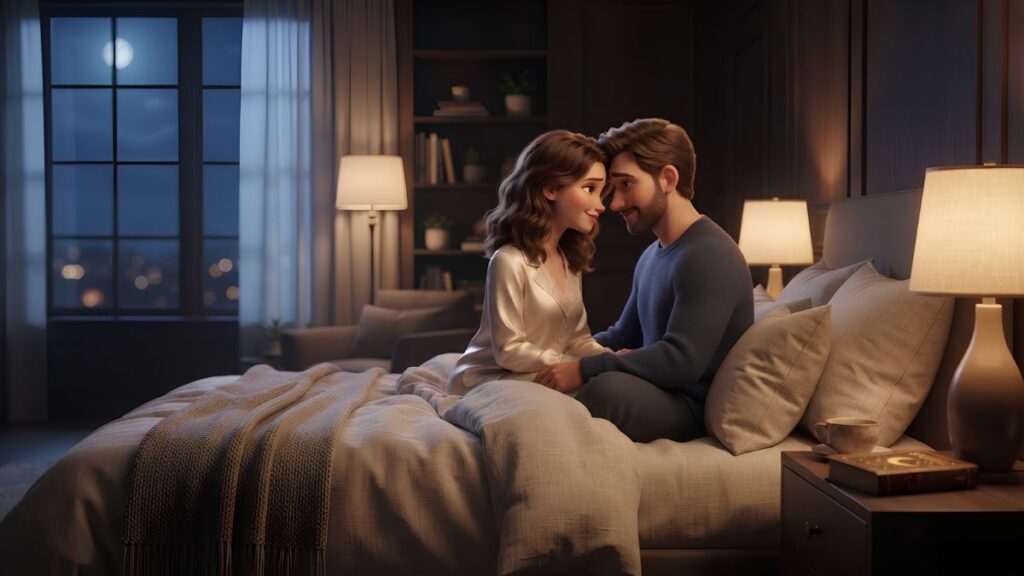
After a long day, there is something deeply comforting about ending the night with a few gentle words from someone you love. Romantic bedtime stories for a boyfriend can turn an ordinary evening into a peaceful and meaningful moment of connection.
A bedtime story does not have to be childish or complicated. For adults, it can be a quiet romantic experience built around affection, imagination, memories, dreams, and emotional closeness.
Whether you are lying beside your boyfriend, talking over a phone call, or maintaining a long-distance relationship, a romantic bedtime story can create a softer transition from a busy day to a peaceful night.
It can make him smile, help him relax, and remind him that he is loved.
What Are Romantic Bedtime Stories for Boyfriend?
Romantic bedtime stories for boyfriend are gentle stories created specifically to share with a romantic partner before sleep.
They can feature couples experiencing peaceful adventures, meaningful conversations, unexpected meetings, shared dreams, or simple moments of affection.
Unlike traditional children’s bedtime stories, romantic stories for adults can focus on emotional intimacy and the everyday details that make relationships special.
A story might describe a couple walking through a quiet city after midnight, watching rain from a bedroom window, taking a spontaneous weekend trip, remembering how they first met, or imagining their life together years in the future.
The goal is not necessarily excitement.
The goal is connection.
A good romantic bedtime story should create a calm emotional atmosphere where both people can slow down, forget the day’s pressures, and enjoy being together.
Romantic Bedtime Stories for Boyfriend
1. The Midnight Bookshop

Theme: Love discovered through shared dreams
Every Friday night, just before the city began to quiet down, Noah walked past the old clock tower and turned into a narrow street where most of the shops had already closed.
There was one exception.
At the very end of the street stood a small bookshop with dark green windows, a brass handle, and a wooden sign that simply read:
Bell & Pages
The bookshop stayed open until midnight.
Noah had discovered it almost by accident.
He had been looking for a particular novel one rainy evening several months earlier. Most shops had been closed, but the warm yellow light spilling from Bell & Pages had caught his attention. He had stepped inside expecting to stay for ten minutes.
He stayed for nearly two hours.
After that, Friday nights became his favorite part of the week.
He would finish work, walk through the evening streets, buy a coffee from the little café across the road, and spend an hour or two wandering between the shelves.
Sometimes he read.
Sometimes he searched for books.
Sometimes he simply sat in the old armchair near the window and listened to the rain.
And sometimes Sophie came with him.
Sophie was his girlfriend, though Noah sometimes thought that word was too small for what she meant to him.
She was the person he wanted to tell about the strange dream he had in the morning.
The person he called when he saw a beautiful sunset.
The person who could make an ordinary Tuesday feel like something worth remembering.
She loved books too, but she read differently from Noah.
Noah chose books according to mood.
Sophie chose them according to feeling.
She would pick up a novel, read the back cover, turn to a random page, read three sentences, and then decide whether the book belonged in her life.
Noah often teased her about it.
“You don’t even know what the story is about.”
“I don’t need to.”
“How?”
“The book knows if I’m supposed to read it.”
Noah would laugh.
But secretly, he loved that about her.
One Friday evening, Sophie arrived at Bell & Pages before him.
She wore a soft cream sweater and a long coat, her hair slightly damp from the rain.
Noah noticed her immediately when he entered.
She was standing in the fiction section, holding a book against her chest.
“You’re early,” he said.
She looked over and smiled.
“And you’re late.”
“I’m three minutes late.”
“Three very important minutes.”
“For what?”
She smiled mysteriously.
“You’ll find out.”
Noah shook his head.
“You’ve been spending too much time around books.”
“Maybe.”
They spent the next hour together.
Sophie searched through the shelves while Noah sat nearby reading.
Eventually, she disappeared around the corner.
When she returned, she had a small smile on her face.
Noah noticed it.
“What?”
“Nothing.”
“That smile is definitely something.”
“Maybe I’m just happy.”
“You’re always happy in bookshops.”
“That’s because you are here.”
Noah smiled.
There were moments like that when neither of them needed to say anything more.
Later that night, they walked home together.
The following Friday, Noah returned alone.
Sophie had work.
He missed her more than he expected.
He wandered through the shelves, pulled out a novel, and opened it.
A small folded piece of paper fell onto the floor.
He picked it up.
At first, he assumed it was an old receipt.
Then he saw the handwriting.
It was Sophie’s.
He recognized it immediately.
The note said:
For Noah.
He stared at it.
Then he unfolded the paper.
“You always choose books about people who leave everything behind to start again. I wonder if you realize that.”
Noah smiled.
He read it twice.
Then a third time.
There was no signature.
There didn’t need to be.
He knew.
He looked around the shop.
Sophie wasn’t there.
For the rest of the evening, the note stayed in his pocket.
When he got home, he placed it beside his bed.
The next Friday, he returned to Bell & Pages.
This time, he deliberately searched the same shelf.
Nothing.
He looked through three books.
Nothing.
Then he noticed another novel.
He opened it.
Another note.
You found this one too.
Noah laughed quietly.
He unfolded it.
“You once told me you would like to live somewhere with a tiny garden, even though you can’t keep a houseplant alive for more than three weeks.”
Noah smiled.
He remembered that conversation.
They had been sitting on a park bench months earlier.
Sophie had asked him what his dream home looked like.
He had described a small house with a garden, a wooden table near a window, shelves filled with books, and a kitchen where they could cook together.
He had forgotten the conversation.
Sophie hadn’t.
At the bottom of the note she had written:
“I still think you’d be terrible at gardening.”
Noah laughed again.
He took out a pen.
On the back of the paper, he wrote:
“You’re right. But I think you’d secretly enjoy watching me try.”
He folded the note and slipped it back inside the book.
The following Friday, another note appeared.
This one was longer.
“If you could wake up tomorrow anywhere in the world, where would you go?”
Noah thought about it.
Then he wrote:
“Somewhere quiet. Somewhere with mountains. Somewhere I could wake up without an alarm.”
The next week:
“What would you do there?”
His answer:
“Make coffee. Read. Walk with you. Do nothing important.”
Sophie replied:
“That sounds perfect.”
Their little game continued.
They never discussed it directly.
They simply left pieces of themselves inside books.
A note about a childhood memory.
A note about a dream.
A note about something they were afraid to admit.
A note about a place they wanted to visit.
A note about a song they loved.
A note about the first moment they realized they were falling in love.
One Friday, Noah found:
“Do you remember the first time you held my hand?”
He did.
It had been during a crowded street festival.
Sophie had almost been separated from him in the crowd.
Without thinking, Noah had reached for her hand.
She had held on.
They hadn’t let go for the rest of the evening.
Noah wrote:
“Yes. I remember thinking that your hand fit perfectly in mine.”
The next week, Sophie’s reply was waiting.
“I remember thinking that I didn’t want you to let go.”
Noah sat in the armchair by the window for a long time after reading that.
The city outside was dark.
Rain moved slowly down the glass.
Inside the shop, the lamps cast golden pools of light between the shelves.
For the first time, Noah realized what their notes had become.
They weren’t playing a game anymore.
They were learning each other again.
Even though they had been together for more than a year, there were still rooms inside each other’s hearts they hadn’t entered.
The notes opened those doors quietly.
One rainy Friday, Noah arrived earlier than usual.
The bookshop was almost empty.
Mr. Bell, the elderly owner, was arranging books behind the counter.
“You’re early tonight,” he said.
“Apparently everyone has decided to leave me alone with my thoughts.”
Mr. Bell smiled.
“Thoughts are usually better company than people.”
Noah laughed.
He walked toward the shelves.
Something felt different.
There was a book waiting on the table near the window.
It was an old hardback with a faded blue cover.
Noah picked it up.
Inside was a note.
But this one wasn’t like the others.
It said:
“Tonight, don’t look for another note.”
Noah frowned.
He looked around.
Then he heard a quiet laugh.
Sophie stepped out from behind the next shelf.
She was holding two cups of coffee.
“You’ve been caught.”
Noah smiled.
“So you’re the mysterious librarian?”
“I’m not a librarian.”
“You’ve been hiding notes in books for weeks.”
“You found them.”
“You knew I would.”
“Of course.”
She handed him a coffee.
They sat together near the window.
For a few minutes, neither spoke.
Rain tapped gently against the glass.
Noah looked at the blue book resting between them.
“Why did you start doing this?”
Sophie looked down at her coffee.
“I wanted to know if there were things about you that you hadn’t told me.”
“You could have just asked.”
“I know.”
“Then why didn’t you?”
She smiled.
“Because sometimes people answer questions with the words they think they’re supposed to say.”
She looked at him.
“But when you write something down alone, you tell the truth differently.”
Noah understood.
He opened the book.
The first page was blank.
“So what now?”
Sophie thought for a moment.
“Maybe we write one together.”
“What?”
“A story.”
“About us?”
“Not exactly.”
She took his pen.
“About the life we want.”
She wrote the first sentence.
Noah read it.
“Once there were two people who loved quiet evenings more than crowded places.”
He smiled.
He added the next line.
“They discovered that happiness was not always a grand adventure.”
Sophie continued.
“Sometimes it was coffee shared beside a rainy window.”
Noah wrote:
“Sometimes it was a hand reaching across the table.”
Sophie:
“Sometimes it was remembering something the other person had forgotten.”
Noah looked at her.
“And sometimes?”
She smiled.
“Sometimes it was leaving a note inside a book.”
They continued writing.
They wrote about the little house Noah had once imagined.
A garden that Sophie insisted would survive.
A kitchen where they would make terrible recipes together.
A room with too many books.
A window where they could watch rain.
Trips they wanted to take.
Cities they wanted to see.
Ordinary mornings they wanted to have.
They wrote about growing older without becoming strangers.
About changing without losing each other.
About the possibility that their future might not look exactly the way they imagined.
And about choosing each other anyway.
By the time they stopped, it was almost midnight.
Mr. Bell quietly turned off the lights near the back of the shop.
“You two planning to move in?” he asked.
Sophie laughed.
“Maybe.”
Noah closed the book.
“Can we keep it?”
Mr. Bell looked at the old blue cover.
“Only if you promise to bring it back someday.”
“We will.”
“Good.”
They walked outside.
The rain had stopped.
The street was almost empty.
Streetlights reflected on the wet pavement, turning the road into a ribbon of gold.
Sophie slipped her hand into Noah’s.
He held it.
“Where are we going?” she asked.
“Home.”
She smiled.
“Which one?”
Noah looked at her.
“For tonight?”
He squeezed her hand.
“Whichever one has you in it.”
They walked slowly beneath the streetlights.
Neither of them hurried.
The bookshop behind them remained glowing softly in the darkness.
Inside, between hundreds of stories written by people they would never meet, one more story had begun.
It wasn’t finished.
They knew that.
There would be difficult chapters.
Unexpected turns.
Days when they disagreed.
Days when they were tired.
Days when life became complicated.
But perhaps that was what made it beautiful.
A love story didn’t have to be perfect to be worth reading.
It only had to be honest.
And theirs was.
Every Friday night, they returned to the little bookshop.
Sometimes they read.
Sometimes they talked.
Sometimes they wrote another page in the blue book.
And sometimes, when one of them had something they couldn’t quite say aloud, they still slipped a small handwritten note inside a book.
Because after all those months, they had discovered something wonderful.
You could know someone for years and still have new things to discover.
You could love someone deeply and still fall for them again in small, unexpected ways.
And sometimes, the quietest love stories were the ones that lasted the longest.
The ones written slowly.
One page at a time.
One Friday night at a time.
One little note at a time.
And somewhere on a narrow street beneath an old clock tower, a tiny bookshop stayed open until midnight, keeping its golden lights on for anyone who still believed that the right story could bring two hearts a little closer together.
Especially when the story was their own.
2. The Train That Arrived at Sunrise

Theme: Reunion and anticipation
For four months, Daniel had been waking up in a city that did not feel like home.
The apartment was comfortable.
The work was good.
The salary was better than he had expected.
Everyone kept telling him that he was lucky.
And Daniel knew they were right.
Still, every morning when the alarm rang, there was a moment before he opened his eyes when he forgot where he was.
In that brief moment, he imagined he was still at home.
He imagined Emma sleeping beside him.
He imagined the soft sound of rain against their bedroom window.
He imagined the smell of coffee coming from the kitchen.
Then he opened his eyes.
The ceiling was unfamiliar.
The room was quiet.
And Emma was several hundred miles away.
It was supposed to have been a six-month assignment.
Six months of working on a major project for his company.
Six months of video calls, weekend messages, photographs, and promises that the distance would be temporary.
They had handled the first few months well.
At least, that was what Daniel told himself.
They talked every evening whenever their schedules allowed.
Emma sent him photographs of things he would normally have seen himself.
A funny dog she passed on her way to work.
The new flowers outside their favorite café.
A crooked painting someone had placed in the hallway of their apartment building.
Daniel sent her photographs too.
His breakfast.
The view from his office.
The sunset outside his apartment.
Sometimes, when they had nothing important to say, they stayed on the phone anyway.
“You still there?” Emma would ask.
“I’m here.”
“You’re very quiet.”
“So are you.”
“I like knowing you’re there.”
“I like it too.”
Then neither of them would speak.
They would simply remain connected through the quiet.
But as the months passed, Daniel began to miss the ordinary things more than the important ones.
He missed Emma leaving one cupboard door open.
He missed her stealing the warm side of the bed.
He missed the way she hummed when she cooked.
He missed hearing her keys in the lock at the end of the day.
He missed grocery shopping with her.
He missed arguments about what movie to watch.
He even missed her habit of taking the last piece of chocolate and pretending she hadn’t.
It was strange.
Distance didn’t always make you miss the big moments.
Sometimes it made you miss the smallest ones.
On a Thursday afternoon, Daniel received an unexpected message from his manager.
The project had finished early.
His work was no longer required in the city.
He could go home.
Immediately.
Daniel read the message three times.
Then he checked the train schedule.
There was a train leaving that evening.
It would travel through the night and arrive just after sunrise.
He could have waited until the weekend.
He could have told Emma.
He could have called her and said, “I’m coming home.”
Instead, he smiled.
An idea had already begun forming.
He wanted to surprise her.
Not with flowers.
Not with an expensive gift.
Not with some elaborate plan.
He simply wanted to appear in front of her.
He wanted to see her face before she had time to prepare it.
So he booked the ticket.
He packed his bag.
And before leaving his apartment, he sent Emma a message.
Long day. Going to sleep early. I’ll call you tomorrow.
Her reply came quickly.
Okay. Sleep well. Love you.
Daniel stared at the screen.
Then he smiled.
Love you too.
He turned off the lights and locked the door.
By seven that evening, he was sitting beside a train window.
The platform was crowded.
People were carrying suitcases, talking on phones, saying hurried goodbyes.
Daniel stood beside his bag and watched them.
He wondered how many people were going home.
How many were leaving.
How many were carrying the same quiet hope he was carrying.
When the train finally arrived, he climbed aboard.
His compartment was almost empty.
He placed his bag above the seat and settled beside the window.
The train moved slowly at first.
Then faster.
The city lights passed outside like scattered stars.
Daniel leaned his head against the glass.
For the first time in months, he felt completely still.
He was going home.
He smiled.
The journey would take the entire night.
That was fine.
He had waited four months.
He could wait one more night.
As the train moved into the countryside, Daniel opened his phone.
He scrolled through his photographs.
There was one from the first week after he had left.
Emma stood outside their apartment holding two cups of coffee.
She had taken the photograph herself.
The caption read:
Your coffee is getting cold. Hurry home.
Daniel had laughed when he first saw it.
Now he stared at it for a long time.
He continued scrolling.
There was a picture of them at the seaside.
Another from a rainy Sunday.
One from the night they had moved into their apartment.
They had owned almost nothing then.
Two chairs.
One mattress.
A borrowed table.
A small television.
And far too many boxes.
Emma had stood in the middle of the living room and announced:
“This is perfect.”
Daniel had looked around.
“We don’t even have curtains.”
“We’ll get curtains.”
“We don’t have a sofa.”
“We’ll get one.”
“We don’t have plates.”
“We can eat from the boxes.”
Daniel laughed at the memory.
At the time, he had thought they were building a home.
Now he understood.
They had already had one.
The home had been there from the beginning.
It had simply been Emma.
The train entered a long tunnel.
Daniel looked at his reflection in the window.
He wondered whether Emma would be surprised.
He wondered whether she would cry.
He hoped she would.
Then he immediately hoped she wouldn’t.
He knew her well enough to know she might do both.
Around midnight, Daniel tried to sleep.
He couldn’t.
He watched the darkness outside.
Occasionally, the train passed through a small town.
A few lights would appear.
A station would flash past.
Then everything would become dark again.
He thought about the first time he had met Emma.
It had been at a friend’s birthday dinner.
She had arrived late.
She had apologized to everyone, then accidentally knocked over a glass of water.
Daniel had helped clean it up.
“You must think I’m very graceful,” she had said.
“I was going to say charming.”
She had looked at him.
“That’s better.”
He had liked her immediately.
Not because she was perfect.
She wasn’t.
She talked too quickly when she was excited.
She became stubborn when she was tired.
She sometimes bought books faster than she could read them.
And she had a remarkable ability to lose her keys while holding them.
But she made life feel warmer.
That was what Daniel loved.
The train rocked gently beneath him.
Eventually, he fell asleep.
When he woke, the sky outside was beginning to change.
The darkness had softened into deep blue.
Far away, the horizon was pale.
Daniel checked the time.
5:21 a.m.
They were less than an hour from home.
He sat upright.
His heart began beating faster.
He imagined Emma still sleeping.
He imagined walking quietly into the apartment.
He imagined waking her.
He imagined her confusion.
He imagined her smile.
He imagined everything.
Then he remembered something.
A message she had sent him two days earlier.
My friend Olivia needs to be picked up from the early train on Saturday. I promised I’d meet her.
Daniel smiled.
He had completely forgotten.
The train would arrive at the same station.
Emma would probably be there.
He leaned back and laughed quietly.
Of all the people he could surprise, he was about to surprise the person who was already planning to be at the station.
The train slowed as dawn began to appear.
The sky turned pink.
Fields stretched across the horizon.
Trees stood in dark silhouettes.
The first sunlight touched the tops of distant buildings.
Daniel gathered his bag.
His hands were slightly nervous.
He hadn’t felt nervous about seeing Emma before.
Not like this.
It was almost as if he were meeting her for the first time.
The train entered the station at 6:07.
Daniel stood near the door.
People gathered around him.
The brakes sighed.
The train stopped.
Daniel stepped onto the platform.
For a moment, he couldn’t see her.
There were too many people.
Then he spotted her.
Emma was standing near the far end of the platform.
She wore a dark coat.
Her hair was tied back.
She held a paper cup of coffee in one hand.
She was looking toward the train doors.
But not at him.
She was searching for someone else.
Daniel stood still.
The surprise was almost too perfect.
He watched her glance at each passenger.
Then she looked down at her phone.
Daniel began walking toward her.
Three steps.
Then five.
He could have called her name.
Instead, he stopped a few feet away.
“Excuse me,” he said.
Emma looked up.
“Yes?”
She didn’t recognize him immediately.
Daniel smiled.
“Are you waiting for someone?”
Her eyes widened.
For a second, she simply stared.
The coffee cup slipped slightly in her hand.
“Daniel?”
He nodded.
She covered her mouth.
“No.”
Daniel laughed softly.
“Yes.”
“No.”
“Definitely yes.”
She dropped the coffee onto the bench beside her and walked toward him.
Then she stopped.
As if she couldn’t quite believe he was real.
Daniel put down his bag.
“Hi.”
Emma’s eyes filled with tears.
“You said you were working.”
“I was.”
“You said you were coming home next month.”
“I was supposed to.”
“You lied.”
“A little.”
She laughed through her tears.
Then she hugged him.
Hard.
Daniel wrapped his arms around her and closed his eyes.
For a long moment, the station disappeared.
There were no announcements.
No trains.
No strangers.
No schedules.
There was only Emma.
He could smell her shampoo.
He could feel her heartbeat.
She was real.
She was there.
He had spent four months imagining this moment.
The real thing was quieter.
And somehow better.
“I can’t believe you’re here,” she whispered.
“I couldn’t wait.”
“You should have told me.”
“I wanted to see your face.”
“You saw it.”
“I did.”
“Was it worth it?”
Daniel smiled.
“Every mile.”
Emma pulled away and looked at him.
“You look tired.”
“I’ve been on a train all night.”
“You’re ridiculous.”
“I know.”
She touched his cheek.
Then she smiled.
“I missed you.”
“I missed you too.”
She looked at his suitcase.
“You really came straight from the train?”
“Straight from the train.”
“Have you eaten?”
“No.”
“Of course you haven’t.”
She took his hand.
“Come on.”
“Where?”
“Home.”
The word settled gently between them.
Home.
Daniel picked up his bag.
They walked through the station together.
Outside, the morning was beginning.
Shops were still closed.
The streets were nearly empty.
The city looked different at sunrise.
Softer.
Quieter.
New.
Emma held his hand as they walked.
After a few minutes, she looked at him.
“Can I tell you something?”
“Of course.”
“I was actually bringing Olivia coffee.”
Daniel laughed.
“I figured.”
“She was supposed to arrive on this train.”
“So I stole your welcome-home coffee.”
“You did.”
“I’ll buy you another one.”
“You’ll buy me breakfast too.”
“Deal.”
They continued walking.
Then Emma stopped.
Daniel turned toward her.
“What?”
She smiled.
“I just want to look at you.”
He smiled back.
“Why?”
“Because I spent four months looking at you through a screen.”
She touched his hand.
“I don’t want to waste the first morning you’re home.”
Daniel squeezed her fingers.
“You don’t have to.”
They began walking again.
Behind them, the train slowly pulled away from the station.
Daniel watched it disappear around the bend.
Four months of distance had ended with a single journey through the night.
But he knew something now.
Coming home wasn’t really about the train.
It wasn’t about the station.
It wasn’t even about the sunrise.
It was about having someone waiting for you.
Someone whose ordinary presence had become part of your idea of peace.
Someone who made a small apartment feel like home.
Someone whose hand you could reach for without thinking.
That morning, Daniel and Emma walked home slowly.
They talked about everything and nothing.
They argued about what to eat for breakfast.
They laughed about the surprise.
They made plans for the weekend.
And when they finally reached their apartment, Emma opened the door.
Daniel stepped inside.
The same little hallway.
The same photographs.
The same shoes by the door.
The same kitchen.
Nothing had changed.
And yet everything felt different.
Because Daniel was home.
Emma placed her coffee on the kitchen counter.
Then she turned toward him.
“You’re staying this time?”
Daniel smiled.
“This time, I’m staying.”
She leaned against him.
Outside the window, the morning sun rose higher.
Inside, the apartment filled with golden light.
For four months, Daniel had dreamed about returning.
He had imagined dramatic reunions and perfect moments.
But the truth was much simpler.
The best part of coming home was not the surprise.
It was waking up the next morning and knowing that when he opened his eyes, Emma would be there.
And for the first time in a very long time, Daniel slept peacefully.
Not because the journey was over.
But because he was exactly where he wanted to be.
Home.
3. The Little Café Above the Clouds

Theme: Escaping everyday worries together
It had been a difficult week.
Not the kind of difficult week that made people stop everything and run away.
Just the ordinary kind.
The kind filled with unanswered emails, delayed trains, unfinished work, unexpected expenses, missed calls, poor sleep, and too many things that needed attention at the same time.
By Friday evening, Oliver felt as though his mind had become a room where everyone had left their belongings.
There were thoughts everywhere.
Things he needed to remember.
Things he needed to fix.
Things he wished he had said differently.
Things he was already worrying about next week.
He sat on the edge of his bed and loosened his tie.
His apartment was quiet.
Too quiet.
Mia was in the kitchen making tea.
She had also had a difficult week.
Oliver could tell by the way she moved.
Normally, Mia sang while making tea.
Tonight, she didn’t.
She simply stood by the counter, watching the kettle boil.
Oliver walked into the kitchen.
“You okay?”
Mia looked at him.
“I’m tired.”
“Me too.”
She poured the tea into two cups.
They sat opposite each other at the small kitchen table.
For a while, neither spoke.
There was nothing wrong between them.
That was almost the problem.
They were both exhausted, but neither knew how to explain exactly what they were exhausted from.
Mia wrapped both hands around her cup.
“I feel like this week has been six months long.”
Oliver smiled faintly.
“I was thinking the same thing.”
She looked at him.
“Do you ever wish you could just disappear?”
Oliver laughed softly.
“All the time.”
“No, I mean really disappear.”
“Where would you go?”
Mia thought.
“Somewhere nobody knows my name.”
Oliver considered it.
“Somewhere with no emails.”
“No phones.”
“No traffic.”
“No meetings.”
“No alarms.”
“No bills.”
“No responsibilities.”
Mia smiled.
“That sounds expensive.”
Oliver laughed.
Then he leaned back in his chair.
“I wish we could disappear somewhere peaceful for one evening.”
Mia looked at him.
“Just one evening?”
“One would be enough.”
She raised her cup.
“To disappearing.”
Oliver raised his.
“To disappearing.”
Neither of them knew that the evening was about to become stranger than they expected.
After dinner, they decided to take a walk.
They didn’t have a destination.
They simply left the apartment and walked.
The city was still busy, but the streets felt different at night.
Shop windows reflected the streetlights.
Cars moved through intersections.
People hurried home.
Oliver and Mia walked slowly.
Their shoulders occasionally touched.
Neither checked the time.
After twenty minutes, they reached an older part of the city.
They had passed through the neighborhood before, but usually during the day.
At night, it seemed almost unfamiliar.
Old brick buildings stood close together.
Small shops had wooden doors.
A narrow staircase led between two buildings.
Mia stopped.
“Have you ever noticed this?”
Oliver looked up.
At the end of the staircase stood a tall, narrow building.
It was seven stories high.
The windows on the lower floors were dark.
But at the very top, one window glowed warmly.
Oliver frowned.
“I’m sure I’ve seen that building.”
“But have you seen the café?”
“What café?”
Mia pointed.
Above the entrance was a tiny wooden sign.
The Cloud Room
Oliver laughed.
“That’s definitely new.”
“Maybe it’s been there forever.”
They stepped inside.
The lobby was old but beautiful.
There was a brass elevator with a small handwritten sign.
Top floor.
Oliver looked at Mia.
“Should we?”
Mia smiled.
“We already said we wanted to disappear.”
They stepped inside.
The elevator groaned as it climbed.
One floor.
Two.
Three.
The numbers continued.
Four.
Five.
Six.
Then seven.
The doors opened.
Oliver expected a hallway.
Instead, they found a small café.
It was warm and quiet.
There were only six tables.
Small lamps glowed on each one.
Plants hung from wooden shelves.
Soft music played somewhere in the background.
And beyond the café was an enormous wall of windows.
Mia walked toward them.
Then she stopped.
Oliver came beside her.
Neither spoke.
Beyond the glass was a sea of clouds.
The city had disappeared.
Clouds stretched beneath them as far as they could see.
The moon floated above them.
Stars shimmered between thin layers of mist.
It looked as though the building had somehow risen above the entire world.
Mia whispered:
“Oliver.”
“I know.”
“How high are we?”
He looked down.
There was no ground visible.
“I don’t know.”
A woman appeared behind the counter.
She was perhaps sixty years old, with silver hair and a warm smile.
“Welcome.”
Oliver looked at her.
“Is this a real café?”
She smiled.
“Does it matter?”
Mia laughed.
“No.”
“Then sit wherever you like.”
They chose the table beside the largest window.
The woman brought them two cups of hot chocolate without asking what they wanted.
Mia took a sip.
“This is amazing.”
The woman smiled.
“Everything tastes better above the clouds.”
Oliver looked outside.
“I think you’re right.”
For the first time all week, neither of them was thinking about work.
They sat quietly.
Clouds moved beneath the moonlight.
Sometimes they looked like mountains.
Sometimes like waves.
Sometimes like enormous white gardens.
Mia rested her head against Oliver’s shoulder.
“This is exactly what I needed.”
Oliver kissed the top of her head.
“Me too.”
They stayed that way for several minutes.
Then Mia said:
“If you could live anywhere, where would you live?”
Oliver smiled.
“You’re asking serious questions now?”
“Yes.”
“Okay.”
He thought about it.
“Somewhere near the sea.”
“Why?”
“I like the idea of hearing waves when I wake up.”
Mia nodded.
“I’d want a small house.”
“With a garden?”
“Definitely.”
“You don’t like gardening.”
“I like the idea of gardening.”
“That’s different.”
She laughed.
“Fine. You can do the gardening.”
Oliver smiled.
“Deal.”
“What else?”
“A kitchen with a big window.”
“For coffee?”
“For you dancing while making breakfast.”
Mia looked at him.
“I don’t dance.”
“You do.”
“I absolutely don’t.”
“You danced yesterday.”
“That was not dancing.”
“What was it?”
“I was trying not to burn the toast.”
Oliver laughed.
Mia smiled.
“Okay. Maybe I dance a little.”
They continued.
They talked about the life they wanted.
Not the impressive life.
Not the life they thought they were supposed to want.
The quiet one.
A home with enough room for books.
A table where friends could stay too long after dinner.
Weekend mornings without alarms.
Long walks.
A kitchen that smelled like cinnamon.
A small balcony.
A dog they would probably regret getting.
Trips they would take.
Places they would return to.
They talked about growing old.
Oliver admitted he wanted to become the kind of old man who knew how to make one perfect meal.
Mia said she wanted to own too many blankets.
Oliver said he wanted a reading chair beside a window.
Mia said she would steal it.
“You always steal my side of the sofa.”
“Because your side is better.”
“It’s the same sofa.”
“Not emotionally.”
Oliver laughed.
The conversation became lighter.
They began remembering silly moments.
The first time they cooked together.
The terrible pasta they had made.
The time they missed a train because Mia stopped to photograph a dog.
The evening they got caught in the rain without umbrellas.
The first movie they watched together and both pretended to understand.
The tiny restaurant where they had celebrated their first anniversary.
The more they remembered, the more they laughed.
Eventually, Oliver noticed something.
He wasn’t tired anymore.
Not completely.
The problems from the week were still real.
Nothing had been fixed.
His inbox was still full.
There were still bills.
There were still difficult decisions waiting for Monday.
But they felt smaller.
Mia seemed to notice the same thing.
She looked through the window.
“Do you think this place is real?”
Oliver smiled.
“I don’t know.”
“Maybe we’re dreaming.”
“If we are, I don’t want to wake up.”
Mia looked at him.
“Neither do I.”
The woman behind the counter walked over.
“You can stay until morning.”
Oliver looked surprised.
“Really?”
“Of course.”
Mia smiled.
“What happens if we do?”
The woman glanced toward the clouds.
“Sometimes people come here because they want to escape.”
“And then?”
“They remember what they’re returning to.”
Mia looked at Oliver.
He understood.
They hadn’t come here because their lives were terrible.
They had come because they had forgotten, for a few days, that their lives contained beautiful things too.
The woman returned to the counter.
Oliver reached for Mia’s hand.
“You know what I realized?”
“What?”
“I don’t actually want to disappear.”
Mia smiled.
“No?”
“No.”
He looked at her.
“I just wanted everything to be quiet for a while.”
She squeezed his hand.
“I think I did too.”
They sat together beneath the moonlight.
Eventually, the clouds began to change.
The darkness softened.
A faint golden color appeared along the horizon.
Morning was coming.
Mia watched the sunrise.
It slowly spread across the clouds.
Pink.
Gold.
White.
The entire sky seemed to glow.
Oliver had seen hundreds of sunrises.
None had looked like this.
Mia whispered:
“Beautiful.”
Oliver looked at her instead.
“Yes.”
She turned toward him.
“You weren’t looking at the sunrise.”
“I was.”
“No, you weren’t.”
He smiled.
“I was looking at my favorite part.”
She shook her head.
“That’s terribly romantic.”
“I’ve had a strange night.”
“So have I.”
They finished their drinks.
When they stood, the café seemed almost smaller.
The woman behind the counter smiled.
“Feeling better?”
Mia nodded.
“Much.”
Oliver placed some money on the counter.
The woman pushed it back.
“First visit is free.”
“Really?”
She nodded.
“Come again when the world feels too loud.”
Oliver smiled.
“We will.”
They stepped into the elevator.
The doors closed.
The elevator descended.
Seven.
Six.
Five.
Four.
Three.
Two.
One.
The doors opened.
They were back in the old lobby.
Oliver stepped outside.
The street looked exactly as it had before.
Cars.
Shops.
People.
Morning traffic.
He turned around.
The building was still there.
But when he looked up, the top floor window was dark.
Mia stood beside him.
“Do you think we’ll find it again?”
Oliver smiled.
“I hope so.”
They began walking home.
The city was waking.
A bakery had just opened.
The smell of fresh bread filled the street.
Mia stopped.
“Breakfast?”
“Absolutely.”
They bought pastries and coffee.
Then they walked home slowly.
Nothing had changed.
The bills were still waiting.
The emails were still there.
Monday was still coming.
But something inside both of them had changed.
They had remembered something simple.
Life wasn’t supposed to be perfect every day.
Some weeks were heavy.
Some days were frustrating.
Sometimes you needed to step away from everything.
But you didn’t always need to escape your life.
Sometimes you simply needed to remember why you loved it.
And sometimes, the best place to remember was beside the person you loved.
That evening, Oliver and Mia returned to their apartment.
They opened the windows.
Made tea.
Put their phones away.
And sat together on the sofa.
Mia rested her head on his shoulder.
Oliver looked around their little home.
The imperfect kitchen.
The books.
The mismatched furniture.
The plant Mia had somehow managed to keep alive.
It wasn’t the house above the clouds.
But he smiled.
It was theirs.
And suddenly, it felt beautiful.
“Hey,” Mia whispered.
“Hmm?”
“If we ever forget again?”
Oliver looked at her.
“We’ll go looking for the café.”
“And if we can’t find it?”
He took her hand.
“Then we’ll make our own.”
Mia smiled.
Outside, the city continued moving.
Inside, everything was quiet.
And for that evening, quiet was enough.
4. The Photograph We Hadn’t Taken Yet
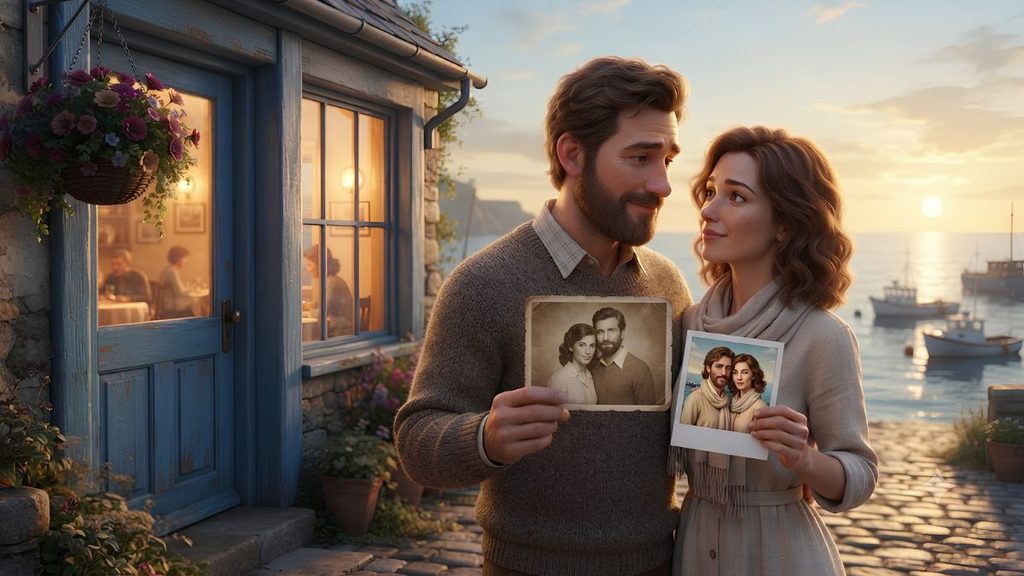
Theme: Imagining a future together
Ethan had never believed that old photographs could remember the future.
Photographs, as far as he knew, belonged to the past.
They captured moments that had already happened.
A birthday.
A wedding.
A summer holiday.
A family dinner.
Two people standing somewhere beautiful and smiling because someone had told them to.
That was what photographs did.
They remembered.
They didn’t predict.
At least, that was what Ethan believed until one Saturday afternoon when he found a photograph that seemed to belong to a life he and Lily had not lived yet.
It happened at a weekend market.
Ethan and Lily had gone there because they had nothing else planned.
They often enjoyed days like that.
No reservations.
No schedules.
No particular destination.
They simply walked through the crowded streets, stopping whenever something caught their attention.
There were stalls selling old books, handmade pottery, paintings, records, lamps, watches, postcards, and furniture.
Lily loved places like that.
“You never know what you’ll find,” she always said.
Ethan usually replied:
“That’s exactly what worries me.”
That afternoon, she laughed when he said it.
Then she stopped beside a table covered with old cameras.
“Look.”
Ethan came over.
The cameras were beautiful.
Some were small and silver.
Some were large and black.
There were old film cameras, instant cameras, and strange-looking devices Ethan couldn’t identify.
Lily picked up a worn leather camera.
“This one is beautiful.”
“You don’t even know if it works.”
“I don’t care.”
“You never care if anything works.”
“I care if it looks good.”
She turned the camera over.
A faded sticker was attached to the bottom.
1978.
Ethan smiled.
“That’s older than my parents.”
“Don’t say things like that.”
“Why?”
“It makes me feel old.”
“You’re twenty-nine.”
“Exactly.”
She placed the camera down.
Ethan noticed something beneath it.
A small envelope.
He picked it up.
Inside was a photograph.
It was slightly faded around the edges.
He looked at it casually.
Then he stopped.
The photograph showed a man and a woman standing outside a small seaside café.
The man wore a dark jacket.
The woman wore a pale sweater.
They were smiling.
Behind them was a blue door.
A narrow window.
A hanging flower basket.
And above the door was a sign.
The Blue Lantern.
Ethan stared at the photograph.
Lily looked over his shoulder.
“What’s wrong?”
“I don’t know.”
He handed it to her.
She studied it.
“It’s nice.”
“No.”
“What?”
“Look at the couple.”
Lily looked again.
Then she laughed.
“They look like us.”
They did.
Not exactly.
But enough.
The man’s hair was dark.
The woman’s hair was brown.
The man had the same slight smile Ethan often wore.
The woman had the same habit Lily had of tilting her head when she smiled.
Even the way they stood together looked familiar.
Lily looked at Ethan.
“That’s weird.”
“Very.”
“Maybe it’s just because we’re looking for similarities.”
“Maybe.”
She turned the photograph over.
There was nothing written on the back.
Ethan looked at the seller.
“Where did this come from?”
The old man behind the table shrugged.
“Box of photographs.”
“Do you know who they are?”
“No idea.”
“Do you know where this was taken?”
The man pointed toward the photograph.
“Somewhere near the coast, I imagine.”
Ethan smiled.
“Very helpful.”
The seller laughed.
“It’s an old photograph. That’s all I know.”
Lily looked at Ethan.
“Are you buying it?”
He nodded.
“Yes.”
The seller named a small price.
Ethan paid.
They continued through the market.
But the photograph stayed in Lily’s hand.
Neither of them talked much about it.
Finally, after ten minutes, Lily said:
“Do you think it’s actually us?”
Ethan smiled.
“No.”
“Why not?”
“Because we’ve never been there.”
“Maybe we have.”
“I think I’d remember.”
Lily looked at the photograph again.
“Wouldn’t it be funny if we hadn’t?”
“What?”
“If the photograph came from somewhere we haven’t visited yet.”
Ethan laughed.
“You think it’s a photograph from the future?”
“No.”
She paused.
“Maybe.”
He shook his head.
“You’re impossible.”
“I know.”
They went home that evening.
The photograph was placed on their kitchen table.
They ate dinner.
Watched a movie.
Made tea.
But every few minutes, one of them looked at it.
Finally, Lily picked it up.
“Let’s find the café.”
Ethan looked at her.
“You’re serious?”
“Completely.”
“We don’t know where it is.”
“We know the name.”
“The Blue Lantern.”
“Exactly.”
“And there are probably hundreds of cafés with that name.”
“Then we’ll start looking.”
Ethan smiled.
“You’ve turned this into a mission.”
“Yes.”
“Why?”
Lily looked at the photograph.
“Because I want to know why it looks like us.”
So they searched.
They found restaurants.
Hotels.
Bars.
Old photographs.
Travel blogs.
Maps.
They found several places called The Blue Lantern.
Most had closed.
One was in another country.
Another was in a city they had visited years before.
None looked like the photograph.
After two hours, Ethan closed his laptop.
“It’s impossible.”
Lily leaned back.
“Maybe.”
She picked up the photograph.
“Still beautiful, though.”
They left it on the bookshelf.
Days passed.
Life returned to normal.
Work.
Groceries.
Laundry.
Dinner.
Sleep.
The photograph remained on the shelf.
Sometimes they forgot about it.
Sometimes Lily would see it and smile.
Then, three weeks later, Ethan received an email from his company.
He needed to travel for work.
The destination was a small coastal town.
He opened the attached itinerary.
Then stopped.
He called Lily.
“Can you check something?”
“What?”
“What’s the name of the town I’m going to?”
She read the message.
“Harborfield.”
“Search for The Blue Lantern.”
There was silence.
Then Lily said:
“Ethan.”
“What?”
“There’s one.”
He sat up.
“What?”
“There’s a café called The Blue Lantern in Harborfield.”
They both became quiet.
Ethan searched for photographs.
The first image loaded.
A small seaside café.
Blue door.
Narrow window.
Flower basket.
He felt a chill move through him.
It was the same building.
Not similar.
The same.
Lily whispered:
“That’s it.”
Ethan stared at the screen.
“I’ll be there Tuesday.”
“You’re taking me.”
“I was going to say that.”
“No, you weren’t.”
“I was thinking it.”
“Take me.”
“I will.”
They arrived in Harborfield on Tuesday afternoon.
The town was small and peaceful.
Old houses lined the streets.
Fishing boats rested in the harbor.
The sea stretched beyond the buildings.
They walked slowly toward the address they had found.
Neither said much.
Then they turned a corner.
There it was.
The Blue Lantern.
Ethan stopped.
Lily took his hand.
The café looked almost exactly like the photograph.
The blue door.
The narrow window.
The flower basket.
Even the small wooden tables outside.
They looked at each other.
“Go on,” Lily whispered.
“You first.”
“No.”
They laughed nervously.
Then they stepped inside.
The café was warm.
A few people sat near the windows.
Soft music played.
An elderly woman stood behind the counter.
She smiled at them.
“Table for two?”
“Yes,” Lily said.
They sat near the window.
Ethan looked around.
Everything felt strangely familiar.
The shape of the room.
The wooden floor.
The shelves.
The blue curtains.
Lily opened the photograph.
She looked from the photograph to the room.
Then back again.
“Where did they sit?”
Ethan looked closely.
In the photograph, the couple stood outside.
He studied the background.
“Maybe here.”
They moved outside.
The same wall.
The same flower basket.
The same blue door.
Lily stood beside Ethan.
She held up the old photograph.
For a moment, they stood exactly where the couple had stood.
Ethan looked at Lily.
She looked at him.
Neither smiled.
Something about the moment felt too strange for laughter.
Then Lily began to laugh.
Ethan joined her.
“Maybe this is it,” she said.
“What?”
“The photograph.”
He smiled.
“You mean we’re supposed to recreate it?”
“Why not?”
They asked a passing tourist to take their photograph.
Lily stood beneath the flower basket.
Ethan stood beside her.
They tried to copy the old photograph.
The tourist raised the camera.
“Ready?”
They smiled.
The photograph was taken.
When they looked at it, they both laughed.
It was almost identical.
Same place.
Same angle.
Same kind of smile.
But there was one difference.
The old photograph had been taken decades earlier.
Their photograph had been taken today.
Ethan looked at Lily.
“So that’s it.”
“Maybe.”
They went back inside.
The elderly woman brought them coffee.
After a while, Ethan showed her the old photograph.
She studied it.
Her expression changed.
“Where did you find this?”
“At a market.”
She looked at the photograph for several seconds.
“I know these people.”
Ethan and Lily looked at each other.
“You do?”
The woman nodded.
“They used to come here when I was young.”
“Who were they?”
She smiled.
“My parents.”
Lily’s eyes widened.
Ethan looked at the photograph again.
“They owned this place?”
“Yes.”
The woman sat down beside them.
“My father built the café. My mother planted those flowers.”
She pointed toward the photograph.
“They were married for fifty-three years.”
Ethan smiled.
“That’s beautiful.”
The woman nodded.
“They loved this place.”
Lily looked at the photograph.
“Do you know when it was taken?”
The woman thought.
“Maybe forty years ago.”
Ethan felt relieved.
The mystery had an ordinary explanation.
It wasn’t a photograph from the future.
It was simply a photograph of two people who happened to resemble them.
But somehow, that made it more meaningful.
Before they left, the woman looked at the photograph they had taken that afternoon.
“You look like them.”
Lily smiled.
“Everyone keeps saying that.”
The woman shook her head.
“No.”
She looked at Ethan.
“You don’t just look like them.”
Then she looked at Lily.
“You stand like them.”
She smiled.
“Some people have a familiar way of loving.”
Ethan didn’t know what to say.
Neither did Lily.
They thanked her and left.
The sun was beginning to set.
They walked toward the harbor.
The sea reflected the evening light.
Boats moved gently in the distance.
Lily held Ethan’s hand.
“Do you think we’ll be together fifty years from now?”
Ethan looked at her.
“I hope so.”
“That’s not very confident.”
“I don’t want to promise something life hasn’t asked me to promise yet.”
Lily nodded.
“What can you promise?”
Ethan thought.
“I can promise that I’ll keep choosing you.”
She smiled.
“That’s better.”
They sat on a bench overlooking the water.
Ethan took the old photograph from his pocket.
Then he took out the new one.
He placed them side by side.
One belonged to the past.
One belonged to the present.
The people were different.
The years were different.
But both couples were standing beneath the same blue door.
Lily leaned against him.
“Maybe that’s what the photograph was trying to tell us.”
“What?”
“That we don’t have to know the future.”
Ethan looked at her.
“We just have to keep making it.”
She smiled.
They sat quietly as the sun disappeared beyond the horizon.
The next morning, they returned home.
The old photograph went into a small frame.
Their new photograph went beside it.
They placed both on the bookshelf.
Years passed.
Life changed.
They moved apartments.
Changed jobs.
Traveled.
Had difficult days.
Had wonderful ones.
They learned things about each other they had never known.
They forgot some things and remembered others.
Sometimes they argued.
Sometimes they laughed until they couldn’t breathe.
Sometimes they sat silently together without needing to say anything.
And every once in a while, they looked at the two photographs.
The old one.
And the new one.
The photograph they hadn’t taken yet.
Then the photograph they had.
And Ethan would always smile.
Because he had learned something that Saturday afternoon at the market.
A photograph could remember the past.
But it could also remind you that the future was still waiting.
Not written.
Not guaranteed.
Not perfectly planned.
Just waiting.
Waiting for two people to step into it together.
And that was enough.
Because love was not knowing exactly what tomorrow would look like.
Love was looking at someone beside you and saying:
“Whatever comes next, let’s find out together.”
And sometimes, that was the most beautiful picture of all.
5. The Rainy Evening Delivery

Theme: Love expressed through small acts of care
By six o’clock on Thursday evening, the rain had turned the city into a blur of silver streets and glowing windows.
Cars moved slowly through the traffic.
Umbrellas crowded the sidewalks.
Water streamed along the edges of the road.
Inside the small apartment he shared with Amelia, James stood by the window and watched the storm.
He had been waiting for her for almost an hour.
She had sent him a message earlier.
Long day. I might be late tonight.
James had replied:
Take your time. I’ll be here.
She had sent a heart.
That was all.
James knew Amelia well enough to understand what those few words meant.
She wasn’t simply going to be late.
She was exhausted.
The week had been difficult for her.
Her manager had given her too much work.
Two meetings had run longer than expected.
A project she had spent days preparing had been delayed.
And that morning, she had missed her train by less than a minute.
James knew all of this because Amelia had told him during a hurried phone call.
But she had ended the call with:
“Don’t worry about me. I’ll be fine.”
She always said that.
Even when she wasn’t.
James looked at the clock.
6:17.
He opened his phone and checked the food delivery app.
There were several restaurants nearby.
He chose Amelia’s favorite.
Her usual noodles.
Her favorite dumplings.
A small dessert she always pretended she didn’t want.
He placed the order.
Then he sent her a message.
Dinner is waiting for you.
A few seconds later, her reply appeared.
You didn’t have to do that.
James smiled.
I know.
She sent another message.
Thank you.
He put the phone down.
Outside, the rain became heavier.
He looked at the order status.
Then he noticed the estimated delivery time.
Forty-five minutes.
James sighed.
Forty-five minutes wasn’t too long.
But when someone was hungry, tired, and coming home from a difficult day, forty-five minutes could feel like an hour and a half.
He went into the kitchen.
The apartment was unusually quiet.
Normally, Amelia would be there.
She would open the refrigerator without actually knowing what she wanted.
She would ask James what they should eat.
He would suggest something.
She would reject it.
He would suggest something else.
She would say yes.
Then she would change her mind.
It was one of their smallest rituals.
James smiled at the memory.
He checked his phone again.
The delivery driver was stuck in traffic.
Thirty-five minutes.
He looked at the clock.
6:31.
He opened the refrigerator.
There wasn’t much inside.
Some vegetables.
Eggs.
Butter.
Cheese.
A few herbs.
He looked at the ingredients.
Then at the rain.
Then at his phone.
He had an idea.
It was not a particularly impressive idea.
He wasn’t a great cook.
In fact, Amelia often described his cooking as “enthusiastic.”
Which wasn’t necessarily a compliment.
Still, he could make something.
He put on an apron.
The first problem was deciding what to make.
He settled on pasta.
Pasta was difficult to completely ruin.
At least, he hoped.
He chopped vegetables.
He boiled water.
He grated cheese.
He tried to remember how much salt Amelia usually added.
Then he accidentally dropped half the pasta onto the floor.
James stared at it.
“Well,” he said to himself.
“Five-second rule.”
He picked it up.
Then he reconsidered.
“No.”
He threw it away.
He started again.
Twenty minutes later, the kitchen looked as though a small cooking competition had ended badly.
There was flour on the counter.
Vegetables beside the sink.
A spoon on the floor.
Two pans on the stove.
And James standing in the middle of everything, looking suspiciously at a sauce that seemed determined to separate.
His phone rang.
Amelia.
He answered.
“Hey.”
“Are you home?”
“Yeah.”
“I’ll be there soon.”
“Okay.”
There was a pause.
“Did you order food?”
James looked at the kitchen.
“No.”
“You did.”
“How do you know?”
“I know you.”
He laughed.
“Fine. I ordered food.”
“Thank you.”
“Actually…”
“What?”
“It’s taking longer than expected.”
“How long?”
“About twenty minutes.”
She sighed.
“That’s okay.”
“No, it’s not.”
“James.”
“I’ve decided to cook.”
Silence.
Then Amelia laughed.
“You?”
“Yes.”
“Are you sure you’re okay?”
“Very funny.”
“What are you making?”
“Pasta.”
Another pause.
“Do you need help?”
“No.”
“Are you certain?”
“Yes.”
“Should I call emergency services?”
James laughed.
“Just come home.”
“I am.”
“Good.”
“I love you.”
“I love you too.”
They hung up.
James looked at the stove.
“Okay.”
He took a deep breath.
“Let’s not disappoint her.”
He turned the heat down.
Then he tasted the sauce.
It wasn’t terrible.
It wasn’t good either.
It was somewhere between the two.
He added cheese.
A little more butter.
Some herbs.
Another pinch of salt.
Then he tasted it again.
Better.
He smiled.
He placed the pasta on two plates.
He lit a small candle.
Then he changed the music.
Instead of the usual playlist, he put on an old album Amelia loved.
The apartment immediately felt warmer.
Outside, the rain continued.
Inside, James waited.
At 7:14, the front door opened.
Amelia stepped inside.
Her coat was wet.
Her hair was slightly damp.
She looked exhausted.
Then she smelled the food.
She stopped.
“What is that?”
James came out of the kitchen.
“Dinner.”
She looked at the table.
Then at him.
“You cooked?”
“I attempted to.”
She smiled.
“You’re adorable.”
“That’s not what I was hoping for.”
She laughed.
Then she walked toward him.
James noticed how tired she looked.
Without saying anything, he took her coat.
She slipped off her shoes.
Then he gently took her hand.
“Come sit.”
“I need to change.”
“You can do that after you eat.”
“James…”
“You’re hungry.”
She looked at him.
Then she smiled.
“You’re right.”
They sat at the table.
Amelia took one bite.
James watched her face carefully.
She chewed.
He waited.
“Well?”
She swallowed.
“This is actually good.”
“Actually?”
“Very good.”
James smiled.
“I knew it.”
“You absolutely did not.”
“I had confidence.”
“You had panic.”
“That too.”
She laughed.
And just like that, the difficult day began to disappear.
They ate slowly.
The rain tapped against the windows.
The music played quietly.
James told her about his cooking disaster.
Amelia laughed so hard she nearly dropped her fork.
“You picked pasta up from the floor?”
“Only briefly.”
“You are impossible.”
“I threw it away.”
“Good.”
“I have standards.”
“Low ones.”
They laughed.
Then Amelia became quiet.
She looked down at her plate.
James noticed.
“What?”
She shook her head.
“Nothing.”
“Tell me.”
She took a breath.
“I’m just tired.”
“I know.”
“I feel like I’m always trying to catch up.”
James reached across the table.
She placed her hand in his.
“You don’t have to catch up tonight.”
She looked at him.
“What if everything is still there tomorrow?”
“It will be.”
She sighed.
“That’s the problem.”
“No.”
James squeezed her hand.
“That’s life.”
She smiled faintly.
“That’s not very comforting.”
“Maybe not.”
He paused.
“But you don’t have to solve tomorrow tonight.”
Amelia looked at him.
For a moment, neither spoke.
Then she nodded.
“I needed to hear that.”
After dinner, they moved to the sofa.
The rain had become softer.
Amelia curled up beside James beneath a blanket.
He handed her the dessert.
She looked at it.
“You remembered.”
“Of course.”
“You always remember.”
“Not always.”
“You remember the important things.”
James smiled.
“I remember you.”
She rested her head against his shoulder.
They listened to the rain.
After a while, Amelia said:
“Do you know what I like about us?”
“What?”
“We don’t need perfect days.”
James looked down at her.
“What do you mean?”
She thought for a moment.
“We’ve had beautiful days.”
“Definitely.”
“Trips.”
“Several.”
“Birthdays.”
“Your birthday was mostly about cake.”
“It was a very good cake.”
“It was.”
She smiled.
“But I think I love nights like this more.”
James looked around.
“The messy kitchen?”
“Yes.”
“The terrible pasta?”
“Not terrible.”
“The rain?”
“Yes.”
“Me?”
“Especially you.”
He smiled.
She continued.
“I like knowing that when the world is difficult, I can come home.”
James kissed her forehead.
“That’s what home is for.”
She closed her eyes.
“I missed you today.”
“I missed you too.”
“You were here all day.”
“I know.”
“But still.”
James understood.
Sometimes missing someone had nothing to do with distance.
Sometimes you could miss someone while they were only a few rooms away.
You could miss their attention.
Their laughter.
Their warmth.
Their calm.
And sometimes love meant noticing.
It meant recognizing the tiredness in someone’s voice.
It meant remembering what they liked.
It meant making dinner even when you weren’t particularly good at cooking.
It meant putting away your own worries for a while because someone you loved needed somewhere safe to put theirs.
The rain became heavier again.
Amelia shifted closer.
“James?”
“Hmm?”
“If we had to live somewhere else someday, where would you choose?”
He smiled.
“You’re asking this now?”
“Yes.”
“Somewhere quiet.”
“Near the sea?”
“Maybe.”
“A small town?”
“Maybe.”
“A house with a garden?”
“Definitely.”
“You still want a garden?”
“Yes.”
“You killed the last plant.”
“It was already struggling.”
“It was completely healthy.”
“It had a difficult personality.”
Amelia laughed.
“You blame the plant?”
“Absolutely.”
She smiled.
“What else?”
“A big kitchen.”
“So you can make terrible pasta?”
“I’ll improve.”
“I hope so.”
“And a table near a window.”
“For breakfast?”
“For everything.”
She became quiet.
Then she said:
“I’d want a little room with a comfortable chair.”
“For reading?”
“Yes.”
“And a dog?”
“Definitely.”
“That’s going to be your responsibility.”
“Why?”
“You’re the one who wants the dog.”
She smiled.
“Fine.”
James looked at her.
“What else?”
She thought.
“A life where we don’t rush everything.”
He nodded.
“That sounds good.”
“Where we have time.”
“For each other.”
“Yes.”
They sat quietly.
The future they were describing wasn’t glamorous.
It didn’t involve a huge house.
Or expensive cars.
Or perfect holidays.
It was simply a life with enough space for them to breathe.
A life with slow mornings.
Rainy evenings.
Home-cooked meals.
Books.
Music.
Friends.
And each other.
James looked toward the kitchen.
The room was still messy.
He should probably clean it.
Instead, he stayed where he was.
Amelia was half asleep against him.
The rain continued outside.
He pulled the blanket higher around her shoulders.
She opened her eyes slightly.
“Are you comfortable?”
“Very.”
“Good.”
She closed her eyes again.
James looked at her.
There was something peaceful about seeing someone you loved finally relax after a difficult day.
He knew he couldn’t remove all her problems.
He couldn’t make work disappear.
He couldn’t guarantee that tomorrow would be easier.
But he could give her this.
A warm meal.
A quiet room.
A hand to hold.
A place to rest.
Sometimes love wasn’t about fixing everything.
Sometimes it was simply saying:
“You don’t have to carry everything alone.”
The clock moved past ten.
The rain softened to a whisper.
Amelia fell asleep.
James stayed awake for a little longer.
He listened to the quiet apartment.
He looked at the two plates still waiting in the kitchen.
He smiled.
The dinner had not been perfect.
The evening had not been planned.
Nothing about it would appear in a travel magazine or a romantic movie.
But perhaps that was what made it beautiful.
Their love wasn’t made only of anniversaries and vacations.
It was made of ordinary Thursdays.
Of tired smiles.
Of shared blankets.
Of remembering someone’s favorite dessert.
Of waiting at the door.
Of making dinner badly and laughing about it afterward.
Of being there.
James gently kissed Amelia’s forehead.
Then he whispered:
“I’m glad you’re home.”
She didn’t wake.
But she smiled.
Outside, the city slept beneath the rain.
Inside, two people rested together in the quiet warmth of their little apartment.
And somewhere between the sound of rain and the soft rhythm of Amelia’s breathing, James understood something simple.
A person didn’t always need a grand gesture to feel loved.
Sometimes they only needed someone to notice that they had had a difficult day.
Someone to open the door.
Someone to say, “Come sit down.”
Someone to make a meal.
Someone to remember the dessert.
Someone to stay.
And sometimes, on an ordinary rainy evening, that was more romantic than anything money could buy.
The next morning, Amelia would return to work.
There would be emails.
Meetings.
Deadlines.
Traffic.
Another long day waiting somewhere in the future.
But tonight, none of that mattered.
Tonight, she was home.
And James was beside her.
The rain kept falling gently outside.
The candle burned low on the table.
And the little apartment, with its messy kitchen and imperfect dinner, felt like the safest place in the world.
6. The House With Two Front Doors
Theme: Building a life together
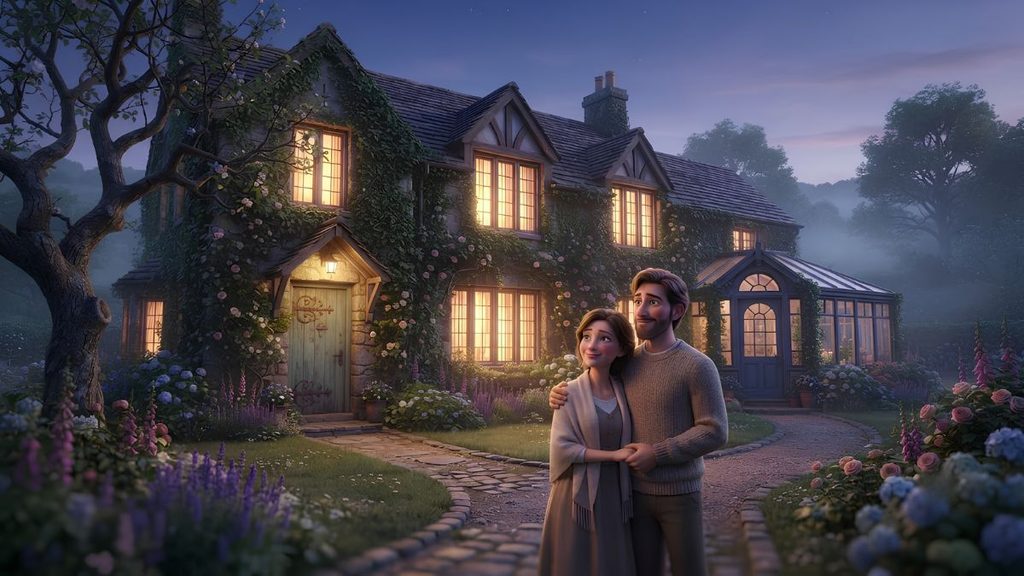
Lucas first noticed the house because it had two front doors.
They were not side by side exactly. One stood beneath a small wooden porch on the left, painted a faded green that had probably once been bright. The other was several steps away, beneath a narrow stone arch, painted deep blue.
Everything else about the house seemed ordinary.
There was an old garden around it, a low stone wall, a crooked apple tree, and tall windows glowing softly in the late afternoon light.
But two front doors?
Lucas slowed the car.
Clara, who had been looking out of the passenger window, noticed.
“What are you staring at?”
“That house.”
She looked.
“Oh.”
“Why does it have two doors?”
Clara smiled.
“Maybe one is for people who arrive early.”
Lucas laughed.
“And the other?”
“People who arrive late.”
“That’s not how doors work.”
“You don’t know that.”
He glanced at her.
“You’ve been reading too many strange novels.”
“That’s because you don’t read enough strange novels.”
They were driving through the countryside with no particular destination.
It had been Clara’s idea to leave the city for the weekend.
The previous few weeks had been tiring. Lucas had been working late almost every evening, and Clara had been trying to finish several projects at once. They had still talked, still eaten dinner together, still kissed goodnight, but their days had begun to feel like lists.
Work.
Groceries.
Laundry.
Bills.
Sleep.
Repeat.
So on Saturday morning, Clara had placed two bags in the car and announced that they were leaving.
“Where are we going?”
“Somewhere else.”
“For how long?”
“Until Sunday.”
“What if we get lost?”
“Then we’ll be lost together.”
Lucas had smiled.
“That sounds suspiciously romantic.”
“It is.”
Now, as evening approached, they were driving through a small village they had never visited before.
The road curved between fields and old stone cottages.
Then they saw the house.
Lucas pulled the car to the side.
“Come on,” Clara said.
“Where?”
“To investigate.”
They walked toward the stone wall.
A small wooden sign near the gate read:
Briar House
Below it, in smaller letters:
Open for viewing.
Lucas looked at Clara.
“You want to go inside?”
“Obviously.”
They pushed open the garden gate.
The house was larger than it had seemed from the road.
Its pale stone walls were covered in ivy. There were roses climbing around the blue door, though most of the flowers had already begun to fade with the season.
The green door faced the road.
The blue door faced the garden.
Between them was a wide section of wall with three tall windows.
Lucas stood in front of the blue door.
“Maybe the house belongs to two families.”
“Maybe.”
“Maybe one family is very polite and doesn’t want to share a door.”
Clara shook her head.
“You always invent complicated explanations.”
“That’s because simple explanations are boring.”
Before she could answer, the green door opened.
An elderly woman stood there.
She wore a cream-colored cardigan and held a small ring of keys.
“You’ve been wondering about the doors,” she said.
Lucas looked embarrassed.
“Was it that obvious?”
“Everyone wonders.”
The woman smiled.
“My name is Mrs. Bennett.”
“Lucas.”
“Clara.”
Mrs. Bennett stepped aside.
“Would you like to see the house?”
They followed her inside.
The first thing Lucas noticed was the warmth.
Not just the temperature.
The house felt warm.
There was an old grandfather clock ticking quietly in the hallway. A vase of dried flowers stood on a wooden table. Framed photographs covered one wall.
Mrs. Bennett led them through the green door.
“This side of the house was built first,” she explained.
They entered a sitting room with tall bookshelves and two comfortable armchairs near a fireplace.
“The blue side was added many years later.”
Clara looked toward the opposite hallway.
“So there really are two sides.”
“There were originally two separate entrances.”
“Why?”
Mrs. Bennett smiled.
“That is the story everyone wants to know.”
Lucas leaned against the doorway.
“We’re listening.”
Mrs. Bennett walked toward an old photograph hanging above the fireplace.
It showed a young couple standing in front of the house.
They were holding hands.
The man wore a dark suit.
The woman wore a long light-colored dress.
“They were Thomas and Eleanor,” Mrs. Bennett said. “They bought this place when they were young.”
Clara looked at the photograph.
“They look happy.”
“They were.”
Mrs. Bennett paused.
“But when they bought the house, it had only one entrance.”
Lucas raised an eyebrow.
“So who added the second?”
“Eleanor.”
“Why?”
“She wanted a blue door.”
Lucas laughed softly.
“That’s it?”
“That’s it.”
Clara smiled.
“I like her already.”
Mrs. Bennett continued.
“Thomas thought one door was perfectly sufficient. Eleanor disagreed. She said every house needed something unnecessary.”
Clara glanced at Lucas.
“She’s definitely my kind of person.”
“Eventually,” Mrs. Bennett said, “they added another entrance on the garden side. Eleanor had always dreamed of having a garden door.”
Lucas looked through the window.
The garden outside was beautiful despite being slightly overgrown.
“Did they use both?”
“Every day.”
Mrs. Bennett led them through the house.
There were two staircases.
Two small sitting rooms.
Two fireplaces.
Two narrow hallways that eventually joined in the middle.
And, surprisingly, two doors leading into the kitchen.
“Why two kitchens?” Lucas asked.
“Only one is a kitchen now,” Mrs. Bennett replied. “The other was originally a pantry.”
Clara ran her fingers lightly along an old wooden counter.
“Imagine living here.”
Lucas smiled.
“You already are.”
She looked at him.
“No, I’m imagining it properly.”
She walked toward the window.
“I’d put a table here.”
“Here?”
“Yes.”
“Why?”
“Because the morning light comes in.”
Lucas studied the room.
“Then where would I sit?”
“Across from me.”
“What if I want to sit beside you?”
“You can move your chair.”
“Good.”
Mrs. Bennett watched them with a quiet smile.
They continued through the house.
In one bedroom, Clara imagined a reading chair beside the window.
Lucas imagined a desk in the smaller room upstairs.
Clara wanted shelves everywhere.
Lucas wanted a large kitchen.
Clara wanted a garden.
Lucas wanted a place where they could have friends over without worrying about disturbing the neighbors.
They argued about curtains.
They disagreed about furniture.
They debated whether a house should have a television in the bedroom.
“Absolutely not,” Clara said.
“Why?”
“Because bedrooms are for sleeping.”
“And talking.”
“Yes.”
“And reading.”
“Yes.”
“And watching movies.”
“No.”
Lucas smiled.
“You’ve made your position very clear.”
They moved into the hallway.
There, Mrs. Bennett stopped beside a small framed letter.
“This belonged to Eleanor.”
Clara leaned closer.
The handwriting was delicate.
“May I read it?”
Mrs. Bennett nodded.
The letter was short.
It said that Eleanor loved the house because it allowed her and Thomas to have different spaces without ever feeling far apart.
She could read in one room while he worked in another.
She could enter through the garden door after walking outside.
He could come through the front door after work.
But every evening, they met in the kitchen.
Clara read the final sentence twice.
“They always met in the kitchen.”
Mrs. Bennett nodded.
“That was their rule.”
Lucas smiled.
“Even after forty years?”
“Especially after forty years.”
They stood quietly.
Outside, the wind moved through the apple tree.
Lucas looked at Clara.
“What would our rule be?”
She thought about it.
“I don’t know.”
“Come on.”
“We need one?”
“Every good house needs one unnecessary rule.”
Clara smiled.
“Fine.”
She considered the question seriously.
“Maybe… no matter how busy the day is, we have tea together before bed.”
Lucas nodded.
“Even if we’re angry?”
“Especially if we’re angry.”
“What if one of us doesn’t want tea?”
“Then coffee.”
“That’s a loophole.”
“It’s a good loophole.”
He laughed.
“Okay.”
They continued upstairs.
At the end of the hallway was a small room with a window overlooking the garden.
Clara stopped.
“Oh.”
Lucas knew immediately that she loved it.
The room was empty except for an old wooden chair.
Sunlight poured across the floor.
“I’d make this my reading room,” she said.
“Of course.”
“What?”
“You’d turn every room into a reading room.”
“Not every room.”
“How many books would you put in here?”
She looked around.
“Maybe two hundred.”
“That’s every wall.”
“Exactly.”
Lucas laughed.
She walked toward the window.
“What would you do with the room next to it?”
“My office.”
“You’d work here?”
“Sometimes.”
“Would you work too much?”
He paused.
The question was gentle, but it mattered.
Lucas looked at her.
“Probably.”
Clara turned around.
“I don’t want our future house to become another place where we are always busy.”
He stepped closer.
“I don’t either.”
She looked through the window.
“I don’t need a house like this.”
“I know.”
“I don’t need two doors.”
“I know.”
“I don’t even need a garden.”
“You definitely need a garden.”
She laughed.
“Maybe.”
Lucas stood beside her.
“What do you need?”
Clara thought for a moment.
Then she answered quietly.
“Time.”
He nodded.
“Me too.”
The house suddenly seemed different.
It was no longer a dream about beautiful rooms.
It was a reminder.
A home could have a hundred windows and still feel empty if the people inside never stopped to look at each other.
A small apartment could feel enormous if there was laughter in the kitchen.
A rented room could become home because someone waited there.
They went downstairs.
Mrs. Bennett was standing near the fireplace.
“Well?” she asked.
Clara smiled.
“It’s beautiful.”
“Would you buy it?”
Lucas looked at Clara.
She looked at him.
“We couldn’t afford it.”
Mrs. Bennett laughed.
“That’s not what I asked.”
Clara thought.
“Maybe one day.”
Lucas nodded.
“Maybe.”
Mrs. Bennett handed Clara a small brass key.
Clara looked surprised.
“What’s this?”
“An old spare key. It doesn’t open anything anymore.”
“Then why keep it?”
“Because sometimes an old key is worth keeping.”
Clara turned it over in her hand.
There was a tiny engraved letter on it.
E.
“For Eleanor?” she asked.
Mrs. Bennett nodded.
“She believed every home should have something that reminded its owners where they began.”
Clara closed her fingers around the key.
“Thank you.”
Mrs. Bennett smiled.
“Perhaps you should start with something smaller.”
Lucas looked at Clara.
“What does that mean?”
Mrs. Bennett walked toward the garden door.
“Build your home wherever you are.”
They thanked her and stepped outside.
The evening sky had turned pale gold.
For a while, they stood beside the apple tree.
Neither of them spoke.
Then Clara slipped her hand into Lucas’s.
“Let’s go home.”
Lucas smiled.
“Back to the apartment?”
“Yes.”
“Not disappointed?”
She shook her head.
“No.”
They walked back to the car.
During the drive home, they talked about the house.
They talked about the blue door.
The reading room.
The garden.
The kitchen.
Their imaginary table.
Their imaginary dog.
Their imaginary Sunday mornings.
But somewhere between the village and the city, Clara stopped talking.
Lucas glanced at her.
“What are you thinking?”
She looked out at the passing fields.
“I’m thinking about the two doors.”
“What about them?”
“Maybe they weren’t really about having two ways in.”
Lucas waited.
“Maybe they were about having two ways back.”
He smiled.
“I like that.”
“Me too.”
When they reached their apartment, it was almost dark.
The hallway light was broken again.
The kitchen was small.
The sofa had a loose cushion.
There were dishes in the sink.
Nothing about the place looked like Briar House.
But when Lucas opened the door, Clara stepped inside and immediately took off her shoes.
She walked into the kitchen.
“Tea?”
Lucas smiled.
“Tea.”
They stood together while the kettle warmed.
Clara opened the cupboard.
Lucas reached for two mugs.
They bumped shoulders.
She laughed.
He laughed.
And suddenly the little kitchen felt exactly right.
Later, they sat together on the sofa.
Clara rested her head against Lucas’s shoulder.
“We don’t need two front doors,” she whispered.
“No.”
“We just need somewhere to return to.”
Lucas kissed the top of her head.
“And someone waiting inside.”
Outside, the city moved quietly through the night.
Cars passed.
Windows glowed.
People returned from work.
Doors opened and closed all along the street.
But inside their small apartment, Lucas and Clara sat close together, listening to the soft sound of rain beginning against the window.
They talked about their imaginary house one last time.
Then Clara became sleepy.
Lucas pulled a blanket over them.
“One day,” she murmured.
“One day what?”
“We’ll have our garden.”
“And your reading room.”
“And your office.”
“And our unnecessary rule.”
She smiled with her eyes closed.
“Tea before bed.”
“Every night.”
She slipped her hand into his.
“Even when we’re angry.”
“Especially then.”
A few minutes later, she was asleep.
Lucas remained awake just long enough to look around their little home.
The uneven bookshelf.
The old lamp.
The two mugs on the table.
The blanket.
Clara sleeping beside him.
It wasn’t a grand house.
It didn’t have two front doors.
It didn’t have two staircases or a garden full of roses.
But it had something better.
It had a place where two people could return to each other.
And Lucas finally understood what Mrs. Bennett had meant.
A home was never really measured by doors, rooms, windows, or walls.
A home was measured by the feeling that waited behind the door.
By the quiet voice saying, “You’re back.”
By the hand reaching for yours.
By the cup of tea waiting in the kitchen.
By the person who stayed.
And as the rain softened outside, Lucas closed his eyes.
For now, this was enough.
Tomorrow, there would be work.
There would be groceries.
There would be laundry.
There would be ordinary days.
But there would also be mornings together.
Evenings together.
Tea before bed.
And perhaps, someday, a garden.
For now, they had found the most important room of all.
The one where they were together.
And that room did not need a door.
It was already home.
7. The Last Light on the Harbor
Theme: Loving someone through change
The harbor always looked different at night.
During the day, it was noisy and bright.
Fishing boats moved slowly across the water. Seagulls circled above the docks. Shopkeepers opened their doors along the waterfront, and tourists wandered between cafés carrying cameras and paper cups of coffee.
But after sunset, everything became quieter.
The boats rocked gently against their ropes.
The water reflected small golden lights.
And along the far edge of the harbor, a row of lamps stretched into the distance like a trail of stars.
Adrian had loved those lights since he was a child.
Tonight, he was seeing them for the last time.
At least for a while.
He stood beside the window of his childhood bedroom, looking down at the familiar street.
His suitcase was lying open on the bed.
Most of his clothes had already been packed.
His passport was inside the front pocket.
His plane ticket was on the desk.
Tomorrow afternoon, Adrian would leave the seaside town where he had lived almost his entire life.
He was moving to another country for a new job.
It was the opportunity he had wanted for years.
It was exciting.
It was frightening.
And tonight, more than anything, it was difficult.
There was a soft knock on the door.
“Come in.”
Marcus appeared in the doorway.
He was holding two cups of coffee.
“I brought reinforcements.”
Adrian smiled.
“Coffee at nine at night?”
“It’s a difficult night.”
“So you brought caffeine.”
“I brought emotional support.”
Adrian took the cup.
“That works too.”
Marcus walked into the room and sat on the edge of the bed.
For a moment, neither of them spoke.
They had been together for almost five years.
They had survived bad apartments, difficult jobs, family disagreements, broken washing machines, terrible cooking experiments, and one unforgettable vacation where they had accidentally boarded the wrong train.
They had also shared thousands of ordinary moments.
Morning coffee.
Grocery shopping.
Walking home in the rain.
Falling asleep during movies.
Laughing at jokes that nobody else understood.
They had built a life quietly.
And tomorrow, Adrian was going to leave it.
Marcus looked at the suitcase.
“Is everything packed?”
“Almost.”
“Almost?”
Adrian nodded.
“I haven’t packed the blue sweater.”
Marcus smiled.
“The one I hate?”
“The one you hate.”
“It’s too large.”
“You said it was comfortable.”
“I said it looked comfortable. There’s a difference.”
Adrian laughed.
It was a small laugh.
But it helped.
Marcus stood.
“Come on.”
“Where?”
“You said tonight belonged to us.”
Adrian looked at him.
“Where are we going?”
“Everywhere.”
They left the house a few minutes later.
The streets were quiet.
It was a cool evening, and the wind carried the smell of salt from the sea.
They walked toward the center of town.
Their first stop was a tiny bakery.
It had been there for decades.
The windows were dark now, but Adrian could still remember coming here before school.
Marcus pointed toward the door.
“This is where you bought me the worst croissant I’ve ever eaten.”
Adrian laughed.
“It wasn’t that bad.”
“It was hard enough to repair a wall.”
“You ate the whole thing.”
“I was being polite.”
“You asked for another.”
“I was being extremely polite.”
They stood outside the bakery, remembering.
Then they walked on.
They passed the old cinema.
The sign had changed since they were teenagers.
They passed the bookstore where Marcus had once spent an entire afternoon looking for a novel he could no longer remember the name of.
They passed the park where Adrian had first told Marcus that he loved him.
Neither of them mentioned that memory.
They didn’t need to.
They both remembered.
Eventually, they reached the little café where they had their first date.
It was still open.
Warm light spilled onto the pavement.
Marcus looked at Adrian.
“One last coffee?”
Adrian nodded.
They went inside.
The same wooden tables stood near the windows.
The same small lamps hung above the counter.
An older woman behind the register recognized them.
“I haven’t seen you two in a while.”
“We’ve been busy,” Marcus said.
The woman smiled.
“Moving?”
Adrian was surprised.
“How did you know?”
“You’ve been coming here for years. People don’t order coffee like that unless something is changing.”
Marcus laughed.
“Is it that obvious?”
“To people who pay attention.”
They ordered two coffees and sat by the window.
For a while, they simply watched the street.
Adrian rested his hands around the warm cup.
“I’m going to miss this.”
Marcus looked at him.
“The coffee?”
“Everything.”
The word stayed between them.
Marcus reached across the table.
Adrian placed his hand over his.
“I know.”
There was no easy answer.
No sentence that could make tomorrow less difficult.
So they didn’t try to find one.
Instead, they talked about other things.
They talked about the apartment Adrian would rent in his new city.
They talked about the tiny kitchen he had seen in photographs.
They laughed about how badly Adrian would probably cook for the first few weeks.
Marcus promised to send him recipes.
Adrian promised not to follow them too carefully.
And then, almost without noticing, they began talking about the future.
Not the distant future.
Just the next few months.
Marcus would visit in December.
Adrian would come home in the spring.
They would call every Sunday.
They would watch the same movie sometimes while sitting in different countries.
They would send photographs.
They would complain about the weather.
They would continue arguing about coffee.
Normal things.
Small things.
The kind of things that made distance feel less frightening.
When they finished their drinks, they walked toward the sea.
The harbor was only a few streets away.
The wind became stronger as they approached the water.
Adrian pulled his coat tighter.
Marcus noticed.
“Cold?”
“A little.”
He took off his scarf and wrapped it around Adrian’s neck.
“You’ll need this.”
“You’ll be cold.”
“I’ll survive.”
Adrian smiled.
“You always do this.”
“Do what?”
“Take care of me.”
Marcus shrugged.
“Someone has to.”
They reached the pier.
It stretched out over the dark water.
There were almost no people around.
Only an elderly fisherman at the far end and a couple standing near the railing.
Adrian and Marcus walked to their usual place.
They had stood there hundreds of times.
Sometimes they talked.
Sometimes they said nothing.
Sometimes they watched storms approaching from the horizon.
Tonight, the sea was calm.
The harbor lights reflected across the water.
Adrian looked toward the opposite shore.
“I used to think I’d never leave.”
Marcus stood beside him.
“Me too.”
“Then I spent years wanting to leave.”
“And now?”
Adrian smiled sadly.
“Now I want both.”
Marcus nodded.
“I understand.”
Adrian looked at him.
“Do you?”
“Yes.”
Marcus leaned against the railing.
“You can want something new without wanting to lose what you already have.”
Adrian looked back at the water.
“I’ve been afraid that leaving means choosing.”
Marcus was quiet for a moment.
Then he said, “Maybe it means changing the way we choose each other.”
Adrian turned toward him.
Marcus continued.
“We don’t have to promise that everything will stay the same.”
The words were gentle.
But they carried weight.
Adrian swallowed.
“That’s what scares me.”
“I know.”
“What if things change?”
“They will.”
Adrian looked down.
Marcus reached for his hand.
“Everything changes.”
The wind moved through them.
“The town will change. Our jobs will change. We’ll change. Maybe our routines will change. Maybe we’ll have difficult days.”
Adrian squeezed his hand.
“But?”
“But I don’t want to promise you that nothing will change.”
Marcus smiled.
“I want to promise something I can actually keep.”
“What?”
“I’ll keep choosing you.”
Adrian’s eyes became wet.
Marcus continued.
“Not because things are easy. Not because we’re in the same place. Not because we know exactly what the future looks like.”
He squeezed Adrian’s hand.
“Because you’re the person I want to keep walking toward.”
Adrian looked at him for a long time.
Then he pulled him into a hug.
They stood there quietly.
No dramatic music.
No perfect words.
Just two people holding each other beside a dark sea.
Eventually, they sat on a wooden bench.
Marcus rested his head against Adrian’s shoulder.
Adrian looked at the harbor.
One by one, the lights along the pier began to dim.
It was getting late.
They stayed anyway.
They talked about their first apartment.
The tiny one with the broken heater.
They talked about their first Christmas together.
The year they had tried to cook an elaborate dinner and ended up ordering pizza.
They talked about the afternoon they got caught in a storm while walking along the beach.
They talked about the day Marcus surprised Adrian at work.
They talked about nothing important.
And somehow, those were the memories that mattered most.
Eventually, Marcus asked, “Do you remember the first time we came here?”
Adrian smiled.
“Of course.”
“What were you thinking?”
“That you talked too much.”
Marcus laughed.
“That’s romantic.”
“I also thought you had nice eyes.”
“Better.”
“And that you were probably going to become very important to me.”
Marcus looked at him.
“Probably?”
“I was trying not to sound desperate.”
“You failed.”
Adrian laughed.
The sound carried softly across the water.
For a while, they simply watched the harbor.
The moon appeared between clouds.
A boat moved slowly across the dark water.
Its small cabin light reflected on the waves.
Adrian thought about how strange life was.
People spent years building routines.
Then one decision could change everything.
A new job.
A new city.
A new country.
A plane ticket.
And yet, the important things did not disappear so easily.
Love wasn’t a building.
It wasn’t a street.
It wasn’t even a particular place.
It was what two people carried with them.
The habits.
The memories.
The jokes.
The promises.
The knowledge of how the other person took their coffee.
The way they reached for each other’s hands without thinking.
The quiet certainty that somewhere in the world, someone knew exactly what your tired face looked like.
Marcus spoke softly.
“Are you ready?”
Adrian knew what he meant.
“For tomorrow?”
“Yes.”
He thought about it.
“No.”
Marcus nodded.
“Me neither.”
Adrian smiled.
“But I’m going.”
“I know.”
“And you’re staying.”
“For now.”
They both laughed softly.
Then Marcus stood.
“Come on.”
“Where?”
“One last walk.”
They walked to the end of the pier.
The harbor looked different from there.
The town was behind them.
Ahead was only the sea.
Adrian could barely see the horizon.
It felt strangely peaceful.
Marcus stood beside him.
“Do you remember what your father used to say about the harbor lights?”
Adrian smiled.
“He said sailors don’t need every light to find their way home.”
Marcus nodded.
“Just enough.”
They watched the lights.
One.
Two.
Three.
Then another disappeared.
The night grew darker.
Adrian felt something loosen inside him.
Not the sadness.
The sadness remained.
But beneath it was something else.
Acceptance.
Tomorrow would be difficult.
He would leave.
Marcus would stay.
They would miss each other.
There would be lonely evenings.
There would be celebrations they couldn’t attend together.
There would be photographs instead of shared mornings.
Phone calls instead of quiet conversations across a kitchen table.
But there would also be reunions.
New memories.
Flights home.
Visits.
Surprises.
Stories they hadn’t lived yet.
A different chapter.
Not the end.
Adrian turned to Marcus.
“Promise me something.”
“Anything.”
“Don’t wait for me to come back before you live.”
Marcus smiled.
“I won’t.”
“And don’t let me do that either.”
“I won’t.”
“Good.”
Marcus took his hand.
“We’ll live.”
“And we’ll come back to each other.”
“Yes.”
They stood there until only a few harbor lights remained.
The eastern sky had begun to change.
The blackness was becoming deep blue.
Morning was approaching.
Adrian looked at the final light at the end of the harbor.
It flickered once.
Then again.
And finally went dark.
For a moment, everything seemed still.
Then the first pale light of dawn appeared beyond the water.
Adrian watched the horizon.
The town behind them was waking.
Soon, people would open shops.
Cars would begin moving through the streets.
The bakery would turn on its lights.
The café would open its doors.
And somewhere above the town, Adrian’s suitcase would be waiting.
Life would continue.
He turned toward Marcus.
“I love you.”
Marcus smiled.
“I love you too.”
There was no promise that distance would be easy.
No promise that nothing would change.
No promise that they would always know what came next.
There was only the promise that mattered.
They would keep choosing each other.
Again and again.
Across different mornings.
Different cities.
Different countries.
Different chapters.
And when the distance became difficult, they would remember the harbor.
The quiet pier.
The cold wind.
The sea.
The fading lights.
And the two of them standing together at the edge of everything familiar.
Adrian rested his forehead against Marcus’s.
“Ready?”
Marcus smiled.
“Not really.”
Adrian laughed softly.
“Me neither.”
They began walking back toward the shore.
The sun was rising behind them.
And although Adrian was leaving the place he had always called home, he no longer felt as though he was leaving everything behind.
He was carrying something with him.
A love built over ordinary days.
A thousand shared memories.
A hand he knew would reach for his again.
And the quiet knowledge that home was not always a place you stayed.
Sometimes, home was the person you kept finding your way back to.
Even across the sea.
Even across the distance.
Even when the lights went out.
Because some lights were never meant to guide you back to the same shore.
They were meant to remind you that someone was still waiting somewhere beyond the horizon.
And sometimes, that was enough.
Why Read a Romantic Bedtime Story to Your Boyfriend?
Romantic bedtime storytelling can be a simple relationship ritual.
Modern relationships often become busy with work, studies, responsibilities, messages, social media, and daily routines. Couples may spend plenty of time communicating but still have very few moments when they are completely present with each other.
A bedtime story can create one of those moments.
It Creates Emotional Closeness
Reading or telling a story requires attention.
Instead of scrolling through a phone or discussing another day’s responsibilities, you are sharing an experience.
The story gives you something to imagine together.
That shared imagination can create emotional closeness, particularly when the story contains feelings that relate to your own relationship.
It Helps Him Relax Before Sleep
A calm story can provide a gentle transition between daytime activity and nighttime rest.
Rather than ending the evening with stressful conversations or stimulating content, you can choose something peaceful and affectionate.
Soft storytelling can become part of a relaxing bedtime routine.
It Gives You Another Way to Express Love
Sometimes saying “I love you” is meaningful but familiar.
A story allows you to express affection differently.
You can communicate ideas such as:
- I enjoy being with you.
- I appreciate the little things you do.
- I feel safe with you.
- I am grateful that we met.
- I look forward to our future.
- I miss you when you are away.
- You make ordinary moments special.
These feelings can be woven naturally into a romantic story.
It Can Make Ordinary Nights Special
Romance does not always require expensive dinners, elaborate gifts, or weekend trips.
Sometimes romance is simply sitting together at the end of a normal Tuesday.
A short bedtime story can turn an ordinary night into a small memory that belongs to both of you.
It Can Strengthen Long-Distance Relationships
Distance can make physical closeness difficult.
A romantic bedtime story can provide a shared nighttime ritual even when two people live in different cities or countries.
You can read the same story over a phone call, send a voice recording, or take turns telling stories.
The physical distance remains, but the emotional connection can feel closer.
Types of Romantic Bedtime Stories for Boyfriend
There is no single format for a romantic bedtime story.
Different stories create different moods, so choosing the right type can make the experience more meaningful.
Sweet Romantic Bedtime Stories
Sweet stories focus on tenderness rather than dramatic romance.
They may involve simple gestures such as making breakfast together, sharing an umbrella, walking home after dinner, or talking quietly beneath the stars.
These stories work particularly well when you want something warm and comforting.
Cute Bedtime Stories
Cute romantic stories can include playful conversations, funny misunderstandings, unexpected surprises, and affectionate moments.
They are ideal when you want your boyfriend to go to sleep with a smile.
Emotional Romantic Stories
Emotional stories explore deeper feelings such as missing someone, overcoming difficult periods together, forgiveness, appreciation, or finding comfort in another person.
These stories can be particularly meaningful for couples who have experienced challenges together.
Long Romantic Bedtime Stories
Long stories allow more space for characters, relationships, settings, and emotional development.
A longer story can feel like a small romantic journey that gradually becomes calmer toward the end.
This format is useful when you want a complete bedtime experience rather than a quick romantic message.
Short Romantic Bedtime Stories
Short stories are useful when your boyfriend is already tired.
They can focus on one beautiful moment rather than developing a complicated plot.
A few hundred words can be enough to create a peaceful ending to the day.
Funny Romantic Bedtime Stories
Romance does not always have to be serious.
Funny stories can include couples getting lost on a date, attempting to cook together, misunderstanding each other’s plans, or dealing with harmless everyday disasters.
Humor can make bedtime storytelling feel natural and personal.
Long-Distance Romantic Bedtime Stories
These stories focus on couples separated by distance.
They can explore waiting for a reunion, sending letters, remembering shared moments, looking at the same moon from different places, or imagining the first morning together after a long separation.
They can be especially comforting when one partner is missing the other.
Future-Love Stories
Some romantic bedtime stories imagine the future.
The couple may picture a home together, peaceful weekends, traveling to new places, growing older together, or enjoying ordinary routines years from now.
These stories can create a gentle sense of anticipation and shared dreams.
What Makes a Good Romantic Bedtime Story?
A romantic bedtime story should feel different from an ordinary romance story.
The purpose is not to create constant suspense or dramatic conflict.
The story should gradually become calmer.
A Gentle Beginning
Start with a peaceful setting.
A quiet bedroom, rainy evening, moonlit street, small café, countryside cottage, or peaceful beach can immediately establish the right mood.
Emotional Connection
The characters should care about each other.
Their relationship should be shown through small actions and conversations rather than constant declarations of love.
For example, one character remembering how the other takes their coffee can communicate affection without needing a dramatic speech.
Simple Conflict
A bedtime story can contain a small problem, but it should not become emotionally exhausting.
A missed train, unexpected rainstorm, difficult decision, temporary misunderstanding, or distance can provide movement without disturbing the peaceful mood.
A Comforting Resolution
The ending should leave the listener feeling safe and emotionally satisfied.
The couple might reconcile, arrive home, share a quiet conversation, watch the sunrise, or simply fall asleep together.
The final moments should slow down rather than become more intense.
Romantic Bedtime Stories Should Feel Personal
One of the best ways to make a bedtime story meaningful is to connect it with your relationship.
You can adapt the story around details that matter to both of you.
For example, you might include:
- The city where you first met
- Your favorite café
- A memorable trip
- A favorite season
- A song you both enjoy
- An inside joke
- A place you want to visit
- A favorite meal
- A meaningful date
- A dream you share
Personal details can make a fictional story feel surprisingly real.
Even a completely imaginary story can become special when it contains small pieces of your relationship.
How to Tell a Romantic Bedtime Story to Your Boyfriend
You do not need to be a professional storyteller.
The way you tell the story matters more than having a perfect voice.
Choose the Right Time
Start when both of you are relatively relaxed.
If your boyfriend is exhausted, a shorter story may work better.
If you are having a peaceful weekend evening, you can choose something longer.
Keep Your Voice Calm
A softer and slower voice naturally fits bedtime.
There is no need to dramatically change your voice for every character.
Simply speak comfortably and allow pauses between important moments.
Avoid Rushing
Give the story room to breathe.
Describe the surroundings.
Let conversations feel natural.
Pause occasionally.
The slower pace can make the story feel more relaxing.
End Softly
The ending matters.
Avoid finishing with a dramatic twist or complicated question.
Instead, bring the story toward a peaceful final image.
The couple might be watching the rain, listening to the ocean, sitting beneath the stars, or falling asleep while holding hands.
Romantic Bedtime Stories Over the Phone
Phone calls can sometimes feel repetitive in long-distance relationships.
A bedtime story offers a different way to spend that time.
One person can read while the other listens.
You can also alternate paragraphs or take turns telling parts of the story.
Another option is recording a story in advance.
Your boyfriend can listen to your voice before going to sleep, even when you cannot call.
This can create a comforting personal ritual.
Romantic Bedtime Stories Through Text Messages
Not every bedtime story needs to be spoken.
A short story can be sent through messages.
You can divide it into several small sections and send them gradually.
For example:
Part 1: Setting the scene
Part 2: The couple’s evening
Part 3: A meaningful conversation
Part 4: A peaceful ending
This format can work especially well when one person has already gone to bed or when phone calls are inconvenient.
How Long Should a Romantic Bedtime Story Be?
There is no perfect length.
The ideal length depends on the listener and the situation.
2 to 5 Minutes
Best for very tired nights.
These stories should focus on one simple romantic moment.
5 to 10 Minutes
A good everyday length.
There is enough room for a beginning, a small emotional development, and a peaceful ending.
10 to 20 Minutes
Suitable when you want a more immersive experience.
These stories can include richer descriptions and deeper emotional development.
20 Minutes or Longer
Long stories can become a complete nighttime ritual.
They work particularly well on weekends or during special occasions when you want to spend more time together.
The important thing is not the word count.
It is how the story makes you both feel.
Romantic Bedtime Stories for a Boyfriend Who Is Stressed
If your boyfriend has had a difficult day, avoid stories with intense conflict.
Instead, choose stories involving:
- Quiet evenings
- Nature
- Comfortable homes
- Gentle conversations
- Supportive relationships
- Rainy nights
- Peaceful travel
- Familiar places
- Hopeful endings
- Simple acts of affection
The story can give his mind somewhere peaceful to rest.
It does not have to solve his problems.
Sometimes the best thing a story can do is provide a few minutes where those problems do not have to be discussed.
Romantic Bedtime Stories for a New Relationship
When a relationship is still new, romance can be gentle rather than overly intense.
Stories about discovering someone’s personality, enjoying first dates, becoming comfortable together, or slowly realizing that feelings are growing can feel natural.
Avoid forcing the relationship into an unrealistic perfect-love narrative.
Small moments are often more believable.
A shared laugh.
A long conversation.
Remembering someone’s favorite drink.
Walking together after dinner.
Those details can create more genuine romance than dramatic declarations.
Romantic Bedtime Stories for Long-Term Couples
Long-term relationships have their own kind of romance.
After years together, couples often share memories, routines, challenges, and experiences that new couples have not yet encountered.
Bedtime stories can celebrate that history.
A story might follow a couple looking back on their first meeting while preparing for another ordinary evening together.
Another might imagine the couple many years in the future, still finding comfort in the same little routines.
These stories remind couples that romance can mature without disappearing.
Romantic Bedtime Stories for Special Occasions
A bedtime story can also become part of a special occasion.
- Birthday: Create a story about why meeting him changed your life or imagine an unforgettable birthday adventure.
- Anniversary: A story can revisit the emotional journey of a couple from their first meeting to the present.
- Valentine’s Day: A romantic fantasy or heartfelt love story can create a memorable ending to the day.
- After an Argument: A gentle story about reconciliation can help create a calmer atmosphere, although it should not replace a genuine conversation about the disagreement.
- Before a Trip: A story about two people preparing for an adventure together can build excitement while keeping the mood relaxed.
Bedtime Stories Can Celebrate Everyday Love
One important thing to remember is that romance does not have to be extraordinary.
Some of the most meaningful romantic moments happen during ordinary routines.
Making tea together.
Sharing a blanket.
Talking after midnight.
Laughing about something silly.
Falling asleep during a movie.
Waiting for the other person to come home.
Sending a goodnight message.
These moments may seem insignificant at the time, but they often become the memories people treasure most.
A good romantic bedtime story can turn those ordinary experiences into something beautiful.
Romantic Bedtime Stories and Emotional Intimacy
Emotional intimacy develops when people feel comfortable sharing thoughts, fears, dreams, memories, and affection.
Storytelling can encourage this naturally.
After reading a story, you might ask your boyfriend:
“What part did you like most?”
“Would you ever want to do something like that together?”
“Which place in the story would you choose for us?”
“What do you think our life might look like in ten years?”
Questions like these can turn a simple bedtime story into a meaningful conversation.
However, there is no need to force conversation afterward.
Sometimes listening quietly and saying goodnight is enough.
Keep Romantic Bedtime Stories Comfortable and Respectful
Romantic storytelling should always match the comfort level of both partners.
Not everyone enjoys the same style of romance.
Some people prefer sweet and sentimental stories.
Others enjoy humor.
Some prefer emotional stories.
Others simply want something peaceful.
The best approach is to notice what makes your boyfriend comfortable and choose stories accordingly.
Romance should feel inviting rather than pressured.
Why Small Romantic Rituals Matter
Relationships are built through repeated moments.
A grand romantic gesture may be remembered for years, but everyday habits often have an even greater effect on emotional connection.
A regular bedtime story can become one of those habits.
Imagine ending the day with the same simple ritual:
Phones away.
Lights dimmed.
A comfortable bed.
A quiet voice.
A few minutes of imagination.
Then a simple goodnight.
Over time, that routine can become associated with comfort and affection.
The story itself may eventually be forgotten.
The feeling may remain.
How to Create Your Own Romantic Bedtime Story
Creating a story for your boyfriend can be easier than it seems.
Start with a place.
Perhaps a small seaside town, a mountain cabin, a quiet European street, or your own city.
Then introduce two people who care about each other.
Give them a simple reason to spend time together.
Maybe they are traveling.
Maybe they are waiting for someone.
Maybe they have just moved into a new home.
Maybe they are celebrating something.
Add a few personal details.
Then let the story move toward a quiet emotional moment.
Finally, end with comfort.
The most important part is not the plot.
It is the feeling.
A Simple Formula for a Romantic Bedtime Story
You can use this structure:
- Peaceful setting: Introduce a calm location and time of day.
- Romantic connection: Show why the two characters enjoy being together.
- Small event: Give them something simple to experience together.
- Emotional moment: Let them share a meaningful thought or feeling.
- Peaceful resolution: Bring them somewhere safe and comfortable.
- Soft ending: End with sleep, stars, moonlight, rain, morning light, or another calming image.
This structure works because it allows the story to gradually slow down.
Final Thoughts
Romantic bedtime stories for boyfriend are more than simple love stories.
They can become a quiet way to express affection, create emotional closeness, and make ordinary nights feel meaningful.
Whether you are together in the same room or separated by thousands of miles, storytelling gives you a chance to share a small world for a few minutes.
The best romantic bedtime stories do not need complicated plots or dramatic romance.
They can be about two people walking home in the rain.
A couple sharing coffee before sunrise.
Two people remembering how they met.
A quiet evening beside an open window.
Or simply a couple lying together at the end of a long day, grateful that they have each other.
When the world becomes busy, these small moments matter.
A gentle story can slow everything down.
It can make your boyfriend smile.
It can remind him that he is loved.
And sometimes, that is the perfect way to end the day.
Romance does not always need grand gestures. Sometimes, it is simply being there, telling one more story, and saying goodnight.