

After a long day, the mind does not always know how to slow down.
Even when the body is tired, thoughts can continue moving. Tomorrow’s responsibilities may come to mind. Conversations from earlier in the day may replay. Work, relationships, finances, plans, and unfinished tasks can make it difficult to settle into a peaceful state.
This is where relaxing bedtime stories for adults can become part of a calming nighttime routine.
Unlike stories designed to create suspense or excitement, relaxing bedtime stories are usually gentle, slow-paced, and emotionally reassuring. They give the mind something pleasant to follow without demanding too much attention. Instead of encouraging anticipation, they create a feeling of safety, quietness, and gradual release.
For adults who struggle to transition from a busy day into restful nighttime, a peaceful story can become a simple way to create that transition.
What Are Relaxing Bedtime Stories for Adults?
Relaxing bedtime stories for adults are gentle narratives created specifically to encourage calmness and mental relaxation before sleep.
They can take many forms.
Some may describe peaceful countryside evenings, quiet coastal villages, warm cafés, peaceful gardens, train journeys, old libraries, small towns, or comforting homes. Others may focus on memories, friendship, nature, healing, simple discoveries, or characters learning to slow down.
The important element is not necessarily the setting.
It is the emotional pace.
A relaxing bedtime story generally avoids excessive conflict, frightening events, complicated twists, or intense emotional scenes. Instead, it allows the reader or listener to move through the story gradually.
The experience can feel almost like taking a quiet walk through someone’s imagination.
Relaxing Bedtime Stories for Adults
1. The Train That Stopped at Willow Station
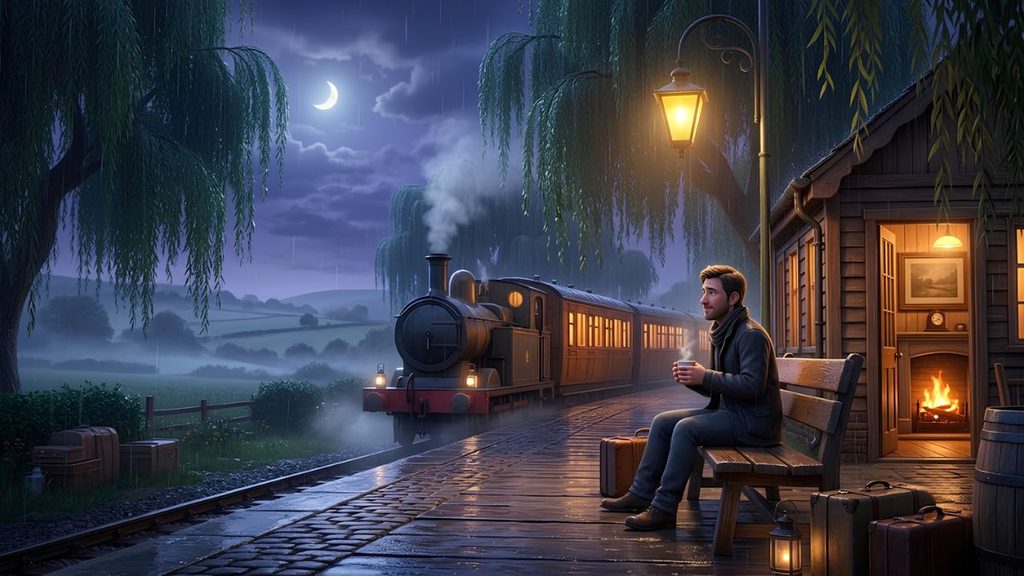
Type: Quiet Travel, New Beginnings & Reflection
Genre: Relaxing Bedtime Fiction, Magical Realism
Lucas had always believed that trains were supposed to take you somewhere.
That was their purpose.
You boarded at one station and left at another.
There was always a destination printed on the ticket, a platform displayed on a sign, a time written on a timetable.
Everything had a place.
Everything had a time.
Perhaps that was why Lucas liked trains.
They made life seem simpler.
You didn’t have to decide where you were going once you were on board.
You simply watched the landscape move.
For the past several months, however, Lucas had felt as though his own life had lost its timetable.
His job had become exhausting.
His apartment felt temporary.
Friends had moved away.
Plans he had once been certain about no longer seemed important.
He wasn’t unhappy exactly.
He was simply tired of making decisions.
So one evening, after a particularly long day, Lucas walked to the railway station without checking where the trains were going.
He bought the first ticket available.
The destination printed on it was unfamiliar.
He boarded.
And somewhere beyond the last familiar suburb, the train stopped at a station that did not appear on any map.
The sign read:
WILLOW STATION
The train had been almost empty when Lucas boarded.
Now there were only six passengers.
An elderly man slept near the front.
A woman with a knitted scarf looked through a small suitcase.
A young couple whispered together.
A boy sat by the window, drawing in a notebook.
And Lucas.
Outside, darkness had settled over the countryside.
The train moved slowly through fields covered in silver moonlight.
Lucas watched his reflection in the glass.
He looked tired.
Not physically.
Something deeper.
The train began slowing.
Lucas glanced at the digital display.
There was no announcement.
No station name.
Just a gentle reduction in speed.
Then the train stopped.
Lucas looked outside.
A small wooden platform stood beneath several enormous willow trees.
One yellow lamp illuminated the station.
There was no ticket office.
No crowd.
No advertisements.
Only a wooden bench and an old station sign.
WILLOW STATION
Lucas checked his phone.
No signal.
He looked at the other passengers.
Nobody seemed surprised.
The elderly man opened his eyes.
“First time?”
Lucas turned.
“Here?”
The man nodded.
“Willow Station.”
“Does this station usually exist?”
The man smiled.
“Usually.”
Lucas looked outside again.
“What does that mean?”
“It means you should get off if you need to.”
The train doors opened.
Cold evening air entered the carriage.
The woman with the suitcase stood.
She picked up her bag.
The young couple followed.
The boy closed his notebook.
One by one, they stepped onto the platform.
Lucas remained seated.
The elderly man looked at him.
“You’re welcome to stay.”
“Where does this train go?”
The man smiled.
“Wherever you were going.”
Lucas looked at the dark platform.
Then he stood.
The moment his shoes touched the platform, the train doors closed.
Lucas turned.
“Wait.”
The train began moving.
He watched the last carriage disappear into darkness.
Then silence returned.
He stood beneath the willow trees.
For several seconds, he wondered whether he had made a terrible mistake.
Then he noticed a small building at the end of the platform.
A sign above the door read:
WAITING ROOM
Lucas entered.
Inside was a warm room with wooden benches, a fireplace, and an old kettle.
The other passengers were already there.
The elderly man sat beside the fire.
The woman with the suitcase was making tea.
The young couple had found a deck of cards.
The boy was drawing again.
Lucas looked around.
“What is this place?”
The elderly man smiled.
“A station.”
“I can see that.”
“Then you know everything you need to know.”
Lucas laughed.
It was the first time he’d laughed all day.
The woman with the suitcase handed him a cup.
“Tea?”
“Thank you.”
“You’re welcome.”
Lucas sat beside the window.
Outside, the willows moved gently in the wind.
“How long does the next train take?” he asked.
The woman looked at the clock.
“Sometimes an hour.”
“Sometimes?”
“Sometimes longer.”
“Is there a timetable?”
She shook her head.
Lucas sighed.
Of course there wasn’t.
He had somehow arrived at the one railway station in the world where nobody knew when the trains came.
He looked at the elderly man.
“How do you know when to leave?”
“You don’t.”
Lucas frowned.
“Then how do you know when it’s time?”
The man smiled.
“You know.”
The evening became quieter.
Nobody talked much.
The young couple played cards.
The boy drew a picture of the station.
The woman read a book.
The elderly man watched the fire.
Lucas drank tea.
For the first time in months, he wasn’t checking the time.
He wasn’t looking at emails.
He wasn’t thinking about tomorrow’s meetings.
There was nowhere he had to be.
He found that strangely uncomfortable.
Then he noticed something.
The other people seemed completely at ease.
They weren’t waiting impatiently.
They weren’t asking when the train would arrive.
They weren’t wondering what they were supposed to do next.
They simply existed.
Lucas watched the fire.
A log cracked softly.
Outside, wind moved through the willow branches.
The boy eventually came over.
“Are you going somewhere?”
Lucas looked at him.
“I suppose.”
“Where?”
“I don’t know.”
The boy smiled.
“Me neither.”
Then he returned to his drawing.
Later, Lucas began talking with the woman.
Her name was Nora.
She told him she had been traveling for three days.
“Where are you going?”
“I don’t know yet.”
Lucas smiled.
“Everyone here says that.”
“Perhaps that’s why we’re here.”
She closed her book.
“I was supposed to move to another country.”
“Supposed to?”
“I changed my mind.”
“Why?”
Nora looked through the window.
“I realized I wanted to stay.”
“Where?”
She shrugged.
“Somewhere that feels like home.”
Lucas understood more than he expected.
“Do you have a home?”
“I used to.”
She smiled.
“Maybe that’s different from having a place to live.”
Lucas looked at the fire.
That sentence stayed with him.
Near midnight, the young couple left the waiting room.
They walked toward the far end of the platform.
Lucas watched them disappear beneath the trees.
A few minutes later, the sound of a train approached.
Lights appeared through the darkness.
The couple boarded.
The train stopped only briefly.
Then it continued into the night.
Lucas turned to the elderly man.
“Do they know where they’re going?”
“Probably.”
“How?”
“They’ve decided.”
Lucas smiled.
“And if they change their minds?”
“They can get off somewhere else.”
The simplicity of it surprised him.
Perhaps life wasn’t a single journey.
Perhaps it was a collection of stations.
You could leave.
You could stay.
You could change trains.
You could even wait.
There was no shame in any of it.
At two in the morning, Lucas stepped outside.
The station was quiet.
The moon hung above the trees.
The willows moved like dark curtains.
He walked along the platform.
At the far end, he found an old wooden bench.
Someone had carved words into it.
YOU ARE NOT LATE.
Lucas sat down.
He read the words again.
You are not late.
He thought about all the times he had felt behind.
Behind his friends.
Behind his career.
Behind his plans.
Behind the person he thought he was supposed to become.
He had spent years believing there was an invisible timetable.
By a certain age, he should have achieved certain things.
By another age, he should have known who he was.
He had measured himself against imaginary deadlines.
And perhaps that was what exhausted him most.
Not life.
The constant feeling that he was failing to keep up with it.
He touched the carved words.
You are not late.
For the first time, he believed them.
At dawn, the station changed.
The darkness softened.
The sky became pale blue.
Birds appeared in the willow branches.
The waiting room smelled of fresh bread.
Lucas returned inside.
The elderly man was preparing breakfast.
“You’ve been awake all night.”
“I think so.”
“Good.”
“Good?”
“You had something to think about.”
Lucas smiled.
The man placed bread on the table.
“What’s your name?”
“Lucas.”
The elderly man nodded.
“I’m Thomas.”
“How long have you been coming here?”
Thomas thought about it.
“Long enough.”
“Where are you going?”
Thomas smiled.
“Home.”
“Where is home?”
“That’s what I’m figuring out.”
Lucas laughed.
Thomas looked at him.
“Don’t worry.”
“About what?”
“Everyone is figuring it out.”
The morning train arrived at 7:15.
This time, Lucas knew he was ready.
He stood on the platform with the others.
The woman with the suitcase hugged him goodbye.
“Do you know where you’re going now?”
Lucas thought about it.
“No.”
She smiled.
“Good.”
The train doors opened.
Lucas stepped inside.
Thomas remained on the platform.
“Aren’t you coming?”
“Not yet.”
“When will you?”
Thomas smiled.
“When I’m ready.”
The doors closed.
The train moved.
Lucas watched Willow Station disappear behind him.
He expected to feel anxious.
Instead, he felt peaceful.
The train traveled through fields.
Sunlight moved across the windows.
Lucas sat beside the glass.
He didn’t know what station would come next.
And for once, he didn’t need to know.
He thought about his apartment.
His job.
His unanswered messages.
His plans.
He realized that none of them had disappeared.
But they no longer felt like things chasing him.
They were simply things waiting for him.
There was a difference.
When he arrived at the next large station, Lucas stepped off.
He bought coffee.
He called his manager.
“I need to take some time off.”
There was a pause.
“Is everything okay?”
Lucas looked through the station window.
“Yes.”
And surprisingly, it was true.
Over the next few weeks, Lucas changed small things.
He stopped checking emails before breakfast.
He began walking home from work.
He called old friends.
He cooked dinner instead of ordering food every night.
He took trains without always checking the destination.
Sometimes he went somewhere simply because he liked the sound of the name.
He never found Willow Station again.
He searched for it online.
Nothing.
He looked through railway maps.
Nothing.
He asked conductors.
Nobody knew it.
Eventually, Lucas stopped searching.
Perhaps Willow Station wasn’t a place that could be found.
Perhaps it appeared only when someone needed to stop.
Months later, Lucas was traveling through the countryside.
It was evening.
Rain tapped against the train window.
He looked outside.
A familiar shape appeared beyond the fields.
Willow trees.
A small wooden platform.
One yellow lamp.
Lucas’s heart lifted.
The train slowed.
He smiled.
The sign appeared.
WILLOW STATION
The doors opened.
Lucas stepped onto the platform.
Thomas was sitting on the bench.
He looked older.
But he smiled.
“I wondered when you’d come back.”
Lucas laughed.
“I didn’t know I was coming.”
“Most people don’t.”
They walked toward the waiting room.
Inside, the fire was burning.
A new group of passengers sat quietly.
A young woman looked frightened.
A man stared at his phone.
An older couple held hands.
A child watched the rain.
Lucas recognized the expressions.
He had worn them himself.
Thomas poured two cups of tea.
“Sit.”
Lucas sat.
The young woman looked at him.
“Do you know when the train leaves?”
Lucas smiled.
“No.”
She looked worried.
“How will I know?”
He thought about the old bench.
Then he said:
“You’ll know.”
The rain continued outside.
The fire burned softly.
The clocks remained still.
Nobody hurried.
Lucas sat beside the window with his tea.
He watched the willow branches move in the rain.
He realized that perhaps the station had never been about trains.
It was about permission.
Permission to stop.
Permission to change your mind.
Permission to admit that you didn’t know.
Permission to wait.
Permission to begin again.
And perhaps most importantly, permission to understand that life was not a race against time.
There was no universal timetable.
No single correct destination.
No deadline for becoming the person you wanted to be.
Sometimes you simply had to sit beside a window, listen to the rain, drink something warm, and allow yourself to breathe.
Eventually, the next train would come.
And when it did, you could decide whether to board.
Or stay a little longer.
Either choice was all right.
Outside, the rain softened.
The willow branches swayed gently.
Lucas closed his eyes.
For the first time in a long while, he wasn’t waiting for anything.
He was simply there.
And that was enough.
The Houseboat Beneath the Willow Trees
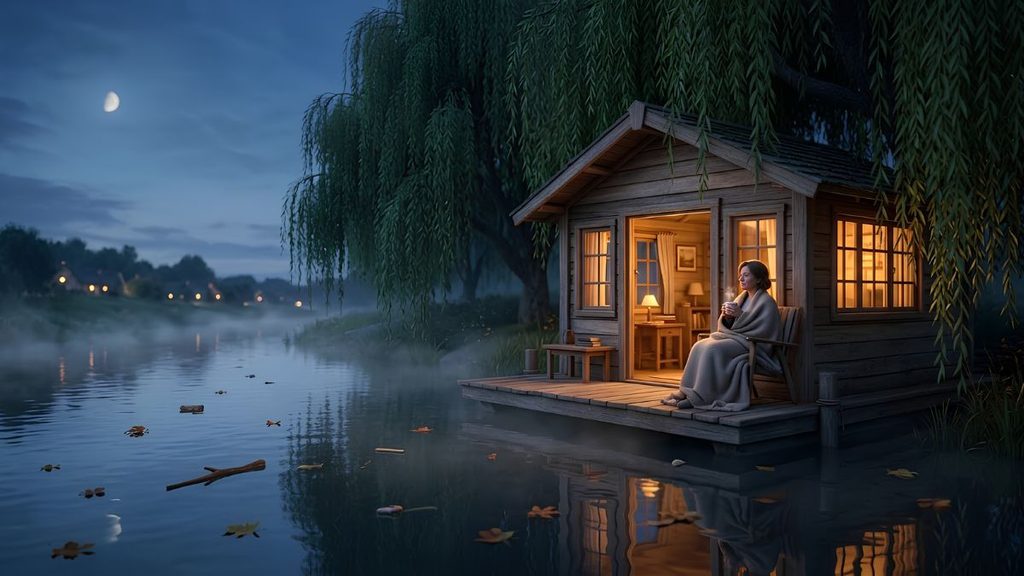
Type: Nature, Solitude & Inner Peace
Genre: Relaxing Bedtime Fiction
Tone: Gentle, atmospheric, reflective, comforting
Amelia had forgotten what silence sounded like.
Not complete silence.
She had never really known that.
Even in the quietest places, there were sounds.
Wind.
Birds.
Water.
Leaves.
The occasional footsteps of someone passing by.
What she had forgotten was the kind of silence in which nobody expected anything from her.
For years, Amelia had lived in a city apartment on the ninth floor of a tall building.
Every morning began with alarms.
Every afternoon brought messages.
Every evening carried traffic noise through the windows.
Her calendar was always full.
Meetings.
Appointments.
Deadlines.
Dinners.
Errands.
Plans.
There were weeks when Amelia felt as though she was moving constantly without actually going anywhere.
Then, one Friday evening, after another exhausting week, she made a decision.
She would leave.
Not permanently.
Not dramatically.
Just for a while.
She searched for a quiet place outside the city.
She found a small houseboat for rent on a river several hours away.
The description was remarkably simple.
One bedroom. Small kitchen. Wood-burning stove. Moored beneath willow trees.
There was no television.
No high-speed internet.
No nearby shopping center.
The nearest village was a twenty-minute walk.
Amelia booked it for two weeks.
She packed a small suitcase.
And on Monday morning, she left the city behind.
The river was quieter than she expected.
It moved slowly between grassy banks, reflecting the pale afternoon sky.
The houseboat was smaller than the photographs had suggested.
Its wooden walls were weathered.
The roof was low.
A narrow deck extended over the water.
Several enormous willow trees grew along the riverbank, their long branches hanging almost to the surface.
Amelia stepped aboard.
The boat moved gently beneath her feet.
She smiled.
For the first time in a long time, she didn’t have anywhere to be.
She unpacked.
There was a small bedroom at the back.
A sitting room with two chairs.
A little kitchen.
A wooden table beneath a window.
On the table was a handwritten note.
Welcome.
Beneath it:
The river will provide everything you need to hear.
Amelia smiled.
She didn’t understand the second sentence.
But she liked it.
That evening, Amelia sat on the deck.
The sun slowly disappeared behind the trees.
Willow branches brushed against the roof with a soft, repetitive sound.
The river moved beneath the boat.
A bird called somewhere in the distance.
Then another answered.
Amelia made tea.
She didn’t check her phone.
At first, this felt almost impossible.
Her hand kept reaching toward her pocket.
Eventually, she laughed at herself.
She had come here to escape her schedule.
She didn’t need to bring the schedule with her.
So she placed the phone inside her suitcase.
Then she listened.
Water.
Wind.
Leaves.
Nothing more.
She slept deeply that night.
The next morning, Amelia woke when sunlight entered through the curtains.
She looked at the clock.
8:47.
She hadn’t set an alarm.
The realization felt strange.
She stayed in bed for another ten minutes.
There was no reason not to.
Eventually, she made toast and tea.
She ate breakfast slowly.
Then she walked into the village.
The path followed the river.
Along the way, she noticed something unusual.
A small wooden spoon floated past.
Amelia stopped.
It moved slowly with the current.
She watched it disappear beneath the willow branches.
A few minutes later, she found a red scarf tangled against the riverbank.
She picked it up.
It was wet and muddy.
Someone had clearly lost it.
She carried it into the village.
At a small bakery, she asked whether anyone had reported losing a scarf.
The woman behind the counter shook her head.
“Not yet.”
Amelia held it up.
“It’s red.”
The woman laughed.
“That narrows it down considerably.”
Amelia smiled.
“Is there somewhere I can leave it?”
“Put it here.”
The woman placed it beside the register.
“Someone will recognize it.”
The woman introduced herself as Rose.
She owned the bakery with her husband.
When Amelia mentioned the houseboat, Rose’s expression brightened.
“You’re staying on the river?”
“For two weeks.”
“Then you’ll probably meet half the village.”
“Why?”
Rose laughed.
“Because the river carries everyone’s things eventually.”
Amelia remembered the spoon.
“Does it really?”
“Everything.”
“What kind of things?”
Rose began counting on her fingers.
“Children’s toys. Hats. Gardening gloves. Letters.”
“Letters?”
“Sometimes.”
“How?”
“People drop things.”
Rose smiled.
“Or they throw them in.”
Amelia wondered why anyone would throw a letter into the river.
Rose seemed to notice her expression.
“Don’t worry. The river keeps secrets.”
That afternoon, Amelia returned to the houseboat.
She sat beside the window.
The river moved slowly.
She began noticing how much passed through the water.
Leaves.
Twigs.
Small pieces of bark.
Once, a yellow plastic duck.
She laughed when she saw it.
Then something larger appeared.
A wooden box.
It floated toward her.
Amelia stepped onto the deck.
The box bumped softly against the side of the boat.
She reached down and pulled it aboard.
It was old.
The lid was tied with string.
She hesitated.
Opening something that didn’t belong to her felt wrong.
Instead, she walked to the village.
At the general store, she asked whether anyone knew who might own it.
The shopkeeper looked at the box.
“That belongs to Mr. Ellis.”
“Who is Mr. Ellis?”
“Retired postman.”
“Where does he live?”
The shopkeeper pointed toward the hill.
“Blue house.”
Mr. Ellis was an elderly man with white hair and a garden full of roses.
When Amelia showed him the box, he smiled.
“I thought I’d lost that.”
“What was inside?”
He opened the lid.
Old gardening tools.
A small notebook.
Three packets of seeds.
“Nothing valuable,” he said.
“But important?”
Mr. Ellis looked at the seeds.
“Yes.”
He explained that he had been collecting them for years.
Some came from his wife.
Some from friends.
Some from gardens that no longer existed.
He planned to plant them in spring.
Amelia smiled.
“I hope you find a good place for them.”
Mr. Ellis nodded.
“So do I.”
Before she left, he gave her a small packet.
“Take these.”
“What are they?”
“Wildflowers.”
“I don’t have a garden.”
He smiled.
“Plant them somewhere.”
Amelia carried the seeds back to the houseboat.
She didn’t know where to plant them.
There was a patch of soil beside the riverbank near the boat.
She knelt there.
Made a small hole.
Dropped in the seeds.
Covered them.
Then watered the earth.
She looked at the tiny patch.
Nothing happened.
Of course.
Seeds took time.
She smiled.
She had forgotten that.
Everything in her life had been designed for immediate results.
Emails were answered immediately.
Messages arrived instantly.
Food appeared within minutes.
Information was available with a search.
But seeds didn’t care about speed.
Neither did rivers.
Neither did trees.
Neither did sunsets.
Perhaps she needed to remember that.
Over the next few days, Amelia began finding more objects.
A child’s wooden boat.
A silver button.
A blue mitten.
A postcard.
A glass marble.
A kitchen towel.
She started taking them into the village.
Each object seemed to belong to someone.
The wooden boat belonged to a boy named Oliver.
The mitten belonged to an old woman named June.
The postcard belonged to a man who had never actually sent it.
The marble belonged to two sisters who had been looking for it since spring.
The kitchen towel belonged to Rose.
“How did that get into the river?” Amelia asked.
Rose laughed.
“I don’t want to know.”
The village began recognizing Amelia.
She became known as the woman on the houseboat.
People waved when she walked through town.
The baker saved her a loaf of bread.
Mr. Ellis checked on the wildflower seeds.
Oliver brought her a drawing of the river.
June invited her for tea.
Without planning it, Amelia had become part of the village.
One evening, Amelia sat on the deck as rain began falling.
The drops created circles on the river.
The willow branches moved in the wind.
She wrapped herself in a blanket.
A small paper boat appeared downstream.
She watched it approach.
It carried something inside.
She reached down and pulled it from the water.
A photograph.
An old one.
A young woman stood beside the river.
On the back was written:
For when you forget where you came from.
Amelia stared at it.
She wondered who had written the words.
The photograph was too old to belong to anyone she knew.
The next morning, she showed it to Rose.
Rose became quiet.
“I know her.”
“Who is she?”
“My mother.”
Amelia stared at the photograph.
“Your mother?”
Rose nodded.
“She used to live by the river.”
“How did the photograph get here?”
Rose touched it gently.
“I don’t know.”
She smiled.
“Perhaps the river decided it was time.”
Rose told Amelia that her mother had died many years earlier.
The photograph had been taken before Rose was born.
“I never had one like this,” Rose said.
“Do you want to keep it?”
Rose smiled.
“Yes.”
She looked toward the river.
“My mother always said the river carried things where they needed to go.”
Amelia thought about that.
“Maybe she was right.”
The days passed quietly.
Amelia stopped wearing a watch.
She stopped planning her mornings.
Sometimes she woke early.
Sometimes she slept late.
Sometimes she read.
Sometimes she walked.
Sometimes she did absolutely nothing.
At first, doing nothing felt wasteful.
Then it began to feel wonderful.
She watched clouds.
She cooked soup.
She listened to rain.
She wrote in a notebook.
She planted more seeds.
She talked to people.
She sat alone.
The two things no longer seemed opposite.
She could be alone without feeling lonely.
She could be around people without feeling obligated to perform.
On her final evening, Amelia sat beside the river.
The wildflowers had begun appearing.
Tiny yellow flowers.
White ones.
Purple ones.
They moved gently in the evening breeze.
Mr. Ellis had been right.
They needed time.
The village had become familiar.
Rose brought her bread.
Oliver brought another drawing.
June gave her a knitted scarf.
Mr. Ellis brought seeds.
“Take these with you,” he said.
“I don’t have a garden.”
“Yet.”
Amelia smiled.
She understood.
That night, she packed her suitcase.
The houseboat was quiet.
The river moved beneath her.
Willow branches brushed softly against the roof.
She looked around the little room.
She had arrived exhausted.
Now she felt different.
Not completely changed.
Life would still be waiting in the city.
Emails.
Meetings.
Responsibilities.
Noise.
But something inside her had become quieter.
She had remembered something important.
A life didn’t have to be full to be meaningful.
A day didn’t have to be productive to be worthwhile.
Rest wasn’t something you earned after finishing everything.
Rest was part of being alive.
Before leaving, Amelia stepped onto the deck.
The moon reflected on the river.
She listened to the water.
Then she heard something against the side of the boat.
Tap.
Tap.
Tap.
She looked down.
A small glass bottle floated beside the houseboat.
Inside was a folded piece of paper.
Amelia pulled it out.
She opened the paper.
There were only five words.
Don’t hurry. The river knows.
She smiled.
She didn’t know who had written it.
She didn’t need to.
She folded the note and placed it in her suitcase.
The next morning, Amelia returned to the city.
The streets were noisy.
Cars moved quickly.
People hurried toward offices.
Her phone filled with notifications.
For a moment, the old feeling returned.
The urge to answer everything.
Fix everything.
Schedule everything.
Then Amelia remembered the river.
She stopped walking.
She took a breath.
And continued at her own pace.
She still worked.
She still answered messages.
She still had responsibilities.
But she began leaving empty spaces in her days.
Spaces where nothing had to happen.
She bought a small pot for her balcony.
She planted the wildflower seeds Mr. Ellis had given her.
Weeks passed.
Tiny green shoots appeared.
Then flowers.
They weren’t spectacular.
They were small.
Simple.
Beautiful.
Amelia sat beside them one evening with a cup of tea.
She watched the city lights.
And imagined willow branches moving above quiet water.
Years later, whenever life became too loud, Amelia returned to the river.
The houseboat was still there.
The willow trees had grown larger.
Rose’s bakery had a new sign.
Oliver was no longer a child.
Mr. Ellis’s garden had become famous in the village.
And the river continued carrying things downstream.
A hat.
A leaf.
A wooden toy.
A letter.
A flower.
A memory.
Amelia would sit on the deck and watch.
She no longer wondered where everything was going.
She had learned not to ask.
Some things arrived.
Some things passed.
Some things stayed for a while.
And some things disappeared around the bend.
That was the nature of rivers.
Perhaps it was the nature of life too.
You didn’t have to hold everything.
You didn’t have to follow everything.
You didn’t have to know where everything was going.
Sometimes you could simply sit beneath the willow trees.
Listen to the water.
Take a slow breath.
And let the current carry away whatever you were finally ready to release.
The river would keep moving.
The trees would keep swaying.
The evening would become night.
And tomorrow would arrive when it was ready.
There was no need to hurry.
There never had been.
3. The Clockmaker Who Made Time Slower
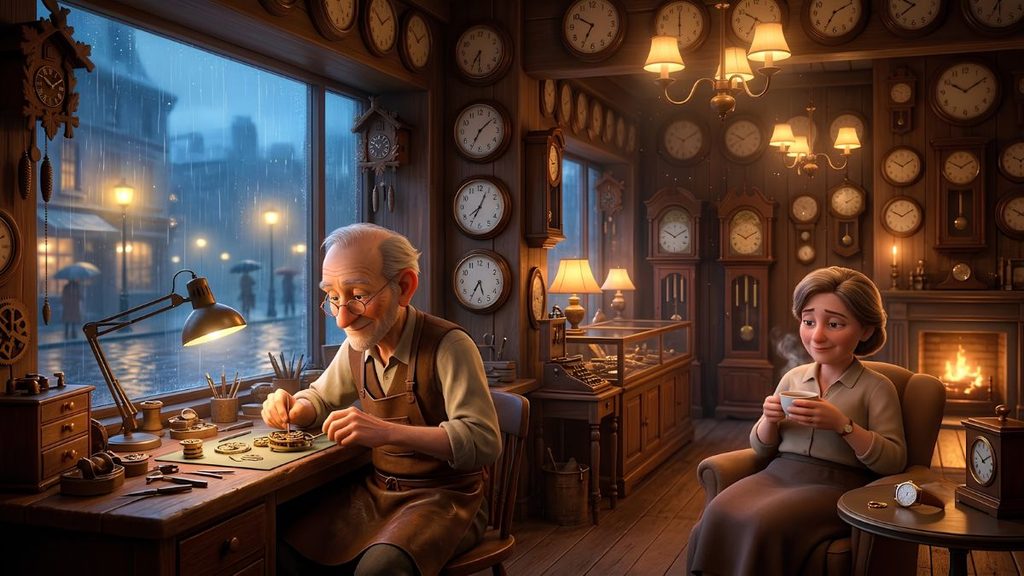
Type: Magical Realism, Time & Everyday Life
Genre: Relaxing Bedtime Fiction
Tone: Gentle, whimsical, reflective, comforting
Sophie measured her life in minutes.
Seven minutes for breakfast.
Twelve minutes to walk to the station.
Twenty-three minutes on the train.
Eight minutes from the station to work.
Forty-five minutes for lunch, although she usually finished eating in fifteen.
She knew exactly how long it took her to shower, dress, make coffee, answer messages, and reach the office.
She even knew how long she could sleep after pressing the snooze button before being officially late.
Seven minutes.
Not eight.
Never eight.
Sophie had become very good at saving time.
She was less good at enjoying it.
Her phone contained reminders for almost everything.
Drink water.
Call Mum.
Submit report.
Buy groceries.
Book dentist.
Reply to Daniel.
Renew insurance.
Stretch.
Sleep.
The last reminder always made her laugh.
Sleep.
As though sleep were another appointment she could schedule.
Lately, she had begun waking in the middle of the night with the uncomfortable feeling that she had forgotten something.
Sometimes she had.
Sometimes she hadn’t.
Either way, she would lie awake thinking about tomorrow.
One Thursday evening, she left the office at 8:14 p.m.
She was exhausted.
Rain had begun falling.
The train was delayed.
Her phone battery was at nine percent.
She stood beneath a streetlamp and looked at the unfamiliar side street beside the station.
She had walked past it hundreds of times.
She had never noticed the shop before.
A narrow wooden sign hung above a dark green door.
ARTHUR BELL
CLOCKMAKER
Sophie looked at her phone.
8:17.
The shop would probably be closed.
But the light inside was on.
She pushed open the door.
A small bell rang.
The shop smelled of wood, brass, and old paper.
Clocks covered almost every wall.
Tall clocks.
Round clocks.
Pocket watches.
Travel clocks.
Small clocks with painted birds.
Large clocks with swinging pendulums.
There must have been hundreds.
Sophie stood near the entrance.
“Are you still open?”
A voice came from behind a wooden counter.
“Apparently.”
An elderly man appeared.
He wore a brown vest over a white shirt and small round glasses.
His gray hair was untidy.
He looked at Sophie.
Then at her wrist.
Then at the clock above the door.
“You are late.”
Sophie frowned.
“Late for what?”
Arthur smiled.
“Nothing.”
She laughed despite herself.
“I need a watch.”
“Most people do.”
“Mine stopped.”
She held out her wrist.
The watch face was cracked.
The hands pointed to 6:43.
“I need it repaired.”
Arthur took the watch.
He examined it carefully.
“How long has it been stopped?”
“About twenty minutes.”
“Does that bother you?”
“Yes.”
“Why?”
“Because I need to know the time.”
Arthur looked at her.
“Do you?”
Sophie sighed.
“Yes.”
He smiled.
“Sit down.”
Sophie sat at a small table.
Arthur carried her watch to his workbench.
He opened the back.
Then closed it again.
He didn’t repair anything.
“What’s wrong with it?”
“Nothing.”
“The watch is broken.”
“Yes.”
“So something is wrong.”
Arthur shook his head.
“Your watch stopped because it was tired.”
Sophie stared at him.
“That’s not how watches work.”
“Perhaps.”
He placed it on the counter.
“Would you like tea?”
“I don’t have time.”
Arthur smiled.
“That’s exactly why you need tea.”
He poured two cups.
Sophie accepted hers.
She looked around the shop.
The clocks were all showing different times.
6:43.
9:12.
2:28.
11:07.
4:51.
None matched.
“Your clocks are wrong.”
Arthur looked around.
“They’re fine.”
“They all show different times.”
“Yes.”
“That’s not fine.”
“Why not?”
“Because clocks are supposed to tell time.”
Arthur smiled.
“They tell time.”
“Different times.”
“Exactly.”
Sophie took a sip of tea.
It was cinnamon.
Warm.
Comforting.
She looked at the clocks again.
“How can you work here?”
Arthur shrugged.
“I don’t ask the clocks to agree.”
For some reason, Sophie stayed.
She wasn’t sure why.
Perhaps because the rain was getting heavier.
Perhaps because the tea was warm.
Perhaps because she was too tired to go home.
Or perhaps because Arthur seemed completely uninterested in the question that occupied her mind every day:
What time is it?
He never looked at his watch.
He never hurried.
He moved through the shop slowly, adjusting tiny screws and cleaning gears.
Sophie watched him work.
“What do you do all day?”
“Repair clocks.”
“That’s it?”
“Sometimes I drink tea.”
She smiled.
“And?”
“Sometimes I listen.”
“To what?”
“The clocks.”
Sophie laughed.
“Clocks don’t talk.”
Arthur looked at her.
“You’re not listening properly.”
He led her toward the back of the shop.
There was a large grandfather clock there.
Its pendulum moved slowly.
Tick.
Pause.
Tick.
Pause.
“Listen.”
Sophie stood quietly.
At first, she heard nothing except the clock.
Then she noticed something else.
Rain against the window.
A kettle cooling on the stove.
Wind moving beneath the door.
The faint sound of traffic outside.
Arthur said:
“People think time is what clocks measure.”
“What is it then?”
“Clocks measure movement.”
He touched the wooden case.
“Time is what happens while you’re alive.”
Sophie didn’t answer.
She thought about that.
Arthur showed her another room.
It contained dozens of small clocks.
Some were running.
Some were stopped.
Some moved backward.
One had no hands at all.
“Why keep broken clocks?”
Arthur smiled.
“Because broken doesn’t mean useless.”
He picked up a small silver watch.
“This belonged to a man who worked every day for forty years.”
“What happened?”
“He retired.”
“And the watch stopped?”
“Eventually.”
“Why?”
“He stopped wearing it.”
Sophie smiled.
“That’s normal.”
“Yes.”
Arthur placed it back.
“Sometimes people think stopping means something is wrong.”
He looked at her.
“Sometimes stopping is the whole point.”
Sophie looked down at her own watch.
6:43.
It still hadn’t moved.
She should have been frustrated.
Instead, she felt oddly calm.
Arthur walked toward a shelf.
“Come here.”
She followed.
He showed her a small wooden clock.
It had no numbers.
Only twelve small painted doors.
“What does it do?”
“Nothing.”
Sophie laughed.
“Then why make it?”
“Because not everything has to do something.”
She looked at him.
“That’s difficult to understand.”
“Yes.”
“Especially when you’re used to being busy.”
Arthur nodded.
“Busy people often find stillness suspicious.”
The rain continued.
Sophie sat beside the window.
Arthur brought her another cup of tea.
She didn’t ask what time it was.
She noticed this only after several minutes.
The realization surprised her.
She looked outside.
The street was almost empty.
Cars passed occasionally.
Their headlights moved across wet pavement.
Inside the shop, the clocks continued their different rhythms.
Tick.
Tick.
Tick.
Some fast.
Some slow.
Some barely moving.
It was strangely beautiful.
Sophie suddenly remembered something.
When she was a child, her grandmother had owned an old kitchen clock.
It had always been five minutes slow.
Her grandmother refused to fix it.
When Sophie asked why, her grandmother had said:
“It gives me five extra minutes.”
At the time, Sophie had thought that was funny.
Now she understood.
Perhaps those five minutes had been the most valuable minutes in the house.
“Do you ever hurry?” Sophie asked Arthur.
“Sometimes.”
“When?”
“When I cross the street.”
She laughed.
“What about work?”
“I enjoy my work.”
“Deadlines?”
“I don’t have many.”
“Appointments?”
“Very few.”
“How do you manage?”
Arthur looked at her.
“I don’t manage time.”
“Then what do you manage?”
“My attention.”
Sophie was quiet.
Arthur continued.
“If you’re drinking tea, drink tea.”
He pointed toward her cup.
“If you’re listening, listen.”
He pointed toward the rain.
“If you’re walking, walk.”
He pointed toward the door.
“The trouble begins when we are always somewhere other than where we are.”
The sentence stayed with Sophie.
She thought about her days.
Breakfast while checking emails.
Walking while listening to podcasts.
Lunch while reading messages.
Watching television while scrolling.
Talking while thinking about what she would say next.
Even resting had become something she tried to optimize.
Maybe she wasn’t short of time.
Maybe she was short of attention.
Arthur took her broken watch from the counter.
“Do you want me to fix it?”
“Yes.”
He placed it on the workbench.
Then he stopped.
“Tomorrow.”
Sophie frowned.
“Why tomorrow?”
“Because tonight you don’t need it.”
She looked toward the clocks.
“What am I supposed to do?”
Arthur smiled.
“Nothing.”
“Nothing?”
“Exactly.”
So Sophie stayed.
She drank tea.
She listened to rain.
Arthur worked quietly.
At some point, he played an old record.
Soft piano filled the shop.
Sophie walked among the clocks.
She read handwritten notes attached to several of them.
Stopped on the day we met.
Five minutes slow for forty years.
Given to me by my father.
Still works after all these years.
One clock had a note that simply said:
I like listening to it at night.
Sophie smiled.
She understood.
The clocks weren’t really there to measure time.
They were there to remind people to notice it.
Around midnight, Arthur turned off the main lights.
Only small lamps remained.
The clocks glowed softly in the darkness.
Sophie sat beside the window.
The rain had stopped.
The street was quiet.
Arthur handed her watch back.
The crack was still there.
But the hands were moving.
Slowly.
6:44.
Then 6:45.
Sophie stared.
“What did you do?”
“Nothing.”
“But it’s working.”
Arthur smiled.
“It was waiting.”
“For what?”
“For you to stop asking it to hurry.”
Sophie laughed.
“You really believe that?”
Arthur nodded.
“Sometimes objects know us better than we think.”
Sophie stood.
“I should go.”
Arthur nodded.
“Yes.”
She reached for her phone.
The battery had died.
She looked at the black screen.
For a moment, she felt panic.
Then she put it back in her bag.
Outside, the air smelled fresh after rain.
She walked home slowly.
She noticed things she usually missed.
A cat sitting beneath an awning.
Light in an upstairs window.
Water dripping from tree leaves.
A bakery preparing bread for morning.
The quiet sound of her own footsteps.
She had walked this route hundreds of times.
She had never really seen it.
The next morning, Sophie woke before her alarm.
She didn’t reach for her phone.
She opened the curtains.
Sunlight filled the room.
She made breakfast.
Then she sat at the table.
No email.
No television.
No scrolling.
Just breakfast.
It took twenty minutes.
She realized she had never eaten breakfast that slowly.
She smiled.
Nothing important had been lost.
In fact, something had been found.
Weeks passed.
Sophie still worked.
She still had meetings.
She still had deadlines.
She still checked the time.
But something had changed.
She stopped trying to fill every empty moment.
She left home five minutes early.
Not so she could do something else.
Just so she didn’t have to hurry.
She ate lunch without her phone.
She walked without constantly checking messages.
Sometimes, on the train, she watched the landscape.
She began leaving evenings unplanned.
At first, this felt strange.
Then it became something she looked forward to.
One Thursday, she returned to Arthur’s shop.
The green door was open.
The bell rang.
Arthur looked up.
“You’re early.”
Sophie smiled.
“Am I?”
“No.”
He laughed.
She sat at the counter.
“Tea?”
“Please.”
Arthur poured it.
The clocks were still showing different times.
Sophie no longer minded.
She listened.
Tick.
Tick.
Tick.
Rain began tapping against the window.
Sophie smiled.
“What happens if someone asks you what time it is?”
Arthur thought.
“I tell them.”
“And if they ask which clock is correct?”
“I tell them all of them.”
“That doesn’t make sense.”
“It doesn’t have to.”
He handed her the tea.
Sophie looked around the shop.
“I think I understand.”
Arthur raised an eyebrow.
“Tell me.”
She looked at the clocks.
“Time isn’t only something we’re trying to get through.”
Arthur smiled.
“What else?”
She took a slow sip.
“It’s something we’re actually living.”
Arthur nodded.
“Better.”
Years later, Sophie would still remember that little shop.
Sometimes she wondered whether Arthur had really existed.
She never found the shop online.
When she returned to the street one afternoon, the building was gone.
A small bookstore stood in its place.
There was no sign of a clockmaker.
No green door.
No brass bell.
No windows filled with clocks.
She asked a nearby shopkeeper.
“Was there ever a clockmaker here?”
The man thought for a moment.
“Not that I remember.”
Sophie smiled.
She wasn’t disappointed.
She already knew.
Some places aren’t meant to be found twice.
At home that evening, Sophie placed her watch on the bedside table.
She looked at it.
The hands moved steadily.
Tick.
Tick.
Tick.
She turned off the lamp.
Outside, the city continued.
Cars moved.
Trains ran.
People hurried.
Clocks measured.
Phones rang.
Tomorrow waited.
But Sophie didn’t need to think about tomorrow yet.
She closed her eyes.
She listened to the quiet.
For once, she wasn’t calculating how many hours remained before morning.
She wasn’t wondering whether she had done enough.
She wasn’t trying to save another minute.
She simply lay there.
Breathing.
Resting.
Existing.
And somewhere in the back of her mind, she could almost hear Arthur’s voice.
If you’re drinking tea, drink tea.
If you’re listening, listen.
If you’re walking, walk.
And if you’re resting, rest.
The clock beside her bed continued ticking.
It didn’t ask her to hurry.
It simply kept moving.
And for tonight, that was enough.
4. The Inn at the End of the Quiet Road
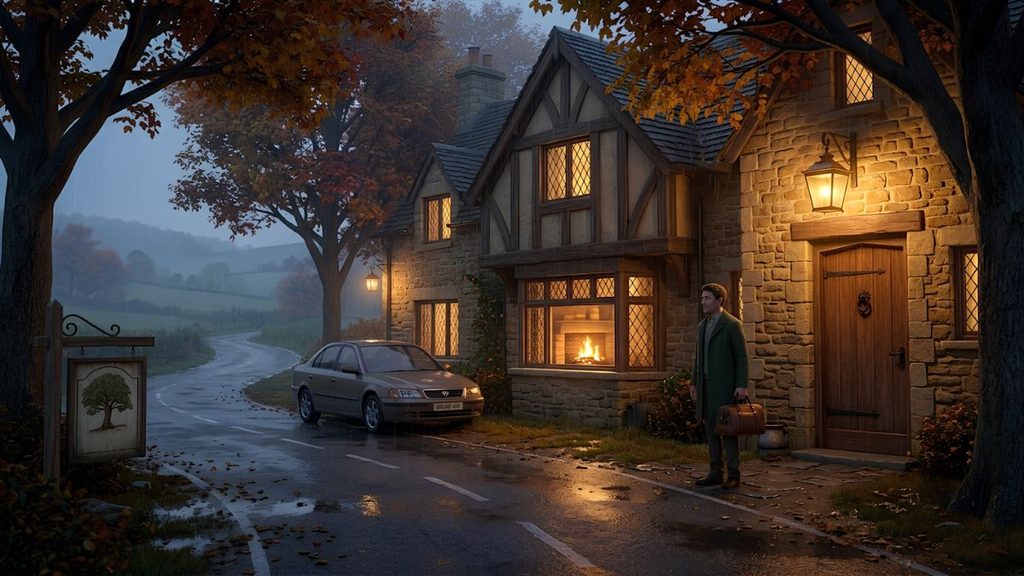
Type: Cozy Fiction, Rest & Human Connection
Genre: Relaxing Bedtime Fiction
Tone: Warm, peaceful, reflective, comforting
Daniel had not planned to get lost.
That was important to him.
He liked plans.
He liked knowing where he was going, how long the journey would take, where he would stop for fuel, and approximately what time he would arrive.
His phone usually guided him.
His calendar guided him.
His work schedule guided him.
Even his weekends had begun to feel as though they required instructions.
But on a cold Friday evening in late autumn, none of those things were helping.
Daniel had left the city just after four.
He had intended to spend the weekend in a small village two hours away.
The plan was simple.
Drive there.
Check into a hotel.
Take a walk.
Have dinner.
Return home Sunday afternoon.
Instead, the rain had started.
Then the main road had closed because of construction.
His navigation app suggested a different route.
Then another.
Then, after losing its signal among the hills, it simply stopped.
Daniel continued driving.
The road became narrower.
The streetlights disappeared.
Houses became fewer.
Soon there were only trees, fields, and darkness.
He looked at the dashboard clock.
8:36 p.m.
He sighed.
“Perfect.”
The car continued along the winding road.
Then he saw a sign.
A wooden sign beside the road.
It pointed toward a narrow lane.
THE WREN INN
Daniel slowed.
He had never heard of it.
There was no hotel on his map.
But the rain was getting heavier.
He turned.
The lane ended at a small stone building surrounded by trees.
Warm yellow light glowed through the windows.
Smoke rose from a chimney.
A lantern hung above the entrance.
Daniel parked.
For a moment, he simply sat in the car.
He wasn’t sure whether the place was open.
Then the front door opened.
An elderly woman stood beneath the lantern.
She wore a knitted cardigan and held an umbrella.
“You’re welcome to come inside,” she said.
Daniel stepped out.
“Is this an inn?”
She smiled.
“Usually.”
Daniel laughed.
“Usually?”
“Come in before you get soaked.”
The inside was warmer than Daniel expected.
There was a fireplace in the main room.
Several comfortable chairs surrounded it.
A wooden staircase led upstairs.
The walls were covered with old photographs.
A grandfather clock stood near the reception desk.
The woman placed a towel on the counter.
“Dry your coat.”
“Thank you.”
“I’m Margaret.”
“Daniel.”
She handed him a cup of tea.
“Do you have a reservation?”
“No.”
“Good.”
Daniel looked confused.
Margaret smiled.
“We have room.”
She opened an old ledger.
“One night?”
“Yes.”
“That will be fine.”
She wrote his name down.
Then she looked at him.
“There is only one rule.”
Daniel waited.
“You don’t have to explain why you need to stay.”
He smiled politely.
“That’s an unusual rule.”
Margaret closed the ledger.
“People usually have reasons.”
She picked up a key.
“They don’t always need to share them.”
Daniel followed her upstairs.
The room was simple.
A bed.
A wooden wardrobe.
A reading chair.
A small lamp.
A window overlooking the dark garden.
There was a folded blanket at the foot of the bed.
“Breakfast begins at seven,” Margaret said.
“What time does it end?”
“When everyone has finished.”
Daniel smiled.
“Okay.”
Margaret turned toward the door.
“Goodnight.”
“Goodnight.”
She paused.
“Mr. Daniel?”
“Yes?”
“You don’t need to solve anything tonight.”
Then she left.
Daniel stood quietly.
He wasn’t sure why those words affected him.
Perhaps because solving things had become his entire life.
He unpacked his bag.
Then repacked it.
Then unpacked it again.
He laughed.
There was nothing to do.
No email he needed to answer.
No meeting to prepare for.
No traffic to navigate.
He sat in the chair.
Rain tapped against the window.
The sound was steady.
Comforting.
Daniel opened the book beside the bed.
He read two pages.
Then three.
His attention wandered.
He looked outside.
The garden was almost invisible.
Only the rain and the yellow glow from the downstairs windows could be seen.
He turned off the lamp.
The room became dark.
For the first time in weeks, Daniel went to sleep without setting an alarm.
He woke naturally.
Morning light entered through the curtains.
He checked his phone.
7:42.
He had missed breakfast.
For a moment, he felt guilty.
Then he remembered Margaret’s words.
Breakfast began at seven.
It ended when everyone had finished.
Daniel went downstairs.
The dining room was warm.
Six people sat around a large wooden table.
Margaret was carrying a basket of bread.
“You made it,” she said.
“I overslept.”
“That’s what beds are for.”
She placed bread in front of him.
“Coffee?”
“Please.”
Daniel sat down.
Nobody asked where he was from.
Nobody asked what he did.
Nobody asked why he was there.
They simply made room for him.
The man sitting opposite Daniel introduced himself as Thomas.
He was perhaps sixty.
He had a gray beard and kind eyes.
Beside him sat a woman named Evelyn.
At the other end of the table were two young travelers, Lily and Ben.
The final guest was an older gentleman called Arthur.
They ate quietly.
Bread.
Eggs.
Fruit.
Jam.
Coffee.
There was something deeply comforting about the simplicity of the meal.
Daniel realized he had eaten breakfast alone for years.
Usually while reading messages.
Usually while thinking about work.
Usually while standing.
Here, everyone sat.
Nobody hurried.
After a few minutes, Lily asked:
“Are you traveling somewhere?”
Daniel considered the question.
“Not anymore.”
She smiled.
“Me neither.”
Thomas laughed.
“That’s a good answer.”
Daniel looked around the table.
“Why is everyone here?”
Margaret, who was pouring coffee, smiled.
“Remember the rule.”
Daniel nodded.
Nobody had to explain.
After breakfast, the guests stayed at the table.
Nobody seemed eager to leave.
Thomas told a funny story about getting on the wrong train.
Lily talked about a village she had visited.
Arthur described the garden he had once kept.
Evelyn listened more than she spoke.
Daniel found himself talking too.
He told them about the road.
The rain.
His failed navigation.
Everyone laughed.
Then he said:
“I suppose I needed somewhere to stop.”
Thomas nodded.
“Most of us did.”
The day moved slowly.
Daniel walked around the garden.
The rain had stopped.
Leaves covered the paths.
A small stream ran behind the inn.
There was a wooden bench beneath an oak tree.
Daniel sat there.
He heard birds.
Water.
Wind.
A distant tractor.
Nothing else.
He realized how long it had been since he had spent an entire hour without checking something.
His phone remained in his room.
He didn’t miss it.
At noon, Margaret placed soup on the table.
The guests returned one by one.
Nobody had planned to eat together.
They simply did.
Daniel sat beside Evelyn.
She smiled.
“You look less worried.”
Daniel laughed.
“Was I worried?”
“Yes.”
“About what?”
Evelyn stirred her soup.
“I don’t know.”
She looked at him.
“But you don’t have to tell me.”
Daniel smiled.
That was the strange thing about the inn.
People noticed things.
But they didn’t demand explanations.
That afternoon, Daniel helped Margaret stack firewood.
He hadn’t intended to.
He saw her carrying logs and offered.
She accepted.
They worked quietly.
After a while, Daniel said:
“Do you run this place alone?”
“Mostly.”
“How long?”
“Thirty-two years.”
“Why?”
Margaret smiled.
“Because people need somewhere to stop.”
Daniel looked at her.
“Did you need somewhere to stop once?”
She placed another log on the pile.
“Yes.”
He waited.
She didn’t explain.
And somehow, that made the answer feel complete.
As evening approached, the inn became quiet again.
The fire was lit.
Rain began falling once more.
Daniel sat in a chair near the fireplace.
Thomas was reading.
Evelyn was knitting.
Arthur was asleep.
Lily and Ben were playing cards.
Margaret was preparing dinner.
The scene felt strangely familiar.
As though Daniel had been there many times before.
He hadn’t.
But perhaps comfort didn’t require familiarity.
Perhaps it simply required permission to relax.
Dinner was stew with fresh bread.
Nobody talked about important things.
They discussed weather.
Books.
Gardens.
Travel.
Food.
Old songs.
Small memories.
At one point, Thomas looked at Daniel.
“Are you going to leave tomorrow?”
Daniel thought about it.
“I suppose.”
Thomas nodded.
“That’s usually how it works.”
Daniel smiled.
“What if I don’t know where I’m going?”
Thomas looked toward the fire.
“Then you don’t need to know tonight.”
Later, Daniel returned to his room.
He opened his laptop.
There were thirty-seven unread emails.
He stared at them.
Then closed the laptop.
Thirty-seven emails could wait.
The world had not ended.
Nothing had collapsed.
Nobody had called.
He turned off the lights.
Rain fell softly against the glass.
He slept.
The next morning, Daniel woke before sunrise.
He dressed quietly.
Then he went downstairs.
The dining room was empty.
Margaret was standing beside the window.
“You’re early.”
“I couldn’t sleep.”
“Bad dreams?”
“No.”
She smiled.
“Then perhaps you slept enough.”
Daniel sat at the table.
Margaret poured coffee.
After a few minutes, the other guests appeared.
One by one.
Nobody seemed surprised to see Daniel.
They ate breakfast together again.
This time, Daniel noticed something.
Everyone looked different.
Not dramatically.
Just lighter.
Thomas laughed more.
Evelyn spoke about a book she wanted to read.
Lily seemed less restless.
Ben had stopped checking his phone.
Arthur talked about going home.
Daniel looked at them.
Perhaps nobody had solved anything.
Yet somehow, everyone seemed better.
After breakfast, Daniel packed his things.
Margaret stood by the entrance.
“Thank you.”
“For what?”
“For the room.”
She smiled.
“You didn’t use it much.”
Daniel laughed.
“I slept.”
“That’s enough.”
He put on his coat.
Then he stopped.
“Margaret?”
“Yes?”
“How do people find this place?”
She smiled.
“Usually when they’re lost.”
He looked toward the road.
“Does the inn appear for everyone?”
“No.”
“Why not?”
“Some people aren’t ready to stop.”
Daniel smiled.
“How do I find it again?”
Margaret opened the door.
“You don’t.”
Daniel walked to his car.
The rain had stopped.
Morning sunlight touched the hills.
The road looked completely ordinary.
He drove away.
Within twenty minutes, his phone regained its signal.
Notifications flooded the screen.
Messages.
Emails.
Reminders.
Calendar alerts.
He looked at them.
Then turned the phone face down.
He didn’t feel the need to answer immediately.
For the first time, waiting didn’t make him uncomfortable.
When Daniel returned home that afternoon, the city seemed louder than before.
Cars.
Construction.
Phones.
People.
Elevators.
Doors.
He entered his apartment.
It felt smaller.
He opened the window.
Traffic filled the street below.
But beneath it, he could hear something else.
Rainwater moving through a gutter.
He smiled.
He made tea.
Then he sat beside the window.
Nothing needed fixing.
Nothing needed deciding.
He simply sat.
The following weeks were not magically different.
Daniel still had difficult days.
Work remained demanding.
There were deadlines.
There were disagreements.
There were mornings when he woke tired.
There were evenings when he felt overwhelmed.
But something had changed.
He had learned that stopping was possible.
Not forever.
Just sometimes.
He began leaving certain evenings empty.
No plans.
No work.
No obligations.
He went for walks.
He cooked slowly.
He read books.
Sometimes he simply sat by the window.
His friends noticed.
“You seem calmer,” one said.
Daniel smiled.
“I got lost.”
They laughed.
He didn’t explain.
Months later, Daniel drove into the countryside again.
He wasn’t looking for the inn.
He simply wanted a quiet weekend.
The road seemed familiar.
Then unfamiliar.
He passed a field.
A small church.
A bridge.
A line of trees.
He wondered whether the inn might appear.
It didn’t.
He wasn’t disappointed.
Perhaps the place had given him what he needed.
He didn’t need to find it again.
He only needed to remember what it had taught him.
That evening, Daniel stopped beside a river.
He turned off the engine.
The countryside was silent.
He stepped out.
The sky was turning gold.
A few birds crossed above the water.
Daniel stood there for several minutes.
No schedule.
No destination.
No reason to hurry.
He realized that the inn had never really been about the building.
It was about the rule.
You don’t have to explain why you need to stay.
Perhaps that was something everyone deserved sometimes.
A place where they could arrive tired.
A place where nobody asked them to justify it.
A place where they could eat.
Sleep.
Listen.
Be quiet.
Talk if they wanted.
Remain silent if they preferred.
And leave when they were ready.
That night, Daniel went home.
He slept deeply.
Before going to bed, he set his alarm.
Then he looked at it.
7:00 a.m.
For a moment, he considered changing it.
Then he smiled.
He turned it off.
Tomorrow could wait.
The room became quiet.
Outside, the city continued moving.
But Daniel was still.
He closed his eyes.
He didn’t know what tomorrow would bring.
For once, he didn’t need to.
He had learned that not every problem needed an answer before morning.
Sometimes you could simply put it down.
Rest.
Breathe.
And trust that whatever needed to be carried could be picked up again tomorrow.
And whatever didn’t need to be carried anymore could remain behind.
Somewhere beyond the hills, perhaps the little inn was still glowing warmly beneath its lantern.
Perhaps Margaret was still pouring tea.
Perhaps travelers were still arriving with tired eyes and quiet hearts.
Perhaps the fireplace was still burning.
And perhaps, somewhere on a wooden sign beside a quiet road, there was still an invitation waiting for anyone who needed it:
Come inside.
You don’t have to explain.
Stay until you’re ready to go.
5. The Woman Who Painted the Morning
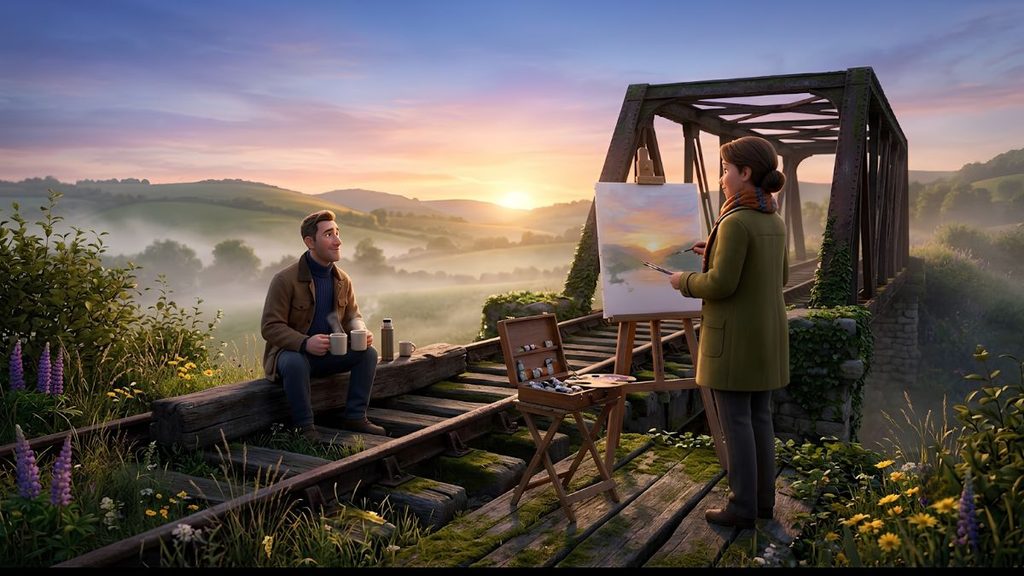
Type: Artistic Fiction, Hope & Renewal
Genre: Relaxing Bedtime Fiction
Tone: Gentle, emotional, atmospheric, hopeful
Every morning, before the town had properly awakened, Clara walked to the old railway bridge.
She carried a canvas under one arm, a wooden box of paints in one hand, and a small thermos of coffee in the other.
She always arrived before sunrise.
Not because she particularly liked waking early.
In fact, Clara had never been a morning person.
She simply liked the few minutes before the sun appeared.
The world seemed different then.
The streets were empty.
Windows remained dark.
Birds were only beginning to stir.
Mist rested above the fields.
And the sky belonged to nobody.
There were no advertisements in it.
No traffic.
No conversations.
No reminders.
Only color.
Every morning, Clara painted that color.
And every morning, she left the painting behind.
She never sold them.
She never displayed them.
She didn’t even sign them.
For years, nobody understood why.
The railway bridge had been abandoned for more than twenty years.
The tracks had been removed.
The station nearby had closed.
Grass grew between the old stones.
Wildflowers appeared along the embankment.
Clara liked the place because nobody came there.
She had discovered it shortly after moving to the town.
At first, she had gone there simply to escape.
Then she began painting.
She painted clouds.
Hills.
Trees.
Birds.
Fog.
Rain.
But mostly, she painted the sky.
Every sunrise was different.
Some mornings were pale and silver.
Others were pink.
Sometimes the horizon burned orange.
Sometimes clouds covered everything, and the sun appeared only as a faint glow.
Clara never knew what she would see.
That was part of the reason she returned.
One morning in early spring, Clara was halfway through a painting when she heard footsteps.
She turned.
A man was standing at the far end of the bridge.
He looked surprised to see her.
“Sorry,” he said.
Clara looked back at her canvas.
“It’s okay.”
“I didn’t know anyone came here.”
“Most people don’t.”
He smiled.
His name was Henry.
He lived in the town and had recently started taking early morning walks.
“I thought the bridge was completely abandoned.”
“It is.”
He looked at the canvas.
“Except for you.”
Clara nodded.
Henry looked at the sky.
Then at the painting.
“You’re painting that?”
“Yes.”
“It doesn’t look like that.”
Clara smiled.
“It will.”
Henry left.
Clara returned to her painting.
She assumed she would never see him again.
The next morning, he came back.
He didn’t interrupt her.
He simply stood a few meters away and watched the sunrise.
When Clara finished, she cleaned her brushes.
Henry asked:
“Do you come here every morning?”
“Almost.”
“Why?”
Clara looked toward the horizon.
“I like watching the day begin.”
Henry nodded.
“Fair enough.”
Then he left.
The following morning, he returned again.
And the morning after that.
Soon, Henry became part of the landscape.
He never arrived with questions.
Sometimes he brought coffee.
Sometimes he carried a book.
Sometimes he simply stood quietly.
Clara didn’t mind.
There was something comforting about having another person nearby who understood that silence didn’t need to be filled.
After several weeks, they began talking.
Not about important things.
At least, not at first.
They talked about weather.
Birds.
The changing seasons.
The strange shape of clouds.
The sound of rain.
Henry told Clara about his childhood.
He had grown up in a house beside a railway line.
He remembered falling asleep to the sound of trains.
Clara told him she had always liked the sound of distant trains.
“They sound like they’re going somewhere important,” she said.
Henry smiled.
“Perhaps they’re just going home.”
One morning, Henry noticed something.
Clara had finished her painting.
She looked at it for several seconds.
Then she carried it to the edge of the bridge.
She placed it against a stone.
And walked away.
Henry followed.
“You don’t take them home?”
“No.”
“Why?”
“I don’t need to.”
He looked at the painting.
It was beautiful.
The sky was soft pink.
A thin line of orange appeared over the distant hills.
The painting made the morning look quieter than it actually was.
“You could sell these.”
“I know.”
“You could exhibit them.”
“I know.”
“You could keep them.”
Clara looked at him.
“I know.”
“Then why don’t you?”
She smiled.
“Because they’re not really mine.”
Henry didn’t understand.
“The morning gives me the colors.”
She picked up her thermos.
“I just borrow them.”
The answer stayed with him.
He began thinking about it during the day.
Perhaps that was why he started returning every morning.
He wanted to understand.
One day, he asked:
“How long have you been painting here?”
“Seven years.”
“Seven years?”
Clara nodded.
“Every morning?”
“Almost.”
Henry looked at the bridge.
“That’s a long time.”
“Yes.”
“Was there a reason you started?”
Clara became quiet.
She looked toward the horizon.
“Yes.”
Henry didn’t ask anything else.
He knew enough to understand that some questions needed time.
The next morning, Clara arrived alone.
Henry was already there.
He had brought two cups of coffee.
She accepted one.
They watched the sky.
After a while, Clara said:
“His name was David.”
Henry looked at her.
She continued.
“He was my brother.”
She hadn’t spoken about him in years.
Not properly.
David had loved mornings.
He used to wake before everyone else.
When they were children, he would knock on Clara’s bedroom door and say:
“Come on. You’re missing it.”
“Missing what?”
“The sunrise.”
She would complain.
She would tell him she was tired.
He would laugh.
Then he would disappear downstairs.
Years later, Clara realized she had spent much of her childhood pretending not to care about the mornings he loved.
Then David died.
Suddenly.
Unexpectedly.
And afterward, mornings became difficult.
Every sunrise reminded her of him.
So she stopped watching them.
She stopped painting.
She stopped going outside early.
She stopped doing almost everything she had once enjoyed.
“Then why did you start again?” Henry asked gently.
Clara held her coffee.
“Because one morning, I woke up before sunrise.”
She looked toward the hills.
“I don’t know why.”
She walked outside.
She came to the bridge.
And she waited.
“The sky changed.”
She smiled faintly.
“And I realized something.”
“What?”
“The sunrise hadn’t stopped because David was gone.”
Henry listened.
“The morning was still happening.”
She looked at her hands.
“I was angry about that.”
“Because life continued?”
“Yes.”
She paused.
“Then I realized that perhaps continuing wasn’t betrayal.”
Henry said nothing.
Clara continued.
“I thought if I enjoyed anything again, it meant I had forgotten him.”
She looked toward the brightening horizon.
“But remembering someone and being sad forever aren’t the same thing.”
That morning, Clara painted slowly.
Henry watched.
When she finished, she looked at the canvas.
There were tears in her eyes.
She didn’t wipe them away.
Henry didn’t say anything.
The sun rose.
The sky became gold.
For a while, neither of them moved.
Then Clara smiled.
“That’s why I paint.”
Henry nodded.
“To remember?”
“To continue.”
After that conversation, something changed.
Not dramatically.
There were no promises.
No grand decisions.
Just a quiet understanding.
Henry began bringing his own chair.
Clara began bringing an extra cup of coffee.
They watched the sunrise together.
Sometimes they talked.
Sometimes they didn’t.
The paintings continued.
So did the seasons.
Spring became summer.
Summer became autumn.
Leaves turned gold around the bridge.
The air became colder.
Clara began wearing gloves.
Henry brought a blanket.
They watched fog settle over the fields.
One morning, snow covered the old railway embankment.
Clara laughed.
“I can’t paint this.”
“Why?”
“Because everything is white.”
Henry looked at the sky.
“Then paint the white.”
She smiled.
So she did.
Over the years, Clara had learned something about painting.
You couldn’t force a sunrise.
You couldn’t hurry it.
You couldn’t tell the sky what color to become.
You simply had to wait.
Sometimes the colors appeared slowly.
Sometimes suddenly.
Sometimes clouds covered everything.
Sometimes the morning was spectacular.
Sometimes it was ordinary.
But every morning arrived.
That became important to her.
Perhaps life was like that.
You couldn’t control everything.
You couldn’t prevent every loss.
You couldn’t know what tomorrow would bring.
But you could meet the morning when it came.
One autumn day, Henry asked:
“Do you ever miss David?”
Clara smiled.
“Every day.”
“Does it still hurt?”
“Sometimes.”
“Does it get easier?”
She thought about it.
“Not exactly.”
Henry waited.
“You get bigger around it.”
She looked toward the fields.
“The sadness doesn’t necessarily become smaller.”
She touched the edge of her painting.
“You become better at carrying it.”
Henry nodded.
He understood.
One morning, Henry didn’t arrive.
Clara waited.
The sky changed from black to purple.
Then pink.
Then gold.
Still no Henry.
She painted alone.
The next morning, he wasn’t there.
Nor the next.
Clara eventually learned that Henry had gone to visit his sister in another town.
She smiled when she heard.
She realized she missed him.
Not painfully.
Just gently.
Like missing someone who had become part of your morning.
She continued painting.
A week later, Henry returned.
Clara was already on the bridge.
He approached carrying two coffees.
“Sorry.”
She smiled.
“I thought you had forgotten the sunrise.”
“Never.”
He handed her a cup.
They stood together.
The sun appeared.
Neither spoke.
They didn’t need to.
Years continued passing.
Clara’s paintings accumulated nowhere.
They existed for a few minutes beside the bridge.
Then the wind changed.
Rain came.
Snow fell.
Visitors sometimes found them.
Sometimes the paintings disappeared.
Sometimes Clara carried them away.
Sometimes she left them beneath the trees.
She didn’t mind.
They had already served their purpose.
They had helped her see the morning.
That was enough.
One morning, a young woman appeared on the bridge.
She looked exhausted.
She stood at the far end watching Clara paint.
Eventually, she approached.
“Are you the woman who paints the sunrise?”
Clara smiled.
“Sometimes.”
The woman looked at the canvas.
“It’s beautiful.”
“Thank you.”
“Do you sell them?”
“No.”
“Why not?”
Clara smiled.
“Because they’re for the morning.”
The woman looked confused.
Clara explained.
“Some things don’t need to become possessions.”
The young woman looked toward the sky.
“Do you come here every day?”
“Almost.”
“Why?”
Clara thought about David.
Henry.
The years.
The losses.
The mornings.
Then she said:
“Because every day deserves a chance to begin.”
The young woman stayed.
She watched Clara finish.
Then she sat on the old stone wall.
Neither spoke.
When the sun was fully above the horizon, Clara cleaned her brushes.
The young woman finally said:
“I think I needed this.”
Clara smiled.
“So did I.”
Eventually, Clara became old.
Her hands weren’t as steady.
She painted more slowly.
Henry’s hair turned gray.
The railway bridge became covered with ivy.
The village grew.
New houses appeared.
Old shops disappeared.
But the sunrise remained.
Every morning, Clara continued climbing the bridge.
Sometimes Henry joined her.
Sometimes he couldn’t.
When he couldn’t, she painted anyway.
When Clara was too tired, Henry painted beside her.
His paintings were not very good.
She told him so.
He laughed.
“I don’t need them to be good.”
“What do you need?”
He looked at the sunrise.
“To be here.”
One particular morning, Clara arrived before dawn.
The sky was almost completely dark.
She placed her canvas on the old easel.
Her hands trembled.
She took a breath.
Then she began.
The first light appeared.
Purple.
Then blue.
Then pale gold.
Then orange.
Clara painted.
Slowly.
Carefully.
When the sun finally rose, she stepped back.
The painting wasn’t perfect.
It was never going to be.
But it felt right.
She looked at it for a long time.
Then she smiled.
She thought of David.
She thought of the boy who had once knocked on her bedroom door.
Come on. You’re missing it.
Clara whispered:
“I’m here.”
The wind moved through the grass.
Birds began singing.
Somewhere far away, a train sounded.
Clara closed her eyes.
For a moment, she imagined David laughing.
Then she opened them.
The morning was still there.
She left the painting against the stone.
As she walked away, the first sunlight touched the bridge.
The painting remained behind.
No frame.
No signature.
No price.
Just a quiet record of another morning.
A reminder that the world could break your heart and still be beautiful.
That grief could remain without preventing joy.
That remembering someone didn’t mean refusing to move forward.
And that sometimes healing wasn’t about leaving the past behind.
Sometimes it was about carrying it gently into the future.
Clara walked home slowly.
The town was beginning to wake.
Shops opened.
Cars moved along the road.
People stepped outside.
The day had begun.
And Clara, as she had done for so many years, welcomed it.
Not because every day would be easy.
Not because every loss could be repaired.
Not because she had finally found all the answers.
But because morning kept arriving.
And she had learned to meet it.
6. The Little Shop of Lost Evenings
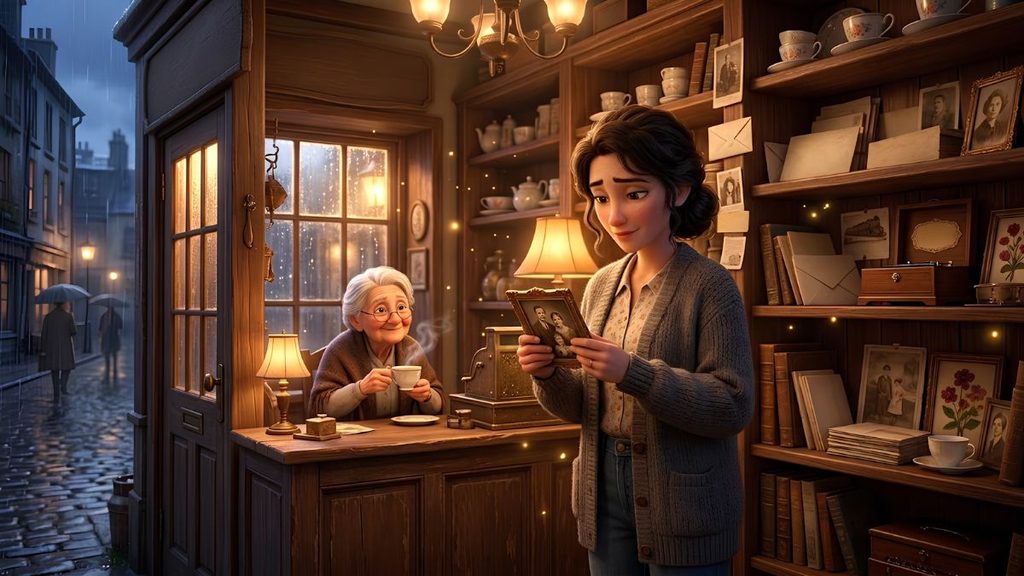
Type: Gentle Fantasy, Memory & Comfort
Genre: Relaxing Bedtime Fiction
Tone: Warm, nostalgic, magical, reflective
There was a little shop on Alder Street that did not appear on any map.
Nora had lived in the neighborhood for almost twelve years.
She knew the grocery store at the corner.
She knew the bakery that opened before sunrise.
She knew which café stayed open late.
She knew the narrow alley that connected Alder Street to the old market.
She knew the apartment buildings, the flower shop, the bus stop, and the small park where elderly people played chess on Sunday mornings.
But she had never seen the little shop.
That changed on a Tuesday evening in November.
It was raining.
Not heavily.
Just enough to make the pavement shine beneath the streetlights.
Nora had finished work later than usual.
She was tired in the peculiar way that comes from a day filled with small demands.
Nothing terrible had happened.
Nothing especially wonderful either.
It had simply been one of those days that seemed to take everything and give nothing back.
She walked home slowly.
Then, halfway down Alder Street, she noticed a warm light between two buildings.
She stopped.
There was a narrow wooden door beneath a small brass sign.
The sign read:
THE LITTLE SHOP OF LOST EVENINGS
Nora frowned.
She was certain the space had been empty the week before.
She looked through the window.
Inside were shelves.
Dozens of them.
Perhaps hundreds.
And on those shelves were ordinary objects.
Teacups.
Photographs.
Books.
Letters.
Old tickets.
Music boxes.
Small lamps.
Keys.
Postcards.
A child’s shoe.
A scarf.
A silver spoon.
Nothing seemed particularly valuable.
Yet somehow, the room felt important.
Nora pushed open the door.
A small bell rang.
An elderly woman sat behind the counter.
She wore a dark blue cardigan and spectacles attached to a thin silver chain.
She looked up.
“Good evening.”
“Is this shop new?”
The woman smiled.
“Not exactly.”
Nora looked around.
“What do you sell?”
“Nothing.”
“Then what is the shop for?”
The woman closed the book she had been reading.
“Lost evenings.”
Nora smiled politely.
“I see.”
“No, you don’t.”
The woman stood.
“My name is Elise.”
“Nora.”
Elise nodded.
“Welcome.”
Nora walked toward the shelves.
“Are these antiques?”
“Some.”
“Are they for sale?”
“No.”
“Then how does anyone get them?”
Elise looked at her.
“They don’t.”
She walked toward a shelf.
“The objects find the people who need to remember them.”
Nora laughed softly.
“That’s a little mysterious.”
“Memory usually is.”
Nora examined a small porcelain cup.
It was white with a blue flower painted on the side.
“Who did this belong to?”
Elise smiled.
“Someone who drank tea from it every evening for forty years.”
“Where is she now?”
“Somewhere else.”
Nora picked up a music box.
It played a slow, delicate melody.
“These objects are connected to memories?”
“To evenings.”
“What’s the difference?”
Elise looked toward the rain-covered window.
“An evening is more than a date on a calendar.”
Nora waited.
“It’s a feeling,” Elise continued.
“A room.”
“A conversation.”
“A person.”
“A moment when you didn’t know something would become important.”
Nora looked at the shelves again.
She understood a little.
She walked farther into the shop.
There were handwritten labels beneath some objects.
The evening he learned to dance.
The evening she decided to stay.
The evening they waited for the snow.
The evening nobody said goodbye.
Nora stopped.
The last one made her uncomfortable.
She moved on.
At the back of the shop was a small wooden cabinet.
One drawer was slightly open.
Nora pulled it.
Inside was an old photograph.
She froze.
She knew the people in it.
Her mother.
Her father.
And herself.
She couldn’t have been more than ten years old.
The photograph showed them sitting at a kitchen table.
There was a birthday cake.
A yellow tablecloth.
Three cups.
A window behind them.
And the old blue teapot her mother had owned.
Nora touched the photograph.
“I remember this.”
Elise stood behind her.
“Do you?”
Nora nodded.
“It was my birthday.”
“No.”
Nora looked at her.
“It wasn’t?”
“It was the evening before.”
Nora stared at the photograph.
She remembered almost nothing about that evening.
She remembered the cake.
She remembered her father’s laugh.
She remembered her mother lighting candles.
But the rest had disappeared.
Or perhaps she had simply stopped thinking about it.
“Why is this here?”
Elise didn’t answer immediately.
“Would you like to see the evening?”
Nora hesitated.
“What does that mean?”
“You can remember it.”
“Like a dream?”
“Something like that.”
“Will I go back?”
“No.”
“Then what happens?”
“You watch.”
Elise led Nora through a narrow doorway behind the cabinet.
Nora expected another room.
Instead, she found herself standing in darkness.
Then a warm yellow light appeared.
She was in her childhood kitchen.
She knew it immediately.
The old curtains.
The wooden table.
The refrigerator covered with magnets.
Her father’s coat hanging beside the door.
Her mother’s blue teapot.
Everything was exactly as she remembered.
But it wasn’t a memory.
It was more vivid.
She could hear the clock ticking.
She could hear rain outside.
She could smell cinnamon.
Her younger self sat at the table.
Her father was making tea.
Her mother was cutting cake.
Nora stood quietly.
Nobody could see her.
She watched.
Her father placed three cups on the table.
Her mother laughed.
“You’ll make it too strong.”
“I always make it too strong.”
“You always say that.”
“I like strong tea.”
Young Nora was drawing something on a piece of paper.
Her father leaned over.
“What are you drawing?”
“A house.”
“Whose house?”
“Mine.”
He smiled.
“Will I be allowed to visit?”
Nora’s younger self looked serious.
“Maybe.”
Her father laughed.
Nora smiled.
She had forgotten that conversation.
Completely.
She watched her younger self draw.
Her father drank his tea.
Her mother cut the cake.
Nothing extraordinary happened.
No great revelation.
No dramatic event.
Just an ordinary evening.
And yet Nora felt something tightening inside her chest.
She remembered the sound of her father’s laughter.
She had forgotten it.
Not the idea of it.
The actual sound.
Warm.
Deep.
A little breathless.
The sound he made when he was genuinely amused.
Nora closed her eyes.
The scene continued.
Her father stood and went to the kitchen.
He returned carrying a small wrapped package.
Nora’s younger self gasped.
“You said there wasn’t a present.”
“I lied.”
Her mother shook her head.
“You shouldn’t teach her that.”
“It’s her birthday.”
“It’s tomorrow.”
“Then I’m early.”
Young Nora opened the package.
Inside was a small music box.
She hugged her father.
Nora watched from the corner of the room.
She remembered the music box.
She had it somewhere.
Or perhaps she had lost it.
She couldn’t remember.
The scene faded.
The kitchen became dark.
Nora opened her eyes.
She was back in the shop.
The photograph remained in her hands.
“Why did you show me that?” she asked.
Elise sat down.
“Because you thought you had forgotten your father.”
Nora looked away.
“He died twelve years ago.”
“I know.”
“I don’t think about him very often anymore.”
“That isn’t the same as forgetting.”
Nora looked at the photograph.
“I thought I had.”
Elise smiled gently.
“Memories don’t disappear simply because we stop visiting them.”
Nora sat beside her.
“Then why do they feel so far away?”
“Because life keeps adding new rooms.”
Nora frowned.
Elise continued.
“The house gets bigger.”
“Some doors become difficult to find.”
“But they’re still there.”
Nora stayed in the shop.
She looked through more objects.
A train ticket from 1987.
A handwritten recipe.
A child’s red mitten.
A cracked pocket watch.
A paperback book with faded pages.
A glass marble.
A wedding invitation.
Each object belonged to an evening.
Each evening had once seemed ordinary.
Until time gave it meaning.
Nora began to understand.
People rarely know which moments will become important.
They think important memories will announce themselves.
They don’t.
Often, the moments that remain are small.
A cup of tea.
Someone laughing.
A hand on your shoulder.
Rain against a window.
A conversation before bed.
A song playing quietly in another room.
A meal shared with someone you love.
You don’t know that you are living a memory while you’re living it.
You only realize later.
“Can I ask you something?” Nora said.
Elise nodded.
“Why does this shop exist?”
Elise looked toward the shelves.
“Because people lose evenings.”
“How?”
“They become busy.”
“They move.”
“They grow older.”
“They leave places.”
“They lose people.”
“They stop paying attention.”
Nora looked at the objects.
“And you collect them?”
“No.”
“Then who does?”
Elise smiled.
“The shop.”
Nora laughed.
“That doesn’t make sense.”
“Neither does memory.”
Before Nora left, Elise gave her the photograph.
“Take this.”
“Are you sure?”
“Yes.”
“How much?”
Elise shook her head.
“Nothing.”
Nora held it carefully.
“What happens to the shop?”
“It will open again tomorrow.”
“At what time?”
“After sunset.”
“Will I be able to find it?”
Elise smiled.
“Only if you need to.”
Nora walked home.
The rain had stopped.
The streets reflected the lights of the buildings.
She held the photograph inside her coat.
When she reached her apartment, she opened a drawer she hadn’t touched in years.
Inside were old photographs.
Letters.
A bracelet.
A movie ticket.
A small music box.
Nora picked it up.
She turned the key.
A familiar melody filled the room.
She sat on the floor.
For several minutes, she simply listened.
She remembered her father’s hands.
The way he used to tap the table while thinking.
The way he always burned toast.
The way he pretended not to cry at sad films.
The way he used to stand beside her bedroom door and say:
“Five more minutes.”
She smiled.
Five more minutes.
She had forgotten that too.
The next morning, Nora woke earlier than usual.
She made tea.
She sat by the window.
She didn’t look at her phone.
She listened to the music box.
The memory didn’t hurt as much as she expected.
It was bittersweet.
But mostly warm.
She realized something.
She had spent years thinking about her father as someone who had died.
The shop had reminded her that he was also someone who had lived.
He had laughed.
He had teased her.
He had made tea.
He had bought her a music box.
He had been young once.
He had been tired.
He had been imperfect.
He had been there.
And remembering him didn’t mean returning to the past.
It meant allowing the past to remain part of her.
Weeks passed.
Nora began noticing other lost evenings.
She remembered a friend she hadn’t spoken to in years.
A summer evening when they had sat on a balcony eating peaches.
A winter night when her mother had taught her to make soup.
A train ride with a stranger who had told her a story.
A rainy evening when she had walked home from school without an umbrella.
None of these memories were extraordinary.
That was what made them precious.
She began keeping a notebook.
Not to record important events.
Just ordinary moments.
Coffee with Sarah.
The smell of rain.
A man laughing on the bus.
Sunlight on the kitchen floor.
Dinner with Mum.
She wrote them down.
Not because she was afraid of forgetting.
But because she wanted to notice them while they were happening.
One evening, Nora returned to Alder Street.
She wanted to find the shop.
The space between the buildings was there.
But the wooden door was gone.
There was only a brick wall.
She smiled.
She wasn’t surprised.
She continued walking.
At the corner, she passed an elderly man sitting outside a café.
He was holding a porcelain cup with a blue flower.
Nora stopped.
For a moment, she wondered.
Then she continued.
Not everything needed an explanation.
Years later, Nora would still think about the little shop.
Sometimes she wondered whether she had imagined it.
But the photograph remained.
So did the music box.
And so did the memory.
One rainy evening, Nora was sitting at home with her daughter.
They were drinking hot chocolate.
Her daughter was telling her about school.
Nora listened.
Really listened.
The rain tapped against the window.
A lamp glowed beside them.
Her daughter laughed at something.
Nora smiled.
Then she looked around the room.
The moment felt ordinary.
Nothing special was happening.
No photograph was being taken.
No one was making an announcement.
Yet Nora knew.
This was one of those evenings.
One of the ones that might disappear from the details of memory someday.
The exact words might be forgotten.
The weather might be forgotten.
Even the color of the room might disappear.
But perhaps the feeling would remain.
Warmth.
Safety.
Love.
Being together.
Nora reached across the table and took her daughter’s hand.
“What’s that for?” her daughter asked.
“Nothing.”
She smiled.
“Just because.”
That night, after her daughter had gone to bed, Nora stood by the window.
The street was quiet.
Rain fell softly.
For a moment, she thought she saw a warm light between two buildings.
She looked again.
Nothing.
Only darkness.
Nora smiled.
She understood now.
The shop had never really been about returning people to the past.
It had been about teaching them how to carry the past.
Memories weren’t instructions to look backward.
They were reminders of what mattered.
A cup of tea could remind you of love.
A song could remind you of home.
A photograph could remind you that someone had once been there.
And an ordinary evening could become precious simply because you had been present for it.
Nora turned away from the window.
She made herself another cup of tea.
Then she sat quietly in the warm room.
She didn’t try to remember anything.
She didn’t try to preserve the moment.
She simply lived it.
And perhaps that was the greatest lesson the little shop had offered her.
You cannot keep every evening.
You cannot hold time still.
You cannot stop people from changing, leaving, or growing old.
But you can pay attention.
You can listen.
You can stay a little longer.
You can notice the warmth of a cup between your hands.
You can remember to look up from your busy life and see the person sitting beside you.
Because someday, without warning, an ordinary evening may become one of the evenings you miss most.
And when that happens, you may discover that it was never really lost.
It was simply waiting inside you.
Quietly.
Patiently.
Until you were ready to remember.
7. The Garden Behind Apartment Nine
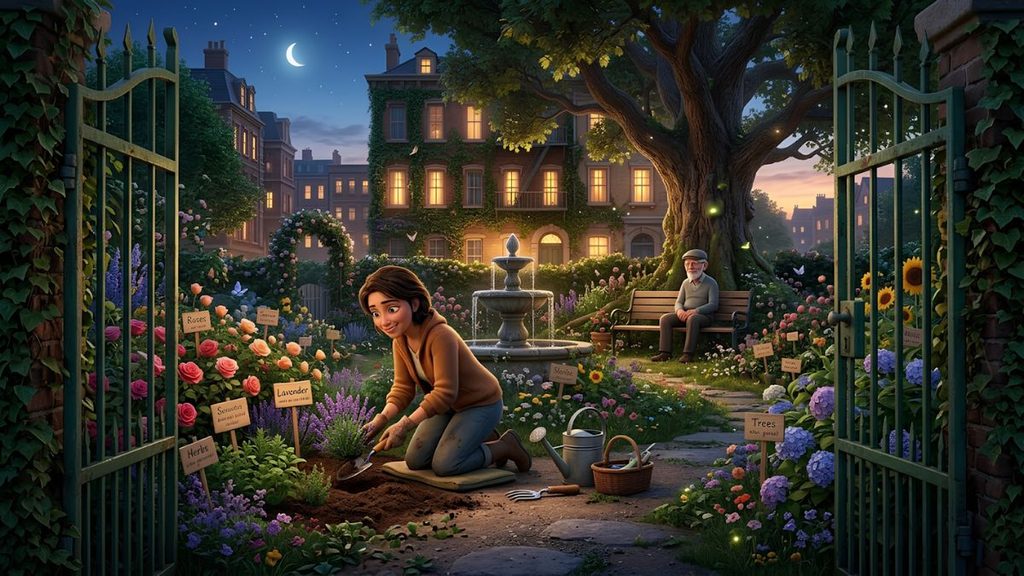
Type: Cozy Mystery, Community & Healing
Genre: Relaxing Bedtime Fiction
Tone: Gentle, atmospheric, hopeful, comforting
Maya had lived in Apartment Nine for almost six months before she noticed the flowers.
This seemed strange because the flowers were impossible to miss.
They grew behind the apartment building, inside a small courtyard surrounded by brick walls.
The courtyard was always locked.
The gate had been painted green once, though years of rain had faded it into a dull mixture of green and gray.
A rusted chain hung around it.
Nobody used the courtyard.
At least, as far as Maya knew.
The apartment building was old.
Its hallways smelled faintly of cooking, dust, and laundry detergent.
People came and went.
Doors opened.
Doors closed.
Neighbors nodded politely in the elevator.
But nobody seemed to know anything about the courtyard.
Maya first noticed it on a Tuesday evening.
She was carrying groceries upstairs when she looked through the narrow window beside the staircase.
For a moment, she thought she had imagined it.
A small cluster of yellow flowers was blooming behind the locked gate.
She stopped.
The courtyard was supposed to be empty.
Yet there they were.
Bright.
Fresh.
Perfectly alive.
The next evening, Maya looked again.
More flowers had appeared.
White ones this time.
And purple.
She pressed her face closer to the glass.
The courtyard was beautiful.
There were stone paths beneath the plants.
A small wooden bench stood beneath an old tree.
Several pots were arranged along the wall.
And in the center was a circular flower bed.
It looked carefully maintained.
Maya wondered who was doing it.
Perhaps the landlord.
But she had never seen him gardening.
Perhaps a neighbor had a key.
But nobody ever seemed to enter.
She asked the woman in Apartment Five.
“Do you know who looks after the courtyard?”
The woman thought about it.
“Courtyard?”
“Behind the building.”
“Oh.”
She shook her head.
“No idea.”
Maya asked another neighbor.
Same answer.
Nobody knew.
A week passed.
The flowers continued blooming.
Every night.
Maya began watching from her window.
At first, she expected to see someone.
A gardener.
A neighbor.
Perhaps an elderly resident who preferred working after dark.
But nobody came.
One night she stayed awake until midnight.
Nothing.
At one in the morning.
Nothing.
At two.
Still nothing.
At 2:17, she finally gave up.
The next morning, she looked through the staircase window.
The flowers were freshly watered.
Maya became curious.
Not desperately curious.
Just enough that she started thinking about the garden during the day.
Who planted it?
Why was the gate locked?
Why did nobody talk about it?
And why did the flowers seem healthier every morning?
One Saturday, she walked around the building.
Behind the courtyard wall was a narrow alley.
At the far end, she noticed a small wooden door.
It had no handle.
Only a brass keyhole.
Maya returned to her apartment.
She searched through the box of documents the landlord had given her when she moved in.
Among the keys was an old brass one.
She had never used it.
She tried it in the door.
It turned.
The door opened quietly.
Maya stepped inside.
She stood still.
The garden was even more beautiful than it looked through the window.
There were roses.
Lavender.
Mint.
Daisies.
Tulips.
Small fruit trees.
Climbing vines.
Herbs.
A narrow stream of water ran through the center, fed by an old stone fountain.
The garden smelled of earth and flowers.
Birds moved between branches.
Maya looked around.
Everything was alive.
Everything was cared for.
But there was no gardener.
Then she noticed the labels.
Small wooden tags had been placed beside the plants.
Each had a handwritten sentence.
The first one read:
I hope my daughter learns to trust herself.
Another:
I wish someone remembers to water the roses.
Another:
May whoever sits here feel less alone.
Maya stopped.
She read another.
I hope my brother comes home safely.
Then another.
Let there always be enough flowers for someone having a difficult day.
Maya stood quietly.
The garden wasn’t simply a garden.
It was a collection of wishes.
She walked slowly along the paths.
Some labels were old and faded.
Others looked newer.
One was attached to a rosemary plant.
I hope I find the courage to begin again.
Another was beneath a small apple tree.
May this tree still be here when my children are grown.
Maya smiled.
She wondered who had written them.
And where those people were now.
At the back of the garden, she found a wooden bench.
A label was attached to it.
Sit down. You have done enough for today.
Maya laughed softly.
She sat.
For several minutes, she did nothing.
She listened to birds.
Water.
Wind.
The distant sounds of traffic.
She felt something loosen inside her.
She had not realized how tired she was.
The next day, Maya returned.
She brought gardening gloves.
She pulled a few weeds.
Watered the flowers.
Removed dead leaves.
She wasn’t sure whether she was allowed.
But the garden seemed to welcome her.
After an hour, she noticed someone watching from the alley.
An elderly man stood near the door.
He had a cane.
Maya stood.
“Hello.”
He smiled.
“You’re in the garden.”
“Yes.”
“I see.”
“Do you know who looks after it?”
The man nodded.
“People.”
“Which people?”
He smiled.
“That’s the interesting part.”
His name was Thomas.
He had lived in the building for forty-one years.
He told Maya that the courtyard had been created by residents long before he moved in.
“Every person planted something.”
“Why?”
“Different reasons.”
Thomas walked slowly toward the roses.
“My wife planted those.”
He touched a leaf.
“She loved roses.”
“Is she still here?”
Thomas smiled.
“No.”
Maya lowered her eyes.
“I’m sorry.”
“Thank you.”
He looked at the garden.
“She left twenty years ago.”
Maya glanced at the labels.
“Did she write one?”
Thomas nodded.
“Over there.”
He pointed toward a lavender plant.
Maya followed him.
The label read:
I hope Thomas remembers that ordinary days can be beautiful.
Maya looked at him.
Thomas laughed softly.
“She knew me well.”
After that, Thomas became a regular visitor.
He taught Maya which plants needed shade.
Which flowers attracted bees.
Which herbs could survive winter.
He also told her stories about the residents who had lived in the building.
There had been a baker.
A violinist.
A teacher.
A train conductor.
A nurse.
A painter.
A young couple who stayed only one year.
A widower who planted sunflowers.
A child who planted a tiny tree and returned years later to see it had become taller than him.
Each person had left something behind.
Not necessarily something valuable.
Just something living.
Soon, other neighbors began appearing.
The woman from Apartment Five brought a watering can.
A young man from Apartment Eleven repaired the broken fountain.
Someone planted tomatoes.
Someone else added marigolds.
A little girl named Sophie placed a new label beside a sunflower.
Maya asked what she had written.
Sophie covered it with both hands.
“It’s private.”
Maya smiled.
“Fair enough.”
The girl carefully pushed the label into the soil.
Then she ran away.
The garden changed.
It became brighter.
People began leaving small things.
A bench cushion.
A birdhouse.
A basket of gardening tools.
A wind chime.
A painted stone.
Nobody organized it.
Nobody made a schedule.
People simply appeared.
Sometimes two neighbors worked together.
Sometimes someone sat alone.
Sometimes children played near the fountain.
Sometimes older residents talked beneath the tree.
The courtyard, once forgotten, became the quietest place in the building.
One evening, Maya found a new label.
It was attached to a small white flower.
She hadn’t seen it before.
The handwriting was unfamiliar.
She read:
I hope the person who finds this knows that starting over is allowed.
Maya stood still.
The words felt personal.
She had moved to the apartment after leaving a difficult period of her life behind.
She hadn’t told anyone.
She hadn’t wanted questions.
She simply wanted a place where she could begin again without explaining everything.
She touched the little flower.
Perhaps someone else had once felt the same.
Maya began looking at the labels differently.
They weren’t instructions.
They weren’t promises.
They were small messages sent across time.
A person could plant something.
Write a sentence.
Leave.
And years later, someone else could find it.
The garden connected people who had never met.
People who had lived decades apart.
People whose lives had crossed only through soil, roots, and flowers.
One night, Maya sat on the bench.
Thomas joined her.
“Who do you think planted the garden?” she asked.
Thomas smiled.
“Everyone.”
“Who started it?”
He thought.
“An old woman named Eleanor.”
“What was she like?”
“Quiet.”
“Did you know her?”
“Very well.”
“What happened to her?”
“She moved away.”
“Did she leave a label?”
Thomas nodded.
He pointed toward the oldest part of the garden.
Maya walked there.
Under a large tree was a small metal plate.
It read:
Plant something that will make a stranger’s life a little softer.
Maya smiled.
“That’s all?”
Thomas nodded.
“That’s all.”
Winter arrived.
The garden became quieter.
Flowers disappeared.
Leaves fell.
The fountain stopped.
But the residents continued visiting.
They covered delicate plants.
Pruned branches.
Protected roots.
The labels remained.
Some were nearly unreadable.
Maya began replacing them carefully.
Not changing the words.
Only making them easier to see.
One afternoon, she found a faded label beneath the snow.
She brushed it clean.
I hope someone remembers me kindly.
Maya stood there for a long time.
Then she whispered:
“Someone does.”
Spring returned.
The first flowers appeared.
Then more.
The garden seemed to wake.
Maya noticed that the plants she had cared for through winter were now blooming more strongly than before.
Thomas came with his cane.
He looked around.
“Beautiful.”
Maya smiled.
“It looks different.”
“No.”
He shook his head.
“It looks alive.”
One Saturday morning, everyone gathered in the courtyard.
There were perhaps twenty people.
Some had lived in the building for decades.
Others had moved in only recently.
Children ran between the flower beds.
Someone brought bread.
Someone brought tea.
The fountain worked again.
Birds moved through the branches.
Maya looked around.
She realized nobody was talking about who owned the garden.
Nobody cared.
It belonged to whoever needed it.
Thomas raised his cup.
“To the people who planted before us.”
Everyone smiled.
“And to those who will plant after us.”
Later that evening, Maya walked alone through the garden.
The sky was darkening.
Flowers moved gently in the breeze.
She stopped beside a small patch of soil.
For the first time, she understood what she wanted to leave behind.
She took a wooden label.
She wrote:
I hope whoever finds this remembers that they don’t have to know where the path leads to take the next step.
She pushed it into the earth.
Then she planted a small lavender plant beside it.
She watered it.
And sat on the bench.
Years passed.
Maya remained in Apartment Nine.
The garden grew.
Some residents left.
New ones arrived.
Thomas eventually stopped coming.
His apartment became quiet.
But his wife’s roses continued blooming.
The label remained beneath them.
I hope Thomas remembers that ordinary days can be beautiful.
Maya never removed it.
She never wanted to.
One summer evening, a young woman moved into Apartment Nine.
She was carrying boxes.
She looked exhausted.
Maya, now older, met her in the hallway.
“Need help?”
The woman smiled.
“Maybe with this one.”
Together, they carried a box upstairs.
Later, the young woman asked:
“Is there anything nice around here?”
Maya thought.
“Yes.”
She took her to the courtyard.
The young woman stopped at the gate.
“I thought this was locked.”
“It used to be.”
Maya opened it.
Warm evening light fell across the flowers.
The garden was full of color.
The fountain murmured.
A breeze moved through the trees.
The young woman looked around.
“It’s beautiful.”
Maya smiled.
“People have been leaving things here for a long time.”
“What kind of things?”
Maya pointed toward the labels.
“Wishes.”
The young woman read a few.
She smiled.
Then she grew quiet.
Maya knew that look.
It was the look of someone who had arrived carrying something they hadn’t yet learned how to put down.
She didn’t ask.
Instead, she walked toward the bench.
“Sit.”
The woman did.
They listened to the fountain.
After a while, the young woman said:
“I think I needed somewhere like this.”
Maya smiled.
“So did everyone.”
That night, after everyone had gone home, Maya walked through the garden one last time before bed.
The flowers moved softly in the moonlight.
The labels were barely visible.
The old tree stood over everything.
Roots beneath the ground connected plants that had been planted decades apart.
Maya touched one of the wooden signs.
She thought about all the people who had passed through the building.
People who had loved.
Lost.
Hoped.
Waited.
Started over.
People who had left behind ordinary things.
A flower.
A sentence.
A tree.
A place to sit.
They had probably never imagined that strangers would find those things years later.
That was the quiet beauty of kindness.
You didn’t always get to see where it went.
Sometimes you simply left it somewhere.
And someone else found it when they needed it.
Maya closed the garden gate.
She looked back.
The flowers were still moving.
The fountain was still running.
The wishes were still there.
Tomorrow someone would water the roses.
Someone would sit beneath the tree.
Someone would read an old label.
Someone would add a new one.
And the garden would continue doing what it had always done.
Holding pieces of people.
Giving them back as beauty.
Maya walked upstairs.
The building was quiet.
She entered Apartment Nine.
Before going to bed, she opened her window.
A soft floral scent drifted inside.
She smiled.
The garden was behind the building.
But somehow, it had become part of home.
And perhaps that was what people really left behind.
Not grand monuments.
Not perfect memories.
Just small acts of care that continued growing after they were gone.
A flower.
A sentence.
A little shade.
A place to rest.
A reminder that even an ordinary person could make the world gentler for someone they would never meet.
Maya turned off the light.
Outside, the garden waited quietly beneath the stars.
And somewhere among the flowers, another wish was taking root.
Why Do Adults Enjoy Bedtime Stories?
Bedtime stories are often associated with childhood, but adults can benefit from storytelling too.
Modern adult life frequently requires constant attention.
During the day, people switch between tasks, conversations, screens, notifications, and responsibilities. The brain becomes accustomed to processing information continuously.
When bedtime arrives, simply telling yourself to stop thinking may not work.
A gentle story provides a softer transition.
Instead of thinking:
“I need to fall asleep now.”
you can focus on a peaceful narrative.
You follow a character.
You imagine a setting.
You listen to the descriptions.
Eventually, the story becomes less important than the relaxed state it creates.
This can make bedtime feel less like a task and more like a ritual.
The Difference Between Relaxing and Exciting Bedtime Stories
Not every bedtime story is equally suitable for sleep.
A thriller might keep you turning pages.
A mystery might make you wonder what happens next.
A horror story might increase alertness.
A dramatic romance might keep your emotions engaged.
These can be enjoyable, but they may not be ideal immediately before sleep.
Relaxing bedtime stories usually take a different approach.
They emphasize:
- Gentle pacing
- Familiar environments
- Comfortable characters
- Positive or reassuring emotions
- Nature and everyday experiences
- Quiet discoveries
- Reflection
- Nostalgia
- Human connection
- Hope
- Emotional resolution
- Simple endings
The goal isn’t to keep you awake to discover the ending.
The goal is to make you comfortable enough that you don’t mind drifting away before reaching it.
How Relaxing Stories Can Help Quiet a Busy Mind
One of the biggest challenges at bedtime is mental overactivity.
You may lie down physically exhausted but mentally alert.
A story can provide a gentle point of focus.
Imagine reading about someone walking through a quiet village while rain falls softly against old rooftops. Your attention begins following the environment rather than returning repeatedly to your own worries.
This doesn’t mean a bedtime story magically eliminates stress.
Instead, it can give your attention somewhere calmer to rest.
That distinction is important.
A relaxing story isn’t a solution to every problem.
It is a transition tool.
It helps create a mental environment that feels more compatible with rest.
Why Slow-Paced Stories Work Well at Night
Fast-paced writing is designed to maintain attention.
It introduces problems.
Creates questions.
Raises stakes.
Adds surprises.
Then encourages you to continue.
Bedtime storytelling can work in almost the opposite direction.
A slow-paced story may spend several paragraphs describing a quiet evening, a warm room, a walk beside the sea, or the sound of rain.
Nothing urgent needs to happen.
That lack of urgency is part of the experience.
The reader doesn’t need to remember every detail.
They don’t need to predict what happens next.
They can simply follow the story.
This makes slow pacing particularly suitable for nighttime reading.
The Importance of Familiar and Comfortable Settings
The setting of a bedtime story can strongly influence its emotional atmosphere.
Some environments naturally suggest relaxation.
- A Quiet Cottage: A countryside cottage surrounded by trees, rain, fireplaces, and soft lamps can create a strong sense of comfort.
- A Coastal Village: The sound of waves, distant lighthouse beams, sea breeze, and empty beaches can provide an expansive but peaceful atmosphere.
- A Small Café: Warm drinks, quiet conversations, rain-covered windows, and soft lighting can create an intimate setting.
- An Old Library: Bookshelves, wooden floors, lamps, and quiet reading rooms can create a sense of peaceful discovery.
- A Garden: Flowers, nighttime breezes, moonlight, and gentle sounds of nature can encourage a slower emotional rhythm.
- A Train Journey: A nighttime train moving through the countryside can provide a feeling of movement without requiring the reader to do anything.
These settings are useful because they give the imagination something peaceful to visualize.
Nature as a Source of Calm
Nature is a common feature in relaxing bedtime stories for adults.
Rain is particularly effective because it creates a repetitive sensory rhythm.
Other useful natural elements include:
- Ocean waves
- Wind through trees
- Falling snow
- A crackling fireplace
- Birds in the early morning
- Leaves moving in the breeze
- Moonlight
- Gentle streams
- Forest paths
- Gardens at dusk
These elements can make a story feel immersive without requiring complicated action.
A character doesn’t have to save the world.
They might simply sit beside a window and listen to rain.
That can be enough.
Emotional Comfort Without Excessive Drama
Relaxing stories can still have emotional depth.
In fact, many adults may prefer stories that acknowledge loneliness, uncertainty, change, memories, or difficult periods of life.
The difference is how those subjects are handled.
A relaxing story might explore someone recovering from a difficult year.
But instead of focusing heavily on suffering, it may show the character discovering small moments of comfort.
A warm meal.
A conversation with a stranger.
A walk through a familiar neighborhood.
A forgotten photograph.
A quiet morning.
A letter.
A garden.
These small experiences can make the story emotionally meaningful without becoming overwhelming.
The Role of Nostalgia
Nostalgia can be particularly powerful in bedtime storytelling.
Many adults associate certain sounds, smells, and places with earlier periods of life.
The smell of freshly baked bread.
An old train station.
A grandmother’s kitchen.
Rain against a childhood bedroom window.
A handwritten letter.
A familiar song.
A dusty bookshelf.
These details can create a feeling of emotional familiarity.
Good bedtime stories can use nostalgia carefully.
The purpose isn’t to make the reader dwell on the past.
Instead, nostalgia can remind them of comforting experiences while gently returning them to the present.
Stories About Small Things Can Be Surprisingly Powerful
A relaxing bedtime story doesn’t need an extraordinary plot.
Sometimes the most comforting stories revolve around ordinary experiences.
Someone restoring an old chair.
Someone opening a small shop.
Someone caring for a garden.
Someone discovering an old notebook.
Someone taking a late-night train.
Someone walking through a quiet neighborhood.
Someone preparing breakfast on a rainy morning.
These stories work because they reduce the pressure to expect something dramatic.
The ordinary becomes meaningful.
And at bedtime, that can be exactly what the mind needs.
Magical Realism Can Add Gentle Wonder
Relaxing bedtime stories can also include elements of magical realism.
The important thing is to keep the magic gentle.
For example, a library might mysteriously open after midnight.
A garden might bloom whenever someone needs encouragement.
An old house might seem to remember its former residents.
A train might always arrive when someone needs a new beginning.
A café might have clocks that stop while people are resting.
These ideas introduce wonder without creating fear or suspense.
The reader can enjoy the mystery without needing to solve it.
What Makes a Bedtime Story Suitable for Adults?
Adult bedtime stories don’t need to be childish.
They can contain mature emotions, sophisticated themes, and thoughtful observations about life.
Common themes include:
- Starting over
- Letting go
- Finding peace
- Friendship
- Love
- Memory
- Forgiveness
- Family
- Hope
- Loneliness
- Personal growth
- Nature
- Home
- Connection
- Acceptance
The writing can remain simple and soothing while still respecting the experiences of adult readers.
A good adult bedtime story doesn’t talk down to its audience.
It simply gives them a peaceful place to rest their attention.
How Long Should a Relaxing Bedtime Story Be?
There is no perfect length.
Different readers prefer different experiences.
Short Stories
Short bedtime stories can work well when you want something simple before sleeping.
They may take only a few minutes to read.
Medium-Length Stories
These offer enough space to develop a setting and emotional atmosphere without becoming demanding.
Long Bedtime Stories
Longer stories can be useful when you enjoy listening or reading for 20, 30, or even 40 minutes before falling asleep.
The important thing is not the word count.
It is whether the story maintains a calm emotional rhythm.
A 2,000-word peaceful story can be more relaxing than a 500-word story packed with tension.
Reading vs. Listening to Bedtime Stories
Relaxing stories can be enjoyed in several ways.
Reading
Reading allows you to control the pace.
You can pause whenever you want.
You can reread a comforting paragraph.
You can stop when you feel sleepy.
Listening
Audio stories can be especially convenient when you don’t want to look at a screen.
You can lie comfortably in bed and listen to a gentle narrator.
Reading Aloud
Some adults enjoy reading stories aloud, either alone or with a partner.
The slower pace of speaking can make the experience feel more intentional.
Creating a Relaxing Bedtime Story Routine
A bedtime story becomes more effective as part of a consistent nighttime routine.
You might begin by dimming the lights.
Put your phone away.
Make a warm, non-caffeinated drink.
Get comfortable in bed or in a favorite chair.
Then choose a relaxing story.
Try not to treat the experience as another task you must complete.
There is no requirement to finish the story.
If you become sleepy halfway through, that’s perfectly fine.
In fact, that may mean the routine is doing exactly what you want it to do.
Reduce Screen Distractions
If you’re reading bedtime stories on a phone, distractions can easily interfere.
Notifications can pull your attention away.
Messages can restart mental activity.
Social media can introduce stimulating information.
If possible, enable a focus or do-not-disturb mode before beginning your story.
You can also reduce screen brightness or use a device designed for comfortable nighttime reading.
The goal is to make the story the final gentle activity rather than one part of an endless stream of digital content.
Choose the Right Story for Your Mood
Your ideal bedtime story may change depending on how you feel.
If you’re stressed, choose something peaceful and predictable.
If you’re lonely, a story about friendship or human connection may feel comforting.
If you’re nostalgic, choose something involving memories or familiar places.
If you’ve had a difficult day, stories about healing and fresh beginnings may feel appropriate.
If your mind is restless, a simple nature-based story may be better than something with a complicated plot.
There is no single best bedtime story for everyone.
The best choice is often the one that matches the emotional state you want to move toward.
Avoiding Stories That Are Too Stimulating
If your primary goal is sleep, consider avoiding stories that contain:
- Graphic violence
- Horror
- Intense suspense
- Complicated mysteries
- Major cliffhangers
- Strong emotional conflict
- Frightening imagery
- Extremely fast pacing
- Highly dramatic endings
These elements can make you want to continue reading rather than put the book down.
Relaxation often comes from knowing that nothing urgent is about to happen.
A Good Bedtime Story Does Not Need a Perfect Ending
One of the most interesting qualities of relaxing bedtime stories is that the ending doesn’t always need to be dramatic.
The character may simply return home.
The rain may stop.
A fire may burn lower.
A train may arrive at its destination.
A garden may become quiet.
A person may look out a window and realize that tomorrow doesn’t need to be solved tonight.
These endings provide closure without demanding excitement.
Sometimes the best ending is simply a feeling of peace.
Bedtime Stories and the Feeling of Being Somewhere Else
A good bedtime story can temporarily transport you away from your immediate surroundings.
You may be lying in a city apartment, but the story places you in a cottage beside the sea.
You may have spent the day at a busy office, but the story takes you into a quiet library.
You may be surrounded by traffic, but the story lets you walk along an empty country road.
This imaginative movement can create psychological distance from the day’s responsibilities.
For a little while, you don’t have to think about your inbox, schedule, errands, or tomorrow’s meetings.
You can simply inhabit the story.
Relaxation Is Often Found in Small Moments
One of the most valuable ideas behind relaxing bedtime stories is that peace doesn’t have to come from something extraordinary.
It can come from ordinary moments.
A cup of tea.
A comfortable blanket.
A quiet conversation.
A familiar book.
Rain against glass.
A warm kitchen.
A walk beneath trees.
A handwritten note.
A sunset.
These moments are small, but they can carry considerable emotional weight.
Bedtime stories allow writers to slow these moments down and give them room to breathe.
Who Can Enjoy Relaxing Bedtime Stories?
Despite the name, relaxing bedtime stories aren’t limited to people who have difficulty sleeping.
They can be enjoyed by anyone who likes peaceful storytelling.
They may appeal to:
- Adults with busy schedules
- People who enjoy quiet fiction
- Readers who like cozy stories
- Couples looking for relaxing nighttime activities
- People who enjoy audiobooks
- Readers who prefer reflective narratives
- Anyone who wants a calmer evening routine
The stories can also be enjoyed during quiet afternoons, travel, meditation, or moments when you simply want to disconnect from a busy day.
Making Bedtime Stories Part of Self-Care
Self-care doesn’t always need to involve elaborate routines.
Sometimes it means giving yourself permission to stop.
A bedtime story can become a small signal that the day is ending.
Work is finished.
Messages can wait.
Tomorrow will arrive when it arrives.
For now, you can sit quietly and listen.
That simple boundary can make nighttime feel more intentional.
Final Thoughts
Relaxing bedtime stories for adults offer a gentle alternative to the noise and stimulation that often follows us into the evening.
They don’t need complicated plots.
They don’t need dramatic twists.
They don’t need perfect solutions.
Instead, they can offer something much simpler: a peaceful setting, a thoughtful character, a few comforting moments, and enough quiet space for the mind to slow down.
The best bedtime story may be one you never finish.
You might reach the middle of a chapter, notice your eyes becoming heavy, and put the story aside.
That’s okay.
The purpose isn’t necessarily to discover what happens next.
It’s to give yourself permission to stop thinking about what happens next.
Tonight, you can simply listen to the rain.
Follow a character down a quiet road.
Sit beside a warm fireplace.
Watch the moonlight move across a window.
Turn one more page.
And when sleep finally arrives, you don’t have to fight it.
You can simply let the story fade into the background and allow the night to become quiet.