

A good bedtime story can do more than entertain you. For many adults, listening to or reading a gentle story before bed creates a peaceful transition between the demands of the day and the quiet of nighttime. Instead of scrolling through stressful news, thinking about tomorrow’s responsibilities, or replaying the day’s events, a soothing story gives the mind something calm and predictable to follow.
Bedtime stories for adults to help you sleep are especially appealing because they combine relaxation with imagination. The best stories are not necessarily dramatic or complicated. They often use peaceful settings, comforting characters, slow pacing, simple language, and reassuring endings that allow the listener’s attention to gradually soften.
This guide explores what makes adult bedtime stories effective, how they can fit into a nighttime routine, which types of stories work particularly well, and how to choose stories based on your mood.
What Are Bedtime Stories for Adults?
Bedtime stories for adults are relaxing narratives designed to be enjoyed before sleep. Unlike children’s bedtime stories, they generally feature adult characters, more sophisticated themes, realistic situations, or reflective ideas.
However, the purpose remains similar: to create a gentle mental transition toward sleep.
An adult bedtime story might take place in:
- A quiet coastal village
- A small bookshop after closing time
- A countryside cottage
- A peaceful train journey
- A hotel overlooking the mountains
- A rainy city apartment
- A little café on a quiet street
- A moonlit garden
- A secluded lakeside cabin
- A fictional town where nothing needs to happen quickly
The story does not need to contain a major conflict or exciting plot. In fact, stories with low tension can be particularly suitable for nighttime reading.
Bedtime Stories for Adults to Help You Sleep
The Last Train to Willowmere
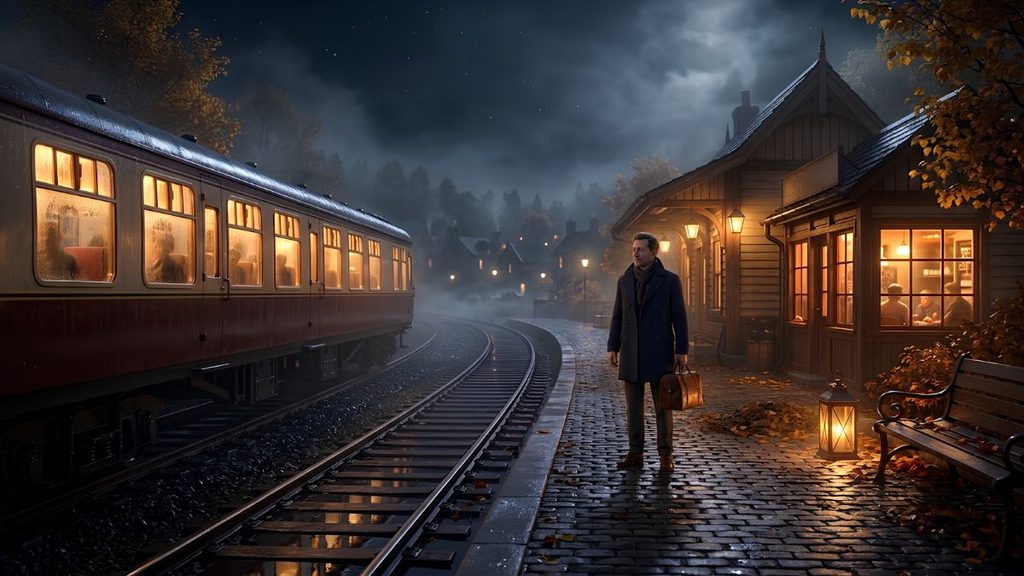
Type: Cozy Travel, Reflection & New Beginnings
Tone: Peaceful, nostalgic, atmospheric, comforting
Daniel had forgotten what it felt like to have nowhere to be.
For most of the year, his days had been measured in small pieces of time.
Seven thirty meant coffee.
Eight fifteen meant the train.
Nine meant the first meeting.
Eleven meant another meeting.
Lunch was something eaten while reading messages. Evenings were filled with unfinished work, unanswered emails, and the quiet promise that tomorrow would somehow be less busy.
Tomorrow rarely was.
Then, one Thursday evening in late autumn, Daniel closed his laptop and realized that he had no idea what day it was.
He sat alone in his apartment with the lights off.
Outside, rain moved softly against the windows.
The city was still awake. Cars passed below. Somewhere in another apartment, someone laughed. A dog barked twice and then became quiet.
Daniel looked at the clock.
10:47 p.m.
He could go to bed.
He could open his laptop again.
He could make himself something to eat.
Instead, he stood up.
He put on his coat.
He took his wallet and keys.
And without deciding where he was going, Daniel walked to the railway station.
The station was almost empty.
Most of the daytime crowds had disappeared. The ticket counters were closing, and the large departure board flickered above the platform.
Daniel stood beneath it with his hands in his coat pockets.
He wasn’t looking for a particular train.
He simply wanted to go somewhere.
Perhaps that was what he had been missing.
Not a holiday.
Not an adventure.
Just somewhere else.
A train appeared on the board.
11:20 — Willowmere
Daniel frowned.
He had never heard of Willowmere.
The train was scheduled to depart from Platform 6.
He walked toward it.
The train was older than the others at the station. Its windows glowed with warm yellow light, and only a few passengers sat inside.
Daniel bought a ticket.
“Willowmere?” the clerk asked.
“Yes.”
“Going all the way?”
Daniel hesitated.
“I suppose.”
The clerk smiled.
“That’s usually the best way.”
Daniel wasn’t sure what she meant.
He boarded.
The carriage was warm.
There were perhaps eight passengers scattered throughout it.
A woman reading a paperback.
An elderly couple sharing a thermos.
A young man sleeping against the window.
A mother and daughter whispering quietly.
Daniel chose a seat near the back.
The doors closed.
The train began to move.
Slowly at first.
Then faster.
The station lights slipped past the window, followed by buildings, streets, apartment blocks, and finally the familiar glow of the city.
Daniel watched everything disappear.
For the first time in months, nobody was asking him for anything.
His phone remained in his pocket.
He didn’t take it out.
The train continued into the darkness.
After an hour, Daniel noticed that the city had completely disappeared.
There were no tall buildings anymore.
No traffic.
No glowing advertisements.
Only fields, occasional houses, and the distant lights of villages.
Rain streaked across the glass.
Daniel leaned his head against the window.
He felt tired.
Not the ordinary tiredness that came from missing sleep.
Something deeper.
The kind of tiredness that arrives when you have spent too long pretending you are fine.
He closed his eyes.
When he opened them again, the carriage was nearly empty.
The elderly couple had disappeared.
The woman with the book was gone.
Only the conductor remained.
“Next stop is Willowmere,” he said.
Daniel looked outside.
There was almost nothing to see.
A few trees.
A narrow road.
A hill.
Then the train slowed.
A small platform appeared.
One old lamp illuminated a wooden sign.
WILLOWMERE
Daniel stepped onto the platform.
The train waited for perhaps thirty seconds.
Then it disappeared into the darkness.
Daniel stood alone.
The rain had stopped.
The air smelled of wet earth.
He looked around.
There was a small station building with a yellow light glowing through one window.
Daniel walked toward it.
Inside was a tiny café.
A wooden sign above the door read:
THE WAITING ROOM
Daniel pushed open the door.
A bell chimed.
Behind the counter stood an elderly woman with silver hair tied loosely behind her head.
She looked at him as though she had been expecting him.
“You’re late,” she said.
Daniel looked at his watch.
“Sorry.”
She smiled.
“Don’t apologize. You’re here now.”
Daniel sat at a small table beside the window.
“What is this place?”
“A café.”
“I can see that.”
The woman laughed.
“Then you’re doing better than most travelers.”
She brought him a cup of tea without asking.
Daniel wrapped his hands around it.
The warmth moved slowly into his fingers.
“Are there any hotels nearby?” he asked.
“One.”
“Is it open?”
“Probably.”
“Probably?”
“It’s Willowmere.”
Daniel smiled despite himself.
The woman sat opposite him.
“You’ve come a long way.”
“I came from the city.”
“I know.”
“You know?”
She pointed toward his coat.
“City rain.”
Daniel looked down.
His coat was still wet.
She continued.
“People from the city always carry a particular kind of tiredness.”
“What kind?”
“The kind that makes them forget to look out the window.”
Daniel looked toward the glass.
Outside, rainwater shimmered beneath the station lamp.
He didn’t know what to say.
So he drank his tea.
The woman introduced herself as Margaret.
She had worked at the station café for thirty-six years.
“Thirty-six?”
“Thirty-seven in March.”
“What made you stay?”
Margaret thought about it.
“The trains.”
“You like trains?”
“I like people arriving.”
Daniel smiled.
“And people leaving?”
“Leaving is important too.”
She stood and began wiping the counter.
“People think a station is about destinations. It isn’t. It’s about pauses.”
Daniel considered that.
“When was the last time you had a proper pause?”
He almost answered immediately.
Then he realized he couldn’t remember.
Margaret didn’t press him.
Instead, she handed him a small notebook.
“What is this?”
“Guestbook.”
“I thought this was a café.”
“It is.”
“Then why does it have a guestbook?”
“Because people leave things here.”
Daniel opened it.
The pages were filled with handwriting.
Some entries were only a sentence.
Some were several paragraphs.
One person had written:
I came here because I didn’t know where else to go.
Another said:
The rain sounds different when you’re not trying to get somewhere.
Another:
I thought I needed a new life. Turns out I needed one quiet evening.
Daniel turned another page.
The handwriting became older.
The ink faded.
There were entries from twenty years ago.
Thirty.
Perhaps more.
“What happens to the people who write these?”
Margaret shrugged.
“They go home.”
“Do they come back?”
“Some do.”
“And the others?”
“They continue.”
Daniel closed the notebook.
Something about that answer stayed with him.
Margaret told him there was a small guesthouse five minutes from the station.
Daniel walked there through quiet streets.
Willowmere was smaller than he had imagined.
There were perhaps twenty houses.
A bakery.
A post office.
A church.
A little grocery shop.
A park.
And a narrow road leading toward a lake.
The guesthouse was warm and simple.
The owner gave Daniel a room on the second floor.
“You’ll sleep well here,” she said.
“How do you know?”
“Nobody sleeps badly in Willowmere.”
Daniel laughed.
He thanked her and went upstairs.
The room contained a bed, a small wooden desk, a lamp, and a window overlooking the rooftops.
There was no television.
No desk phone.
No city noise.
Daniel placed his phone on the table.
He considered checking his messages.
Instead, he turned it off.
Then he went to bed.
For the first time in a very long time, he slept without setting an alarm.
Daniel woke late the next morning.
Sunlight entered through the curtains.
For a moment, he didn’t remember where he was.
Then he heard birds.
He smiled.
Downstairs, breakfast was waiting.
Fresh bread.
Butter.
Eggs.
Coffee.
A bowl of apples.
Daniel ate slowly.
There was no reason to hurry.
After breakfast, he walked toward the lake.
The road passed between small houses with gardens.
An old man was sweeping leaves from his front steps.
A woman carried flowers from a shop.
Two children rode bicycles along the road.
Nobody appeared to be rushing.
Daniel reached the lake.
The water was perfectly still.
Autumn trees surrounded it, their leaves reflected in the surface.
He sat on a wooden bench.
He stayed there for an hour.
Then another.
Nothing happened.
And somehow, that was exactly what he needed.
That afternoon, Daniel returned to the station.
Margaret was there.
“You came back.”
“I said I would.”
“No, you didn’t.”
Daniel laughed.
“I suppose I didn’t.”
She poured him tea.
“How was the lake?”
“Quiet.”
“Good.”
They sat without talking.
After a while, Daniel opened the guestbook.
He found a blank page.
He held the pen.
“What should I write?”
“Whatever you came here to say.”
Daniel thought about it.
Then he began.
I thought I was looking for somewhere to go.
He paused.
Outside, a train passed slowly through the station.
He continued.
I think I was looking for somewhere to stop.
He looked at the sentence.
Then added:
I had forgotten that stopping isn’t the same as giving up.
Margaret read it over his shoulder.
She nodded.
“That’s a good one.”
Daniel closed the book.
“Do people really come here when they’re lost?”
“Everyone is lost sometimes.”
“And you help them?”
“No.”
Margaret smiled.
“They help themselves. I just make tea.”
Daniel stayed in Willowmere for three days.
On Saturday morning, he walked through the forest.
On Saturday afternoon, he bought a book from the little shop.
That evening, he sat beside the lake until the sky became purple.
On Sunday, he helped the owner of the guesthouse carry firewood.
Nobody asked about his job.
Nobody asked how much money he made.
Nobody asked what his five-year plan was.
He began to remember things he had forgotten.
He liked walking.
He liked quiet mornings.
He liked handwritten notes.
He liked watching rain.
He liked having tea without checking his phone.
He liked not knowing what came next.
On Monday morning, Daniel returned to the station.
The same old train waited on Platform 1.
Margaret stood outside the café.
“Going home?”
“Yes.”
“Ready?”
Daniel looked at the train.
Then at Willowmere.
“I think so.”
Margaret handed him a folded piece of paper.
“What is this?”
“For the journey.”
Daniel opened it after boarding.
It contained only four words.
Don’t hurry through your life.
Daniel folded the paper carefully and placed it inside his wallet.
The train began to move.
Willowmere slowly disappeared behind him.
Daniel watched until the last rooftop vanished.
Then he closed his eyes.
When Daniel returned to the city, nothing had changed.
The streets were crowded.
His apartment looked exactly as he had left it.
His inbox contained hundreds of messages.
His calendar was full.
The world had continued while he was away.
But Daniel had changed one thing.
He did not open his laptop immediately.
He made tea.
He opened the window.
He listened to the city.
Then he took the small piece of paper from his wallet and placed it beside his computer.
Don’t hurry through your life.
He knew he would forget sometimes.
He knew there would be busy days.
Difficult days.
Days when everything seemed urgent.
But now he knew something else.
There was always a train somewhere.
There was always a quiet station.
There was always a place where he could stop for a while.
And sometimes, the journey you take because you don’t know where you’re going is the one that quietly brings you back to yourself.
That evening, Daniel went to bed early.
Rain began tapping against the window.
He listened.
He didn’t reach for his phone.
He didn’t think about tomorrow.
He simply listened to the rain.
And somewhere in the distance, almost too faint to hear, a train moved through the night.
Daniel smiled.
Then he fell asleep.
The House That Kept the Rain
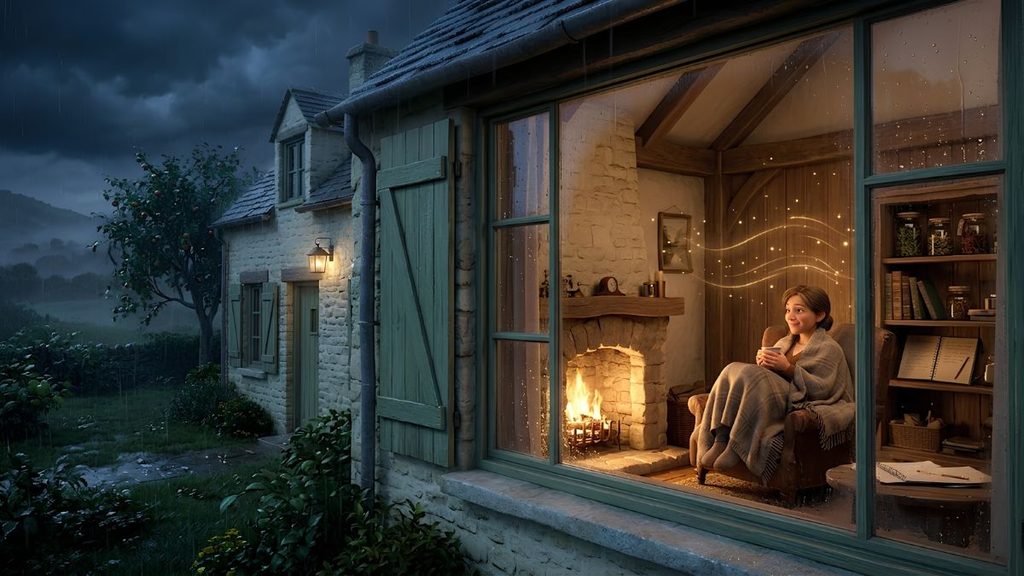
Type: Cozy Mystery, Home & Healing
Tone: Atmospheric, peaceful, reflective, comforting
Clara had always believed that houses remembered things.
She couldn’t have explained why.
It wasn’t something she had learned from a book or been told by her parents. It was simply an idea that had followed her since childhood. Certain houses felt cheerful. Others felt serious. Some seemed to hold their silence differently, as if they were waiting for someone to return.
The countryside house she rented that autumn felt like it was waiting.
It stood at the end of a narrow road bordered by old trees and fields that stretched toward distant hills. The house itself was small, two stories high, with pale stone walls, green shutters, and a sloping roof darkened by decades of weather.
Clara found it through an ordinary rental listing.
The photographs were not particularly impressive.
There was an old kitchen, a sitting room with a fireplace, two bedrooms, and a garden that appeared to have been neglected for years.
But when Clara saw the house in person, she knew she wanted it.
Perhaps it was because of the quiet.
After months of living in a noisy apartment above a busy street, she had begun craving silence.
Not complete silence.
That would have frightened her.
She wanted the softer kind.
Birds in the morning.
Wind through trees.
The occasional passing car.
Rain against a roof.
So she signed the lease.
She moved in on a Saturday afternoon.
By evening, the boxes were stacked along the walls, the kitchen cupboards were filled, and Clara had managed to make the bedroom look almost comfortable.
She made tea.
She sat beside the fireplace.
And for the first time in months, she breathed deeply.
“This might work,” she whispered.
The house seemed to listen.
That night, rain arrived.
It began gently.
A few drops tapped against the windows.
Then the wind rose.
Within an hour, rain was falling steadily over the countryside.
Clara lay in bed listening.
She loved the sound.
There was something comforting about being indoors while the weather moved outside.
She pulled the blanket closer.
Then she heard it.
A strange sound.
It was faint at first.
Tap.
Tap.
Tap.
Clara opened her eyes.
She listened.
The sound continued.
Tap.
Tap.
Tap.
It didn’t seem to be coming from the window.
It sounded closer.
From inside the wall.
Clara sat up.
The sound stopped.
She waited.
Nothing.
She smiled to herself.
“Old house,” she whispered.
She lay down again.
A few minutes later, the sound returned.
This time it was louder.
Not frightening.
Just unusual.
It sounded almost like rain falling inside the wall.
Clara got out of bed.
She walked toward the bedroom wall.
She placed her palm against it.
Cool plaster.
Nothing else.
Then she heard something that made her pause.
It sounded like distant thunder.
But there was no thunder outside.
Only steady rain.
Clara stepped back.
She decided not to investigate.
She returned to bed.
Eventually, she fell asleep.
The next morning, sunlight filled the bedroom.
Clara almost forgot about the sound.
She made coffee and opened the back door.
The garden smelled of wet grass.
Drops of water hung from the branches of an old apple tree.
Everything looked peaceful.
She spent the morning unpacking.
Around noon, she noticed something unusual.
The sound had returned.
There wasn’t any rain outside.
Yet somewhere inside the house came the faint sound of water.
Clara stopped unpacking.
She listened.
Tap.
Tap.
Tap.
She followed the sound into the hallway.
It seemed louder near the staircase.
She pressed her ear against the wall.
There it was.
Rain.
She stepped back.
“Okay,” she said quietly.
The house was officially strange.
That afternoon, Clara called the landlord.
His name was Edward.
He was a friendly man in his sixties who lived several villages away.
“Did you know there was something inside the walls?” Clara asked.
Edward became quiet.
“What do you mean?”
“There’s a sound.”
“A pipe?”
“No. It sounds like rain.”
There was another pause.
Then Edward laughed softly.
“Ah.”
“Ah?”
“I wondered when you’d notice.”
Clara stared at the phone.
“You knew?”
“Only about the sound.”
“What’s causing it?”
“I don’t know.”
“You don’t know?”
“The previous owner built the house.”
“Who was that?”
“Thomas Bell.”
“Was he an architect?”
“Something like that.”
Edward hesitated.
“He had some unusual ideas.”
“What kind of ideas?”
“I think you’ll find out.”
Clara disliked answers like that.
“What happened to him?”
“He died several years ago.”
“And the house?”
“It stood empty for a while.”
“Did he live here alone?”
“Mostly.”
Edward paused.
“Listen, Clara. The house is old, but it’s safe. I’ve never had any serious problems with it.”
“Except mysterious rain inside the walls?”
Edward laughed.
“Except that.”
That night, Clara listened more carefully.
The rain started at ten.
The strange sound began shortly afterward.
This time she noticed that it wasn’t random.
There was a rhythm to it.
The tapping began slowly.
Then became steady.
Then softer.
Almost as though someone were gradually turning down the volume.
Clara walked through the house.
The sound seemed strongest in the hallway.
She ran her fingers along the wooden wall paneling.
One section felt slightly different.
She pressed it.
Nothing happened.
She pressed harder.
A small wooden panel moved inward.
Clara froze.
Behind it was darkness.
She found a flashlight.
Then she opened the panel completely.
A narrow space appeared inside the wall.
There was a small wooden shelf.
On it sat a glass jar.
Clara carefully removed it.
Inside was a handwritten note.
She unfolded it.
It said:
For evenings when the rain is outside and you need it inside.
Clara read the sentence twice.
Then she looked into the hidden space.
There were more jars.
Dozens of them.
Each was carefully labeled.
April 7
May 19
October 12
December 3
Some labels included years.
Clara picked up another jar.
There was nothing visibly unusual about it.
But when she moved it slightly, she heard something.
Rain.
Real rain.
It sounded exactly like the storm outside.
Clara sat on the floor.
She listened.
The sound was soft and distant.
Almost beautiful.
She suddenly understood.
Someone had recorded rain.
But why?
The next morning, Clara called Edward again.
He wasn’t surprised.
“You found the jars.”
“You knew about them?”
“Not all of them.”
“What are they?”
“Thomas called them rain memories.”
“Rain memories?”
“Yes.”
Clara waited.
Edward sighed.
“Thomas believed people remembered places through sound as much as sight. He recorded rainstorms from different years. He kept them in the walls.”
“Why?”
“I don’t know.”
“Did you ever ask him?”
“He wasn’t particularly good at explaining himself.”
Edward paused.
“But he once told me the house wasn’t meant to be impressive.”
“What was it meant to be?”
“A place where people could rest.”
Clara looked around the kitchen.
“Did many people stay here?”
“Over the years.”
“Family?”
“Friends. Travelers. People going through difficult periods.”
“Like a guesthouse?”
“Not exactly.”
Edward chuckled.
“Thomas had a habit of letting people stay without asking questions.”
Clara thought about the sentence.
Perhaps that was why she had felt comfortable there immediately.
The house didn’t seem interested in who she had been.
It simply allowed her to be.
Over the next few days, Clara explored.
She found more hidden spaces.
Behind a loose section of wooden paneling in the sitting room was a collection of small notebooks.
Each contained a date and a description.
First rain after the drought.
Rain during Anna’s wedding week.
Storm from the year the apple tree flowered twice.
Rain heard from the attic window.
The notes weren’t detailed.
They didn’t need to be.
Thomas had recorded sounds and attached memories to them.
One notebook contained a sentence that Clara read several times:
We don’t always remember what people said. Sometimes we remember what the room sounded like when they were there.
Clara sat beside the fireplace.
She thought about her own memories.
Her grandmother’s kitchen.
The sound of a kettle.
Her father’s footsteps in the hallway.
The old ceiling fan in her childhood bedroom.
Rain against the windows during school holidays.
She realized that Edward was right.
Sound could carry memories.
Sometimes more powerfully than photographs.
A week after Clara moved in, another storm arrived.
The rain began after midnight.
Clara was sitting in the sitting room with a book.
The lights were low.
The fireplace was burning.
The house was quiet.
Then the rain started inside the walls.
This time, Clara didn’t investigate.
She simply listened.
The sound moved from one wall to another.
Softly.
Like a memory traveling through the house.
Clara closed her book.
She turned off the lamp.
She sat in darkness.
Outside, rain fell across the garden.
Inside, another rainstorm seemed to answer it.
For the first time in months, Clara didn’t think about the future.
She didn’t think about the job she had left.
She didn’t think about the relationship that had ended.
She didn’t think about whether moving to the countryside had been a mistake.
She simply sat.
And listened.
Several weeks passed.
Clara began to change.
Not dramatically.
There was no single morning when she woke up and felt like a different person.
Instead, the change arrived quietly.
She began eating breakfast without checking her phone.
She started walking through the fields.
She planted herbs beside the kitchen window.
She repaired an old wooden chair.
She read books in the afternoons.
She began sleeping better.
And whenever it rained, she listened.
One evening, she discovered something she hadn’t noticed before.
Behind a loose stone near the fireplace was another hidden compartment.
Inside was a letter.
It was addressed simply:
To whoever needs this house next.
Clara opened it carefully.
Thomas’s handwriting was neat.
The letter explained why he had built the hidden rooms.
Years earlier, Thomas had lost his wife.
Afterward, he discovered that people kept telling him he needed to move on.
He disliked the phrase.
Moving on sounded like leaving something behind.
Instead, he began collecting sounds that reminded him of ordinary life.
Rain.
Wind.
Birdsong.
Fire.
Footsteps.
A kettle boiling.
He discovered that listening to these sounds allowed him to remember without feeling trapped in grief.
Eventually, he began inviting others to stay.
Some were friends.
Some were strangers.
Some were people who had lost someone.
Others were simply exhausted.
He never asked what troubled them.
He only gave them a room.
Food.
Books.
And quiet.
At the end of the letter, he had written:
If you are reading this, I hope the house gives you what it gave me.
Not an escape from life.
Only enough quiet to hear it again.
Clara lowered the letter.
For a long time, she sat without moving.
The following spring, Clara decided not to leave.
Her original lease had been for six months.
Edward called her near the end of March.
“Have you found another place?”
Clara looked through the kitchen window.
The apple tree was covered in white blossoms.
“No.”
“Are you looking?”
“No.”
Edward laughed.
“I thought you might say that.”
Clara smiled.
“I’d like to stay.”
“Good.”
There was a pause.
Then Edward said:
“Thomas would have liked that.”
Years later, people in the village still talked about the house.
They said it was unusual.
They said rain could sometimes be heard inside the walls.
They said the old owner had hidden recordings everywhere.
They said people who stayed there often seemed calmer when they left.
Clara never corrected them.
She simply continued living there.
Sometimes friends visited.
Sometimes travelers stayed for a night.
Sometimes someone arrived carrying a suitcase and looking exhausted.
Clara never asked why.
She would make tea.
Show them their room.
Point out the fireplace.
Tell them where to find books.
And when rain arrived, she would simply say:
“Listen.”
The house would begin its quiet song.
Rain outside.
Rain inside.
Two different storms meeting in the walls.
And slowly, whoever was listening would stop thinking about tomorrow.
For a little while, they would simply be there.
Safe.
Warm.
Unhurried.
Clara eventually understood what Thomas had meant.
A house doesn’t always need to protect you from the weather.
Sometimes it protects you by giving you a place to hear the weather.
To hear the rain.
To hear your own thoughts beneath it.
And sometimes, after months or years of rushing through life, that is enough.
One evening, many years after she first arrived, Clara sat beside the fireplace with a blanket around her shoulders.
Rain moved gently across the roof.
The hidden recordings began somewhere behind the walls.
She closed her eyes.
The sound was soft.
Steady.
Familiar.
She thought about all the people who had sat in that same room.
All the conversations.
All the silences.
All the memories held quietly within the walls.
Then she smiled.
The house had never really been keeping the rain.
It had been keeping moments.
And perhaps that was the real reason it had always felt like it was waiting.
Not for someone to arrive.
But for someone to slow down enough to listen.
Clara listened.
The rain continued.
And eventually, without realizing when it happened, she fell asleep beside the fire.
The Night Gardener of Bell Street
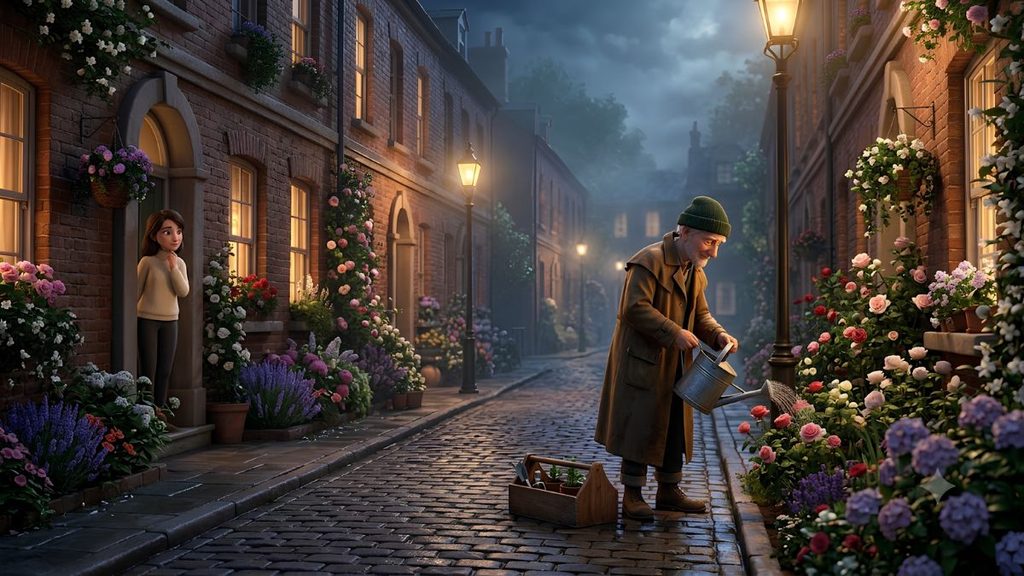
Type: Gentle Fantasy, Nature & Connection
Tone: Peaceful, magical, nostalgic, heartwarming
Bell Street was not the sort of street people wrote about.
It was narrow and slightly crooked, tucked between two larger roads in an old part of the city. The buildings were three and four stories high, their brick facades darkened by years of rain and winter.
There was a bakery on one corner.
A small laundromat on the other.
Halfway down the street stood a closed bookstore with faded gold lettering above the door.
Nothing about Bell Street seemed particularly remarkable.
Except for the flowers.
They appeared everywhere.
Window boxes overflowed with lavender and white geraniums. Tiny roses climbed the iron railings outside apartment buildings. Purple crocuses emerged between cracks in the pavement every spring. Even the narrow strip of soil beneath the streetlamps seemed to produce something colorful whenever the weather allowed.
Nobody knew exactly who planted them.
The residents had theories.
Some believed the city maintained them.
Others thought an elderly woman who lived above the bakery cared for them.
A few people insisted the flowers had been there for generations.
Emma had lived on Bell Street for almost three years.
She had never thought much about the flowers.
Until one night when she couldn’t sleep.
It was twelve forty-seven in the morning.
Emma was lying awake in her apartment, staring at the ceiling.
She had spent the entire evening trying to convince herself that tomorrow would feel better.
It hadn’t been a particularly terrible day.
That was the problem.
Nothing dramatic had happened.
There had simply been too many small disappointments.
A difficult conversation at work.
A message she had hoped to receive but hadn’t.
An appointment that had been canceled.
A bill she had forgotten.
A feeling she couldn’t quite name.
By midnight, she was tired but unable to sleep.
So she made tea.
She put on her coat.
And went outside.
The city was unusually quiet.
Bell Street looked completely different after midnight.
The bakery windows were dark.
The laundromat was empty.
Streetlights cast pale circles onto the pavement.
Emma walked slowly.
Then she noticed someone kneeling beside the flowers outside number seventeen.
An old man.
He wore a long brown coat and a wool hat.
Beside him sat a wooden box filled with gardening tools.
He was carefully planting something beneath a streetlamp.
Emma stopped.
The man didn’t notice her.
He pressed the soil gently around a small plant.
Then he watered it.
He stood.
Looked at the flower.
And smiled.
Emma watched from across the street.
Then the man walked away.
He didn’t enter a building.
He simply continued down Bell Street.
At the next garden, he stopped.
Then another.
And another.
Emma followed at a distance.
The old gardener worked quietly for almost an hour.
At one point, he stopped beside a window box filled with wilted flowers.
He removed the dead stems.
Loosened the soil.
Added a little water.
Then he placed a tiny white flower in the middle.
Emma finally spoke.
“Excuse me?”
The man turned.
He didn’t seem startled.
Instead, he smiled.
“Good evening.”
“Do you work for the city?”
“No.”
“Then who do you work for?”
The old man looked down Bell Street.
“Nobody.”
Emma frowned.
“Then why are you doing this?”
He picked up his wooden box.
“Because someone has to.”
Then he walked away.
Emma stood beneath the streetlamp.
The little white flower moved gently in the night breeze.
The following night, Emma saw him again.
12:52 a.m.
Same coat.
Same wooden box.
Same quiet footsteps.
This time she didn’t follow him.
Instead, she stood outside her apartment and watched.
He stopped beneath a tree.
He inspected the soil.
Then he took out a small notebook.
He wrote something.
Emma became curious.
“What are you writing?”
The gardener looked up.
“Names.”
“Whose names?”
“People.”
“Why?”
He closed the notebook.
“Some flowers need names.”
Emma didn’t understand.
The gardener smiled.
“You’ll understand eventually.”
Then he continued down the street.
For several nights, Emma watched him.
She began noticing things.
He never worked quickly.
He seemed to know every plant personally.
He knew which flowers needed more water.
Which soil was too dry.
Which plants needed pruning.
Which walls received enough sunlight.
Sometimes he worked for an hour.
Sometimes only ten minutes.
And sometimes he would simply sit on a bench and look at the flowers.
One night, Emma followed him.
He led her to a small courtyard behind an old apartment building.
There were dozens of plants.
Some were familiar.
Others she had never seen before.
“How long have you been doing this?” she asked.
The gardener looked at the courtyard.
“Long enough.”
“How long is long enough?”
He smiled.
“Forty-three years.”
Emma stared at him.
“You’ve been gardening here for forty-three years?”
“Yes.”
“Why?”
The old man took a small watering can.
“Because Bell Street needed flowers.”
“That doesn’t explain anything.”
“No.”
He began watering the plants.
“But perhaps it doesn’t need explaining.”
Emma sat on the bench.
She watched him work.
Eventually she asked:
“What is your name?”
“Arthur.”
“Arthur what?”
“Just Arthur.”
She laughed.
“That’s mysterious.”
“So I’ve been told.”
The next night, Emma left a note.
She wrote it on a small piece of paper.
Thank you for the flowers.
She folded it and placed it beneath the flowerpot outside number seventeen.
The following evening, the note was gone.
In its place was another.
Arthur’s handwriting was neat and slightly old-fashioned.
You’re welcome.
Emma smiled.
The next night, she wrote:
Why do you garden at night?
Arthur replied:
The city is quieter then. Flowers like quiet.
Emma wrote:
Do they really?
The answer came the next night.
People do too.
That sentence stayed with her.
Their correspondence continued.
They never spoke about it.
Emma left notes.
Arthur answered.
Sometimes her questions were simple.
What’s your favorite flower?
The one that survives.
Why do you plant flowers outside people’s homes?
Because everyone deserves something beautiful when they open the door.
Do you know everyone who lives here?
Not everyone.
Then how do you know where to plant them?
Arthur’s answer was:
People leave clues.
Emma thought about that.
What clues?
She began paying attention.
A woman in apartment nine always walked slowly beneath the trees.
A young man from number twenty-one sat alone on the steps every Sunday.
The baker sometimes stood outside before dawn, staring at the sky.
An elderly couple rarely left their apartment except in the afternoon.
Perhaps Arthur noticed these things too.
Perhaps that was how he knew.
One rainy evening, Emma found Arthur sitting beneath the awning of the closed bookstore.
He wasn’t gardening.
He was holding an old photograph.
Emma sat beside him.
“Who are they?”
He showed her the picture.
It was Bell Street.
But the street looked completely different.
There were fewer cars.
Different buildings.
Children playing near the pavement.
And almost no flowers.
“That’s when I first came here,” Arthur said.
“Why?”
“My wife and I moved into number twenty-six.”
“What happened?”
Arthur smiled at the photograph.
“We thought we’d stay for a year.”
“How long did you stay?”
“She stayed forty years.”
Emma looked at him.
“I’m sorry.”
Arthur nodded.
“Thank you.”
He folded the photograph carefully.
“She loved flowers.”
“Is that why you started?”
“Partly.”
He looked down the street.
“But there was another reason.”
“What?”
“She believed people become stronger when they have something small to care for.”
Emma was quiet.
Arthur continued.
“After she died, I didn’t know what to do with myself.”
“So you planted flowers?”
“I planted one.”
“One?”
“A rose outside the bakery.”
“What happened?”
“It grew.”
Arthur smiled.
“And someone watered it.”
Over the next few years, Arthur planted more.
He discovered that people noticed.
Someone placed a flowerpot outside their door.
Then another person planted herbs.
Someone repaired an old garden box.
A child began leaving sunflower seeds on the pavement.
Eventually Bell Street became known for its flowers.
But Arthur never claimed credit.
He preferred to remain invisible.
Emma understood why.
The flowers belonged to everyone.
One spring morning, Emma noticed a new flower outside apartment twelve.
It was small and blue.
She had never seen it before.
That evening, she asked Arthur about it.
“That’s for Mr. Harris.”
“Who is Mr. Harris?”
“The man who lives there.”
“Why does he need a flower?”
Arthur smiled.
“Everyone needs one eventually.”
Emma thought about that.
“What does the flower mean?”
“Nothing.”
“Nothing?”
“That’s the point.”
He knelt beside it.
“Sometimes beauty doesn’t need to mean anything.”
Emma smiled.
As the months passed, Emma became part of the quiet tradition.
She started helping Arthur.
Not every night.
Only sometimes.
She learned how to prune roses.
She learned when to plant bulbs.
She learned which flowers survived cold weather.
Most importantly, she learned to notice people.
The woman who always walked slowly.
The baker who stood outside before sunrise.
The young man who sat alone on the steps.
The elderly couple.
She began noticing when someone had a difficult week.
And sometimes, without telling anyone why, she planted something.
A little lavender.
A yellow flower.
A pot of mint.
A single rose.
She discovered that Arthur had been right.
People left clues.
You simply had to pay attention.
Years later, Arthur became too old to walk the whole length of Bell Street.
One evening, Emma found him sitting on a bench.
His wooden gardening box rested beside him.
“You should go home,” she said.
“I am home.”
Emma sat beside him.
They watched the street.
Flowers moved gently in the evening breeze.
“Who will take care of them?” she asked.
Arthur looked at her.
“Who do you think?”
Emma laughed.
“I don’t know enough.”
“You know more than I did when I started.”
“What if I make mistakes?”
“You will.”
“What if I forget something?”
“You will.”
“What if the flowers die?”
“Some will.”
Arthur smiled.
“That’s gardening.”
Emma looked at the flowers.
Then she understood.
The gardener’s job had never been to make everything last forever.
It was to keep planting.
Arthur died quietly the following winter.
Bell Street felt different afterward.
For several nights, no one watered the flowers.
Then something unexpected happened.
At midnight, Emma stepped outside.
She found the residents of Bell Street working together.
The baker was carrying water.
The young man from number twenty-one was pruning roses.
The elderly couple had brought seeds.
Children were placing small stones around new plants.
Everyone was there.
Nobody had organized it.
Nobody had asked them to come.
They simply knew.
Emma looked at the street.
For forty-three years, Arthur had believed flowers could remind people to care.
He had been right.
The flowers had taught them.
Years passed.
Bell Street became greener.
The old bookstore reopened.
The bakery expanded.
The laundromat received new windows.
People moved away.
New people arrived.
Children grew up.
Buildings changed.
But the flowers remained.
And every night after midnight, someone could be seen walking down Bell Street with a wooden gardening box.
Sometimes it was Emma.
Sometimes it was a neighbor.
Sometimes a child carrying a tiny watering can.
Nobody called themselves the night gardener.
The title belonged to Arthur.
But his work had become something larger than one person.
It had become a quiet tradition.
One night, long after Arthur was gone, Emma found an old note tucked beneath a flowerpot.
She recognized the handwriting immediately.
It must have been written years earlier.
Perhaps Arthur had left it there intentionally.
It said:
Plant something for someone who needs hope.
Emma stood beneath the streetlamp.
The city around her was sleeping.
Windows glowed softly in the darkness.
A breeze moved through the flowers.
Emma smiled.
Then she knelt.
She dug a small hole in the soil.
Placed a seed inside.
Covered it gently.
And watered it.
She didn’t know who would need the flower.
She didn’t know when it would bloom.
She didn’t even know what it would become.
But she knew something Arthur had known all those years ago.
Sometimes hope doesn’t arrive as a grand promise.
Sometimes it arrives as a tiny seed beneath the soil.
Sometimes it is a flower outside a stranger’s door.
Sometimes it is a note left in the darkness.
And sometimes, when the city is quiet and everyone has finally gone to sleep, hope looks like an old gardener walking gently beneath the streetlights, caring for something beautiful simply because it is there.
Emma stood.
She looked down Bell Street.
The flowers swayed in the night breeze.
And somewhere beneath the soil, something had already begun to grow.
The Library Open After Midnight
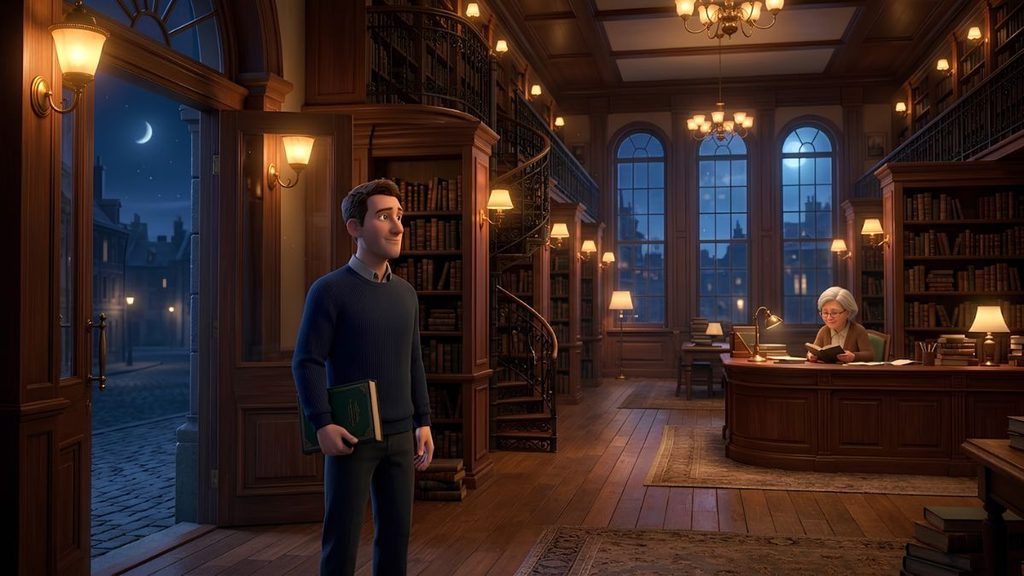
Type: Magical Realism, Books & Quiet Discovery
Tone: Gentle, atmospheric, reflective, comforting
Michael had stopped reading for pleasure.
He still read, of course.
He read emails.
Reports.
News articles.
Messages.
Instructions.
Occasionally, he read the first few pages of a novel before putting it aside because something else needed his attention.
But he could no longer remember the last time he had read a book simply because he wanted to know what was inside it.
His apartment was full of books.
They stood on shelves.
They were stacked beside the sofa.
There were even several boxes of them in the hallway.
Some had been gifts.
Some had belonged to his parents.
Some had been bought during periods when Michael had promised himself that he would become the sort of person who spent quiet evenings reading.
That person had never quite appeared.
Then, one November night, Michael discovered a library that should not have been open.
It was 12:14 a.m.
Michael was walking home from the train station.
The day had been long.
Not terrible.
Just long.
His thoughts were full of unfinished conversations and small worries that had followed him all the way home.
He turned onto his street.
The old library stood at the corner.
It had been closed for years.
Everyone knew that.
The building had once been beautiful, with tall arched windows, stone columns, and a large wooden door.
But the roof had developed problems.
The city had eventually moved the library to a modern building several streets away.
The old one remained empty.
Michael had passed it hundreds of times.
That night, however, he noticed something.
A light.
One of the tall windows on the second floor was glowing.
Michael stopped.
He looked again.
Warm yellow light.
Definitely.
He walked closer.
Then he saw another light.
And another.
Finally, he noticed something else.
The front door was open.
Michael stood on the pavement.
He should have continued home.
Instead, he walked toward the entrance.
A brass plaque beside the door read:
BELLWOOD PUBLIC LIBRARY
The lettering was old and slightly worn.
Michael pushed the door.
It opened without resistance.
Inside was darkness except for a series of lamps glowing along the central staircase.
The smell of old paper surrounded him.
He stepped inside.
The door closed behind him.
Somewhere deeper in the building, a clock chimed.
Once.
Michael looked at his phone.
12:17 a.m.
A small desk stood near the entrance.
Behind it sat an elderly librarian.
She was wearing round glasses and reading a book.
She looked up.
“Good evening.”
Michael stared at her.
“Is this library open?”
She smiled.
“Apparently.”
“Apparently?”
“You’re here, aren’t you?”
Michael glanced around.
“I thought this place had been closed for years.”
“It has.”
“Then what am I doing here?”
The librarian closed her book.
“Probably looking for something.”
Michael laughed nervously.
“I’m not looking for anything.”
The woman studied him.
“Everyone says that.”
Her name was Mrs. Ellis.
She didn’t ask Michael for identification.
She didn’t ask for a library card.
Instead, she handed him a small paper slip.
At the top was a handwritten sentence:
You have one hour.
Michael looked at the clock.
12:19.
“One hour for what?”
“To find what you need.”
“What if I don’t know what I need?”
“Most people don’t.”
She pointed toward the shelves.
“That’s why there are books.”
Michael walked away.
The library seemed much larger inside than it appeared from outside.
Rows of shelves stretched into darkness.
Lamps hung overhead.
Their light was soft and golden.
There was no humming of computers.
No ringing phones.
No footsteps.
Only the occasional sound of a page turning somewhere in the distance.
Michael ran his fingers along the books.
History.
Poetry.
Travel.
Philosophy.
Fiction.
Gardening.
Cooking.
Art.
Biographies.
Then he noticed a section without a sign.
It contained only a handful of books.
He picked up the nearest one.
There was no title.
Only his name.
MICHAEL
He almost dropped it.
He carried the book to a reading table.
The cover was dark blue.
He opened it.
The first page contained a single sentence:
You don’t have to solve everything tonight.
Michael stared at it.
He read it again.
Then again.
Something inside him loosened.
He had spent months believing that every problem needed an immediate solution.
The difficult conversation.
The uncertain career decision.
The strained friendship.
The question about where his life was going.
Everything seemed urgent.
But the sentence suggested something different.
Maybe some things could simply remain unresolved for a while.
Michael closed the book.
He looked toward the desk.
Mrs. Ellis was still reading.
He returned the book to the shelf.
Then he noticed something strange.
The book was gone.
In its place stood another.
Its title was:
The Things You Cannot Carry Forever
Michael picked it up.
This book was different.
It contained no story.
Instead, every few pages there was a short reflection.
One page said:
Some responsibilities belong to you.
Another:
Some responsibilities were handed to you because someone else didn’t know how to carry them.
Another:
Returning something to its rightful owner is not cruelty.
Michael sat down.
He thought about his family.
For years, he had carried expectations that had never been spoken aloud.
He had believed he needed to make everyone proud.
He had believed that disappointing someone meant he had failed.
But perhaps expectations were not always obligations.
He read another page.
You can love people without living the life they imagined for you.
Michael closed the book.
His eyes felt unexpectedly warm.
He hadn’t realized how tired he was.
At 12:41, he returned the book.
Another appeared.
This one was titled:
A Small Guide to Ordinary Days
It contained descriptions of simple moments.
Making breakfast.
Walking through a park.
Calling an old friend.
Watching rain from a window.
Buying bread.
Watering a plant.
Listening to music while doing nothing else.
Michael smiled.
He realized how long it had been since he had done something without trying to make it productive.
His entire life had become a series of goals.
Even relaxation had become something he needed to accomplish correctly.
He turned another page.
An ordinary day is not a wasted day.
Michael read the sentence slowly.
Then he closed the book.
At 12:53, Michael began exploring again.
The library seemed to change as he walked.
A staircase appeared where he was certain there had been a wall.
A narrow hallway led to a reading room he had never seen.
There were comfortable chairs beside tall windows.
Outside, the city was sleeping.
Inside, everything was still.
On a table lay another book.
Its title was:
For the Person Who Keeps Looking Back
Michael hesitated.
Then he opened it.
The book was about memory.
Not forgetting.
Not moving on.
Simply remembering without constantly returning.
One passage said:
The past is a place you can visit.
It does not have to be a place where you live.
Michael thought about his father.
His father had died several years earlier.
Michael had avoided thinking about him because every memory seemed to bring regret.
Things he wished they had discussed.
Things he wished he had said.
Arguments that now seemed insignificant.
The book didn’t tell him to stop remembering.
It offered something gentler.
Memory could be painful and beautiful at the same time.
He didn’t have to choose between the two.
At 1:02 a.m., the library clock chimed.
Michael looked at the time.
His hour was almost over.
He walked back toward the entrance.
Mrs. Ellis looked up.
“Did you find what you needed?”
Michael thought about it.
“I don’t know.”
She smiled.
“That’s usually a good sign.”
He looked at the shelves.
“Who writes these books?”
“People.”
“Which people?”
“The people who need them.”
Michael frowned.
“How can a book know what someone needs?”
Mrs. Ellis adjusted her glasses.
“Perhaps books don’t know.”
“Then how does it work?”
“Perhaps you do.”
Michael smiled.
“Is this place always open at midnight?”
“No.”
“When does it open?”
“When someone needs a quiet place.”
“How often does that happen?”
“More often than you’d think.”
Before leaving, Michael asked:
“Can I borrow a book?”
Mrs. Ellis looked amused.
“You can borrow one.”
“Which one?”
She pointed toward a shelf.
A thin green book stood alone.
Its title was:
Tomorrow Can Wait Until Morning
Michael picked it up.
Mrs. Ellis stamped the inside cover.
The date was blank.
“So when is it due?”
“When you’re finished.”
“And when is that?”
“You’ll know.”
Michael thanked her.
He walked outside.
The street was exactly as he remembered it.
Cold.
Quiet.
Ordinary.
He looked back.
The library door was closed.
All the lights had disappeared.
He checked his phone.
1:09 a.m.
He turned toward home.
The green book felt warm beneath his arm.
Michael read it the next evening.
Then the next.
It wasn’t a traditional book.
There was no main character.
No plot.
No dramatic ending.
It contained small observations about life.
One page described the comfort of clean sheets.
Another talked about cooking something slowly.
Another described sitting beside someone without needing to speak.
Another said:
You are allowed to have an unfinished life.
Michael stopped there.
He read the sentence again.
His life had always felt unfinished.
He had thought that was a problem.
He had imagined that one day everything would finally make sense.
The right job.
The right relationship.
The right home.
The right plans.
Then, finally, peace.
But perhaps peace wasn’t waiting at the end of everything.
Perhaps it could exist alongside uncertainty.
Michael closed the book.
For the first time in years, he felt no need to figure out what came next.
Weeks passed.
Michael changed small things.
He started leaving work on time once a week.
He called his mother more often.
He began walking home instead of taking the train when the weather was pleasant.
He cooked dinner without checking his phone.
He returned to reading.
Not every night.
Not perfectly.
But enough.
The green book remained on his bedside table.
Sometimes he opened it.
Sometimes he didn’t.
Eventually, he noticed something strange.
The library had become part of his thoughts.
Whenever life felt overwhelming, he imagined those warm lamps.
The quiet shelves.
The smell of paper.
Mrs. Ellis sitting behind the desk.
He began wondering whether the library was still there.
One rainy night, months after his first visit, he walked past the old building.
The windows were dark.
The door was locked.
There was no sign of Mrs. Ellis.
Michael smiled.
Perhaps it had only been a dream.
Perhaps it had been something else.
He didn’t need to know.
Years later, Michael still remembered the library.
He had changed jobs.
Moved apartments.
Made new friends.
Lost some old ones.
He had learned that life rarely followed the plans people made for it.
There were still difficult days.
Still unanswered questions.
Still moments when he wished he could go back and change something.
But he no longer demanded that every uncertainty be resolved immediately.
Sometimes, when he felt overwhelmed, he would walk somewhere quiet.
Sit down.
Put his phone away.
And remember the first book.
You don’t have to solve everything tonight.
It remained one of the most useful things anyone had ever told him.
Then, one winter evening, Michael was walking through another part of the city when he saw something familiar.
An old stone building.
Tall windows.
A wooden door.
A brass plaque.
He stopped.
The building was not the Bellwood Library.
He knew that.
This was a completely different neighborhood.
Yet there was something about it.
He pushed the door.
Inside was a small reading room.
Warm lamps.
Wooden shelves.
An elderly woman behind a desk.
Michael smiled.
“Are you open?”
The woman looked up.
She smiled.
“Only for an hour.”
Michael stepped inside.
“Do you have a book for someone who doesn’t know what he needs?”
The woman nodded.
“We usually do.”
Outside, the city continued rushing through the night.
Inside, a clock ticked quietly.
A page turned.
And for one peaceful hour, there was nowhere else Michael needed to be.
The Lighthouse Keeper’s Guestbook

Type: Coastal, Nostalgia & Human Connection
Tone: Peaceful, nostalgic, atmospheric, warm
Sophie had not planned to disappear.
She had simply reached a point where she didn’t know what else to do.
For months, her life had been filled with noise.
Not necessarily loud noise.
Emails.
Phone calls.
Traffic.
Conversations.
Notifications.
The endless hum of people moving quickly from one thing to another.
She had become very good at appearing busy.
She answered messages quickly.
She attended meetings.
She remembered birthdays.
She made lists.
She kept promises.
And yet, somewhere beneath all of it, Sophie felt tired in a way that sleep alone couldn’t fix.
So when she found an advertisement for a small lighthouse cottage on the coast, she booked it for one week.
There was almost no information in the listing.
One bedroom. Small kitchen. Ocean view. Lighthouse nearby.
That was enough.
She packed one suitcase.
Turned off her work phone.
And drove toward the sea.
The lighthouse stood on a rocky point several kilometers beyond the nearest village.
It was white, weathered, and slightly crooked-looking from a distance.
Beside it stood a small stone cottage with blue shutters.
An elderly caretaker named Harold met Sophie at the gate.
“You’re staying seven nights,” he said.
“Yes.”
“Good.”
He handed her a brass key.
“Everything you need is inside.”
“Is there a shop nearby?”
“Village is four kilometers.”
“A restaurant?”
“One.”
“Anything else?”
Harold looked toward the lighthouse.
“The sea.”
Sophie smiled.
“I suppose that’s enough.”
Harold nodded.
“It usually is.”
The cottage was small but beautiful.
There was a wooden table beside the window.
A narrow bed.
A fireplace.
A bookshelf.
A kettle.
Two comfortable chairs.
The windows looked directly toward the sea.
Sophie unpacked slowly.
There was no television.
The internet signal was weak.
Her phone showed one bar.
She put it in a drawer.
Then she opened the window.
Wind entered the room.
She could hear waves crashing against the rocks below.
For the first time in months, Sophie felt her shoulders relax.
That evening, she walked around the lighthouse.
The door was locked.
A sign explained that the tower was no longer used as an active lighthouse but had been preserved as a historic landmark.
Sophie walked back to the cottage.
On the kitchen table, she noticed something she hadn’t seen before.
A thick blue book.
Its cover was worn.
There was no title.
She opened it.
The first page said:
Visitors’ Guestbook
Below that was a date.
June 1948.
Sophie sat down.
She began reading.
The first entry was short.
I came here because my brother returned from the war and I didn’t know how to talk to him.
Sophie turned the page.
Another:
The sea is larger than my worries.
Another:
We brought sandwiches and forgot the picnic basket.
Another:
I proposed today. She said yes.
Another:
My father brought me here when I was nine. Today I brought my daughter.
Sophie smiled.
She continued.
The handwriting changed from page to page.
Some entries were neat.
Some hurried.
Some almost unreadable.
People had written in pencil, blue ink, black ink, even red crayon.
There were drawings.
Pressed flowers.
Small photographs.
A train ticket.
A postcard.
A child’s handprint.
Sophie closed the book after midnight.
She had intended to read only a few pages.
Instead, she had spent nearly three hours traveling through other people’s lives.
The next morning, Sophie walked to the village.
On the way, she kept thinking about the guestbook.
She wondered how many people had stood in the cottage.
How many had looked through the same window.
How many had watched the same waves.
At the village café, she asked the owner about it.
“Ah,” the woman said.
“The guestbook?”
“Yes.”
“You know about it?”
“Everyone knows.”
“How old is it?”
“Older than me.”
“Who started it?”
“No one knows.”
The woman poured coffee.
“Harold might.”
“I met him yesterday.”
“Ask him.”
Sophie found Harold near the lighthouse that afternoon.
“Who started the guestbook?”
Harold smiled.
“Nobody knows.”
“That’s what the café owner said.”
“Then she is right.”
“How did it get here?”
“People brought their stories.”
Sophie looked confused.
“Stories?”
“People come to the sea when they have something they can’t say anywhere else.”
He looked toward the water.
“Sometimes they write it down.”
“Do you read them?”
“Not usually.”
“Why not?”
“They aren’t mine.”
Sophie respected that.
Then Harold added:
“Although some people leave messages specifically for whoever comes next.”
“Have you read those?”
“A few.”
“Do you remember any?”
He smiled.
“One said, ‘If you’re reading this, you’re probably worrying too much.'”
Sophie laughed.
“That’s good advice.”
“Yes.”
Harold walked away.
Sophie stood beside the lighthouse.
The wind lifted her hair.
She looked toward the horizon.
That evening, she opened the guestbook again.
She began looking for messages addressed to future visitors.
She found one from 1963:
You don’t need to know what happens next.
Another from 1979:
Stay until sunset.
Another from 1988:
The thing you think is the end may simply be a change of direction.
Another from 1997:
We came here after losing our home. We didn’t know what we would do next. Somehow, the sea made tomorrow seem possible.
Sophie stopped reading.
She looked out the window.
The sun was beginning to set.
Orange light stretched across the water.
She closed the book.
Then she walked outside.
She sat on the rocks until the sun disappeared.
The sea changed color.
Blue.
Silver.
Purple.
Then almost black.
She thought about the people whose messages she had read.
They had all stood somewhere near this same place.
Different decades.
Different clothes.
Different worries.
Different lives.
But the sea had remained.
The lighthouse had remained.
The wind had remained.
And somehow, their words had remained too.
Sophie felt something she hadn’t expected.
Companionship.
She was alone.
Yet she no longer felt lonely.
On the third night, she found an entry written by someone named Thomas.
The date was 1956.
I am twenty-three years old and have no idea what I am doing.
Sophie smiled.
Then she read the next line.
I thought by this age I would understand my life.
She laughed quietly.
Thomas could have written it that morning.
The next page contained another entry from thirty years later.
I am fifty-two and still don’t know what I am doing.
Then another:
I am seventy-one. Still figuring it out.
Sophie sat back.
The three messages were separated by decades.
Yet together they formed something comforting.
Nobody had ever completely figured life out.
Perhaps nobody was supposed to.
On the fourth day, rain arrived.
It began before breakfast.
By afternoon, the sea had disappeared behind gray mist.
Sophie lit the fireplace.
She made tea.
Then she opened the guestbook.
The rain continued for hours.
She read messages from people who had visited during storms.
One person wrote:
The lighthouse looked lonely tonight.
Another responded beneath it:
No. It looked like it was keeping watch.
Another:
We stayed indoors all day. Best day of the trip.
Sophie smiled.
She had expected bad weather to ruin her holiday.
Instead, she discovered that the cottage felt even more peaceful during rain.
She sat beside the window.
The lighthouse disappeared and reappeared through the mist.
She read until she became sleepy.
On the fifth night, Sophie found a photograph.
It had been tucked between two pages.
A young couple stood beside the lighthouse.
The woman was holding a small child.
On the back someone had written:
Our first family holiday. 1972.
Sophie wondered what happened to them.
Did the child grow up?
Did the couple remain together?
Did they ever return?
She would never know.
That was the strange beauty of the guestbook.
Most stories had no ending.
People arrived.
They wrote something.
Then they left.
Their lives continued somewhere else.
The book captured only a moment.
A single evening.
A single thought.
A single version of a person.
Sophie realized that perhaps her own life was like that too.
She didn’t need to understand the entire story.
She only needed to live the page she was currently on.
On the sixth evening, Sophie decided to write something herself.
She opened the guestbook to the next blank page.
She held the pen.
For several minutes, she didn’t know what to say.
Then she wrote:
I came here because I was tired of carrying everything.
She paused.
Then continued.
I thought being alone would make me feel lonely.
She looked toward the sea.
Instead, I discovered that hundreds of people had stood here before me, carrying their own worries.
She wrote:
None of them knew me.
I don’t know them.
But somehow, tonight, I don’t feel alone.
Sophie stopped.
Then she added one final sentence.
If you’re reading this years from now, I hope you are doing okay.
She closed the book.
The next morning, Harold came to check the cottage.
“You’ve written in the book,” he said.
Sophie looked surprised.
“How did you know?”
“You have ink on your hand.”
She laughed.
Harold smiled.
“What did you write?”
“Nothing important.”
“Those are usually the important things.”
They walked toward the lighthouse together.
Sophie asked:
“Do you think people remember this place?”
Harold looked at the sea.
“Some do.”
“How do you know?”
“They come back.”
“After years?”
“Sometimes decades.”
“Why?”
Harold shrugged.
“Perhaps they want to see whether the sea is still here.”
“Is it?”
He smiled.
“It usually is.”
That afternoon, Sophie packed her suitcase.
She wasn’t ready to leave.
But she had to.
She placed the guestbook on the table.
Before closing the cottage door, she looked back at the room.
The chair.
The fireplace.
The window.
The table.
The sea.
She felt strangely grateful.
Nothing spectacular had happened during her week.
No grand discovery.
No dramatic transformation.
She had simply read words written by strangers.
Watched sunsets.
Walked beside the water.
Drunk tea.
Listened to rain.
And rested.
But perhaps that was enough.
Before she left, Sophie walked to the lighthouse one final time.
She placed her hand against its white stone.
It was cold.
She looked out toward the horizon.
The sea stretched endlessly beneath the morning sky.
She thought about Thomas, the twenty-three-year-old who had worried about his future.
The family from 1972.
The person who had lost their home.
The person who had proposed.
The person who had written about their brother.
All of them had believed their moments were temporary.
And yet here they were.
Still speaking.
Across decades.
Across generations.
Across the distance between strangers.
Sophie smiled.
Perhaps that was what the guestbook really preserved.
Not stories.
Presence.
Proof that someone had stood here.
Someone had watched this sea.
Someone had felt uncertain.
Someone had hoped.
Someone had been happy.
Someone had been afraid.
Someone had simply needed a quiet place.
And for a few minutes, Sophie felt connected to all of them.
Years later, Sophie would sometimes think about the lighthouse.
She would remember the sound of waves at night.
The blue guestbook.
The smell of the old cottage.
The handwritten messages.
And whenever life became too loud, she would remember one particular sentence:
You don’t need to know what happens next.
It became something she carried with her.
She didn’t know who had written it.
She didn’t know whether that person was still alive.
She didn’t know what their life had become.
But she knew they had once stood beside the same sea.
And somehow, that was enough.
Because life was not a single story.
It was a collection of moments.
Some bright.
Some difficult.
Some unfinished.
Some forgotten.
And every once in a while, two strangers could leave words for each other across the years.
A sentence in a book.
A flower pressed between pages.
A photograph.
A simple reminder:
You were here.
You felt this.
You made it through.
Keep going.
That night, back in her apartment, Sophie opened her bedroom window.
The city sounded different now.
Cars passed below.
Someone laughed in the street.
A distant siren faded.
She made tea.
Then she sat quietly beside the window.
For a moment, she imagined the lighthouse far away.
Its light turning slowly over the dark sea.
She imagined the guestbook resting on the wooden table.
Waiting for another visitor.
Waiting for another story.
And somewhere, perhaps years from now, another tired person would open its pages.
They would read the words of strangers.
They would discover that other people had once been uncertain too.
That other people had once stood exactly where they were standing.
That life had continued.
That the sea had remained.
And perhaps they would write a few words of their own.
Then close the book.
Turn off the light.
And sleep peacefully.
The Café Where Nobody Was in a Hurry
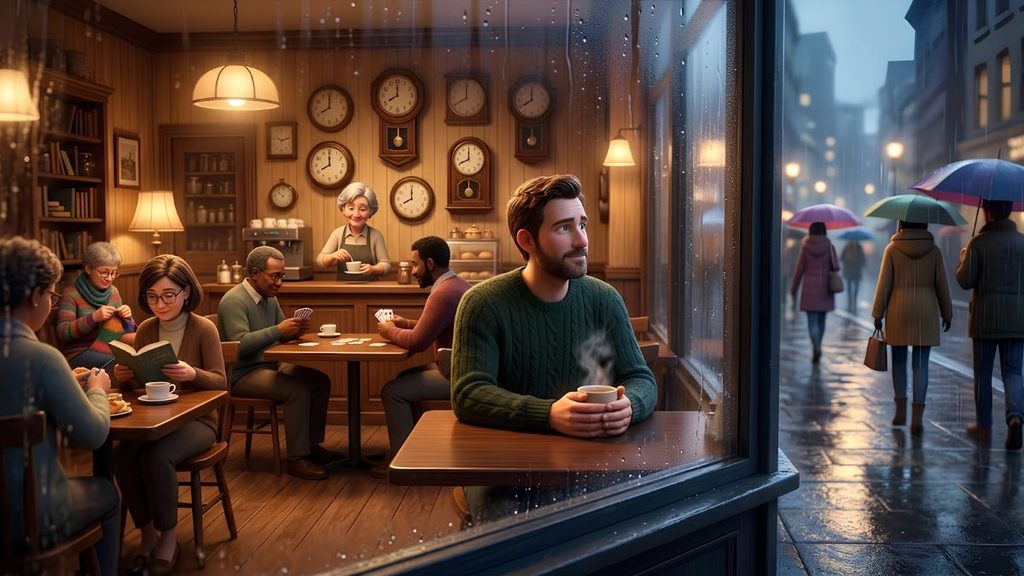
Type: Cozy Fiction, Everyday Life & Peace
Tone: Warm, slow-paced, comforting, reflective, gently whimsical
Daniel was always late.
Not dramatically late.
Never late enough to miss a train or arrive after a meeting had ended.
He was the sort of person who was three minutes late to everything.
Three minutes late to breakfast.
Three minutes late to appointments.
Three minutes late to dinner.
Three minutes late to his own life.
He compensated by walking quickly.
He ate quickly.
He spoke quickly.
He read emails while drinking coffee and checked his phone while waiting for elevators.
Even his weekends had schedules.
Saturday morning meant groceries.
Saturday afternoon meant errands.
Sunday meant laundry, meal preparation, and catching up on work.
When people asked him how he was doing, Daniel usually answered:
“Busy.”
It had become the easiest word in his vocabulary.
Then, one Thursday evening, it rained.
Not ordinary rain.
A steady autumn rain that seemed to cover the entire city in silver.
Daniel left work at 7:36 p.m.
His train was delayed.
His phone battery was at eleven percent.
His umbrella had broken.
And he had forgotten to eat dinner.
By the time he reached his neighborhood, his shoes were wet and his coat was dripping.
He stood beneath the awning of a closed shop and looked at the rain.
He could go home.
It was only ten minutes away.
But the thought of his empty apartment suddenly felt exhausting.
He wanted somewhere warm.
Somewhere quiet.
Somewhere that didn’t require him to do anything.
Then he noticed a small café.
He had walked past it hundreds of times.
He had never seen it open.
Tonight, a golden light glowed behind the windows.
A wooden sign hung above the door.
THE CORNER TABLE
Daniel pushed the door open.
A bell chimed.
Warmth surrounded him.
And for the first time that day, he stopped moving.
The café was tiny.
Six tables.
A long wooden counter.
A bookshelf.
Three lamps.
A collection of mismatched chairs.
Rain covered the windows.
Behind the counter stood an elderly woman wearing a gray cardigan.
She smiled.
“Good evening.”
“Are you still open?”
“Yes.”
Daniel looked at the clock above the counter.
8:02 p.m.
“Until when?”
The woman shrugged.
“Whenever.”
Daniel smiled uncertainly.
“I’ll have coffee.”
“We have tea.”
“Coffee?”
“We have tea.”
He looked at the menu.
There was no coffee.
No sandwiches.
No cakes.
Only tea.
“What kind?”
The woman pointed toward a handwritten list.
“Mint. Chamomile. Black. Ginger. Cinnamon.”
“Cinnamon.”
“Good choice.”
Daniel sat beside the window.
The woman brought him a cup.
He took a sip.
It was warm.
Sweet.
Comforting.
He looked around.
There were four other people in the café.
A man reading a newspaper.
A young woman knitting.
An elderly couple playing cards.
Nobody seemed to be in a hurry.
Daniel checked his phone.
8:07.
He had a message from work.
He opened it.
Then stopped.
He looked at the people around him.
For some reason, he put the phone away.
Ten minutes passed.
Then twenty.
Daniel expected someone to announce closing time.
Nobody did.
He looked at the clock again.
8:21.
Then 8:22.
Then 8:22.
The second hand wasn’t moving.
Daniel frowned.
He looked at another clock above the bookshelf.
8:22.
He checked his phone.
8:22.
He waited.
The minute changed.
8:23.
The clocks remained at 8:22.
Daniel looked at the woman behind the counter.
“Are the clocks broken?”
She glanced up.
“No.”
“Then why aren’t they moving?”
“They’ve stopped.”
“All of them?”
“Yes.”
“Why?”
She smiled.
“They do that sometimes.”
Daniel laughed.
“That’s not very reassuring.”
“It isn’t meant to be.”
He looked at the clocks again.
“Shouldn’t you fix them?”
“Why?”
“So people know what time it is.”
The woman shrugged.
“Nobody needs to know what time it is here.”
Daniel stared at her.
“What?”
She leaned against the counter.
“Our only rule is simple.”
“What rule?”
She smiled.
“While you’re inside, there is nowhere else you need to be.”
Daniel didn’t know how to respond.
The elderly woman returned to her work.
The room became quiet again.
Rain tapped against the windows.
The man reading the newspaper turned a page.
The young woman continued knitting.
The cards on the table made a soft clicking sound.
Daniel looked at his tea.
He realized something strange.
He wasn’t thinking about work.
He wasn’t checking his phone.
He wasn’t wondering what he should be doing next.
He was simply sitting.
It felt uncomfortable.
Then pleasant.
Then uncomfortable again.
He wasn’t accustomed to stillness.
After a while, the man with the newspaper spoke.
“First time?”
Daniel looked up.
“Here?”
The man smiled.
“Yes.”
“Yes.”
“Everyone finds it strange.”
“What is this place?”
“A café.”
“Obviously.”
The man laughed.
“You’re trying very hard to understand it.”
Daniel smiled.
“I like understanding things.”
“So do I.”
The man folded his newspaper.
“My name is Samuel.”
“Daniel.”
They shook hands.
Samuel pointed toward the rain.
“I come here every Thursday.”
“Why?”
“Because Thursday is the only day I remember to stop.”
Daniel thought about that.
“Do you work nearby?”
“I retired twelve years ago.”
“Then why do you need to stop?”
Samuel smiled.
“That’s exactly why.”
The young woman eventually introduced herself as Lily.
She was knitting a scarf.
“Who is it for?” Daniel asked.
“Myself.”
“How long will it take?”
She looked at the scarf.
“I don’t know.”
“Don’t you want to finish it?”
“Eventually.”
“How long have you been working on it?”
“Three years.”
Daniel laughed.
“Three years?”
Lily smiled.
“I like making it more than I like finishing it.”
Daniel looked at her hands.
The needles moved slowly.
One stitch.
Then another.
No urgency.
No deadline.
He found himself strangely fascinated.
At the table beside them, the elderly couple continued playing cards.
The woman noticed Daniel watching.
“Would you like to play?”
Daniel hesitated.
“I don’t know the game.”
“Neither do we.”
Her husband laughed.
“We’ve been making up the rules for twenty years.”
Daniel smiled.
“Does anyone ever win?”
“Not really.”
“Then what’s the point?”
The woman placed a card on the table.
“Exactly.”
Daniel laughed.
Something about the café was beginning to make sense.
Or perhaps it was beginning to make less sense in a way that felt good.
The owner brought him another cup of tea.
“I didn’t order this.”
“I know.”
“I should pay for it.”
“You can.”
“How much?”
“Nothing.”
Daniel frowned.
“Nothing?”
“Tea is cheap.”
She placed the cup down.
“Rest is harder to find.”
Daniel looked at her.
“What is your name?”
“Margaret.”
“How long have you owned this café?”
“Thirty-one years.”
“Has it always been like this?”
Margaret smiled.
“Not exactly.”
“What changed?”
“I did.”
Margaret sat at the table.
She told Daniel that when she had opened the café, she had been impatient.
She wanted more customers.
More money.
More recognition.
She opened early.
Closed late.
Added menus.
Changed furniture.
Advertised.
Eventually, she became exhausted.
One evening, after a particularly difficult day, she sat down after closing.
She realized she had no idea what the café sounded like when nobody was working.
So she stayed.
She listened to the rain.
She drank tea.
She watched the street.
The next morning, she removed the clocks.
Daniel laughed.
“You removed the clocks?”
“Most of them.”
“Why?”
“Because I realized everyone was using them to leave.”
She looked around the café.
“So I made a place where leaving wasn’t urgent.”
Daniel looked at his phone.
The battery was now at four percent.
He turned it off.
He put it on the table.
Something about the gesture felt significant.
Without the phone, the room seemed quieter.
He could hear the rain more clearly.
He noticed the smell of cinnamon.
The warmth of the cup in his hands.
The soft movement of Lily’s knitting needles.
Samuel turning pages.
The elderly couple laughing at their invented card game.
He had spent years moving through life without noticing any of these things.
At some point, Margaret brought out a plate of warm bread.
“Where did that come from?”
“The kitchen.”
“You have a kitchen?”
“Of course.”
Daniel smiled.
“I thought you only served tea.”
“We serve whatever people need.”
Daniel took a piece of bread.
It was warm.
He spread butter across it.
He ate slowly.
He couldn’t remember the last time he had eaten something without simultaneously doing something else.
No television.
No phone.
No reading.
No conversation.
Just bread.
He smiled.
The rain became heavier.
The windows fogged.
The café grew warmer.
Daniel leaned back in his chair.
His eyes became heavy.
He checked the clock.
Still 8:22.
“How long have I been here?”
Margaret smiled.
“Long enough.”
“But what time is it really?”
“Does it matter?”
Daniel thought about it.
For once, it didn’t.
Samuel began telling a story about his first job.
Lily talked about a grandmother who had taught her to knit.
The elderly couple described the first apartment they had shared fifty years earlier.
Daniel listened.
He told them about his work.
About his apartment.
About how he had forgotten what weekends were supposed to feel like.
Nobody offered advice.
Nobody told him to change his life.
They simply listened.
And Daniel realized how rare that was.
Sometimes people didn’t need solutions.
They needed somewhere to put their thoughts down for a while.
Near midnight, Daniel stood.
“I should go.”
Margaret nodded.
“Of course.”
He looked around.
The clocks still showed 8:22.
“Are they ever going to start again?”
“Yes.”
“When?”
“When everyone leaves.”
Daniel laughed.
“Then they’ll never move.”
Margaret smiled.
“They always do.”
Daniel put on his coat.
At the door, he turned.
“Will you be here next Thursday?”
Margaret nodded.
“Probably.”
“Can I come back?”
“You don’t need permission.”
He opened the door.
Cold air entered.
The rain had stopped.
Daniel stepped onto the pavement.
The city was quiet.
He looked back.
The café’s golden windows glowed behind him.
He walked home.
His apartment was exactly as he had left it.
Dark.
Quiet.
Ordinary.
Daniel put his wet coat away.
He made tea.
Then he sat beside the window.
His phone remained turned off.
He didn’t turn it back on.
The next morning, he woke up without an alarm.
He was late for work.
For perhaps the first time in his life, he didn’t panic.
He showered.
Made breakfast.
Walked to the train station.
The city was still rushing.
People hurried along sidewalks.
Cars honked.
Phones rang.
Daniel moved through it all at his own pace.
Not slowly.
Not quickly.
Just normally.
Thursday came again.
At 7:30 p.m., Daniel left work.
He didn’t check his messages.
He walked toward the little café.
The wooden sign was glowing beneath the streetlamp.
THE CORNER TABLE
He opened the door.
The bell chimed.
Margaret looked up.
“Good evening.”
Daniel smiled.
“Good evening.”
He sat beside the window.
She brought him cinnamon tea.
The clocks showed 8:22.
Daniel didn’t ask why.
Lily was there, still working on her scarf.
Samuel sat with his newspaper.
The elderly couple were playing cards.
Nothing had changed.
And somehow, everything had.
Daniel looked through the window.
People hurried along the street outside.
They carried umbrellas.
They checked their phones.
They looked at their watches.
They were going somewhere.
They had things to do.
Daniel understood.
He had spent years living exactly like that.
There was nothing wrong with being busy.
Nothing wrong with having plans.
Nothing wrong with moving forward.
But there had to be moments when you stopped.
Moments when you allowed yourself to simply exist.
Moments when you remembered that life wasn’t only the things waiting for you.
It was also the things happening right now.
Years later, Daniel would still visit the café.
Sometimes once a week.
Sometimes once a month.
Sometimes only when he needed it.
The café remained small.
The clocks remained broken.
The tea remained warm.
People came and went.
Some stayed for ten minutes.
Others stayed for hours.
Some talked.
Some read.
Some cried quietly.
Some fell asleep.
Nobody was asked to explain why they were there.
The rule remained the same.
While you’re inside, there is nowhere else you need to be.
Daniel eventually understood why the clocks stopped.
They weren’t broken.
They were simply unnecessary.
Outside, time measured everything.
Appointments.
Deadlines.
Trains.
Meetings.
Birthdays.
Years.
Inside, time was different.
It was measured in cups of tea.
Pages turned.
Stories shared.
Rainstorms watched through windows.
And quiet moments when someone finally stopped asking themselves what they should be doing.
One winter evening, Daniel sat beside the window while snow began falling.
He looked at the clock.
8:22.
He smiled.
Margaret placed a cup of tea in front of him.
“You look tired.”
“I am.”
“Then rest.”
Daniel wrapped his hands around the warm cup.
Outside, the city continued moving.
Inside, nobody was in a hurry.
And for a little while, neither was Daniel.
He watched the snow.
Listened to the quiet.
Took a slow breath.
And let the evening pass without asking it to become anything else.
That was the secret of the little café.
It didn’t stop time.
It simply gave people permission to stop chasing it.
And sometimes, that was all a tired person needed.
A warm chair.
A quiet window.
A cup of tea.
And one small reminder:
There is nowhere else you need to be.
The Suitcase Full of Quiet Things

Type: Emotional Journey, Memory & Letting Go
Tone: Gentle, nostalgic, reflective, comforting
When Eleanor moved to the city, she brought only what she thought she needed.
Two suitcases of clothes.
One box of books.
A small kitchen box.
Her laptop.
A framed photograph of her grandmother.
And a collection of things she had promised herself she would sort through later.
Later was Eleanor’s favorite word.
She would unpack later.
Call people later.
Decide what to do next later.
Think about the past later.
The move itself had been sudden.
Her old apartment had become too expensive, her job had changed, and the neighborhood she had known for years no longer felt like home.
So she found a small apartment in another city.
The place was on the fourth floor of an old building with tall windows and narrow hallways.
It wasn’t beautiful.
But it had good light.
Eleanor liked that.
For the first few weeks, she concentrated on settling in.
She learned which bakery opened early.
Which bus arrived on time.
Which grocery store had the best fruit.
She bought a plant for the windowsill.
She found a secondhand armchair.
Slowly, the apartment began to feel like hers.
Then one rainy Saturday afternoon, while unpacking the last few boxes, Eleanor found the suitcase.
It was an old brown suitcase.
The leather was cracked.
One brass clasp was slightly bent.
A faded luggage tag hung from the handle.
Eleanor recognized it immediately.
It had belonged to her grandmother.
She had seen it years ago in the attic of her grandmother’s house.
She remembered being told not to open it.
Not because there was anything dangerous inside.
Her grandmother had simply said:
“Some things are better opened when you’re ready.”
At the time, Eleanor had thought that sounded mysterious.
Now, sitting on the floor of her new apartment, she wondered what her grandmother had meant.
Her grandmother had died two years earlier.
Eleanor had not spoken about her much since.
Not because she didn’t love her.
Because she did.
Sometimes love made memories harder to touch.
Eleanor placed the suitcase on the floor.
She opened it.
Inside were six objects.
A train ticket.
A pressed leaf.
A handwritten recipe card.
A seashell.
An unfinished letter.
And several photographs.
There was no explanation.
No note.
Nothing telling her why these things had been kept.
Eleanor touched the train ticket first.
The Train Ticket
It was old and yellowed.
The date was printed in faded ink.
October 14, 1968.
The destination was a city Eleanor didn’t recognize.
She turned it over.
On the back, her grandmother had written:
The day I almost didn’t go.
Eleanor sat down.
She knew her grandmother had moved away from her hometown when she was young.
She had never known exactly why.
That evening, Eleanor called her mother.
“Did Grandma ever tell you about a train journey in 1968?”
Her mother thought for a moment.
“She told me a little.”
“What happened?”
“She was supposed to leave that morning.”
“Why?”
“She wanted to start working in another city.”
“Was she afraid?”
“Very.”
Eleanor smiled.
That didn’t surprise her.
Her grandmother had always seemed fearless.
She had run a small shop.
Raised three children.
Learned to drive in her forties.
Traveled alone.
But apparently, she had once stood on a railway platform wondering whether she should leave.
“What made her go?” Eleanor asked.
Her mother laughed softly.
“Her older sister pushed her onto the train.”
Eleanor laughed too.
Later that night, she placed the ticket on her desk.
She thought about all the lives that began with uncertain journeys.
Perhaps leaving wasn’t always a sign that you knew where you were going.
Sometimes it simply meant you were willing to discover it.
The Pressed Leaf
The second object was a maple leaf.
It had been carefully pressed between two sheets of paper.
The color had faded to a warm brown.
On the paper was written:
October 1974. North Hill.
Eleanor remembered North Hill.
Her grandmother used to take her there when she was a child.
They would walk along the trails.
Her grandmother always carried apples in her coat pocket.
Eleanor remembered sitting beneath a tree while her grandmother told stories.
She had forgotten how much she loved those afternoons.
She placed the leaf beside the train ticket.
Then she noticed something on the back of the paper.
A single sentence:
Some seasons are beautiful because they end.
Eleanor stared at it.
She thought about the apartment she had left.
The friendships that had faded.
The job she had outgrown.
The life she had thought she would have.
Perhaps endings weren’t always failures.
Some things ended because their season was finished.
That didn’t make them meaningless.
It made them complete.
The Recipe Card
The recipe card was stained with flour.
At the top, in her grandmother’s handwriting, were the words:
Sunday Apple Cake
Eleanor smiled.
She remembered the cake.
It had been one of the few desserts her grandmother made regularly.
She turned the card over.
There was a handwritten note:
For when the house feels too quiet.
Eleanor read it twice.
Then she looked around her apartment.
The house did feel quiet.
Not unpleasantly quiet.
Just unfamiliar.
She decided to make the cake.
The next morning, she bought apples.
She measured flour.
Cracked eggs.
Mixed cinnamon and sugar.
The kitchen slowly filled with warmth.
The smell reminded her of childhood.
When the cake was ready, Eleanor sat at the small kitchen table and ate a slice.
For a moment, she could almost hear her grandmother saying:
“Don’t cut it while it’s too hot.”
Eleanor laughed.
Then she cried.
Not because she was sad.
At least, not entirely.
Sometimes grief arrived carrying gratitude.
The Seashell
The seashell was small and pale.
Eleanor held it to her ear.
She didn’t expect to hear the ocean.
Of course she didn’t.
But childhood had trained her to try.
On the bottom of the shell was a tiny piece of tape.
Written on it:
Brighton, 1981.
Eleanor knew the story.
Her grandmother had once taken a solo trip to the coast.
At the time, Eleanor had thought it strange that a grandmother would travel alone.
Now she understood.
Her mother later told her that the trip had happened shortly after her grandfather lost his job.
“They were having a difficult year,” her mother said.
“Did Grandma go because she was unhappy?”
“Maybe.”
“What did she do there?”
“Walked.”
“That’s all?”
“Mostly.”
Eleanor smiled.
Her grandmother had never needed grand solutions.
Sometimes she simply walked until her thoughts became quieter.
Eleanor placed the shell beside the other objects.
She began to see a pattern.
The suitcase wasn’t filled with important things.
It was filled with ordinary things.
But each ordinary thing had once held a moment.
The Photographs
There were seven photographs.
The first showed her grandmother as a young woman beside a train.
The second showed her walking through autumn trees.
The third showed the apple cake on a kitchen table.
The fourth showed a beach.
The fifth showed a small apartment.
The sixth showed Eleanor as a child.
The seventh was different.
It showed her grandmother standing alone in front of a house.
On the back was written:
The first place that was truly mine.
Eleanor studied the photograph.
She had never seen the house before.
She called her mother.
“Where is this?”
Her mother gave her the address.
It was in the city where Eleanor now lived.
Eleanor stared at the photograph.
Her grandmother had once lived there.
Not just in the city.
On the same side of town.
Possibly only a few kilometers from Eleanor’s apartment.
She looked at the photograph again.
The house was gone now.
A modern building stood there instead.
But suddenly the city didn’t feel quite so unfamiliar.
Her grandmother had once walked these streets.
Bought groceries here.
Caught buses here.
Gone to work here.
Fallen in love here.
Perhaps even felt lonely here.
Eleanor felt a strange connection.
She wasn’t starting from nothing.
She was simply continuing a journey someone else had once begun.
The Unfinished Letter
The final object was an envelope.
It had never been sealed.
Inside was a single sheet of paper.
The letter was written in her grandmother’s handwriting.
But there was no recipient.
It began:
I used to think memories were supposed to keep us connected to the past.
Eleanor read slowly.
The letter continued:
Now I think they can do something else.
They can remind us that we have survived change before.
Eleanor sat very still.
The next lines were shorter.
I have left homes.
I have lost people.
I have started again.
Every time, I thought I was leaving something behind.
But perhaps I was carrying something with me.
Eleanor felt her throat tighten.
She continued.
Not the furniture.
Not the addresses.
Not even the photographs.
What we carry is what those things taught us.
The letter ended abruptly.
There was no signature.
No final sentence.
Just empty space.
Eleanor stared at it.
Then she understood why it had been left unfinished.
Perhaps it wasn’t meant to be finished by her grandmother.
That evening, Eleanor placed all the objects on the floor.
The train ticket.
The leaf.
The recipe card.
The seashell.
The photographs.
The unfinished letter.
They looked insignificant together.
A collection of old things.
Yet each one had opened a door.
Her grandmother’s life was no longer a distant story.
It had become a series of small moments.
A train platform.
An autumn walk.
A kitchen.
A beach.
A new apartment.
A young woman deciding to begin again.
Eleanor realized that she had always imagined her grandmother’s life as something complete.
Something finished.
But perhaps every life was made of unfinished pieces.
People left places without knowing where they would end up.
They made decisions without knowing whether they were right.
They lost people.
They began again.
They carried memories.
And somehow, they kept going.
The next morning, Eleanor did something she hadn’t planned.
She took the train.
She carried the old ticket with her.
She traveled to the neighborhood where her grandmother had once lived.
The house from the photograph was gone.
But the street remained.
A bakery stood where there had once been a small grocery store.
The trees were larger.
The sidewalks had been repaired.
Everything had changed.
And yet, Eleanor could imagine her grandmother walking there.
Young.
Nervous.
Hopeful.
Carrying a small suitcase.
Starting a life.
Eleanor walked for an hour.
She didn’t look for anything specific.
She simply walked.
At the end of the street was a small park.
She sat on a bench.
The same kind of trees her grandmother had loved grew along the path.
Eleanor opened her grandmother’s letter.
She read the final complete sentence again:
What we carry is what those things taught us.
She finally understood.
The suitcase had never been a box of memories.
It was a collection of lessons.
The train ticket had taught her that beginning again could be frightening and still worthwhile.
The leaf had taught her that endings could be beautiful.
The recipe card had taught her that comfort could be created from ordinary things.
The seashell had taught her that sometimes walking was enough.
The photographs had taught her that every unfamiliar place could eventually become home.
And the unfinished letter had taught her that not every story needed a perfect ending.
When Eleanor returned home, she opened the suitcase again.
She didn’t put everything back.
Instead, she kept the train ticket and the letter.
The leaf went into a small frame.
The recipe card went into her kitchen drawer.
The seashell went onto the windowsill.
The photographs went into an album.
Then Eleanor took out a blank sheet of paper.
She sat at the table.
For a long time, she didn’t write.
Finally, she began.
Dear Grandma,
She stopped.
Then continued.
I think I understand now.
She wrote about the move.
The uncertainty.
The loneliness.
The strange feeling of starting over.
She wrote about finding the suitcase.
She wrote about the train ticket.
The leaf.
The cake.
The beach.
The photograph.
And finally, she wrote:
I used to think moving forward meant leaving the past behind.
Now I think it means carrying the right parts with me.
She folded the letter.
She didn’t put it in an envelope.
She placed it inside the suitcase.
Then she closed the lid.
Months passed.
The apartment began to change.
Eleanor added plants.
She hung photographs.
She learned the names of her neighbors.
She found a favorite café.
She started walking through the park.
She invited friends for Sunday apple cake.
The city gradually became familiar.
Not because she had forgotten the place she came from.
Because she had stopped believing that loving one home meant she couldn’t love another.
One evening, Eleanor opened the suitcase again.
She smiled.
The objects were still there.
Quiet.
Ordinary.
Patient.
She realized that memories didn’t ask her to stay in the past.
They simply reminded her where she had come from.
That was different.
The past was not a place she needed to return to.
It was a place she could carry.
And perhaps that was what her grandmother had been trying to tell her all along.
We don’t move forward by forgetting.
We move forward by understanding what is worth carrying.
The rest can stay behind.
Years later, when Eleanor found herself facing another uncertain beginning, she opened the suitcase.
She touched the old train ticket.
She looked at the pressed leaf.
She read the unfinished letter.
Then she smiled.
She packed a small bag.
Not because she knew exactly where she was going.
But because she had learned something from the woman who had once stood on a railway platform in 1968, afraid to leave.
You don’t need to know everything before you begin.
Sometimes you simply need enough courage for the next step.
Eleanor closed the suitcase.
Outside, the city was waking.
Trains were moving.
People were beginning their mornings.
Somewhere, a bakery door opened.
The world continued.
And Eleanor stepped into it.
Not empty-handed.
Not burdened.
Just carrying the quiet things that mattered.
Why Stories Can Be Helpful Before Sleep
The period immediately before bed can sometimes be surprisingly difficult. Your body may be tired while your mind remains active.
You may find yourself thinking about:
- Work
- Family responsibilities
- Finances
- Tomorrow’s schedule
- Conversations from the day
- Unfinished tasks
- Personal goals
- Things you wish you had done differently
A calm story can provide a change of mental focus.
Instead of deliberately trying to stop thinking, you allow your attention to follow a simple narrative. The characters, setting, sounds, and imagery give your mind something gentle to concentrate on.
This can make bedtime feel less like a struggle and more like a transition.
What Makes a Good Sleep Story for Adults?
Not every story is suitable for bedtime. A suspenseful thriller might be fascinating, but it could leave you more alert than when you started.
Effective sleep stories usually share several characteristics.
1. Slow, Comfortable Pacing
A bedtime story should not feel rushed.
Scenes can unfold gradually. Characters can walk, talk, observe their surroundings, prepare food, travel quietly, read, remember pleasant moments, or simply enjoy their environment.
The slower pace gives the listener permission to slow down too.
2. Gentle Emotional Themes
Comforting emotions work particularly well at night.
Examples include:
- Nostalgia
- Friendship
- Belonging
- Gratitude
- Hope
- Love
- Forgiveness
- Peace
- Discovery
- Personal growth
The goal is not necessarily to make the reader emotional. Instead, the story should create a feeling of emotional safety.
3. Limited Conflict
A little tension can make a story interesting, but intense conflict is generally less appropriate for sleep.
Stories intended for bedtime can focus more on atmosphere and character than on danger, confrontation, or complicated mysteries.
4. Predictable Structure
A familiar narrative rhythm can be comforting.
For example:
Arrival → Exploration → Reflection → Quiet resolution
The reader knows that the story is moving toward a peaceful conclusion rather than an unexpected dramatic event.
5. Pleasant Settings
The setting can be almost as important as the characters.
Imagine:
rain tapping softly against a bedroom window while an old lamp illuminates a book beside a warm cup of tea.
Descriptions like this create mental imagery without requiring an intense plot.
Different Types of Adult Bedtime Stories
There is no single style that works for everyone. Your ideal bedtime story may depend on your personality and mood.
Romantic Bedtime Stories
Romantic stories can be particularly comforting for couples or people who enjoy emotional narratives.
They might focus on:
- Two people reconnecting
- A quiet evening together
- Long-distance relationships
- A meaningful first meeting
- Memories shared between partners
- A couple taking a peaceful journey
The romance can remain gentle and emotional rather than dramatic.
Funny Bedtime Stories
Humor can help release some of the tension accumulated during the day.
Adult bedtime humor often works best when it is lighthearted rather than loud or chaotic.
A story about a person repeatedly trying to teach their stubborn cat to sleep in its own bed, for example, could provide a pleasant smile before bedtime.
Inspirational Bedtime Stories
Inspirational stories can encourage reflection without creating excitement.
They may explore themes such as:
- Starting again
- Finding purpose
- Appreciating ordinary moments
- Overcoming disappointment
- Following a forgotten dream
- Discovering that small actions matter
The best inspirational sleep stories usually end with reassurance rather than a dramatic motivational speech.
Short Bedtime Stories
Short stories are ideal for readers who don’t want a long nighttime commitment.
A five- or ten-minute story can become a simple part of a nightly routine.
Short stories are also useful when you are already tired and want something calming without committing to a long narrative.
Long Bedtime Stories
Longer stories can be useful when you enjoy listening to a narrative for an extended period.
They may include several connected scenes while maintaining a calm atmosphere.
A long story can feel almost like a gentle journey. You follow the characters through different locations while the pace remains deliberately relaxed.
Cozy Bedtime Stories
Cozy stories are among the most natural choices for nighttime reading.
They often include:
- Small towns
- Libraries
- Bakeries
- Bookshops
- Gardens
- Cottages
- Cafés
- Rainy evenings
- Warm kitchens
- Old family homes
The emphasis is on atmosphere, comfort, and everyday beauty.
Fantasy Bedtime Stories
Fantasy doesn’t have to mean battles, monsters, or intense adventures.
Gentle fantasy can involve:
- A village where the stars seem unusually close
- A magical garden
- A lighthouse that remembers everyone who visits
- A mysterious but friendly forest
- A town where clocks move according to the seasons
Soft fantasy can give adults an opportunity to escape everyday concerns without creating excessive stimulation.
Bedtime Stories and Imagination
One of the most enjoyable aspects of a bedtime story is that it allows the imagination to create its own world.
When you read about a quiet cabin beside a lake, you may automatically imagine:
- The sound of water
- The smell of pine trees
- The warmth of a fireplace
- The texture of an old blanket
- The cool evening air
This imaginative process can make reading feel immersive.
For some people, that is more relaxing than simply lying in bed and trying to force themselves to fall asleep.
Reading vs. Listening to Bedtime Stories
Adult bedtime stories can be enjoyed in several ways.
Reading
Reading a physical book or an e-reader can become a relaxing evening ritual.
If screens interfere with your nighttime routine, a traditional book may be preferable.
Audiobooks
Listening allows you to close your eyes while following the narrative.
A calm narrator can add another layer of relaxation, particularly when the pacing and voice are gentle.
Sleep Story Podcasts
Some people prefer short-form audio stories that are specifically created for nighttime listening.
These can be convenient because you can choose a story according to your available time.
Reading Aloud With a Partner
Couples can take turns reading stories to one another.
This can turn bedtime into a shared ritual rather than an individual activity.
How to Create a Bedtime Story Routine
A story becomes more useful as a relaxation tool when it is part of a consistent nighttime routine.
You could create a simple sequence:
- Finish demanding tasks: Give yourself some distance from work and other responsibilities.
- Lower the stimulation: Dim the lights and move away from activities that keep your mind highly engaged.
- Get comfortable: Prepare your bed, pillow, blanket, and anything else you normally associate with relaxation.
- Choose a gentle story: Select something appropriate for your current mood.
- Read or listen slowly: There is no need to finish the story.
- Stop when you become sleepy: The goal isn’t to reach the final paragraph. Falling asleep before the ending is perfectly fine.
How Long Should an Adult Bedtime Story Be?
There is no universal ideal length.
Different situations call for different formats.
| Story Length | Best For |
|---|---|
| 2–5 minutes | Very tired nights |
| 5–10 minutes | Quick relaxation |
| 10–20 minutes | Regular bedtime routine |
| 20–40 minutes | Longer relaxation sessions |
| 40+ minutes | Audiobook-style listening |
A shorter story may be enough on busy nights, while a longer story can become part of a slower weekend routine.
Choosing a Story Based on Your Mood
Your emotional state can influence which type of story feels relaxing.
- If You Had a Stressful Day: Choose something predictable and comforting. Cozy stories, peaceful journeys, and gentle family stories may work well.
- If You Feel Lonely: Stories about friendship, companionship, community, and meaningful relationships can provide emotional warmth.
- If Your Mind Is Overactive: Choose a story with a simple plot and limited conflict. Avoid complicated mysteries or suspenseful narratives if they encourage you to keep guessing what happens next.
- If You Feel Unmotivated: A gentle inspirational story can provide perspective without turning bedtime into a productivity session.
- If You Want to Escape: Try soft fantasy, countryside adventures, peaceful travel stories, or fictional towns.
Why Familiar Stories Can Be Comforting
There is something reassuring about returning to a story you already know.
Because you are familiar with the characters and outcome, there is less need to remain mentally alert.
You don’t have to wonder:
“What happens next?”
You already know.
That predictability can make familiar stories particularly appealing when the goal is relaxation rather than entertainment.
What to Avoid in a Sleep Story
A bedtime story doesn’t need to be completely emotionless, but certain elements may make it harder to relax.
Consider avoiding stories dominated by:
- Graphic violence
- Frightening imagery
- Intense suspense
- Major arguments
- Complicated mysteries
- Sudden plot twists
- Extremely fast action
- Disturbing endings
- Heavy emotional distress
If a particular story makes you want to stay awake to discover the ending, it may be better suited to daytime reading.
The Importance of the Ending
The ending of a sleep story matters.
A peaceful conclusion can reinforce the transition toward rest.
Good bedtime endings might involve:
- Returning home
- Watching the sunset
- Turning off the lights
- Falling asleep beside someone you love
- Listening to rain
- Looking at the stars
- Closing a book
- Finishing a quiet journey
The story doesn’t necessarily need a dramatic resolution.
Sometimes the best ending is simply that everything is okay.
Bedtime Stories for Couples
Bedtime stories can also become a shared activity.
Couples might read the same story together, alternate chapters, or listen to an audio story while lying comfortably in bed.
Romantic stories can create a sense of closeness without requiring a complicated activity.
For long-distance couples, reading or listening to the same story can also create a shared nighttime experience even when they are physically apart.
Creating a Comfortable Sleep Environment
A story works best when the surrounding environment supports relaxation.
Consider making your bedroom:
- Quiet
- Comfortable
- Dark or softly lit
- Cool enough for comfortable sleep
- Free from unnecessary distractions
You can also create small rituals around your story, such as preparing caffeine-free tea, putting your phone away, or spending a few minutes reading in a comfortable chair before getting into bed.
Bedtime Stories Shouldn’t Feel Like Homework
One common mistake is turning relaxation into another task.
You don’t have to:
- Finish the story
- Read a certain number of pages
- Follow a strict schedule
- Understand every detail
- Remember the story afterward
If you fall asleep halfway through, the story has done exactly what you wanted it to do.
Building a Personal Collection of Sleep Stories
You can create different categories based on your needs.
For example:
- For stressful nights: Cozy and peaceful stories
- For lonely evenings: Romantic and friendship stories
- For weekends: Longer travel and fantasy stories
- For very tired nights: Two- to five-minute stories
- For reflective evenings: Inspirational and nostalgic stories
Over time, you may discover which themes consistently help you settle into a calmer mood.
Bedtime Stories as a Digital Detox
Another benefit of reading a story before bed is that it can replace some forms of nighttime screen use.
Many adults spend their final moments of the day checking:
- Social media
- News
- Emails
- Messages
- Work notifications
- Short-form videos
These activities can keep the mind engaged when you are trying to transition toward sleep.
Replacing some of that screen time with a quiet story creates a more intentional end to the day.
Final Thoughts
Bedtime stories for adults to help you sleep offer a simple way to make nighttime feel calmer and more intentional. They don’t need complicated plots, dramatic characters, or thrilling adventures. Often, the most effective stories are the ones that move slowly, create beautiful imagery, and leave you with a sense of comfort.
Whether you prefer romance, humor, fantasy, inspiration, nostalgia, or cozy everyday stories, the right bedtime narrative can become a small ritual that signals to your mind that the day is coming to an end.
The most important thing is to choose stories that make you feel safe, comfortable, and ready to let go of the day.
And remember, you don’t have to finish the story.
If you fall asleep before you reach the ending, that’s probably the best ending of all.