

After a long day, getting into bed does not always mean the mind is ready to sleep. Work, responsibilities, conversations, plans, memories, and unfinished thoughts can continue running through the mind long after the lights are turned off.
This is where bedtime stories for adults can become a simple and enjoyable part of a nighttime routine.
Unlike stories designed primarily for children, adult bedtime stories can explore romance, humor, everyday life, gentle adventure, emotional moments, friendship, nostalgia, mystery, and peaceful imaginary worlds. The goal is not necessarily excitement or suspense. Instead, a good bedtime story gives the mind something calm to follow while gradually creating a sense of comfort and relaxation.
Whether you prefer a short story that takes only a few minutes to read or a longer story that becomes part of your entire bedtime routine, there are many different ways to enjoy bedtime stories as an adult.
What Are Bedtime Stories for Adults?
Bedtime stories for adults are stories specifically written or selected to be enjoyed before sleep. They are usually designed around relaxing themes, engaging but manageable plots, comforting characters, and endings that leave the reader feeling peaceful rather than overstimulated.
Adult bedtime stories can take many forms.
Some are romantic and focus on relationships and emotional connection. Others are funny and provide a gentle laugh before bed. Some are inspirational, while others focus on friendship, family, memories, ordinary life, or small moments of kindness.
The important difference is often the mood.
A bedtime story does not need to contain a complicated plot or dramatic conflict. In many cases, the most enjoyable stories are about simple experiences that feel warm, familiar, and emotionally satisfying.
A quiet café during a rainy evening, two people talking over tea, an old bookstore, a forgotten photograph, a peaceful train journey, or a walk through a sleepy town can all become the foundation for an excellent bedtime story.
Bedtime Stories for Adults
1. The Dinner They Almost Didn’t Make

Type: Romantic Bedtime Story
Characters: Sophie and Daniel
By Friday evening, Sophie was too tired to cook.
She stood in the kitchen with one hand resting on the counter and stared at the refrigerator as though it might offer her a solution.
It did not.
Inside were half a bell pepper, three eggs, some cheese, a container of leftover rice, and a collection of sauces she had bought because they seemed useful at the time.
She closed the refrigerator.
Then she opened it again.
Nothing had changed.
Behind her, Daniel walked into the kitchen.
He loosened the collar of his shirt and dropped his keys into the small wooden bowl beside the door.
“Please tell me you’re not thinking about cooking,” he said.
Sophie turned around.
“I was considering it.”
Daniel looked genuinely concerned.
“After this week?”
Sophie laughed.
“That’s what I was thinking.”
It had been one of those weeks.
Daniel had spent four days dealing with a difficult project at work. Sophie had been working late almost every evening. They had both been sleeping badly, eating at strange hours, and answering messages long after they should have stopped.
Friday was supposed to feel different.
Instead, it felt like the end of a very long race.
Sophie leaned against the counter.
“I don’t want to cook.”
“I don’t want to cook either.”
“Good.”
Daniel smiled.
“Takeout?”
“Definitely.”
They ordered dinner from a small Italian restaurant about fifteen minutes away.
Sophie chose pasta.
Daniel ordered pizza.
They added garlic bread because neither of them could resist it.
“Perfect,” Sophie said after placing the order.
Daniel nodded.
“No dishes.”
“No chopping.”
“No washing pans.”
“That’s the most romantic thing you’ve said all week.”
He smiled.
“I have more.”
“I’m listening.”
“No dishes.”
Sophie laughed again.
For the first time that evening, the heaviness of the week seemed to lift slightly.
They changed into comfortable clothes.
Daniel put on quiet music.
Sophie opened the windows because the evening outside was cool and fresh.
They sat together on the sofa and waited.
Ten minutes passed.
Then twenty.
Then thirty.
Sophie checked the restaurant’s delivery app.
“He’s nearby.”
“Excellent.”
Five minutes later, someone knocked.
Daniel jumped up.
“Finally.”
He opened the door.
A delivery driver handed him two bags.
“Thank you.”
Daniel carried them inside.
Sophie moved toward the table.
“Smells good.”
Daniel opened the first container.
Then he stopped.
“What?”
Sophie looked over his shoulder.
Daniel pulled out a box.
Inside was a large bowl of mushroom risotto.
He looked at the receipt.
“This isn’t ours.”
“Maybe they gave us something extra.”
Daniel opened another container.
Vegetable soup.
Another.
A plate of roasted vegetables.
Sophie stared.
“Where’s the pizza?”
Daniel looked at the remaining boxes.
No pizza.
No pasta.
No garlic bread.
Instead, they had received what appeared to be an entire dinner for four people.
Sophie started laughing.
Daniel checked the receipt again.
“Wrong order.”
“What did you order?”
“Pizza and pasta.”
“And what did we receive?”
“Enough food to feed a small wedding.”
Sophie laughed harder.
Daniel looked at the food.
“It actually smells amazing.”
“It does.”
He picked up the phone.
“I’ll call them.”
Sophie sat down.
“Maybe we should just eat this.”
Daniel looked at her.
“Is that legal?”
“I think so.”
“What if the owners come looking for their risotto?”
“Then we’ll explain that we ate it under mysterious circumstances.”
Daniel shook his head.
He called the restaurant.
The manager apologized immediately.
They had mixed up two orders.
Their actual dinner was still at the restaurant.
A new driver would bring it.
“How long?” Daniel asked.
The manager estimated another thirty minutes.
Daniel hung up.
Sophie looked at the table.
“So.”
“So.”
“We have thirty minutes.”
Daniel opened the refrigerator.
“What can we make?”
Sophie looked at him.
“We just ordered dinner because we didn’t want to cook.”
“True.”
“Are you suggesting we cook anyway?”
Daniel smiled.
“Not exactly.”
He started taking things out of the refrigerator.
Eggs.
Cheese.
The bell pepper.
Leftover rice.
Sophie watched.
“You know this is how disasters begin.”
“We’ve survived worse.”
“Have we?”
“Remember the camping trip?”
Sophie smiled.
“The tent?”
“The rain?”
“The broken stove?”
“The instant noodles?”
“You dropped them.”
“That was gravity.”
“You dropped them into the mud.”
Daniel nodded thoughtfully.
“An aggressive form of gravity.”
Sophie laughed.
He put the rice on the counter.
“What can we make with this?”
She thought for a moment.
“Fried rice.”
“Good.”
“With eggs.”
“Excellent.”
“And the pepper.”
“Perfect.”
Sophie opened a cupboard.
“We have soy sauce.”
Daniel looked impressed.
“We are officially professionals.”
They began cooking.
It was not elegant.
Daniel chopped the pepper too large.
Sophie tried to correct him.
“Those pieces are enormous.”
“They’re rustic.”
“They’re the size of playing cards.”
“Rustic playing cards.”
She shook her head.
He grinned.
Soon the kitchen filled with the sound of sizzling food.
For the first time all week, neither of them was looking at a phone.
No emails.
No work messages.
No notifications.
Just the two of them standing in the kitchen.
Sophie stirred the rice.
Daniel cracked the eggs into a bowl.
“Remember when we first started cooking together?” he asked.
Sophie smiled.
“That was a disaster.”
“You burned toast.”
“I did not burn it.”
“It was black.”
“It was slightly enthusiastic.”
Daniel laughed.
“And you tried to make soup.”
“I was following a recipe.”
“You put cinnamon in it.”
“The recipe said coriander.”
Daniel stopped.
“That’s different.”
“I know that now.”
They laughed.
The rice was finally ready.
They divided it between two plates.
Daniel tasted his.
He raised his eyebrows.
“This is actually good.”
Sophie tasted hers.
“It is.”
“We should open a restaurant.”
“No.”
“Why not?”
“Because then we’d have to cook.”
“Excellent point.”
They carried their plates to the table.
The room had become darker.
Outside, the sky was turning deep blue.
The lights from nearby houses had begun appearing one by one.
Sophie lit a small candle.
Daniel poured two glasses of sparkling water.
They sat across from each other.
“This is nice,” Sophie said.
Daniel nodded.
“It is.”
Neither spoke for a few seconds.
The quiet was comfortable.
Sophie looked at him.
“I think we needed this.”
“What?”
“Just this.”
Daniel smiled.
“Me too.”
Their real dinner arrived twenty minutes later.
The driver apologized.
Daniel thanked him.
They opened the bags.
The pizza was still warm.
The pasta smelled wonderful.
The garlic bread was perfect.
Sophie looked at the table.
“We have a problem.”
Daniel looked concerned.
“What?”
“We now have dinner for six people.”
Daniel looked at the homemade fried rice.
Then at the pizza.
Then at the pasta.
“We’ll survive.”
They laughed.
Instead of putting the homemade food away, they brought everything to the table.
Pizza.
Pasta.
Fried rice.
Garlic bread.
Roasted vegetables.
Risotto.
It was ridiculous.
It was far too much food.
And somehow, it was perfect.
They served themselves small portions of everything.
“This is the strangest Friday dinner we’ve ever had,” Sophie said.
Daniel nodded.
“Definitely top five.”
“What are the other four?”
He thought.
“The camping noodles.”
“The birthday cake you tried to bake.”
“The Christmas dinner where the turkey was still frozen.”
“That wasn’t my fault.”
“I know.”
“And the time we ordered Indian food and somehow received twelve naan.”
Daniel smiled.
“You forgot the pancakes.”
Sophie laughed.
“The pancakes were good.”
“They were shaped like countries.”
“They were artistic.”
“They looked like Australia.”
“That one did.”
“And the other one looked like a shoe.”
“That’s because you poured the batter.”
Daniel raised his glass.
“To our culinary achievements.”
Sophie raised hers.
“To eating everything except the things we planned to eat.”
They touched glasses.
The evening continued.
They talked about ordinary things.
A book Sophie wanted to read.
A place Daniel wanted to visit.
A restaurant they had passed but never entered.
A movie they had both forgotten to watch.
Then the conversation slowly became more personal.
“What do you want to do this summer?” Sophie asked.
Daniel thought.
“I don’t know.”
“Nothing?”
“Maybe.”
She waited.
He looked at her.
“I think I’d like to take a trip somewhere.”
“Where?”
“Somewhere neither of us has been.”
Sophie smiled.
“That’s a lot of places.”
“Exactly.”
They began imagining possibilities.
A small coastal town.
A cabin near a lake.
A quiet village surrounded by hills.
A city they had never visited.
They searched on the map.
They found places they had never heard of.
They laughed at strange town names.
They imagined staying in tiny hotels.
They discussed trains.
They discussed renting a car.
They discussed getting lost.
“I don’t want a trip where everything is scheduled,” Sophie said.
“Neither do I.”
“I want somewhere we can wake up and decide what to do.”
Daniel nodded.
“Walk somewhere.”
“Find a café.”
“Eat something we can’t pronounce.”
“Get lost.”
“Find our way back.”
Sophie smiled.
“That sounds perfect.”
Daniel looked at her.
“It does.”
The conversation slowed again.
The candle flickered.
The plates were nearly empty.
Outside, the neighborhood had become quiet.
Sophie leaned back in her chair.
“I can’t believe we almost didn’t make dinner.”
Daniel smiled.
“We didn’t.”
“We kind of did.”
“We made fried rice.”
“We made accidental fried rice.”
“Still counts.”
She looked around the kitchen.
The room was not particularly beautiful.
There were dishes in the sink.
A cutting board sat on the counter.
A dish towel was hanging crookedly from the oven handle.
The refrigerator was still open slightly.
It was an ordinary kitchen.
But Sophie suddenly felt grateful for it.
Not because it was perfect.
Because it was theirs.
Their table.
Their chairs.
Their mismatched glasses.
Their ridiculous collection of sauces.
The little wooden bowl where Daniel dropped his keys.
The photograph on the refrigerator.
The plant Sophie had nearly killed three times.
The place where they had built a life out of hundreds of ordinary evenings.
She looked at Daniel.
“What?”
He noticed her staring.
“Nothing.”
“You have that look.”
“What look?”
“The thinking look.”
Sophie smiled.
“I was just thinking about us.”
“Should I be worried?”
“No.”
She reached across the table.
“I was thinking about how easy it is to forget the good things when you’re tired.”
Daniel became quiet.
She continued.
“We spend all week trying to get through everything.”
He nodded.
“And then Friday comes, and we’re too exhausted to enjoy it.”
Daniel gently held her hand.
“I know.”
“I don’t want us to do that all the time.”
“We won’t.”
“You can’t promise that.”
“No.”
He smiled.
“But we can try.”
Sophie squeezed his hand.
“That’s enough.”
They sat like that for a while.
There was nothing dramatic about the moment.
No grand declaration.
No perfect music.
No carefully planned romantic gesture.
Just two tired people holding hands across a messy dinner table.
Sometimes that was enough.
Later, they cleared the table together.
Daniel washed dishes.
Sophie dried them.
They moved around the kitchen without getting in each other’s way.
At one point, Daniel handed her a plate.
She took it.
Their fingers touched.
They smiled.
“You know,” Daniel said, “we should have dinner like this more often.”
“With six different meals?”
“Maybe not.”
“With no plan?”
“Definitely.”
Sophie nodded.
“I like that.”
They finished the dishes.
The kitchen became quiet again.
Daniel turned off the main light.
Only the small lamp above the counter remained.
Sophie stood beside him.
“Ready for bed?”
“Almost.”
She looked toward the table.
One candle still burned.
She walked over and blew it out.
The room became softly dim.
Daniel took her hand.
They walked toward the bedroom.
Halfway down the hallway, Sophie stopped.
“What?”
She turned around.
“I forgot something.”
She walked back into the kitchen.
Daniel waited.
She picked up the small piece of paper containing the restaurant receipt.
She folded it once.
Then again.
“What are you doing?”
“Keeping it.”
“Why?”
Sophie smiled.
“Because one day we’ll find it and remember the night we almost didn’t make dinner.”
Daniel laughed.
“That’s your keepsake?”
“Yes.”
He shook his head.
“You’re strange.”
“You knew that when you married me.”
“I did.”
She tucked the receipt into a drawer.
Then she turned off the final light.
The house became quiet.
Outside, the street was still.
The refrigerator hummed softly.
Somewhere in the distance, a car passed.
Sophie and Daniel climbed into bed.
Daniel pulled the blanket over them.
Sophie rested her head against his shoulder.
“Good night.”
“Good night.”
A few seconds passed.
Then Daniel whispered:
“Hey.”
“What?”
“Next Friday?”
“Yes?”
“No cooking.”
Sophie smiled.
“Agreed.”
“Takeout?”
“Absolutely.”
“Same restaurant?”
She laughed quietly.
“Maybe not.”
Daniel laughed too.
They closed their eyes.
The week was finally over.
Tomorrow would bring other responsibilities.
There would be emails.
There would be errands.
There would be plans.
There would probably be another difficult day somewhere ahead.
But tonight, none of that mattered.
Tonight there had been a wrong delivery, an accidental dinner, a ridiculous amount of food, an imaginary restaurant, a conversation about traveling, and two people remembering something important.
Love was not always found in grand gestures.
Sometimes it was found in someone standing beside you in a messy kitchen.
Sometimes it was a hand reaching across a table.
Sometimes it was laughing about burnt toast and terrible pancakes.
Sometimes it was making dinner because the food you ordered had gone somewhere else.
Sometimes it was simply looking at the person you loved and realizing that an ordinary evening had quietly become a memory you would want to keep.
Sophie fell asleep first.
Daniel stayed awake for another minute.
He looked toward the bedroom window.
The moonlight rested softly against the curtains.
He smiled.
Then he closed his eyes.
And in the quiet of the house, surrounded by all the ordinary things they had collected together over the years, the two of them slept peacefully.
The dinner they had almost didn’t make had become one of their favorite evenings.
Not because anything had gone according to plan.
But because, for once, nothing needed to.
Theme: Everyday love, companionship, appreciating small moments.
2. The Dog Who Chose the Wrong Apartment

Type: Funny Bedtime Story
Characters: Emma and Lucas
Emma had always believed that apartment buildings had personalities.
Her building, Willow Court, was the sort of place that seemed permanently half-asleep.
It had six floors, an old brass elevator that complained whenever it moved, narrow hallways with cream-colored walls, and a lobby plant that had somehow survived for more than ten years.
People knew each other, but mostly in the way apartment neighbors did.
They knew which doors belonged to families.
They knew who received too many packages.
They knew which neighbor played music on Saturday mornings.
They knew which apartment always smelled like fresh bread.
Emma lived on the fourth floor in apartment 4B.
She liked the quiet.
She liked her small balcony.
She liked the fact that her nearest neighbor, Lucas, lived directly across the hall in 4A.
Lucas was friendly, although Emma had originally suspected he was too friendly.
He remembered people’s birthdays.
He offered to carry groceries.
He once helped an elderly neighbor assemble a bookshelf.
He also had an unfortunate habit of borrowing things and forgetting to return them.
Three months earlier, Emma had lent him a screwdriver.
She had not seen it since.
“I’m beginning to think you adopted it,” she had told him.
Lucas had promised to return it.
He had forgotten.
Emma had forgiven him.
Mostly.
On a Tuesday evening in early autumn, Emma returned from work carrying a grocery bag in one hand and her handbag in the other.
She stepped into the fourth-floor hallway.
Then she stopped.
There was a dog sitting outside her apartment.
Not a small dog.
Not a nervous dog.
A large golden retriever sat directly in front of her door as though he had been waiting for her.
He had golden fur, floppy ears, a black nose, and an expression of complete confidence.
Emma stared at him.
The dog stared back.
“Hello.”
His tail moved once.
Emma looked behind her.
The hallway was empty.
She looked at the dog again.
“Are you lost?”
The dog’s tail moved twice.
Emma put down her grocery bag.
“Where is your owner?”
The dog tilted his head.
Emma crouched down.
He immediately stood and walked toward her.
Then he sat directly beside her feet.
Emma laughed.
“That’s not an answer.”
The dog looked toward apartment 4B.
Then back at Emma.
Emma unlocked her door.
The dog stood.
“No.”
He followed her.
“Absolutely not.”
He walked inside.
Emma looked at him.
The dog looked around her apartment.
Then he walked straight to the living room, turned in a circle, and lay down on the rug.
Emma closed the door slowly.
“This is not your home.”
The dog sighed.
It was a remarkably dramatic sigh.
Emma folded her arms.
“Don’t try that.”
The dog closed his eyes.
Emma picked up her phone.
She searched the building’s residents’ group chat.
No message about a missing dog.
She took a photograph.
She posted it.
FOUND DOG ON FOURTH FLOOR. DOES ANYONE KNOW HIM?
Within two minutes, someone replied.
Mrs. Parker from 5B: Is that Max?
Another message appeared.
David from 2A: Looks like Max.
Then:
Sonia from 3C: Definitely Max.
Emma looked at the dog.
“Apparently everyone knows you.”
The dog opened one eye.
A moment later, Mrs. Parker appeared at the apartment door.
She was wearing slippers and holding a small bag of dog treats.
“Oh, Max!”
Max immediately stood.
Mrs. Parker smiled.
“He belongs to Mr. Harrison in 6C.”
Emma stared.
“Sixth floor?”
“Yes.”
“How did he get down here?”
Mrs. Parker laughed.
“Probably the stairs.”
Max looked pleased with himself.
Mrs. Parker gave him a treat.
“He’s very clever.”
Emma looked at the dog.
“He’s very lost.”
“No, no. He does this.”
“What?”
“He visits.”
“Visits?”
Mrs. Parker nodded.
“Max loves people.”
That was apparently an understatement.
Mr. Harrison arrived a few minutes later, looking embarrassed.
“I’m so sorry.”
Max wagged his tail.
“How did he get out?”
Mr. Harrison sighed.
“He opened the door.”
Emma blinked.
“He opened the door?”
“He has learned how to push it with his nose.”
Lucas opened his apartment door across the hall.
“What happened?”
Emma pointed.
“Your friend here broke into my apartment.”
Lucas looked at Max.
Then at Emma.
Then at the dog again.
“He’s adorable.”
“Do not encourage him.”
Lucas crouched down.
Max immediately walked toward him.
“See?”
Emma shook her head.
“You are both making this worse.”
Mr. Harrison apologized again and took Max upstairs.
Emma closed her door.
Five minutes later, there was a knock.
She opened it.
Max was sitting outside.
Mr. Harrison stood behind him.
“I don’t understand.”
Emma stared.
“I thought you took him upstairs.”
“I did.”
Max wagged his tail.
Mr. Harrison looked exhausted.
“He came back down.”
Lucas stepped into the hallway.
“Maybe he likes Emma.”
Emma pointed at him.
“Don’t say that.”
Max walked into Emma’s apartment again.
This time, he went straight to the kitchen.
Emma followed.
He sat beside the refrigerator.
She stared.
“You’ve been here once.”
Max looked at her.
“You don’t know what’s in my refrigerator.”
His tail moved.
Emma opened the refrigerator.
Max looked inside.
Then he looked at her.
Emma laughed despite herself.
“You’re just hungry.”
Mr. Harrison sighed.
“He’s had dinner.”
Lucas smiled.
“Maybe he’s inspecting yours.”
“He’s not getting anything.”
Max looked deeply offended.
Emma eventually gave him a small dog biscuit that Mrs. Parker had left behind.
Max accepted it politely.
Then he returned to the rug.
Emma looked at Lucas.
“I think he has chosen my apartment.”
Lucas nodded.
“Apparently.”
“This is not how property ownership works.”
“No.”
“Good.”
Max sighed again.
The next morning, Emma woke to scratching sounds outside her apartment.
She opened the door.
Max was there.
He was sitting beside her doormat.
She stared at him.
“Good morning.”
His tail wagged.
“Where is your owner?”
Max looked toward the stairs.
Then back at Emma.
Emma checked her phone.
There was a message from Mr. Harrison.
Sorry. He escaped again. I’ll come down.
Emma looked at Max.
“You really are determined.”
Max licked her hand.
She sighed.
“You know, you’re lucky you’re cute.”
Max sat proudly.
Lucas appeared from across the hall carrying a coffee.
“Morning.”
Emma looked at him.
“He’s back.”
Lucas looked at Max.
“Good morning, Max.”
Max wagged his tail.
Lucas took a sip.
“I think you’ve been chosen.”
“I am beginning to understand that.”
Mr. Harrison arrived.
He clipped Max’s leash to his collar.
“Come on, Max.”
Max refused to move.
Mr. Harrison pulled gently.
Max sat down.
Emma tried not to laugh.
Lucas failed.
“Don’t laugh,” Mr. Harrison said.
“I’m sorry.”
Max looked at Emma.
Emma looked away.
“Don’t look at me.”
Max continued looking.
Finally, he stood.
Mr. Harrison led him upstairs.
Emma watched them go.
Then she turned to Lucas.
“You know what I think?”
“What?”
“I think this dog is running some kind of operation.”
Lucas raised an eyebrow.
“What kind?”
“I don’t know yet.”
That evening, Emma returned from work.
Max was waiting outside her apartment again.
She stared.
“No.”
Max wagged his tail.
“No.”
Tail wag.
“Max.”
Tail wag.
“You have a home.”
Max sat.
“Your home is upstairs.”
He looked at the stairs.
Then back at Emma.
“You understand me, don’t you?”
Max blinked.
Emma sighed.
“Fine.”
She opened the door.
Max entered.
Lucas came out.
He looked at the dog.
“Again?”
Emma nodded.
“I’m starting to feel like I have a second roommate.”
Lucas smiled.
“Maybe you should charge rent.”
“I’ll accept payment in dog food.”
Max walked into the living room.
Lucas followed.
“He really likes this place.”
Emma looked around.
There was nothing special about it.
A sofa.
A small bookshelf.
A television.
A rug.
A plant beside the window.
“Why?”
Lucas shrugged.
“Maybe it’s quiet.”
Max had curled up beside the sofa.
Emma looked at him.
“Maybe.”
The next morning, something strange happened.
Emma was leaving for work when she noticed Max was not outside her door.
Instead, she heard barking from down the hallway.
She followed the sound.
Max was sitting outside apartment 4D.
The door opened.
A young woman named Claire stepped out.
“Oh, Max!”
She laughed.
“You again.”
Emma stopped.
“You know him?”
Claire nodded.
“He comes here sometimes.”
Emma stared.
“Sometimes?”
“Yes.”
“Why?”
Claire smiled.
“I work from home. He likes sitting beside my desk.”
Emma looked at Max.
He appeared completely comfortable.
“How long has this been happening?”
Claire shrugged.
“Maybe a few weeks.”
Emma looked at Lucas, who had followed her.
Lucas looked impressed.
“He’s got a schedule.”
Emma folded her arms.
“Apparently.”
They started asking around.
They discovered Max had several regular destinations throughout Willow Court.
Apartment 2A belonged to David, who often gave Max a carrot.
Apartment 3C belonged to Sonia, who played classical music during the afternoon. Max liked sleeping while she practiced piano.
Apartment 4D belonged to Claire, who worked from home.
Apartment 5B belonged to Mrs. Parker, who always had treats.
And apartment 6C belonged to Mr. Harrison, who had somehow failed to realize his dog had become the unofficial social coordinator of the building.
Emma was amazed.
“So he doesn’t actually live here.”
Lucas smiled.
“He has multiple residences.”
“No.”
“Multiple offices?”
“No.”
“A network?”
Emma laughed.
“You’re ridiculous.”
Max walked past them.
He stopped outside another door.
Emma followed.
The door belonged to an elderly man named Arthur.
Arthur opened it.
His face brightened.
“Max!”
Max walked inside.
Emma looked at Lucas.
“What does he do here?”
Arthur smiled.
“He sits with me.”
Emma’s expression softened.
Arthur explained that his wife had died the previous year.
The apartment had become very quiet afterward.
Then Max had started visiting.
“He doesn’t need anything,” Arthur said.
“He just sits beside my chair.”
Emma looked at Max.
The dog was lying quietly near Arthur’s feet.
“He comes almost every afternoon.”
Emma smiled.
“Maybe that’s why.”
Arthur nodded.
“I think so.”
They left quietly.
In the hallway, Lucas said nothing.
Emma looked at him.
“I understand now.”
“Understand what?”
“Why he keeps coming back.”
Lucas nodded.
“He likes people.”
“He knows who needs him.”
They found Mr. Harrison later that evening.
Emma explained everything.
Mr. Harrison looked surprised.
“I knew he liked walking around.”
“He has a whole social life.”
Mr. Harrison laughed.
“I suppose he does.”
Emma smiled.
“Maybe you shouldn’t try so hard to stop him.”
Mr. Harrison looked uncertain.
“He’s been getting out.”
“Then perhaps you can make it safer.”
Lucas nodded.
“We could put a little notice in the lobby.”
They decided to create a simple arrangement.
Max would remain with Mr. Harrison at night.
During the day, he could visit neighbors, provided someone was home and Mr. Harrison knew where he was.
It seemed like a reasonable solution.
For approximately two days.
Then Max disappeared.
Emma discovered this when she returned home and found no dog outside her apartment.
She was strangely disappointed.
She unlocked her door.
The apartment was quiet.
Too quiet.
She put down her bag.
“Max?”
Nothing.
She laughed at herself.
“Why am I calling for someone else’s dog?”
Her phone buzzed.
It was Lucas.
Have you seen Max?
Emma replied:
No. Why?
A moment later:
Mr. Harrison can’t find him.
Emma immediately went into the hallway.
Within minutes, several neighbors were searching.
They checked the stairs.
The lobby.
The courtyard.
The laundry room.
The garden.
Nothing.
Emma suddenly realized something.
“Wait.”
Everyone looked at her.
“Where did we last see him?”
Lucas thought.
“Arthur’s apartment.”
They went there.
Arthur opened the door.
He looked surprised.
“You are looking for Max?”
Emma nodded.
Arthur smiled.
“He’s here.”
Max was asleep beside his chair.
Everyone stared.
Mr. Harrison put his hands on his hips.
“Max.”
Max opened his eyes.
His tail moved once.
Emma started laughing.
“You have got to be kidding.”
Arthur smiled.
“He came this morning.”
Mr. Harrison shook his head.
“I thought he was missing.”
“He was not missing,” Lucas said.
“He was visiting.”
Mr. Harrison looked at Max.
“You’re impossible.”
Max closed his eyes again.
That evening, something changed.
Emma realized she had become attached to him.
She had initially seen Max as an inconvenience.
Now she noticed his absence.
She missed his cheerful face outside her door.
She missed his dramatic sighs.
She even missed him sitting in her kitchen waiting for food he was not supposed to receive.
A week later, Emma came home carrying groceries.
Max was sitting outside her apartment.
She stopped.
“Hello.”
His tail began wagging.
Emma smiled.
“You came back.”
Lucas opened his door.
“Of course he did.”
Emma looked at him.
“Did you see the news?”
“What news?”
She held up her phone.
“The building group chat.”
Lucas looked.
Someone had posted:
MAX HAS STARTED VISITING APARTMENT 1C. THEY HAVE A NEW BABY.
Lucas laughed.
“He has expanded the network.”
Emma shook her head.
“He’s unstoppable.”
Max looked at them both.
Then he walked into Emma’s apartment.
Emma closed the door.
“All right.”
She put the groceries away.
Max lay down on the rug.
Lucas stood in the doorway.
“You know, Emma…”
“What?”
“I think he likes you.”
Emma looked at the dog.
“I think he likes everyone.”
Lucas smiled.
“Maybe.”
Emma sat on the floor beside Max.
He placed his head on her knee.
She gently scratched behind his ears.
For a while, nobody spoke.
The apartment was quiet.
Outside, the evening settled over the building.
Emma looked down at Max.
“You’re still not allowed to live here.”
Max closed his eyes.
“But you can visit.”
His tail moved gently against the rug.
Lucas smiled.
“That’s basically permission.”
Emma looked at him.
“Don’t ruin the moment.”
He laughed.
Over the following months, Max became part of Willow Court.
He still belonged to Mr. Harrison.
But everyone knew that Max had chosen the entire building as his second home.
He visited Mrs. Parker for treats.
He sat with Arthur in the afternoons.
He listened to Sonia play piano.
He slept beside Claire’s desk while she worked.
He waited outside David’s apartment for carrots.
And every evening, he often sat outside Emma’s door.
Sometimes Lucas joined them.
Emma would make tea.
Lucas would bring coffee.
Max would lie between them.
They talked about ordinary things.
Work.
Weather.
Books.
Neighbors.
Plans.
Sometimes they said nothing at all.
One evening, Emma looked at Max and laughed.
“Do you remember when you first came here?”
Lucas smiled.
“You walked straight into her apartment.”
“He had confidence.”
“Too much confidence.”
Emma scratched his ears.
“I thought he was lost.”
Lucas looked at Max.
“He wasn’t lost.”
Emma smiled.
“No.”
She looked around the quiet hallway.
“Maybe he knew exactly where he wanted to be.”
Max rested his head against her leg.
Lucas nodded.
“Maybe he chose us.”
Emma looked at him.
“Or maybe he chose everyone.”
Lucas smiled.
“That sounds more like Max.”
The hallway grew quiet.
The old elevator creaked somewhere below.
A door closed on the second floor.
Someone laughed in the lobby.
The building settled into its usual evening silence.
Emma looked down at the golden retriever sleeping peacefully beside her.
She had spent the first few weeks wondering why a dog would keep choosing the wrong apartment.
Now she understood.
Perhaps Max had never chosen the wrong apartment.
He had simply discovered something humans sometimes forgot.
A home was not always the place where your things were kept.
Sometimes it was the place where someone was happy to see you.
Sometimes it was a quiet chair beside an old man’s feet.
Sometimes it was a sunny patch of carpet.
Sometimes it was a bowl of carrots.
Sometimes it was a piano playing softly through an open door.
And sometimes it was an apartment across the hall where someone had once thought you were a nuisance but eventually started waiting for you to come back.
Emma smiled.
“Good night, Max.”
The dog’s tail moved once without opening his eyes.
Lucas stood.
“Ready for bed?”
Emma nodded.
“Yes.”
She opened her apartment door.
Max stood.
Emma looked at him.
“Your apartment is upstairs.”
Max looked toward the stairs.
Then at Emma.
She pointed.
“Go home.”
Max walked toward the stairs.
He took three steps.
Then stopped.
He turned around.
Emma stared at him.
“No.”
Max wagged his tail.
“Do not.”
Lucas laughed.
Emma covered her face.
“Fine. Five minutes.”
Max happily walked back.
Lucas shook his head.
“You’re never going to win.”
Emma smiled.
“I know.”
And somehow, she didn’t mind.
Because sometimes the best friendships arrive without asking permission.
Sometimes they have golden fur, muddy paws, and absolutely no understanding of personal boundaries.
And sometimes, the wrong apartment turns out to be exactly the right place.
Theme: Humor, unexpected friendships, kindness.
3. The Five-Minute Moon

Type: Short Bedtime Story
Characters: Clara
Every evening at exactly six twenty, Clara left the office.
She did not leave because six twenty was the official end of her working day.
It wasn’t.
Her official finishing time was six.
But there was always one more email.
One more message.
One more document that needed checking.
One more small thing that somehow became three small things.
So Clara had developed a quiet rule for herself.
At six twenty, she stopped.
No matter what remained on her screen, she closed her laptop, put on her coat, picked up her bag, and went home.
She had been doing it for almost a year.
Her walk home took about twenty-five minutes.
She could take the bus, but she preferred walking.
The route was not particularly beautiful.
It passed an office building, a pharmacy, a supermarket, a laundromat, and several apartment buildings.
There was a bakery on the corner.
There was a small park with three benches.
There was a narrow street where bicycles were usually parked against a brick wall.
Nothing about the route was remarkable.
Clara liked it precisely because of that.
It was familiar.
She did not have to think about where she was going.
She could simply walk.
Some evenings she listened to music.
Some evenings she listened to podcasts.
On particularly tiring days, she listened to nothing at all.
She just walked.
One Thursday evening in early autumn, Clara left the office beneath a sky that had already begun turning dark.
The air was cool.
A light breeze moved through the trees.
People hurried along the sidewalks, heading toward buses, trains, restaurants, and homes.
Clara crossed the main road and turned onto her usual street.
She had walked there hundreds of times.
Then, halfway down the street, she stopped.
She wasn’t sure why.
Perhaps something had caught her attention.
She looked upward.
Between two old buildings stood a narrow opening of sky.
And perfectly inside that opening was the moon.
It was large and pale.
Almost impossibly bright.
The buildings on either side framed it like the edges of a giant window.
Clara stood still.
People continued walking around her.
A man carrying groceries passed.
A woman hurried toward the train station.
A cyclist moved along the road.
But Clara remained where she was.
She looked at the moon.
It was beautiful.
Not in a dramatic way.
There were no clouds.
No unusual colors.
No stars bright enough to compete with it.
Just the moon, hanging quietly between two old buildings.
Clara checked her phone.
6:47 p.m.
She looked again.
The moon had shifted slightly.
She smiled.
Then she continued walking.
The next evening, she remembered it.
At 6:47, she found herself looking toward the same place.
The moon was there again.
Almost perfectly framed.
Clara stopped.
She checked the time.
6:46.
She waited.
At 6:47, the moon appeared to settle into the narrow space between the buildings.
Clara smiled.
She stayed for a few minutes.
Then she went home.
On Saturday evening, she walked that way again.
This time she stopped intentionally.
6:44.
She waited.
6:45.
6:46.
6:47.
There it was.
The Five-Minute Moon.
Clara began calling it that.
She did not know why.
Perhaps because it felt like something that belonged to no one.
A small moment that appeared every evening and disappeared just as quickly.
She stood there until 6:51.
Then the moon began moving beyond the edge of one building.
The frame changed.
The moment was gone.
Clara walked home.
The following Monday, she told her coworker about it.
“You mean the moon?”
“No. The way it appears between two buildings.”
Her coworker looked confused.
“Which buildings?”
Clara described them.
Her coworker shrugged.
“I’ve never noticed.”
“You’re always driving.”
“True.”
Clara smiled.
“You should walk sometime.”
“I’ll consider it.”
The conversation ended.
Clara forgot about it.
But that evening, she stopped again.
6:45.
6:46.
6:47.
She looked up.
A young man was already standing there.
He had a backpack and a paper cup of coffee.
Clara slowed down.
The man looked at the moon.
Then at his watch.
Then back at the moon.
Clara smiled.
“Nice evening.”
He looked at her.
“Very.”
They stood quietly.
Neither said anything else.
After a few minutes, the man walked away.
Clara remained.
The next evening, he was there again.
The evening after that, too.
They never introduced themselves.
They simply shared the five minutes.
Sometimes Clara arrived first.
Sometimes he did.
Sometimes there were other people.
An older woman carrying a shopping bag.
A teenager wearing headphones.
A man walking his small dog.
A nurse still wearing her work clothes.
A father holding his daughter’s hand.
They would stop.
Look up.
Wait.
Then continue walking.
Nobody seemed to know exactly how the tradition had begun.
There was no announcement.
No sign.
No social media group.
No agreement.
It simply happened.
People discovered the moon.
Then they discovered each other.
One evening, Clara arrived at 6:43.
There were already four people standing beneath the buildings.
She recognized the man with the coffee.
The older woman.
The man with the dog.
And a young woman she had never seen before.
Clara stood beside them.
The moon appeared.
Nobody spoke.
For five minutes, strangers stood together in silence.
Clara found herself thinking about how unusual that was.
During the day, people were always trying to communicate.
Emails.
Messages.
Phone calls.
Meetings.
Questions.
Answers.
Opinions.
Arguments.
But here, nobody needed to say anything.
The moon was enough.
At 6:51, the older woman smiled.
“Same time tomorrow?”
Everyone laughed softly.
The man with the coffee nodded.
“Same time.”
Clara smiled.
“Same time.”
The tradition continued.
Some evenings there were only two people.
Other evenings there were ten.
Once, there were nearly twenty.
Someone had brought a camera.
Someone else had brought a thermos of tea.
A child drew the moon on the pavement with chalk.
A couple stood together holding hands.
A tired-looking businessman arrived at 6:50 and stayed for only one minute.
Clara noticed that nobody ever asked who anyone was.
Nobody asked where they worked.
Nobody asked how much money they made.
Nobody asked whether they were married.
Nobody asked what they believed.
For five minutes, everyone was simply there.
And somehow, that felt enough.
One rainy evening, Clara assumed nobody would come.
The sky was covered with clouds.
The buildings were dark and wet.
Water ran along the pavement.
Clara almost walked past the familiar spot.
Then she noticed someone standing there.
The man with the coffee.
He was holding an umbrella.
Clara smiled.
“You came.”
He looked at the sky.
“I wasn’t sure it would be visible.”
“It probably won’t be.”
He shrugged.
“Still.”
Clara stood beside him.
They waited.
The rain continued.
6:47 came.
Nothing.
The moon remained hidden.
6:48.
Still nothing.
6:49.
The man laughed quietly.
“Five-minute moon decided to take the evening off.”
Clara laughed.
“Apparently.”
They stood for another minute.
Then the clouds shifted.
For perhaps thirty seconds, the moon appeared.
Just enough.
Pale and silver between the buildings.
Both of them looked up.
The man smiled.
“Worth waiting for.”
Clara nodded.
“Definitely.”
They walked away in opposite directions.
That was the first evening they spoke more than a sentence.
The next week, Clara learned his name.
Ethan.
He worked at a library three streets away.
He had noticed the moon months earlier while walking home.
“I thought I was the only person who had seen it,” he told her.
“So did I.”
“Then one evening I saw you.”
“And I thought you were strange.”
He laughed.
“You did?”
“A little.”
“Fair.”
They became friends.
Not close friends.
Not immediately.
Just the kind of friends who knew each other’s evening routine.
They would occasionally talk during the five minutes.
Sometimes about books.
Sometimes about weather.
Sometimes about nothing.
Ethan liked the moon because it reminded him that not everything needed to be useful.
Clara liked that.
“What do you mean?”
He looked upward.
“We spend so much time measuring things.”
Time.
Money.
Productivity.
Progress.
Results.
He paused.
“But nobody measures whether a moment was beautiful enough.”
Clara smiled.
“That’s a good thought.”
“I’ve been saving it.”
“For what?”
“I don’t know.”
She laughed.
The Five-Minute Moon became part of their lives.
Then something unexpected happened.
Clara’s company announced that her department was moving.
The new office would be across town.
Her commute would change.
Instead of walking along the familiar street, she would take a train.
She would no longer pass beneath the two old buildings at 6:47.
The news was not terrible.
The new office was better.
The work would be interesting.
The salary would be higher.
Everyone told her it was a good opportunity.
Clara agreed.
Still, she felt strangely sad.
On her final evening at the old office, she left at six twenty as usual.
She walked slowly.
She passed the bakery.
The pharmacy.
The laundromat.
The park.
Then she reached the familiar spot.
6:43.
Several people were already waiting.
Ethan was there.
The older woman.
The man with the dog.
A few others.
Clara stood beside them.
Ethan looked at her.
“Last day?”
She nodded.
“Tomorrow I start at the new office.”
He smiled.
“Congratulations.”
“Thank you.”
“Are you still going to come?”
She looked at the moon.
“I don’t know.”
The moon appeared at 6:47.
Everyone became quiet.
Clara looked upward.
For the first time, she tried to memorize everything.
The pale circle of light.
The dark outlines of the buildings.
The windows glowing on either side.
The sound of distant traffic.
The footsteps behind her.
The dog breathing quietly.
The cool evening air.
Ethan standing beside her.
She realized something.
She had spent months worrying that the moment would disappear.
But perhaps that was the point.
It was beautiful because it did not stay.
At 6:51, the moon moved beyond the building.
Everyone began leaving.
Clara turned to Ethan.
“I’ll miss this.”
He smiled.
“So will I.”
Then he handed her something.
A small piece of folded paper.
“What is this?”
“Open it later.”
Clara put it into her bag.
That night, she opened it at home.
Inside was a simple drawing.
Two buildings.
A moon between them.
And underneath, Ethan had written:
Some moments are short because they are meant to be remembered.
Clara smiled.
The next morning, she began her new job.
Her new commute was longer.
The train was crowded.
Her days became busier.
She learned new names.
New systems.
New responsibilities.
But every evening at around 6:47, she looked at the sky.
She rarely saw the moon.
Sometimes it was hidden.
Sometimes she was underground.
Sometimes she was still working.
Still, she looked.
Weeks passed.
Then months.
One evening, Clara finished work early.
She had no plans.
Without thinking, she took the train toward her old neighborhood.
She walked the familiar streets.
The bakery was still there.
The pharmacy was still there.
The laundromat still glowed softly.
She reached the two old buildings.
6:44.
There were people waiting.
She recognized several faces.
The man with the dog.
The older woman.
Ethan.
He saw her.
His face brightened.
“You came back.”
“Just for tonight.”
The moon appeared.
6:47.
Clara looked up.
Then she noticed something.
There were more people than before.
Some were new.
A woman holding a baby.
Two university students.
A delivery driver.
A couple standing beneath one umbrella.
An elderly man with a walking stick.
They all looked upward.
Nobody spoke.
Clara smiled.
The Five-Minute Moon had continued without her.
And that made her happy.
Because it had never belonged to her.
It had never belonged to Ethan.
It belonged to anyone who happened to notice.
Anyone who happened to slow down.
Anyone who happened to look upward at exactly the right moment.
After five minutes, the moon moved away from the narrow opening.
People began walking home.
Clara stayed for a moment longer.
Ethan stood beside her.
“You know what I like about this?” he asked.
“What?”
“We keep thinking we’re the only ones who need a quiet moment.”
Clara nodded.
“Yes.”
“But we’re not.”
She looked around the street.
The people were already disappearing into different directions.
Back to apartments.
Families.
Jobs.
Dinners.
Responsibilities.
Ordinary lives.
Five minutes had brought them together.
Then five minutes had sent them back.
Clara smiled.
“Maybe that’s enough.”
Ethan nodded.
“I think it is.”
They walked toward the train station together.
Neither hurried.
Neither needed to.
The evening was quiet.
Above the buildings, the moon continued its slow journey across the sky.
It did not wait for anyone.
It did not announce itself.
It simply appeared.
And disappeared.
Just as beautiful.
Just as temporary.
Just enough.
Years later, Clara still remembered the Five-Minute Moon.
She moved apartments twice.
Changed jobs again.
Made new friends.
Lost touch with some old ones.
Life continued in all the ordinary ways.
But whenever she walked through a city street in the evening, she looked upward.
Sometimes she found the moon framed between buildings.
Sometimes she didn’t.
Sometimes she stopped anyway.
And when she did, she remembered something she had learned on that quiet street.
People did not always need long conversations to feel connected.
Sometimes they only needed to notice the same beautiful thing.
Sometimes strangers could stand beside each other without asking anything.
Sometimes five minutes could be enough to interrupt an entire day.
And sometimes, the smallest moments became the ones we carried longest.
One evening, Clara was walking home through another unfamiliar neighborhood.
She stopped beneath two tall buildings.
The moon was perfectly framed above her.
She smiled.
A few seconds later, another person stopped nearby.
Then another.
Nobody spoke.
They simply looked up.
For five quiet minutes, strangers shared the same piece of sky.
Then the moon moved.
The people continued walking.
Clara did too.
And somewhere behind her, someone probably wondered how such a small moment could make an ordinary evening feel so peaceful.
Clara already knew.
It was not really about the moon.
It was about stopping long enough to notice.
It was about remembering that everyone around us was carrying a life we knew almost nothing about.
And sometimes, without saying a word, we could still share something beautiful.
Just for five minutes.
Just long enough.
Just enough to feel a little less alone.
Theme: Small moments, connection, quiet beauty.
4. The House at the End of the Lavender Road
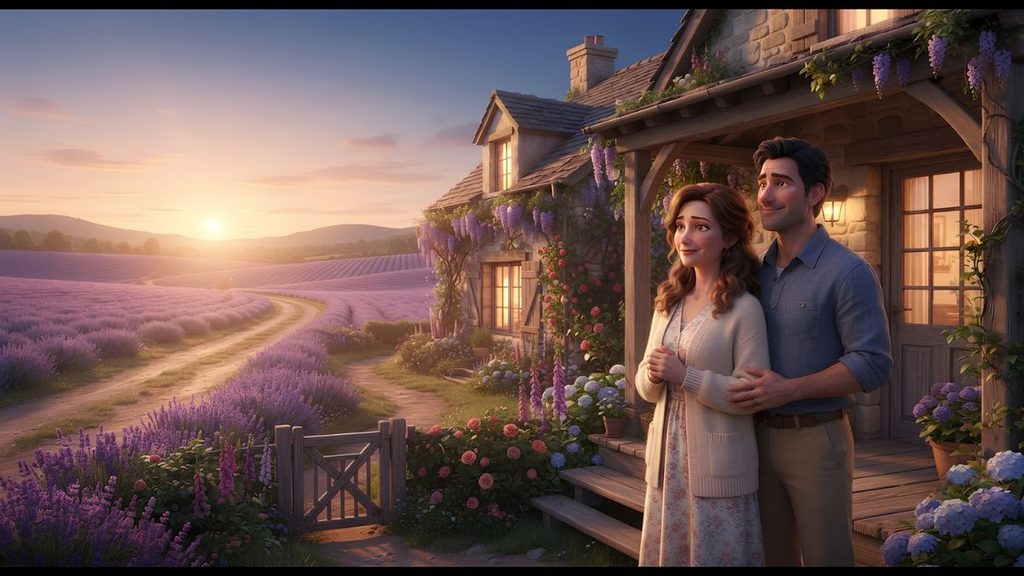
Type: Long Bedtime Story
Characters: Amelia and Henry
Amelia received the letter on a Tuesday morning.
It arrived in an ordinary white envelope, tucked between a bank statement and a grocery advertisement.
She almost threw it away.
There was no return address she recognized, only her name written carefully across the front.
Amelia Hart
The handwriting was unfamiliar.
She opened it while standing in the kitchen of her apartment, waiting for the kettle to boil.
Inside was a single sheet of paper.
Dear Ms. Hart,
I am writing to inform you that you have been named the beneficiary of a property in the village of Bellmere. The house belonged to your great-aunt, Eleanor Hart, who passed away peacefully last month.
The property has remained largely unused for several years. According to her wishes, it is now yours.
Please contact our office to arrange the transfer.
Amelia read the letter twice.
Then a third time.
She had never heard of Eleanor Hart.
At least, she thought she hadn’t.
She knew her grandmother’s name.
She knew her parents’ names.
She knew there had once been relatives scattered across different parts of the country.
But a great-aunt with a house in a village called Bellmere?
That was completely new.
She sat at the kitchen table.
The kettle clicked off.
She didn’t move.
Her life in the city had become predictable.
She worked in an office.
She answered emails.
She attended meetings.
She bought groceries on Thursday evenings.
She ordered dinner when she was too tired to cook.
Her apartment was comfortable but impersonal.
Everything had its place.
Everything was convenient.
And yet, lately, Amelia had begun feeling as though she were living inside a life someone else had planned.
She wasn’t unhappy.
That was the difficult part.
If she had been unhappy, she could have pointed to something and said, There. That’s the problem.
Instead, she simply felt tired.
Tired in a way that sleep didn’t completely fix.
The letter remained on the table for three days.
On Friday evening, Amelia called the solicitor.
By Monday morning, she had booked a train.
She told herself she was only going to see the house.
She wasn’t making any decisions.
She wasn’t changing her life.
She was simply curious.
The train left the city just after eight.
For the first hour, Amelia watched buildings pass outside the window.
Then the landscape began to change.
Concrete gave way to fields.
Traffic disappeared.
The sky seemed larger.
By the time she reached Bellmere, she had almost forgotten what it felt like to see so much open land.
The village was small.
There was a bakery.
A grocery shop.
A post office.
A church with a narrow stone tower.
A café with three tables outside.
And beyond the village, rolling fields stretched toward distant hills.
Amelia stepped onto the platform carrying one suitcase.
A man stood beside an old dark-green car.
He held a small piece of paper with her name on it.
AMELIA HART
She approached him.
“Are you Amelia?”
“Yes.”
“I’m Henry.”
He smiled.
“Henry Bennett.”
She shook his hand.
“I’m sorry. Do we know each other?”
“No.”
He laughed softly.
“But I know the house.”
That made Amelia curious.
“The house?”
“Everyone knows the house.”
Henry picked up her suitcase.
“It’s at the end of Lavender Road.”
“Why is it called Lavender Road?”
“You’ll see.”
They drove out of the village.
For several minutes, neither spoke.
Then the road narrowed.
On both sides were fields filled with purple flowers.
Lavender.
Rows and rows of it.
The afternoon sun rested low over the hills, turning the flowers silver at their edges.
Amelia looked through the window.
“Oh.”
Henry smiled.
“That’s usually what people say.”
The road continued between the fields.
At the very end stood an old stone house.
It was larger than Amelia expected.
Two stories.
Whitewashed walls.
Dark wooden shutters.
A wide front porch.
An old chimney.
And a garden that had clearly once been beautiful.
Now it was mostly overgrown.
A wooden gate hung slightly crooked.
Vines climbed the walls.
But there was something peaceful about the place.
Henry stopped the car.
Amelia stepped out.
For a moment, she simply stood there.
She had never seen the house before.
Yet something about it felt strangely familiar.
Henry handed her the keys.
“Here you are.”
Amelia looked at him.
“You said you know the house.”
“I’ve been helping with restoration work in the village for years. Your great-aunt asked me to look at this place a few times.”
“You knew her?”
“A little.”
“What was she like?”
Henry looked toward the house.
“Quiet.”
He thought for a moment.
“Kind. Stubborn.”
Amelia smiled.
“That sounds like someone in my family.”
Henry laughed.
“I suspected there might be a connection.”
They walked inside.
Dust covered almost everything.
The furniture was old but solid.
A grandfather clock stood against one wall.
There was a fireplace in the sitting room.
A dining table large enough for eight people.
In the kitchen, copper pans hung above an old wooden counter.
The house smelled of dust, wood, and lavender.
Amelia walked slowly from room to room.
In the upstairs hallway, she stopped beside a window.
From there, she could see the lavender fields stretching toward the horizon.
Henry stood behind her.
“You can see the whole road from here.”
Amelia nodded.
“It’s beautiful.”
“It is.”
She turned.
“How much work does it need?”
Henry smiled.
“Do you really want the honest answer?”
“Yes.”
“Quite a lot.”
She laughed.
“How much is quite a lot?”
“Roof repairs. Plumbing. Electrical work. Several windows. Floors. The garden. Probably the kitchen.”
“Anything else?”
Henry considered it.
“Yes.”
“What?”
“The house needs someone to live in it.”
Amelia looked at him.
“I thought houses didn’t have opinions.”
“This one does.”
She smiled.
“I’ll keep that in mind.”
Henry left before sunset.
Amelia remained.
She opened the windows.
The evening air drifted through the rooms.
Lavender filled the house with its gentle scent.
She made tea using the only clean cup she could find.
Then she sat on the porch.
The village was too far away to hear clearly.
There were no car horns.
No sirens.
No neighbors arguing through thin walls.
Only crickets.
Wind.
And somewhere in the distance, the soft sound of a bell.
Amelia looked at the house.
For the first time in months, she didn’t feel the need to check her phone.
She stayed on the porch until the sky turned dark.
The next morning, Henry returned with a toolbox.
“You came back.”
He looked surprised.
“I said I’d help.”
“I thought you meant you’d come back tomorrow.”
“I did.”
He smiled.
“Good.”
They began with the kitchen.
The old cabinets were covered in dust.
Behind one cabinet, Henry found a loose wooden panel.
“There’s something here.”
He carefully removed it.
Behind the panel was a narrow space.
Inside sat a small metal box.
Amelia looked at Henry.
“Did you know about this?”
“No.”
She opened it.
Inside were photographs.
Letters.
A silver key.
And a small dried lavender flower pressed between two sheets of paper.
Amelia picked up the first photograph.
It showed a young woman standing outside the house.
She wore a long dress and held a basket of flowers.
Amelia stared at her.
“That’s Eleanor.”
Henry looked at the photograph.
“Yes.”
“She was beautiful.”
“She was.”
Amelia turned the photograph over.
There was a date.
June 1968.
On the back, someone had written:
The year we thought everything was beginning.
Amelia picked up a letter.
The envelope was yellow with age.
It was addressed to Eleanor.
She hesitated.
“Should I read it?”
Henry shrugged.
“If it’s yours, I suppose.”
Amelia opened it carefully.
The letter was from a man named Samuel.
It described the village.
The lavender fields.
The house.
A summer evening.
And a promise.
One day, when we are older, I hope we will sit on the porch and wonder why we were ever afraid to begin.
Amelia read the sentence twice.
“Who was Samuel?”
Henry shook his head.
“I don’t know.”
They found more letters.
Some were from Samuel.
Some were from Eleanor.
There were gaps between them.
Months.
Sometimes years.
The letters told a story of two people who had loved each other but had never managed to build the life they imagined.
There had been work.
Family responsibilities.
Distance.
Fear.
And eventually, silence.
But Eleanor had kept every letter.
Amelia sat on the kitchen floor surrounded by old photographs.
“What happened to them?”
Henry looked at the letters.
“Maybe life happened.”
“That’s a depressing answer.”
“It’s an honest one.”
She looked at him.
“Do you always answer questions like that?”
“Only difficult ones.”
She smiled.
Over the next few days, the house became their project.
Henry repaired the windows.
Amelia cleaned the rooms.
They pulled weeds from the garden.
They found an old well beneath a tangle of ivy.
They discovered a stone path leading from the garden to a small wooden bench.
One afternoon, Amelia found another box in the attic.
Inside were childhood drawings.
Recipes.
Pressed flowers.
A train ticket.
A photograph of Eleanor standing beside Samuel.
They looked happy.
Very happy.
On the back was written:
Bellmere, before we knew how quickly time could pass.
Amelia sat on the attic floor for a long time.
Henry found her there.
“Another discovery?”
She handed him the photograph.
He looked at it.
“I’ve never seen this.”
“Do you think they stayed in love?”
Henry sat beside her.
“I think some people remain part of each other’s lives even when they aren’t physically there.”
“That’s not the same thing.”
“No.”
He looked toward the small attic window.
“But it can still be real.”
Amelia folded the photograph carefully.
“What if you had the chance to start over?”
Henry thought about the question.
“I’d be scared.”
“So would I.”
“I’d probably do it anyway.”
She smiled.
“That’s brave.”
“Not really.”
He stood.
“Sometimes staying exactly where you are is scarier.”
That evening, Amelia walked into the village.
She passed the bakery.
The woman behind the counter recognized her.
“You must be Eleanor’s niece.”
“Great-niece.”
“Ah.”
The woman smiled.
“She talked about you.”
Amelia stopped.
“She did?”
“She didn’t know you personally. But she knew your grandmother.”
The woman handed Amelia a loaf of bread.
“Eleanor used to buy this every Saturday.”
Amelia thanked her.
As she walked back toward the house, she thought about the strange feeling that had followed her since arriving.
Perhaps the house wasn’t entirely unfamiliar.
Perhaps it was a place her family had carried quietly through the generations.
That night, Amelia opened her laptop.
She had emails waiting.
Her manager wanted confirmation about an upcoming project.
A colleague needed an answer.
There were reminders.
Deadlines.
Plans.
The city was still there.
Her old life was still there.
But now it felt very far away.
She closed the laptop.
Outside, the lavender fields moved gently in the wind.
A few weeks passed.
The house changed.
The walls were cleaned.
The windows opened easily.
The floors were polished.
The garden began to look alive again.
Henry repaired the old porch.
Amelia painted the kitchen cabinets.
They worked together most mornings.
In the afternoons, they often walked through the village.
Sometimes they talked.
Sometimes they didn’t.
Their friendship grew quietly.
There was no dramatic moment.
No sudden declaration.
Just small things.
Henry bringing coffee without being asked.
Amelia leaving a sandwich for him when he worked late.
Walking together beneath the lavender fields.
Sharing stories about childhood.
Laughing about the terrible condition of the garden.
One evening, Amelia asked him why he had stayed in Bellmere.
Henry looked across the fields.
“I left once.”
“Where did you go?”
“The city.”
“Why did you come back?”
“My father got sick.”
“I’m sorry.”
“He recovered.”
Henry smiled.
“But by then, I’d realized something.”
“What?”
“I had been trying to build a life that looked successful instead of one that felt right.”
Amelia was quiet.
“I understand that.”
Henry looked at her.
“You might.”
They continued walking.
The sun was setting.
Lavender filled the air.
Amelia suddenly realized she couldn’t remember the last time she had walked somewhere without checking the time.
The next morning, she received a call from her manager.
“We need to talk about your position.”
Amelia sat on the porch.
She knew what was coming.
“You’re asking whether I’m returning.”
“Yes.”
“When?”
“Monday.”
Amelia looked at the house.
The roof had been repaired.
The garden was blooming.
The windows reflected the morning sun.
She had spent three weeks in Bellmere.
She had planned to stay four days.
“I don’t know,” she said.
Her manager sighed.
“Amelia, this is a serious position.”
“I know.”
“We need an answer.”
“I understand.”
After the call ended, Amelia sat quietly.
Henry found her there.
“You look worried.”
“I have to decide.”
“About the job?”
“About everything.”
He sat beside her.
“I don’t want to tell you what to do.”
“I know.”
“You shouldn’t stay because of me.”
She looked at him.
“I know.”
“And you shouldn’t leave because you’re afraid.”
She looked toward the lavender fields.
“What if I make the wrong choice?”
Henry smiled gently.
“Then you’ll make another choice later.”
Amelia laughed.
“That’s not very comforting.”
“Maybe it is.”
He stood.
“Life isn’t a test where you get one answer.”
She watched him walk toward the garden.
That afternoon, Amelia went into the attic.
She found the old box of letters.
She read them again.
At the bottom was one final envelope.
She hadn’t noticed it before.
It was addressed simply:
For whoever finds this.
Amelia opened it.
The letter was written by Eleanor.
If you are reading this, then you have found the house after I am gone.
I don’t know who you are or what brought you here. Perhaps you are family. Perhaps you are simply curious.
But if you are standing in this room, please remember something I learned too late.
A home is not the place where everything is perfect.
It is the place where you are willing to stay long enough to care for what is broken.
People are like that too.
So are dreams.
Don’t wait for life to become completely certain before you begin living it.
With love,
Eleanor.
Amelia cried.
Not because the letter was sad.
Because it felt like an answer.
That evening, she found Henry repairing the garden gate.
“I’ve made my decision.”
He looked up.
“Okay.”
“I’m staying.”
Henry smiled.
“Good.”
“At least for a year.”
“That’s a sensible amount of time.”
“I may regret it.”
“Probably.”
She laughed.
“You could at least pretend to be encouraging.”
“I am.”
He put down the screwdriver.
“I think you’re going to like it here.”
Amelia looked at the house.
“I think I already do.”
Summer arrived slowly.
The lavender fields became brighter.
The village became busier.
Visitors came for the annual lavender festival.
The house at the end of the road became part of Amelia’s life.
She turned one room into a small office.
Another became a reading room.
She repaired the old dining table.
She planted roses beside the porch.
Henry helped her restore the garden.
One evening, they sat together outside.
The sky was full of stars.
Amelia held two cups of tea.
“Do you ever wonder what happened to Samuel?”
Henry nodded.
“Sometimes.”
“I searched the letters.”
“And?”
“He moved abroad.”
“Did they ever meet again?”
“I don’t know.”
Henry looked at the lavender fields.
“Maybe that’s something we’ll never know.”
Amelia smiled.
“Maybe that’s okay.”
She leaned back in her chair.
“Not every story gets every answer.”
“No.”
“But it can still have a beautiful ending.”
Henry looked at her.
“Or a beautiful next chapter.”
Amelia smiled.
“That too.”
The following spring, Amelia opened the house for a small community gathering.
People from the village brought food.
Children played in the garden.
Someone brought music.
Someone else brought flowers.
The old dining table was covered with plates.
Henry stood near the porch, watching everyone laugh.
Amelia joined him.
“Do you remember the first day I came here?”
“Yes.”
“I thought I was just visiting.”
“You were.”
She smiled.
“And now?”
Henry looked at the house.
“Now you’re home.”
Amelia looked at him.
The word settled quietly between them.
Home.
Not a perfect place.
Not a finished place.
There were still repairs to make.
There were still uncertainties.
There were still days when she missed the city.
But the house no longer felt like something she had inherited.
It felt like something she had chosen.
Later that evening, after everyone had gone, Amelia and Henry sat on the porch.
The lavender fields were silver beneath the moon.
“Thank you,” Amelia said.
“For what?”
“For showing me the road.”
Henry smiled.
“You were the one who decided to follow it.”
She looked toward the house.
Inside, the old clock began to chime.
Once.
Twice.
Three times.
Amelia smiled.
The house was quiet again.
But it was no longer empty.
It held photographs.
Letters.
Books.
Fresh flowers.
Laughter.
Memories that belonged to people who had lived there long before Amelia arrived.
And new memories that belonged to her.
She thought about Eleanor.
About Samuel.
About all the choices that had brought her to this place.
For years, Amelia had believed that starting over meant leaving something behind.
Now she understood.
Sometimes starting over meant finally giving yourself permission to stay.
The wind moved through the lavender.
Henry reached for her hand.
She took it.
Neither of them spoke.
There was nothing that needed saying.
The house stood at the end of the lavender road, glowing softly beneath the stars.
And for the first time in a long time, Amelia did not wonder where she was supposed to be.
She knew.
She was exactly where her life had been waiting for her to arrive.
And somewhere inside the old house, beneath the floorboards and behind the walls, the past remained.
Not as a burden.
Not as something unfinished.
But as a reminder.
Every home begins with a door.
Every journey begins with a road.
And every new beginning starts with one quiet decision.
To open the door.
To take the next step.
And to believe that somewhere ahead, there may be a place where the heart can finally rest.
At the end of the lavender road, Amelia had found that place.
And she had found something else too.
A reason to stay.
A reason to hope.
And someone with whom she could build whatever came next.
The house was old.
The future was uncertain.
But the evening was peaceful.
And that was enough.
Theme: New beginnings, belonging, love, discovering what truly matters.
5. The Café That Opened After Midnight
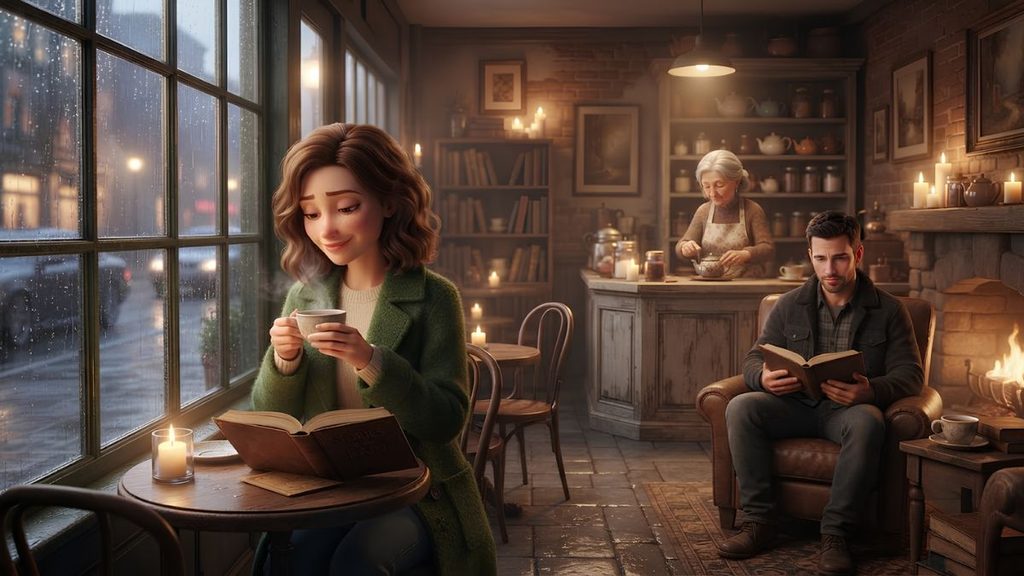
Type: Peaceful Bedtime Story
Characters: Nora and James
Nora discovered the café on a rainy Tuesday night.
She had not been looking for it.
In fact, she had been looking for nothing at all.
She had simply wanted to walk.
The day had been long.
Not unusually difficult.
Not tragic.
Just long in the quiet, exhausting way some days become when too many small things happen at once.
There had been emails waiting when she arrived at work.
A meeting that lasted nearly an hour longer than planned.
A colleague asking for help with something that wasn’t really her responsibility.
Three unanswered messages from people she cared about.
A grocery list she had forgotten to write down.
And a phone that seemed determined to remind her of everything she hadn’t done.
By eleven thirty, Nora was home.
She made tea.
She drank half of it.
Then she poured the rest down the sink.
She tried reading.
She read the same paragraph four times.
She tried watching something.
She spent fifteen minutes choosing what to watch and then turned the television off.
At midnight, she put on her coat.
She didn’t know why.
She simply felt that she needed to leave the apartment.
Outside, the rain was falling gently.
Not heavily enough to be unpleasant.
Just enough to make the streets shine beneath the lamps.
Nora walked without a destination.
She passed the closed bakery.
The pharmacy.
The bus stop.
The little park where she sometimes sat on Sunday mornings.
Then she turned onto a narrow street she rarely used.
That was when she saw the light.
A warm golden glow came from a small window between two dark buildings.
Nora stopped.
She was certain there had never been a café there before.
She walked closer.
There was no sign.
No menu.
No name above the door.
Only a small window glowing against the darkness.
She looked through the glass.
Inside was a tiny café.
Four tables.
A fireplace.
A wooden counter.
Several bookshelves.
And a man sitting alone near the fire.
Nora checked her phone.
12:17 a.m.
She almost walked away.
Then the door opened.
An elderly woman stood behind it.
She had silver hair tied loosely at the back of her head.
She smiled.
“You’re welcome to come in.”
Nora looked around.
“Is this a café?”
The woman smiled.
“Most nights.”
“Are you open?”
“Tonight, yes.”
Nora hesitated.
“What time do you close?”
The woman glanced at the clock.
“Whenever everyone has finished being awake.”
Nora wasn’t sure whether that was a joke.
But she smiled.
“Can I have some tea?”
“Of course.”
Nora stepped inside.
The café was warmer than she expected.
The rain sounded softer from behind the glass.
The fireplace crackled gently.
There was a faint smell of cinnamon and wood.
She chose a table near the window.
The woman brought her a pot of tea.
“What kind?”
“Whatever you recommend.”
The woman nodded.
“Chamomile.”
Nora smiled.
“That seems appropriate.”
The woman laughed quietly.
“My name is Evelyn.”
“Nora.”
“Nice to meet you, Nora.”
Evelyn returned to the counter.
Nora wrapped both hands around the warm cup.
For the first time that day, nobody was asking her anything.
No message needed a reply.
No email needed attention.
No decision needed to be made.
There was only rain.
Fire.
Tea.
And silence.
Nora stayed for nearly an hour.
When she finally stood to leave, Evelyn said, “Good night.”
Nora paused.
“Will you be open tomorrow?”
Evelyn shrugged.
“Perhaps.”
“How will I know?”
“You won’t.”
Nora laughed.
Then she stepped back into the rain.
The next night, she returned.
The café was there.
The same warm light.
The same unmarked door.
The same fireplace.
Evelyn smiled when she saw her.
“Chamomile?”
Nora nodded.
“You remembered.”
“I remember most things.”
Nora sat at the same table.
She opened a book.
This time, she read.
Not because the book was particularly interesting.
Because she could.
No notifications.
No interruptions.
No pressure to finish.
Just pages turning slowly while rain touched the windows.
There were three other customers that night.
A young man writing in a notebook.
An older couple sharing a slice of cake.
And the man Nora had seen the night before.
He sat near the fireplace.
He looked to be in his early thirties.
Dark hair.
Simple coat.
A book resting beside him.
Nora had noticed him before, but she hadn’t spoken to him.
Neither did he speak to her.
That was perfectly fine.
She began visiting several nights a week.
Sometimes she stayed for twenty minutes.
Sometimes an hour.
Sometimes she arrived after midnight and left before one.
She discovered that the café had no menu.
Evelyn simply asked what people wanted.
Tea.
Coffee.
Hot chocolate.
Soup.
Toast.
Cake.
Whatever seemed right.
There was no background music.
No loud conversations.
No televisions.
Phones were allowed, but hardly anyone used them.
Something about the place made people lower their voices.
One evening, Nora asked Evelyn about the café.
“How long have you been here?”
“Long enough.”
“That’s not an answer.”
Evelyn smiled.
“Maybe it isn’t supposed to be.”
“Why does it only open at night?”
“Because the daytime has enough places to go.”
Nora laughed.
“That’s true.”
Evelyn placed a cup of tea in front of her.
“At night, people sometimes need somewhere to be without needing a reason.”
Nora looked around.
That made sense.
She began noticing the people who came.
A nurse who arrived after her shift.
A taxi driver who drank coffee for half an hour before going home.
A university professor who read old novels.
A young woman who knitted quietly by the window.
A father who came on nights when he had custody of his children, after putting them to bed at home.
Nobody seemed to ask questions.
Nobody seemed curious about anyone else’s story.
They simply shared the room.
One Thursday night, Nora arrived to find only one table available.
It was across from the man by the fireplace.
She hesitated.
He looked up.
“You can sit here.”
“Are you sure?”
“Yes.”
Nora sat down.
For several minutes, neither spoke.
Rain tapped softly against the window.
Finally, he closed his book.
“I’m James.”
“Nora.”
“I’ve seen you here.”
“I’ve seen you too.”
He smiled.
“Then we’ve officially met.”
Nora laughed.
“What are you reading?”
James showed her the cover.
It was a collection of essays about walking.
“I like books about people going somewhere without knowing exactly why.”
Nora looked toward the window.
“That sounds familiar.”
James smiled.
“That’s why I chose it.”
Their conversation lasted perhaps ten minutes.
They talked about books.
Then rain.
Then the strange comfort of quiet places.
When Evelyn brought James another coffee, she looked between them.
“Making friends?”
James shook his head.
“Discussing books.”
“That’s how it usually begins.”
Nora laughed.
James smiled.
After that, they sometimes sat together.
Not every night.
Not even most nights.
But often enough.
Their conversations remained simple.
“What did you read today?”
“Did you see the rain?”
“Have you tried the cinnamon cake?”
“Are you working tomorrow?”
Sometimes they talked for twenty minutes.
Sometimes only five.
Sometimes they didn’t talk at all.
There was something comforting about that.
Nora had spent much of her life believing that friendship required constant conversation.
With James, she discovered that companionship could also mean sitting quietly while someone else turned pages.
One night, she arrived feeling particularly tired.
She dropped into her usual chair.
James was already there.
He looked at her.
“Long day?”
Nora nodded.
“Very.”
He didn’t ask what happened.
Instead, he moved the sugar bowl closer to her.
She smiled.
“Thank you.”
They sat quietly.
After a while, Nora said, “Do you ever feel like everything is moving too quickly?”
James looked into the fire.
“Most days.”
“How do you stop it?”
“I don’t think you can.”
He paused.
“But sometimes you can stop running with it.”
Nora thought about that.
She looked around the café.
Maybe that was what this place was for.
Not escaping life.
Just stepping out of its speed for a little while.
A few weeks later, Nora had a difficult evening.
A project at work had gone wrong.
Someone had blamed her for a mistake she hadn’t made.
She had defended herself.
Then spent the rest of the evening wondering whether she should have said less.
At home, she couldn’t settle.
So she walked to the café.
When she arrived, James was there.
Evelyn was preparing tea.
Nora sat down.
James looked at her.
“Bad night?”
“Yes.”
He nodded.
She waited for him to ask.
He didn’t.
Instead, he said, “Tea?”
Nora smiled.
“Tea.”
They sat together.
After ten minutes, Nora began talking.
She told him about the project.
The accusation.
The argument.
The thoughts she couldn’t stop replaying.
James listened.
When she finished, he said only:
“That sounds exhausting.”
Nora nodded.
“It is.”
“You don’t have to solve it tonight.”
She looked at him.
“What if it still bothers me tomorrow?”
“Then you can deal with it tomorrow.”
Nora smiled.
It seemed obvious.
Yet she had forgotten.
Not everything needed to be solved before sleep.
Some things could wait until morning.
That night, Nora walked home more slowly.
The rain had stopped.
The streets were almost empty.
She noticed things she normally missed.
A cat sitting beneath a parked car.
Light glowing behind an upstairs curtain.
The smell of wet pavement.
A tree moving gently in the wind.
The world hadn’t changed.
She had simply stopped rushing through it.
Winter arrived.
The nights became colder.
Evelyn kept the fireplace burning.
The café became warmer.
Nora brought a thicker coat.
James started arriving earlier.
Sometimes he saved her a chair.
Sometimes she saved one for him.
Neither made a big deal of it.
One evening, Evelyn placed two cups of tea on their table.
“We’re closing early tonight.”
James looked surprised.
“Why?”
“My niece is getting married tomorrow.”
Nora smiled.
“You’re going to a wedding?”
“Yes.”
“Do you have a dress?”
Evelyn raised an eyebrow.
“I own several things besides aprons.”
James laughed.
Nora smiled.
“Will you be back tomorrow night?”
Evelyn thought about it.
“Of course.”
The café closed at one that night.
Nora and James walked outside together.
The street was cold and clear.
Above them, stars were visible between the clouds.
James looked up.
“Beautiful.”
Nora nodded.
“Yes.”
They stood there for a moment.
Then James said, “Good night.”
“Good night.”
They walked in opposite directions.
Nora didn’t know where their friendship was going.
She didn’t think it needed a destination.
Some relationships were like roads.
Others were like benches.
They existed simply because it was good to have somewhere to sit.
Spring came.
The rain returned.
The café remained.
One night, Nora arrived early.
The door was locked.
She checked the time.
11:54 p.m.
She waited.
Midnight came.
Nothing.
12:05.
Still nothing.
12:20.
No light appeared.
Nora felt strangely disappointed.
She had never realized how much she depended on that little café until it wasn’t there.
She returned the next night.
The door was open.
Evelyn stood behind the counter.
“Where were you?”
Nora asked.
“Family emergency.”
“Is everything okay?”
“Everything is fine now.”
Nora nodded.
She sat down.
James arrived twenty minutes later.
“You missed yesterday.”
“So did you.”
“I was worried.”
Nora smiled.
“About me?”
“About the café.”
She laughed.
“Of course.”
He smiled.
Then, after a moment, he said, “I was worried about you too.”
Nora looked down at her tea.
“Thank you.”
They didn’t say anything more.
They didn’t need to.
Months passed.
The café became part of Nora’s life.
Not an obligation.
Not a routine she had to maintain.
A place she could return to.
Some nights she went alone.
Some nights James was there.
Sometimes they talked.
Sometimes they simply sat together.
One night, Nora asked him the question she had wondered about for months.
“Why do you come here?”
James was quiet.
“I come when I don’t want to be alone.”
Nora nodded.
“But you don’t always talk to anyone.”
“I know.”
“Then how does it help?”
James looked around the room.
“Because being alone and being lonely aren’t always the same thing.”
Nora smiled.
“I like that.”
He looked at her.
“What about you?”
She thought for a moment.
“I think I come here because nobody expects anything from me.”
James nodded.
“That’s probably why I like it too.”
They sat quietly.
Outside, rain began falling again.
It tapped against the windows.
The fireplace crackled.
Evelyn moved quietly behind the counter.
The clock approached one in the morning.
Nora looked around.
She suddenly realized that the café had taught her something.
Rest didn’t always mean sleeping.
Sometimes rest meant being somewhere without performing.
Without explaining.
Without accomplishing.
Without becoming better.
Just being.
She finished her tea.
James closed his book.
“Ready?”
Nora nodded.
They stood.
Evelyn waved from the counter.
“Good night.”
“Good night,” they said together.
Outside, the rain had softened to a mist.
Nora and James walked down the street.
They stopped at the corner.
“Same time tomorrow?”
James asked.
Nora smiled.
“Maybe.”
“That’s not very reliable.”
“It’s more peaceful.”
He laughed.
“Fair enough.”
They went their separate ways.
Nora walked home slowly.
Her apartment was waiting.
Tomorrow would bring emails.
Meetings.
Deadlines.
Messages.
Problems.
Decisions.
Life would continue moving quickly.
But now she knew something she hadn’t known before.
She didn’t have to match its speed every moment.
Sometimes she could stop.
Sometimes she could breathe.
Sometimes she could sit beside another person without needing to fill the silence.
And sometimes, after midnight, when the world became quiet enough to hear your own thoughts, there might be a small café at the end of an unmarked street.
A fireplace.
A cup of tea.
Rain against the glass.
And someone else who had also decided to slow down.
Years later, Nora would still remember the first night she found the café.
She would remember the rain.
The warm window.
The mysterious door.
Evelyn’s smile.
And the man sitting quietly beside the fireplace.
James.
She would remember that they had never promised each other anything.
They had never needed to.
Their friendship had grown in the spaces between conversations.
In shared cups of tea.
In quiet evenings.
In simple questions.
In comfortable silence.
And perhaps that was why it lasted.
It had never demanded to become something larger.
It had simply been allowed to be what it was.
A peaceful place.
A familiar face.
A reminder that life did not always need to be exciting to be meaningful.
Sometimes the most important moments were the quiet ones.
The ones nobody photographed.
The conversations nobody remembered word for word.
The evenings that seemed ordinary while they were happening.
Nora finally understood that slowing down was not the same as falling behind.
Resting was not wasting time.
And silence was not emptiness.
Sometimes silence was where peace had been waiting all along.
Outside the café, the rain continued falling.
Inside, the fire burned gently.
And somewhere between midnight and morning, Nora and James sat quietly together, reading their books while the world carried on without them.
For a little while, that was enough.
And when Nora finally walked home, she carried the quiet with her.
Not just in her memory.
But somewhere deeper.
A small, steady peace.
The kind that doesn’t disappear when the door closes.
The kind that follows you home.
The kind that reminds you that tomorrow can wait.
For tonight, you can simply breathe.
And rest.
And let the world be quiet.
Theme: Peace, quiet companionship, slowing down.
6. The Letter She Wrote to Tomorrow
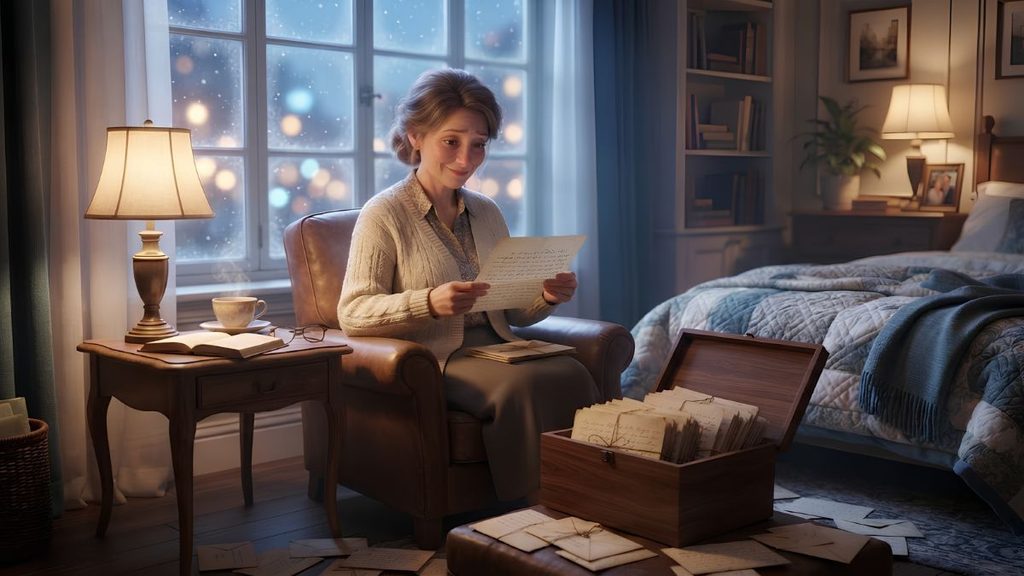
Type: Inspirational Bedtime Story
Characters: Eleanor
Eleanor had always believed that change happened loudly.
She imagined it arriving with important phone calls, plane tickets, dramatic decisions, and moments that divided life neatly into a before and an after.
But after one particularly difficult year, she began to wonder if she had been wrong.
Perhaps change could be quiet.
Perhaps it could happen while washing dishes.
While walking home.
While making tea.
Perhaps a person could become different without noticing the exact moment it happened.
The year had not been one terrible disaster.
It had simply been a collection of difficult things.
A friendship had ended.
A project she had worked hard on had failed.
Someone she loved had moved away.
She had made mistakes she wished she could undo.
There were places she had planned to visit but never did.
There were opportunities she had been too afraid to take.
And there were mornings when getting out of bed felt like an accomplishment she wasn’t proud enough to mention.
By December, Eleanor was tired of making plans.
She had spent months telling herself that the next month would be better.
January would be better.
Then February.
Then spring.
Then summer.
Every month had arrived carrying the promise of a new beginning.
Every month had left without keeping it.
On the final Sunday of the year, Eleanor sat beside her bedroom window.
Snow rested lightly on the rooftops outside.
She had made tea but forgotten to drink it.
Her notebook lay open on her lap.
For years, she had kept notebooks.
Lists.
Plans.
Ideas.
Things to buy.
Things to accomplish.
Places to visit.
People to call.
Most of the pages had been filled with things she believed she should become.
That evening, she turned to a blank page.
She wrote the date.
Then she stopped.
She didn’t know what to write.
Eventually, she wrote:
Dear Eleanor, one year from now,
She smiled.
The idea had arrived unexpectedly.
She continued.
I don’t know where you are when you read this.
She paused.
Then she wrote:
I hope you are kinder to yourself.
That sentence made her eyes sting.
She continued.
I hope you have forgiven yourself for the things you cannot change.
She looked out the window.
I hope you have gone somewhere you’ve never been.
Then:
I hope you have laughed more.
And:
I hope you remember that difficult seasons don’t last forever.
She thought for a moment.
Finally, she wrote:
Please don’t forget me. I am trying my best to get you here.
Eleanor closed the notebook.
She didn’t know why she had written the letter.
It wasn’t a plan.
It wasn’t a resolution.
It wasn’t a promise.
It was simply a message to someone she hoped she would become.
The next Sunday, she wrote another.
This one was shorter.
She wrote about the coffee shop near her apartment.
About a song she had heard that morning.
About the fact that she had finally cleaned the cupboard she had been ignoring for six months.
At the end, she wrote:
I hope you still notice small things.
The Sunday after that, she wrote again.
Then again.
Soon, Sunday evening became her favorite part of the week.
She would make tea.
Turn off the television.
Put her phone on silent.
Open the notebook.
And write to herself one year ahead.
Some letters were hopeful.
Some were frustrated.
Some were only a few sentences.
One began:
Dear Eleanor,
This week was awful. I don’t have anything wise to tell you. I just hope things feel lighter when you read this.
Another said:
Today I saw a woman helping an old man carry his groceries. It made me think that kindness is often quieter than we imagine. I hope you have remembered that.
Another said:
I made a mistake at work. I apologized. I survived. Apparently, life continues.
Eleanor laughed when she wrote that one.
She began putting the letters into a wooden box.
She kept the box on the top shelf of her wardrobe.
She didn’t read any of them.
That was the rule.
The letters belonged to tomorrow.
Not today.
As the weeks passed, something changed.
Not suddenly.
Not dramatically.
Eleanor simply began paying more attention to her life.
She noticed the first warm morning of spring.
She called an old friend.
She started walking after work.
She signed up for a pottery class she had been considering for years.
She visited a small town two hours away simply because she liked the photographs of it.
She learned how to make bread.
She failed.
She made another loaf.
It was better.
She began laughing at her own mistakes.
One Sunday evening, she wrote:
Dear Eleanor,
Today I made terrible bread. I almost threw it away. Then I ate it anyway. I think there is a lesson somewhere in that, but I am too tired to find it.
She smiled.
Then she added:
Maybe not everything has to be perfect before it is worth keeping.
Summer came.
Eleanor began feeling different.
She was still herself.
She still worried.
She still made mistakes.
She still had difficult days.
But she had stopped waiting for life to become perfect before allowing herself to enjoy it.
She bought flowers sometimes.
She ate dinner outside.
She took longer walks.
She stopped answering work emails after dinner.
She learned to say no without writing an explanation afterward.
She also learned that some things would not change simply because she wished they would.
The friendship that had ended did not return.
The person who had moved away did not suddenly come back.
The project that had failed remained a failure.
There were losses that could not be repaired.
But Eleanor began discovering something else.
A life did not have to be repaired completely to become good again.
One Sunday, she wrote:
I thought healing meant getting everything back.
Then:
Maybe it means learning how to live well with what remains.
She closed the notebook.
Outside, the evening sky was orange.
She sat by the window until the light disappeared.
Autumn arrived.
The leaves changed.
The days became shorter.
Eleanor’s wooden box slowly filled with letters.
She sometimes wondered what she would think when she read them.
Would she laugh?
Would she cry?
Would she be disappointed?
Would she recognize the woman who had written them?
There were times when she wanted to open the box.
Especially after difficult days.
But she kept her promise.
One year.
She would wait one year.
Then, on a cold Sunday evening, Eleanor realized something.
It was the final Sunday of the year.
Exactly twelve months had passed.
She made tea.
She sat beside the bedroom window.
The same window.
The same chair.
The same winter darkness outside.
But Eleanor felt different sitting there.
She climbed onto the small step stool and reached for the wooden box.
She brought it down carefully.
It was heavier than she expected.
Not because the letters were heavy.
Because the year was inside them.
She placed the box on the floor.
For several minutes, she simply looked at it.
Then she opened it.
The first letter was on top.
The paper had become slightly soft around the edges.
Eleanor unfolded it.
Dear Eleanor, one year from now…
She read slowly.
She reached the sentence:
I hope you are kinder to yourself.
Eleanor stopped.
She looked toward the window.
Had she become kinder to herself?
She wasn’t sure.
Then she thought about all the mistakes she had made that year.
She remembered the things she had once replayed endlessly in her mind.
She remembered the shame.
The regret.
The fear.
She realized she no longer thought about them every day.
Some had become memories rather than wounds.
Maybe that counted.
She continued reading.
I hope you have gone somewhere you’ve never been.
Eleanor smiled.
She had.
She had visited the little town she once considered too far away.
She had walked along its river.
She had eaten lunch alone.
She had taken photographs.
She had come home feeling strangely proud.
The next line read:
I hope you have laughed more.
Eleanor laughed.
She thought about the terrible bread.
The pottery class.
A neighbor’s dog that had somehow stolen one of her shoes.
The afternoon she had gotten on the wrong bus and discovered a beautiful park because of it.
Yes.
She had laughed more.
Then she reached the final sentence.
Please don’t forget me. I am trying my best to get you here.
Eleanor put the letter down.
Tears filled her eyes.
She whispered:
“I didn’t forget you.”
She looked around the room.
“I brought you here.”
She picked up the next letter.
Then the next.
Some predictions had come true.
Some hadn’t.
She had hoped to change jobs.
She hadn’t.
She had hoped to travel abroad.
She hadn’t.
She had hoped an old relationship might heal.
It hadn’t.
She had imagined herself becoming fearless.
That certainly hadn’t happened.
But she had become braver.
There was a difference.
She had imagined becoming completely confident.
Instead, she had learned to do things while still uncertain.
She had wanted every difficult memory to disappear.
Instead, she had learned to carry them without letting them control every decision.
She had hoped to become someone new.
Instead, she had become more fully herself.
Eleanor continued reading until midnight.
Some letters made her laugh.
Others made her cry.
One simply said:
I don’t know what I’m doing.
Another said:
Today was beautiful. I don’t know why. I just wanted you to know.
Another said:
You don’t need to have everything figured out. Please remember that.
She placed the letters around her on the floor.
Soon the room was covered with pieces of her own past.
Different versions of herself.
Worried Eleanor.
Hopeful Eleanor.
Tired Eleanor.
Excited Eleanor.
Angry Eleanor.
Grateful Eleanor.
None of them knew exactly what the future would bring.
Yet somehow, they had all helped create the woman sitting there now.
At one in the morning, Eleanor found the final letter.
It was written only a few weeks earlier.
She unfolded it.
Dear Eleanor,
If you’re reading this, then the year is over.
I wonder if you’re disappointed.
Maybe you didn’t become the person you imagined.
Maybe some things are still difficult.
Maybe there are still questions you can’t answer.
She paused.
Then continued.
But I hope you’ve noticed something.
You kept going.
Eleanor’s eyes filled with tears.
She read the final lines.
You kept going when you were tired.
You kept going when you were uncertain.
You kept going when plans failed.
You kept going when you had to begin again.
That has to count for something.
At the bottom, she had written:
Tomorrow is not a promise that everything will be easy.
It is simply another chance to continue.
Eleanor folded the letter.
She sat in silence.
Outside, snow had begun falling again.
One year earlier, she had sat in exactly the same place feeling as though her life had become smaller.
Now she understood that perhaps her life hadn’t become smaller.
Perhaps she had simply stopped noticing how much remained.
The next morning, Eleanor woke early.
She made coffee.
She opened the curtains.
Snow covered the street.
For the first time in months, she didn’t reach immediately for her phone.
She stood by the window.
She watched a man clear snow from the steps of the building next door.
A woman walked past carrying flowers.
A dog jumped through a patch of untouched snow.
Nothing extraordinary happened.
And yet Eleanor smiled.
She made breakfast.
Then she opened a fresh notebook.
She wrote the date.
She thought about what to write.
Then she began.
Dear Eleanor, one year from now,
She paused.
The words felt familiar.
But this time, she wasn’t writing from a place of desperation.
She wasn’t asking the future to rescue her.
She wasn’t begging tomorrow to become easier.
She was simply sending a message forward.
I don’t know what this year will bring.
She continued.
There will probably be difficult days. There will probably be mistakes. There will probably be things I cannot control.
She smiled.
But there will also be mornings like this one.
She looked outside.
There will be conversations I haven’t had yet. Places I haven’t seen. People I haven’t met. Things I haven’t learned.
She wrote more slowly.
So I don’t need you to become perfect.
I just hope you remain curious.
I hope you keep going.
I hope you forgive yourself quickly.
I hope you notice small beautiful things.
And when something doesn’t work out, I hope you remember that one closed door is not the end of the story.
She stopped.
Then she added one final sentence.
I will meet you there.
Eleanor closed the notebook.
She placed it beside the wooden box.
The first year of letters would remain.
She didn’t need to hide them anymore.
They had done what they were meant to do.
They had carried her through a year when she didn’t know where she was going.
They had reminded her that the future was not a distant place waiting to judge her.
It was something she created one ordinary day at a time.
A year later, Eleanor understood something she had not known when she wrote that first letter.
Tomorrow could not promise happiness.
It could not guarantee that dreams would come true.
It could not return everything she had lost.
But tomorrow offered something just as valuable.
Possibility.
Every morning gave her another opportunity to choose.
To try again.
To apologize.
To rest.
To learn.
To love.
To begin.
And sometimes, to begin again.
Eleanor stood in her kitchen and looked at the wooden box.
There were still empty spaces inside it.
She knew they would fill.
There would be more letters.
More difficult weeks.
More unexpected joys.
More questions.
More answers.
More things she would understand only after they had already happened.
And that was okay.
She no longer needed to know the entire path.
She only needed to take the next step.
Outside, the snow continued falling.
The city slowly woke.
Cars moved along the street.
Lights appeared in windows.
Someone laughed somewhere below.
Eleanor poured herself another cup of coffee.
Then she opened the door.
She stepped outside.
The morning air was cold.
She pulled her coat around herself and began walking.
She didn’t know where the day would take her.
For once, that didn’t frighten her.
It felt like freedom.
Because somewhere ahead was another Sunday.
Another blank page.
Another letter.
Another version of herself waiting patiently at the other end of time.
And Eleanor had finally learned that she did not need to become that future person all at once.
She only needed to keep moving toward her.
One Sunday.
One letter.
One small step.
At a time.
Theme: Hope, personal growth, patience, second chances.
7. The Photograph Behind the Clock
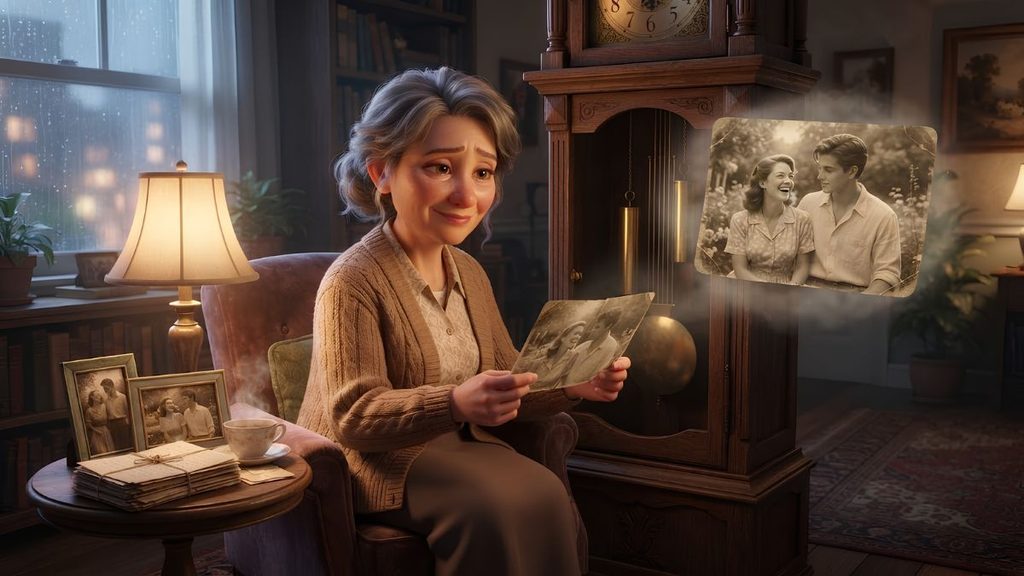
Type: Emotional Bedtime Story
Characters: Margaret and Thomas
Margaret inherited the clock on a quiet Thursday morning.
It was not a beautiful clock.
At least, not in the way people usually described beautiful things.
The wooden frame was scratched.
One of the brass hands was slightly bent.
The glass had a small crack near the bottom corner.
And the pendulum had stopped moving sometime before Margaret was born.
But her grandmother had loved it.
For as long as Margaret could remember, the clock had stood in the hallway of her grandmother’s house.
It had always been there.
When Margaret was a child, she used to sit beneath it and listen to the slow ticking.
She had once asked her grandmother why the clock was so important.
Her grandmother had smiled.
“Because some things are worth keeping.”
That was all she had said.
Years later, when her grandmother passed away, Margaret found herself standing in the same hallway.
The house felt impossibly quiet.
Family members had already begun sorting through belongings.
Books were placed into boxes.
Dishes were wrapped in newspaper.
Photographs were gathered from drawers.
Clothes were folded.
Every object seemed to carry a decision with it.
Keep.
Give away.
Throw away.
The clock was different.
Margaret couldn’t imagine giving it away.
So she took it home.
For several months, it stood against the wall in her living room.
She rarely looked at it.
Then, one rainy Saturday afternoon, she decided to repair it.
She carried the clock onto her kitchen table.
She wiped the dust from the wooden frame.
She removed the back panel.
The inside was filled with gears, springs, and tiny pieces of metal.
Margaret smiled.
She knew almost nothing about clocks.
Still, she enjoyed the idea of bringing this one back to life.
She watched a few repair videos.
She cleaned the gears carefully.
She adjusted the pendulum.
She replaced a small spring.
Then she noticed something.
Behind the wooden frame, there was a narrow gap.
Something dark was caught inside it.
Margaret frowned.
She tilted the clock.
A small piece of paper slipped free.
She caught it before it fell.
It was a photograph.
The edges were faded.
The paper had turned slightly yellow.
Margaret looked at the image.
Her grandmother stood in a garden.
She was young.
Perhaps twenty-five.
Maybe younger.
Margaret had never seen her grandmother like that.
She was wearing a light-colored dress.
Her hair was long.
And she was smiling.
Not the polite smile Margaret remembered from family gatherings.
This was different.
It was open.
Joyful.
Almost carefree.
But her grandmother wasn’t alone.
Beside her stood a man.
He was tall.
Dark-haired.
His hand rested lightly against the garden fence.
He was looking at her grandmother.
Not at the camera.
At her.
Margaret turned the photograph over.
There was writing on the back.
Only four words.
Summer before everything changed.
Margaret stared at them.
Who was the man?
She searched her memories.
She had seen hundreds of photographs of her grandmother.
At weddings.
At birthdays.
With Margaret’s grandfather.
With Margaret’s mother as a child.
With cousins.
Friends.
Neighbors.
But never this man.
She called her mother.
“Mom, can I ask you something?”
“Of course.”
“Do you know who Samuel was?”
There was a pause.
“Samuel?”
“Yes.”
Another pause.
“Where did you hear that name?”
Margaret looked at the photograph.
“From Grandma’s clock.”
Her mother became quiet.
“What do you mean?”
“I found a photograph hidden inside it.”
Margaret described the picture.
For several seconds, neither spoke.
Then her mother said:
“I’ve heard the name.”
“You have?”
“Only once.”
“When?”
“Your grandmother mentioned him when I was very young.”
“What did she say?”
“I don’t remember exactly.”
Margaret waited.
Her mother sighed.
“Something about an old friend.”
“Was he a boyfriend?”
“I don’t know.”
“You don’t remember anything else?”
“Margaret, your grandmother wasn’t someone who talked much about her past.”
That was true.
Her grandmother had been private.
She talked about recipes.
Gardening.
The weather.
Books.
She remembered everyone’s birthdays.
She knew which flowers bloomed first in spring.
She could tell when rain was coming by the smell of the air.
But she rarely spoke about herself.
Especially about the years before Margaret’s mother was born.
Margaret looked at the photograph again.
“Mom, do you know what happened to him?”
“No.”
The call ended.
Margaret placed the photograph on the table.
The clock sat beside it.
For some reason, she felt as though the two belonged together.
The following weekend, Margaret visited her grandmother’s younger sister, Rose.
Rose was ninety years old and lived in a small apartment filled with plants.
Margaret showed her the photograph.
Rose’s expression changed immediately.
“Samuel.”
“You know him?”
Rose sat down.
“I haven’t heard that name in years.”
“Who was he?”
Rose looked at the photograph.
“Someone your grandmother loved.”
Margaret felt a strange ache in her chest.
“My grandfather?”
Rose shook her head.
“No.”
“Then who?”
Rose touched the photograph gently.
“His name was Samuel Reed.”
“How did they meet?”
“They grew up in the same town.”
Rose smiled faintly.
“They were friends first.”
“What happened?”
“Life.”
Margaret almost laughed.
“Everyone keeps saying that.”
Rose looked at her.
“Because it’s often the truth.”
She continued.
“They spent nearly every summer together. Your grandmother loved books. Samuel loved music. They used to sit by the river and argue about which was more important.”
“Who won?”
“Neither.”
Margaret smiled.
Rose continued.
“They talked about leaving town someday.”
“Did they?”
“Samuel did.”
“Where did he go?”
“London first. Then Canada.”
Margaret looked surprised.
“Canada?”
“Yes.”
“Why?”
“He wanted to become a musician.”
“Did he?”
Rose smiled.
“He became a music teacher.”
Margaret looked down at the photograph.
“What happened between them?”
Rose was quiet.
“They planned to leave together.”
Margaret looked up.
“They did?”
“Your grandmother was supposed to go with him.”
“Why didn’t she?”
Rose sighed.
“Your great-grandfather became ill.”
Margaret listened.
“Your grandmother stayed to help the family. She said she would join Samuel later.”
“But she didn’t.”
“No.”
“Why?”
Rose looked toward the window.
“Because later is not always as reliable as we think.”
Margaret said nothing.
“Samuel wrote to her,” Rose continued.
“For how long?”
“Years.”
“Did she write back?”
“At first.”
“What happened?”
“Eventually, the letters stopped.”
“Why?”
Rose shook her head.
“I don’t know.”
Margaret looked at the photograph.
“Did she love him?”
Rose smiled sadly.
“I think she did.”
“Then why did she marry Grandpa?”
Rose looked surprised by the question.
“Your grandfather was a good man.”
“I know.”
“He loved her.”
“I know.”
“She loved him too.”
Margaret looked confused.
Rose leaned back.
“Life isn’t always divided into one love and then another. Sometimes people love more than once. Sometimes they love people differently. Sometimes one relationship belongs to the past while another becomes home.”
Margaret thought about that.
It was more complicated than the stories she had heard growing up.
She had always imagined her grandparents as though they had simply existed together.
Married.
Raised a family.
Grown old.
She had never imagined her grandmother as a young woman with another future in front of her.
Rose touched the photograph again.
“Your grandmother never spoke badly about Samuel.”
“Did she regret losing him?”
“I think everyone has something they wonder about.”
“What did she wonder about?”
Rose smiled.
“You’d have to ask her.”
Margaret almost said, “I can’t.”
Then she remembered the clock.
She went home and searched through old boxes.
She found letters.
Photographs.
Christmas cards.
Her grandmother’s old address book.
Nothing.
Then she found a wooden recipe box.
Inside were handwritten recipes.
At the bottom was an envelope.
Margaret recognized the handwriting.
Her grandmother’s.
The envelope had never been mailed.
There was no address.
Inside was a single page.
Margaret read it slowly.
Samuel,
I don’t know where you are now.
Perhaps you have a family. Perhaps you have forgotten this place entirely.
I hope you haven’t forgotten the summer.
Margaret stopped.
She continued.
I wanted to leave with you.
I think you knew that.
But my father was ill, and I couldn’t leave him.
I told myself there would be another chance.
I believed we would have more time.
I was wrong.
Margaret sat down.
The letter continued.
Years later, I married.
I have a good life.
I have a husband who is kind to me.
I have children I love more than I knew a person could love anyone.
I do not regret them.
But sometimes, when summer comes, I remember the river.
I remember the plans we made.
I remember how certain we were that life would wait for us.
At the bottom, she had written:
Perhaps that is what youth gives us. The courage to believe there will always be another tomorrow.
Margaret wiped her eyes.
There was one final sentence.
I hope you found happiness somewhere. I hope you know that I did too.
The letter wasn’t signed.
Margaret wondered why.
Perhaps because it had never been meant to be sent.
Perhaps it had simply been written so the words could exist somewhere outside her grandmother’s heart.
Margaret folded it carefully.
She returned to the clock.
She looked at the photograph.
There was something she still didn’t understand.
Why had her grandmother hidden the photograph inside the clock?
She examined the wooden frame more closely.
There was a small compartment beneath the back panel.
Inside was a second piece of paper.
Margaret pulled it out.
This one was much smaller.
It contained a date.
And an address.
Samuel Reed
Maple Street
Brighton
Margaret stared at it.
Brighton.
She searched online.
There were too many Samuel Reeds.
She knew she might never find him.
Still, she tried.
She searched old newspaper archives.
Music teacher directories.
Community records.
Historical society websites.
Nothing certain appeared.
Then, weeks later, she found something.
A photograph from an old school newsletter.
A music teacher named Samuel Reed.
The photograph was decades old.
But the face was familiar.
Margaret’s hands began to shake.
The article mentioned that Samuel had taught music for many years before retiring.
It also said he had moved to a coastal town.
Margaret searched again.
This time, she found an obituary.
Samuel Reed had died six years earlier.
He had been eighty-one.
He had taught music.
He had two children.
Four grandchildren.
And, according to the obituary, he had “maintained a lifelong love of classical music and gardening.”
Margaret stared at the screen.
He had lived a full life.
He had grown old.
He had become a father.
A grandfather.
A teacher.
A person with an entire story of his own.
Somewhere in that story was her grandmother.
Margaret wondered if Samuel had kept the photograph too.
She wondered whether he had remembered the summer.
She wondered whether he had ever regretted not leaving with her.
She would never know.
And strangely, that was okay.
Not every mystery needs to be solved.
Some are simply invitations to understand.
Margaret began looking at her grandmother differently.
She remembered the way she used to pause when summer arrived.
The way she sometimes stood at the kitchen window watching rain.
The way she kept old songs on a small radio.
The way she never threw away handwritten letters.
Suddenly, these things seemed less ordinary.
Perhaps her grandmother had carried memories inside her that nobody else could see.
Margaret realized how little she had truly known about the woman who had helped raise her.
That thought made her sad.
But it also made her grateful.
One evening, Margaret repaired the clock completely.
She cleaned the glass.
Straightened the brass hand.
Polished the wooden frame.
Adjusted the pendulum.
Then she wound it.
Tick.
Tick.
Tick.
The sound filled the room.
Margaret smiled.
She placed the photograph beside it.
For the first time, she noticed something about the image she hadn’t seen before.
In the background stood a large tree.
Beneath it was a wooden bench.
Margaret recognized it.
She had seen that bench in another photograph.
Her grandmother’s wedding album.
The same garden.
The same tree.
The same bench.
Margaret opened the album.
There was her grandmother beside her grandfather.
Young again.
Happy.
Standing beneath the same tree.
Margaret looked from one photograph to the other.
Two moments.
Two possible lives.
One woman.
She understood then that her grandmother had not been divided between two people.
She had simply lived through different chapters.
The young woman in the first photograph had dreamed of one future.
The older woman in the wedding photograph had built another.
Both were real.
Both belonged to her.
And neither needed to erase the other.
Margaret placed the old photograph carefully into a frame.
She kept the letter in a safe place.
She returned the clock to the hallway.
The pendulum moved steadily.
Tick.
Tick.
Tick.
A few months later, Margaret visited the town where her grandmother had grown up.
She found the old river.
The town had changed.
The shops were different.
The road was wider.
Several old houses had disappeared.
But the river remained.
Margaret sat on a bench beneath a tree.
She imagined her grandmother sitting there decades earlier.
Young.
Hopeful.
Certain that the future would unfold according to plan.
Margaret smiled.
She had once believed that knowing someone’s history meant knowing the important events.
Birth.
Marriage.
Children.
Work.
Death.
Now she understood that a person’s real history was often hidden between those events.
A song they remembered.
A person they never mentioned.
A dream they abandoned.
A letter they never sent.
A place they visited once and never forgot.
A decision that changed everything.
Every ordinary life contained invisible rooms.
Margaret had spent years knowing her grandmother from the outside.
Now, through one faded photograph, she had been given a glimpse inside.
She was grateful.
Not because the discovery had changed the past.
It couldn’t.
Samuel was still gone.
Her grandmother was still gone.
The years could not be returned.
But understanding had changed something.
Margaret no longer saw her grandmother only as the grandmother who had taught her how to bake.
She saw a young woman who had once stood beside a river.
A woman who had loved someone.
A woman who had made difficult choices.
A woman who had carried both happiness and regret.
A woman who had continued living.
Perhaps that was what growing older meant.
Not becoming simpler.
Becoming more complicated.
Understanding that people could hold contradictions without being broken by them.
That someone could love deeply and still move forward.
That regret could exist alongside gratitude.
That a life could contain roads not taken without becoming a failed life.
When Margaret returned home, the clock was still ticking.
She stood beneath it for a moment.
The photograph hung beside it now.
Her grandmother was young in the picture.
Samuel stood beside her.
Both were smiling.
Margaret imagined them looking toward the future.
Neither could have known what was coming.
Neither could have known how many years would pass.
Neither could have known which promises would be kept and which would disappear.
Perhaps that was the strange beauty of being young.
You believe tomorrow belongs to you.
Later, you learn that tomorrow is borrowed.
So you begin paying attention to today.
Margaret touched the edge of the photograph.
“Thank you, Grandma,” she whispered.
The clock continued ticking.
She smiled.
There were still unanswered questions.
She would never know exactly why her grandmother had hidden the photograph.
She would never know what Samuel remembered.
She would never know whether they had spoken one final time.
But she no longer needed to know.
The photograph had already told her something important.
People are rarely only the roles we know them by.
A grandmother can once have been a young woman in love.
A grandfather can have had dreams no one remembers.
A quiet neighbor can have survived an extraordinary life.
A parent can carry a sorrow their children never noticed.
An old photograph can contain an entire world.
And sometimes, all it takes is a moment of curiosity to open the door.
That night, Margaret sat in her living room with a cup of tea.
The clock ticked softly in the hallway.
She closed her eyes.
She thought about her grandmother.
Not as a memory frozen in time.
But as a whole person.
Someone who had loved.
Someone who had lost.
Someone who had chosen.
Someone who had regretted.
Someone who had found happiness anyway.
The thought comforted her.
Life did not always give us the ending we imagined.
Sometimes it gave us something quieter.
A different road.
A different home.
A different kind of love.
And perhaps the greatest form of peace was not knowing that every choice had been perfect.
It was knowing that we had lived.
That we had loved.
That we had continued.
Margaret opened her eyes.
The clock struck midnight.
One.
Two.
Three.
She listened until the final chime faded.
Then she looked at the photograph once more.
The young woman smiled from another summer.
Margaret smiled back.
Somewhere in the past, two people had stood together believing they had all the time in the world.
They hadn’t.
None of us do.
But perhaps that was why memories mattered.
They allowed moments to survive long after the people who lived them were gone.
And sometimes, hidden behind an old clock, a forgotten photograph could remind someone that an ordinary life was never ordinary at all.
Every person carried stories.
Some were told.
Some were remembered.
Some were written down.
And some remained quietly hidden behind the wooden frames of time.
Waiting for someone to discover them.
Waiting to be understood.
Waiting, perhaps, to be loved one more time.
The clock kept ticking.
Margaret turned off the light.
And in the quiet darkness, the sound continued.
Tick.
Tick.
Tick.
Like a gentle reminder that time moves forward.
But nothing we truly love is ever completely lost.
Not if we remember.
Not if we listen.
Not if, every once in a while, we take the time to look behind the clock.
Theme: Memory, love, regret, family history, understanding the past.
8. The Lantern Road to Willow Bay

Type: Gentle Adventure Bedtime Story
Characters: Lily and Noah
Lily and Noah had not planned to stop in the village.
They had planned to keep driving.
The road followed the coast for nearly two hundred kilometers, winding between green hills and the sea. Their original plan was simple: drive until evening, find a small hotel, eat dinner somewhere near the water, and continue the next morning.
They had taken the trip because both of them needed a break.
Not a dramatic escape.
Just a few days without schedules.
Without alarms.
Without checking the time every twenty minutes.
The first few hours were wonderful.
They drove with the windows partly open.
They listened to old songs.
They stopped at a roadside bakery and bought pastries they didn’t need.
They laughed about getting lost twice.
By late afternoon, the sky had become cloudy.
The sea looked dark blue beneath the gray clouds.
Lily rested her head against the window.
“How much farther?”
Noah glanced at the navigation screen.
“About forty minutes.”
“Good.”
“We should probably get fuel first.”
“We have enough.”
“Probably.”
Lily looked at him.
“That’s not very reassuring.”
“We have enough fuel.”
The car continued along the coastal road.
Then, without warning, the engine made a strange sound.
Noah frowned.
“What was that?”
The car slowed.
Lily looked at him.
“Noah?”
“I don’t know.”
The engine coughed once.
Then again.
And stopped.
Noah guided the car onto the side of the road.
For several seconds, neither spoke.
The sea moved quietly below the cliffs.
A gull called somewhere in the distance.
Noah turned the key.
Nothing.
He tried again.
Nothing.
Lily sighed.
“Well.”
Noah leaned back.
“That wasn’t part of the plan.”
“No.”
“At least we’re not in the middle of nowhere.”
Lily looked around.
There were fields on one side of the road.
The sea on the other.
A narrow sign stood nearby.
Willowmere Village – 2 km
“There’s a village.”
Noah looked at the sign.
“Two kilometers.”
“We can walk.”
They took their bags from the car and locked it.
The road into the village was narrow and quiet.
After about twenty minutes, they saw the first houses.
Willowmere was small.
There were perhaps fifty homes.
Most were built from pale stone with dark wooden roofs.
A bakery stood beside a little post office.
There was a church with a bell tower.
And near the center of the village was a small square with a fountain.
Lily and Noah stopped at a general store.
An elderly woman stood behind the counter.
She listened while Noah explained what had happened.
“Mechanic?” she asked.
“Yes.”
She shook her head.
“Old Peter might help.”
“Where can we find him?”
“He’s usually at the workshop.”
She pointed toward the far end of the village.
Then she looked at Lily.
“You’ve come on the right evening.”
Lily smiled.
“What happens tonight?”
The woman’s expression changed.
“You don’t know?”
“No.”
The woman looked amused.
“It’s Lantern Night.”
Noah glanced at Lily.
“Lantern Night?”
“Once a year, the village lights the old road to Willow Bay.”
Lily became interested.
“Willow Bay?”
The woman nodded.
“It’s a hidden beach beyond the hill.”
“Can we walk there?”
“You can.”
She paused.
“But you shouldn’t go alone if you don’t know the road.”
Noah smiled.
“Would you recommend it?”
The woman looked toward the window.
“If you have never seen Willow Bay on Lantern Night, I’d recommend it.”
“What makes it special?”
The woman smiled.
“You’ll see.”
The mechanic was able to look at their car.
Unfortunately, he couldn’t repair it until the following morning.
“Small problem,” he said.
“How small?”
“Small enough that you’ll survive the night.”
Noah laughed.
“So we’re staying.”
“Looks that way.”
The mechanic pointed toward the village.
“There are rooms at the guesthouse.”
They found a small room above the bakery.
After leaving their bags, they returned to the village square.
It was getting dark.
People were carrying lanterns.
Children ran between the houses.
Older couples walked slowly toward the edge of the village.
Lily noticed that everyone seemed to know exactly where they were going.
A path began beyond the last houses.
It disappeared into the hills.
Lanterns had already been placed along it.
Small glass lamps.
Paper lanterns.
Old metal lamps.
Some were hanging from branches.
Others rested on stone walls.
The path looked like a ribbon of warm light disappearing into the darkness.
Noah looked at Lily.
“Ready?”
She smiled.
“Absolutely.”
They started walking.
At first, the path was easy.
It passed between low stone walls and gardens.
The first house they passed was tiny.
A wooden door.
Two windows.
A chimney.
Outside was a bench with a handwritten note attached to it.
Lily stopped.
“What does it say?”
Noah leaned closer.
If you’re tired, sit for a while. The bay will still be there.
Lily smiled.
“That’s good advice.”
She sat on the bench.
Noah sat beside her.
“Are we already tired?”
“No.”
“Then why are we sitting?”
“Because the sign told us to.”
They laughed.
After a few minutes, they continued.
The path climbed gently.
They crossed an old stone bridge over a narrow stream.
Lanterns hung from its sides.
Their reflections moved in the water below.
On the other side was a forgotten garden.
Wildflowers grew between broken stone paths.
An old wooden chair sat beneath an apple tree.
Another message had been attached to the tree.
Someone planted this tree before you were born. Enjoy the shade anyway.
Lily touched the trunk.
“I like this road.”
Noah smiled.
“It’s very dramatic.”
“It’s thoughtful.”
“Same thing.”
They continued.
The road became narrower.
The village disappeared behind them.
The only sounds were their footsteps, the wind, and the distant sea.
Every few minutes, they found another message.
One was written on a piece of wood.
Take your time.
Another was painted on a small stone.
You are allowed to look around.
Another hung from a lantern.
Not every journey needs to be fast.
Lily stopped at that one.
She looked at Noah.
“Maybe the road is trying to tell us something.”
“Probably.”
“What?”
“That we should stop rushing.”
She smiled.
“Maybe.”
They walked more slowly after that.
They noticed things they might otherwise have missed.
Moss growing between stones.
Tiny flowers beneath a fence.
A fox watching them from the edge of the trees.
The sound of waves far below.
An old cottage with blue shutters.
A wooden mailbox shaped like a boat.
A row of lanterns leading around a bend.
The road eventually descended.
The trees opened.
Lily saw the sea.
And then she stopped.
“Look.”
Below them was Willow Bay.
The beach was hidden between two tall cliffs.
It curved gently around the water.
And along the entire shore were lanterns.
Hundreds of them.
Perhaps more.
They had been placed along the sand, around the rocks, and beside the water.
Some floated on small wooden platforms.
Others rested in glass jars.
Their warm lights reflected across the dark sea.
The waves moved gently beneath them.
For a moment, neither Lily nor Noah spoke.
They simply watched.
Noah finally whispered:
“Wow.”
Lily smiled.
“That’s exactly what I was going to say.”
They walked down the final part of the path.
At the beach, villagers had gathered quietly.
There was no stage.
No loud music.
No fireworks.
Just people sitting together.
Talking softly.
Some carried blankets.
Others had baskets of food.
Children carefully placed small lanterns near the water.
An old man played a guitar.
The sound drifted across the beach.
Lily and Noah found a quiet place near the edge of the sand.
They sat down.
Noah looked toward the sea.
“Do you know what I like?”
“What?”
“We didn’t plan this.”
Lily smiled.
“Our car breaking down?”
“Not the car.”
“The fact that we ended up here.”
She nodded.
“I know.”
For several minutes, they said nothing.
The lanterns moved gently in the breeze.
Their reflections stretched across the water.
The moon appeared between the clouds.
Lily leaned against Noah’s shoulder.
“We would have missed this.”
“Definitely.”
“If the car hadn’t broken down.”
“Definitely.”
She smiled.
“Maybe accidents aren’t always interruptions.”
Noah looked at her.
“Sometimes they’re invitations.”
“That sounded suspiciously wise.”
“I’ve been spending time with the lanterns.”
She laughed quietly.
They stayed until the crowd began to thin.
Eventually, an elderly woman approached them.
Lily recognized her.
It was the woman from the general store.
“You made it.”
“We did.”
She smiled.
“Beautiful, isn’t it?”
“Very.”
The woman sat beside them.
“People come here every year.”
“Do you know who started Lantern Night?”
She looked toward the sea.
“No one knows for certain.”
“Really?”
“Some say it began with fishermen.”
She paused.
“Others say it began with a woman waiting for someone who never came home.”
Lily looked at the lanterns.
“What do you believe?”
The woman smiled.
“I think the truth doesn’t matter as much as what people do with it.”
“What do you mean?”
“Every year, we light the road.”
She pointed toward the path.
“We remind ourselves that someone has walked it before.”
Lily nodded.
“And someone will walk it after us.”
“Exactly.”
The woman stood.
“That’s why the messages are there.”
She smiled.
“People leave them for strangers.”
“Do they ever know who reads them?”
“Usually not.”
“Then why leave them?”
The woman looked at the lanterns.
“Because sometimes a stranger needs exactly the words you needed once.”
Then she walked away.
Lily watched her disappear into the crowd.
Noah looked at her.
“That’s probably the best thing anyone has said tonight.”
“Yes.”
The fire near the center of the beach began to burn lower.
The guitar stopped.
One by one, people gathered their things.
Lily and Noah remained.
They didn’t feel ready to leave.
So they stayed.
The tide moved closer.
The lanterns reflected in the water.
A cool breeze came from the sea.
Lily took off her shoes and let her feet rest in the sand.
“Noah?”
“Yes?”
“Do you remember when we said this trip would be about doing as much as possible?”
He laughed.
“Yes.”
“We were going to visit six towns.”
“Seven.”
“Seven?”
“I added one.”
She smiled.
“And now?”
“We’ve visited one village.”
“One.”
“And spent an entire evening sitting on a beach.”
“Sounds like failure.”
“Complete failure.”
They laughed.
Then Noah looked at the lanterns.
“I think it’s the best trip we’ve taken.”
Lily nodded.
“Me too.”
They stayed until almost midnight.
When they finally walked back along the lantern road, they moved slowly.
The messages looked different in the darkness.
They passed the one that said:
Take your time.
Lily smiled.
They crossed the old stone bridge.
The stream below reflected the lanterns.
They passed the garden.
They passed the little cottage.
At the bench, Lily stopped.
She sat down.
Noah joined her.
“Again?”
“Again.”
They watched the lanterns sway.
“Do you ever think,” Lily said, “that we spend too much time trying to make life memorable?”
“Probably.”
“And maybe we should just notice it.”
Noah nodded.
“Probably.”
They sat quietly.
When they returned to the village, the streets were almost empty.
The bakery was dark.
The church bell tower disappeared into the night.
The guesthouse door creaked as they entered.
Upstairs, Lily opened the window.
The sea was barely visible beyond the rooftops.
She could still see a few lanterns glowing in the distance.
She thought about all the messages.
Take your time.
You are allowed to look around.
Not every journey needs to be fast.
She realized how rarely she allowed herself to do those things.
She was always thinking about the next task.
The next destination.
The next deadline.
The next plan.
But tonight had been different.
There had been nowhere else to go.
Nothing else to accomplish.
Just a road.
A beach.
A hundred small lights.
And someone beside her.
The next morning, the mechanic repaired the car.
The problem had indeed been small.
They thanked him.
Before leaving, they returned to the village square.
The elderly woman from the store was there.
Lily approached her.
“Thank you.”
“For what?”
“For telling us about Willow Bay.”
The woman smiled.
“Did you enjoy it?”
“Very much.”
“Then tell someone else.”
“About the lantern road?”
“Yes.”
“Why?”
The woman shrugged.
“So it continues.”
Lily smiled.
“We will.”
They drove away from Willowmere.
The coast opened before them.
The sea shone beneath the morning sun.
They were heading toward the next town.
But they weren’t in a hurry anymore.
They stopped whenever they saw something beautiful.
A quiet beach.
A roadside garden.
A little café.
A hill overlooking the sea.
They arrived at their destination later than planned.
It didn’t matter.
The trip had changed.
Or perhaps they had.
Months later, Lily would sometimes think about the lantern road.
She remembered the stone bridge.
The forgotten garden.
The handwritten messages.
The hidden beach.
Most of all, she remembered sitting beside Noah while hundreds of lanterns reflected in the water.
She realized that some memories became important precisely because they had not been planned.
There had been no perfect photograph.
No reservation.
No carefully designed itinerary.
Just a broken car.
A quiet village.
A road they had never heard of.
And an evening they could never have arranged themselves.
Years later, they would still talk about Willow Bay.
Sometimes they would wonder whether the lantern road was still there.
It probably was.
Perhaps new messages had been added.
Perhaps old ones had faded.
Perhaps another traveler had stopped beneath the same tree.
Perhaps someone else had sat on the same bench and read:
If you’re tired, sit for a while. The bay will still be there.
And perhaps they had listened.
Perhaps they had slowed down.
Perhaps they had discovered, as Lily and Noah had, that the world sometimes offers its most beautiful moments when our plans fall apart.
The road to Willow Bay had taught them something simple.
Not every journey needs to be efficient.
Not every destination needs to be famous.
Not every evening needs entertainment.
Sometimes the greatest adventure is simply following a path you didn’t know existed.
Sometimes beauty waits beyond the road you intended to take.
And sometimes, when life unexpectedly asks you to stop, the best thing you can do is stop.
Look around.
Breathe.
Listen.
And stay for a while.
That night, long after the lanterns had gone dark, the bay remained.
The sea continued moving beneath the moon.
The old road waited quietly among the hills.
And somewhere along the path, another lantern would eventually be lit.
Then another.
Then another.
Until the road glowed again.
A gentle line of light leading through the darkness.
A reminder for anyone willing to follow it:
You don’t always have to know where you’re going.
Sometimes you only need enough light for the next step.
And sometimes, that is more than enough.
Theme: Wonder, friendship, gentle adventure, slowing down, unexpected beauty.
Why Do Adults Enjoy Bedtime Stories?
Bedtime stories are sometimes associated with childhood, but storytelling remains appealing throughout adulthood.
Adults experience the same basic need for transition between activities that children do. After spending hours working, studying, using technology, managing responsibilities, and responding to information, the mind may benefit from a slower activity before sleep.
Reading or listening to a gentle story can create that transition.
Instead of moving directly from emails, social media, television, or work into sleep, a bedtime story provides an intermediate period where attention can gradually settle.
Stories can also create an emotional experience that is different from everyday responsibilities.
For a few minutes, the reader can stop thinking about tomorrow’s schedule and simply follow the experiences of fictional characters.
Benefits of Reading Bedtime Stories for Adults
1. They Can Help Create a Bedtime Transition
One of the biggest advantages of bedtime stories is that they can become a consistent signal that the day is ending.
For example, a person might finish dinner, complete their nighttime routine, turn down the lights, make a warm drink, and read a short story.
Repeating the same sequence can make bedtime feel more structured and predictable.
The story itself does not have to be dramatic. In fact, calm stories may work particularly well because they encourage a slower mental pace.
2. They Offer a Break From Daily Responsibilities
Adults often spend much of the day thinking about responsibilities.
There may be work deadlines, household tasks, financial decisions, appointments, messages, family responsibilities, or plans for the next day.
A story creates a temporary change of focus.
Instead of asking what needs to be done next, the reader can simply wonder what a character will do next.
That small change can make bedtime feel more enjoyable.
3. They Can Provide Emotional Comfort
Stories can create feelings of warmth, nostalgia, companionship, hope, and connection.
A peaceful story about two old friends meeting again can feel comforting.
A romantic story can create a sense of closeness.
A funny story can end the day with a smile.
An inspirational story can provide encouragement after a difficult day.
The emotional quality of the story matters just as much as its plot.
4. They Can Encourage Screen-Free Time
Many people spend significant amounts of time looking at screens throughout the day.
Reading a printed book or listening to an audio story can provide a different experience from continuously scrolling through short-form content.
For people who prefer reading digitally, reducing brightness and using comfortable settings can also make the experience more suitable for nighttime.
The important idea is to make bedtime storytelling feel calmer than daytime digital activity.
5. They Can Become a Personal Nighttime Ritual
A bedtime story does not have to be an occasional activity.
It can become a nightly ritual.
Some people may read one short story every evening.
Others may prefer a longer story on weekends and shorter stories during busy weekdays.
Over time, the ritual itself can become something to look forward to.
Different Types of Bedtime Stories for Adults
One of the best things about adult bedtime stories is the variety of available themes.
Different moods call for different stories.
Romantic Bedtime Stories
Romantic bedtime stories focus on affection, relationships, emotional connection, and meaningful moments between couples.
They do not have to involve dramatic romance.
A story about preparing dinner together, taking a nighttime walk, remembering a first date, sharing a cup of tea, or planning a future trip can be deeply romantic.
Gentle romance is often particularly suitable for bedtime because it can create feelings of warmth and closeness.
Funny Bedtime Stories
Funny bedtime stories provide light entertainment before sleep.
They can involve amusing misunderstandings, unsuccessful cooking attempts, pets causing chaos, awkward dates, travel mishaps, or ordinary situations that become unexpectedly funny.
The humor should generally remain gentle.
Extremely intense comedy or suspense may keep some readers awake rather than helping them wind down.
Short Bedtime Stories
Short bedtime stories are ideal for people who do not want to spend a long time reading.
A story of a few hundred words can provide a complete experience without requiring a large time commitment.
Short stories are particularly useful on busy nights when someone wants a relaxing activity before sleep without starting a lengthy chapter.
Long Bedtime Stories
Long bedtime stories allow readers to become more immersed in a fictional world.
They can include deeper character development, multiple scenes, emotional arcs, and more detailed settings.
A long bedtime story can be especially enjoyable when read gradually over several nights.
However, longer does not necessarily mean better.
The best length depends on the reader’s preference and bedtime routine.
Peaceful Bedtime Stories
Peaceful stories focus on calm environments and gentle experiences.
Common settings include:
- Quiet villages
- Small cafés
- Bookstores
- Gardens
- Countryside homes
- Coastal towns
- Train stations
- Parks
- Rainy streets
- Cozy apartments
These stories often have limited conflict and emphasize atmosphere.
Inspirational Bedtime Stories
Inspirational bedtime stories can focus on personal growth, perseverance, kindness, second chances, friendship, forgiveness, or hope.
They can be especially appealing after a difficult day.
A good inspirational bedtime story does not need to deliver a complicated lesson. Sometimes a simple reminder that difficult periods eventually change can be enough.
Emotional Bedtime Stories
Emotional stories can explore memories, family relationships, missed opportunities, forgiveness, reunion, grief, gratitude, and personal change.
These stories can be meaningful, but bedtime readers may prefer emotional stories that ultimately provide comfort or hope rather than ending in distress.
Adventure Bedtime Stories
Adventure stories can provide imagination and escapism.
For bedtime, however, gentle adventure often works better than intense action.
A mysterious train journey, a hidden village, a forgotten lighthouse, or a nighttime walk through an unfamiliar town can create a sense of wonder without relying on frightening or stressful situations.
Bedtime Stories for Adults Who Have Trouble Switching Off
Some adults find it difficult to stop thinking when they go to bed.
The body may be tired while the mind remains active.
This can happen after a busy workday, a stressful conversation, extensive screen use, or simply a day filled with responsibilities.
A bedtime story can provide a single narrative thread for attention.
Instead of jumping between unrelated thoughts, the reader follows one sequence of events.
The story becomes a gentle destination for attention.
For this reason, stories with clear plots, familiar structures, peaceful settings, and reassuring endings may be preferable to highly complicated or suspenseful narratives.
Bedtime Stories for Couples
Bedtime stories can also become a shared activity.
Couples can read stories to each other, listen to audio stories together, or take turns choosing what to read.
This can create a small shared ritual at the end of the day.
The activity does not require a major date night or elaborate planning.
Simply sitting together with a story can create a sense of connection.
Romantic stories can be especially appropriate for couples, but funny, emotional, peaceful, and nostalgic stories can also work well.
Bedtime Stories for Long-Distance Couples
Distance can make ordinary shared routines more difficult.
A bedtime story can become one way for couples living apart to create a shared nighttime experience.
Partners can choose the same story and read it separately.
They can listen to an audio version together during a call.
They can also take turns reading sections aloud.
The important part is the shared ritual rather than the specific format.
A simple story can become a small reminder that two people are still making time for each other even when they are physically separated.
How Long Should an Adult Bedtime Story Be?
There is no universal ideal length.
The right length depends on how much time someone wants to spend reading before sleep.
2-Minute Stories
These are extremely short and can work well as a final calming activity before turning off the light.
5-Minute Stories
Five-minute stories provide enough time for a simple beginning, middle, and ending without making bedtime feel lengthy.
10-Minute Stories
Ten-minute stories offer more room for atmosphere and character development while still remaining relatively easy to finish.
15-Minute Stories
These are suitable for readers who enjoy spending more time with a story before sleep.
Longer Stories
Longer stories can be useful for people who enjoy immersive fiction or prefer reading several chapters as part of their nighttime routine.
The goal should not be to reach a specific word count.
The goal is to choose a length that fits naturally into the reader’s evening.
What Makes a Good Bedtime Story for Adults?
Not every enjoyable story is necessarily a good bedtime story.
A strong bedtime story usually balances engagement with calmness.
A Gentle Opening
The story should be easy to enter.
A complicated introduction involving many characters, locations, and timelines can require too much concentration.
Relatable Characters
Adult readers often enjoy characters with recognizable experiences, emotions, and responsibilities.
A character thinking about an old friendship, preparing dinner, changing careers, returning to a childhood town, or meeting someone unexpectedly can feel more relatable than an overly complicated fictional hero.
Manageable Conflict
Conflict can make a story interesting, but bedtime stories generally benefit from manageable levels of tension.
The reader should want to know what happens without feeling anxious about the outcome.
Strong Atmosphere
Setting is particularly important.
Rain against a window, warm lights in a quiet café, a fireplace in a countryside house, or moonlight over an empty street can create a soothing mental environment.
A Satisfying Ending
A bedtime story should ideally leave the reader with a sense of completion.
Hopeful, peaceful, funny, romantic, or emotionally satisfying endings can work particularly well.
Choosing a Bedtime Story Based on Your Mood
Your mood can determine which type of story feels most appropriate.
If you are feeling stressed, choose something peaceful.
If you are feeling lonely, a warm story about friendship or connection may feel comforting.
If you want to end the day smiling, choose a funny story.
If you are with your partner, a romantic story may be appropriate.
If you are feeling nostalgic, try a story about childhood memories or returning home.
If your mind is restless, a simple short story may be better than a complicated mystery.
The goal is not to force yourself to enjoy a particular type of story.
Choose something that matches the emotional pace you want before sleep.
Bedtime Stories and Imagination
One reason stories remain powerful for adults is that they allow the imagination to become active in a gentle way.
When reading, the mind creates images of characters, buildings, landscapes, weather, sounds, and small details.
A quiet story can therefore become a form of mental travel.
You might spend a few minutes imagining a small seaside town, an old railway station, a warm apartment during a rainy evening, or a garden illuminated by moonlight.
Unlike rapidly changing digital content, a story allows the reader’s imagination to determine much of the visual experience.
Reading Versus Listening to Bedtime Stories
Bedtime stories can be enjoyed in different formats.
Reading
Reading gives the user control over speed.
You can pause, reread a sentence, or stop whenever you become sleepy.
Printed books can also create a more traditional bedtime experience.
Audio Stories
Audio stories can be useful for people who prefer closing their eyes while listening.
A calm narrator can make the story feel more immersive.
Audio can also be useful for couples or people who want to listen while resting.
Digital Reading
Digital stories provide convenience and accessibility.
A large collection can be carried on a phone, tablet, or e-reader.
For nighttime reading, however, users may prefer comfortable brightness settings and reduced distractions.
Creating a Relaxing Bedtime Story Routine
A bedtime story becomes more effective as a relaxing habit when the surrounding environment supports it.
Consider creating a simple routine.
Step 1: Finish the Day’s Responsibilities
Complete important tasks before beginning your bedtime routine where possible.
Step 2: Reduce Stimulation
Move away from work-related activities and highly stimulating content.
Step 3: Make the Environment Comfortable
Dim the lights and make the bedroom comfortable.
Step 4: Choose Your Story
Pick a story based on your mood and available time.
Step 5: Read or Listen Slowly
There is no need to rush.
Allow the story to unfold naturally.
Step 6: Stop When You Feel Sleepy
You do not have to finish every story.
If you become tired halfway through, that can be a sign that the routine is doing exactly what you wanted it to do.
Bedtime Stories as a Screen-Free Alternative
Many people automatically reach for their phones when they get into bed.
A few minutes of scrolling can easily become much longer.
A bedtime story offers another option.
Instead of checking notifications, reading endless posts, or jumping between unrelated videos, you can focus on one complete narrative.
This creates a clearer boundary between daytime activity and nighttime rest.
If you use a phone or tablet to read, consider putting it into a mode that limits notifications and distractions.
Why Simple Stories Can Be Powerful
Adult readers sometimes assume that a good story needs a complicated plot.
Bedtime stories demonstrate that this is not necessarily true.
A story about someone making breakfast for a loved one can be meaningful.
A story about an old friend returning to town can be memorable.
A story about a forgotten letter can create curiosity.
A story about someone sitting quietly beneath a tree can create peace.
Small moments can carry significant emotional meaning.
In many cases, simplicity is exactly what makes a bedtime story relaxing.
Everyday Life as a Source of Bedtime Stories
Some of the most comforting stories are built around ordinary experiences.
Consider the possibilities:
- Finding an old photograph
- Receiving an unexpected letter
- Meeting an old friend
- Visiting a childhood home
- Sharing dessert
- Getting caught in the rain
- Discovering a forgotten book
- Taking a late train
- Walking through a quiet neighborhood
- Cooking dinner together
- Finding an old family recipe
- Hearing a familiar song
- Returning to a favorite café
These situations are ordinary, but they can contain emotion, nostalgia, humor, and connection.
That makes them excellent foundations for adult bedtime stories.
Bedtime Stories and Nostalgia
Nostalgia can be particularly comforting at night.
Stories involving childhood homes, family traditions, old photographs, familiar streets, childhood friendships, or objects from the past can create a gentle emotional connection.
Nostalgic stories should ideally balance the past with the present.
Rather than focusing entirely on what has been lost, a comforting story can show how memories continue to influence people in meaningful ways.
Bedtime Stories About Love and Relationships
Romance does not always need grand gestures.
For adults, romantic bedtime stories can explore the quieter parts of relationships.
Remembering someone’s favorite drink.
Saving the last piece of dessert.
Waiting for someone after a long day.
Leaving a note beside the bed.
Taking a walk together.
Laughing about an embarrassing memory.
These small moments can make romantic stories feel natural and emotionally believable.
Bedtime Stories About Friendship
Friendship is another strong theme for adult bedtime stories.
Adult friendships can change over time because of work, marriage, family responsibilities, relocation, or other circumstances.
A story about two friends reconnecting after years apart can explore forgiveness, memories, and the importance of maintaining meaningful relationships.
Friendship stories can also provide emotional comfort for readers who may be missing someone in their own lives.
Bedtime Stories About Family
Family stories can explore connection across generations.
They may involve parents, grandparents, siblings, children, cousins, or extended family members.
A simple family tradition can become the heart of a story.
For example, a character might discover an old recipe, photograph, letter, or piece of furniture that reveals something about a relative’s life.
These stories often combine nostalgia with emotional warmth.
Should Bedtime Stories Have Happy Endings?
A bedtime story does not necessarily need a perfectly happy ending.
However, an ending that feels peaceful, hopeful, or emotionally complete can be particularly appropriate before sleep.
The ending may involve reconciliation.
It may involve acceptance.
It may simply show that tomorrow offers another opportunity.
A quiet ending can be just as satisfying as a dramatic happy ending.
The important thing is that the reader does not finish the story feeling overwhelmed.
Bedtime Stories and Escapism
Everyday life can become repetitive.
Work, responsibilities, schedules, and obligations can make days feel similar.
Stories provide a temporary escape.
You can spend a few minutes somewhere else without physically going anywhere.
You might visit an imaginary village, walk through a fictional city, explore a mysterious bookstore, travel by train, or sit in a seaside café.
This type of gentle escapism can make bedtime feel more enjoyable.
How to Find the Right Bedtime Story
When selecting a story, consider four simple questions:
How much time do I have?
Choose a short story if you only have a few minutes.
What mood am I in?
Choose romance, humor, comfort, inspiration, or peace accordingly.
How much mental energy do I have?
If you are tired, choose a simple story.
How do I want to feel afterward?
Choose a story that moves you toward that feeling.
This approach makes it easier to build a personal collection of stories for different nights.
Common Mistakes When Choosing Bedtime Stories
Choosing Stories That Are Too Suspenseful
A gripping thriller may be enjoyable during the day but may keep the mind active at night.
Choosing Very Disturbing Stories
Horror and intense psychological stories can create unwanted thoughts before sleep.
Reading for Too Long
If reading becomes another activity that keeps you awake, shorten the routine.
Constantly Switching Between Stories
Jumping between multiple stories can become stimulating rather than relaxing.
Keeping Notifications On
Notifications can interrupt the atmosphere and pull attention away from the story.
Building a Personal Bedtime Story Collection
A personal bedtime library can make the nightly routine easier.
You could organize stories into categories such as:
- Short bedtime stories
- Long bedtime stories
- Romantic bedtime stories
- Funny bedtime stories
- Peaceful bedtime stories
- Inspirational bedtime stories
- Emotional bedtime stories
- Adventure bedtime stories
- Bedtime stories for couples
- Bedtime stories for long-distance relationships
This allows you to choose a story based on your mood instead of searching randomly every night.
Bedtime Stories for Different Situations
Bedtime stories can also fit different circumstances.
- After a Stressful Day: Choose a peaceful or reassuring story.
- During a Weekend: A longer story can provide a more immersive experience.
- With Your Partner: Try a romantic or funny story.
- During a Long-Distance Relationship: Choose a story that can be read or listened to together.
- When Feeling Nostalgic: Choose a family or memory-based story.
- When You Only Have a Few Minutes: Choose a short bedtime story.
Personalizing Bedtime Stories
One advantage of modern storytelling is the ability to personalize stories.
Readers can look for stories featuring settings they enjoy, characters they relate to, or themes that match their interests.
A person who loves travel might prefer stories involving trains, airports, hotels, or distant towns.
Someone who enjoys quiet environments might prefer stories set in cafés, gardens, libraries, or countryside homes.
Someone who enjoys romance may prefer stories centered around couples.
Personalization can make the bedtime experience feel more meaningful.
How to Read a Bedtime Story More Relaxingly
The way a story is read can influence the experience.
Try slowing down rather than rushing through sentences.
Take natural pauses between paragraphs.
Let descriptive scenes create mental images.
Avoid trying to analyze every detail.
The purpose is not to study the story.
It is simply to enjoy it.
If you notice yourself becoming sleepy, allow yourself to stop.
There is no requirement to reach the final paragraph.
A Simple 15-Minute Bedtime Story Routine
A simple routine could look like this:
First 5 minutes: Prepare for bed and reduce distractions.
Next 5 minutes: Read a short section of a calming story.
Final 5 minutes: Continue reading slowly or close the book and relax.
The exact timing is not important.
Consistency matters more than precision.
Final Thoughts
Bedtime stories for adults offer more than simple entertainment.
They can create a small pause between the demands of the day and the quiet of the night.
A good bedtime story does not need a complicated plot, dramatic conflict, or extraordinary characters. Sometimes the most memorable stories are about ordinary people experiencing small moments of kindness, love, friendship, humor, discovery, or hope.
The right story can give the mind somewhere gentle to go.
For some readers, that might be a quiet café during a rainy evening.
For others, it might be a countryside home, an old bookstore, a train traveling through the night, or a conversation between two people who have finally found their way back to each other.
What matters most is how the story makes you feel.
If it helps you slow down, smile, imagine, reflect, or simply enjoy a few peaceful minutes at the end of the day, it has already served its purpose.
So turn down the lights, put away the day’s responsibilities for a while, choose a story that matches your mood, and give yourself permission to enjoy a quieter ending to the day.
Sometimes, a few gentle pages are all it takes to make bedtime feel a little more peaceful.