

After a long and busy day, sometimes the best way to slow down is with something simple.
You may not want to read a long novel, watch an entire movie, or spend an hour scrolling through your phone. You may simply want a few quiet minutes with a gentle story before going to sleep.
That is where short bedtime stories can be especially enjoyable.
Short bedtime stories are brief, easy-to-follow tales designed to provide a calm and pleasant reading experience before sleep. They can be funny, romantic, heartwarming, inspirational, peaceful, mysterious, or simply comforting.
The best short bedtime stories do not require a lot of concentration. They give the mind something pleasant to focus on while helping create a natural transition from the activities of the day to a quieter nighttime mood.
Whether you are looking for a story to read alone, share with a partner, listen to before bed, or enjoy as part of a nightly routine, short stories can make bedtime feel more relaxing and meaningful.
What Are Short Bedtime Stories?
Short bedtime stories are brief pieces of fiction intended to be read or listened to before going to sleep.
Unlike long stories, which may require several reading sessions to complete, a short bedtime story can usually be finished in just a few minutes.
The story may have only a few characters and a simple plot. It might describe an ordinary evening, a funny misunderstanding, a small romantic moment, a peaceful journey, or an unexpected act of kindness.
The goal is not necessarily to create a complicated adventure.
Instead, short bedtime stories often focus on one central idea or emotional moment.
For example, a story might be about:
- A person finding an old letter before bed
- Two people sharing a quiet evening together
- A baker leaving a warm pastry for a tired customer
- A couple laughing about a small mistake
- A traveler discovering a peaceful village
- A child listening to a gentle story from a parent
- A person remembering a beautiful moment from the past
- Two friends reconnecting after many years
Because the stories are short, they can provide emotional satisfaction without demanding too much time or attention.
Short Bedtime Stories
1. The Lamp That Stayed On
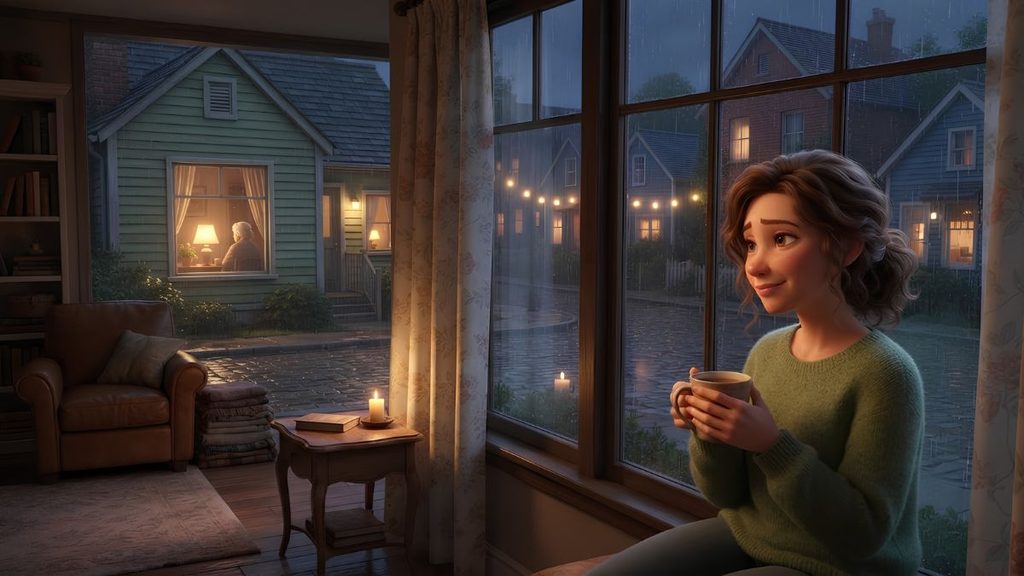
Type: Peaceful / Heartwarming
Characters: Emily and Daniel
Every evening at exactly seven o’clock, Emily noticed the lamp.
It stood in the front window of the old house across the street.
The house was small, with pale green shutters, a narrow porch, and a garden that had once been carefully maintained but was now beginning to grow a little wild.
Most of the houses on Emily’s street looked dark by seven.
People came home from work, ate dinner, watched television, and gradually turned off their lights.
But the old house was different.
One small lamp always remained glowing in the front window.
It wasn’t bright.
It wasn’t decorative.
It was simply a warm yellow light behind a cream-colored lampshade.
Emily noticed it because she often sat beside her own window after dinner.
She lived alone in a comfortable apartment across the street.
Her evenings were usually quiet.
She made tea.
She read a few pages of a book.
Sometimes she listened to music.
Sometimes she simply watched the world outside.
And every evening, without fail, she saw the lamp.
Seven o’clock.
On.
Eight o’clock.
Still on.
Nine o’clock.
Still on.
Ten o’clock.
Still glowing.
At first, Emily thought the light had been forgotten.
Perhaps the owner was elderly and simply didn’t notice it.
Perhaps the lamp was connected to a timer.
Perhaps there was no particular reason at all.
But after several weeks, Emily began to wonder.
One cold November evening, she stood by her window holding a cup of tea.
Rain tapped gently against the glass.
Across the street, the little lamp was glowing as usual.
Emily smiled.
“You really never turn off, do you?”
The lamp, of course, said nothing.
But Emily found herself looking forward to it.
There was something comforting about seeing that warm light every evening.
It made the street feel less empty.
Then, one Monday morning, Emily noticed a woman standing in the old house’s garden.
She was perhaps in her seventies.
She wore a long brown coat and a knitted hat.
She was carefully trimming a rose bush beside the porch.
Emily had never seen her before.
The woman looked up.
Their eyes met.
Emily smiled politely.
The woman smiled back.
That was all.
The next evening, Emily saw the lamp again.
She wondered if the woman was the owner.
She wondered about the light.
But she didn’t ask.
A few days later, Emily was returning from the grocery store when she saw the woman struggling with two heavy bags.
Without thinking, Emily crossed the street.
“Can I help you?”
The woman looked surprised.
Then she smiled.
“That would be lovely.”
Emily took one of the bags.
“Do you live here?”
The woman laughed.
“I suppose the house gives that away.”
Emily smiled.
“I’ve seen your lamp.”
The woman paused.
“My lamp?”
“The one in the window.”
“Oh.”
The woman looked toward the front window.
“Yes.”
“It is always on.”
The woman smiled.
“I know.”
Emily hesitated.
“Is there a reason?”
The woman held the door open.
“Come inside.”
Emily followed.
The house smelled faintly of cinnamon and old books.
It was warm and tidy.
There were framed photographs on the walls.
A small clock ticked somewhere in the hallway.
The woman placed the grocery bags on the kitchen counter.
“I’m Eleanor,” she said.
“Emily.”
“It’s nice to meet you properly.”
Emily smiled.
“Nice to meet you too.”
Eleanor filled the kettle.
“Tea?”
Emily laughed.
“I already had tea.”
“Then you can have more.”
There was something about Eleanor that made saying no difficult.
A few minutes later, they sat together at the kitchen table.
Emily looked toward the hallway.
“How long have you lived here?”
“Forty-six years.”
“That’s a long time.”
“It is.”
Eleanor looked around the kitchen.
“My husband and I bought the house when we were young.”
Emily smiled.
“Is he still here?”
Eleanor’s expression softened.
“No.”
She didn’t explain immediately.
Emily didn’t ask.
After a moment, Eleanor continued.
“His name was Arthur.”
She wrapped both hands around her teacup.
“He was a teacher. Very patient man.”
“Was?”
“He passed away eight years ago.”
“I’m sorry.”
“Thank you.”
Eleanor looked toward the window.
“He used to turn that lamp on every evening.”
Emily looked at her.
“Why?”
Eleanor smiled.
“He said every home should have one light waiting for someone to come home.”
Emily felt something tighten gently in her chest.
“Was he waiting for you?”
“Sometimes.”
Eleanor laughed softly.
“Sometimes I was the one waiting for him.”
She took a sip of tea.
“But Arthur liked the idea of a light being left on.”
“Even when nobody was coming?”
“Especially then.”
Emily smiled.
“Why?”
Eleanor looked at the lamp.
“He used to say you never know who might need to see a light.”
Emily remained quiet.
Eleanor continued.
“When our children were young, they would sometimes come home late. Arthur would leave the lamp on.”
“That makes sense.”
“But later, when the children grew up and moved away, he still kept doing it.”
“Why?”
“Because he said the habit had changed.”
Emily smiled.
“Changed how?”
“It was no longer just for our children.”
Eleanor looked at her.
“It was for anyone who needed to know that there was still a little light somewhere.”
Emily thought about that.
She had never considered a lamp that way.
It had always seemed like an object.
Now it felt like a message.
A small one.
But a message nonetheless.
That evening, when Emily returned home, she looked across the street.
The lamp was glowing.
For the first time, she didn’t simply notice it.
She understood it.
The next morning, Emily had an idea.
It was a small idea.
Almost silly.
But she decided to try it.
That evening, at seven o’clock, she switched on the lamp beside her own window.
It was an old table lamp with a white shade.
She had bought it years earlier but rarely used it.
Now it stood glowing in her front room.
Across the street, Eleanor’s lamp was already on.
Emily smiled.
Two lights.
One on each side of the street.
The following morning, Eleanor noticed.
She sent Emily a message.
“Nice lamp.”
Emily laughed.
“Thank you.”
Eleanor replied:
“Arthur would have liked that.”
Emily looked at the message for a long time.
Then she wrote:
“Maybe it can stay on too.”
Eleanor answered:
“I think it should.”
And so it did.
Every evening, Emily switched on her lamp.
Every evening, Eleanor switched on hers.
It became a quiet little tradition.
They rarely talked about it.
They didn’t need to.
The two lamps simply appeared each evening.
Then something unexpected happened.
A week before Christmas, Emily was walking home when she noticed a man standing outside his house.
He looked tired.
He was carrying a suitcase.
Emily knew him only slightly.
His name was David.
He lived two houses down.
“Everything all right?” she asked.
He looked toward his dark house.
“My wife left this morning.”
Emily didn’t know what to say.
David looked embarrassed.
“Sorry. I don’t know why I’m telling you.”
“You don’t have to apologize.”
He nodded.
“I just don’t really want to go inside yet.”
Emily looked at the houses around them.
Most were dark.
Then she looked at the two warm lamps across the street.
David followed her gaze.
“What are those?”
Emily smiled.
“Lights waiting for someone to come home.”
David looked at them for a moment.
Then he smiled faintly.
“That’s nice.”
Emily nodded.
“Yes.”
He stood there a little longer.
Then he said goodnight and went inside.
The next evening, Emily noticed another lamp.
David had placed one in his window.
Three lights.
The following week, another appeared.
Then another.
Soon, several homes on the street had a warm lamp glowing in the evening.
Nobody had organized it.
Nobody had announced it.
There were no rules.
People simply noticed the lights and decided to add one of their own.
The street began to look different.
Not brighter exactly.
Warmer.
One evening, Emily and Eleanor stood together on Eleanor’s porch.
They looked down the street.
There were lamps glowing in several windows.
Eleanor smiled.
“Arthur would have been delighted.”
Emily smiled.
“I think he started something.”
Eleanor nodded.
“Perhaps.”
A few days later, a young couple moved into a house at the end of the street.
They were unpacking boxes late one evening.
Emily noticed their windows were dark.
She wondered if they had seen the lamps.
The next morning, she left a small note at their door.
It said:
“Welcome to the neighborhood. If you ever wonder why people leave their lamps on in the evening, ask Eleanor at the green house.”
The young couple smiled when they found it.
That evening, they visited Eleanor.
The next night, a new lamp appeared.
It became the newest light on the street.
Years passed.
The tradition remained.
People moved in.
People moved away.
Children grew older.
Gardens changed.
Paint faded.
New houses were built.
But the lamps continued.
Seven o’clock.
On.
Eight o’clock.
Still on.
Nine o’clock.
Still glowing.
Sometimes people left them on when they went out.
Sometimes they forgot.
Sometimes the bulbs needed replacing.
But someone always seemed to remember.
Emily eventually moved to a larger house with a small garden.
She was no longer directly across from Eleanor.
But she took her old lamp with her.
Every evening, she placed it in the front window.
Eleanor did the same.
They continued their tradition from different streets.
One winter evening, Emily received a letter from Eleanor.
It wasn’t unusual.
They had remained friends for many years.
But this letter was different.
Eleanor had written:
“Dear Emily,
I think Arthur was right.
A light does not have to solve anything.
It does not have to make the darkness disappear.
Sometimes it only needs to say, ‘You are not completely alone.’
Thank you for understanding that.
Love,
Eleanor.”
Emily read the letter twice.
Then she placed it beside her lamp.
That evening, she sat quietly by the window.
Outside, the street was covered with a thin layer of snow.
The houses were quiet.
The world seemed to have slowed down.
Her lamp glowed warmly against the glass.
Emily thought about how strange it was that something so small could become so meaningful.
A lamp could not fix loneliness.
It couldn’t bring someone back.
It couldn’t erase sadness.
It couldn’t guarantee that everything would be all right.
But it could offer something simpler.
A reminder.
Someone cared.
Someone remembered.
Somewhere, there was still warmth.
And sometimes, that was enough to help a person take one more step forward.
Emily looked at the clock.
Seven o’clock.
She smiled.
Across the street, another lamp turned on.
Then another.
Then another.
Soon the neighborhood was dotted with small golden lights.
Emily imagined Eleanor looking out her own window.
Perhaps she was smiling too.
Perhaps she was thinking of Arthur.
Perhaps she was simply enjoying the evening.
Emily closed the curtains halfway.
The lamp remained visible.
She made herself a cup of tea.
Then she settled into her chair with a book.
The room was quiet.
The lamp glowed beside her.
And for a little while, Emily thought about all the people who might be looking at their own little lights that evening.
Someone returning from work.
Someone waiting for a phone call.
Someone missing a loved one.
Someone beginning again.
Someone having a difficult day.
Someone simply enjoying the quiet.
They might never know who had turned the light on.
They might never know the story behind it.
They might never know that the tradition had begun with an old man named Arthur who believed that every home should have one light waiting for someone to come home.
But perhaps they didn’t need to know.
Perhaps the message was enough.
The night grew darker.
The houses became quieter.
The rain began tapping softly against Emily’s window.
She closed her book.
The lamp was still on.
She smiled.
Then she whispered into the quiet room,
“Goodnight, Arthur.”
She wasn’t sure why she said it.
Perhaps because some people leave this world but remain in the smallest habits of those who loved them.
Perhaps because a kindness can travel farther than the person who first offered it.
Or perhaps because sometimes the simplest things are the ones that stay with us.
Emily turned off the other lights.
She left the little lamp glowing.
Outside, the neighborhood rested beneath the quiet night sky.
And one by one, the homes became peaceful.
But the lamps remained.
Small.
Warm.
Steady.
Waiting.
Not necessarily for someone specific.
Just waiting.
As if each one were quietly saying:
There is still light here.
You can come home.
Theme: Hope, kindness, and the comfort of feeling welcome.
2. The Last Cup of Tea

Type: Romantic / Cozy
Characters: Clara and James
The rain began just before six o’clock.
At first, it was soft.
A few drops tapped against the kitchen window, barely loud enough to notice.
Then the sky darkened.
The rain became heavier.
Within half an hour, the street outside Clara and James’s apartment had turned silver beneath the streetlights.
Cars moved slowly along the wet road.
People hurried beneath umbrellas.
The windows of nearby houses began glowing with warm yellow light.
Inside the apartment, everything was quiet.
Clara was curled up on the sofa with a book.
James was in the kitchen.
He had been there for almost twenty minutes.
Clara looked up from her book.
“What are you doing?”
“Nothing.”
She smiled.
“That sounded suspicious.”
“I’m making tea.”
“That doesn’t usually take twenty minutes.”
“It does when you’re doing it properly.”
Clara laughed.
“Tea doesn’t require twenty minutes.”
James appeared in the doorway holding two cups.
“You’re right.”
He placed one cup on the coffee table.
Clara picked it up.
The familiar smell of their favorite tea rose gently from the cup.
It was a blend they had discovered several years earlier in a tiny tea shop while traveling.
They had bought one small packet.
Then another.
Eventually, it became their tea.
Whenever one of them said, “Should we make our tea?” they both knew exactly what they meant.
Clara took a sip.
“It’s perfect.”
James smiled.
“I know.”
He sat beside her.
For a few minutes, they listened to the rain.
Neither spoke.
They didn’t need to.
They had been together long enough to understand that silence did not always need filling.
Sometimes silence was simply another way of being together.
Clara turned a page.
James looked toward the window.
Then he looked at his cup.
Something caught Clara’s attention.
“Wait.”
James looked at her.
“What?”
“Is that your cup?”
“Yes.”
Clara looked at the table.
There were two cups.
One beside her.
One beside James.
But something seemed strange.
She looked at James’s cup.
Then at hers.
She realized that James had given her the larger cup.
The last of the tea was in it.
His cup contained only a little.
“You gave me most of it.”
James shrugged.
“Did I?”
“Yes.”
“I didn’t notice.”
Clara smiled.
“You absolutely noticed.”
James looked innocent.
“I may have made a small decision.”
“You wanted more.”
“No.”
“You love this tea.”
“I do.”
“And you gave me almost all of it.”
James smiled.
“Maybe.”
Clara stared at him.
“Why?”
He looked toward the rain.
“Because you like it more when it’s raining.”
Clara laughed softly.
“You like it too.”
“I know.”
“Then why didn’t you keep the last cup?”
James looked at her.
“I almost did.”
“Almost?”
“I poured mine first.”
Clara raised an eyebrow.
“And?”
“And then I looked outside.”
He paused.
“I thought you would enjoy it.”
Something about the simplicity of his answer made Clara quiet.
There was no dramatic declaration.
No elaborate romantic gesture.
He had simply noticed the rain.
Thought about her.
And given her the better cup.
Clara looked down at her tea.
Then she smiled.
“You’re ridiculous.”
“I’ve been told.”
She took another sip.
Then she looked at his cup.
“How much is left?”
James looked.
“Not much.”
“Give it to me.”
He laughed.
“No.”
“We’re sharing.”
“It’s your cup.”
“You gave it to me.”
“Exactly.”
“And now I’m giving it back.”
“That’s not how gifts work.”
Clara laughed.
“Fine.”
She took his cup.
James watched her.
Clara poured the remaining tea into her cup.
Then she divided it back between them.
“There.”
James looked at the two cups.
“That’s very fair.”
“Now we both have some.”
He smiled.
“You’re impossible.”
“Apparently, we’re both ridiculous.”
They settled back into the sofa.
The rain continued outside.
For a while, they simply drank their tea.
Then Clara said,
“Do you remember the first time we had this?”
James smiled immediately.
“Of course.”
“Where were we?”
“That little tea shop in York.”
“The one with the blue door?”
“Yes.”
“And the owner had that enormous orange cat.”
James laughed.
“The cat hated me.”
“The cat didn’t hate you.”
“It stared at me.”
“It stared at everyone.”
“Not like it stared at me.”
Clara smiled.
“You tried to feed it.”
“I thought it was hungry.”
“You gave it a piece of cake.”
“It looked hungry.”
“It was sitting beside a full bowl of food.”
James laughed.
“Details.”
Clara leaned back.
“That was eight years ago.”
“Nine.”
She looked at him.
“Nine?”
“We went in September.”
Clara thought about it.
“You remember?”
“I remember everything.”
She smiled.
“Everything?”
“Not everything.”
“Good.”
James laughed.
“I remember important things.”
Clara looked at him.
“Like what?”
He thought for a moment.
“The first time you laughed at one of my terrible jokes.”
“That happened once.”
“It happened enough for me to remember.”
“The joke wasn’t funny.”
“You laughed.”
“I felt sorry for you.”
“Still counts.”
Clara smiled.
“What else?”
James looked toward the window.
“The first apartment we rented.”
“The tiny one?”
“The very tiny one.”
“We could touch the kitchen sink from the bedroom.”
“That was convenient.”
“It was terrible.”
“It had character.”
“It had a leaking ceiling.”
“Character.”
Clara laughed.
They remembered the apartment.
The crooked shelves.
The noisy upstairs neighbor.
The tiny balcony where they had tried to grow tomatoes.
The one tomato they managed to produce.
James had taken a photograph of it.
They still had the photograph somewhere.
Then Clara remembered something else.
“Do you remember when I got sick before my first big presentation?”
James nodded.
“You couldn’t sleep.”
“I was nervous.”
“You were terrified.”
“I wasn’t terrified.”
“You practiced the presentation twelve times.”
“Thirteen.”
Clara laughed.
“See?”
James smiled.
“You were good.”
“I forgot half of it.”
“But you finished.”
She looked at him.
“You stayed awake with me.”
“I made tea.”
“You made terrible tea.”
“That’s unfair.”
“It was too strong.”
“You were sick.”
“You made it stronger because you thought it would help.”
“I was trying.”
“I know.”
They smiled at each other.
That was the thing about memories.
They rarely returned alone.
One memory opened the door for another.
Clara remembered the winter James lost his job.
James remembered the summer Clara had worked every weekend.
They remembered the evening their washing machine broke.
The day they adopted their first houseplant.
The plant that died.
The second plant that somehow survived.
The holiday they had planned for months and nearly missed because James had forgotten to check the train times.
The birthday when Clara wanted no celebration but secretly hoped James would bring cake.
He had.
The morning James had left a note beside her keys because he knew she was having a difficult day.
The evening Clara had waited outside his office with an umbrella because the weather forecast predicted rain.
The sandwich she had packed for him when he forgot to eat lunch.
The coffee he had brought her when she was working late.
The countless evenings when one of them had quietly made tea for the other.
None of these moments seemed important when they happened.
They weren’t anniversaries.
They weren’t grand surprises.
They weren’t the kinds of things people photographed for social media.
But sitting together on the sofa years later, Clara began to realize how many of them there were.
Love had been there.
Quietly.
Repeatedly.
In ordinary places.
In grocery bags.
In packed lunches.
In umbrellas.
In cups of tea.
In reminders.
In waiting.
In listening.
In noticing.
Clara looked at James.
“Do you know something?”
“What?”
“I think we remember the big things because they’re easy to remember.”
James nodded.
“But the small things…”
She looked at their cups.
“They’re everywhere.”
James smiled.
“What do you mean?”
“All those little things we did for each other.”
“Like tea?”
“Exactly.”
He looked at his cup.
Then hers.
“I suppose we did quite a lot of tea.”
“We did.”
“Too much, probably.”
“Definitely.”
They laughed.
The rain became heavier.
Thunder sounded somewhere far away.
Clara moved closer to James.
He put his arm around her.
Neither spoke for a while.
Then Clara said,
“What’s the smallest thing I’ve ever done that you remember?”
James thought carefully.
“You once put a chocolate biscuit inside my coat pocket.”
Clara laughed.
“I forgot about that.”
“I didn’t.”
“Why did I do that?”
“You had noticed I was having a bad day.”
She looked at him.
“When?”
“Years ago.”
“You never told me.”
“I didn’t need to.”
He smiled.
“I found it when I was waiting for the bus.”
Clara laughed softly.
“You ate it?”
“Obviously.”
“Did it help?”
“Very much.”
She smiled.
“What about you?”
“What?”
“What’s the smallest thing you’ve done for me that you remember?”
James thought.
“There was that morning you couldn’t find your keys.”
Clara groaned.
“Don’t remind me.”
“You searched for twenty minutes.”
“They weren’t where I left them.”
“They were in your hand.”
Clara covered her face.
“Please stop.”
James laughed.
“I brought you coffee while you searched.”
“You did.”
“And when you finally realized you were holding your keys, you were so embarrassed that you nearly dropped the coffee.”
“I remember.”
They laughed together.
The story of the lost keys had become one of their favorite jokes.
But tonight, it felt different.
Clara looked at James.
“That’s what I mean.”
“What?”
“None of these things are extraordinary.”
“No.”
“But somehow they became our life.”
James nodded.
“I think that’s what a life together is.”
Clara rested her head against his shoulder.
“Small things?”
“Lots of small things.”
They finished their tea.
James looked at the empty cups.
“I can make more.”
Clara shook her head.
“No.”
“No?”
“We should save some for tomorrow.”
James smiled.
“Good idea.”
He took the cups into the kitchen.
Clara watched him disappear around the corner.
She listened to the sound of running water.
The sound of the kettle being rinsed.
The soft clink of porcelain.
Ordinary sounds.
Familiar sounds.
She realized that she loved those sounds.
Not because they were beautiful.
But because they belonged to their life.
James returned and sat beside her again.
Clara looked at him.
“I love you.”
He smiled.
“I love you too.”
She reached for his hand.
“Even when you give away your tea?”
“Especially then.”
She laughed.
The rain continued through the evening.
The city outside became quieter.
Cars became less frequent.
Windows went dark one by one.
But Clara and James remained on the sofa.
They talked about the future.
Not in grand terms.
They talked about places they might visit.
A garden they wanted to create.
Books they wanted to read.
Meals they wanted to learn how to cook.
A small house they might someday live in.
They talked about getting older.
About how strange it would be to have gray hair.
James said he would look distinguished.
Clara said he would look exactly like his father.
He pretended to be offended.
She laughed.
Eventually, the conversation became quieter.
Clara looked toward the window.
The rain had softened.
Only a gentle drizzle remained.
The streetlights reflected across the wet road.
She thought about the last cup of tea.
It seemed like such a small thing.
Almost too small to matter.
James had wanted it.
She knew that.
Yet he had saved it for her.
Not because he expected anything.
Not because he wanted praise.
Simply because he knew she liked tea when it rained.
And suddenly Clara understood something she had perhaps known all along.
Love was not always found in grand gestures.
Sometimes it was hidden in the kitchen.
Sometimes it was waiting beside the kettle.
Sometimes it was the umbrella held over someone else’s head.
Sometimes it was the last piece of cake.
Sometimes it was a message asking whether you had arrived safely.
Sometimes it was staying awake when the other person couldn’t sleep.
Sometimes it was simply remembering.
Remembering how someone takes their tea.
Remembering which song makes them smile.
Remembering that they are nervous about tomorrow.
Remembering that they like the window open when it rains.
Remembering the little things.
Clara looked at James.
“Thank you.”
He looked confused.
“For what?”
She smiled.
“For remembering.”
James squeezed her hand.
“Someone has to.”
She leaned against him.
Outside, the rain finally stopped.
The clouds began to separate.
A small patch of dark blue sky appeared above the buildings.
Neither of them noticed immediately.
They were too comfortable.
Too quiet.
Too content to move.
Eventually, James looked at the clock.
“It’s late.”
Clara nodded.
“We should sleep.”
“Probably.”
Neither moved.
A few minutes passed.
James looked at her.
“Still not moving?”
“No.”
“Good.”
He smiled.
“Me neither.”
They stayed there a little longer.
Then Clara stood.
She held out her hand.
“Come on.”
James took it.
They turned off the lights together.
The apartment became dark except for the soft glow of the streetlights coming through the curtains.
Before going to bed, Clara paused in the kitchen.
She looked at the kettle.
There was enough tea left for tomorrow.
She smiled.
James stood behind her.
“What?”
She shook her head.
“Nothing.”
“You’re smiling.”
“I know.”
“Why?”
She turned toward him.
“Because tomorrow we’ll make tea again.”
James smiled.
“Of course we will.”
They walked toward the bedroom.
The kitchen fell silent.
The cups sat clean beside the sink.
The kettle waited on the counter.
Outside, the last drops of rain slipped from the roof.
And in the quiet apartment, there was nothing remarkable.
No grand declaration.
No perfect ending.
Just two people who had spent years learning the language of small kindnesses.
Two cups.
One rainy evening.
And a love that had been growing quietly, one little gesture at a time.
Sometimes the greatest love stories are not built from extraordinary moments.
They are built from ordinary ones.
A cup of tea.
A saved seat.
A remembered preference.
A hand reaching across the sofa.
A light left on.
A message sent at the right moment.
A little kindness offered without being asked.
The things that seem too small to remember often become the things we remember most.
And perhaps that is because love is rarely one enormous moment.
Perhaps love is thousands of tiny moments that quietly say the same thing.
I noticed you.
I remembered you.
I thought of you.
I am here.
And sometimes, on a rainy evening, all of that can fit inside the last cup of tea.
Theme: Everyday love and thoughtful gestures.
3. The Bookshop That Closed at Eight

Type: Gentle Mystery / Heartwarming
Characters: Sophie and Oliver
Every evening at exactly eight o’clock, the little bookshop closed.
It did not matter if a customer was still browsing.
It did not matter if someone arrived at seven fifty-nine.
At eight, the owner turned the sign in the window from OPEN to CLOSED, lowered the small brass lamp beside the door, and locked the shop.
Sophie noticed this because she passed the bookshop almost every evening.
The shop stood halfway down a narrow street in the oldest part of town.
Its name was printed in faded gold letters above the door:
The Corner Shelf
The letters were beginning to peel.
The windows were slightly crooked.
The wooden door had been painted several times, and the most recent coat of dark green paint had begun to fade around the edges.
It was not the sort of shop people noticed immediately.
There were no bright signs.
No advertisements.
No modern display screens.
Just books.
Hundreds of them.
They filled the windows, the shelves, the tables, and sometimes even the floor.
Sophie loved it.
She had discovered The Corner Shelf several months earlier while looking for a secondhand copy of a novel she had read as a teenager.
The owner, an elderly man named Mr. Bennett, had found the book in less than a minute.
“You look like someone who needs this one,” he had said.
Sophie had laughed.
“I was actually looking for it.”
“I know.”
She had raised an eyebrow.
“You don’t know me.”
“Books tell you things.”
She had smiled.
“Do they?”
“Sometimes.”
That was the first conversation they had ever had.
Since then, Sophie had visited regularly.
She liked the smell of the shop.
Old paper.
Wood.
Dust.
Coffee.
Rain drifting in whenever the door opened.
She liked the narrow aisles and handwritten price tags.
She liked the way afternoon sunlight entered through the front window and rested on the books.
But most of all, she liked the feeling that the shop had been waiting for her.
One Thursday evening, Sophie entered just before seven.
Oliver was supposed to meet her for dinner, but he had sent a message saying he would be twenty minutes late.
Sophie decided to browse while she waited.
Mr. Bennett was behind the counter.
He looked up.
“Evening, Sophie.”
“Hello.”
“Looking for anything?”
“Not particularly.”
“Good.”
Sophie smiled.
“Why is that good?”
“It means you’ll probably find something.”
She walked toward the back shelves.
She was passing a section of old travel books when she noticed something unusual.
A small piece of paper had been placed inside an open book.
She pulled the book from the shelf.
It was an old collection of local photographs.
The note was handwritten.
Only one sentence appeared on it.
She always bought yellow flowers on Fridays.
Sophie frowned.
There was no signature.
No explanation.
She looked around.
Mr. Bennett was arranging receipts.
“Mr. Bennett?”
“Yes?”
“Did you put this here?”
He looked toward the book.
“Perhaps.”
“What does it mean?”
He smiled.
“It means exactly what it says.”
Sophie waited.
He returned to his receipts.
“Who bought yellow flowers?”
Mr. Bennett looked up.
“That’s the interesting question.”
Sophie laughed.
“You aren’t going to tell me?”
“Not yet.”
She placed the note back inside the book.
“Why?”
“Because some stories are better when you discover them yourself.”
Just then, the door opened.
Oliver entered, shaking rain from his umbrella.
“Sorry.”
Sophie smiled.
“You’re late.”
“I know.”
“Twenty minutes.”
“Traffic.”
“You walked here.”
Oliver looked at her.
“Pedestrian traffic.”
She laughed.
They left for dinner.
But Sophie kept thinking about the note.
She always bought yellow flowers on Fridays.
The following week, she returned to The Corner Shelf.
It was almost seven thirty.
She browsed the shelves.
Then she noticed another handwritten note.
This time it was inside an old cookbook.
He made soup every Sunday, even after she stopped coming home.
Sophie stared at the sentence.
She looked toward Mr. Bennett.
He was sitting behind the counter reading.
“Another one.”
He looked up.
“Another what?”
“Note.”
“Ah.”
“Who are these people?”
“People.”
Sophie sighed.
“That isn’t helpful.”
Mr. Bennett smiled.
“Most people aren’t.”
She brought the book to the counter.
“Can I ask you something?”
“Of course.”
“Are these stories real?”
Mr. Bennett looked at the note.
“Yes.”
“How do you know?”
“I knew some of them.”
“And the others?”
“I heard their stories.”
“From whom?”
“From people who remembered them.”
Sophie looked around the shop.
“Why put the notes inside books?”
Mr. Bennett shrugged.
“Where else should stories go?”
Sophie smiled.
That answer stayed with her.
She began noticing the notes everywhere.
Not every day.
Only occasionally.
Sometimes they were inside old books.
Sometimes new ones.
Sometimes the notes were only a sentence.
Sometimes they contained a date.
Sometimes they mentioned a place.
Sometimes they described a tiny event that seemed almost meaningless.
One read:
She waited for the number seventeen bus every morning, even after they changed the route.
Another said:
He repaired watches but never wore one himself.
Another:
They met here every Tuesday for twenty-six years.
And another:
She planted three apple trees. Only one survived.
Sophie began collecting the sentences in a notebook.
She did not know why.
Perhaps she simply didn’t want to forget them.
One evening, Oliver noticed.
“What are those?”
“Notes.”
“I can see that.”
“From the bookshop.”
He read one.
“She always bought yellow flowers on Fridays.”
He looked at Sophie.
“What’s that supposed to mean?”
“I don’t know.”
“You’ve been collecting them?”
“Yes.”
Oliver smiled.
“You’ve become part of the mystery.”
“I think so.”
“Should we investigate?”
Sophie looked at him.
“Would you?”
“Obviously.”
They returned to the shop together on Saturday.
The shop was quiet.
Rain had begun outside.
Oliver examined the shelves.
Sophie looked for another note.
After several minutes, she found one.
It was inside a book about the town’s history.
The house with the blue door belonged to a violin maker named Samuel Reed.
Oliver looked up.
“Blue door?”
Sophie nodded.
“Do you know where it is?”
“Not yet.”
Mr. Bennett was listening.
“You’re looking for the house?”
“Maybe.”
He smiled.
“Then you’ll need to walk.”
The rain continued.
So they waited until Monday.
On Monday evening, Sophie and Oliver walked through the older part of town.
They passed the library.
The old cinema.
The bakery.
A closed tailor’s shop.
Then they found it.
A small house with a blue door.
The garden was overgrown.
The windows were dusty.
There was a brass number beside the door.
Sophie looked at Oliver.
“Samuel Reed.”
“Maybe.”
They walked around the corner.
On the side wall was a small plaque.
Samuel Reed, violin maker, 1931-1987.
Sophie smiled.
The note had been real.
But that raised another question.
How did Mr. Bennett know?
They returned to the shop the next evening.
Sophie went directly to the counter.
“Mr. Bennett.”
He looked up.
“Yes?”
“Who was Samuel Reed?”
Mr. Bennett smiled.
“Now you’re asking better questions.”
“Please.”
He sighed gently.
“Samuel was a violin maker.”
“I know.”
“He was also my uncle.”
Sophie blinked.
“Your uncle?”
“Yes.”
“You knew him?”
“I grew up three streets away.”
“Why didn’t you tell me?”
“You never asked.”
Sophie laughed.
“That’s fair.”
Mr. Bennett reached beneath the counter.
He brought out an old photograph.
It showed a young man standing outside a small workshop.
He held a violin beneath one arm.
“That’s Samuel.”
Sophie looked at the photograph.
“He looks happy.”
“He was.”
“Do you have more?”
Mr. Bennett nodded.
He brought out a box.
Inside were photographs, letters, receipts, newspaper clippings, postcards, and handwritten pages.
Oliver leaned closer.
“What is all this?”
“Memories.”
Sophie looked at him.
“How long have you been keeping them?”
“Most of my life.”
Mr. Bennett explained that his uncle had taught him the importance of remembering ordinary people.
Not famous people.
Not wealthy people.
Ordinary people.
People who opened shops.
People who planted gardens.
People who waited for buses.
People who baked bread.
People who wrote letters.
People who loved someone quietly.
“When people die,” Mr. Bennett said, “their stories often disappear faster than their names.”
Sophie listened.
“So you save them?”
“When I can.”
“Why?”
He looked around the shop.
“Because someone should.”
Over the following weeks, Sophie and Oliver learned more.
The woman who bought yellow flowers on Fridays had been named Margaret Bell.
She had worked at the post office for thirty-eight years.
Every Friday, she bought yellow flowers because her husband had once told her they made the kitchen look happy.
The man who made soup every Sunday was Thomas Green.
His wife had moved to another city after they separated.
He continued making soup every Sunday because it was the meal they had cooked together when they were newly married.
The watchmaker was Arthur Lane.
He repaired clocks and watches but never wore one because he said he preferred knowing the time by looking at the sky.
The couple who met every Tuesday had owned the bakery across the street.
They had met there when they were eighteen.
They continued meeting every Tuesday even after retiring.
Sophie began to understand.
The notes were not clues to a single mystery.
They were pieces of many lives.
The bookshop was full of them.
One evening, Sophie asked Mr. Bennett,
“How many stories do you have?”
He laughed.
“More than I can count.”
“Do you write them all down?”
“When I can.”
“What happens when you’re gone?”
The question surprised him.
He was quiet.
Then he smiled.
“That is a very serious question for a Tuesday.”
“I’m serious.”
“I know.”
He looked at the shelves.
“I suppose someone else will decide what happens.”
Sophie looked at Oliver.
Something had changed.
She suddenly understood that the bookshop itself was part of the collection.
The shelves.
The photographs.
The notes.
The books.
The stories.
Everything was preserving something.
A month later, Mr. Bennett became ill.
He closed the shop for several days.
When Sophie heard, she visited his house with groceries.
Oliver came too.
Mr. Bennett smiled when he saw them.
“You two are becoming troublesome.”
“We brought soup,” Oliver said.
“Then perhaps you’re forgiven.”
Sophie looked at the old photographs on the wall.
“You need to tell us more stories.”
Mr. Bennett smiled.
“I thought you had enough.”
“We don’t.”
So he began.
He told them about the town.
About streets that had changed.
Buildings that had disappeared.
Shops that had once stood where apartments now existed.
He told them about people who had been forgotten.
And Sophie wrote everything down.
When Mr. Bennett recovered, he returned to the shop.
But something had changed.
Sophie began helping him.
She interviewed local residents.
She collected photographs.
She listened to stories.
She wrote down memories.
Oliver helped organize the archive.
They created a small cabinet at the back of the shop.
A handwritten sign appeared above it:
Stories of Our Town
People began bringing things.
An old photograph.
A recipe.
A letter.
A theater ticket.
A school notebook.
A postcard.
A faded wedding invitation.
Each object had a story.
Each story found a place.
One evening, Sophie arrived at seven fifty-five.
The shop was quiet.
Mr. Bennett was preparing to close.
Sophie looked around.
“You’re closing?”
“At eight.”
“Exactly?”
“Exactly.”
She smiled.
She had come to understand why.
The shop needed an ending to each day.
A moment when the books became quiet.
A moment when the stories rested.
At seven fifty-nine, Mr. Bennett turned the sign.
Sophie stood beside him.
Oliver waited outside.
Mr. Bennett locked the door.
Then he looked at Sophie.
“Do you know why I always close at eight?”
She shook her head.
“I think it’s time you knew.”
He pointed toward the shelves.
“A bookshop is full of open doors.”
Sophie smiled.
“But?”
“But people need to know when to close the door too.”
She looked at him.
“Why?”
“Because tomorrow, we open again.”
Sophie understood.
The closing was not an ending.
It was a promise.
There would be another morning.
Another reader.
Another story.
Another memory waiting to be discovered.
The three of them stood outside the shop.
The street was quiet.
A warm light glowed behind the window.
Sophie looked at the books inside.
She thought about all the people whose lives had become notes.
The woman with yellow flowers.
The man who made soup.
The watchmaker.
The bakery couple.
Samuel Reed.
So many ordinary lives.
So many small acts.
So many moments that might otherwise have disappeared.
She reached for Oliver’s hand.
“Do you think people realize how many stories they leave behind?”
Oliver smiled.
“Probably not.”
“Maybe that’s okay.”
“Why?”
“Because someone else can remember.”
They walked home slowly.
That night, Sophie opened her notebook.
She turned to a blank page.
Then she wrote:
Some stories are not written because they are famous.
They are written because someone loved them enough to remember.
She closed the notebook.
The next morning, she returned to The Corner Shelf.
There was a new note waiting inside a book.
Sophie opened it.
Only one sentence was written.
She came looking for a book and found a town full of stories.
Sophie smiled.
She looked toward Mr. Bennett.
He was pretending not to watch her.
“Did you write this?”
“Perhaps.”
“Is it about me?”
“Perhaps.”
Sophie laughed.
Oliver entered the shop.
“What’s funny?”
Sophie held up the note.
He read it.
Then he smiled.
“Seems accurate.”
She placed the note carefully back inside the book.
Outside, the town was waking.
Shopkeepers lifted shutters.
Buses moved along the street.
A bakery opened its doors.
Someone walked past carrying flowers.
The town was beginning another ordinary day.
And inside the little bookshop, hundreds of stories waited quietly on the shelves.
Some belonged to famous writers.
Some belonged to strangers.
Some belonged to people nobody remembered anymore.
But all of them had something in common.
They had once been someone’s life.
And that was enough.
At eight o’clock that evening, The Corner Shelf closed again.
The sign turned from OPEN to CLOSED.
The brass lamp beside the door was lowered.
The lock clicked.
The street became quiet.
But the stories remained.
Waiting patiently between the pages.
Waiting for morning.
Waiting for another curious reader.
Waiting for someone to discover that the most beautiful stories are not always about extraordinary people.
Sometimes they are about ordinary people who bought flowers on Fridays.
Who made soup on Sundays.
Who repaired watches.
Who planted trees.
Who met someone every Tuesday.
Who loved.
Who lost.
Who remembered.
Who lived quietly.
And who, for a little while, were remembered.
The bookshop closed at eight.
But the stories never really closed.
They simply waited for the next person to open the door.
Theme: Memories, stories, and preserving the past.
4. The Bench Under the Willow Tree

Type: Peaceful / Inspirational
Characters: Anna and Michael
Every evening, just before sunset, Michael walked to the same park.
He never hurried.
He would leave his apartment around six, carry a small book beneath his arm, and follow the quiet road that led toward the river.
At the far end of the park stood an enormous willow tree.
Its branches stretched downward like long green curtains, almost touching the grass. Beneath those branches was an old wooden bench.
Michael always sat there.
Sometimes he read.
Sometimes he watched the river.
Sometimes he did absolutely nothing.
He simply sat.
People in the neighborhood had noticed the habit.
Children ran past him on their way to the playground.
Dog walkers nodded when they saw him.
Older couples sometimes smiled.
But Michael rarely spoke to anyone.
He had been coming to the bench for almost three years.
Then Anna moved into the neighborhood.
Her apartment was on the third floor of a small building across from the park.
She noticed Michael during her first week.
Every evening, she saw him walking toward the willow tree.
At first, she thought nothing of it.
Then she began noticing the details.
He arrived at almost exactly the same time.
He sat on the left side of the bench.
He stayed for about an hour.
And before leaving, he always looked toward the river for a few quiet moments.
Anna found the routine strangely comforting.
Her own evenings were rarely peaceful.
She worked from home, which sounded relaxing until she actually experienced it.
There were emails.
Deadlines.
Phone calls.
Messages arriving at all hours.
Some evenings, she finished work feeling as though she had spent the entire day running without going anywhere.
She would close her laptop and still feel the day’s noise inside her head.
One Thursday evening, after an especially difficult day, Anna left her apartment and walked into the park.
She had no particular destination.
She simply wanted to get away from her desk.
The sun was low.
The air was cool.
A few birds moved through the branches of the willow.
Michael was sitting on the bench.
Anna slowed as she approached.
He looked up.
“Good evening.”
“Good evening,” Anna replied.
She continued walking.
But something about the quiet place made her stop.
She looked at the empty space beside him.
“Do you mind if I sit?”
Michael moved his book slightly.
“Not at all.”
Anna sat down.
For several minutes, neither spoke.
The willow branches moved gently above them.
Somewhere nearby, a bicycle bell rang.
A dog barked once.
Then everything became quiet again.
Anna looked toward the river.
“This is nice.”
Michael smiled.
“Yes.”
She waited.
He did not say anything else.
Eventually, Anna laughed softly.
“You come here every day, don’t you?”
“Almost.”
“Why?”
Michael looked at the river.
For a moment, Anna thought he might not answer.
Then he said, “My father used to sit here.”
Anna turned toward him.
“He did?”
Michael nodded.
“Many years ago.”
He looked up at the willow.
“The tree was smaller then.”
Anna smiled.
“It is difficult to imagine this tree being small.”
“It was.”
Michael paused.
“My father planted it with my grandfather when I was a child.”
Anna looked at the enormous branches.
“And he came here every evening?”
“Not every evening at first.”
Michael smiled.
“Only when life became difficult.”
Anna waited.
Michael continued.
“My father had a saying.”
“What was it?”
He looked at her.
“Sit long enough, and tomorrow will look different.”
Anna repeated the words quietly.
“Sit long enough, and tomorrow will look different.”
Michael nodded.
“He said it whenever someone in the family was worried.”
“What did he mean?”
“I don’t think he meant that sitting here would magically solve anything.”
Michael looked toward the river.
“He simply believed that things often look worse when you’re tired and upset. Sometimes you need to let the day finish before deciding what tomorrow means.”
Anna thought about that.
It sounded almost too simple.
Yet somehow, she understood.
She looked at the river again.
“Your father sounds wise.”
“He was.”
Michael smiled.
“Not always.”
Anna laughed.
“That’s probably what makes people wise.”
Michael laughed too.
It was the first time Anna had seen him laugh.
The sun disappeared behind the trees.
The park became quieter.
Eventually, Michael stood.
“I should go.”
Anna nodded.
“Thank you for letting me sit here.”
“You don’t need permission.”
He smiled.
“The bench belongs to everyone.”
Anna watched him walk away.
She remained beneath the willow for another ten minutes.
When she finally returned home, her problems had not disappeared.
The deadline was still there.
The unanswered email was still waiting.
Tomorrow’s meeting had not become easier.
But something inside her felt quieter.
She slept well that night.
The next evening, Anna returned to the park.
Michael was already there.
He raised an eyebrow when he saw her.
“Back again?”
Anna smiled.
“I thought I might sit long enough to see if tomorrow looks different.”
Michael laughed.
“Good reason.”
She sat beside him.
They watched the river.
They talked occasionally.
Sometimes they said very little.
It became a habit.
Anna discovered that she liked the silence.
There was no pressure to fill it.
No need to explain herself.
No need to be productive.
She could simply sit.
Some evenings, Michael brought his book.
Some evenings, Anna brought tea.
Once, she brought two cups.
Michael looked at the second cup.
“Is that for me?”
“If you want it.”
He accepted it.
“Thank you.”
They drank tea beneath the willow.
The following week, Anna had a difficult conversation with her manager.
She left work frustrated and angry.
She wanted to call someone.
Instead, she walked to the park.
Michael was there.
He looked at her face.
“Bad day?”
“Very.”
He moved slightly to make room.
Anna sat down.
For several minutes, she said nothing.
Then she told him everything.
Her manager had criticized a project she had worked on for weeks.
She felt unappreciated.
She felt tired.
She wondered whether she was even good at her job anymore.
Michael listened.
He did not interrupt.
When she finished, he said, “Do you want advice?”
Anna thought about it.
“No.”
Michael nodded.
“Then I won’t give you any.”
She smiled.
“Thank you.”
They sat quietly.
After a while, Michael said, “My father would probably tell you to sit here until tomorrow.”
Anna smiled.
“I think I’m starting to understand him.”
The next morning, Anna looked at the situation differently.
The criticism still bothered her.
But she could see what she needed to improve.
She also realized that one difficult conversation did not define her entire career.
Tomorrow had indeed looked different.
Not because the problem had vanished.
Because she had changed the way she saw it.
Weeks passed.
The bench became their quiet place.
They never officially decided that they were friends.
Friendship simply happened.
They learned small things about each other.
Anna discovered that Michael liked old detective novels.
Michael discovered that Anna could never keep a houseplant alive for more than six months.
Anna learned that Michael hated raisins in baked goods.
Michael learned that Anna loved rainy afternoons.
They talked about childhood memories.
Favorite places.
Travel.
Work.
Family.
Regrets.
Dreams.
Sometimes they discussed serious things.
Sometimes they laughed about completely unimportant things.
And sometimes they sat together without speaking.
The silence never felt uncomfortable.
It felt like rest.
One autumn evening, Anna arrived at the bench and found Michael staring at the ground.
“You look worried,” she said.
He nodded.
“My sister called.”
“Is everything okay?”
“Not really.”
He told Anna that his sister was moving to another country.
He was happy for her.
But he was afraid.
They had always lived close to each other.
Now there would be oceans between them.
Anna listened.
When he finished, she asked, “Do you want advice?”
Michael smiled.
“No.”
“Then I won’t give you any.”
He laughed.
“Fair enough.”
They sat beneath the willow.
The leaves had begun turning yellow.
A few drifted onto the bench.
After a while, Michael said, “I used to think my father’s saying was about waiting.”
Anna looked at him.
“And now?”
“Now I think it was about giving yourself enough time to see clearly.”
Anna nodded.
“I think that’s true.”
Michael looked at the tree.
“My father spent a lot of time here.”
“Did he tell you why?”
“Not exactly.”
“What happened to him?”
Michael was quiet.
“He died eleven years ago.”
Anna lowered her voice.
“I’m sorry.”
“Thank you.”
Michael touched the old wooden armrest.
“He had heart problems toward the end. Some days were difficult.”
Anna listened.
“Near the end, I asked him why he still came here.”
“What did he say?”
Michael smiled.
“He said, ‘Because I have spent enough time worrying about tomorrow. I would rather spend a little time watching today.'”
Anna looked at the river.
The words stayed with her.
Watching today.
It was something she rarely did.
She was usually planning tomorrow.
Fixing yesterday.
Answering today.
But simply watching today felt different.
The next few months brought changes.
Winter arrived.
The willow lost its leaves.
The branches became bare.
The bench looked smaller beneath the enormous tree.
Michael continued coming.
So did Anna.
They began bringing warm drinks.
Sometimes they wore thick scarves and sat for only twenty minutes.
Sometimes snow covered the ground.
The river moved slowly beneath the pale winter sky.
One particularly cold evening, Anna said, “Maybe we should stay home.”
Michael looked at her.
“Probably.”
Neither moved.
Anna laughed.
“We’re ridiculous.”
“Very.”
They stayed another fifteen minutes.
Spring eventually returned.
Small green leaves appeared on the willow.
The park became bright again.
People came back.
Children played near the river.
Dogs chased sticks.
Cyclists passed along the path.
The bench remained.
One evening, Anna arrived carrying something.
“What is that?” Michael asked.
She held up a small wooden plaque.
“My brother made it.”
Michael looked curious.
Anna placed it carefully beside the bench.
It read:
Take a moment. Tomorrow can wait.
Michael smiled.
“You didn’t ask the park authorities.”
“I know.”
“We may get in trouble.”
“Then we’ll remove it.”
He looked at the little plaque again.
“My father would have liked it.”
Anna smiled.
“I hoped he would.”
They sat beneath the willow.
For a long time, they watched the evening light move across the river.
Years later, Anna would remember many things about that time.
She would remember the first cup of tea.
The autumn leaves.
The winter evenings.
The difficult conversations.
The laughter.
But most of all, she would remember how ordinary the bench was.
It was not beautiful.
The wood had faded.
One leg had been repaired.
There were scratches along the back.
Birds sometimes left unpleasant surprises on it.
Yet it had become important.
Not because the bench was special.
Because people had given it meaning.
One evening, after a long day, Anna arrived and found Michael already waiting.
He looked at the space beside him.
“Your seat.”
Anna smiled.
“You saved it?”
“Of course.”
She sat down.
They watched the sun disappear.
After several quiet minutes, Anna said, “Do you think your father knew how much this place would mean to you?”
Michael thought about it.
“Probably not.”
“Do you think he would be happy?”
Michael smiled.
“I think he would tell us to stop worrying about whether he was happy and enjoy the evening.”
Anna laughed.
“That sounds like him.”
They sat quietly.
The willow branches moved gently overhead.
The river reflected the last light of the day.
There was nothing remarkable happening.
No great discovery.
No dramatic event.
No problem being solved.
Just two friends sitting beneath an old tree.
And somehow, that was enough.
Anna realized then that peace did not always arrive as a grand feeling.
Sometimes it came quietly.
Sometimes it looked like a bench.
Sometimes it sounded like leaves moving in the wind.
Sometimes it was a friend who knew when to speak and when to remain silent.
Sometimes it was simply allowing yourself to stop carrying tomorrow for a few minutes.
Michael looked at the sky.
“Ready to go?”
Anna looked toward the river.
“Not yet.”
Michael smiled.
“Good.”
They stayed.
The sky grew darker.
The first evening star appeared above the trees.
Eventually, they stood.
Anna brushed a few leaves from the bench.
Michael looked back at the willow.
“Same time tomorrow?”
Anna nodded.
“Same time tomorrow.”
They walked out of the park together.
Behind them, the bench remained beneath the willow tree.
Waiting.
Quiet.
Patient.
It had witnessed worries that once seemed enormous.
It had held conversations that changed nothing and conversations that changed everything.
It had offered no solutions.
No promises.
No guarantees.
Only a place to sit.
And sometimes, a place to sit was exactly what a tired heart needed.
Because tomorrow did not always become better simply because a person waited.
But sometimes, after resting, breathing, listening, and allowing the day’s noise to settle, a person discovered that tomorrow had more possibilities than yesterday had suggested.
That was what Michael’s father had understood.
That was what Anna had slowly learned.
Life would continue bringing difficult days.
There would be disappointments.
There would be uncertainty.
There would be goodbyes.
There would be mornings when the future felt unclear.
But there would also be evenings.
There would be trees.
There would be rivers.
There would be friends.
There would be benches beneath willow branches.
And there would always be another tomorrow.
Anna looked back once before leaving the park.
The willow stood quietly against the evening sky.
She smiled.
Then she continued home.
Tomorrow could wait.
For tonight, she was at peace.
Theme: Patience, friendship, and finding peace in simple places.
5. The Little Train That Wasn’t in the Schedule

Type: Gentle Adventure / Cozy
Characters: Lily and Noah
The station was almost empty.
Lily noticed it first.
She looked down the long platform and counted the people she could see.
There was an elderly man sitting beneath the station clock.
A woman stood near the ticket office, holding a small suitcase.
At the far end of the platform, a railway employee was sweeping fallen leaves.
And that was almost everyone.
No crowds.
No hurried footsteps.
No announcements.
Just the quiet sound of wind moving along the tracks.
Noah checked his phone.
“Twenty-three minutes.”
Lily smiled.
“Until our train?”
“Twenty-three minutes until the train we’re supposed to take.”
They were traveling home after spending the day in a nearby town.
Their original plan had been simple.
Dinner.
A walk through the old market.
Then the evening train home.
But dinner had taken longer than expected.
The market had been unusually busy.
And when they finally reached the station, they had discovered that their train had been delayed.
Now they were waiting.
Lily sat on a wooden bench.
Noah sat beside her.
The station lights had already come on.
Beyond the platform, fields stretched into the darkness.
A few distant houses had warm yellow windows.
Somewhere far away, a dog barked.
Lily looked at the station clock.
“Do you ever think stations feel different at night?”
Noah glanced around.
“Different how?”
“Like they belong to another world.”
He smiled.
“That’s because you’re tired.”
“Maybe.”
Lily leaned back.
“I like it.”
Noah put his phone away.
“Me too.”
They sat quietly.
The station seemed to become even quieter.
Then Lily noticed something.
A faint light was moving in the distance.
She straightened.
“Noah.”
He looked toward the tracks.
“What?”
“Is that our train?”
Noah stood.
“No. Ours is coming from the other direction.”
The light grew brighter.
But the sound was strange.
It was not the familiar rumble of a modern passenger train.
It was softer.
Almost musical.
A low rhythmic sound approached through the darkness.
Then a small train appeared.
Lily stared.
It was an old-fashioned train.
Its dark green carriages were polished despite their age.
Warm golden lights glowed from the windows.
A small brass lamp shone at the front.
The train slowed.
Then stopped.
Right in front of them.
Noah looked at the timetable.
“There isn’t supposed to be a train here.”
Lily stood.
“Maybe they changed the schedule.”
“No.”
He checked his phone.
“Nothing.”
The railway employee who had been sweeping had disappeared.
The woman with the suitcase was gone too.
Even the elderly man beneath the clock had vanished.
Lily looked around.
“Where did everyone go?”
Noah didn’t answer.
The doors of the little train opened.
A man stepped onto the platform.
He wore a dark railway uniform and a traditional cap.
He looked neither young nor old.
He smiled at Lily and Noah.
“Are you waiting for the train?”
Noah looked confused.
“Yes.”
“Then you should come aboard.”
Lily glanced at Noah.
“What train is this?”
The conductor smiled.
“The right one.”
Noah laughed nervously.
“Where does it go?”
The conductor looked toward the dark countryside.
“Where you need to go.”
Lily felt a strange warmth in her chest.
She wasn’t frightened.
The train seemed peaceful.
Almost welcoming.
She looked at Noah.
“What do you think?”
Noah studied the train.
Then the empty station.
Then the conductor.
“I think this is either a very strange railway service or we’re both dreaming.”
Lily smiled.
“There’s only one way to find out.”
They stepped aboard.
Inside, the carriage was beautiful.
The seats were covered in soft green fabric.
Small lamps hung above each window.
Wooden panels lined the walls.
There were brass handles and polished fittings.
Everything looked like it belonged to another time.
Yet the carriage was warm.
Comfortable.
Safe.
The conductor closed the door.
“Find a seat.”
Lily and Noah sat together beside a window.
The train began moving.
Slowly at first.
Then faster.
The station disappeared behind them.
The familiar town lights faded.
Soon there was nothing outside except fields.
Lily watched the countryside pass.
“Where are we going?”
Noah shook his head.
“I have no idea.”
The conductor walked through the carriage.
Lily called to him.
“Excuse me?”
He stopped.
“Yes?”
“How long will the journey take?”
He looked at the large round watch on his wrist.
“Not very long.”
“Where are we going?”
The conductor smiled.
“You’ll see.”
Then he continued down the carriage.
Noah leaned closer.
“I have several questions.”
“So do I.”
“Do you think we’re supposed to be worried?”
Lily considered the question.
“No.”
“Why not?”
She looked around the warm carriage.
“Because nothing about this feels dangerous.”
Noah nodded.
“I suppose that’s true.”
The train moved deeper into the countryside.
The sky was clear.
Stars appeared above the dark fields.
Occasionally, they passed a farmhouse.
Then a bridge.
Then a small pond reflecting the moonlight.
The journey was strangely beautiful.
Neither Lily nor Noah spoke much.
They simply watched.
After perhaps twenty minutes, Lily saw lights ahead.
Hundreds of them.
Tiny golden lights scattered across a valley.
She leaned toward the window.
“Noah.”
He looked.
His eyes widened.
“What is that?”
The train began slowing.
As they approached, Lily could see a small village.
Lanterns hung from trees.
Lanterns lined the streets.
Lanterns floated beside the river.
There were lanterns in windows, along fences, and outside little houses.
The whole village seemed to glow.
The train stopped beside a tiny platform.
The conductor opened the door.
“You have arrived.”
Lily stepped down.
“Where are we?”
The conductor smiled.
“Bellweather.”
Noah looked around.
“I’ve never heard of it.”
“Most people haven’t.”
Lily looked at the village.
“What is happening here?”
The conductor pointed toward the lights.
“The lantern festival.”
Music drifted through the night.
Soft violin music.
Laughter followed.
People walked through the streets carrying lanterns of different shapes.
Some were round.
Some were square.
Some looked like stars.
Others had been painted with flowers, birds, and moons.
A little girl carried a lantern shaped like a rabbit.
An old man held one shaped like a sailing boat.
Lily smiled.
“It is beautiful.”
The conductor nodded.
“You have until midnight.”
“Until midnight for what?”
“To enjoy it.”
Then he stepped back aboard the train.
Noah called after him.
“Will the train still be here?”
The conductor smiled.
“It will.”
Then the doors closed.
The train remained beside the platform.
Lily and Noah walked into the village.
Nobody seemed surprised to see them.
A woman handed Lily a small paper lantern.
“Welcome.”
“Thank you.”
She handed Noah one too.
“Write something you are grateful for.”
Noah looked at Lily.
“Do we have to?”
The woman laughed.
“You don’t have to do anything at a festival.”
They walked through the village.
Everywhere they looked, there were small moments of happiness.
Children ran between the houses.
Musicians played near the square.
People shared warm bread and bowls of soup.
Someone had built a wooden table covered with candles.
At the center of the square stood an enormous willow tree.
Hundreds of lanterns hung from its branches.
Lily stood beneath it.
“I wish we had places like this near home.”
Noah smiled.
“Maybe we do.”
She looked at him.
“Where?”
“We just don’t know where to look.”
They continued walking.
At a small stall, an elderly baker offered them two honey cakes.
“Festival tradition,” he said.
Noah took one.
“How much?”
The baker waved his hand.
“Tonight, nothing.”
Lily smiled.
“Thank you.”
They sat beside the river and ate the cakes.
The water reflected hundreds of tiny lights.
For a while, neither spoke.
Then Noah said, “This is the strangest thing that’s ever happened to me.”
Lily laughed.
“Same.”
“Do you think it’s real?”
She looked at the lanterns floating on the water.
“I don’t know.”
Noah smiled.
“I don’t either.”
They walked farther along the river.
At the end of the path was a small stone bridge.
Lanterns had been placed along its railing.
People stood there quietly.
One by one, they released small lanterns onto the water.
Lily watched as the lights drifted away.
“What’s that for?”
A young man standing nearby answered.
“To let go of something.”
Lily looked at Noah.
“Like what?”
“Anything you don’t want to carry into tomorrow.”
She thought about that.
She had been carrying something for months.
A mistake at work.
She had replayed it countless times.
She had imagined different choices.
Different words.
Different outcomes.
But nothing could change what had already happened.
Lily took her lantern.
She whispered something to herself.
Then she placed it gently on the river.
The little light drifted away.
Noah watched it.
“What did you let go of?”
Lily smiled.
“The need to keep correcting the past.”
Noah nodded.
“That’s a good one.”
“What about you?”
He held his lantern for a moment.
Then he placed it on the water.
“The worry that I’m always supposed to know what’s coming next.”
Lily looked at him.
“That’s a difficult one.”
“I know.”
They watched their lanterns move downstream.
For the first time in a long while, Noah felt no need to plan the next day.
Lily felt the same.
They simply stood there.
Watching the lights.
Listening to the river.
When they returned to the village square, music had become livelier.
People danced beneath the lanterns.
Lily laughed.
“Do you want to dance?”
Noah looked horrified.
“Absolutely not.”
She laughed harder.
“Why?”
“I don’t dance.”
“You danced at our friend’s wedding.”
“I was being forced.”
“You enjoyed it.”
“I survived it.”
She pulled him toward the square.
“No.”
“Yes.”
“No.”
Five minutes later, Noah was dancing.
Badly.
Very badly.
Lily could barely breathe from laughing.
“You are terrible.”
“I warned you.”
“You’re stepping on my feet.”
“That’s part of my technique.”
They laughed until their sides hurt.
Eventually, they escaped the dance floor and sat on a low stone wall.
The music continued.
The lanterns moved in the breeze.
Noah looked at the clock above the square.
“Eleven forty.”
Lily’s smile faded slightly.
“We should go.”
They walked back toward the station.
The village seemed quieter now.
People were returning home.
The lanterns still glowed.
When they reached the platform, the little train was waiting.
The conductor stood beside the door.
“Enjoy your evening?”
Lily smiled.
“Very much.”
Noah looked at him.
“Can I ask something?”
“Of course.”
“Where is Bellweather?”
The conductor smiled.
“Somewhere between where you were and where you are going.”
Noah frowned.
“That doesn’t answer the question.”
“It answers the important part.”
Lily laughed softly.
They climbed aboard.
The conductor closed the door.
The train began moving.
This time, Lily sat quietly beside Noah.
The village lights slowly disappeared.
The fields returned.
The stars remained above them.
Noah leaned against the window.
“I wish we knew where we were.”
Lily smiled.
“Maybe we’re not supposed to.”
The train moved smoothly through the darkness.
The rhythmic sound of the wheels became almost hypnotic.
Lily’s eyes grew heavy.
She rested her head against Noah’s shoulder.
He looked down.
“Tired?”
“Very.”
“Sleep.”
“What if we miss our stop?”
The conductor’s voice came from somewhere behind them.
“You won’t.”
Lily smiled.
She closed her eyes.
When she opened them again, the train was standing at their station.
Morning had not arrived.
The station clock showed eleven fifty-eight.
Lily sat upright.
“No.”
Noah looked around.
“What?”
“We left before eleven.”
He checked his phone.
The time was eleven fifty-eight.
There were still two minutes until midnight.
He stared at the screen.
“That’s impossible.”
They stepped onto the platform.
The little train remained behind them.
Lily turned.
“Thank you.”
The conductor tipped his cap.
“You’re welcome.”
“Will we see you again?”
He smiled.
“If you ever need to.”
The train doors closed.
The small engine began to move.
It traveled down the track.
Then, just beyond the curve, it disappeared.
Lily and Noah stood silently.
A few seconds later, their scheduled train arrived.
This one was modern.
Bright.
Ordinary.
The doors opened.
People stepped onto the platform.
Nobody seemed to notice anything strange.
Lily and Noah boarded.
They sat beside each other.
Neither spoke until the train was moving.
Finally, Noah said, “Do you think it happened?”
Lily looked out the window.
She could see nothing but darkness.
“I don’t know.”
He smiled.
“Maybe we dreamed it.”
“Maybe.”
They reached home shortly after midnight.
Before going to sleep, Lily emptied her coat pockets.
A ticket fell onto the table.
She picked it up.
It was made of thick cream-colored paper.
At the top was a small drawing of a lantern.
Beneath it were the words:
Bellweather, One Journey.
Lily stared at it.
Noah looked over her shoulder.
“Okay.”
He laughed quietly.
“That makes it harder to call it a dream.”
Lily placed the ticket inside a small wooden box.
She did not know whether she would ever see Bellweather again.
Perhaps the train had been real.
Perhaps it had been a strange moment created by tired minds and moonlit tracks.
Perhaps there were places in the world that appeared only when people were willing to stop following the expected route.
She never found out.
But something changed after that night.
Whenever life felt too busy, Lily remembered the village of lanterns.
Whenever Noah worried about the future, he remembered the conductor’s words.
And sometimes, when they were traveling by train in the evening, they would look toward the dark countryside and wonder.
Maybe the little train was somewhere out there.
Maybe its golden windows were glowing beyond the next hill.
Maybe another quiet station was waiting.
Maybe another unexpected journey was about to begin.
Or maybe it had all been a dream.
Either way, they were grateful.
Because sometimes the most beautiful moments in life were not the ones we planned.
They were the moments that arrived unexpectedly.
A quiet station.
A strange train.
A village full of lanterns.
A few hours outside the ordinary world.
And the simple reminder that there was still wonder waiting somewhere beyond the next turn.
Lily turned off the bedroom light.
Noah pulled the blanket over them.
“Goodnight,” he said.
“Goodnight.”
Outside, the town was quiet.
The railway tracks stretched into the darkness.
And far away, beneath a sky full of stars, a tiny golden light seemed to move across the countryside.
Perhaps it was a train.
Perhaps it was only a distant house.
Perhaps it was nothing at all.
But Lily smiled before she closed her eyes.
She knew one thing.
Tomorrow did not have to be completely predictable to be beautiful.
Sometimes, it was enough to leave a little room for wonder.
Theme: Wonder, adventure, and unexpected moments.
6. The Photograph in the Kitchen Drawer

Type: Emotional / Family
Characters: Margaret and Ethan
Margaret had never been good at throwing things away.
Her kitchen drawers were proof of it.
There were rubber bands she had saved because they might be useful someday.
Old birthday candles.
A collection of takeout menus from restaurants that no longer existed.
Three different kinds of batteries.
A broken measuring spoon.
A tiny screwdriver.
Several keys whose locks she could no longer remember.
And beneath all of it, there were things she had forgotten she owned.
On a quiet Saturday morning, Margaret decided it was finally time to clean.
She had made the decision after opening the second drawer and finding a packet of sauce from a restaurant that had closed more than ten years earlier.
She held it up.
“Really?”
The kitchen, naturally, did not answer.
Margaret laughed at herself.
She threw the packet away.
Then she began sorting.
One drawer became two piles.
Keep.
Throw away.
The keep pile grew quickly.
The throw-away pile remained suspiciously small.
Margaret was about to close the drawer when something slipped from beneath a stack of old instruction manuals.
A photograph.
It landed face down on the kitchen floor.
Margaret bent down and picked it up.
At first, she did not recognize it.
The photograph had faded with age.
The edges were slightly bent.
The colors had softened into shades of brown and gray.
She turned it over.
Then she stopped.
There, standing beside an enormous tree, were two children.
A little girl with dark hair.
A boy standing beside her, grinning at the camera.
Margaret stared.
The little girl was her.
The boy was Thomas.
Her younger brother.
She sat down at the kitchen table.
For several seconds, she simply looked at the photograph.
She had seen hundreds of photographs during her lifetime.
Family weddings.
Birthdays.
Christmas mornings.
School performances.
Holiday trips.
But this one felt different.
She could not remember it.
Not the photograph.
Not the tree.
Not even the day.
Margaret turned the picture over.
Nothing was written on the back.
No date.
No location.
Nothing.
She looked at the children again.
Thomas was probably seven.
Margaret would have been ten.
They were standing beneath the branches of a huge tree.
Thomas had one hand raised as though he had just been caught doing something mischievous.
Margaret was smiling.
A real smile.
The kind that reached her eyes.
She looked at the photograph for a long time.
Then she noticed something else.
Behind the tree was a small wooden fence.
Beyond it appeared to be a field.
And in the distance was the roof of a house.
Margaret frowned.
She knew the picture was somewhere from her childhood.
But where?
Her childhood home had been sold years ago.
The garden had changed.
The neighborhood had changed.
She had not thought about those years in a very long time.
Then she remembered Ethan.
Her nephew.
Thomas’s son.
Margaret reached for her phone.
She called him.
Ethan answered after a few rings.
“Hi, Aunt Margaret.”
“Are you busy?”
There was a pause.
“Not particularly. Why?”
“I found something.”
“What?”
“A photograph.”
“Of what?”
“You.”
Ethan laughed.
“I wasn’t even born when most of your old photographs were taken.”
“Not you exactly.”
She smiled.
“Your father.”
There was silence.
“My dad?”
“Yes.”
Ethan’s voice became quieter.
“What kind of photograph?”
“Your father as a child.”
“Can you send it to me?”
Margaret took a picture of the photograph with her phone and sent it.
A few seconds later, Ethan replied.
“Wow.”
“I know.”
“That’s Dad?”
“Very much so.”
“He looks exactly like you described him.”
Margaret smiled.
“I don’t think I’ve ever described him looking like that.”
“Maybe you should.”
She looked at the old photograph again.
“I think I need to.”
Ethan called her.
“Do you know where this was taken?”
“No.”
“Do you remember the tree?”
Margaret stared at it.
“That’s the strange part.”
“What do you mean?”
“I don’t remember it at all.”
Ethan laughed softly.
“How can you forget a tree that big?”
“I have no idea.”
They both became quiet.
Then Ethan said, “Could we find it?”
Margaret smiled.
“You want to look for a tree?”
“Yes.”
“How?”
“I don’t know.”
She laughed.
“That’s not a very good plan.”
“We’ll figure it out.”
Margaret looked at the photograph again.
“All right.”
The following Sunday, Ethan came to visit.
He brought coffee and a notebook.
Margaret had placed the photograph on the kitchen table.
“You came prepared.”
“I thought we were investigating.”
Margaret laughed.
“We are looking for a tree.”
“A very specific tree.”
“That we don’t know where it is.”
“Exactly.”
They studied the photograph.
Margaret pointed at the background.
“I think that’s a house.”
“Do you recognize it?”
“No.”
“The fence?”
“No.”
“The tree?”
She shook her head.
“Nothing.”
Ethan leaned closer.
“Look at the branches.”
“What about them?”
“They’re huge.”
Margaret smiled.
“Very helpful.”
“I’m serious.”
He opened a map on his phone.
“Where did your family live when you were this age?”
Margaret gave him the name of the neighborhood.
Ethan searched.
They found an old satellite image online.
The neighborhood had changed.
Several houses had been rebuilt.
A road had been widened.
An old field had become a row of houses.
They compared the map with the photograph.
Nothing seemed to match.
For nearly an hour, they searched.
Then Margaret noticed something.
“Wait.”
She pointed at the photograph.
“There’s a stone wall behind the fence.”
Ethan zoomed in.
“I see it.”
“I remember a stone wall.”
“Where?”
Margaret closed her eyes.
For a moment, nothing came.
Then she remembered.
“Behind the old community garden.”
Ethan looked at her.
“You had a community garden?”
“Not exactly.”
She smiled.
“There was a patch of land behind our street. People grew vegetables there.”
“Do you think the tree was there?”
“I don’t know.”
There was only one way to find out.
They drove there that afternoon.
The road seemed smaller than Margaret remembered.
She looked out of the car window.
“I used to think this was a very long road.”
Ethan smiled.
“Everything looks bigger when you’re a child.”
They reached the old neighborhood.
Margaret barely recognized it.
The houses were different.
New fences had replaced old ones.
The little shop where her mother bought bread was now a pharmacy.
The school looked smaller.
They parked near the old community garden.
Margaret stepped out.
She looked around.
A few large trees stood near the edge of the property.
None looked like the tree in the photograph.
They walked farther.
Then Margaret stopped.
“Ethan.”
He turned.
She was looking toward a grassy area behind an old stone wall.
There stood a tree.
It was enormous.
Its trunk was thick and deeply ridged.
Its branches spread wide above the field.
Margaret stared at it.
“I think that’s it.”
Ethan smiled.
“The tree?”
“I think so.”
They walked toward it.
Margaret touched the trunk.
The bark was rough beneath her fingers.
She closed her eyes.
And suddenly, something returned.
Not the whole memory.
Just a moment.
She was ten years old.
Thomas was seven.
They were running through tall grass.
Their mother was calling them from somewhere behind the camera.
Thomas had found a small bird’s nest.
Margaret had told him not to touch it.
He had wanted to.
She had grabbed his hand.
Then they had argued.
Then they had laughed.
The memory was brief.
But it was real.
Margaret opened her eyes.
“I remember.”
Ethan smiled.
“What?”
“This tree.”
She touched the bark again.
“We used to come here.”
“Why?”
“I don’t know.”
She looked around.
Then another memory surfaced.
“Wait.”
She laughed.
“We used to race from that wall to this tree.”
Ethan looked at the distance.
“That’s a long way for a seven-year-old.”
“My brother thought he was faster than me.”
“Was he?”
“Absolutely not.”
Ethan laughed.
“Of course.”
Margaret smiled.
Then she began remembering more.
Thomas hiding behind the tree.
Thomas climbing the lower branches.
Their mother bringing sandwiches.
Their father sitting on the stone wall reading a newspaper.
A summer afternoon.
A blue bicycle.
A red ball.
The smell of cut grass.
The sound of bees.
A small wooden bench that had disappeared long ago.
Memories came back in fragments.
None of them were complete.
But together they formed something beautiful.
A childhood she had thought she had lost.
Margaret sat beneath the tree.
Ethan sat beside her.
For several minutes, neither spoke.
Then he asked, “What was Dad like when he was little?”
Margaret smiled.
“Annoying.”
Ethan laughed.
“Seriously.”
“He was curious.”
“That sounds like him.”
“He asked too many questions.”
“Definitely him.”
“He once tried to build a boat from two pieces of wood and an old curtain.”
“Did it work?”
Margaret laughed.
“No.”
“What happened?”
“He put it in the pond.”
“And?”
“It sank immediately.”
Ethan laughed.
“I wish I had seen that.”
“I remember your grandmother standing on the bank, trying not to laugh.”
“Did she help him?”
“Of course.”
Margaret’s smile softened.
“She always helped us.”
Ethan looked at the tree.
“Tell me more.”
Margaret looked surprised.
“About what?”
“Everything.”
So she began.
She told him about the summer Thomas learned to ride a bicycle.
About the time he accidentally painted one side of the kitchen wall blue.
About the games they invented.
About their father teaching them to skip stones.
About their mother making pancakes on Sunday mornings.
About the old house.
About the little garden.
About rainy afternoons when the family would sit together and listen to the storm.
Some memories were funny.
Some were ordinary.
Some made Margaret’s eyes fill with tears.
Ethan listened to every one.
The afternoon became evening.
Eventually, Margaret looked at the photograph again.
“I can’t believe I forgot all of this.”
Ethan shook his head.
“You didn’t forget it.”
“What do you mean?”
“Maybe it was just waiting.”
She looked at him.
“Waiting for what?”
“For the right photograph.”
Margaret smiled.
“That’s a nice thought.”
They stayed beneath the tree until the sun began to disappear.
Before leaving, Ethan took a photograph of Margaret standing beside the tree.
“Why are you taking that?”
“Because someday we might forget this day too.”
Margaret laughed.
“Then we’ll need another photograph.”
They returned home.
Margaret placed the original photograph on the kitchen table.
For the next several days, she found herself thinking about the tree.
More memories appeared.
Not all at once.
One came while she was washing dishes.
Another while she was folding laundry.
Another while she was making tea.
A smell.
A song.
A particular kind of sunlight.
Each small detail seemed to unlock another door.
She called Ethan again.
“I remembered something else.”
“What?”
“Your father used to bury marbles near the tree.”
“Why?”
“He said he was hiding treasure.”
“Did you ever find it?”
Margaret laughed.
“No.”
“Then we need to go back.”
They returned the following weekend.
They did not actually find any marbles.
But they spent the afternoon talking.
Ethan brought a picnic.
Margaret brought the old photograph.
They sat beneath the tree and listened to the wind.
“This should become a tradition,” Ethan said.
“What should?”
“Family memory day.”
Margaret smiled.
“Explain.”
“Everyone brings one old photograph.”
“Then what?”
“We find out the story behind it.”
Margaret looked at the photograph in her hand.
“I like that.”
“So do I.”
And so they began.
The following month, Ethan brought an old photograph of his father holding a birthday cake.
Margaret told the story.
Then another family member brought a picture from a holiday.
Someone else brought an old wedding photograph.
Another brought a picture of a house that no longer existed.
They began collecting stories.
Not important historical stories.
Not famous stories.
Just family stories.
The kind that could easily disappear.
A grandmother’s first job.
A grandfather’s old bicycle.
A child’s favorite toy.
A rainy Christmas.
A family picnic.
A birthday when the cake fell over.
A dog that slept beneath the kitchen table.
Small memories.
Ordinary memories.
But together, they created a family history.
Margaret kept the photographs in a wooden box.
She labeled each one with a date and a short description.
Sometimes she wrote only a few sentences.
Sometimes she filled several pages.
She discovered that remembering was not always about recovering every detail.
Sometimes it was about asking someone to help you see what was still there.
Months later, Margaret and Ethan returned to the willow tree.
They brought a new photograph.
This time, it showed Margaret and Ethan standing beneath the enormous branches.
They placed the old photograph beside the new one.
Two generations.
The same tree.
Different faces.
The same afternoon light.
Margaret looked at the pictures.
“I never imagined this would happen.”
Ethan smiled.
“Neither did I.”
She touched the older photograph.
“I thought this was just an old picture.”
“It was.”
“Now?”
“Now it’s a beginning.”
Margaret smiled.
The wind moved through the branches.
Leaves rustled above them.
For a moment, she imagined hearing children laughing somewhere nearby.
Perhaps it was only memory.
Perhaps it was the sound of another family in the distance.
It didn’t matter.
She was grateful.
The photograph had been hidden inside a kitchen drawer for years.
She had almost thrown it away.
Instead, it had given her something unexpected.
Not just a memory.
A connection.
It had reminded her that families were made not only from the years they shared together, but also from the stories they continued telling afterward.
People leave.
Houses change.
Gardens disappear.
Children grow older.
Trees remain for a while, then one day they are gone too.
But a story can travel.
It can move from one person to another.
From a mother to a daughter.
From a father to a son.
From an aunt to a nephew.
And sometimes, a faded photograph is enough to begin the journey.
That evening, Margaret returned home.
She placed the original photograph inside the wooden memory box.
Then she added the new photograph beside it.
She closed the lid.
The kitchen was quiet.
The drawers were finally organized.
Almost.
Margaret smiled.
She knew she would probably collect more things over the years.
More photographs.
More notes.
More memories.
And perhaps that wasn’t such a bad habit after all.
Before going to bed, she looked once more at the wooden box.
She thought about Thomas as a little boy.
She thought about Ethan as a child.
She thought about her parents.
She thought about the enormous tree.
And she realized that some things are never truly lost.
They simply become quiet.
They wait in old photographs.
In familiar songs.
In forgotten places.
In stories that someone remembers just when you need them.
Margaret turned off the kitchen light.
Tomorrow, she would probably forget where she had put something.
She laughed softly at the thought.
But tonight, she remembered.
And that was enough.
Somewhere beyond the houses, the old tree stood beneath the night sky.
Its branches moved gently in the wind.
It had stood there for generations.
It had watched children grow.
It had witnessed laughter, arguments, picnics, tears, and quiet afternoons.
And now, after all those years, it had helped one family remember.
Margaret went upstairs.
She climbed into bed.
For the first time in a long while, she thought about her childhood without feeling that it belonged to another lifetime.
It felt close.
Almost within reach.
Like an old photograph waiting quietly in a kitchen drawer.
She closed her eyes.
And before sleep came, she smiled at the thought that somewhere in the world, a tree was still standing.
And beneath its branches, a little piece of yesterday was waiting patiently to be remembered.
Theme: Family memories, connection, and rediscovering forgotten moments.
7. The Rainy Night Café

Type: Romantic / Peaceful
Characters: Charlotte and Henry
Charlotte had always liked rain.
She liked the way it changed familiar streets.
A road she walked every day could suddenly look mysterious beneath a curtain of water. Streetlights became soft golden circles. Shop windows reflected puddles like pieces of glass. The sound of tires passing over wet pavement seemed to quiet everything else.
But she did not particularly like being caught in it.
Especially when she was walking home without an umbrella.
That was exactly what happened on a Thursday evening.
Charlotte had left work later than usual.
She had spent the final hour answering emails, closing unfinished tasks, and trying to convince herself that tomorrow would be more organized.
By the time she stepped outside, the sky was already dark.
She looked up.
Clouds covered almost everything.
“That doesn’t look good.”
She had barely walked two blocks when the first drops appeared.
Then more.
Then suddenly, the rain came down heavily.
Charlotte pulled her coat closer.
She tried walking faster.
It made no difference.
Within minutes, her hair was damp.
Her shoes were wet.
Water ran down the sleeves of her coat.
She looked across the street.
A tiny café stood between a flower shop and an old bookstore.
Charlotte had passed it many times.
She had never gone inside.
Above the door was a small wooden sign.
The Corner Cup.
Warm light spilled through the windows.
Charlotte hesitated for only a second.
Then she crossed the street.
She pushed open the door.
A small bell rang above her.
Warmth surrounded her immediately.
The café was tiny.
There were perhaps six tables.
A counter stood along one wall.
A few lamps gave the room a soft golden glow.
The smell of coffee, cinnamon, and freshly baked bread filled the air.
Charlotte took off her wet coat.
She looked around.
Only one table was occupied.
A man sat beside the window.
He had a book open in front of him.
He looked up when Charlotte entered.
Then he smiled.
“Rough evening?”
Charlotte laughed.
“You could say that.”
The café owner handed her a towel.
“You’re welcome to sit anywhere.”
“Thank you.”
Charlotte chose the table near the counter.
She wiped her hair and looked outside.
Rain covered the window.
The street had almost disappeared.
She ordered tea.
A few minutes later, the owner placed a steaming cup in front of her.
Charlotte wrapped both hands around it.
“Much better.”
The man by the window smiled.
She noticed.
“What?”
“Nothing.”
“You smiled.”
“I did.”
“Why?”
He closed his book.
“You looked like someone who had just survived a small natural disaster.”
Charlotte laughed.
“I feel like I did.”
“I’m Henry.”
She hesitated.
“Charlotte.”
“Nice to meet you.”
“You too.”
The conversation could have ended there.
Perhaps it would have.
But the rain continued.
And something about the quiet café made conversation feel easy.
Henry glanced at her tea.
“Good choice.”
“Is it?”
“Best thing on the menu.”
“You’ve tried everything?”
“Almost.”
Charlotte smiled.
“Then I trust you.”
Henry picked up his book.
“What are you reading?”
He showed her the cover.
“A novel.”
“Is it good?”
“I’m halfway through.”
“That wasn’t my question.”
He laughed.
“Yes.”
Charlotte smiled.
“I like books where you don’t know what’s going to happen.”
“So do I.”
“What do you usually read?”
They began talking.
At first, the conversation was simple.
Books.
Coffee.
Tea.
The café.
The rain.
Then, somehow, it changed.
Charlotte asked Henry why he had chosen that café.
He told her that he had discovered it several months earlier.
He liked sitting beside the window.
He came there when he needed to think.
Charlotte smiled.
“I suppose I accidentally found the thinking café.”
“Apparently.”
The rain struck the window harder.
Charlotte watched the drops race down the glass.
“Do you ever think rain makes people more honest?”
Henry considered it.
“How?”
“When everyone has to slow down.”
He looked outside.
“Maybe.”
She smiled.
“I don’t know. It just feels like the kind of night when people tell stories.”
Henry closed his book again.
“Tell me one.”
Charlotte laughed.
“About what?”
“Anything.”
She thought for a moment.
“When I was eight, I wanted to become a marine biologist.”
“Really?”
“Yes.”
“What happened?”
“I discovered I was terrified of deep water.”
Henry laughed.
“So that ended the career.”
“Completely.”
“What did you become instead?”
Charlotte smiled.
“Someone who spends too much time in front of a computer.”
Henry laughed.
“That’s a very different ocean.”
“What about you?”
“When I was a child, I wanted to be an architect.”
“And?”
“I still draw buildings.”
“Do you build them?”
“Not yet.”
Charlotte smiled.
“Maybe someday.”
“Maybe.”
The rain continued.
Half an hour passed.
Then another.
Neither noticed.
The café owner brought them more tea without asking.
Outside, the street became almost empty.
Inside, the two of them continued talking.
They discovered that they both loved old houses.
Both preferred quiet mornings.
Both had once wanted to travel by train across Europe.
Both liked the smell of books.
Both disliked crowded restaurants.
Charlotte loved autumn.
Henry preferred spring.
They debated which was better.
Autumn won by a small margin.
Henry complained about the voting system.
Charlotte laughed.
They talked about childhood.
Charlotte told him about the house where she grew up.
It had a small garden and a wooden swing.
Henry told her about his grandfather’s workshop.
He had spent countless afternoons there as a child.
“He taught me how to repair clocks.”
“Do you still know how?”
“Somewhat.”
“That’s impressive.”
“My grandfather used to say that if you learn how something works, you become less afraid when it stops working.”
Charlotte looked thoughtful.
“I like that.”
They talked about family.
Friends.
Work.
Places they had lived.
Places they wanted to visit.
Dreams they had abandoned.
Dreams they still carried.
At some point, Charlotte looked at the clock.
She was surprised.
“Nine forty-five.”
Henry looked at his watch.
“I thought it was eight.”
“So did I.”
The café owner smiled from behind the counter.
“Time moves differently when people are talking.”
Charlotte laughed.
“I suppose it does.”
Another hour passed.
The rain began to soften.
The café grew quieter.
The owner started wiping tables.
Charlotte looked outside.
“I think it’s stopping.”
Henry turned toward the window.
“It is.”
Neither moved.
Charlotte noticed that her coat was nearly dry.
She picked it up.
Henry closed his book.
For the first time that evening, there was a small silence between them.
Not the comfortable silence from earlier.
This one felt different.
It was the silence that comes when something is about to end.
Charlotte put on her coat.
“Thank you for the tea.”
Henry smiled.
“You should thank the rain.”
“Why?”
“Otherwise you wouldn’t have come in.”
She smiled.
“That’s true.”
She walked toward the door.
Then stopped.
She looked back.
Henry was still standing beside the window.
For a moment, neither said anything.
Charlotte opened the door.
The bell rang.
She stepped outside.
The rain had stopped.
The street was wet and shining.
She took three steps.
Then stopped.
She looked back through the café window.
Henry was looking at her.
She smiled.
He smiled.
Charlotte returned to the door.
She opened it again.
“Do you have anywhere you need to be?”
Henry looked surprised.
“No.”
“Would you like to walk?”
He smiled.
“Yes.”
They stepped outside together.
The city was quiet.
Water dripped from rooftops.
Puddles reflected the streetlights.
The air smelled fresh.
They walked slowly.
Neither seemed interested in reaching home quickly.
They talked as they walked.
About the things they had not managed to discuss inside the café.
Henry told Charlotte about a small village he had visited as a child.
Charlotte told him about a place by the sea where she wanted to return someday.
They talked about future plans.
Not serious plans.
Not promises.
Just possibilities.
Places they might go.
Things they might learn.
Books they might read.
Meals they might cook.
The kind of future that feels gentle because it is not yet demanding anything.
At the corner of Charlotte’s street, they stopped.
“This is me.”
Henry nodded.
“I had a feeling.”
Charlotte laughed.
“How?”
“You’ve mentioned this street three times.”
“Have I?”
“Yes.”
She smiled.
“I suppose I was trying to make sure we ended up here.”
Henry looked at her.
“I was hoping you were.”
There was a pause.
The kind that did not need filling.
Charlotte looked toward her apartment.
Then back at him.
“I had a nice evening.”
“So did I.”
“Even though I got completely soaked?”
“Especially because of that.”
She laughed.
“That’s a strange thing to say.”
“Maybe.”
They stood beneath a streetlight.
The pavement still glistened from the rain.
Charlotte took a small step backward.
“Goodnight, Henry.”
“Goodnight, Charlotte.”
She turned.
Then he called her name.
She looked back.
“Would you like to meet again?”
Charlotte smiled.
“Yes.”
“Tomorrow?”
She thought about it.
“Tomorrow might be too soon.”
Henry nodded.
“Saturday?”
“Saturday sounds good.”
“Same café?”
Charlotte smiled.
“Same café.”
She walked toward her building.
Halfway there, she turned around.
Henry was still standing beneath the streetlight.
He waved.
She waved back.
Then she disappeared through the doorway.
That night, Charlotte lay in bed thinking about the evening.
It had been ordinary.
Nothing remarkable had happened.
She had been caught in the rain.
She had entered a café.
She had talked to a stranger.
She had walked home.
Yet somehow, the evening felt different from all the others.
Perhaps it was because she had not planned it.
Perhaps it was because neither of them had been trying to impress the other.
They had simply talked.
Really talked.
About childhood dreams.
About favorite places.
About things they remembered.
About things they hoped for.
Charlotte smiled in the darkness.
Sometimes, she thought, life changed quietly.
Not with dramatic announcements.
Not with grand gestures.
Sometimes it changed because you forgot your umbrella.
Because the rain started at the right moment.
Because a tiny café happened to have one empty table.
Because someone sitting beside a window looked up from a book.
The following Saturday, Charlotte returned to The Corner Cup.
Henry was already there.
He was sitting at the same table.
Beside the window.
He looked up when she entered.
“You came.”
“I said I would.”
“I know.”
He smiled.
“I was still hoping.”
Charlotte sat down.
The café owner brought two cups of tea.
“On the house.”
Charlotte looked surprised.
“Why?”
The owner smiled.
“Some evenings deserve a little help.”
Henry laughed.
Charlotte shook her head.
“I think I like this café.”
“I told you.”
She looked at him.
“You were right.”
Outside, clouds gathered in the distance.
Charlotte looked at them.
“Do you think it’s going to rain?”
Henry glanced toward the window.
“Probably.”
Charlotte smiled.
“Good.”
And for some reason, neither of them was worried about getting wet.
Because now they knew where they could go when the rain came.
A little café.
A warm table.
A window covered in silver drops.
And a conversation that could last as long as the evening allowed.
Over time, The Corner Cup became their place.
They returned often.
Sometimes they talked for hours.
Sometimes they read quietly beside each other.
Sometimes they disagreed about books.
Sometimes they shared a slice of cake.
Sometimes they simply watched the rain.
Their relationship grew slowly.
There was no dramatic beginning.
No perfect moment.
No certainty about where it would lead.
Just one ordinary evening that had given them a reason to meet again.
Years later, Charlotte would still remember that first night.
She would remember the wet streets.
The warm café.
The book in Henry’s hands.
The tea between them.
The questions that slowly became stories.
And most of all, she would remember the moment when the rain stopped.
She had been ready to go.
So had Henry.
But neither of them really wanted the evening to end.
Perhaps that was the secret.
Sometimes the best moments in life are not the ones we arrange carefully.
They are the ones that interrupt our plans.
A missed train.
A wrong turn.
A sudden rainstorm.
An unexpected conversation.
A door opened simply because someone needed shelter.
And sometimes, behind that door, there is something you did not know you were looking for.
Charlotte closed her eyes.
She thought about the café.
She thought about Henry.
She thought about the rain.
And she smiled.
Tomorrow would bring ordinary things.
Work.
Emails.
Laundry.
Traffic.
Appointments.
All the little responsibilities of life.
But tonight had reminded her that ordinary life could hold beautiful surprises.
You only had to leave a little room for them.
Outside her window, a few final drops of rain slipped from the roof.
The city was quiet.
Charlotte pulled the blanket closer.
Somewhere across town, a small café was closing for the night.
The chairs were being turned upside down.
The lights were being lowered.
The last cup was being washed.
And beside the window where Henry had been sitting, the rain had left a silver pattern on the glass.
Tomorrow, people would walk past that café without noticing anything unusual.
They would see an ordinary little shop.
But Charlotte knew better.
Sometimes an ordinary place becomes special because of what happens there.
A conversation.
A laugh.
A shared silence.
A new beginning.
And sometimes, all it takes is one rainy evening.
Theme: Unexpected connection, conversation, and finding something beautiful in an ordinary evening.
Why Are Short Bedtime Stories Popular?
Modern life can make it difficult to transition immediately from activity to rest.
During the day, people may move between work, school, household responsibilities, social conversations, entertainment, and digital devices.
When bedtime arrives, the body may be tired while the mind is still active.
A short story can create a small pause.
Instead of moving directly from a busy day into sleep, you can spend a few quiet minutes following a simple narrative.
The story becomes a gentle bridge between daytime activity and nighttime relaxation.
Short stories are also convenient.
You do not need to dedicate an entire evening to them. Even a story that takes five or ten minutes can become part of a regular bedtime routine.
Benefits of Reading Short Bedtime Stories
Short bedtime stories can offer several benefits beyond simple entertainment.
1. They Create a Transition to Bedtime
Going directly from work or entertainment to sleep can feel abrupt.
Reading a short story creates a small transition period.
You sit down, slow your pace, and focus on something that is separate from your daily responsibilities.
This can make bedtime feel more intentional.
2. They Provide Gentle Mental Stimulation
The mind often needs something pleasant to focus on.
A short story provides enough mental engagement to hold your attention without requiring you to solve complicated problems.
A simple narrative can be much easier to follow at night than complicated nonfiction or demanding material.
3. They Encourage a Screen-Free Moment
Many people spend significant amounts of time looking at screens during the day.
Reading a physical storybook or printed story provides an opportunity to put the phone aside.
Even a short period away from notifications, social media, and constant digital stimulation can make bedtime feel calmer.
4. They Can Become a Nightly Ritual
A bedtime ritual becomes more enjoyable when it contains something you genuinely look forward to.
Reading one short story each night can become a small personal tradition.
You might read after brushing your teeth, after making tea, or immediately before turning off the light.
Over time, the story becomes associated with the end of the day.
5. They Offer Emotional Comfort
Stories can create feelings of warmth, nostalgia, hope, humor, and companionship.
A comforting story may be particularly enjoyable after a difficult day.
Instead of ending the evening with stressful news or unresolved thoughts, you can finish with a simple story that leaves you feeling hopeful.
6. They Are Easy to Finish
One advantage of a short story is that you can usually reach the ending in one sitting.
There is something satisfying about completing a story before going to sleep.
You do not have to remember where you stopped or keep track of a complicated plot for the following night.
How Long Should a Short Bedtime Story Be?
There is no universal definition of the perfect short bedtime story length.
However, stories designed specifically for bedtime are often most convenient when they can be completed in approximately 5 to 15 minutes.
Different situations call for different lengths.
2-Minute Bedtime Stories
These are extremely brief stories designed for moments when you have very little time.
They can work well as a final calming activity before sleep.
5-Minute Bedtime Stories
Five-minute stories provide enough space for a simple beginning, middle, and ending while remaining easy to finish.
They are particularly useful for regular nightly reading.
10-Minute Bedtime Stories
Ten-minute stories offer more room for character development, gentle humor, romance, or a small adventure.
They can provide a satisfying experience without becoming too long.
15-Minute Bedtime Stories
A slightly longer short story can include more detail and emotional depth while still being suitable for one bedtime session.
The ideal length ultimately depends on the reader.
The most important factor is whether the story feels relaxing rather than demanding.
Different Types of Short Bedtime Stories
One of the best things about short bedtime stories is their variety.
Different moods call for different stories.
Short Funny Bedtime Stories
Funny stories can end the day with laughter.
They might involve a silly misunderstanding, an unsuccessful cooking attempt, an amusing date, a mischievous pet, or a couple competing over something completely unimportant.
The best bedtime humor is gentle.
It should make the reader smile rather than create excitement that makes it harder to settle down.
Short Romantic Bedtime Stories
Romantic bedtime stories can focus on affection, connection, thoughtful gestures, and everyday moments between two people.
They do not need dramatic romance.
A story about someone remembering their partner’s favorite dessert can be just as meaningful as a grand romantic adventure.
Short Cute Bedtime Stories
Cute stories often feature charming situations, lovable characters, small surprises, and warm endings.
They are particularly suitable when you want something light and cheerful.
Short Inspirational Bedtime Stories
Inspirational stories can focus on hope, perseverance, kindness, forgiveness, second chances, or personal growth.
These stories can leave the reader with a positive thought before sleep.
Short Emotional Bedtime Stories
Emotional stories may explore relationships, memories, family, loss, forgiveness, or meaningful life experiences.
For bedtime, emotional stories generally work best when they provide some sense of comfort or resolution.
Short Peaceful Bedtime Stories
Peaceful stories are specifically designed around calm environments.
They might take place in:
- Quiet villages
- Small coastal towns
- Country houses
- Cozy cafés
- Forest cabins
- Lakeside cottages
- Bookshops
- Gardens
- Train stations at night
These settings can create a gentle atmosphere without requiring an intense plot.
Short Adventure Bedtime Stories
Adventure stories can still work at bedtime when the adventure remains gentle.
A character might discover an old map, explore a forgotten garden, visit a lighthouse, or follow a mysterious path.
The story can provide curiosity without relying on frightening or stressful events.
Short Bedtime Stories for Adults
Bedtime stories are not only for children.
Adults can enjoy short stories for many of the same reasons.
Adult bedtime stories can explore more mature emotions and situations while remaining relaxing.
They may involve:
- Relationships
- Friendship
- Career changes
- Memories
- Personal growth
- Travel
- Family
- Forgiveness
- Second chances
- Everyday humor
- Romance
- Quiet adventures
The important difference is not necessarily the complexity of the vocabulary or plot.
A good adult bedtime story can actually be quite simple.
What matters is whether the story creates the right emotional atmosphere.
Short Bedtime Stories for Couples
Reading a short story together can become a pleasant activity for couples.
One person can read while the other listens.
Alternatively, couples can take turns reading stories to each other.
This can be especially useful for couples who want a relaxing alternative to watching television or browsing social media before bed.
A romantic or funny story can also lead naturally into conversations about shared memories.
You might remember your first date, a funny mistake you made together, a favorite trip, or a small moment that still makes you smile.
Short Bedtime Stories for Long-Distance Couples
Short stories can also work well for couples who live in different cities or countries.
A couple can choose a story before a video call or read the same story separately.
They can then talk about the characters, favorite moments, or emotions the story created.
Because the story is short, it does not require a long shared session.
Even when schedules are busy, a few minutes can still create a sense of connection.
What Makes a Good Short Bedtime Story?
Not every short story works well before sleep.
A good bedtime story usually has several qualities.
Simple Plot
A simple plot is easier to follow when the reader is tired.
There should be a clear central situation rather than many complicated subplots.
Small Number of Characters
Too many characters can make a short story confusing.
One or two main characters are often enough.
Comfortable Pacing
Bedtime stories generally benefit from a gentle pace.
The story does not need constant action.
Small details, conversations, observations, and quiet moments can make the story enjoyable.
Pleasant Emotional Direction
A story does not necessarily need to be completely happy.
However, many readers prefer stories that eventually provide comfort, hope, humor, acceptance, or resolution.
Memorable Ending
The ending is especially important in a bedtime story.
A satisfying final moment can leave the reader with a peaceful thought before sleep.
Should Short Bedtime Stories Have a Happy Ending?
They do not have to.
However, peaceful or hopeful endings are often particularly appropriate for bedtime.
A story can begin with uncertainty or sadness and still end with emotional comfort.
For example, a character might remember someone they miss but discover an old letter that brings back a beautiful memory.
The emotional journey can be meaningful without ending in complete happiness.
The important thing is that the reader does not feel emotionally stranded at the end.
How to Choose a Short Bedtime Story
Choosing the right story can depend on your mood.
If You Had a Stressful Day
Choose something peaceful, comforting, or gently humorous.
Avoid stories with intense conflict.
If You Want to Laugh
Choose a funny story involving everyday situations.
A light relationship comedy or harmless misunderstanding can work well.
If You Want Romance
Choose a story focused on affection, thoughtful gestures, memories, or shared dreams.
If You Feel Nostalgic
Choose something involving childhood memories, old photographs, letters, familiar places, or returning home.
If You Want Inspiration
Choose a story about perseverance, kindness, forgiveness, or a second chance.
If You Are Already Very Tired
Choose the shortest and simplest story available.
You do not need a complicated narrative when you are ready to sleep.
How to Read a Short Bedtime Story
The way a story is read can influence the experience.
You do not need to become a professional storyteller.
A calm voice is usually enough.
Read slowly.
Allow small pauses between paragraphs.
Do not rush through dialogue.
If you are reading to a partner, you can make the experience more personal by occasionally looking at them rather than keeping your attention entirely on the page.
The goal is not performance.
The goal is creating a peaceful shared moment.
Creating a Short Bedtime Story Routine
A simple routine can make bedtime storytelling more enjoyable.
You might follow this sequence:
- Finish your evening responsibilities.
- Put your phone aside.
- Dim the lights.
- Get comfortable in bed or in a favorite chair.
- Choose one short story.
- Read slowly.
- Take a quiet moment after the ending.
- Turn off the light and prepare for sleep.
The routine does not need to be complicated.
Consistency is often more important than complexity.
Short Stories Can Be Better Than Long Stories at Bedtime
Long stories have their place.
They allow characters to develop and plots to become more complicated.
But bedtime is sometimes better suited to simplicity.
A short story does not require a large time commitment.
You can finish it before becoming too tired.
You can also choose a different story every night.
This variety prevents the bedtime routine from becoming repetitive.
Short Bedtime Stories and Everyday Life
Some of the most enjoyable short stories are inspired by ordinary experiences.
A trip to a grocery store can become a funny story.
A missed train can become a romantic story.
A cup of coffee can become the beginning of a friendship.
A forgotten birthday card can become an emotional story about memory.
This is one reason short fiction can feel relatable.
The story does not have to involve extraordinary events.
Sometimes an ordinary moment becomes meaningful because of the people involved.
Why Small Moments Work So Well in Bedtime Stories
Bedtime is naturally associated with quiet moments.
That makes stories about small experiences particularly effective.
A character noticing the first snowfall.
Someone leaving a light on for a loved one.
Two people sharing tea during a rainy evening.
A forgotten photograph being discovered in an old drawer.
A person returning to a familiar café after many years.
These moments may seem ordinary.
But stories can give them emotional meaning.
Short Bedtime Stories as a Form of Escapism
Stories allow readers to temporarily step outside their own routines.
For a few minutes, you can visit another home, another town, another time, or another imagined world.
This does not require a complicated fantasy.
Even a fictional café on a rainy evening can provide a small mental escape.
The experience is temporary and simple.
You read.
You imagine.
You reach the ending.
Then you return to your own quiet evening.
Can You Listen to Short Bedtime Stories?
Yes.
Short bedtime stories do not have to be read.
They can also be listened to through an audiobook, podcast, narration, or recorded story.
Listening can be especially convenient when you are already lying in bed.
A calm narration can create a soothing atmosphere without requiring you to keep your eyes open.
Some people may also prefer alternating between reading and listening depending on their mood.
How Technology Can Be Used Carefully
Technology can make bedtime stories easier to access.
However, it is useful to separate the story itself from unnecessary digital distractions.
If you are reading on a phone or tablet, consider reducing notifications and avoiding unrelated apps.
The purpose is to use the device for the story rather than allowing it to pull you into social media, news, messages, or other stimulating content.
A dedicated e-reader or physical book can also provide a simpler reading experience.
Building a Collection of Short Bedtime Stories
If you enjoy bedtime stories regularly, creating a personal collection can make choosing one easier.
You could organize stories into categories such as:
- Funny
- Romantic
- Cute
- Peaceful
- Inspirational
- Emotional
- Adventure
- Friendship
- Family
- Shortest stories
- Five-minute stories
- Ten-minute stories
This makes it easier to choose a story according to your mood.
You could also maintain a list of favorites.
Some stories may become associated with particular memories, people, or periods of your life.
Personalizing Short Bedtime Stories
Personalization can make a simple story feel much more meaningful.
You can use familiar details such as:
- A favorite café
- A beloved pet
- A memorable holiday
- A favorite meal
- A shared joke
- A favorite song
- A meaningful location
- A special date
- A recurring relationship habit
For couples, adding small details from their relationship can make a fictional story feel surprisingly personal.
The story does not have to copy real life.
It can simply borrow a few familiar details.
Short Bedtime Stories for Different Ages
Different age groups may prefer different types of stories.
- Children: Children often enjoy simple characters, gentle adventures, animals, imagination, and reassuring endings.
- Young Adults: Young adults may prefer friendship, romance, humor, adventure, personal growth, and relatable experiences.
- Adults: Adults can enjoy stories about relationships, memories, humor, travel, family, forgiveness, personal growth, and everyday life.
- Older Adults: Older readers may particularly appreciate stories involving nostalgia, family memories, old friendships, familiar places, life transitions, and meaningful relationships.
There is no strict age limit for bedtime stories.
The right story is simply one that suits the listener or reader.
Common Mistakes to Avoid
When choosing or creating short bedtime stories, several mistakes can reduce their relaxing quality.
- Too Much Conflict: Constant arguments, danger, or dramatic tension may leave the reader more alert rather than relaxed.
- Too Many Characters: A large cast can make a short story difficult to follow.
- Complicated Plotlines: Bedtime is usually not the best time for a story that requires intense concentration.
- Abrupt Ending: A story that suddenly stops can feel unsatisfying.
- Excessive Fear: Scary stories can be entertaining for some readers, but they may not be appropriate when the goal is relaxation.
- Overly Long Descriptions: Descriptions should create atmosphere without slowing the story excessively.
- No Emotional Resolution: Even a simple story benefits from some sense of completion.
Short Bedtime Stories vs. Long Bedtime Stories
Both have advantages.
Short stories are convenient, easy to finish, and suitable for busy evenings.
Long stories provide deeper character development and more immersive experiences.
The choice depends on the reader.
If you have ten minutes before sleep, a short story may be ideal.
If you enjoy spending half an hour or more reading at night, a longer story may be more satisfying.
There is no single correct format.
How Short Bedtime Stories Can Become a Daily Habit
A bedtime storytelling habit does not need to start with a complicated schedule.
Start with one story.
Read it at roughly the same time each night.
Keep the environment comfortable.
After several days, the activity can begin to feel like a natural part of the evening.
The story becomes something to look forward to rather than another task to complete.
Questions to Ask After Reading a Story
If you are reading with a partner, a few gentle questions can extend the experience.
You might ask:
- Which part did you like most?
- Which character did you relate to?
- Would you make the same decision?
- Did the ending surprise you?
- What would you have done differently?
- Which part made you smile?
- Would you like to live in the story’s setting?
The conversation does not have to become serious.
Sometimes simply sharing a laugh or favorite moment is enough.
Short Bedtime Stories as Gifts
A collection of short stories can also make a thoughtful personal gift.
You could create a small collection for a partner, friend, parent, or family member.
The stories could reflect shared memories or simply be chosen according to the person’s personality.
For example, a collection for a partner might contain:
- Funny relationship stories
- Romantic stories
- Stories inspired by shared memories
- Peaceful stories
- Stories about future dreams
The gift becomes more meaningful when the selection feels personal.
Final Thoughts
Short bedtime stories prove that a story does not need to be long to be meaningful.
A few pages can create laughter.
A few paragraphs can bring back a memory.
A simple conversation between two fictional characters can inspire a thought about your own relationships.
And a quiet ending can provide a pleasant way to finish the day.
The best short bedtime stories are not necessarily the most complicated.
They are the ones that fit the moment.
Sometimes you may want something funny.
Sometimes you may want romance.
Sometimes you may want a peaceful little adventure.
And sometimes, after a difficult day, you may simply want a story that reminds you that tomorrow is another opportunity for something good.
That is the appeal of short bedtime stories.
They ask for only a few minutes of your time while offering a small escape from the noise of everyday life.
So when the day is finally over, the lights are low, and the world becomes quiet, a short story can be enough.
One story.
A few peaceful minutes.
Then sleep.