

After a busy day, it can be difficult to switch from a mind filled with responsibilities to a state of calm. Work, family, messages, plans, unfinished tasks, and tomorrow’s schedule can keep the mind active long after the body is ready for sleep.
This is where 10 minute bedtime stories for adults can become part of a simple and enjoyable nighttime routine.
A story that takes around ten minutes to read or listen to is long enough to create a sense of escape without requiring a major time commitment. It can provide something gentle for the mind to focus on while helping the evening gradually become quieter.
Unlike a long novel or an intense television show, a good bedtime story does not need to demand constant attention. It can simply offer a peaceful journey before sleep.
Whether you prefer romantic stories, funny situations, emotional moments, peaceful adventures, inspirational stories, or gentle everyday experiences, ten minutes can be enough to create a relaxing bedtime experience.
What Are 10 Minute Bedtime Stories for Adults?
10 minute bedtime stories are short fictional stories designed to take approximately ten minutes to read or listen to at a comfortable pace.
They are generally longer than very short bedtime stories but considerably shorter than traditional long-form stories. This makes them particularly convenient for adults who want something meaningful before bed without spending half an hour or more reading.
The exact length can vary depending on reading speed, writing style, dialogue, and paragraph structure. A story written for a ten-minute experience may contain enough detail to create characters, atmosphere, and a satisfying ending while remaining easy to follow.
The goal is not simply to make a story short.
The goal is to create a complete experience within a limited amount of time.
A well-written ten-minute bedtime story can introduce a situation, develop an emotional or imaginative journey, and bring the reader to a comfortable conclusion without feeling rushed.
10 Minute Bedtime Stories for Adults
1. Romantic: The Table by the Window
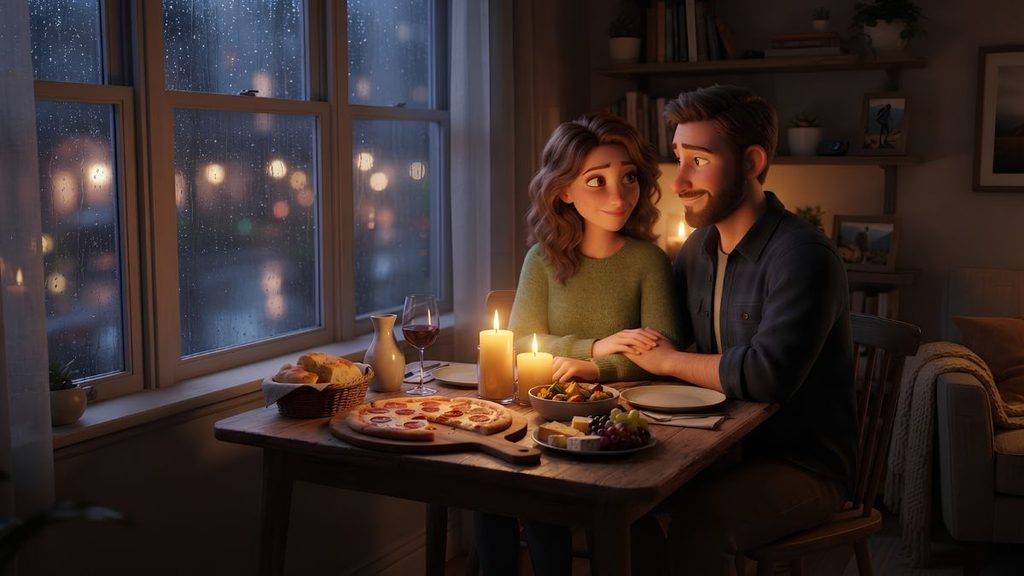
Characters: Sophie and Daniel
Sophie noticed the rain before Daniel did.
She was standing in the kitchen, staring through the window while the last light of the evening disappeared behind the apartment buildings across the street.
The sky had been gray all afternoon, but now the rain had finally arrived.
It began softly.
A few drops against the glass.
Then more.
Within minutes, the windows were covered with tiny streams of water that caught the light from the streetlamps below.
Daniel walked into the kitchen carrying his laptop.
“Still raining?”
Sophie smiled.
“You say that like you were expecting it to stop.”
“I was hoping.”
“Why?”
“Because I was planning to take the trash out.”
Sophie laughed.
“You can survive another ten minutes.”
Daniel looked at the clock.
“It has been another ten minutes for the last three hours.”
Sophie turned away from the window.
“Long day?”
“Very.”
“So was mine.”
Daniel closed the laptop.
Neither of them said anything for a moment.
They were both tired.
Not dramatically tired.
Not the kind of tired that came after an emergency or an exhausting journey.
It was the ordinary kind.
The kind that accumulated slowly through meetings, emails, traffic, errands, unfinished tasks, and too many small decisions.
The kind that made Friday evening feel like a reward simply because there was nowhere else they had to be.
Daniel walked toward the living room.
“What do you want for dinner?”
Sophie thought about it.
“Something we don’t have to cook.”
“Excellent.”
“Pizza?”
“Perfect.”
Daniel picked up his phone.
Within a few minutes, the order was placed.
They had done this many times.
Friday night.
Pizza.
Something to drink.
A movie they might or might not finish.
Phones nearby.
Lights low.
A comfortable routine.
There was nothing wrong with it.
In fact, Sophie usually enjoyed it.
But lately, she had noticed something.
They were together all the time.
And yet they didn’t always talk.
They shared the same apartment.
The same kitchen.
The same bedroom.
The same grocery list.
The same calendar.
But somehow, their days sometimes passed without either of them asking the other a question that wasn’t practical.
Did you buy milk?
What time will you be home?
Did you pay the electricity bill?
Can you send that email?
Have you seen my charger?
Their conversations had become efficient.
That evening, however, something unexpected happened.
Just as the pizza delivery notification appeared on Daniel’s phone, the apartment went dark.
Sophie froze.
Daniel looked around.
“Did you see that?”
“The lights?”
“Yes.”
“They’re off.”
“I gathered that.”
Sophie laughed.
Daniel walked toward the window.
Across the street, several buildings were also dark.
“The whole block?”
“Looks like it.”
A moment later, the rain became louder.
Without the hum of appliances, the apartment seemed strangely quiet.
The refrigerator stopped.
The air conditioner stopped.
The small clock in the kitchen stopped.
Even the background noise they had never consciously noticed disappeared.
Daniel turned on his phone flashlight.
“I guess the movie is out.”
“And the pizza?”
“Hopefully still coming.”
Sophie opened the curtains.
The street outside was almost completely dark except for a few headlights moving slowly through the rain.
Then she remembered something.
“Wait.”
She walked into the storage cabinet and returned with two candles.
Daniel smiled.
“You were prepared for this?”
“I bought them because they looked nice.”
“That’s not the same thing.”
“It is now.”
She placed the candles on the dining table.
The table was small and round, with two wooden chairs and a third chair that they rarely used.
Daniel lit the candles.
The warm light immediately changed the room.
It wasn’t bright.
But it was enough.
Enough to see each other.
Enough to see the rain.
Enough to make the apartment feel different.
Sophie looked toward the dining room.
“Let’s eat there.”
Daniel raised an eyebrow.
“Without electricity?”
“Why not?”
“We don’t have food.”
“We have bread.”
“That’s not dinner.”
“We also have cheese.”
“Still not dinner.”
“And olives.”
Daniel considered this.
“Now we’re getting somewhere.”
They searched the kitchen.
The refrigerator was still cold enough to keep the food safe for a while, so they collected whatever they could find.
Bread.
Cheese.
Olives.
A few tomatoes.
Some leftover roasted vegetables.
Two apples.
A jar of jam.
Daniel found a packet of crackers.
Sophie found some chocolate.
“This is becoming surprisingly respectable,” she said.
Daniel arranged everything on a large plate.
They carried it to the small table by the window.
The table had always been there.
They had bought it shortly after moving into the apartment because the dining room was too small for anything larger.
For years, it had mostly been used as a place to put mail.
Sometimes laundry.
Sometimes grocery bags.
Sometimes Daniel’s laptop.
They rarely actually ate there.
That night, they did.
They sat across from each other.
The candles flickered between them.
Rain tapped gently against the glass.
For the first few minutes, neither spoke.
They simply ate.
The food was ordinary.
The bread was slightly stale.
The tomatoes were not particularly sweet.
The cheese was almost finished.
But somehow, everything tasted better.
Perhaps it was the candlelight.
Perhaps it was the rain.
Perhaps they were simply hungry.
Or perhaps they had forgotten what it felt like to sit across from each other without something else demanding their attention.
Daniel reached for an olive.
“Do you remember our first dinner together?”
Sophie smiled.
“Of course.”
“What did we eat?”
She looked at him.
“You don’t remember?”
“I remember the restaurant.”
“You remember the restaurant?”
“Yes.”
“You don’t remember what we ate?”
Daniel shook his head.
“Not even slightly.”
Sophie laughed.
“It was pasta.”
“Was it?”
“Yes.”
“What kind?”
“I don’t remember.”
Daniel pointed at her.
“So neither of us remembers.”
Sophie laughed again.
“Apparently not.”
They smiled at each other.
Then Sophie remembered something else.
“We almost didn’t go.”
Daniel nodded.
“Because you said you were tired.”
“You were tired.”
“You were the one who canceled first.”
“I changed my mind.”
“After I had already taken off my shoes.”
Daniel laughed.
“I remember that.”
They had been younger then.
Not dramatically younger.
But young enough to believe that everything important was still ahead of them.
They had talked about traveling.
Buying a house.
Learning another language.
Starting a business.
Moving somewhere near the sea.
They had made plans casually, the way young people sometimes do when the future seems like an enormous open space.
Sophie looked toward the window.
“We never moved to the sea.”
“No.”
“We never learned Italian.”
“No.”
“We never started that little bakery.”
Daniel smiled.
“You were terrible at baking.”
“I improved.”
“You once burned soup.”
“That was one time.”
“You cannot burn soup one time and call yourself an improved baker.”
Sophie threw a cracker at him.
He caught it.
They laughed.
For the first time that week, Sophie felt completely relaxed.
Not because anything had changed.
Her work was still waiting.
The laundry still needed folding.
The bills still existed.
Tomorrow would still arrive.
But for a few minutes, none of those things mattered.
Daniel looked at her.
“Do you ever think about how different we thought life would be?”
“All the time.”
“Are you disappointed?”
Sophie was quiet.
She looked around the apartment.
The small table.
The candles.
The rain.
The framed photograph on the wall.
The plant they had nearly killed three times but somehow kept alive.
The old blue blanket on the sofa.
Then she looked at Daniel.
“Sometimes.”
He nodded.
“Me too.”
There was no sadness in his voice.
Only honesty.
Sophie took a sip of water.
“What did you imagine?”
Daniel thought for a moment.
“I thought we’d travel more.”
“We still can.”
“I know.”
“I thought we’d have a bigger place.”
“We probably don’t need one.”
“I know.”
“I thought we’d have more money.”
Daniel smiled.
“Definitely.”
Sophie laughed.
Then he became quiet.
“I also thought we’d always have time.”
That sentence stayed between them.
The rain seemed louder.
Sophie understood exactly what he meant.
When they were younger, they assumed there would always be time for everything.
Time to travel.
Time to call friends.
Time to visit family.
Time to learn things.
Time to sit together.
Time to talk.
Time to become the people they wanted to be.
But life had a way of filling every empty space.
A free weekend became an opportunity to catch up on work.
An evening became errands.
A holiday became a list of places to visit.
Even dinner became something to finish while watching something on television.
Sophie reached across the table.
She placed her hand over Daniel’s.
“We still have time.”
Daniel looked at her.
“Do we?”
“We have tonight.”
He smiled.
“That’s true.”
They sat quietly for a while.
The power remained off.
Eventually, Daniel checked his phone.
“The pizza is here.”
Sophie laughed.
“Of course.”
They heard a knock.
Daniel went downstairs.
A few minutes later, he returned carrying two pizza boxes.
The smell filled the apartment.
Sophie opened the first box.
“Perfect.”
Daniel looked at their little table.
“There’s no way we’re fitting these boxes here.”
“We can try.”
They tried.
The candles were moved to the windowsill.
The bread and cheese were pushed aside.
The pizza boxes were opened.
They ate slowly.
At some point, Sophie realized they were both smiling.
Not because of anything extraordinary.
Simply because the evening had become unexpectedly good.
Daniel picked up a slice.
“You know what?”
“What?”
“We should do this again.”
“Have the electricity fail?”
“No.”
“Eat at this table.”
Sophie looked at the table.
“On purpose?”
“Yes.”
She smiled.
“Every Friday?”
“Maybe once a week.”
“Without the power outage?”
“Preferably.”
They continued eating.
Later, the electricity returned.
The lights came on suddenly.
The refrigerator hummed.
The air conditioner started.
The clock in the kitchen began ticking again.
For a moment, neither moved.
The apartment was exactly as it had been before.
But somehow it felt different.
Sophie stood and switched off the overhead light.
She left the candles burning.
Daniel looked at her.
“Why did you turn the light off?”
“I like this better.”
He smiled.
“Me too.”
They finished their dinner by candlelight.
When the plates were empty, they didn’t immediately get up.
They stayed at the table.
They talked about places they wanted to visit.
Not because they had to make a plan.
Not because they needed to book anything.
Just because it was nice to imagine.
Sophie wanted to see the northern lights.
Daniel wanted to take a train through the mountains.
Sophie wanted to return to the little town where they had spent their first vacation together.
Daniel wanted to visit the coast.
They made a list.
Then they laughed at how long the list became.
“We’ll need ten years,” Daniel said.
“We have time.”
He looked at her.
“Yes.”
The rain continued.
Eventually, the streets outside became quiet.
They cleared the plates together.
Sophie washed.
Daniel dried.
They moved around the kitchen easily, without needing to ask who would do what.
When everything was clean, they returned to the table.
The candles were almost finished.
Daniel looked at the little wooden surface.
“Funny.”
“What?”
“We’ve had this table for eight years.”
“Yes.”
“And tonight is the first time I’ve realized how nice it is.”
Sophie smiled.
“Maybe we just weren’t looking.”
Daniel took her hand.
“Maybe.”
They stayed there until the candles burned low.
Before going to bed, Sophie looked once more through the window.
The rain had stopped.
The streets were wet and shining beneath the lamps.
Cars moved slowly through the darkness.
Everything looked clean and new.
Daniel stood beside her.
“Ready?”
“Yes.”
They turned off the remaining lights.
As they walked toward the bedroom, Sophie glanced back at the table.
Two empty plates.
Two glasses.
A few crumbs.
The candles had gone out.
It looked completely ordinary.
But she knew she would remember that evening.
Not because the electricity had failed.
Not because the pizza had arrived late.
Not because they had discovered anything extraordinary.
She would remember it because they had stopped.
For one evening, they had stopped rushing.
Stopped checking.
Stopped planning.
Stopped trying to make the evening productive.
They had simply sat together.
Years later, Sophie would still remember the sound of rain against the window.
She would remember Daniel laughing when she claimed she could bake.
She would remember the candlelight on his face.
And she would remember what he said.
I thought we’d always have time.
She would also remember her answer.
We still have time.
Because sometimes love was not found in grand gestures.
Sometimes it was found in choosing to sit down.
In listening.
In remembering.
In asking a question and actually waiting for the answer.
In noticing the person who had been beside you all along.
The next Friday, they ate at the table by the window again.
There was no power outage.
No unexpected problem.
No special occasion.
Sophie cooked pasta.
Daniel opened a bottle of sparkling water.
They put their phones in another room.
And they talked.
The following Friday, they did it again.
Soon, the little table became their favorite place in the apartment.
It was where they celebrated small victories.
Where they planned trips.
Where they discussed difficult days.
Where they laughed.
Where they sometimes sat silently.
The table did not become special because it changed.
It became special because they finally paid attention to it.
And years later, whenever life became too busy, one of them would look toward the window and say,
“Should we have dinner there tonight?”
The answer was almost always yes.
Because the table by the window had taught them something simple.
A good life was not always waiting somewhere far away.
Sometimes it was already sitting across the table.
And sometimes, all you had to do was put down your phone, light a candle, and stay long enough to notice.
They remember their first date, the tiny restaurant where they could barely afford dessert, and the dreams they had when they were younger. As the rain continues, they realize that the life they once imagined is not exactly the life they built, but it may be better in ways they never expected.
Theme: Everyday love, companionship, gratitude, and rediscovering connection.
2. Funny: The Apartment Cat Committee

Characters: Emma, Lucas, and a very confident cat named Winston
Emma first noticed Winston on a Tuesday evening.
She had just returned from work and was standing outside her apartment, trying to balance her handbag, a grocery bag, and her keys at the same time.
The grocery bag was winning.
One orange rolled out.
Then another.
Emma sighed and bent down to pick them up.
That was when she saw the cat.
He was sitting directly beside her apartment door.
Not hiding.
Not frightened.
Not even particularly curious.
He was simply sitting there as if he had an appointment.
Emma stared at him.
The cat stared back.
He was a large gray-and-white cat with a white chest, white paws, and an expression of complete confidence.
“Hello,” Emma said.
The cat blinked.
“Do you live here?”
The cat continued blinking.
Emma looked at the apartment door.
Then at the cat.
Then back at the door.
“You know this is my apartment, right?”
The cat slowly turned his head toward the hallway.
Emma laughed.
“Fine.”
She opened the door.
The cat stood up.
Emma immediately blocked the entrance with her foot.
“No.”
The cat looked offended.
“Absolutely not.”
He sat down again.
Emma put her groceries inside.
When she came back out, the cat was still there.
She crouched down.
“Where is your owner?”
The cat looked at her.
“That’s not an answer.”
He blinked.
Emma stood.
“Well, good luck.”
She went inside.
Ten minutes later, there was a soft scratching sound at her door.
Emma opened it.
Winston was sitting outside.
She stared at him.
He stared at her.
“You cannot be serious.”
He stood.
Emma stepped aside accidentally.
Winston walked directly into her apartment.
He did not explore.
He did not sniff the furniture.
He walked straight to the living room sofa, jumped onto it, turned around twice, and curled into a comfortable ball.
Emma stood in the doorway.
“This is impressive.”
Winston closed his eyes.
Emma picked up her phone.
She took a photograph.
Then she sent it to her neighbor, Lucas.
Lucas lived across the hall and was one of the few people in the building Emma regularly spoke to.
A few seconds later, her phone buzzed.
Lucas: That’s Winston.
Emma looked at the cat.
Emma: You know him?
Lucas: Everyone knows Winston.
Emma frowned.
Emma: Why is he in my apartment?
There was a pause.
Then:
Lucas: Probably because he wants to be.
Emma looked at Winston.
“Apparently you have a reputation.”
Winston opened one eye.
Then closed it again.
Lucas knocked on the door a few minutes later.
He looked at Winston.
Then at Emma.
“See?”
“See what?”
“That’s Winston.”
“I know.”
“No, I mean that’s what he does.”
Lucas walked over and gently scratched Winston behind the ears.
Winston immediately began purring.
Emma crossed her arms.
“Does he belong to someone?”
“Mr. Harrison in 6C.”
“Then why is his cat in my apartment?”
Lucas shrugged.
“Winston has hobbies.”
Emma laughed.
“You’re telling me he has hobbies?”
“Yes.”
“What kind?”
“Visiting people.”
Emma looked at Winston.
“That’s not a hobby.”
Lucas smiled.
“For Winston, it is.”
The next evening, Winston appeared again.
This time, Emma was ready.
She opened her door and found him sitting there.
“You again.”
Winston walked inside.
Emma pointed toward the hallway.
“Your home is upstairs.”
Winston sat down.
“Your owner is probably looking for you.”
Winston blinked.
“Stop looking at me like that.”
Winston continued looking at her.
Emma sighed.
“Fine. Ten minutes.”
She gave him a small bowl of water.
Winston drank.
Then he jumped onto the sofa.
Ten minutes became thirty.
Thirty became an hour.
Eventually, Emma heard footsteps in the hallway.
Mr. Harrison appeared.
He was an elderly man with silver hair and a permanent look of mild amusement.
“I’m sorry,” he said. “Has he been bothering you?”
Emma looked at Winston.
“Not exactly.”
Mr. Harrison smiled.
“Winston has always been social.”
“How social?”
Mr. Harrison laughed.
“Very.”
He called the cat.
“Winston.”
The cat ignored him.
Mr. Harrison called again.
“Winston, come on.”
Winston opened one eye.
He remained on the sofa.
Emma looked at Mr. Harrison.
“Does he normally do this?”
“Every day.”
“Where does he go?”
Mr. Harrison shrugged.
“Wherever he feels welcome.”
Winston finally stood.
He walked toward the door.
Then stopped.
He looked back at Emma.
Emma pointed at him.
“Don’t look at me like that.”
Winston walked out.
Mr. Harrison laughed.
“Good night.”
“Good night.”
Emma closed the door.
She thought that would be the end of it.
It wasn’t.
By Friday, Winston had become part of her evening routine.
He appeared around seven.
Sometimes he sat outside.
Sometimes he wandered into her apartment.
Sometimes he simply sat in the hallway and watched people walk past.
Emma began wondering where he went before coming to her apartment.
She discovered the answer by accident.
One evening, she returned from the grocery store earlier than usual.
As she entered the building, she saw Winston walking out of apartment 5B.
Mrs. Parker was standing in the doorway.
She waved at him.
“Come back tomorrow, Winston!”
Emma stopped.
“Mrs. Parker?”
The older woman smiled.
“Hello, dear.”
Emma pointed toward the stairs.
“Winston was in your apartment?”
“Of course.”
“Why?”
Mrs. Parker looked surprised.
“He likes my chicken.”
Emma laughed.
“He eats chicken here?”
“Sometimes.”
Emma shook her head.
“I thought he was visiting me.”
“He visits everyone.”
“Everyone?”
Mrs. Parker smiled.
“Almost.”
Emma went upstairs.
She found Lucas in the hallway.
“Apparently Winston has been seeing other people.”
Lucas laughed.
“You sound jealous.”
“I’m not jealous.”
“You sound jealous.”
“I’m simply confused.”
Lucas leaned against the wall.
“You haven’t discovered his full schedule yet.”
“Schedule?”
“Exactly.”
Emma stared at him.
“You know his schedule?”
“Not all of it.”
“Then how do you know he has one?”
“Because he visits me every Wednesday.”
Emma raised an eyebrow.
“What does he do?”
“Watch television.”
Emma burst out laughing.
“You are joking.”
“No.”
“You sit with a cat and watch television?”
“Sometimes.”
“What do you watch?”
“Mostly documentaries.”
“Does he have preferences?”
Lucas thought about it.
“He likes nature programs.”
Emma stared at him.
“Of course he does.”
Lucas smiled.
“I think he likes the birds.”
“You are telling me Winston has television preferences.”
“I didn’t say he has preferences.”
“You just said he likes nature programs.”
“Maybe I have preferences.”
Emma laughed.
“You’re impossible.”
Lucas shrugged.
“Wait until you meet Claire.”
“Who is Claire?”
“Apartment 4D.”
“What about her?”
“Winston spends Tuesday afternoons there.”
“Why?”
“She works from home.”
Emma waited.
“And?”
“Apparently Winston sits beside her desk.”
“Why?”
“She says he keeps her company.”
Emma looked toward the stairs.
“This cat has more social interaction than I do.”
Lucas laughed.
“Probably.”
The mystery became impossible to ignore.
By the following week, Emma had discovered that Winston visited at least six apartments.
Mrs. Parker gave him chicken.
Lucas watched television with him.
Claire worked beside him.
David in apartment 2A claimed Winston helped him eat healthier because he only gave the cat carrots.
Sonia in 3C said Winston liked listening to her play the piano.
Arthur in 1B said Winston sat beside him every evening after dinner.
Emma was beginning to suspect Winston had become the unofficial mayor of the building.
Then one evening, the residents’ group chat became unusually active.
Mrs. Parker sent a message.
Mrs. Parker: Has anyone seen Winston?
Claire replied.
Claire: He left here twenty minutes ago.
Lucas wrote:
Lucas: He was with me at 6:30.
David:
David: He came to my apartment at 7:00.
Emma stared at the messages.
Then she typed:
Emma: He’s here.
Three people immediately replied.
Mrs. Parker: Can you send him down to me?
Lucas: He owes me the ending of a documentary.
David: He hasn’t finished his carrots.
Emma laughed.
Then Arthur sent:
Arthur: He usually comes here around eight.
Emma looked at the clock.
7:52.
She looked at Winston.
“You have appointments?”
Winston licked his paw.
Emma shook her head.
“This is ridiculous.”
She took a photograph of him.
Then she sent it to the group.
Emma: Winston is currently on the sofa. Apparently he has an appointment at 8:00.
Lucas replied:
Lucas: Don’t be late.
Emma laughed.
That was how the idea of the schedule began.
Nobody intended to create one.
It started as a joke.
Lucas wrote:
Lucas: We should make a Winston schedule.
Claire replied:
Claire: I’m serious.
Mrs. Parker:
Mrs. Parker: I am too.
David:
David: Tuesday is mine.
Arthur:
Arthur: He likes quiet evenings.
Sonia:
Sonia: Wednesday piano?
Lucas:
Lucas: Wednesday is television.
Emma stared at the screen.
“Are they actually negotiating?”
She looked at Winston.
“Your social calendar is more complicated than mine.”
Within fifteen minutes, the building had accidentally created a schedule.
Monday: Mrs. Parker, 6:30 p.m.
Tuesday: Claire, 5:00 p.m.
Wednesday: Lucas, 7:00 p.m.
Thursday: Sonia, 6:00 p.m.
Friday: Emma, 7:00 p.m.
Saturday: Arthur, 5:30 p.m.
Sunday: Free day.
Nobody could explain why Sunday had been declared a free day.
When Mr. Harrison discovered the schedule, he laughed so hard that he had to sit down.
“You people have created an appointment system for my cat?”
Emma nodded.
“Apparently.”
Mr. Harrison looked at Winston.
Winston was sitting beside him.
“How do you feel about this?”
Winston yawned.
Mr. Harrison laughed.
“I suppose that’s approval.”
The schedule lasted exactly four days.
On Monday, Winston ignored Mrs. Parker and went to Claire.
On Tuesday, he went to Lucas.
On Wednesday, he disappeared entirely.
On Thursday, he spent two hours in the laundry room.
On Friday, he visited Emma at 4:15 instead of 7:00.
Emma looked at the clock.
“You’re early.”
Winston sat down.
“You’re not following the schedule.”
Winston blinked.
Emma sighed.
“Of course you’re not.”
Lucas appeared in the hallway.
“What’s happening?”
“He’s ignoring the schedule.”
Lucas looked at Winston.
“You can’t blame him.”
“I can absolutely blame him.”
Lucas laughed.
Winston walked past them and disappeared downstairs.
The residents eventually gave up.
The schedule was abandoned.
But something unexpected happened.
People had started talking.
Before Winston, the residents mostly knew each other by apartment number.
They knew who lived upstairs.
They recognized faces in the elevator.
They exchanged brief greetings.
Now they were discussing Winston.
Then they began discussing other things.
Mrs. Parker brought extra cookies for Claire.
Sonia invited Lucas to hear her play piano.
David started joining Arthur for evening tea.
Emma began having coffee with Claire on Saturday mornings.
The building slowly became less like a collection of apartments and more like a community.
Winston had not planned any of it.
At least, nobody knew whether he had.
One rainy evening, Winston disappeared.
Emma noticed first.
He didn’t appear outside her door.
She checked the hallway.
Nothing.
She messaged Lucas.
Emma: Have you seen Winston?
Lucas: No.
Mrs. Parker hadn’t seen him.
Neither had Claire.
The building became strangely quiet.
Everyone searched.
They checked the basement.
The courtyard.
The laundry room.
The parking area.
Finally, Emma heard a faint sound from apartment 1B.
She knocked.
Arthur opened the door.
He smiled.
“He’s here.”
Emma looked inside.
Winston was asleep on Arthur’s sofa.
Arthur sat beside him.
Emma sighed with relief.
“Why didn’t you tell anyone?”
“I thought everyone knew.”
“They didn’t.”
Arthur looked at Winston.
“He came in around seven.”
“Was he all right?”
“Perfectly.”
Arthur smiled.
“He stayed with me.”
Emma looked at the two of them.
Arthur was an older man who lived alone.
His apartment was quiet.
Too quiet, perhaps.
There were photographs on the walls.
One showed Arthur with his late wife.
Emma had seen it before but had never asked about it.
Now she understood why Winston kept visiting.
Maybe the cat was not simply looking for food.
Maybe he was looking for people.
Or maybe people were looking for him.
Arthur reached down and scratched Winston’s head.
“He seems to know when someone needs company.”
Emma smiled.
“He’s a strange cat.”
Arthur nodded.
“Very.”
The next morning, Emma found Lucas in the hallway.
“You know what I realized?”
Lucas looked at her.
“That Winston is smarter than both of us?”
“Possibly.”
“He visits people who need him.”
Lucas thought about it.
“Maybe.”
Emma smiled.
“And people give him food because they think he needs them.”
Lucas laughed.
“So everyone thinks they’re helping Winston.”
“And Winston thinks he’s helping everyone.”
They both looked down the hallway.
Winston was walking toward them.
He stopped.
Looked at Emma.
Looked at Lucas.
Then continued walking.
Lucas smiled.
“Where do you think he’s going?”
Emma shrugged.
“Probably wherever he wants.”
Winston stopped at apartment 4D.
Claire opened the door.
“Oh, hello.”
He walked inside.
Emma and Lucas laughed.
Months passed.
The residents never recreated the official schedule.
They learned better.
Winston did not belong to a schedule.
He belonged to the building.
He continued visiting whoever he wanted.
Some evenings he slept on Emma’s sofa.
Other nights he watched television with Lucas.
He still visited Mrs. Parker for chicken.
He still sat beside Claire while she worked.
He listened to Sonia’s piano.
He visited David for carrots.
And he continued spending quiet evenings with Arthur.
The residents stopped asking where Winston was.
They simply assumed he was somewhere nearby.
One evening, Emma was sitting outside her apartment with a cup of tea.
Lucas came out.
“You know,” he said, “I think Winston has improved this building.”
Emma smiled.
“I think you’re right.”
“Should we give him an award?”
“What kind?”
“Best community member.”
Emma laughed.
“He’d probably expect treats.”
“Definitely.”
Just then, Winston appeared.
He walked between them.
Then sat down.
Emma looked at him.
“You know, you’re very confident.”
Winston blinked.
Lucas leaned down.
“Do you want your award?”
Winston looked at him.
Then at Emma.
Then toward the kitchen.
Emma laughed.
“He wants chicken.”
“Of course he does.”
They walked inside.
That evening, several residents gathered in the hallway.
Someone brought tea.
Someone brought cookies.
Sonia played a little music.
Arthur told a story about Winston stealing a piece of toast.
Everyone laughed.
Winston sat in the middle of the group.
He looked completely satisfied.
Nobody knew whether he understood what was happening.
But somehow, it didn’t matter.
He had done what he always did.
He had walked into someone’s apartment.
Then someone else’s.
Then another.
He had accepted food.
He had offered company.
He had interrupted routines.
And without meaning to, he had brought people together.
Emma looked around the hallway.
A year earlier, she barely knew half these people.
Now she knew their names.
Their stories.
Their habits.
Their favorite foods.
She knew who liked quiet evenings.
Who needed conversation.
Who preferred coffee.
Who preferred tea.
And somehow, she knew exactly which cat had made it all possible.
Winston stood up.
He walked toward Emma.
Then he walked past her.
Emma laughed.
“Not even saying goodbye?”
Winston disappeared around the corner.
Lucas shook his head.
“He has another appointment.”
“Where?”
“Probably somewhere we haven’t discovered yet.”
Emma smiled.
“Of course.”
The next morning, a handwritten note appeared on the building noticeboard.
It said:
IMPORTANT COMMUNITY ANNOUNCEMENT
Winston’s official visiting schedule has been permanently canceled.
Reason: Winston refuses to cooperate.
Someone had added another line underneath:
Also, he appears to be in charge anyway.
Emma smiled when she saw it.
She took a photograph and sent it to the group chat.
Within seconds, everyone started laughing.
Then Winston appeared at the bottom of the stairs.
He looked at the noticeboard.
He looked at everyone.
And then, with the confidence of a cat who had never once doubted his own importance, he walked away.
Emma watched him go.
Somewhere in the building, a door opened.
Someone called his name.
Winston disappeared inside.
Emma smiled.
The apartment cat committee had never really been about the cat.
It had been about the people.
About neighbors who had forgotten how easy it could be to knock on a door.
About lonely evenings becoming shared ones.
About unexpected friendships.
About discovering that community does not always begin with a meeting or an organized plan.
Sometimes it begins with a cat sitting outside your apartment.
Sometimes it begins with a bowl of water.
Sometimes it begins with someone saying, “Have you seen Winston?”
And sometimes, without realizing it, you discover that the strange little visitor who keeps appearing at your door has made your whole building feel a little more like home.
Winston, naturally, would have taken full credit.
Theme: Unexpected friendship, community, and the humorous habits of pets.
3. Peaceful: The Last Bench Before the Sea

Characters: Clara
Clara discovered the bench on an ordinary Tuesday.
There was nothing remarkable about the day.
She had finished work at six.
She had answered too many emails, attended two meetings that could probably have been messages, and spent the last hour of the afternoon looking at a spreadsheet that seemed determined to make her tired.
By the time she left the office, the sun was already beginning to soften.
Clara could have taken the bus home.
Instead, she decided to walk.
She had been doing that more often lately.
Not because she particularly enjoyed walking.
At first, it was simply because she needed a little time between work and home.
Her apartment was only twenty minutes away from the office by bus, but the bus ride had never really felt like leaving work.
There were always phones ringing.
People talking.
Traffic.
News playing through someone’s headphones.
Notifications appearing on her screen.
Walking was different.
Walking gave her twenty minutes in which nobody expected anything from her.
That Tuesday, she followed a narrow road toward the coast.
She had passed it many times without paying much attention.
At the end of the road was a path.
The path led through a small patch of grass and wildflowers before reaching the sea.
Clara followed it.
The evening air was cool.
The ocean was calm.
A few clouds rested low over the horizon.
And there, at the very end of the path, she found the bench.
It was old.
The wood had faded from years of wind and salt.
One of the legs looked slightly uneven.
A small patch of moss had grown beneath it.
But the bench faced the sea perfectly.
Clara sat down.
She expected to stay for a minute.
Instead, she stayed for ten.
She watched the waves.
She listened to the water.
She noticed a gull flying low above the surface.
Then she looked at her watch.
Ten minutes had passed.
Clara stood.
She walked home.
The next evening, she returned.
She wasn’t sure why.
Perhaps because the day had been difficult.
Perhaps because she had liked the quiet.
Perhaps because the bench had made no demands of her.
Whatever the reason, she sat down again.
Ten minutes.
Then she went home.
After a week, it became a habit.
Every evening after work, Clara walked to the sea.
She sat on the bench.
She stayed for ten minutes.
Then she returned home.
She did not bring a book.
She did not listen to music.
She did not check her phone.
She simply sat.
At first, her mind refused to cooperate.
The moment she sat down, thoughts arrived.
Did I reply to that email?
I forgot to call Mom.
I need to buy groceries.
What am I doing this weekend?
Why did I say that in the meeting?
What if I had taken the other job?
What if things had gone differently?
The sea seemed completely uninterested in any of these questions.
It continued moving.
Wave after wave.
Clara would sit there thinking about everything she needed to solve.
Then, slowly, she began noticing things instead.
The sound of the water.
The wind moving through the grass.
The changing color of the sky.
The distant lights of boats.
The temperature of the wooden bench beneath her.
The smell of salt in the air.
She began leaving the bench feeling lighter.
Not because her problems had disappeared.
They hadn’t.
She simply carried them differently.
Then she began noticing the other people.
The first was a fisherman.
Clara saw him one morning when she had arrived unusually early.
She had been awake since five and couldn’t get back to sleep.
Instead of staying in bed, she walked to the sea.
The fisherman was already there.
He stood near the rocks, holding a long fishing rod.
He seemed completely comfortable with silence.
Clara watched him for a moment.
He noticed her.
“Morning.”
“Good morning.”
That was all.
The next morning, Clara saw him again.
He nodded.
She nodded back.
They never learned each other’s names.
But they became familiar.
Then there was the elderly couple.
They appeared most evenings just before sunset.
The woman always carried a small thermos.
The man walked slowly beside her.
They would sit together on the grass or near the bench and watch the sun disappear.
Sometimes they talked.
Sometimes they didn’t.
One evening, Clara arrived before them.
A few minutes later, she heard the woman say,
“Good evening.”
Clara turned.
“Good evening.”
The woman smiled.
They sat a few feet away.
After a while, the woman opened her thermos.
She poured two cups.
The man looked at the sea.
“Beautiful tonight.”
“It is,” she said.
Clara smiled.
Nobody said anything else.
The young man came next.
He was probably around thirty.
He wore a dark coat and carried a book.
He always sat at the far end of the bench.
At first, Clara wondered what he was reading.
One day, she finally noticed the cover.
It was a novel.
Another evening, it was a different book.
He rarely looked up.
But when he did, he always looked toward the horizon.
Then there was the woman with the tea.
Clara first saw her on a Thursday.
She arrived carrying a small metal flask and two cups.
She sat on the bench.
She poured tea.
She drank slowly.
Then she left.
The following evening, she returned.
The same flask.
The same cup.
The same quiet expression.
Clara began to wonder whether everyone had their own reason for coming.
She imagined the fisherman had always loved the sea.
Perhaps the elderly couple had met there.
Maybe the young man was hiding from a noisy apartment.
Maybe the woman simply liked tea with an ocean view.
Clara never asked.
She didn’t need to.
The bench became a place where people could be present without having to explain themselves.
Over time, something unusual happened.
They became a small community without ever becoming friends in the ordinary sense.
They knew each other’s faces.
They recognized each other’s routines.
They noticed absences.
When the fisherman didn’t appear for several mornings, Clara wondered where he was.
When the elderly couple didn’t come one evening, she noticed.
When the young man changed books, Clara noticed that too.
Nobody asked questions.
Nobody exchanged phone numbers.
Nobody made plans.
And yet, somehow, they were no longer strangers.
One rainy evening, Clara arrived at the bench and found the woman with the tea sitting there.
The rain was light.
The sky was gray.
“You’re here,” the woman said.
Clara smiled.
“So are you.”
The woman laughed.
“I suppose that’s true.”
They sat quietly.
After a few minutes, the woman offered her the second cup of tea.
Clara hesitated.
“Are you sure?”
“I brought two.”
Clara accepted it.
The tea was warm.
It smelled like cinnamon.
“Thank you.”
The woman nodded.
They watched the rain.
“My name is Clara,” Clara said.
The woman smiled.
“Margaret.”
It was the first time either of them had offered a name.
They didn’t talk much.
But after that evening, Clara knew Margaret.
And Margaret knew Clara.
The next week, the fisherman introduced himself too.
His name was Daniel.
The young man’s name was Oliver.
The elderly couple were Arthur and Rose.
None of them had planned introductions.
They simply happened.
Their little group remained quiet.
Sometimes they talked.
Often they didn’t.
One evening, Arthur brought a small bag of apples.
Rose handed one to Clara.
“For you.”
Clara smiled.
“Thank you.”
Arthur looked at her.
“You come here every evening.”
“Almost.”
“Why?”
Clara thought about it.
“I don’t know anymore.”
Arthur smiled.
“That’s probably a good reason.”
Clara laughed.
“I used to come because I needed to think.”
“And now?”
She looked toward the water.
“I think I come because I don’t need to think.”
Arthur nodded.
“I understand.”
The sentence stayed with her.
That was exactly it.
At some point, the bench had stopped being a place where she went to solve things.
It had become a place where she didn’t have to solve anything.
She simply sat.
The distinction was small.
But it mattered.
One Friday, Clara had a terrible day.
A project she had spent weeks working on was canceled.
Her manager had been impatient.
Two coworkers had argued.
An email from home had left her worried.
By the time she left the office, she felt exhausted.
She walked quickly toward the sea.
When she reached the bench, she dropped her bag beside her and sat down.
Her phone vibrated.
She ignored it.
The ocean was unusually calm.
The sky was pale orange.
Clara breathed deeply.
She tried to think about what she should do.
Should she look for another job?
Should she speak to her manager?
Should she call her family?
Should she make a plan?
The questions arrived one after another.
Then she heard footsteps.
Margaret sat beside her.
“You look tired.”
“I am.”
Margaret didn’t ask why.
She simply sat there.
After a while, Clara said,
“Everything feels like too much today.”
Margaret nodded.
“I’ve had days like that.”
“Does it get easier?”
Margaret looked at the ocean.
“Not always.”
Clara looked at her.
“That’s not very encouraging.”
Margaret smiled.
“No. But I think we become better at carrying things.”
Clara considered that.
Margaret continued.
“Some days you need to fix something.”
She paused.
“Other days, you only need somewhere to sit.”
Clara smiled.
“Is that why you come here?”
“Partly.”
“What is the other part?”
Margaret looked toward the horizon.
“I like the tea.”
Clara laughed.
It was the first time she had laughed that day.
The next evening, Clara returned.
She realized something.
She had not thought about work once on the walk to the bench.
Not once.
That surprised her.
The bench had become part of her life.
Not a solution.
Not an escape.
Just a small place where she could breathe.
Weeks passed.
The seasons began to change.
The evenings became colder.
The grass lost some of its color.
The sunset arrived earlier.
Clara started wearing a thicker coat.
The fisherman appeared less often.
The elderly couple still came.
Oliver still brought his books.
Margaret still carried tea.
The bench remained.
One evening, Clara arrived and found the bench covered in fallen leaves.
She brushed them away with her hand.
Then she sat down.
She looked at the sea.
She realized she had been coming to the bench for nearly a year.
A year.
Hundreds of evenings.
Thousands of waves.
Hundreds of sunsets.
She had watched storms arrive.
She had watched clear mornings.
She had seen boats disappear beyond the horizon.
She had watched strangers become familiar faces.
And during that year, her life had changed in ways she hadn’t expected.
She had changed jobs.
Her mother had recovered from a difficult illness.
A close friend had moved away.
She had traveled once.
She had learned to say no to some things.
She had started saying yes to others.
Nothing had happened because of the bench.
The bench had simply been there while life happened.
That was perhaps why it mattered.
The bench had never demanded that she become someone different.
It had simply given her somewhere to be while she became whoever she was becoming.
One evening, Clara arrived and found the bench empty.
The others hadn’t come yet.
She sat alone.
The sun was setting.
The sky turned gold.
Then pink.
Then a deep blue.
The ocean reflected every color.
Clara checked her watch.
Ten minutes had passed.
She didn’t stand.
She stayed.
For the first time, she realized she had stopped measuring her time there.
She stayed for twenty minutes.
Then thirty.
She smiled.
The old rule no longer mattered.
She had come to the bench because she enjoyed being there.
That was enough.
Eventually, Arthur and Rose appeared.
Then Margaret.
Oliver arrived with a new book.
Daniel came later with his fishing rod.
They all exchanged greetings.
No one asked Clara why she was still sitting there.
They simply joined her.
The sun disappeared.
The first stars appeared.
Margaret poured tea.
Arthur opened a packet of biscuits.
Oliver closed his book.
For a while, nobody spoke.
Then Daniel said,
“Good evening.”
Everyone smiled.
“Good evening.”
They sat together.
Not because they had planned to.
Not because they had anything important to discuss.
They were simply there.
Clara looked around.
She thought about how strange it was.
These people had become part of her life without ever entering it in the usual way.
They had never gone to dinner together.
They had never exchanged birthday gifts.
They didn’t know each other’s full histories.
They didn’t know about each other’s childhoods or relationships or private worries.
And yet, they knew something important.
They knew how each other liked to sit.
They knew who preferred sunrise.
Who preferred sunset.
Who brought tea.
Who carried books.
Who fished.
They knew when someone was missing.
They knew when someone needed silence.
Sometimes that was enough.
The following winter brought several days of heavy rain.
The path became muddy.
The bench was often empty.
Clara stopped going for a while.
She told herself it was because of the weather.
But she eventually realized she missed it.
One evening, despite the cold, she put on her coat and walked there.
The bench was wet.
The sea was rough.
The wind was strong.
There was nobody else.
Clara stood for a moment.
Then she sat.
Her coat quickly became damp.
She laughed.
“What am I doing?”
The ocean offered no answer.
It never did.
She stayed for ten minutes.
Then she walked home.
The next evening, Margaret was there.
“So you came back.”
Clara smiled.
“I missed it.”
Margaret handed her a cup of tea.
“I thought you might.”
They sat together.
The sea was dark.
The wind had quieted.
Clara held the warm cup between her hands.
She looked at the bench.
It was still old.
Still uneven.
Still weathered.
Nothing about it had changed.
But Clara had.
She had learned that rest didn’t always mean sleeping.
Stillness didn’t mean doing nothing.
Silence didn’t mean loneliness.
And being alone didn’t necessarily mean being lonely.
Sometimes, a person simply needed a place where the world stopped asking questions.
For Clara, that place was the last bench before the sea.
Years later, she would still remember it.
She would remember the fisherman.
Daniel.
The elderly couple.
Arthur and Rose.
The young man with the books.
Oliver.
Margaret and her cinnamon tea.
She would remember the countless evenings when nothing happened.
Those were some of her favorite evenings.
Because something had happened.
She had been there.
She had watched the sky change.
She had listened to the waves.
She had allowed herself to be quiet.
And slowly, almost without noticing, she had learned how to stop rushing through her own life.
One evening, as Clara sat on the bench, the sun disappeared beyond the horizon.
Margaret sat beside her.
Arthur and Rose were nearby.
Oliver was reading.
Daniel was preparing his fishing line.
The sea moved gently beneath the fading light.
Clara looked at her watch.
Ten minutes had passed.
She smiled.
Then she put the watch away.
There was nowhere else she needed to be.
For once, she did not need to count the minutes.
She simply stayed.
And the sea continued moving.
Quietly.
Patiently.
Without hurry.
Just as it always had.
Just as it always would.
Theme: Stillness, quiet companionship, nature, and learning to slow down.
4. Emotional: The Key in the Kitchen Drawer
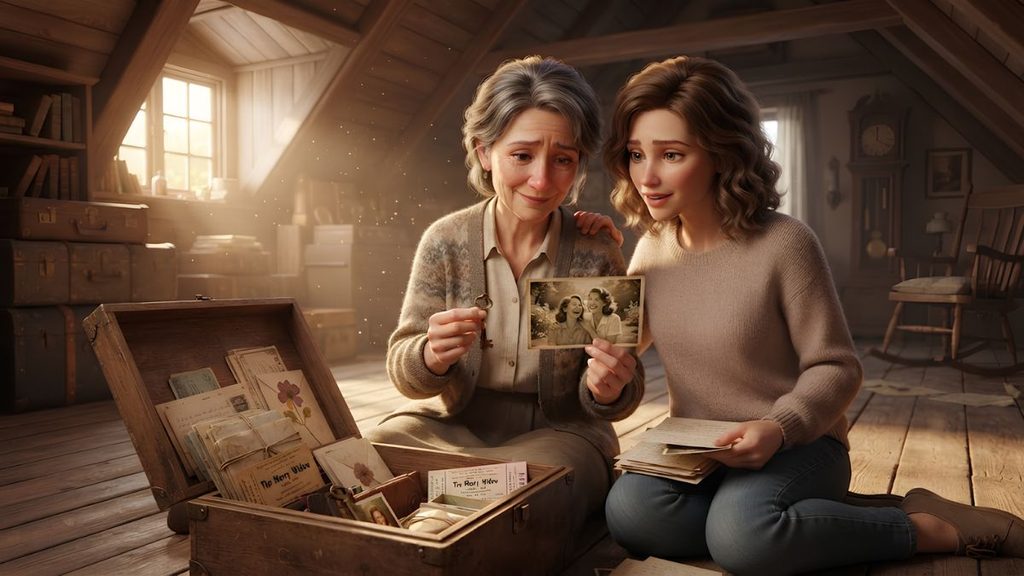
Characters: Margaret and her daughter, Elise
Margaret had always believed that she knew her mother.
She knew how her mother took her tea.
She knew which flowers she liked in the garden.
She knew that her mother disliked loud restaurants, loved old songs, and could never walk past a bakery without buying something sweet.
She knew the stories her mother had told many times.
She knew about the house where she had grown up.
She knew about Margaret’s childhood.
She knew about the years when Margaret was young and Elise was born.
She knew the practical things.
But after her mother died, Margaret began to wonder whether she had ever really known the woman who had raised her.
The thought came quietly.
It did not arrive during the funeral.
It did not arrive when relatives gathered around the dining table and told familiar stories.
It came several weeks later, on an ordinary Tuesday afternoon, while Margaret was cleaning the kitchen.
Her mother’s house was almost empty now.
Most of the furniture had been given to family members.
The photographs had been divided.
The clothes had been packed into boxes.
The books had gone to Margaret, except for a few that Elise wanted.
There were still dozens of small things left.
Things nobody knew what to do with.
A wooden spoon.
Three chipped mugs.
An old sewing basket.
A ceramic bird with one broken wing.
A collection of birthday cards.
And a kitchen drawer that seemed to contain everything her mother had ever owned but never found a proper place for.
Margaret opened it.
Inside were rubber bands, old batteries, birthday candles, a measuring tape, two pens that no longer worked, a small screwdriver, several buttons, a faded recipe card, and a handful of coins.
She smiled.
It was exactly the sort of drawer her mother had always kept.
Margaret began sorting through it.
Then something cold touched her fingers.
She pulled out a small brass key.
It was old.
Not rusty, but darkened with age.
A thin red thread was tied around its top.
Margaret turned it over in her hand.
There was no label.
No note.
Nothing that explained what it opened.
She held it up toward the kitchen light.
“What’s this for, Mom?”
Of course, there was no answer.
Margaret put the key on the counter.
She almost threw it away.
Instead, she placed it in her pocket.
That evening, she showed it to Elise.
Her daughter was sitting at the kitchen table, helping her sort through photographs.
“Do you know what this opens?” Margaret asked.
Elise examined it.
“Maybe a diary?”
“Your grandmother didn’t keep a diary.”
“An old jewelry box?”
“She didn’t have one.”
Elise turned the key between her fingers.
“Maybe it’s a mystery.”
Margaret smiled.
“My mother was not mysterious.”
Elise looked at her.
“Are you sure?”
Margaret laughed softly.
“Pretty sure.”
They put the key beside the photographs.
Neither thought about it again that night.
But Margaret kept it.
She carried it home.
For the next few weeks, the key appeared in strange places.
Sometimes it sat on the kitchen counter.
Sometimes Margaret put it in a bowl beside her front door.
Once, she found it in the pocket of her winter coat.
Each time she saw it, she wondered what it opened.
She checked old cabinets.
Nothing.
She tried the desk drawer.
Nothing.
She searched the attic of her own house.
Nothing.
She even called her aunt.
“Do you remember Mom having a small brass key?”
Her aunt thought for a moment.
“No.”
“Any old boxes?”
“Your mother had dozens of boxes.”
Margaret smiled.
“That’s not very helpful.”
Her aunt laughed.
“Your mother kept everything.”
That was true.
Margaret’s mother, Evelyn, had been a keeper of small things.
She kept birthday ribbons.
Receipts from favorite restaurants.
Letters from old friends.
Pressed flowers.
Photographs.
Christmas cards.
Even the little paper ticket from the train Margaret had taken on her first trip abroad.
Margaret had once teased her about it.
“You keep everything.”
Her mother had shrugged.
“You never know when you’ll want to remember something.”
At the time, Margaret had thought it was simply an old person’s habit.
Now she wondered.
Maybe remembering had always mattered more to her mother than Margaret had realized.
One Saturday morning, Margaret returned to the house to finish clearing the attic.
The attic was small and dusty.
Sunlight came through a narrow window near the roof.
There were boxes stacked against the walls.
Margaret opened one.
Old blankets.
Another.
Christmas decorations.
Another.
School papers.
She sat down on the wooden floor.
For a moment, she felt tired.
Not physically.
Emotionally.
Every box seemed to contain another piece of a life that was already gone.
She almost stopped.
Then she noticed something behind an old suitcase.
A wooden box.
It was about the size of a large book.
Dark brown.
Simple.
There was a small brass lock on the front.
Margaret stared at it.
Her heart began beating faster.
She reached into her pocket.
The key was still there.
“Really?”
She laughed quietly.
She inserted the key into the lock.
It turned easily.
The lid opened with a soft wooden creak.
Inside were envelopes.
Photographs.
A small silver bracelet.
A pressed flower.
Several postcards.
A theatre ticket.
A faded blue ribbon.
And a stack of handwritten pages tied together with string.
Margaret sat completely still.
She lifted the first photograph.
Her mother was standing beside a lake.
She was young.
Very young.
Perhaps twenty years old.
Her hair was long and dark.
She wore a simple white dress.
And she was laughing.
Not smiling politely.
Laughing.
Margaret had never seen that photograph.
She picked up another.
Her mother stood beside three young women outside a small theatre.
On the back, someone had written:
“Summer, 1964. We finally did it.”
Margaret frowned.
Did what?
She opened the next envelope.
Inside was a newspaper clipping.
A small article about a local theatre production.
Her mother’s name was listed among the performers.
Margaret stared at it.
“Mom?”
She had never known.
She searched through the pages.
There were handwritten notes about plays.
Ideas for stories.
Descriptions of characters.
Little pieces of dialogue.
One page contained a list of places her mother had wanted to visit.
Paris.
Vienna.
Rome.
Edinburgh.
Another page contained a list of books she wanted to read.
Another had a sentence written across the top.
“I would like to write something of my own someday.”
Margaret sat back.
For several minutes, she could not move.
She had known her mother as a mother.
As a wife.
As a grandmother.
As the woman who prepared meals, remembered birthdays, watered plants, folded laundry, and worried about everyone else.
But this woman was different.
This woman had dreams.
This woman had ambitions.
This woman had friends Margaret had never heard about.
This woman had apparently stood on a stage.
Margaret smiled through tears.
“You never told me.”
She turned another page.
There was a photograph of Evelyn sitting at a café with a young man Margaret did not recognize.
On the back were the words:
“David. Terrible coffee. Wonderful conversation.”
Margaret laughed.
She had never imagined her mother writing something like that.
There were no secrets in the box that felt dangerous.
There was simply a life.
A younger life.
A life before Margaret.
A life before marriage.
A life before motherhood.
Margaret began reading the handwritten pages.
They were not a diary exactly.
They were fragments.
Thoughts.
Descriptions.
Dreams.
Little observations.
One page said:
“Sometimes I wonder whether I am brave enough to choose the life I want.”
Another said:
“I want a home filled with books and sunlight.”
Another read:
“I am afraid of disappointing people.”
Margaret stopped there.
She read the sentence again.
I am afraid of disappointing people.
For most of Margaret’s life, she had thought of her mother as someone who always knew what to do.
Her mother had seemed certain.
Steady.
Practical.
Strong.
But perhaps strength had never meant certainty.
Perhaps her mother had been afraid too.
Perhaps she had simply learned how to continue while being afraid.
Margaret placed the page in her lap.
She thought about all the times she had disagreed with her mother.
All the times she had complained.
All the times she had assumed her mother could not understand.
She remembered being seventeen and shouting that her mother did not know anything about the world.
She remembered being twenty-five and telling her mother that she was too old-fashioned.
She remembered being thirty-five and becoming frustrated whenever her mother offered advice.
And she remembered the last year of her mother’s life.
The illness.
The appointments.
The tired conversations.
The repeated questions.
Margaret had sometimes been impatient.
She had regretted that.
But now she wondered about something else.
How much of her mother’s life had existed inside her that Margaret had never asked about?
That evening, Margaret took the wooden box home.
Elise was waiting for her.
“You found something?”
Margaret nodded.
They sat together at the dining table.
Margaret opened the box.
Elise picked up the first photograph.
“Oh my goodness.”
“I know.”
“That’s Grandma?”
“Apparently.”
Elise smiled.
“She was beautiful.”
“She was.”
They continued looking.
Elise found the theatre clipping.
“Grandma acted?”
“Apparently.”
“Why didn’t she ever tell me?”
Margaret looked at the photograph.
“I don’t know.”
Maybe that was the hardest part.
There were so many things people never told us.
Not because they were hiding something.
Sometimes they simply moved on.
A dream became a responsibility.
A friendship faded.
A journey was postponed.
A talent was set aside.
A person grew older.
Life filled the spaces where dreams had once been.
Elise picked up the handwritten page.
“She wanted to write.”
Margaret nodded.
“Yes.”
“Did she ever?”
Margaret shook her head.
“Not that I know of.”
Elise looked at her mother.
“Maybe she thought she had no time.”
Margaret looked down.
The thought hurt.
Not because it was necessarily true.
But because it was possible.
For a long time, they sat without speaking.
Then Elise asked, “What was Grandma like when you were little?”
Margaret began answering.
At first, she gave the usual stories.
Her mother made excellent soup.
She hated waste.
She sang while cleaning.
She loved roses.
She could remember every birthday.
But then Margaret looked at the photographs again.
She began telling different stories.
Stories she had forgotten.
Her mother dancing in the kitchen when she was twenty-eight.
Her mother laughing so loudly at a friend’s joke that she spilled tea.
Her mother once trying to learn French from a library book.
Her mother secretly eating chocolate before dinner.
Elise laughed.
“I never knew that about her.”
“Neither did I,” Margaret said.
She realized something then.
She had not forgotten these memories.
She had simply stopped looking for them.
The next Sunday, Margaret returned to her mother’s house alone.
She walked through the quiet rooms.
The kitchen still smelled faintly of lavender soap.
The living room looked strangely large without the furniture.
She stood beside the window where her mother had spent so many afternoons.
Margaret imagined the younger Evelyn.
The girl by the lake.
The young woman outside the theatre.
The woman with dreams of travel and writing.
The woman who was afraid of disappointing people.
The woman who eventually became Margaret’s mother.
For the first time, Margaret did not think of these as separate people.
They were all the same person.
The young woman had not disappeared when she became a mother.
She had simply become harder to see.
Margaret sat at the kitchen table.
She understood something about parents that she wished she had understood years earlier.
Parents are not born as parents.
They arrive in our lives already carrying histories we may never fully know.
Before they held us, someone held them.
Before they worried about our futures, they worried about their own.
Before they gave us advice, they made mistakes.
Before we knew them as mothers and fathers, they were simply people trying to understand their lives.
Margaret wished she could ask her mother about the theatre.
She wished she could ask about David.
She wished she could ask why she stopped writing.
She wished she could ask which city she most wanted to visit.
She wished she could ask what she had been afraid of when she was young.
Most of all, she wished she could tell her mother that she finally understood.
But the house was quiet.
There was no one to answer.
Margaret cried.
Not loudly.
Not dramatically.
She simply sat there with tears running down her cheeks.
After a while, she opened the wooden box again.
At the very bottom was one final envelope.
Her name was written on it.
Margaret.
Her hands trembled.
She opened it.
Inside was a single sheet of paper.
The handwriting was unmistakably her mother’s.
It was not dated.
It was not addressed to anyone.
It simply said:
“One day, you will look at your life and wonder where all the years went.
Do not be too hard on yourself.
We all leave things unfinished.
We all change.
We all become people we never expected to be.
If you are lucky, you will understand that a life does not have to contain everything you once dreamed about to have been a good life.
Some dreams become memories.
Some become responsibilities.
Some become other dreams.
And some remain quietly inside us, reminding us who we were.
Be grateful for all of it.”
Margaret read the note twice.
Then she pressed it against her chest.
She thought about her own unfinished dreams.
There were plenty.
A book she had always wanted to write.
Places she had never visited.
A painting class she had postponed.
Letters she had never sent.
Apologies she had delayed.
For years, she had told herself there would be time.
Now she wondered if perhaps that was the lesson her mother had left behind.
Not that every dream had to be completed.
But that dreams should at least be remembered.
A month later, Margaret framed one of the photographs from the box.
It showed her mother beside the lake, young and laughing.
She placed it on a shelf in her living room.
Beside it, she put the little brass key.
Elise visited the following weekend.
She looked at the photograph.
“She looks happy.”
Margaret smiled.
“She was.”
“Do you think she was happy with her life?”
Margaret thought for a moment.
“Yes.”
Then she added, “I think she was many things.”
Elise nodded.
Margaret looked at her daughter.
“That’s what I forgot.”
“What?”
“That she was a whole person.”
Elise was quiet.
Then she smiled.
“I think that’s what we’re all supposed to remember.”
Margaret reached for her daughter’s hand.
They sat together for a while.
There was no sadness in the silence this time.
Only warmth.
That evening, Margaret opened a blank notebook.
On the first page, she wrote:
“Things I still want to do.”
She thought about it.
Then she began writing.
Visit Vienna.
Take a writing class.
Learn to play the piano.
Spend a week by the sea.
Call old friends.
Ask more questions.
Say thank you more often.
And at the bottom of the page, she wrote:
“Remember that everyone has a story.”
She closed the notebook.
The brass key remained on the shelf.
It had opened a wooden box.
But perhaps that was not its most important purpose.
It had opened a part of Margaret’s memory.
It had opened a new understanding of her mother.
And, unexpectedly, it had opened something in Margaret herself.
She no longer thought of her mother’s life as a list of things that had been lost.
She thought of it as a life that had been lived.
There had been dreams.
There had been compromises.
There had been laughter.
There had been fear.
There had been love.
There had been things left unfinished.
And there had been a daughter who, many years later, finally discovered the woman behind the word “Mom.”
Margaret turned off the lights.
Before going to bed, she looked once more at the photograph.
Her mother was laughing beside the lake.
Margaret smiled.
“Goodnight, Mom.”
Then she went upstairs.
The little brass key remained downstairs on the shelf.
It was only a piece of old metal.
Small.
Ordinary.
Easy to overlook.
Yet sometimes the smallest things carry the greatest stories.
Sometimes a key does not simply open a lock.
Sometimes it opens a memory.
Sometimes it opens forgiveness.
Sometimes it opens a new way of seeing someone we thought we already knew.
And sometimes, when we finally understand that the people who raised us were once young, uncertain, hopeful people too, we begin to understand ourselves a little better.
Margaret had spent years thinking of her mother as the person who had taught her how to live.
Now, in a quiet way, her mother had taught her something else.
How to look back with tenderness.
How to accept what was unfinished.
How to remember without living in the past.
And how to keep a little room in the heart for the person someone had been before we ever knew their name.
The next morning, sunlight entered Margaret’s kitchen.
She made tea.
She opened her notebook.
And she began writing.
Not because she needed to become someone new.
But because she had finally remembered that there was still a part of herself waiting to be heard.
And on the shelf nearby, the old brass key caught the morning light.
For the first time, Margaret understood why her mother had kept it.
Perhaps she had never intended for anyone to find it.
Perhaps she had simply kept it because she could not bear to throw away one more piece of her past.
Either way, Margaret was grateful.
Some memories arrive when we are ready for them.
Some doors open years after we stop looking for the key.
And sometimes, the person we discover on the other side is not someone we have never known.
It is someone we have known all our lives.
We simply never knew how much more there was to see.
Theme: Family, memory, understanding parents as individuals, and emotional healing.
5. Inspirational: The Smallest Garden
Characters: Eleanor
Eleanor moves into a new apartment after deciding to start over following a difficult period in her life.
Her balcony is completely empty.
She buys one small plant.
The plant struggles.
She almost gives up, but continues caring for it.
Eventually, she adds another plant, then another. Months later, the balcony has become a small garden.
Neighbors begin asking for gardening advice, and Eleanor starts giving away small cuttings.
Without realizing it, the neglected balcony has become a place where people stop and talk.
Eleanor discovers that rebuilding a life does not always begin with a dramatic decision.
Sometimes it begins with taking care of one small thing.
Theme: New beginnings, patience, personal growth, and small steps toward change.
6. Gentle Adventure: The Road Behind the Lighthouse

Characters: Amelia and Noah
The village of Bellmere was the kind of place people visited when they wanted to forget what time it was.
There were no tall buildings.
No busy intersections.
No trains rushing through the center of town.
Only a narrow harbor, a row of small cafés, a bakery that opened before sunrise, and houses with faded blue and green doors.
At the edge of the village stood an old lighthouse.
It was white once, though the years had given it a weathered appearance. Its paint had begun to peel near the base, and the iron railing around the top showed patches of rust.
Amelia loved it.
Noah did too.
They had come to Bellmere for a few days because both of them felt they had been moving too quickly for too long.
They had not planned a complicated vacation.
They wanted long breakfasts.
Walks near the water.
Books.
Quiet evenings.
Perhaps a little exploring.
On their second afternoon, they were sitting outside a small café near the harbor when an elderly fisherman mentioned something that caught Amelia’s attention.
“You know the lighthouse?” he asked.
Amelia nodded.
“There’s an old road behind it.”
Noah looked up from his coffee.
“An old road?”
The fisherman smiled.
“Not much of a road anymore. More like a path.”
“Where does it go?” Amelia asked.
The fisherman looked toward the lighthouse.
“Up the hill.”
“That’s all?”
“That’s enough.”
Amelia smiled.
The fisherman continued.
“Most visitors never notice it. They walk to the lighthouse, take their photographs, and go back.”
Noah leaned toward Amelia.
“Sounds like something we’d do.”
“Exactly,” she whispered.
The fisherman laughed.
“Follow the stone wall behind the lighthouse. You’ll see it.”
“Is it safe?” Noah asked.
The fisherman shrugged.
“Safe enough if you use common sense.”
Then he added, “And don’t rush.”
Amelia smiled.
“We can manage that.”
The fisherman looked at her.
“Everyone says that.”
They thanked him.
For the next hour, they continued exploring the village.
But Amelia kept thinking about the road.
Eventually, she looked at Noah.
“What do you think?”
He knew exactly what she meant.
“I think we’re going.”
They left the village around four in the afternoon.
The sunlight had softened.
The air smelled of salt and grass.
They walked along the harbor, past the small boats, and followed the road toward the lighthouse.
From below, the lighthouse looked taller than it had from the village.
A few tourists were taking photographs near the entrance.
Amelia and Noah walked around the back.
For several minutes, they saw nothing.
Then Noah noticed an opening between two sections of old stone wall.
“There.”
A narrow path disappeared into tall grass.
Amelia looked at him.
“That’s definitely not the tourist path.”
“Which means we’re probably in the right place.”
They stepped through the opening.
Almost immediately, the sounds of the village faded.
The path was barely wide enough for two people.
Wildflowers grew along both sides.
Small yellow flowers.
White flowers.
Purple ones Amelia could not name.
Butterflies moved between them.
The old stone wall followed the path for several hundred feet before disappearing beneath thick greenery.
Noah looked back.
The lighthouse was still visible.
“Should we turn around?”
Amelia smiled.
“We’ve walked thirty seconds.”
“Just checking.”
They continued.
The path climbed gently.
There was no difficult hiking.
No steep cliffs.
No dangerous crossing.
It was simply an old road slowly being reclaimed by nature.
Every few minutes, Amelia stopped.
She noticed a bird sitting on a branch.
A tiny snail moving across a stone.
A cluster of wild strawberries.
An old iron gate leaning against a wall.
Noah began teasing her.
“We’re going to reach the viewpoint next year.”
She laughed.
“We’re not in a hurry.”
“I know.”
That was the strange thing.
They really weren’t.
They had both become so accustomed to rushing that doing something without a schedule felt almost unfamiliar.
At work, there were always deadlines.
At home, there were always chores.
On ordinary weekends, there were errands.
Even vacations sometimes came with lists.
See this.
Visit that.
Take photographs.
Eat here.
Leave by five.
But this path had no list.
There was nowhere they needed to be.
So they walked.
After a while, they found the first wooden sign.
It was attached to an old post beside the path.
The paint had faded.
The letters were handwritten.
It said:
Walk slowly. The view is not going anywhere.
Amelia smiled.
Noah looked at her.
“That’s good advice.”
“You need it.”
“I was going to say you need it.”
They laughed.
A few minutes later, they found another.
Look up.
They both looked toward the trees.
Above them, sunlight filtered through the leaves.
A hawk circled high above the hill.
They stood there quietly until it disappeared.
Further along, another sign appeared.
Listen before you continue.
They stopped.
At first, Amelia heard nothing unusual.
Then she noticed the sound of water.
A small stream ran somewhere below the path.
There was also the rustling of grass.
Birdsong.
The distant cry of a gull.
The wind moving through the leaves.
Noah closed his eyes.
“That’s actually beautiful.”
Amelia smiled.
“Yes.”
They continued.
The path became narrower.
An old wooden fence appeared on one side.
Beyond it was a garden.
Or what had once been one.
The garden was nearly hidden beneath weeds.
There were broken flower beds.
A stone bench covered in moss.
An old watering can.
Several rose bushes growing wild.
At the center stood a small wooden gate.
It hung open.
Amelia stepped closer.
“Someone used to take care of this.”
Noah nodded.
“Probably years ago.”
They did not enter.
Instead, they stood at the edge and looked.
There was something peaceful about the abandoned garden.
Nothing had been arranged for visitors.
Nothing was maintained.
Yet the roses continued growing.
The grass covered the old paths.
Wildflowers filled the spaces between stones.
Nature had not destroyed the garden.
It had simply changed it.
Amelia wondered who had planted the roses.
Perhaps an old couple.
Perhaps a family.
Perhaps someone who had lived there alone.
She imagined someone watering flowers on summer mornings.
Someone sitting on the stone bench.
Someone looking toward the sea.
Then she noticed another wooden sign.
This one was attached to the garden gate.
Some places are beautiful because they are no longer finished.
Amelia read it twice.
“That’s my favorite one.”
Noah nodded.
“Mine too.”
They stayed there for several minutes.
Then they continued uphill.
The sun was beginning to lower.
The sky had changed from bright blue to pale gold.
They could now see the ocean between the trees.
The path curved around the hill.
Another sign appeared.
You are closer than you think.
Noah looked at Amelia.
“Finally.”
She laughed.
“You’re impatient again.”
“I’ve been walking for at least six years.”
“It has been forty minutes.”
“Exactly.”
They walked on.
The trees gradually became shorter.
The wind grew stronger.
The ocean appeared through the branches.
Then, suddenly, the path opened.
They stepped onto a wide grassy hill.
Amelia stopped.
Noah stopped beside her.
Below them stretched the sea.
The coastline curved gently around the village.
The lighthouse stood far below, its white tower glowing in the evening light.
The harbor looked tiny.
The fishing boats were little dark shapes on the water.
The village seemed peaceful and distant.
Neither of them spoke.
They had reached the viewpoint.
But there was no grand monument.
No dramatic cliff.
No hidden treasure.
No ancient ruins.
There was only grass.
Wildflowers.
Wind.
And an old wooden chair facing the sea.
Amelia walked toward it.
The chair was worn and faded.
One armrest was cracked.
The wood had turned gray from years of weather.
She touched it gently.
“Someone put this here.”
Noah looked at the ocean.
“Someone knew exactly what they were doing.”
They sat.
For a while, they said nothing.
The sun moved lower.
The sea changed color.
Gold appeared across the water.
Then orange.
Then a soft pink.
The clouds caught the last light.
Amelia leaned back.
“This was worth it.”
Noah smiled.
“Definitely.”
She looked toward the path behind them.
“I think I liked getting here more than being here.”
Noah nodded.
“I was thinking the same thing.”
They remembered the flowers.
The signs.
The hawk.
The stream.
The abandoned garden.
The old stone wall.
The little strawberries growing beside the path.
None of those things had been the destination.
Yet somehow, they had become the adventure.
Amelia smiled.
“We almost missed all of that.”
“We almost missed the road completely.”
“And if we had known exactly what was here, we might have walked faster.”
Noah laughed.
“That’s probably true.”
They sat quietly again.
After several minutes, Noah noticed one final sign.
It stood a little farther down the hill.
They had not seen it when they arrived.
Noah walked over.
The sign was smaller than the others.
Its writing was almost completely faded.
He called Amelia over.
She read it.
The journey is part of the place.
She looked at Noah.
“That’s the best one.”
He nodded.
They stayed until the sun disappeared below the horizon.
Then they began walking back.
The return journey felt different.
They knew the path now.
They recognized the bends.
The old fence.
The abandoned garden.
The signs.
But they walked just as slowly.
When they reached the garden, Amelia stopped again.
The evening light had settled over the roses.
She took one last look.
“Do you think someone comes here to take care of it?”
“Maybe.”
“Maybe not.”
Noah looked at the wild roses.
“Maybe it doesn’t need anyone anymore.”
They continued.
At the stream, they stopped to listen.
At the wooden sign that said Look up, they looked up again.
The sky was darker now.
The first stars had appeared.
At the sign that said Walk slowly, Amelia smiled.
“We’re doing pretty well.”
Noah nodded.
“Very slowly.”
By the time they reached the lighthouse, the village lights had begun to glow.
The harbor was quiet.
A few people were sitting outside the cafés.
Someone was carrying a basket of bread home.
A dog slept beneath a table.
Everything looked ordinary.
But Amelia felt different.
Not transformed.
Not dramatically changed.
Just quieter.
Noah seemed to feel the same.
They walked back to their guesthouse without talking much.
That night, they sat by an open window.
The sound of the ocean reached them from the harbor.
Amelia poured two glasses of water.
“Tomorrow,” she said, “I don’t want to make a plan.”
Noah smiled.
“Good.”
“We can have breakfast whenever we wake up.”
“Excellent.”
“Then maybe walk.”
“Where?”
She shrugged.
“Anywhere.”
He raised his glass.
“To anywhere.”
They smiled.
The following morning, they returned to the harbor.
They saw the old fisherman again.
He was sitting beside his boat.
He looked at them.
“You found the road.”
Amelia smiled.
“We did.”
“Did you reach the viewpoint?”
“Yes.”
He nodded as though this were not particularly surprising.
“And?”
Noah answered.
“The chair was worth it.”
The fisherman laughed.
“I told you not to rush.”
Amelia looked at him.
“Did you put up those signs?”
The fisherman smiled.
“Some of them.”
“Which ones?”
He looked toward the lighthouse.
“That depends.”
“On what?”
“On whether you needed to read them.”
Amelia laughed.
“That’s a very mysterious answer.”
The fisherman shrugged.
“Old people are allowed one mystery.”
They thanked him and walked away.
Before leaving Bellmere, Amelia and Noah returned to the lighthouse one final time.
They did not climb the tower.
They did not take photographs.
They simply stood near the beginning of the old road.
Amelia looked at the narrow path.
“I think I’ll remember this.”
Noah nodded.
“Me too.”
Then they walked back toward the village.
Their trip had not included anything extraordinary.
There had been no unexpected treasure.
No dramatic discovery.
No great adventure story to tell at dinner.
But perhaps that was why they would remember it.
They had gone looking for a viewpoint and found something much simpler.
They had remembered how to notice things.
How to walk without counting the minutes.
How to stop when something was beautiful.
How to listen.
How to let an afternoon unfold without demanding that it become something important.
Sometimes an adventure was not about going somewhere nobody had been.
Sometimes it was about seeing an ordinary place differently.
Years later, Amelia would still remember Bellmere.
She would remember the lighthouse.
The wildflowers.
The abandoned garden.
The handwritten signs.
The old wooden chair.
And most of all, she would remember the feeling of sitting beside Noah while the sun disappeared over the sea.
There had been nothing they needed to solve.
Nothing they needed to prove.
Nothing they needed to hurry toward.
They had simply been there.
And perhaps that was the quiet lesson of the old road behind the lighthouse.
Not every journey needs a dramatic destination.
Not every discovery needs to change your life.
Sometimes the greatest gift is simply having enough time to notice that you are already somewhere beautiful.
That evening, as they left Bellmere, Amelia looked through the car window at the lighthouse.
For a moment, she could see the old path behind it.
She imagined the wooden signs still standing among the flowers.
Walk slowly.
Look up.
Listen before you continue.
She smiled.
Then she turned toward Noah.
“Next time we travel,” she said, “let’s leave one day completely empty.”
Noah smiled.
“Done.”
And neither of them knew where that empty day would lead.
That was the best part.
They did not need to know.
Sometimes, the most peaceful adventures begin when there is nowhere particular to go.
Theme: Wonder, exploration, nature, friendship, and enjoying the journey.
7. Nostalgic: The Record Shop on Maple Street
Characters: Oliver
Oliver had not walked down Maple Street in seventeen years.
He knew that because he had counted.
It was strange what the mind remembered.
He could not remember the password to an account he used every day.
He sometimes forgot where he had left his keys.
He occasionally stood in the middle of the supermarket trying to remember what he had come there to buy.
But he remembered Maple Street.
He remembered the crack in the pavement outside the bakery.
He remembered the green mailbox near the corner.
He remembered the large oak tree that had seemed enormous when he was eight years old.
And he remembered a tiny record shop that had once stood between a pharmacy and a shop selling lamps.
Oliver had not expected the neighborhood to look the same.
It did not.
The bakery had become a café.
The pharmacy had been renovated.
Several houses had new doors and windows.
The old cinema was now an apartment building.
Even the oak tree seemed smaller.
Or perhaps Oliver was simply older.
He walked slowly along the pavement, carrying a small paper bag from the café.
He had returned to the neighborhood because his aunt was selling her house.
There was paperwork to complete.
Boxes to sort.
Old belongings to collect.
It was not supposed to be a sentimental trip.
At least, that was what Oliver had told himself.
He had lived in another city for years.
He had built a career.
He had an apartment.
He had friends.
He had a life that felt entirely separate from the boy he had once been.
Yet as he walked along Maple Street, memories appeared without asking permission.
His father’s hand holding his when they crossed the road.
The smell of fresh bread.
Rainwater running along the curb.
His mother calling from the front door.
Sunday mornings.
Especially Sunday mornings.
Oliver stopped walking.
He looked across the street.
There it was.
The record shop.
He stared at it for several seconds.
The sign above the door was faded.
The windows were dusty.
A small display of old records stood behind the glass.
But the name was still there.
Harper’s Records.
Oliver laughed quietly.
“No way.”
He crossed the street.
The bell above the door rang when he entered.
The shop smelled exactly as he remembered.
Dust.
Wood.
Paper.
Old cardboard sleeves.
And something else that was difficult to describe.
Perhaps it was simply the smell of time.
Rows of records filled the narrow room.
There were shelves along the walls.
Boxes beneath the tables.
A small listening station in the corner.
And behind the counter sat an elderly man reading a newspaper.
Oliver looked at him.
The man looked up.
For a moment, neither spoke.
Then the elderly man narrowed his eyes.
“Oliver?”
Oliver froze.
“Yes.”
The man smiled.
“I knew it.”
Oliver laughed.
“Mr. Harper?”
“Still here.”
“I can’t believe it.”
Mr. Harper folded his newspaper.
“You’ve been gone a long time.”
“Seventeen years.”
Mr. Harper nodded.
“That sounds about right.”
Oliver looked around.
“You remember me?”
“Of course I remember you.”
Mr. Harper stood slowly.
“You used to come in with your father.”
Oliver smiled.
“Every Sunday.”
“Not every Sunday.”
Oliver looked surprised.
“Really?”
“Almost every Sunday.”
Mr. Harper pointed toward a shelf.
“You always looked at the same records.”
Oliver followed his finger.
“Jazz?”
“Mostly.”
Oliver smiled.
“I don’t remember that.”
“You were a serious child.”
“I was not.”
Mr. Harper laughed.
“You were. You would stand there for twenty minutes deciding between two records.”
Oliver shook his head.
“I must have been unbearable.”
“You were eight.”
“That’s my excuse.”
They both laughed.
Oliver walked through the narrow aisles.
He touched the edges of old record sleeves.
Some of the artists were familiar.
Others meant nothing to him.
But every few steps, another memory appeared.
He remembered sitting on the floor while his father searched through records.
He remembered the way his father held each album carefully.
He remembered asking why some records cost more than others.
He remembered his father saying, “Because some things are worth taking care of.”
At the time, Oliver had assumed he was talking about records.
Now he wondered.
Mr. Harper watched him.
“Your father still listening to music?”
Oliver stopped.
He looked down.
“My father died six years ago.”
Mr. Harper’s expression softened.
“I’m sorry.”
“Thank you.”
There was a quiet moment.
Then Mr. Harper said, “I remember him.”
Oliver smiled.
“Did you?”
“Good customer.”
“He loved this place.”
“I know.”
Oliver walked toward the back of the shop.
There was a small wooden chair beside a shelf.
He remembered sitting there as a child.
Mr. Harper had sometimes allowed him to listen to records while his father shopped.
“You still have the chair.”
Mr. Harper looked over.
“Some things survive.”
Oliver sat down.
The chair felt smaller than he remembered.
Everything did.
The shelves seemed lower.
The ceiling seemed closer.
The shop itself seemed almost tiny.
Oliver smiled.
“When I was a kid, this place felt enormous.”
“Everything feels enormous when you’re small.”
Oliver looked around.
“How many people still buy records?”
“Enough.”
“Really?”
“People like having something they can hold.”
Mr. Harper returned to his chair.
“Music is different when it comes out of something you can touch.”
Oliver nodded.
He understood.
They talked for almost an hour.
Mr. Harper told him about old customers.
Mrs. Bell, who had bought classical records every Friday.
The Wilson brothers, who had argued over which band was better.
A university student who had once spent an entire summer working in the shop.
A man who bought the same album every December because his wife loved it.
Some customers were still alive.
Others had moved away.
Some had died.
The neighborhood had changed.
People had changed.
But Mr. Harper remembered them.
“Do you remember everyone?” Oliver asked.
“Not everyone.”
He smiled.
“Only the ones who stayed long enough.”
Oliver looked at the shelves.
“Then I must have stayed a long time.”
“You did.”
Mr. Harper stood.
“I might have something for you.”
He disappeared into the back room.
Oliver heard boxes moving.
Then a drawer opening.
A few moments later, Mr. Harper returned carrying an old record.
He placed it gently on the counter.
Oliver stared at it.
He knew the cover.
He knew it immediately.
For a moment, he was not standing in a record shop.
He was sitting at a kitchen table thirty years earlier.
It was Sunday morning.
The curtains were open.
Sunlight was falling across the floor.
His father was making coffee.
His mother was preparing breakfast.
And this music was playing from an old record player in the corner.
Oliver picked up the album.
“I remember this.”
Mr. Harper smiled.
“I thought you might.”
“My father played it every Sunday.”
“Every Sunday?”
“Almost every Sunday.”
Mr. Harper laughed.
“Sounds familiar.”
Oliver turned the record over.
The cover was worn.
There were small marks along the edges.
It was not in perfect condition.
But that made it more beautiful.
“How much?”
Mr. Harper waved his hand.
“No.”
Oliver looked up.
“No?”
“Take it.”
“I can’t.”
“Your father bought it here.”
Oliver stared at him.
“He did?”
“Many years ago.”
Mr. Harper smiled.
“Consider it coming home.”
Oliver swallowed.
He wanted to say something.
Instead, he simply nodded.
“Thank you.”
Mr. Harper wrapped the record carefully.
Before Oliver left, he looked around the shop one more time.
“Are you really going to stay here?”
Mr. Harper smiled.
“Where else would I go?”
Oliver laughed.
“Fair enough.”
The bell rang as he stepped outside.
Maple Street looked different now.
The afternoon sun had begun to fade.
People walked past carrying groceries.
A cyclist passed him.
A bus stopped at the corner.
Everything was moving forward.
Oliver held the paper-wrapped record against his chest.
For the first time that day, he felt the weight of the years.
Not as something painful.
Just something real.
He returned to his apartment that evening.
It was quiet.
He placed the record on the kitchen counter.
For a few minutes, he simply looked at it.
Then he found an old record player he had bought years ago at a secondhand shop.
He rarely used it.
He had purchased it because he liked the idea of owning one.
Now he finally had something worth playing.
Oliver carefully removed the record from its sleeve.
He placed it on the turntable.
He lowered the needle.
There was a soft crackle.
Then the music began.
Oliver stopped moving.
The sound filled the kitchen.
And suddenly, the years became thin.
He could almost smell coffee.
He could almost hear his mother’s footsteps.
He could almost hear his father humming along.
Oliver closed his eyes.
For a few minutes, his apartment was no longer his apartment.
It was the kitchen from his childhood.
The curtains were moving in the morning breeze.
His father was standing by the counter.
His mother was laughing.
Oliver was small again.
Eight years old.
Sitting at the table.
Listening to music he did not understand but somehow loved.
He opened his eyes.
The kitchen was still there.
The apartment was still quiet.
His father was still gone.
His mother was still gone.
The house from his childhood belonged to someone else now.
The neighborhood had changed.
He knew that.
But instead of feeling sad, Oliver felt something gentler.
Gratitude.
He understood that the past was not something he could return to.
It was not a room waiting for him to walk through the door.
It was not a Sunday morning he could recreate perfectly.
It was simply something he carried.
A collection of sounds.
Smells.
Faces.
Words.
Small moments.
Things that had shaped him without his noticing.
Oliver turned down the music.
He began preparing dinner.
He chopped vegetables.
He heated a pan.
He opened a bottle of sparkling water.
The record continued playing.
He found himself humming.
It was the same melody his father used to hum.
Oliver smiled.
He had not realized he remembered it.
When dinner was ready, he sat at the kitchen table.
The music was still playing.
He looked around his apartment.
It was not his childhood home.
It did not need to be.
He had spent years thinking that home was a place.
A particular house.
A particular street.
A particular kitchen.
Now he wondered if home could also be a collection of things carried quietly inside us.
A song.
A smell.
A voice.
A Sunday morning.
A hand held while crossing a road.
A record chosen by someone we loved.
Oliver finished his dinner.
He did not turn off the record.
Instead, he sat back and listened.
The music sounded older than he remembered.
Perhaps because he was older.
He could hear details he had never noticed as a child.
The pauses.
The instruments.
The spaces between the notes.
He realized that his father must have heard those things too.
That thought made him smile.
For years, Oliver had remembered his father mostly through large moments.
Birthdays.
Holidays.
Family trips.
Important conversations.
But now he remembered something smaller.
His father standing in the kitchen on a Sunday morning.
One hand around a coffee cup.
The other adjusting the volume on the record player.
Nothing extraordinary.
Nothing worth photographing.
Just a morning.
Yet somehow, that morning had stayed.
Oliver understood then that childhood memories were rarely made of important events.
They were usually made of ordinary moments that we did not know were precious until years later.
A parent making breakfast.
A song playing in another room.
Rain against a window.
Someone calling your name.
The sound of a familiar door opening.
The smell of dinner.
The feeling that tomorrow would always come.
Oliver looked at the record.
He wondered how many people had heard it before him.
How many kitchens had filled with its music.
How many people had danced to it.
How many Sunday mornings had passed while it played.
The thought comforted him.
His memory was not only his.
It was connected to thousands of other ordinary lives.
The next morning, Oliver returned to Maple Street.
He brought coffee for Mr. Harper.
The record shop was already open.
Mr. Harper looked up.
“Back again?”
Oliver handed him the coffee.
“I thought you might need this.”
Mr. Harper smiled.
“You’re becoming a good customer.”
“I’ll try not to spend twenty minutes choosing between two records.”
“You probably will.”
They laughed.
Oliver told him about playing the record.
Mr. Harper listened.
Then he said, “Your father used to tell me that was his favorite album.”
Oliver smiled.
“He never told me.”
“People don’t always tell us everything.”
Oliver nodded.
They stood quietly for a moment.
Then Oliver said, “I’m glad you kept this place.”
Mr. Harper looked around.
“So am I.”
Oliver glanced toward the shelves.
“Do you think I’ll come back?”
Mr. Harper smiled.
“You’re already here.”
Oliver laughed.
“Fair point.”
Before leaving, Oliver bought another record.
Then another.
Not because he needed them.
But because he wanted to begin building something new.
A collection.
His own collection.
Music his father had loved.
Music he discovered himself.
Music he might one day share with someone else.
That evening, he placed the new records beside the old one.
The collection looked small.
But it felt like a beginning.
Oliver understood that remembering the past did not mean living there.
He did not need to turn his childhood into something perfect.
There had been arguments.
Difficult years.
Things he wished had happened differently.
Growing up had not been simple.
His family had not been perfect.
His father had made mistakes.
Oliver had made his own.
But the record did not ask him to forget any of that.
It simply reminded him that good things had existed too.
The next Sunday morning, Oliver played the record again.
He opened the curtains.
He made coffee.
He prepared breakfast.
Then he stood by the kitchen window and listened.
The apartment slowly filled with music.
Oliver smiled.
He understood that time had taken many things from him.
People.
Places.
Versions of himself.
But time had also given him something.
Perspective.
The ability to look backward without needing to go backward.
The ability to remember without becoming trapped by memory.
He could miss his father and still continue living.
He could remember his childhood and still build an adult life.
He could love where he came from without needing to return there.
The record continued turning.
Its gentle crackle filled the quiet room.
Oliver looked around his apartment.
This was his home now.
Not the house on Maple Street.
Not the kitchen where he had been eight years old.
This place.
This morning.
This life.
And perhaps that was what growing older really meant.
Not leaving the past behind.
Not forgetting who we had been.
But learning how to carry the best parts forward.
Oliver smiled as the music played.
He imagined his father hearing it somewhere.
He imagined him smiling.
Perhaps saying nothing.
Perhaps simply listening.
Oliver returned to his breakfast.
The morning sunlight crossed the kitchen floor.
For a moment, the old and the new seemed to exist together.
His childhood was there.
His father’s memory was there.
But so was the future.
And Oliver realized he did not need to choose between them.
He could keep the song.
He could keep the memory.
And he could keep moving forward.
That night, before going to bed, Oliver placed the record carefully back into its sleeve.
He did not put it away in a box.
Instead, he left it on the shelf where he could see it.
A small reminder.
Not of something lost.
But of something received.
A childhood.
A family.
A father.
A neighborhood.
A song.
A thousand ordinary Sunday mornings.
All of them gone.
And somehow, still with him.
Oliver turned off the kitchen light.
The apartment became quiet.
Outside, the city continued moving.
Cars passed.
Someone laughed on the sidewalk.
A distant train sounded in the night.
Oliver stood for a moment in the darkness.
Then he smiled.
The record shop on Maple Street had not taken him back in time.
It had done something better.
It had reminded him that the past could be remembered with tenderness without becoming a place he needed to live.
He could carry a song forward.
He could carry a memory forward.
He could carry love forward.
And sometimes, that was enough.
The next Sunday, Oliver would play the record again.
Not because he wanted to become the boy he had been.
But because the man he had become still had room for the music.
And somewhere inside that quiet room, between the soft crackle of the record and the morning light, Oliver finally understood something he had spent years trying to learn.
Home was not always where you returned.
Sometimes, home was what you carried with you.
And sometimes, a song was enough to remind you.
Theme: Childhood memories, family, music, home, and making peace with the passage of time.
Why Choose a 10 Minute Bedtime Story?
Ten minutes is a useful middle ground for bedtime reading.
Very short stories may end before the reader has fully settled into the experience. Longer stories can sometimes encourage readers to stay awake because they want to discover what happens next.
A ten-minute story can offer enough time to become immersed while still providing a natural stopping point.
1. Easy to Fit Into a Nighttime Routine
Most adults have limited time at the end of the day.
A ten-minute story is easy to add to an existing routine.
You can read one after brushing your teeth, listen while relaxing in bed, or make it the final activity before turning off the light.
Because the commitment is small, it is easier to make the habit consistent.
2. Helps Create a Transition Between Day and Night
Going directly from work, social media, entertainment, or household responsibilities into sleep can feel abrupt.
A bedtime story creates a transition.
For ten minutes, you can stop thinking about emails, schedules, deadlines, and tomorrow’s responsibilities.
The story gives your attention somewhere else to go.
Over time, this can become a familiar signal that the active part of the day is ending.
3. Provides Gentle Mental Stimulation
The mind does not always become quiet simply because the lights are turned off.
For some people, trying to force themselves not to think can actually make thoughts more noticeable.
A gentle story gives the imagination something simple to follow.
Instead of repeatedly thinking about unfinished tasks, you can focus on characters, places, conversations, and small moments within the story.
4. Short Enough to Avoid Overcommitting
Sometimes the problem with reading before bed is not reading itself. It is choosing something that is too long.
You may begin a novel intending to read for fifteen minutes and eventually realize that an hour has passed.
Ten-minute bedtime stories offer a natural boundary.
You know approximately how much time you are committing before you begin.
What Makes a Good 10 Minute Bedtime Story?
A bedtime story should feel different from a story designed to keep someone awake with suspense.
The objective is usually comfort, imagination, emotional warmth, or gentle entertainment.
A good ten-minute bedtime story often includes several important qualities.
A Simple Premise
The central idea should be easy to understand.
The story does not need multiple complicated plots or a large cast of characters.
A simple situation can be more effective.
For example, a person discovering a forgotten letter, two people sharing a quiet evening, a traveler finding a peaceful village, or someone returning to a meaningful place can provide enough material for a satisfying story.
Comfortable Pacing
A bedtime story benefits from a relaxed pace.
There should be enough movement to maintain interest, but not so much that the reader feels pressured to continue.
Quiet conversations, descriptions of surroundings, small discoveries, and reflective moments can help create this atmosphere.
Relatable Characters
Adult readers often connect strongly with characters experiencing ordinary emotions.
A character may be tired after a difficult week.
Someone may be remembering an old friendship.
A couple may be enjoying a quiet evening together.
Another person may be starting over in a new place.
These situations are familiar enough to feel believable while still leaving room for imagination.
A Satisfying Ending
A ten-minute story does not necessarily need a dramatic twist.
In fact, bedtime stories often work better when the ending provides emotional resolution.
The character might find peace.
A misunderstanding might be resolved.
A friendship might begin.
A person might finally make a decision.
Or the story may simply end with a beautiful realization.
The reader should feel that the journey has reached a natural stopping point.
Types of 10 Minute Bedtime Stories for Adults
One of the advantages of ten-minute stories is their flexibility.
Different moods can call for completely different kinds of stories.
Romantic 10 Minute Bedtime Stories
Romantic bedtime stories can focus on love, companionship, memories, meaningful conversations, or small gestures between partners.
They do not need to involve dramatic romance.
Sometimes the most comforting romantic stories are about everyday relationships.
A couple preparing dinner together, remembering their first meeting, taking an evening walk, or discovering something unexpected can create a warm bedtime experience.
Funny 10 Minute Bedtime Stories
Humor can be an excellent way to end a stressful day.
Funny bedtime stories for adults can revolve around misunderstandings, unusual neighbors, pets, failed cooking attempts, awkward dates, travel problems, or ordinary situations that become unexpectedly complicated.
The humor should generally remain light enough to avoid creating too much excitement before sleep.
Peaceful Bedtime Stories
Peaceful stories are designed around atmosphere.
They might take place in a quiet village, a small café, a countryside home, a beach, a library, or a rainy city evening.
These stories often emphasize sounds, weather, scenery, warm lighting, comfortable spaces, and slow conversations.
Emotional Bedtime Stories
Emotional stories can explore memories, family relationships, friendship, forgiveness, nostalgia, and personal growth.
They can be touching without becoming overwhelmingly sad.
A hopeful conclusion can make an emotional story particularly appropriate for bedtime.
Inspirational Bedtime Stories
Inspirational stories can focus on second chances, courage, patience, personal growth, and new beginnings.
They may remind readers that progress does not always happen dramatically.
Sometimes change happens through small decisions repeated over time.
Gentle Adventure Stories
Adventure does not always have to involve danger.
A gentle adventure might involve discovering a hidden path, finding an old lighthouse, exploring a quiet coastal village, following an unusual map, or taking an unexpected journey.
These stories allow adults to experience a sense of wonder without relying on intense action.
Nostalgic Stories
Nostalgia can be particularly comforting at night.
A story may involve an old photograph, a childhood home, a familiar song, a handwritten letter, an old shop, or a place that has changed over time.
These stories can encourage reflection while maintaining a peaceful atmosphere.
10 Minute Bedtime Stories for Couples
Bedtime stories are not limited to individual readers.
Couples can also use short stories as part of their evening routine.
One person can read while the other listens.
Alternatively, both partners can listen to an audio version together.
The activity provides an opportunity to put phones aside and share a quiet experience.
Romantic stories can be particularly appropriate, but couples do not necessarily need romantic content every night.
A funny story can create laughter.
A peaceful story can help both people relax.
An emotional story can lead to a meaningful conversation.
The important part is creating a shared moment at the end of the day.
10 Minute Bedtime Stories for Stressful Days
Some evenings are harder than others.
After a stressful day, complicated plots may not be appealing.
A simple and predictable story can sometimes be more comfortable.
Stories featuring familiar environments, kind characters, peaceful settings, and hopeful conclusions can provide a temporary mental break.
The story does not have to solve the reader’s real-world problems.
It simply provides a few minutes in which those problems do not have to be the center of attention.
That distinction is important.
A bedtime story is not a replacement for solving responsibilities.
It can simply provide space between the day’s responsibilities and the night’s rest.
How Long Is a 10 Minute Story?
There is no universal word count for a ten-minute story because reading speeds vary.
A story that takes one reader ten minutes may take another person eight or twelve minutes.
Dialogue, sentence length, paragraph spacing, and reading style also affect the experience.
For online bedtime content, the most important factor is the overall reading experience rather than an exact word count.
A ten-minute story should feel substantial enough to have a beginning, middle, and ending while remaining easy to finish in one sitting.
Reading vs Listening to 10 Minute Bedtime Stories
Ten-minute bedtime stories can work particularly well in both written and audio formats.
Reading
Reading gives you control over the pace.
You can pause, reread a paragraph, or stop whenever you feel ready.
Reading also provides a simple alternative to scrolling through social media before bed.
Listening
Listening can be more relaxing for people who do not want to look at a screen.
An audio story can be played while lying comfortably in bed with the lights turned down.
A calm narrator and gentle pacing can make the experience feel almost like being told a story in person.
Reading Together
Couples, friends, or family members can also take turns reading stories aloud.
This can transform a short story into a shared nighttime ritual.
How to Build a 10 Minute Bedtime Story Routine
The biggest benefit of a bedtime story often comes from consistency.
You do not need an elaborate routine.
A simple sequence can work well.
Step 1: Finish Your Main Responsibilities
Complete the most important tasks of the evening before beginning the story.
This makes it easier to stop thinking about unfinished responsibilities.
Step 2: Reduce Stimulation
Dim the lights.
Put the phone away or activate a distraction-free setting.
Lower the volume of background noise.
Give yourself a few quiet minutes.
Step 3: Choose a Story Based on Your Mood
Do not choose the same type of story every night.
If you feel cheerful, try something funny.
If you want comfort, choose something peaceful.
If you want connection, try a romantic story.
If you feel reflective, an emotional or nostalgic story may be appropriate.
Step 4: Read or Listen for Around Ten Minutes
Allow yourself to become absorbed in the story.
There is no need to rush.
Step 5: Let the Story End Naturally
When the story finishes, resist the urge to immediately open another app or start scrolling.
Give yourself a few quiet moments.
The goal is to allow the story to become the final transition toward sleep.
Choosing the Right Story for Your Mood
Your bedtime story can match how you feel.
| Mood | Suitable Story Type |
|---|---|
| Tired | Peaceful |
| Stressed | Comforting |
| Happy | Funny |
| Romantic | Love story |
| Nostalgic | Memory-based |
| Reflective | Emotional |
| Hopeful | Inspirational |
| Curious | Gentle adventure |
| Lonely | Friendship or companionship |
| Mentally restless | Simple, slow-paced story |
The right story is often less about genre and more about emotional tone.
A romantic story can be peaceful.
A funny story can be comforting.
An adventure story can be gentle.
An emotional story can be hopeful.
Why Adults Can Enjoy Simple Stories
Adults often spend much of their day dealing with complexity.
Work involves decisions.
Finances involve planning.
Relationships require communication.
Household responsibilities require attention.
Technology constantly provides new information.
Bedtime can therefore be an opportunity to experience something simpler.
A story does not need to teach a complicated lesson.
It does not need to contain a shocking twist.
It can simply tell a small story about people experiencing a meaningful moment.
That simplicity can be part of its appeal.
The Role of Imagination Before Sleep
Imagination can transform an ordinary bedtime routine.
When reading about a quiet village, a candlelit café, a moonlit road, or a small house beside the sea, the reader creates a mental picture.
This gives the mind something gentle to explore.
Unlike visual entertainment, reading requires the imagination to participate.
The reader supplies the faces, voices, rooms, landscapes, and details.
That personal involvement can make each story feel different.
10 Minute Bedtime Stories Without Heavy Drama
Not every story needs conflict.
For bedtime content, excessive drama can sometimes work against the purpose of the experience.
A story can revolve around discovery rather than danger.
It can focus on friendship rather than conflict.
It can explore memory rather than suspense.
It can celebrate an ordinary evening rather than a major event.
This does not mean stories should be boring.
Small events can be meaningful when they are written with emotional detail.
A conversation between two old friends can be just as engaging as a dramatic confrontation.
Creating a Personal Collection of 10 Minute Stories
One useful approach is to create a personal bedtime library.
Instead of searching for something new every night, save stories that match different moods.
You might have separate collections for:
- Romantic stories
- Funny stories
- Peaceful stories
- Emotional stories
- Inspirational stories
- Gentle adventures
- Nostalgic stories
- Stories for couples
- Stories for difficult days
- Stories for quiet weekends
Over time, this creates a collection that you can return to whenever you need a particular type of bedtime experience.
Should You Read the Same Story More Than Once?
Absolutely.
A bedtime story does not have to be new every night.
In fact, familiar stories can sometimes feel especially comforting.
Knowing how the story ends removes the need to stay awake to discover what happens.
The familiar characters and setting can create a sense of predictability.
Some readers may eventually develop favorite stories that become part of their regular nighttime routine.
10 Minute Bedtime Stories and Screen-Free Evenings
Screens are deeply integrated into modern life.
Many adults spend their days looking at computers and phones.
Using a bedtime story as an alternative evening activity can create a small break from constant digital stimulation.
A printed story or an audio story can be particularly useful when the goal is to make bedtime feel separate from daytime technology.
Even if you continue using a device to read, choosing a story intentionally is different from endlessly scrolling through unrelated content.
The difference is purposeful attention.
Common Mistakes When Choosing Bedtime Stories
Not every short story is suitable for bedtime. Some types of content may be too stimulating.
- Excessive Suspense: A major cliffhanger can make you want to keep reading.
- Intense Horror: Scary content can leave the imagination active long after the story ends.
- Complicated Plots: Too many characters and timelines can require unnecessary mental effort.
- Heavy Conflict: Arguments and emotionally intense situations may not create the calm atmosphere you want before sleeping.
- Stories With No Resolution: If every story ends by promising something dramatic in the next chapter, it may encourage continued reading.
For bedtime, a satisfying standalone ending is often preferable.
How to Make 10 Minute Bedtime Stories More Relaxing
The environment matters almost as much as the story.
Try combining your story with a few simple habits.
Keep the room comfortable.
Use softer lighting.
Lower background noise.
Choose a comfortable position.
Avoid checking notifications during the story.
Take slow breaths between paragraphs if you are reading.
Allow yourself to stop when you feel sleepy.
The objective is not to finish every story at all costs.
If you become sleepy before the final paragraph, the bedtime routine has already served its purpose.
A Simple 10 Minute Bedtime Routine
A practical routine might look like this:
- Minute 1: Put away your phone and settle into bed.
- Minutes 2 to 3: Take a few slow breaths and allow your attention to leave the day’s activities.
- Minutes 3 to 9: Read or listen to a calming bedtime story.
- Minute 10: Let the story finish and remain quietly in bed.
There is no requirement to follow the routine perfectly.
The value comes from creating a familiar pattern that tells your mind the day is winding down.
10 Minute Bedtime Stories for Better Relaxation
The purpose of bedtime storytelling is not to guarantee sleep.
Different people respond differently to reading, listening, imagination, and nighttime routines.
However, a calm story can be one enjoyable part of a broader sleep-friendly routine.
If you regularly struggle with sleep, it can also be useful to consider your overall sleep habits, including your schedule, evening activities, bedroom environment, caffeine intake, and exposure to stimulating content.
A bedtime story should be viewed as a relaxing ritual rather than a medical solution.
Why Small Stories Can Have Big Emotional Impact
A ten-minute story may be short, but length does not determine emotional value.
A brief story can capture a meaningful conversation.
It can remind someone of a person they love.
It can describe the feeling of returning home.
It can show a character forgiving someone.
It can celebrate a small act of kindness.
It can remind readers that change often begins with one small decision.
These moments can stay with a reader long after the story has ended.
Final Thoughts
10 minute bedtime stories for adults offer a simple way to make the final part of the day feel calmer and more intentional.
They do not require a large time commitment.
They do not require complicated preparation.
You only need a comfortable place, a story that matches your mood, and around ten quiet minutes.
Some nights, you may want romance.
Other nights, you may prefer humor.
Sometimes a peaceful story about an ordinary evening may be exactly what you need.
The important thing is not the category.
It is the feeling the story creates.
A good bedtime story gives you permission to step away from the day’s responsibilities for a few minutes and enter a quieter world.
And when the story ends, you can close your eyes, let the final images fade, and allow the night to continue peacefully.
Ten minutes may not seem like much.
But sometimes, ten quiet minutes are enough to change the way the entire evening feels.