

After a long day, the mind does not always know how to slow down.
Even when the body is tired, thoughts can continue moving through unfinished tasks, conversations, plans, worries, memories, and tomorrow’s responsibilities. This is one reason many adults find it difficult to transition from a busy day into restful sleep.
Good bedtime stories for adults can offer a simple and enjoyable way to make that transition easier. Rather than demanding concentration, a well-written bedtime story gives the mind something gentle to follow. It creates a quiet mental space where everyday concerns can gradually become less important.
Bedtime stories are not only for children. Adults can enjoy stories filled with cozy settings, meaningful relationships, gentle mysteries, peaceful journeys, nostalgia, romance, nature, imagination, and quiet emotional moments.
The best stories for bedtime do not need constant action or dramatic twists. Sometimes, the most comforting story is one where very little happens.
It might be about someone discovering a quiet café on a rainy evening, walking through a moonlit garden, staying at a countryside inn, finding an old letter, listening to the sea, or simply having a conversation with a stranger who changes the way they see an ordinary day.
This guide explores what makes a bedtime story good for adults, the different types you can enjoy, how stories can fit into a relaxing nighttime routine, and how to choose the right story for your mood.
What Makes a Good Bedtime Story for Adults?
A good bedtime story for adults should feel different from something you would read during the middle of a busy afternoon.
The purpose is not necessarily to keep you awake wondering what happens next.
Instead, it should gradually create a feeling of calm.
Several qualities can make a story particularly suitable for bedtime.
A Calm and Comfortable Setting
The setting plays an important role.
Peaceful locations naturally encourage relaxation. A small cottage surrounded by trees, a quiet seaside village, an old bookstore, a warm café during rainfall, or a countryside inn can provide an inviting mental environment.
These settings allow readers to imagine themselves somewhere removed from daily responsibilities.
A calm environment can also make the story feel almost like a visual meditation.
Gentle Storytelling
Bedtime fiction works best when the writing doesn’t feel rushed.
Short scenes, natural conversations, sensory details, and gradual developments can make the reading experience smoother.
The story should give you enough to imagine without requiring constant attention.
Low-Stress Conflict
A story can still have a problem.
Perhaps the main character is starting over in a new town, searching for an old friend, discovering something unexpected, or trying to understand a memory.
But the conflict doesn’t need to be frightening or intense.
Gentle problems are often more appropriate for bedtime because they create curiosity without stimulating anxiety.
Emotional Warmth
Adults often enjoy bedtime stories that contain emotional depth.
The story might explore loneliness, friendship, family, healing, nostalgia, hope, aging, new beginnings, or finding meaning in ordinary experiences.
The emotions should ideally move toward comfort rather than distress.
A Satisfying Ending
A peaceful ending can be particularly effective before sleep.
The protagonist doesn’t necessarily need to solve every problem.
Sometimes the best ending is simply a sense that things will be okay.
The character may have gained a new perspective, made peace with something from the past, met someone meaningful, or learned to slow down.
Good Bedtime Stories for Adults
1. The Apartment Above the Quiet Bakery

Type: Cozy Bedtime Story | Home, Community & Belonging
Elena had always believed that moving somewhere new would feel like beginning a new life.
She had imagined the fresh start would be obvious.
A new apartment.
A different street.
New cafés and unfamiliar faces.
Perhaps even a new version of herself waiting somewhere beneath all the routines she had accumulated over the years.
Instead, when she arrived in the city on a gray Thursday afternoon, she mostly felt tired.
Her apartment was on the third floor of an old brick building on a narrow street called Willow Lane.
It was small.
One bedroom.
A narrow kitchen.
A sitting room with two tall windows.
A bathroom with blue tiles.
Nothing luxurious.
But the rent was reasonable, the neighborhood was quiet, and the landlord had assured her that the building was safe.
There was only one unusual thing.
The bakery downstairs.
Its name was painted in faded gold letters across the front window:
MORROW’S BAKERY
Elena noticed it immediately.
She also noticed the smell.
Warm bread.
Butter.
Cinnamon.
Something sweet and toasted.
It drifted through the hallway and made the old building feel strangely welcoming.
The first night, Elena unpacked only the things she needed.
A lamp.
Her toothbrush.
A few clothes.
A kettle.
She sat on the floor beside a half-open box and listened to the city outside.
She had expected traffic.
Instead, she heard almost nothing.
Then, sometime before dawn, she woke to a soft mechanical sound.
A door opening downstairs.
Then footsteps.
Then the faint clatter of trays.
She looked at the clock.
5:12 a.m.
She pulled the curtain aside.
The street was still dark.
A light had appeared in the bakery window.
Someone was already working.
The next morning, Elena went downstairs.
The bakery was narrow but warm.
Shelves lined the walls.
Loaves of bread sat behind glass.
Small cakes rested on wooden trays.
A chalkboard listed pastries and sandwiches.
Behind the counter stood an elderly man with silver hair.
“You’re the new tenant,” he said.
Elena smiled.
“Yes.”
“Apartment three?”
“Three-B.”
He nodded.
“I’m Arthur.”
“The baker?”
“The person who makes a mess with flour, yes.”
She laughed.
“I’m Elena.”
“I know.”
She raised an eyebrow.
“How?”
“Landlord told me someone was moving in.”
Arthur placed a paper bag on the counter.
“Take this.”
She looked inside.
A warm roll.
“I can’t.”
“You can.”
“I haven’t paid.”
“First breakfast is free.”
Elena smiled.
“Thank you.”
Arthur waved her away.
“Go upstairs before it gets cold.”
The roll was still warm when Elena reached her apartment.
She made coffee and sat beside the window.
The street was slowly waking.
A delivery van stopped outside.
A woman walked a dog.
A cyclist passed.
A bus moved through the intersection.
Elena took a bite of the bread.
It was simple.
Soft inside.
Crisp around the edges.
She closed her eyes.
For the first time since moving, she felt something other than exhaustion.
She felt settled.
Only for a moment.
But it was enough.
Over the next few weeks, Elena developed a routine.
She woke at seven.
Worked from home.
Went downstairs for lunch.
Walked through the park in the evening.
Returned to the apartment.
Read for a while.
Went to bed.
The bakery became part of that routine.
She began recognizing its regular customers.
There was an elderly woman named Margaret who came every morning at 7:30.
She always bought one loaf of rye bread.
Nothing else.
A young delivery driver named Leo arrived around eight.
He carried boxes of bread to cafés across the neighborhood.
A man in a green coat came every afternoon for coffee and sat at the same table.
A mother and her young daughter came on Saturdays.
The girl always pressed her hands against the glass display and tried to decide between chocolate pastries.
Elena watched these people from her window.
She didn’t know their stories.
Yet their routines slowly became familiar.
One rainy Wednesday, Elena came downstairs later than usual.
Arthur was arranging bread on a shelf.
“You’re late,” he said.
“Late for what?”
“Nothing.”
He smiled.
“You looked like someone who needed breakfast.”
He handed her a cup of tea.
Elena took it.
“Thank you.”
Arthur nodded toward the window.
“Rain makes people forget to eat.”
“Does it?”
“Everything makes people forget to eat.”
She laughed.
They stood quietly.
Rain slid down the glass.
The bakery smelled of cinnamon and fresh bread.
For a few minutes, Elena forgot about work.
She forgot the boxes still sitting unopened in her apartment.
She forgot that she hadn’t made many friends in the city.
She simply stood there.
“How long have you had this place?” she asked.
“Forty-three years.”
“Forty-three?”
Arthur nodded.
“I started when I was twenty-seven.”
“That’s longer than I’ve been alive.”
“That’s rude.”
Elena laughed.
Arthur smiled.
“You get used to a place after that long.”
“Do you ever want to leave?”
He looked around.
“Sometimes.”
“Really?”
“Everyone does.”
He placed another loaf on the shelf.
“But wanting to leave and wanting to be somewhere else aren’t always the same thing.”
Elena thought about that.
She understood more than she wanted to.
As winter approached, the bakery became busier.
The air outside grew colder.
People came in with scarves wrapped around their faces.
Arthur placed a small heater near the door.
Margaret began arriving earlier.
Leo stayed longer when delivering bread.
The woman in the green coat started talking to people.
The neighborhood seemed to contract around the bakery.
People came for bread.
But they stayed for conversation.
One evening, Elena entered just before closing.
Only Arthur and the man in the green coat were there.
Arthur looked up.
“Coffee?”
“Please.”
She sat at the counter.
The man in the green coat introduced himself.
“Thomas.”
“Elena.”
“I know.”
She smiled.
“Apparently everyone knows who lives upstairs.”
Thomas laughed.
“You live above the bakery. You’re famous.”
They talked.
Nothing important.
Thomas had lived on Willow Lane for twenty-six years.
He had worked at the train station before retiring.
His wife had died three years earlier.
He still came to the bakery every evening because she used to meet him there.
Elena didn’t know what to say.
“I’m sorry.”
Thomas nodded.
“Thank you.”
Then he smiled.
“She always ordered the same thing.”
“What?”
“Apple tart.”
Arthur called from the kitchen:
“She ordered two.”
Thomas laughed.
“Yes.”
Elena smiled.
“Two?”
“One for her and one for me.”
“That seems reasonable.”
“It was.”
For a while, they sat quietly.
The rain began tapping against the windows.
Elena realized she wasn’t uncomfortable with the silence.
That surprised her.
A few days later, Margaret didn’t come in.
Nobody mentioned it.
But Arthur looked toward the door several times.
The next morning, she still didn’t come.
On the third morning, Elena asked.
“Is Margaret okay?”
Arthur sighed.
“Hospital.”
“What happened?”
“Nothing serious, I hope.”
He looked at the empty space where Margaret usually stood.
“She’ll be annoyed if we worry.”
Elena smiled.
“She seems like that kind of person.”
“She is.”
That afternoon, Elena saw Arthur carrying a paper bag upstairs.
“Where are you going?”
“Margaret’s daughter called.”
He lifted the bag.
“Rye bread.”
“She needs bread?”
“No.”
He smiled.
“Her daughter says she refuses to eat hospital food.”
Elena laughed.
“That sounds like Margaret.”
Arthur nodded.
The bakery had become more than a business.
Elena slowly realized that.
Arthur knew when someone was having a bad day.
He knew who had lost a job.
Who had become engaged.
Whose child had passed an exam.
Who had moved away.
Who was lonely.
Who needed conversation.
Sometimes he gave away bread at the end of the day.
Sometimes someone left a bag of fruit for another customer.
Nobody announced these things.
They simply happened.
Then, one cold Monday morning, Elena woke to silence.
There was no bakery noise.
No trays.
No footsteps.
No warm smell drifting through the floorboards.
She looked at the clock.
6:45.
She went downstairs.
The bakery was dark.
A handwritten sign hung on the door.
CLOSED TODAY
Elena felt strangely disappointed.
She returned upstairs.
At 8:30, she heard knocking.
It was Leo.
He stood outside with a box.
“Arthur asked me to give you this.”
Elena opened it.
Inside were loaves of bread.
“Why?”
“Bakery’s closed.”
“I can see that.”
Leo laughed.
“Arthur’s sick.”
“Is he okay?”
“He says he’s fine.”
“Of course he does.”
Leo smiled.
“Exactly.”
Arthur returned two days later.
He looked tired.
But he was standing behind the counter.
Elena entered.
“You should be resting.”
“I rested.”
“For two days?”
“Three.”
“That’s not enough.”
He raised an eyebrow.
“You sound like my daughter.”
“Good.”
Arthur smiled.
“Coffee?”
“Yes.”
“Then I’m forgiven.”
Spring arrived quietly.
The city changed.
Trees along Willow Lane became green.
Windows opened.
People sat outside the bakery.
The young girl who loved chocolate pastries was taller now.
Leo got a new delivery van.
Margaret returned.
She complained about hospital food for nearly twenty minutes.
Thomas still came every evening.
Elena had begun talking to everyone.
She no longer watched the neighborhood from her window as a stranger.
She was part of it.
She hadn’t noticed when that happened.
One Saturday morning, Elena went downstairs and found Arthur looking worried.
“What happened?”
“The bakery’s oven.”
“Broken?”
“Very.”
A repairman had already been called.
But the oven was old.
Arthur wasn’t sure it could be repaired.
“This oven has been here since before you were born,” he said.
“That’s not reassuring.”
“It has survived forty years.”
“Then perhaps it deserves another forty.”
Arthur smiled.
But he still looked worried.
The bakery depended on that oven.
Without it, there was no bread.
No pastries.
No bakery.
No morning smell.
The next day, something unusual happened.
People began arriving.
Thomas came with tools.
Leo brought a friend who worked with machinery.
Margaret brought sandwiches.
The young girl’s mother brought coffee.
Even the landlord appeared.
Elena stood in the doorway.
“What is everyone doing?”
Thomas smiled.
“Helping.”
“With what?”
“The oven.”
By afternoon, the bakery was full.
Someone cleaned.
Someone repaired shelves.
Someone painted a wall.
Someone fixed a loose cabinet.
Arthur stood in the middle of everything, looking overwhelmed.
“You don’t have to do this,” he said.
Margaret replied:
“Of course we do.”
Arthur shook his head.
“I pay you people in bread.”
Thomas smiled.
“You’ve been paying us in bread for forty-three years.”
The oven was repaired.
It wasn’t perfect.
It was old.
It made strange noises.
Arthur said it had personality.
The bakery reopened Monday morning.
At 5:12 a.m., Elena woke to the familiar sound of trays.
She smiled before she even opened her eyes.
She went downstairs.
The bakery was glowing.
Arthur was already working.
“You fixed it.”
“Everyone fixed it.”
Elena looked around.
She realized that was true.
The bakery had been built by Arthur.
But it belonged, in some quieter way, to everyone who had spent years passing through it.
That evening, Elena sat beside her apartment window.
She thought about the first night she had arrived.
She had believed she was moving to a new city.
She hadn’t realized she was moving into a community.
A place became home slowly.
Not because the walls changed.
Not because the furniture became familiar.
But because people began recognizing you.
Someone knew how you took your coffee.
Someone noticed when you were absent.
Someone saved you a seat.
Someone asked whether you had eaten.
Someone remembered your birthday.
Someone handed you a warm loaf of bread simply because it was raining.
Home, Elena realized, wasn’t always something you found.
Sometimes it was something that quietly formed around you.
Years later, people would still talk about the bakery.
Arthur eventually retired.
He didn’t close the shop.
Instead, he handed it over to Leo.
The bakery remained.
The same wooden shelves.
The same old tables.
The same brass bell above the door.
Even the oven survived.
It still made strange noises.
People still came in.
New customers appeared.
Old customers disappeared.
Children grew up.
Families moved away.
New families arrived.
But every morning, before sunrise, the bakery lights came on.
And every morning, the smell of fresh bread drifted through the building.
Elena remained upstairs.
She never moved.
Her apartment changed over the years.
New furniture.
New books.
Different curtains.
But whenever she woke before sunrise and smelled bread below her floor, she felt the same quiet comfort she had experienced during her first week.
She was home.
Not because everything was perfect.
Not because life had stopped changing.
But because she had learned that belonging rarely arrives with a grand announcement.
It comes in small things.
A familiar face.
A shared cup of tea.
A warm loaf.
A conversation after closing.
A light left on for someone arriving late.
A neighbor who notices you’re missing.
A group of people who show up when something breaks.
These things seem ordinary.
Until you realize they are not.
They are the small architecture of belonging.
One winter evening, Elena walked downstairs.
The bakery was closing.
Leo was cleaning the counter.
Arthur, now much older, sat by the window with a cup of tea.
Elena joined him.
Outside, snow had begun falling.
The street was quiet.
Arthur looked toward the window.
“Beautiful.”
Elena nodded.
“Yes.”
He took a sip of tea.
“Do you remember when you moved in?”
“Very clearly.”
“You looked terrified.”
“I was.”
Arthur smiled.
“And now?”
Elena looked around.
The warm lights.
The wooden tables.
The familiar shelves.
The quiet street.
The people who had become part of her life.
She smiled.
“Now I’m not.”
Arthur nodded.
“Good.”
Neither said anything else.
They didn’t need to.
The bakery hummed softly around them.
Outside, snow continued falling.
Above them, Elena’s apartment waited.
Below it, the bakery glowed.
And between those two spaces was something she had never expected to find when she first arrived.
Home.
Not a place.
Not exactly.
A collection of ordinary moments that had slowly become a life.
Elena closed her eyes.
She could smell fresh bread.
She could hear the old oven.
She could hear people laughing softly.
And for the first time in a very long time, she didn’t feel the need to be somewhere else.
She was exactly where she needed to be.
2. The House by the Sleeping Lake

Type: Relaxing Bedtime Story | Water, Solitude & Reflection
Genre: Adult Bedtime Fiction
Tone: Peaceful, atmospheric, reflective, comforting
Thomas had forgotten what silence sounded like.
For years, his life had been filled with small noises.
Traffic outside his apartment.
Elevators opening and closing.
Phones vibrating on tables.
People talking in cafés.
Notifications arriving one after another.
The hum of air conditioners.
The sound of keyboards.
The distant sirens that seemed to belong to someone else’s emergency but still interrupted his thoughts.
Even at night, there was always something.
A television through a wall.
A motorcycle passing beneath his window.
Someone laughing in the street.
Somewhere, something was always happening.
And Thomas had slowly become convinced that he needed to know about it.
He checked his phone before getting out of bed.
He checked it while drinking coffee.
He checked it while waiting for elevators.
He checked it during meals.
He checked it before sleeping.
He had become very good at being available.
He had become less good at being present.
So when his doctor suggested taking some time away from work, Thomas initially laughed.
“A vacation?”
“Not necessarily.”
“What else is there?”
“Rest.”
Thomas smiled.
“I know how to rest.”
His doctor looked at him.
“Do you?”
Thomas had no answer.
Three weeks later, he rented a small wooden cottage beside a lake called Lake Arden.
The cottage belonged to an elderly woman named Margaret, who lived in a village several kilometers away.
When Thomas arrived, she gave him a key and a short list of instructions.
“The heating works.”
“The kitchen stove sometimes needs encouragement.”
“The porch light turns off automatically.”
“And the lake?”
Thomas asked.
Margaret looked at the water.
“The lake takes care of itself.”
He smiled.
“I meant whether it’s safe to swim.”
“Oh.”
She thought for a moment.
“Probably.”
“Probably?”
Margaret laughed.
“You’ll be fine.”
Then she handed him a second key.
“What’s this?”
“The boathouse.”
“I didn’t rent a boat.”
“No.”
“Then why do I need the key?”
“You might.”
She walked toward her car.
Thomas watched her leave.
He looked at the lake.
It was completely still.
The cottage was simple.
A small bedroom.
A kitchen.
A sitting room.
A fireplace.
One bathroom.
There was a wooden dock stretching into the lake.
Thomas unpacked his suitcase.
Then he did something he hadn’t done in years.
Nothing.
He sat in a chair.
He looked out the window.
The lake remained still.
A bird crossed the sky.
Leaves moved gently in the trees.
Thomas reached for his phone.
He stopped.
He put it back down.
Five minutes later, he picked it up again.
There were eleven notifications.
He read them.
Then he turned the phone off.
The silence returned.
That first evening, Thomas sat on the dock.
The sun was setting.
The water turned gold.
Then orange.
Then pale gray.
A flock of birds crossed the far end of the lake.
Thomas watched them disappear.
He realized he didn’t know how long he had been sitting there.
He checked his watch.
6:43.
He had been there for almost two hours.
It felt like twenty minutes.
Or perhaps an entire afternoon.
He couldn’t tell.
The next morning, Thomas woke at 6:18.
There was no alarm.
No traffic.
No voices.
Only birds.
He made coffee.
Then he carried the cup outside.
The lake was covered in mist.
It looked as though the water were sleeping.
Thomas smiled.
He sat on the dock.
The coffee was warm.
The air was cool.
Nothing happened.
And somehow, that was enough.
Later that morning, Thomas walked into the village.
He bought groceries.
At the small general store, an elderly man stood behind the counter.
“You’re staying at Margaret’s cottage.”
Thomas looked surprised.
“How do you know?”
“You’re wearing city shoes.”
Thomas looked down.
The man laughed.
His name was Walter.
“How long are you staying?”
“Two weeks.”
“Good.”
“Why?”
Walter shrugged.
“Lake needs company.”
Thomas smiled.
“Does it?”
“Sometimes.”
Thomas returned to the cottage.
That afternoon, he read a book.
Not an article.
Not an email.
A real book.
He read ten pages.
Then fifteen.
Then he realized he had been staring at the same paragraph for five minutes.
He wasn’t bored.
He was simply unused to doing one thing.
He put the book down.
Walked outside.
And sat beneath a tree.
A breeze moved through the leaves.
He closed his eyes.
For a while, he listened.
Water.
Leaves.
Birds.
Wind.
His own breathing.
He realized that silence wasn’t the absence of sound.
It was simply sound without demands.
On the fourth day, Thomas discovered the notes.
He was walking along the dock when he noticed something beneath one of the boards.
A small envelope.
He pulled it out.
Inside was a piece of paper.
Written in blue ink were the words:
Today, notice something you usually miss.
Thomas smiled.
He looked around.
The lake.
Trees.
Sky.
Dock.
He thought about it.
Then he noticed a tiny bird perched on the railing.
He had seen it before.
But never really looked at it.
It was small and brown with a white stripe near its eye.
The bird flew away.
Thomas wondered who had left the note.
The next morning, there was another.
It was tucked beneath the coffee cup on the porch.
Listen to the water before you listen to the world.
Thomas laughed.
He carried the note to the dock.
He sat down.
Then he listened.
Water moved gently against the wooden posts.
Small waves reached the shore.
A fish broke the surface.
Then everything became quiet again.
Thomas closed his eyes.
He understood.
The notes continued.
Take the long way home.
Eat slowly.
Watch the clouds.
Leave the phone inside.
Sit somewhere without needing a reason.
They weren’t signed.
Thomas began looking forward to them.
He wondered who was leaving them.
Perhaps Margaret.
Perhaps Walter.
Perhaps someone who had stayed at the cottage years ago.
He decided not to ask.
There was something pleasant about not knowing.
One afternoon, Thomas found a note on the boathouse door.
Row to the other side.
He opened the boathouse.
Inside was a small wooden boat.
He hesitated.
Then he laughed.
“All right.”
He took the boat onto the lake.
The water was calm.
The oars made soft sounds.
Dip.
Pull.
Drip.
Dip.
Pull.
Drip.
Thomas rowed slowly.
He didn’t need to get anywhere quickly.
For the first time, he understood how strange that felt.
Usually, movement meant progress.
Walking meant reaching somewhere.
Driving meant arriving.
Working meant completing.
Here, he moved simply because he was moving.
Halfway across the lake, Thomas stopped rowing.
The boat drifted.
He looked back at the cottage.
It seemed small from the water.
The world seemed smaller too.
He saw the shoreline.
The trees.
The mountains beyond them.
The sky.
He realized how much of his life had been spent looking at things through screens.
Maps.
Messages.
Photos.
Videos.
Schedules.
Here, he was looking at the real thing.
No notifications.
No comments.
No one asking what he thought.
Just water.
That evening, Thomas met Walter again.
They sat outside the village store.
“Did you find the boat?”
Walter asked.
Thomas looked at him.
“You leave the notes.”
Walter smiled.
“Sometimes.”
“Why?”
“Because people forget how to be quiet.”
Thomas laughed.
“Did you need them too?”
“Once.”
“What happened?”
Walter looked toward the road.
“Nothing.”
“Nothing?”
“That’s what happened.”
Thomas waited.
Walter smiled.
“I was always waiting for something to happen.”
He looked at the hills.
“Then I realized life was happening.”
Thomas thought about that all evening.
Back at the cottage, he sat on the porch.
The sun disappeared.
The lake turned dark.
One by one, stars appeared.
He didn’t count them.
He didn’t take a photograph.
He didn’t post anything.
He simply watched.
On the ninth day, Thomas woke to rain.
He stayed inside.
Rain tapped against the windows.
He made tea.
Then another.
He read.
He cooked soup.
He listened to music.
The cottage smelled of herbs and warm bread.
At some point, he fell asleep in the chair.
When he woke, it was evening.
The rain had stopped.
A mist hovered above the lake.
Thomas stepped outside.
Everything was wet and shining.
He smiled.
He realized that he had slept without setting an alarm.
He couldn’t remember the last time he had done that.
The next morning, there was no note.
Neither was there one the day after.
Thomas looked beneath the dock.
Nothing.
Inside the boathouse.
Nothing.
Under the coffee cup.
Nothing.
He began to feel strangely disappointed.
Then he understood.
He didn’t need the notes anymore.
They had taught him how to notice.
Now he could continue without instructions.
On his final evening, Thomas sat on the dock.
He thought about the person he had been two weeks earlier.
He had arrived exhausted.
He had believed rest was something you did after finishing everything.
Now he understood that everything was never finished.
There would always be messages.
Tasks.
Plans.
Problems.
Deadlines.
People who needed answers.
The world would continue asking for his attention.
But he didn’t have to give all of it away.
He could choose.
He could sit.
He could walk slowly.
He could drink coffee without checking his phone.
He could watch the sky.
He could leave some questions unanswered.
He could have an evening with nowhere else to be.
The following morning, Thomas packed his suitcase.
Before leaving, he walked to the dock.
He sat down one final time.
The lake was perfectly still.
Then he noticed something beneath the bench.
A piece of paper.
He picked it up.
It said:
You don’t have to come back to remember what you learned here.
Thomas smiled.
He folded the note.
Then he placed it back beneath the bench.
Someone else might need it.
Margaret arrived just after ten.
She found Thomas waiting outside.
“Did you enjoy the cottage?”
“Very much.”
“Did you rest?”
Thomas smiled.
“Yes.”
“Good.”
She looked at him.
“You seem different.”
“Do I?”
“A little.”
Thomas looked toward the lake.
“I think I remember how to be bored.”
Margaret laughed.
“That’s useful.”
When Thomas returned to the city, nothing had changed.
The traffic was still there.
His phone still contained messages.
His apartment was exactly as he had left it.
His work still waited.
The world had not paused for him.
But Thomas had changed one small thing.
He didn’t immediately return to his old rhythm.
That evening, he made tea.
He opened the window.
He turned off his phone.
And he sat.
There was no lake.
No wooden dock.
No forest.
No distant mountains.
Only his apartment.
Only the sounds of the city.
But he listened differently.
He heard rain beginning outside.
He heard someone walking down the hallway.
He heard a distant train.
He heard his own breathing.
And for the first time, he realized that peace wasn’t always somewhere else.
The cottage had not created it.
The lake had not given it to him.
The quiet had simply made it easier to notice.
It had been there all along.
Months later, Thomas returned to Lake Arden.
He stayed for only three days.
The cottage looked the same.
The lake looked the same.
The boathouse still stood beside the water.
He walked to the dock.
Under the bench, he found a new note.
He unfolded it.
Welcome back.
Thomas laughed.
He sat down.
The lake moved gently against the shore.
He took a deep breath.
There was nowhere he needed to be.
Nothing he needed to solve.
Nothing he needed to explain.
The evening was slowly becoming night.
The first star appeared above the trees.
Then another.
Thomas leaned back.
He closed his eyes.
And listened.
The lake breathed softly beneath him.
The trees moved in the wind.
Somewhere in the distance, a bird called once and then became quiet.
Thomas smiled.
He finally understood what Margaret had meant.
The lake did take care of itself.
The trees did not hurry.
The water did not check the time.
The stars did not worry about tomorrow.
And perhaps people were never meant to spend every moment rushing toward the next thing.
Sometimes they were meant to sit beside still water.
To breathe.
To listen.
To let an evening pass without measuring it.
And to discover, quietly and without ceremony, that doing nothing at all could be its own kind of living.
3. The Clock in Room Seven
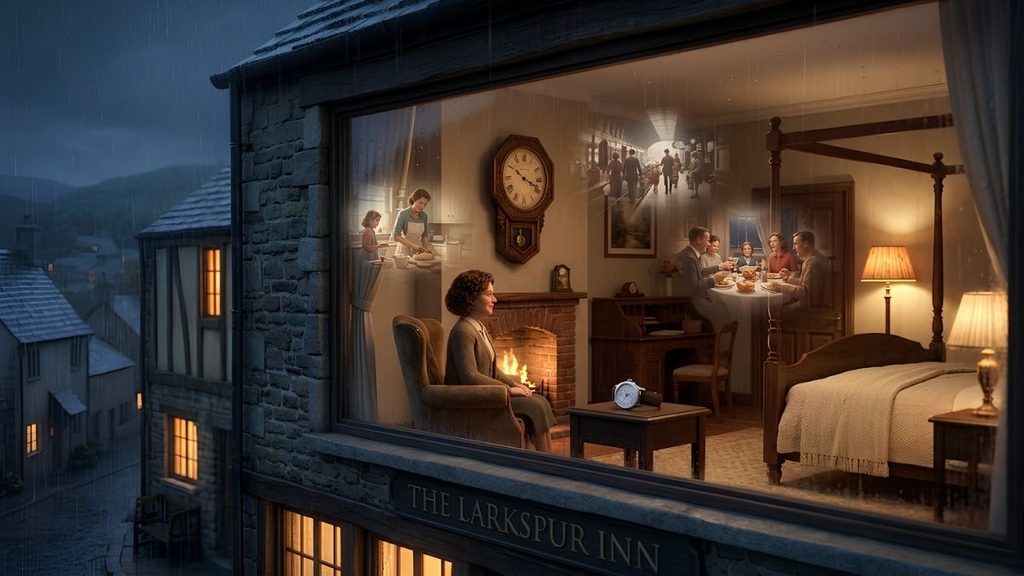
Type: Magical Realism Bedtime Story | Time, Memory & Acceptance
Genre: Relaxing Adult Bedtime Fiction
Tone: Gentle, nostalgic, atmospheric, reflective
Margaret arrived at the Bellweather Hotel just before sunset.
She had not planned to stay there.
In fact, she had not planned to stay anywhere.
Her original intention had been to drive north until she felt tired, find a small hotel, sleep, and continue the following morning.
She had been doing that for nearly a week.
Driving.
Stopping.
Sleeping.
Driving again.
It wasn’t a holiday.
It wasn’t quite an escape either.
Margaret simply needed some distance from her ordinary life.
Her apartment was filled with reminders.
Bills on the kitchen counter.
Books she had promised herself she would finish.
A coat hanging behind the door that still carried the faint scent of her husband.
A calendar she had stopped looking at.
She had spent months moving around those things without really seeing them.
So she had left.
She hadn’t told many people where she was going.
She simply packed a suitcase and started driving.
The Bellweather Hotel stood at the edge of a small village.
It was an old stone building with green shutters, a slate roof, and a wooden sign swinging above the entrance.
A row of flower boxes sat beneath the windows.
The flowers were beginning to fade with the arrival of autumn.
Margaret parked her car.
Inside, the hotel was quiet.
A fireplace burned at the far end of the lobby.
An old grandfather clock stood beside the reception desk.
Behind the counter was a thin man with silver hair.
“Good evening,” he said.
“Good evening.”
“Room?”
“Just one night.”
He smiled.
“Of course.”
Margaret signed the register.
The man handed her a brass key.
“Room Seven.”
She picked up her suitcase.
“Is there a restaurant?”
“Dining room closes at eight.”
She looked at the clock.
6:47.
“I’ll make it.”
The man smiled.
“You have plenty of time.”
His name was Henry.
He was the hotel manager.
Room Seven was at the end of the second-floor hallway.
It was small but comfortable.
A wooden bed.
A writing desk.
A reading chair.
A wardrobe.
A window overlooking the village.
And above the fireplace was a clock.
Margaret looked at it.
The hands showed 9:14.
She frowned.
She checked her watch.
6:52.
She looked at the clock again.
9:14.
Perhaps it had stopped.
She moved closer.
The second hand was moving.
Tick.
Tick.
Tick.
“Strange.”
Margaret unpacked a few things.
Then she went downstairs.
The dining room contained six tables.
Only three were occupied.
A couple near the window.
An elderly man reading a newspaper.
A woman drinking tea.
Margaret ordered soup and bread.
When she finished, she returned to the lobby.
Henry was standing near the grandfather clock.
“Is the clock in Room Seven broken?”
Henry looked at her.
“No.”
“It says nine fourteen.”
“I know.”
“Why?”
Henry smiled.
“Room Seven’s clock has always been unusual.”
Margaret waited.
He didn’t elaborate.
“Does it run fast?”
“No.”
“Slow?”
“No.”
“Then what?”
Henry looked toward the staircase.
“It doesn’t measure the time.”
Margaret laughed.
“All right.”
He smiled.
“Not in the usual sense.”
Margaret went upstairs.
The clock still read 9:14.
She brushed her teeth.
Read for a while.
Then turned off the lamp.
The room became dark.
Rain began falling outside.
Margaret lay awake.
She thought about the clock.
At 11:30, she got out of bed.
She turned on the lamp.
The clock now read 7:38.
Margaret stared at it.
She checked her watch.
11:32.
She walked closer.
7:38.
The hands moved.
Tick.
Tick.
Tick.
She wondered whether she was dreaming.
Then something strange happened.
The room smelled of oranges.
Fresh oranges.
Margaret closed her eyes.
And suddenly, she was sixteen.
She was sitting in her parents’ kitchen.
It was summer.
The windows were open.
A radio played softly.
Her father was peeling oranges.
Her younger brother was complaining about homework.
Her mother was making tea.
Nothing extraordinary was happening.
It was an ordinary afternoon.
Margaret watched herself laughing.
She remembered the orange.
The juice running down her fingers.
Her father’s ridiculous joke.
Her mother’s voice.
The sound of the radio.
She had completely forgotten that afternoon.
Yet now it was clear.
Perfectly clear.
Then the room faded.
Margaret opened her eyes.
She was back in Room Seven.
The clock read 7:39.
She sat on the edge of the bed.
Her heart was beating faster.
The next morning, Margaret went downstairs.
Henry was serving coffee.
“Good morning.”
“Morning.”
She looked at him.
“The clock.”
Henry smiled.
“Yes.”
“It showed a different time.”
“I know.”
“And I remembered something.”
He nodded.
“That’s what it does.”
Margaret stared at him.
“What exactly is that clock?”
“An old clock.”
“That’s not an answer.”
“No.”
He poured her coffee.
“It’s the only answer I have.”
She sat down.
“Why did I remember my parents?”
“Because that was the time you remembered.”
“But it wasn’t the actual time.”
“No.”
“Then what was it?”
Henry looked toward the window.
“The time that moment still has inside you.”
Margaret was silent.
She stayed another night.
She told herself it was because the weather was bad.
It wasn’t.
She wanted to see what the clock would do.
That evening, it showed 3:22.
Margaret recognized the time immediately.
She was twenty-three.
Standing on a train platform.
She was holding a suitcase.
A young man was standing beside her.
His name was Daniel.
Her future husband.
She remembered the first time they had met.
She had forgotten the details.
She remembered the relationship.
The wedding.
The house.
The years.
But not the beginning.
Now she remembered.
Daniel had been holding two coffees.
He had offered her one.
She had said no.
He had insisted.
She had eventually accepted.
They had missed their train.
They had laughed about it.
That missed train had led to another train.
That train had taken them to another city.
That city had eventually become their home.
Margaret watched the memory unfold.
She didn’t change anything.
She simply observed.
When it ended, she was back in Room Seven.
The clock showed 3:23.
She smiled.
Each night, the clock showed another time.
6:11.
Her daughter learning to walk.
Margaret remembered sitting on the floor, laughing as the little girl took three uncertain steps toward her.
10:42.
A winter evening when Daniel had cooked dinner.
He had burned the potatoes.
They had eaten them anyway.
1:07.
A summer morning when Margaret had swum in the sea for the first time.
8:26.
The evening her father taught her how to drive.
4:55.
A rainy afternoon spent reading beside a window.
11:18.
Her daughter’s graduation.
2:31.
A quiet conversation with Daniel when they were both too tired to sleep.
None of the moments were dramatic.
None would have appeared in a biography.
They weren’t milestones.
They were simply pieces of a life.
And yet the clock kept showing them.
On the sixth night, Margaret became angry.
The clock showed 9:03.
She immediately knew what it meant.
Daniel was sitting beside her in the hospital.
It was one of the last evenings before he died.
The memory was painful.
Margaret didn’t want to watch.
She turned away.
“No.”
The clock continued ticking.
She covered it with a cloth.
But she could still hear it.
Tick.
Tick.
Tick.
Eventually, she removed the cloth.
The memory began.
Daniel was tired.
Margaret was sitting beside him.
Neither spoke for a while.
Then he reached for her hand.
“I wish we’d taken more holidays.”
Margaret laughed through tears.
“We had holidays.”
“Not enough.”
“Nobody ever has enough.”
He smiled.
“That’s true.”
Then they sat quietly.
There was no dramatic goodbye.
No perfect final speech.
Only two people holding hands.
Margaret remembered that evening differently now.
At the time, she had thought it was a terrible night.
Now she saw something else.
They had been together.
That had been enough.
The next morning, Margaret found Henry in the garden.
“Why does it show the difficult memories too?”
He looked at her.
“Because they’re part of the time we remember.”
“I don’t want to remember everything.”
“You don’t have to.”
“Then why does the clock?”
Henry smiled.
“Perhaps it isn’t telling you what to remember.”
Margaret frowned.
“What is it doing?”
“Perhaps it’s showing you what you’ve already carried.”
She thought about that.
The clock wasn’t creating memories.
It wasn’t forcing anything.
It was revealing what remained.
Some memories were bright.
Others were faded.
Some were painful.
Some were almost forgotten.
But all of them had shaped her.
On the seventh night, Margaret sat beside the clock.
She didn’t sleep.
She simply watched it.
The hands moved.
Then stopped.
The time became 5:16.
A memory appeared.
She was thirty-eight.
Her daughter was away at university.
Daniel had fallen asleep on the sofa.
Margaret had been sitting beside the window, drinking tea.
Rain was falling.
She had been worried about her daughter.
She remembered thinking:
I wonder when life became so complicated.
Then Daniel had woken.
He had looked at her.
“Tea?”
She had nodded.
He had made another cup.
They had sat together.
Nothing had been solved.
The worry hadn’t disappeared.
But somehow, the evening had become peaceful.
Margaret smiled.
That memory had seemed insignificant.
Now it felt precious.
She finally understood.
The clock wasn’t showing her the most important moments of her life.
It was showing her the moments that had quietly mattered.
The ordinary evenings.
The forgotten conversations.
The meals.
The walks.
The mistakes.
The laughter.
The silence.
The cups of tea.
The people sitting beside her.
A meaningful life wasn’t necessarily made from the moments people photographed.
It was made from thousands of ordinary moments that slowly became the story of a person.
The following morning, Margaret packed her suitcase.
She went downstairs.
Henry was standing behind the reception desk.
“Leaving?”
“Yes.”
“Are you sure?”
Margaret smiled.
“Yes.”
She placed the brass key on the counter.
“Can I ask you one last question?”
“Of course.”
“Who built the clock?”
Henry smiled.
“My grandfather.”
“Did he know what it did?”
“I think so.”
“Did it work for everyone?”
Henry nodded.
“Everyone who stayed in Room Seven.”
“Why Room Seven?”
He shrugged.
“Seven was his wife’s favorite number.”
Margaret smiled.
“Where is she now?”
“She died many years ago.”
Margaret nodded.
“I see.”
Henry looked at the clock in the lobby.
“Some people believe time is what passes.”
He paused.
“My grandfather believed time was what remains.”
Margaret stepped outside.
The morning was cool.
The village was quiet.
She walked toward her car.
Before opening the door, she looked back at the hotel.
For a moment, she considered returning upstairs.
She didn’t.
She didn’t need to.
The memories were already hers.
On the drive home, Margaret stopped at a roadside café.
She ordered tea.
While waiting, she noticed an elderly couple sitting near the window.
The woman was laughing.
The man was trying to open a sugar packet.
He couldn’t.
She took it from him.
Opened it.
Then handed it back.
He smiled.
Margaret watched them.
For some reason, she thought about the clock.
She realized that someday, perhaps, one of them might remember this ordinary morning.
Not the café.
Not the tea.
Not the sugar packet.
But the feeling.
Being together.
She smiled.
When Margaret finally returned home, the apartment looked exactly as she had left it.
The bills were still on the counter.
The books were still unfinished.
Daniel’s coat was still behind the door.
She stood there for a long time.
Then she touched the coat.
For months, she had avoided it.
Now she didn’t.
She took it from the hook.
She held it close.
The scent was almost gone.
But she smiled anyway.
She didn’t feel as though she had traveled backward.
She felt as though she had finally understood how to carry something forward.
That evening, Margaret made tea.
She sat beside the window.
Rain began falling.
She thought about the Bellweather Hotel.
The clock.
Her parents.
Her daughter.
Daniel.
The countless evenings she had once considered ordinary.
She understood something she hadn’t understood before.
Time didn’t only take things away.
It also left things behind.
A laugh.
A voice.
A recipe.
A photograph.
A habit.
A song.
A hand reaching for yours.
A cup of tea made without asking.
A rainy evening.
A missed train.
A burned dinner.
A quiet conversation.
None of these moments had seemed important when they were happening.
But together, they had been her life.
Margaret opened a notebook.
At the top of the first page, she wrote:
Things I Don’t Want to Forget
Then she stopped.
She thought about it.
Crossed out the sentence.
And wrote instead:
Things I Am Glad I Lived
She began writing.
Not the biggest moments.
The smallest ones.
Her father’s oranges.
Daniel’s burnt potatoes.
Her daughter’s first steps.
Rain against the window.
The smell of coffee.
A train she had missed.
A summer evening by the sea.
A hand held in a hospital room.
She wrote slowly.
There was no need to finish.
For once, she wasn’t measuring time.
She was remembering it.
Years later, Margaret would sometimes think about Room Seven.
She never knew whether the hotel had truly existed as she remembered it.
Perhaps the clock had been old and faulty.
Perhaps the memories had simply been waiting beneath the surface.
Perhaps the whole thing had been a dream brought on by exhaustion.
She didn’t care.
Because something had changed.
She no longer waited for extraordinary days.
She noticed ordinary ones.
When her daughter called, Margaret listened longer.
When it rained, she sat by the window.
When someone laughed, she laughed with them.
When an evening felt quiet, she didn’t immediately fill it.
She let it remain quiet.
And sometimes, just before bed, she would look at the clock on her wall.
It always showed the correct time.
But Margaret no longer thought that was the only kind of time that mattered.
There was another kind.
The time inside a memory.
The time measured not in hours or minutes, but in meaning.
The moments that stayed.
The moments that returned unexpectedly.
The moments that whispered:
You were here.
You loved.
You laughed.
You were alive.
And perhaps that was enough.
Perhaps a life did not need to be measured by how much time had passed.
Perhaps it could be measured by how many ordinary moments had quietly become precious.
Margaret turned off the lamp.
The room became still.
Rain continued against the window.
She closed her eyes.
And somewhere in the gentle darkness of memory, a clock kept ticking.
Not counting down.
Not urging her forward.
Simply reminding her that every ordinary evening was becoming something.
Something she might one day remember.
Something she was living right now.
And with that thought, Margaret smiled and fell asleep.
4. The Last Train to Willowmere
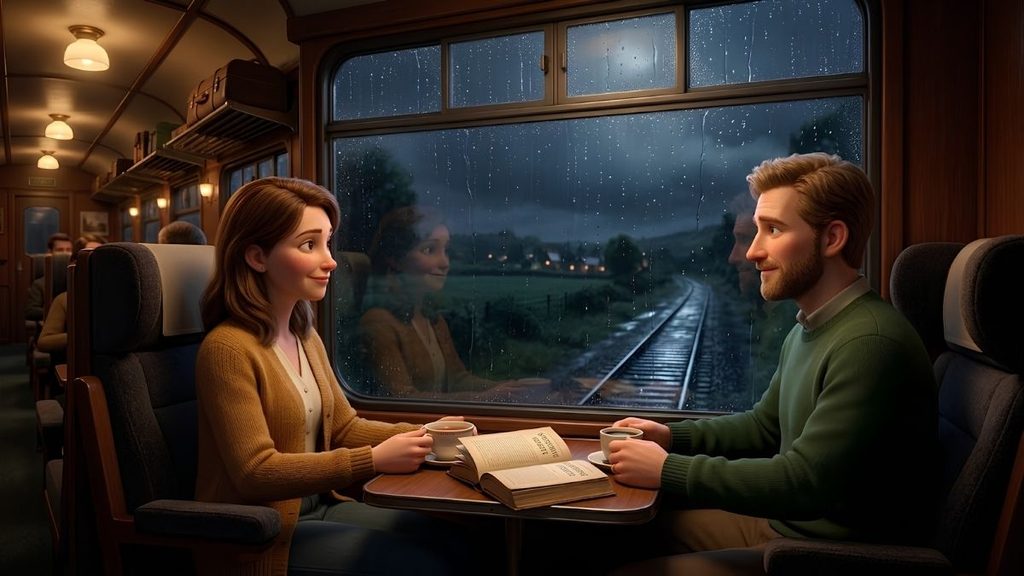
Type: Romantic Bedtime Story | Second Chances & Quiet Connection
Genre: Romantic Adult Bedtime Fiction
Tone: Gentle, nostalgic, intimate, peaceful
Sophie had never considered the last train particularly romantic.
It was simply the train she took because it was the last one that brought her home.
Every Friday evening, shortly after nine, she left her office, walked through the narrow streets toward the station, and boarded the same train.
The platform was usually quiet.
A few tired commuters.
A student carrying a backpack.
An elderly couple returning from the city.
Someone buying coffee from the vending machine.
Someone else staring at their phone.
Then the train would arrive with a low metallic rumble.
Sophie would board the second carriage.
She always chose the seat beside the window.
She liked watching the city disappear.
Streetlights became scattered dots.
Buildings became fields.
Fields became dark shapes beneath the moon.
The journey lasted forty-eight minutes.
Sophie knew because she had timed it many times.
Forty-eight minutes from the station to Willowmere.
Forty-eight minutes in which nobody expected anything from her.
She had been taking that train for almost three years.
It had become a ritual.
She didn’t particularly enjoy her job.
She wasn’t miserable either.
It was simply a job.
Emails.
Meetings.
Reports.
Deadlines.
Small problems that became large because someone had forgotten to answer an email.
By Friday evening, Sophie was always tired.
But when she sat by the train window, something inside her loosened.
She put her phone away.
She watched the countryside.
Sometimes she read.
Sometimes she slept.
Sometimes she did nothing.
The train gave her permission to be unavailable.
One rainy Friday in October, Sophie arrived at the station later than usual.
Rain had been falling since afternoon.
The platform shone beneath the lamps.
She boarded just as the doors were closing.
The carriage was almost empty.
She took her usual seat.
Then she noticed the man sitting across the aisle.
He was reading a book.
Sophie looked at it.
Then looked again.
She knew that book.
It was an old novel called The Winter Garden.
She had read it when she was twenty-two.
She hadn’t thought about it in years.
The man turned a page.
Sophie smiled.
He noticed.
“Have you read it?”
She hesitated.
“Yes.”
“Is it good?”
She laughed softly.
“You’re asking me that after you’ve already started it?”
“I like second opinions.”
Sophie looked at the cover.
“It’s very good.”
“That’s encouraging.”
He smiled.
Then returned to his book.
That could have been the end of the conversation.
It probably should have been.
But Sophie found herself saying:
“Don’t trust the first chapter.”
He looked up.
“Why?”
“It makes you think the book is going to be one kind of story.”
“And it isn’t?”
“No.”
“What kind is it?”
Sophie smiled.
“That would ruin it.”
He laughed.
“Fair enough.”
The train moved through the rain.
His name was Daniel.
She learned that twenty minutes later.
He worked as an architect in the city.
He lived in a small village beyond Willowmere.
He had bought the book from a secondhand shop because the cover reminded him of one his mother used to own.
Sophie told him she had read it during university.
“Did you like university?”
“Most days.”
“That’s not a strong recommendation.”
“It wasn’t the university I liked.”
“What was it?”
She looked out the window.
“The person I was then.”
Daniel smiled.
“I understand.”
The train entered a tunnel.
For a few seconds, their reflections appeared in the glass.
Then the countryside returned.
When the train reached Willowmere, Sophie said goodbye.
“Goodnight, Sophie.”
“Goodnight, Daniel.”
She walked home.
She didn’t expect to see him again.
But the following Friday, he was there.
Same carriage.
Same side.
Same book.
She sat across from him.
“You finished it.”
He held up the book.
“Last night.”
“And?”
He smiled.
“You were right.”
“About?”
“The first chapter.”
She laughed.
“Good.”
“There’s something I don’t understand.”
“What?”
“Why did you recommend it if you knew I’d finish it?”
“I didn’t know you would.”
“Perhaps you hoped I would.”
Sophie looked out the window.
“Perhaps.”
That became the beginning.
Not a date.
Not a plan.
Just a conversation.
Every Friday, they found each other on the last train.
Sometimes they talked.
Sometimes they didn’t.
They began bringing books.
Daniel brought one for Sophie.
Sophie brought one for Daniel.
They argued about endings.
They recommended authors.
They discovered they both liked old bookstores.
Neither liked crowded restaurants.
Daniel loved mornings.
Sophie preferred evenings.
He drank coffee without sugar.
She drank tea with too much honey.
He liked long walks.
She liked sitting somewhere and watching people walk.
Their differences were comfortable.
Weeks passed.
Autumn became winter.
The countryside turned gray.
Bare trees stood along the railway.
The evenings became darker.
Sometimes the train windows fogged.
Sophie and Daniel would draw small shapes in the condensation.
A star.
A house.
A tree.
Once, Daniel drew a terrible cat.
Sophie laughed for nearly five minutes.
“You can’t draw.”
“I design buildings.”
“Buildings don’t have whiskers.”
“Some do.”
“That’s unfortunate.”
They never exchanged phone numbers.
It seemed strange.
But neither asked.
The train was enough.
Friday evening arrived.
They met.
They talked.
Then they went home.
There was something comforting about the boundary.
Their lives remained separate.
They didn’t know everything about one another.
They didn’t need to.
One evening, Sophie arrived carrying a book.
Daniel looked at it.
“What’s that?”
“My favorite.”
“You’re finally trusting me with it?”
“Don’t lose it.”
“I won’t.”
She handed it to him.
He turned it over.
Inside the cover, Sophie had written a sentence.
Some journeys are important because of where they take us. Others are important because of who sits beside us.
Daniel read it twice.
Then looked at her.
“That’s a little unfair.”
“Why?”
“Now I have to find something equally meaningful to write in your book.”
Sophie smiled.
“You don’t.”
He closed the book.
“I think I do.”
That winter, they began arriving at the station early.
Not because they discussed it.
They simply did.
Sometimes they sat on the platform for ten minutes before boarding.
Daniel would buy two coffees.
Sophie would bring biscuits.
They would talk about nothing.
Weather.
Books.
Neighbors.
Food.
Childhood memories.
Things they had never told anyone else.
One night, Daniel told Sophie about his father.
Another night, Sophie told him about the relationship that had ended before she met him.
Neither offered advice.
They simply listened.
“Why didn’t it work?” Daniel asked one evening.
Sophie looked out the window.
“Because we were always trying to become people we weren’t.”
“Do you regret it?”
“No.”
“Why not?”
“Because I learned what I don’t want.”
Daniel nodded.
“That’s useful.”
“Did you ever love someone like that?”
“Yes.”
“What happened?”
“We were good people at the wrong time.”
Sophie looked at him.
“Do you think timing matters?”
“More than people admit.”
The train continued through the darkness.
One Friday in March, the railway announced that the Willowmere line would be discontinued.
The announcement appeared on the station noticeboard.
Sophie read it twice.
The route would close at the end of June.
The last train would run on the final Friday of the month.
She felt something unexpectedly heavy in her chest.
She took a photograph of the notice.
Then deleted it.
She didn’t know why.
That evening, Daniel was already waiting.
“You saw it.”
She nodded.
“The line.”
“I saw it.”
Neither spoke for a while.
The train arrived.
They boarded.
The carriage seemed different.
Although nothing had changed.
For the first time, the forty-eight-minute journey felt short.
They talked about the closure.
“There are buses,” Daniel said.
“I know.”
“And another railway line.”
“I know.”
“So we’ll still get home.”
Sophie smiled.
“Yes.”
“But?”
She looked at him.
“But this won’t be the same.”
Daniel nodded.
“No.”
They began meeting on other days.
At first, it felt strange.
Coffee on Sunday.
A walk on Wednesday.
Lunch one Saturday.
Without the train, their lives began moving closer together.
They discovered things they hadn’t known.
Daniel cooked well.
Sophie didn’t.
Sophie loved museums.
Daniel preferred gardens.
Daniel had a habit of leaving books everywhere.
Sophie had a habit of organizing them.
He teased her.
She pretended to be annoyed.
They were becoming something neither had named.
Yet they still took the Friday train.
Every week.
Even though they could have gone home earlier.
Even though they were no longer strangers.
The train remained their place.
A small moving room between two parts of their lives.
In June, the evenings became warm.
The fields outside the windows turned green.
Flowers appeared beside the tracks.
The final Friday approached.
Neither spoke about it much.
Then it arrived.
The platform was crowded.
People had come to ride the last train.
Some carried cameras.
Some brought children.
Some simply stood quietly.
Sophie and Daniel found their usual seats.
The train departed.
The city slowly disappeared.
They watched the countryside.
Neither spoke for several minutes.
Then Daniel reached into his bag.
“I brought you something.”
It was a book.
The same Winter Garden he had been reading when they first met.
But it looked different.
Older.
More worn.
Sophie opened it.
Inside was a note.
She read it.
For the first Friday, and all the Fridays after it.
She smiled.
“You kept it.”
“Of course.”
Sophie had brought something too.
She handed him an envelope.
Inside was a photograph.
The photograph showed their train disappearing into the countryside.
She had taken it months earlier.
On the back, she had written:
Forty-eight minutes was never enough.
Daniel laughed softly.
“That’s a little dramatic.”
“I know.”
“I like it.”
The train continued.
At every station, people grew quieter.
Some passengers talked about memories.
Some took photographs.
Some simply looked out the windows.
When they reached Willowmere, nobody immediately stood.
The train remained at the platform.
The final departure was delayed by a few minutes.
Daniel looked at Sophie.
“Do you remember when we first met?”
“Of course.”
“What did you think of me?”
She smiled.
“I thought you were reading a book I liked.”
“That’s all?”
“At the time.”
“And now?”
She looked at him.
“Now I think I was lucky.”
He took her hand.
She held it.
The train eventually moved.
The final journey was over.
The railway line fell silent.
But the story didn’t end there.
Months later, Sophie and Daniel still talked about the last train.
They didn’t try to recreate it.
They didn’t need to.
They found other rituals.
Saturday breakfasts.
Evening walks.
Old bookstores.
Rainy afternoons.
Sunday trains to places neither had visited.
Sometimes they still traveled without speaking.
Sometimes they talked for hours.
Sometimes they sat beside one another reading different books.
Their relationship had never begun with fireworks.
There had been no dramatic confession.
No perfect first date.
No grand promise.
It had begun with a book.
A rainy evening.
Two strangers.
A conversation that might easily have ended after three sentences.
Instead, it continued.
One winter evening, nearly a year after the railway closed, Sophie and Daniel returned to the old station.
The platform was quiet.
Grass had begun growing between the tracks.
The signs had faded.
The station building was closed.
They stood beneath the old shelter.
Daniel looked down the tracks.
“Do you miss it?”
Sophie thought for a moment.
“Sometimes.”
“Me too.”
She slipped her hand into his.
“But I’m glad it ended.”
Daniel looked surprised.
“Why?”
“Because if it hadn’t ended, we might never have realized how much it meant.”
He smiled.
“That’s a very philosophical answer.”
“I’ve had time to prepare.”
They laughed.
A train passed in the distance.
Not their train.
Not their line.
Just another train traveling somewhere beyond them.
Sophie watched its lights disappear.
She thought about how strange life was.
Sometimes we believe the important moments will announce themselves.
They don’t.
Sometimes they arrive disguised as ordinary Fridays.
A seat across the aisle.
A familiar book.
A conversation.
A person who happens to be going the same way.
And sometimes a journey becomes precious only after it has ended.
Years later, Sophie would occasionally open the old book.
The pages had softened with age.
The cover was worn.
Daniel had underlined a sentence near the middle.
She couldn’t remember when he had done it.
She didn’t ask.
She simply smiled whenever she saw it.
The book remained on their living-room shelf.
Beside it was the photograph of the final train.
Sometimes, on rainy evenings, they would make tea and sit by the window.
Daniel would read.
Sophie would look outside.
The rain would fall against the glass.
And neither would hurry.
Because they had learned something on that old railway line.
Not every journey needs to be long.
Not every relationship needs to begin dramatically.
Not every meaningful moment needs to become a story immediately.
Sometimes, the most beautiful things begin quietly.
A person sits across from you.
A book lies between you.
Rain moves across the windows.
The countryside passes in darkness.
And for forty-eight minutes, you are simply two people going home.
Until one day you realize that somewhere along the way,
home has become wherever the other person is sitting.
And that is how Sophie remembered the last train to Willowmere.
Not as the train that stopped running.
But as the journey that taught her something she had never expected to learn:
Sometimes the best second chances don’t take you back to where you started.
They take you somewhere new.
And sometimes, if you’re fortunate, someone is waiting in the seat across from you.
5. The Photograph in the Winter Drawer

The Photograph in the Winter Drawer
Type: Nostalgic Bedtime Story | Family, Memory & Home
Genre: Nostalgic Adult Bedtime Fiction
Tone: Gentle, emotional, reflective, comforting
Claire had always thought of her grandmother’s house as a place that had stopped changing.
Even after her grandmother was gone, the house seemed to hold its breath.
The curtains remained exactly where they had always been.
The kitchen clock still ticked above the doorway.
A blue ceramic bowl sat beside the sink.
There were books on the shelves with faded spines and small handwritten notes inside them.
A wool blanket remained folded across the back of the living-room chair.
Everything looked as though her grandmother might walk through the door at any moment and ask Claire whether she wanted tea.
But she wouldn’t.
Claire knew that.
Still, knowing something and accepting it were different things.
It had been six months since her grandmother died.
The family had delayed clearing the house because nobody wanted to be the first person to touch anything.
Eventually, practical matters forced them to begin.
The house needed to be sold.
The furniture needed to be sorted.
Clothes had to be donated.
Books had to be divided.
Photographs had to be placed into boxes.
Claire volunteered to help.
She preferred being busy.
It was easier than sitting at home and remembering.
On a cold Saturday morning, Claire began with the bedroom.
Her grandmother’s wardrobe stood against the far wall.
It was an old wooden wardrobe with brass handles.
Inside were dresses, coats, scarves, and sweaters arranged neatly.
Claire worked slowly.
She folded things.
She made piles.
Keep.
Donate.
Unsure.
The “unsure” pile grew larger than the others.
She found a green wool coat that her grandmother had worn every winter.
Claire remembered it immediately.
Her grandmother used to wear it whenever they walked to the village market.
She would put on the coat, wrap a scarf around her neck, and tell Claire to bring an umbrella even when the sky was perfectly clear.
Claire smiled at the memory.
She placed the coat on the bed.
Then she noticed something.
The inside pocket was unusually heavy.
She reached into it.
Her fingers touched paper.
Claire pulled out a photograph.
It was small.
Black and white.
The edges were worn.
A young woman stood outside a small seaside house.
Claire stared at the photograph.
She recognized the woman.
Her grandmother.
But she had never seen her like this.
Her grandmother was perhaps twenty-five.
Maybe younger.
She had short dark hair.
She wore a simple dress.
And she was smiling.
Not the familiar smile Claire remembered from childhood.
This was different.
Younger.
Carefree.
Almost mischievous.
Behind her stood a small white house with blue shutters.
Beyond it was the sea.
Claire turned the photograph over.
Nothing.
No date.
No name.
No explanation.
She looked again.
Something about the picture unsettled her.
Not because it was mysterious.
Because it revealed a person she didn’t know.
Claire took the photograph downstairs.
Her mother was sorting dishes in the kitchen.
“Mom?”
“Yes?”
“Do you know this place?”
Her mother looked at the photograph.
Her expression changed.
“Where did you find that?”
“In Grandma’s coat.”
Her mother took the photograph.
She stared at it for several seconds.
“I’ve never seen this.”
“Do you know the house?”
“No.”
“What about the place?”
Her mother shook her head.
“I don’t know.”
Claire studied her face.
“Are you sure?”
Her mother smiled faintly.
“Your grandmother wasn’t very good at talking about her younger years.”
“Why?”
“I don’t know.”
She handed the photograph back.
“Ask your uncle.”
Claire called her uncle that evening.
His name was Peter.
He lived several hours away.
When Claire described the photograph, he laughed.
“That’s definitely your grandmother.”
“Do you know where it is?”
“No.”
“Do you know anything about the house?”
There was a pause.
“I might.”
Claire sat up.
“You might?”
“Your grandmother used to mention a place called Seaborne.”
“Where?”
“Somewhere on the coast.”
“Was it a family house?”
“I don’t think so.”
“What was it?”
Peter laughed softly.
“If I knew, I’d tell you.”
He thought for a moment.
“Wait.”
“What?”
“I remember an old story.”
“What story?”
“Your grandmother used to talk about working near the sea when she was young.”
“Doing what?”
“I don’t know. Something with a guesthouse.”
Claire looked at the photograph again.
“Do you remember the name?”
“No.”
“Anything else?”
“She had a friend named Evelyn.”
Claire wrote the name down.
“Evelyn.”
“Yes.”
“Who was she?”
“I have no idea.”
The next day, Claire searched through old family boxes.
She found school photographs.
Birthday cards.
Letters.
Christmas decorations.
Receipts.
Postcards.
A small envelope containing dried flowers.
But nothing about Seaborne.
Nothing about Evelyn.
Then, at the bottom of a box, she found a postcard.
The front showed a seaside town.
On the back, written in her grandmother’s handwriting, were four words:
Wish you were here.
There was no name.
No address.
No date.
Claire turned the postcard over several times.
The photograph suddenly felt less like an isolated memory.
It belonged to something.
A week later, Claire drove to the coast.
The town was called Seaborne.
It was smaller than she expected.
White cottages lined the streets.
Fishing boats rested near the harbor.
The sea stretched beyond the breakwater.
Claire walked into a small café.
She showed the photograph to the woman behind the counter.
“Do you recognize this house?”
The woman adjusted her glasses.
“Maybe.”
She called an older man from the kitchen.
He looked at the photograph.
His face brightened.
“That house.”
“You know it?”
“Old Blue House.”
“Where is it?”
He pointed toward the cliffs.
“About two miles north.”
Claire thanked him.
She walked.
The road became narrower.
The sea appeared between the trees.
Eventually she saw it.
The house from the photograph.
It had changed.
The blue shutters were gone.
The walls were weathered.
But the shape was unmistakable.
Claire stood outside.
For a moment, she imagined her grandmother as a young woman walking through the same doorway.
She wondered what her life had been like.
What had she wanted?
Who had she loved?
What had she feared?
Why had she never talked about this place?
An elderly woman appeared at the neighboring house.
“Are you looking for someone?”
Claire turned.
“I’m looking for information about this house.”
The woman looked at the photograph.
Then at Claire.
“Who is she?”
“My grandmother.”
The woman’s eyes widened.
“What was her name?”
“Margaret.”
She smiled.
“Margaret.”
Claire felt her heart beat faster.
“You knew her?”
“Everyone knew Margaret.”
The woman’s name was Rose.
She invited Claire inside.
They sat beside a small fireplace.
Rose poured tea.
“Your grandmother came here when she was twenty-four.”
“Why?”
“She was working at the guesthouse.”
“The guesthouse?”
Rose nodded.
“This house used to be part of it.”
Claire looked surprised.
“She worked here?”
“Yes.”
“What did she do?”
“Everything.”
Rose laughed.
“Cleaning. Cooking. Serving guests. Carrying laundry. She hated washing windows.”
Claire smiled.
“That sounds like her.”
“No.”
Rose shook her head.
“That wasn’t the same Margaret.”
Claire looked at her.
“What do you mean?”
Rose smiled.
“Your grandmother was fearless.”
Claire listened.
Margaret had arrived in Seaborne after leaving her first job.
She had wanted to see the sea.
She had wanted to earn enough money to travel.
She had wanted to learn how to swim.
She had wanted, according to Rose, “to do everything at least once.”
“Was she happy?”
Rose considered the question.
“Sometimes.”
“Sometimes?”
“She was young.”
Rose laughed.
“Young people are rarely as simple as we remember them.”
“What about Evelyn?”
Rose smiled.
“Evelyn was her best friend.”
“Where is she now?”
Rose looked toward the window.
“Still here.”
Claire couldn’t believe it.
“You mean she’s alive?”
Rose nodded.
“She lives at the other end of town.”
Claire met Evelyn the next afternoon.
She was ninety-one.
She had white hair and bright eyes.
When Claire showed her the photograph, Evelyn became very quiet.
“Margaret,” she whispered.
“You knew her?”
“Of course.”
She touched the photograph.
“She hated this picture.”
“Why?”
“She thought she looked too serious.”
Claire laughed.
“She doesn’t look serious.”
“Exactly.”
Evelyn smiled.
They spent three hours talking.
Claire learned things her family had never known.
Margaret had once climbed the cliff path in a storm because she wanted to see what the sea looked like from the top.
She had learned to swim badly but enthusiastically.
She had danced at village festivals.
She had written terrible poetry.
She had once spent an entire afternoon trying to repair a broken radio.
She had dreamed of opening a little restaurant.
She had saved money to travel.
She had fallen in love once before meeting Claire’s grandfather.
The relationship had ended peacefully.
There had been no betrayal.
No scandal.
No secret tragedy.
They had simply wanted different lives.
Claire realized that was perhaps the greatest surprise of all.
There was no dramatic secret.
There was simply a life.
A whole life.
One that had existed before Claire knew her.
“Why didn’t she ever tell us?”
Evelyn smiled.
“She did.”
“When?”
“Whenever she talked about the sea.”
Claire looked down.
“I never heard those stories.”
“You weren’t listening for them.”
That sentence stayed with Claire.
Before she left, Evelyn gave her something.
A small envelope.
“Your grandmother left this here years ago.”
Claire opened it.
Inside was a letter.
It wasn’t addressed to anyone.
The handwriting was unmistakable.
Claire read it slowly.
Her grandmother had written about the house.
About the sea.
About being young.
About feeling uncertain.
One sentence caught Claire’s attention:
I hope someday I become someone who remembers this time kindly.
Claire read it twice.
On the drive home, Claire thought about the sentence.
Her grandmother had not known what her future would look like.
She had been uncertain.
She had made mistakes.
She had changed her mind.
She had loved and lost.
She had tried things that didn’t work.
She had eventually married.
She had raised children.
She had become the grandmother Claire remembered.
But she had once been someone else.
Someone who stood beside the sea in a simple dress.
Someone who wanted to see the world.
Someone who didn’t yet know what her life would become.
When Claire returned to the house, she found her mother in the kitchen.
She placed the photograph on the table.
“Mom.”
Her mother looked at it.
“I found out where this was.”
She told her everything.
Her mother listened.
When Claire finished, she smiled.
“I wish I’d known.”
“Why didn’t you ask?”
Her mother looked down.
“Because when you’re young, you think your parents were always parents.”
Claire understood.
She had done the same.
Her grandmother had always been Grandma.
It was difficult to imagine that she had once been a young woman with dreams and uncertainty.
They spent the evening looking through old photographs.
For the first time, Claire noticed things she had never noticed before.
Her grandmother standing beside a bicycle.
Her grandmother laughing at a picnic.
Her grandmother wearing a bright dress.
Her grandmother holding a suitcase.
There were photographs of people Claire didn’t recognize.
Friends.
Neighbors.
Coworkers.
People who had once mattered deeply.
Some had disappeared from the family story.
Not because they were unimportant.
Simply because life had moved on.
Claire began asking questions.
She called relatives.
She wrote down names.
She collected stories.
Not secrets.
Stories.
Her grandmother had once wanted to travel.
She had wanted to learn French.
She had loved dancing.
She had disliked ironing.
She had been terrible at keeping plants alive.
She had once spent an entire summer painting the kitchen yellow before deciding she hated the color.
Claire laughed.
“That’s definitely Grandma.”
The house gradually became easier to enter.
It was still sad.
But sadness had changed.
Before, Claire had thought of the house as evidence of what had been lost.
Now she saw it differently.
It was evidence of what had existed.
Every scratch on the table.
Every mark on the doorframe.
Every faded photograph.
Every recipe.
Every old coat.
They weren’t simply reminders of absence.
They were traces of a life.
A life that had been full long before Claire arrived.
One evening, Claire opened the winter drawer again.
She found the green coat.
She put it on.
It was too large.
She stood in front of the mirror.
For a moment, she laughed.
She imagined her grandmother wearing it on a cold morning by the sea.
Then she remembered something Rose had said.
Young people are rarely as simple as we remember them.
Claire understood.
Perhaps older people weren’t simple either.
Perhaps no person could ever be reduced to one role.
Mother.
Father.
Grandmother.
Grandfather.
Friend.
Partner.
Every person carried earlier versions of themselves.
Some were remembered.
Others disappeared.
But they were all there.
A year later, Claire returned to Seaborne.
She brought the photograph.
Rose was still living next door.
Evelyn was still drinking tea at four every afternoon.
Claire walked to the old house.
The sea was calm.
She stood where her grandmother had once stood.
She looked at the horizon.
For a moment, she imagined her grandmother beside her.
Not as the grandmother she had known.
But as the young woman in the photograph.
Twenty-four.
Hopeful.
Uncertain.
Alive with possibilities.
Claire smiled.
“I understand now,” she whispered.
She wasn’t sure what she was talking about.
Perhaps the house.
Perhaps the photograph.
Perhaps her grandmother.
Perhaps herself.
That evening, Claire sat by the sea until sunset.
She realized that understanding the past didn’t mean living in it.
It meant seeing the people who came before us more completely.
Her grandmother had not belonged only to the years Claire knew.
She belonged to all of them.
The seaside years.
The uncertain years.
The joyful years.
The difficult years.
The ordinary years.
And all those years had eventually become the woman who taught Claire how to make soup, how to fold towels, how to save birthday cards, and how to always carry an umbrella.
A whole life had existed behind the familiar face.
Claire felt grateful that she had discovered even a small part of it.
That night, she placed the photograph in a new frame.
She didn’t put it away in a drawer.
She placed it beside the family photographs.
Her grandmother as a young woman stood beside photographs of her later life.
Different ages.
Different places.
The same person.
Claire looked at them for a long time.
Then she turned off the light.
The house was quiet.
For the first time, the quiet didn’t feel empty.
It felt full.
Full of voices.
Footsteps.
Laughter.
Rain.
Seaside wind.
Family dinners.
Old songs.
Forgotten dreams.
Ordinary days.
The kinds of things that rarely become history but somehow become a life.
Claire went upstairs.
Before closing the bedroom door, she looked once more at the photograph.
Her grandmother was smiling.
Young.
Uncertain.
Hopeful.
Claire smiled back.
Then she went to bed.
And somewhere between remembering the past and welcoming tomorrow, she understood something simple:
We never know the whole story of the people we love.
We know only the chapters they happened to share with us.
And perhaps that is why memories are so precious.
They allow us to discover, little by little, how much life existed before we arrived.
And how much of it continues inside us after someone is gone.
6. The Path Through the Silver Pines

Type: Nature-Based Bedtime Story | Forest, Solitude & Renewal
Genre: Relaxing Adult Bedtime Fiction
Tone: Peaceful, reflective, atmospheric, comforting
Daniel had forgotten what silence sounded like.
For most of his adult life, he had lived in cities where something was always happening.
Traffic moved outside his apartment until midnight.
Elevators opened and closed in the hallway.
Neighbors argued through thin walls.
Phones vibrated.
Messages arrived.
Machines hummed.
People hurried.
Even on quiet mornings, Daniel could hear buses stopping at intersections several streets away.
He had become so accustomed to noise that he barely noticed it.
Then one afternoon, after eleven years working in a crowded office, Daniel resigned.
He didn’t have another job waiting.
He didn’t have a detailed plan.
He simply knew that he couldn’t continue living at the speed he had been living.
A month later, he accepted a temporary position as caretaker of a small forest lodge.
The lodge stood several hours north of the city.
There was a main building, three guest cabins, a wood shed, a narrow lake, and a long path that disappeared into a grove of silver pine trees.
Daniel was told the job would last through winter.
He agreed.
He arrived in November.
The first thing he noticed was the cold.
The second was the silence.
The third was how uncomfortable the silence made him feel.
He unpacked his bags in the caretaker’s cottage.
There was a small kitchen.
A bedroom.
A wood-burning stove.
A desk.
A window overlooking the forest.
On his first evening, Daniel made dinner.
He ate quickly.
Then he washed the plate.
Then he checked his phone.
There were no messages.
He checked again.
Still nothing.
He put the phone down.
Five minutes later, he picked it up.
Nothing.
He laughed at himself.
He had forgotten how to be alone.
The next morning, the lodge owner showed him around.
“The important thing is keeping the paths clear,” she explained.
“Snow gets heavy around here.”
Daniel nodded.
“There’s one path guests like most.”
She pointed toward the trees.
“It runs through the silver pines.”
Daniel looked.
Tall pine trees stood in a long row, their trunks pale beneath the winter sky.
“The path goes all the way to the stream,” she said.
“How long?”
“Twenty minutes.”
“Twenty minutes?”
“About that.”
She smiled.
“Unless you walk slowly.”
Daniel began walking that evening.
The sun was already low.
Fresh snow covered the ground.
His boots made a soft crunching sound.
For the first few minutes, he walked quickly.
Then he realized there was nowhere he needed to go.
He slowed down.
The trees stood quietly around him.
Their branches held small amounts of snow.
A breeze moved through the needles.
It made a sound like distant rain.
Daniel stopped.
He listened.
It was strange.
He could hear his own breathing.
He could hear his boots.
He could hear the wind.
Nothing else.
At the end of the path was a stream.
It was still flowing.
Not quickly.
Just enough to keep moving beneath a thin layer of ice.
Daniel stood beside it.
He watched a small leaf travel through the water.
It disappeared beneath the ice.
Then emerged again.
He stayed there for several minutes.
Eventually, he turned around.
The walk back felt shorter.
The following evening, he took the same path.
He noticed something he hadn’t seen before.
Small tracks crossed the snow.
Four tiny footprints.
Daniel crouched down.
He didn’t know what animal had made them.
He followed them with his eyes.
They disappeared beneath a fallen branch.
He smiled.
That was all.
But something about discovering the tracks made the forest feel different.
There was life everywhere.
He simply hadn’t been looking.
The days settled into a rhythm.
Daniel woke early.
He lit the stove.
Made coffee.
Checked the lodge.
Cleared snow from the steps.
Prepared firewood.
Walked the silver pine path.
At first, the routine felt repetitive.
Then he began noticing small differences.
One morning, the stream was covered with a thin layer of ice.
The next morning, a crack had appeared across it.
A week later, the ice had thickened.
He began wondering how long it would take before the entire stream froze.
He never looked it up.
He simply watched.
One afternoon, Daniel met his neighbor.
An elderly man was standing beside the path with a walking stick.
“You’re the new caretaker,” he said.
“Yes.”
“I’m Samuel.”
“Daniel.”
Samuel nodded toward the forest.
“Good walking today.”
Daniel looked at the sky.
“Snow coming?”
“No.”
“Then why is it good?”
Samuel smiled.
“Because it’s here.”
Daniel laughed.
“I suppose that’s true.”
Samuel began walking beside him.
They didn’t talk much.
They didn’t need to.
Samuel lived in a small cottage beyond the lake.
He had lived there for forty years.
He knew the forest better than anyone.
He could identify birds by their calls.
He knew where foxes crossed the road.
He knew which trees lost their branches during heavy snow.
He knew where the first wildflowers appeared in spring.
Daniel found this fascinating.
“You’ve memorized everything.”
Samuel shook his head.
“No.”
“Then how do you know?”
“I’ve watched.”
That answer stayed with Daniel.
I’ve watched.
He began watching too.
One morning, he noticed that the moon had left a pale glow between the trees.
The next evening, it appeared farther to the left.
Daniel began paying attention.
The moonlight changed as the winter progressed.
Sometimes it reached the path.
Sometimes the trees swallowed it.
Sometimes the snow reflected enough light to make the entire forest seem blue.
Daniel began walking after dinner just to see what the night looked like.
His phone remained mostly untouched.
At first, this worried him.
Then it didn’t.
He discovered that there was a difference between being disconnected and being absent.
He wasn’t absent.
He was simply present somewhere else.
One afternoon, Daniel found a bird sitting on the same branch.
It returned the following day.
And the next.
He began looking for it.
Sometimes it was there.
Sometimes it wasn’t.
He never knew where it went.
But eventually he learned to recognize its call.
He didn’t know the species.
He didn’t need to.
He called it the winter bird.
January arrived.
The snow became deeper.
The forest changed.
Branches bent under white weight.
The stream slowed.
The path narrowed.
Daniel cleared it every morning.
One evening, Samuel appeared again.
“You’ve been walking alone too much.”
Daniel smiled.
“I thought you liked walking.”
“I do.”
“Then come with me.”
Samuel nodded.
They walked together.
Samuel told stories.
Not dramatic ones.
Small ones.
He told Daniel about a winter when the lake froze so completely that villagers played hockey on it.
He told him about a fox that once stole his gloves.
He told him about a summer when the forest caught fire and the entire community worked together to protect the lodge.
He told him about his wife, Anna.
“She loved this path,” he said.
“When did she pass?”
“Seven years ago.”
Daniel didn’t know what to say.
Samuel continued walking.
“She used to stop at the stream.”
“Why?”
“She said the water was always going somewhere.”
Daniel looked at him.
“That sounds like her?”
“Very much.”
They continued.
After that, Daniel sometimes thought about Anna when he walked.
He never met her.
But somehow the forest carried traces of her.
A favorite tree.
A place beside the stream.
A bench near the lake.
A path she had walked many times.
Daniel began to understand something.
Places remember people differently.
Not through photographs.
Through habits.
Someone sits beneath a tree often enough, and that place becomes part of their story.
Someone walks the same path for forty years, and the path carries their footsteps long after they are gone.
February arrived.
The stream finally froze.
Not completely.
A narrow ribbon of water remained in the center.
Daniel stood beside it one evening.
He listened.
The sound was faint.
Almost like whispering.
He looked at the ice.
It was beautiful.
He realized he had spent much of his life rushing past things like this.
A frozen stream would have been something to photograph quickly.
Now he simply stood there.
One afternoon, he noticed fresh animal tracks.
They were larger than the earlier ones.
He followed them until they disappeared near a cluster of trees.
He didn’t know what had made them.
For the first time, he didn’t feel the need to find out.
The mystery was enough.
March brought warmer days.
Snow began melting.
The silver pines dropped old needles.
Small patches of brown earth appeared along the path.
Birds returned.
Daniel recognized some of their calls.
He noticed that the winter bird was no longer alone.
There were others now.
The forest sounded different.
Not louder.
Just more alive.
Samuel stopped walking with him every evening.
His knees had begun bothering him.
So Daniel visited his cottage instead.
They drank tea.
Samuel told stories.
Sometimes they sat without speaking.
One evening, Samuel handed Daniel an old notebook.
“What’s this?”
“Anna’s.”
Daniel hesitated.
“Are you sure?”
Samuel nodded.
“She wrote down things she noticed.”
Daniel opened it.
The pages contained simple observations.
First snow.
Three deer near the lake.
The moon between the pines.
First bird of spring.
Nothing profound.
Nothing literary.
Just observations.
Daniel smiled.
“She noticed everything.”
Samuel looked toward the window.
“She taught me to.”
Daniel returned the notebook.
Samuel shook his head.
“Keep it for a while.”
“I couldn’t.”
“You can.”
Daniel accepted it.
That night, he walked the silver pine path alone.
The forest was changing.
Snow was melting.
Water dripped from branches.
The moon was visible through the trees.
Daniel stopped beside the stream.
He opened Anna’s notebook.
On one page she had written:
Things don’t hurry because they don’t need to prove they are alive.
Daniel read it twice.
Then closed the notebook.
His life in the city suddenly seemed very far away.
He remembered meetings where everyone had spoken at once.
Mornings spent checking emails before getting out of bed.
Lunch eaten at a desk.
Evenings filled with screens.
Weekends used to recover from weekdays.
He had always believed he was moving toward something.
He had never stopped to ask where.
The answer didn’t arrive that night.
It arrived slowly.
Over weeks.
Like snow melting.
Like the stream opening.
Like birds returning.
Daniel began to understand that peace wasn’t a place he had to find.
It was an attention he had forgotten.
By April, the forest was green again.
The silver pines still stood tall.
But beneath them, small plants appeared.
Flowers opened beside the path.
The stream moved freely.
Birds filled the branches.
Daniel walked the same route every evening.
The path looked almost identical.
Yet it never felt the same.
One evening, Samuel joined him again.
He walked more slowly now.
Daniel matched his pace.
They reached the stream.
Samuel looked at the water.
“Spring.”
“Yes.”
“Did you miss it?”
Daniel smiled.
“I think I learned to notice it.”
Samuel nodded.
“That’s better.”
They stood quietly.
Then Samuel said:
“You’ll be leaving soon.”
Daniel looked at him.
“How do you know?”
“You only took the job for winter.”
Daniel had forgotten.
He had spent so much time living there that leaving had seemed impossible.
“Yes,” he said.
“I suppose I will.”
“Will you go back to the city?”
Daniel looked at the trees.
“I don’t know.”
Samuel smiled.
“Good.”
Daniel stayed until May.
The lodge was preparing for summer guests.
The snow was completely gone.
The forest floor was green.
The lake reflected the morning sky.
On his final evening, Daniel walked the silver pine path one last time.
He walked slowly.
Very slowly.
He noticed everything.
The rough bark of the pines.
The sound of water.
A bird calling from a distant branch.
The smell of damp earth.
The movement of leaves.
The fading sunlight.
The first evening star.
He reached the stream.
He sat beside it.
For a long time, he did nothing.
He thought about the person who had arrived six months earlier.
That Daniel had been tired.
Impatient.
Restless.
Always looking ahead.
This Daniel felt different.
Not transformed.
Not magically healed.
Just quieter.
He understood now that life did not always require an answer.
Sometimes it required attention.
Sometimes it required staying still long enough to notice what was already there.
When he returned to the lodge, Samuel was waiting outside.
“You leaving tomorrow?”
“Yes.”
Samuel nodded.
“Where will you go?”
Daniel smiled.
“I haven’t decided.”
Samuel laughed.
“Good.”
They shook hands.
Then Samuel hugged him.
It was brief.
Neither said much.
They didn’t need to.
Daniel drove away the next morning.
The forest disappeared behind him.
The road became wider.
Traffic increased.
Buildings appeared.
His phone began vibrating.
Messages.
Emails.
Notifications.
He looked at the screen.
Then turned it off.
Not forever.
Just for a while.
He stopped at a roadside café.
Ordered coffee.
Sat beside the window.
Outside, people hurried across the parking lot.
Daniel watched them.
He didn’t judge them.
He understood.
Everyone had somewhere to go.
Everyone was carrying something.
Everyone was trying to keep moving.
He simply wasn’t sure he wanted to move quite so quickly anymore.
Eventually, Daniel returned to the city.
But he changed small things.
He walked instead of driving when he could.
He ate meals without his phone.
He stopped checking email before breakfast.
He visited parks.
He bought a small plant for his apartment.
He learned the names of three birds.
He took long walks on Sundays.
He didn’t become a different person.
He simply became more aware of the person he already was.
Every winter, he returned to the forest lodge.
Sometimes for a weekend.
Sometimes for a week.
The silver pines remained.
The stream froze and thawed.
Birds came and went.
Animal tracks appeared in the snow.
The moon moved through the branches.
Samuel grew older.
The forest changed.
And yet, in another sense, nothing changed at all.
The path was still there.
Waiting.
Years later, Daniel would sometimes walk that path alone.
He would notice a new tree fallen across the ground.
A bird he didn’t recognize.
A different pattern in the snow.
A new crack in the ice.
And he would smile.
Because he had finally learned something the forest had been teaching him from the beginning.
Nothing in nature was in a hurry.
The trees did not worry about how quickly they grew.
The stream did not complain about how far it had to travel.
The moon did not rush across the sky.
Birds did not apologize for taking their time.
Winter did not try to become spring before it was ready.
Everything simply moved when it was time to move.
Rested when it was time to rest.
Changed when it was time to change.
And Daniel began doing the same.
Not perfectly.
Not every day.
But often enough.
He stopped measuring his life only by achievements.
He began measuring it by moments he had actually experienced.
A quiet morning.
A conversation.
A walk.
A cup of tea.
A snowy path.
A stream beneath the ice.
Moonlight between silver pines.
The things that never hurried had taught him how to slow down.
And sometimes, when the world became noisy again, Daniel closed his eyes and remembered the forest.
He remembered the soft crunch of snow beneath his boots.
The cold air.
The distant birds.
The patient trees.
The quiet stream.
And the path that seemed to say, without words:
There is nowhere else you need to be.
Not yet.
For now, simply walk.
And Daniel would breathe slowly.
Then take another step.
And another.
Until the noise inside him became quiet enough to hear the peaceful rhythm that had been there all along.
7. The Window That Was Lit Every Thursday
Type: Gentle Mystery Bedtime Story | Neighborhood, Kindness & Discovery
James first noticed the light on a Thursday evening.
It was not a particularly remarkable evening.
The sky was turning pale blue above the rooftops, dinner smells drifted from open kitchen windows, and somewhere down the street a dog barked twice before settling into silence.
James was walking home after returning a library book.
He usually took the same route.
Past the bakery.
Past the little playground.
Past the row of houses with flowerpots on their steps.
Then along the final stretch of road toward his own house.
At the very end of that road stood an old house.
Everyone called it the empty house.
Nobody seemed to know exactly how long it had been empty.
Its garden had grown wild.
The paint around the windows had faded.
A wooden gate leaned slightly to one side.
Yet that evening, one of the upstairs windows was glowing.
A warm yellow light.
James stopped.
He stared at it.
The house was supposed to be empty.
He took a few steps closer.
The light remained.
There was no movement behind the curtain.
No shadow.
No sound.
Just that soft square of golden light against the darkening evening.
James looked at his watch.
Thursday.
He continued walking home.
But he couldn’t stop thinking about the window.
The Following Thursday
The next Thursday, James remembered.
He wasn’t deliberately waiting for the light.
At least, that’s what he told himself.
After dinner, he went for a walk.
The evening was cool.
Leaves moved gently along the pavement.
When James reached the end of the street, he looked toward the old house.
The window was dark.
He felt strangely disappointed.
Then, just as he was about to turn around, the light came on.
James froze.
There it was again.
Warm.
Yellow.
Steady.
He checked his watch.
Exactly seven o’clock.
“That’s strange,” he whispered.
The light didn’t flicker.
It didn’t brighten.
It simply remained there.
James walked home.
The following week, he found himself wondering whether it would happen again.
A Small Investigation
James was twelve and considered himself good at noticing things.
He noticed when his mother rearranged the furniture.
He noticed when the bakery changed its cake display.
He noticed when his neighbor bought a new bicycle.
So he decided to investigate.
Not because he was frightened.
He wasn’t.
The window didn’t feel frightening.
It felt almost comforting.
But he wanted to know who turned it on.
The following Thursday, he arrived at the house at ten minutes to seven.
He stood across the street.
At exactly seven, the window lit up.
James watched carefully.
Nothing moved.
No person appeared.
No car arrived.
No door opened.
The light simply appeared.
“Okay,” James said quietly.
“Now I really want to know.”
Asking Around
The next afternoon, James visited Mrs. Parker, who had lived on the street longer than anyone else.
She was watering plants outside her house.
“Mrs. Parker?”
“Yes?”
“Do you know anything about the empty house?”
She stopped watering.
“The old Wilson house?”
“I think so.”
James pointed toward the end of the street.
“The light in the upstairs window.”
Mrs. Parker smiled.
“You’ve noticed it.”
“You know about it?”
“I was wondering when someone would ask.”
James leaned forward.
“Who turns it on?”
Mrs. Parker shook her head.
“Nobody.”
James frowned.
“But it comes on every Thursday.”
“It does.”
“How?”
Mrs. Parker turned off the water.
“You’ll have to ask Mr. Bell.”
“Who’s Mr. Bell?”
“The man who runs the hardware shop.”
The Hardware Shop
Mr. Bell’s shop was small and crowded.
There were shelves filled with screws, tools, batteries, locks, light bulbs, and things James couldn’t identify.
Mr. Bell was sitting behind the counter reading a newspaper.
When James mentioned the old house, Mr. Bell smiled.
“Ah.”
“You know about the light?”
“I do.”
“Who turns it on?”
Mr. Bell leaned back.
“That’s the interesting part.”
James waited.
“Nobody has lived there for years.”
“I know.”
“The light is automatic.”
James looked disappointed.
“Automatic?”
“Yes.”
“Why?”
Mr. Bell smiled.
“Because of something that happened a long time ago.”
The Story of Eleanor Wilson
The house had once belonged to a woman named Eleanor Wilson.
She had lived there for almost forty years.
“Was she a nice person?”
Mr. Bell smiled.
“Very.”
“What happened to her?”
“She moved to live with her daughter when she became older.”
James nodded.
“And the light?”
Mr. Bell became quiet for a moment.
“Every Thursday evening, Eleanor would light a lamp in the upstairs window.”
“Why?”
“She said everyone deserved to know that someone was thinking of them.”
James looked puzzled.
“What did that mean?”
Mr. Bell explained.
Eleanor had started the tradition after a difficult period in her life.
Every Thursday, she would light the lamp and leave it burning until bedtime.
Sometimes she knew someone nearby was having a difficult week.
Sometimes she didn’t.
It didn’t matter.
The lamp wasn’t meant for a particular person.
It was simply a reminder.
“If anyone walked past and needed a little hope,” Mr. Bell said, “they could look up and see it.”
James imagined the old woman lighting the lamp.
“Did people know about it?”
“Eventually.”
The Thursday Light
Over the years, the lamp became part of the neighborhood.
Children walking home from school saw it.
People returning from work saw it.
Neighbors sitting alone saw it.
Nobody made a big announcement about it.
Nobody organized a ceremony.
It simply appeared every Thursday.
A small light in a window.
When Eleanor moved away, she asked Mr. Bell to make sure the tradition continued.
“So he turns it on?”
Mr. Bell shook his head.
“No.”
“Then who does?”
Mr. Bell smiled.
“The house has a timer.”
James stared at him.
“A timer?”
“An old one. Eleanor installed it herself.”
“And it still works?”
“Apparently.”
James laughed.
“So there’s no mystery.”
Mr. Bell smiled.
“Perhaps not the kind you were expecting.”
The Meaning of the Light
That evening, James walked past the old house again.
The window was dark.
It wasn’t Thursday.
He stood beneath the tree across the street.
For the first time, the house didn’t look empty.
He imagined Eleanor living there.
He imagined neighbors noticing the lamp.
Perhaps someone returning from a difficult day had seen it.
Perhaps a lonely person had looked at it through a rainy window.
Perhaps a child had asked their parents about it.
Perhaps someone had simply smiled.
James thought about how easy it was to underestimate small things.
A lamp.
A wave.
A kind word.
A note.
A cup of tea.
A message asking:
Are you okay?
None of them seemed important by themselves.
But sometimes, James realized, people didn’t need something enormous.
Sometimes they simply needed a reminder that they had not been forgotten.
The Empty House
The house remained empty for another year.
The neighborhood gradually became used to the Thursday light.
James became especially aware of it.
Every Thursday at seven, he would notice the golden window.
Sometimes he was walking home.
Sometimes he was riding his bicycle.
Sometimes he was standing in his bedroom when he saw the distant glow.
He began thinking of the light as a quiet friend.
Then one winter Thursday, something changed.
James was walking home through a light snowfall.
The wind was cold.
The streets were nearly empty.
He reached the end of the road.
The window was dark.
He checked his watch.
7:03.
Nothing.
James waited.
7:05.
Still dark.
He felt strangely worried.
The next morning, he went to see Mr. Bell.
The Broken Timer
Mr. Bell examined the old timer.
“It’s finally stopped.”
“Can you fix it?”
“I can try.”
James looked at the clock.
“When?”
Mr. Bell smiled.
“Tomorrow.”
James shook his head.
“Can we fix it today?”
Mr. Bell laughed.
“Why the hurry?”
James looked toward the window.
“It should be lit tonight.”
Mr. Bell understood.
He nodded.
“All right.”
They worked together.
The timer was old.
One wire had become loose.
A small component needed replacing.
By late afternoon, they had repaired it.
But there was still a problem.
The power to the house had been disconnected.
The light couldn’t turn on.
A New Idea
James walked home thinking about Eleanor.
The tradition had lasted decades.
It seemed wrong for it to disappear because an old house no longer had electricity.
Then he had an idea.
He ran back to the hardware shop.
“What about a battery lamp?”
Mr. Bell looked at him.
“That could work.”
“Could we put it in the window?”
“Yes.”
James smiled.
“Then let’s do it.”
The First New Light
That evening, James carried a small rechargeable lamp to the old house with Mr. Bell.
They placed it carefully in the upstairs window.
At seven o’clock, James switched it on.
The window glowed.
Warm yellow light filled the glass.
James stepped back.
It looked exactly as it had before.
For a moment, neither of them spoke.
Then Mr. Bell smiled.
“Good.”
James nodded.
“Very good.”
The tradition had survived.
But something else had happened too.
James had become part of it.
The Neighborhood Notices
The next Thursday, James saw something unexpected.
A small paper lantern appeared in another window.
Then another.
Then another.
Someone had placed a warm light beside their front door.
Another neighbor put a candle-shaped lamp in their kitchen window.
Nobody had organized it.
Nobody had asked them to.
People had simply remembered the old tradition.
Soon, Thursday evening became a quiet tradition throughout the neighborhood.
Some people lit lamps.
Others left porch lights on.
One family placed a lantern outside for anyone walking home.
A child down the street began drawing little pictures of the lights.
James watched it happen with amazement.
One small lamp had become many.
The Note
One Thursday, James found a folded note attached to the old gate.
He opened it.
It said:
Thank you for keeping the light on.
There was no name.
James smiled.
The following week, another note appeared.
I always notice it when I walk home.
Then another.
My mother used to talk about Eleanor’s lamp. I’m glad it’s still here.
James kept the notes in a small box.
They became part of the story.
Eleanor Returns
Several months later, an elderly woman arrived on the street with her daughter.
James was standing near the old house.
The woman looked at the upstairs window.
She smiled.
“Is it still there?”
James nodded.
“The light?”
“Yes.”
The woman became emotional.
“My mother started that.”
James stared.
“You’re Eleanor’s daughter?”
She nodded.
“Her name was Eleanor.”
“I know.”
The woman smiled.
“How?”
James told her everything.
The broken timer.
Mr. Bell.
The battery lamp.
The neighborhood lights.
The notes.
Eleanor’s daughter listened quietly.
Then she looked at the window.
“My mother would have loved this.”
A Tradition for Everyone
That evening, the neighborhood gathered outside the old house.
Nobody had planned a large celebration.
There was no stage.
No speeches.
Just neighbors.
People brought tea.
Children carried small lanterns.
Someone brought cookies.
Eleanor’s daughter told stories about her mother.
She explained that Eleanor had never thought the lamp was a grand gesture.
“She used to say that kindness doesn’t need to be loud.”
James remembered those words.
Kindness didn’t need to be loud.
Maybe that was why the lamp had lasted.
It didn’t demand attention.
It simply offered it.
The Window That Was Lit Every Thursday
Years later, people still remembered the Thursday light.
The empty house eventually found a new owner.
The garden was repaired.
The gate was painted.
The upstairs room became a bedroom again.
But the light remained.
The new owners had heard the story.
They kept the tradition.
Every Thursday at seven, the window glowed.
And other windows around the neighborhood often joined it.
Sometimes there were five.
Sometimes ten.
Sometimes only one.
It didn’t matter.
The tradition had never been about numbers.
It was about the message.
Someone is thinking of you.
James grew older.
He eventually moved away for university.
But whenever he returned home on a Thursday evening, he looked toward the end of the street.
And there it was.
The warm yellow window.
Waiting quietly in the evening.
He would smile.
Because he knew now that some mysteries aren’t meant to be solved.
Some are meant to be continued.
And sometimes the smallest light can travel farther than anyone expects.
Not because it is bright.
But because someone chose to turn it on.
Why Adults Enjoy Bedtime Stories
Adults often associate storytelling with childhood, but the appeal of stories doesn’t disappear with age.
In fact, adulthood can make certain kinds of stories even more meaningful.
An adult reader understands experiences such as starting over, losing touch with friends, changing careers, moving away from home, remembering family members, falling in love, experiencing loneliness, or discovering that life has become too busy.
A quiet story can therefore provide more than entertainment.
It can create recognition.
You may read about a character sitting alone beside a window and realize that you understand exactly how they feel.
You may encounter a story about someone returning to their childhood home and suddenly remember a place from your own past.
Or you may simply enjoy spending twenty minutes inside a world where nobody is rushing.
That temporary change of perspective can be comforting.
Different Types of Good Bedtime Stories for Adults
There is no single definition of a good adult bedtime story.
Different moods call for different kinds of stories.
Cozy Bedtime Stories
Cozy stories are among the most natural choices for nighttime reading.
They often include warm homes, small towns, cafés, bookstores, gardens, bakeries, inns, libraries, or quiet neighborhoods.
The plot tends to focus on ordinary experiences rather than major adventures.
A character might discover an old shop, meet a neighbor, learn a forgotten family recipe, or spend an unexpected evening somewhere peaceful.
These stories create a sense of familiarity and safety.
Relaxing Bedtime Stories
Relaxing stories are designed around atmosphere.
The plot may be relatively simple, while the surroundings receive more attention.
Rain against windows.
Waves along a shoreline.
Leaves moving in the wind.
A fireplace burning quietly.
Footsteps along an empty street.
These sensory details encourage readers to slow down and imagine the environment.
For someone who wants to fall asleep, atmosphere can sometimes matter more than an elaborate plot.
Magical Realism Bedtime Stories
Magical realism can add a gentle sense of wonder without turning the story into an intense fantasy adventure.
Perhaps an old clockmaker owns clocks that seem to remember their owners.
Perhaps a library opens for one hour after midnight.
Perhaps a mysterious shop contains objects connected to forgotten evenings.
The magical element doesn’t need to dominate the story.
Instead, it can provide a metaphor for memory, time, healing, love, or change.
Romantic Bedtime Stories
Romantic bedtime stories for adults can focus on tenderness rather than dramatic relationships.
They may involve two people meeting unexpectedly, reconnecting after many years, sharing a quiet evening, or gradually realizing how important someone has become.
A romantic bedtime story can be especially comforting when the relationship develops slowly.
Small gestures often work better than constant drama.
A cup of tea.
A shared walk.
A handwritten note.
An umbrella held over someone in the rain.
A conversation that lasts longer than expected.
These details can make romance feel intimate and peaceful.
Nostalgic Bedtime Stories
Nostalgia can be particularly powerful at night.
The quieter environment gives people more space to think about earlier parts of their lives.
Nostalgic stories might involve childhood homes, old photographs, family traditions, train stations, handwritten letters, forgotten songs, or objects kept for decades.
The story doesn’t need to recreate the past perfectly.
Instead, it can explore what memories mean to someone in the present.
Nature-Based Bedtime Stories
Stories set around nature can be especially calming.
Imagine a character living beside a quiet river, staying in a forest cabin, walking along a beach at dusk, caring for a garden, or watching the first light appear over distant hills.
Nature provides a naturally slow rhythm.
The changing weather, movement of water, seasons, birds, trees, and night sky can become part of the storytelling.
These stories often work well for readers who want to mentally escape from busy urban environments.
Gentle Mystery Stories
Mystery doesn’t have to mean danger.
A gentle mystery might involve discovering who has been leaving flowers outside an apartment building, finding a series of anonymous letters, noticing a mysterious light in an abandoned shop, or discovering a hidden room in an old house.
The reader remains curious without feeling anxious.
This balance makes cozy mysteries particularly suitable for bedtime.
Good Bedtime Stories Don’t Need Big Adventures
One of the biggest differences between daytime entertainment and bedtime fiction is the role of excitement.
During the day, you may enjoy stories with fast pacing, complicated plots, suspense, battles, surprises, or intense emotional conflicts.
Before sleep, those elements may not always be helpful.
A bedtime story can be satisfying precisely because it is small.
Someone misses a train and discovers a lovely village.
Someone finds an old letter.
Someone learns to bake bread.
Someone spends an evening talking to a stranger.
Someone returns to a childhood garden.
Someone watches the rain from a quiet room.
These simple experiences can still contain meaning.
In fact, ordinary moments often become more powerful when the world around them is quiet.
The Importance of Pacing
Pacing is one of the most important elements of bedtime storytelling.
A story that moves too quickly may encourage you to keep reading rather than relax.
A story that moves too slowly without purpose can become frustrating.
The ideal pace sits somewhere between the two.
Good bedtime fiction often uses:
- Short or moderate-length scenes
- Gentle transitions
- Natural dialogue
- Descriptive surroundings
- Limited conflict
- Gradual emotional development
- Comfortable repetition
- A reassuring conclusion
The writing should feel as though it is walking beside the reader rather than pulling them forward.
Bedtime Stories and the Imagination
One reason stories can be enjoyable before sleep is that they give the imagination something pleasant to explore.
Reading about a quiet house near the sea, for example, allows you to imagine its rooms, windows, sounds, smells, and surroundings.
You don’t have to physically travel anywhere.
The story creates a temporary destination inside your mind.
This can make bedtime feel like more than simply turning off the lights.
It becomes a small transition between the demands of the day and the quiet of night.
How Long Should an Adult Bedtime Story Be?
There is no perfect length.
Some people prefer a short story that can be finished in ten minutes.
Others enjoy longer stories that take thirty minutes or more.
Your ideal length depends on your reading habits.
Short stories
Good for:
- Busy nights
- Quick relaxation
- Reading before turning off the light
- Readers who fall asleep quickly
Medium-length stories
Good for:
- A dedicated bedtime routine
- Relaxing after work
- Quiet evening reading
- Readers who enjoy character development
Long bedtime stories
Good for:
- Weekend nights
- Extended relaxation
- Immersive reading
- Readers who enjoy detailed settings and emotional journeys
The important thing is not the number of words.
It’s whether the story leaves you feeling calmer than when you started.
How to Choose a Bedtime Story Based on Your Mood
Your mood can determine what kind of story feels right.
If you feel stressed
Choose a story involving:
- Nature
- Rain
- Quiet homes
- Gardens
- Gentle conversations
- Slow journeys
If you feel lonely
Try:
- Friendship stories
- Community stories
- Stories about unexpected connections
- Cozy village settings
- Stories involving neighbors or strangers becoming friends
If you feel nostalgic
Choose:
- Family stories
- Old photographs
- Childhood memories
- Train journeys
- Letters
- Old houses
If you want something imaginative
Try:
- Magical realism
- Enchanted libraries
- Mysterious shops
- Time-related stories
- Gentle fantasy
If you want romance
Look for:
- Slow-burn relationships
- Reunions
- Quiet dates
- Long conversations
- Unexpected meetings
If you simply want to sleep
Choose something with:
- A predictable rhythm
- Low conflict
- Familiar surroundings
- Gentle descriptions
- A reassuring ending
Creating a Relaxing Bedtime Story Routine
A bedtime story becomes even more enjoyable when it becomes part of a consistent nighttime routine.
You don’t need an elaborate ritual.
A simple routine might look like this:
Step 1: Reduce Evening Distractions
Put away unnecessary notifications and avoid constantly checking messages.
Give yourself permission to stop responding to the outside world for a while.
Step 2: Make Yourself Comfortable
Dim the lights.
Get into bed or sit somewhere comfortable.
Use a blanket if the room is cool.
Step 3: Choose One Story
Avoid spending twenty minutes searching for the perfect story.
Choose one that matches your mood.
Step 4: Read Slowly
There is no need to finish.
If you become sleepy halfway through, that’s perfectly fine.
Step 5: Let the Story End Naturally
When the story finishes, avoid immediately switching to stimulating content.
Allow the quiet feeling to remain.
What to Avoid in a Bedtime Story
Not every adult story works well before sleep.
Some themes can make the mind more active.
You may want to avoid stories dominated by:
- Intense horror
- Graphic violence
- Extremely suspenseful mysteries
- Constant plot twists
- Highly stressful situations
- Complicated political conflicts
- Disturbing imagery
- Aggressive confrontations
- Cliffhangers designed to make you continue reading
These stories can be excellent at another time of day.
But bedtime fiction has a different job.
The goal is usually to gently lower mental intensity rather than increase it.
Why Ordinary Moments Work So Well
There is something special about stories that treat ordinary life as meaningful.
A character washing dishes while listening to rain might not sound like a compelling plot.
But if the scene reminds the character of their grandmother, a childhood kitchen, or a relationship they once had, it suddenly becomes meaningful.
The same applies to:
- Making coffee
- Walking home
- Buying bread
- Sitting beside a window
- Gardening
- Reading an old book
- Waiting for a train
- Watching the sunset
- Sharing dinner
Good bedtime stories can make these moments feel important without making them dramatic.
Bedtime Stories Can Be About Rest, Not Escape
It’s tempting to think of fiction as a way to escape reality.
Sometimes it is.
But bedtime stories can do something slightly different.
They can help us return to reality with a softer perspective.
A story about someone learning to slow down might remind you that not everything needs to be completed tonight.
A story about someone carrying an old memory might remind you that the past can be remembered without controlling the present.
A story about a quiet friendship might remind you that connection doesn’t always require constant conversation.
A story about a character starting over might make tomorrow feel a little less intimidating.
In this way, bedtime fiction can be both an escape and a gentle return.
How to Make Bedtime Stories More Immersive
You can make the experience more enjoyable without making it complicated.
Try imagining the setting as you read.
If the story takes place beside the ocean, imagine the sound of waves.
If it takes place in a cottage, picture the warm light coming through the windows.
If it takes place during rainfall, imagine the sound against the roof.
If the character is drinking tea, imagine the warmth of the cup.
This kind of gentle visualization can make the story feel more immersive while keeping the experience calm.
The Best Bedtime Stories Leave You With a Feeling
A good bedtime story doesn’t necessarily need to teach a lesson.
It doesn’t have to contain a dramatic transformation.
Sometimes its greatest achievement is simply creating a feeling.
- Peace.
- Warmth.
- Hope.
- Nostalgia.
- Connection.
- Comfort.
- Wonder.
A story may end with the character sitting beside a window, watching the rain.
Nothing has been dramatically resolved.
Yet the reader feels that everything is going to be okay.
That feeling can be more valuable at bedtime than an elaborate ending.
Final Thoughts
Good bedtime stories for adults are stories that understand the difference between entertainment and relaxation.
They don’t need to be childish.
They don’t need to be completely plotless.
And they certainly don’t need to avoid meaningful emotions.
Instead, they can explore the experiences adults understand best: memories, relationships, loneliness, hope, change, healing, new beginnings, and the quiet beauty hidden inside ordinary days.
The most effective bedtime stories create a peaceful world that readers can visit for a little while.
They might take you to a small inn at the end of a country road, a quiet café during rainfall, a hidden garden behind an apartment building, an old library open after midnight, or a little house beside a river.
You don’t need to solve anything while you’re there.
You don’t need to achieve anything.
You simply read.
And as the story slows down, perhaps your thoughts begin to slow down too.
The day can remain outside the bedroom door.
Tomorrow can wait.
For tonight, there is only a quiet story, a comfortable place to rest, and a little time to breathe.
That is often what makes a bedtime story truly good.