

These small details help create a soothing atmosphere.After a long and demanding day, falling asleep is not always as simple as turning off the lights and getting into bed. The body may be tired, yet the mind can remain active, replaying conversations, organizing tomorrow’s tasks, remembering unfinished responsibilities, or simply refusing to slow down.
This is where soothing bedtime stories for adults can offer a gentle transition from daytime activity to nighttime relaxation.
Unlike stories designed to create suspense or excitement, soothing bedtime stories are usually calm, predictable, emotionally comforting, and easy to follow. They give the mind something pleasant to focus on without demanding intense concentration.
A quiet story can become part of a relaxing bedtime routine, helping create a familiar signal that the day is ending and it is time to rest.
What Are Soothing Bedtime Stories for Adults?
Soothing bedtime stories for adults are gentle narratives written or selected specifically for nighttime listening or reading.
They generally avoid intense conflict, frightening scenes, complicated mysteries, or dramatic endings. Instead, they focus on peaceful environments, reassuring relationships, ordinary moments, emotional warmth, and slow-moving experiences.
A story might follow someone walking through a quiet village after sunset, preparing a late-night meal, visiting a peaceful bookstore, traveling through a sleepy countryside, or remembering a pleasant moment from the past.
The plot does not need to be complicated.
In fact, simplicity is often one of the qualities that makes a bedtime story relaxing.
The purpose is not necessarily to keep the reader awake until the final page.
It is to make staying with the story feel comfortable enough that the mind can gradually become quieter.
Soothing Bedtime Stories for Adults
1. The Last Ferry to Willow Bay

Type: Quiet Evening Walk & Peaceful Travel
Oliver Hayes had forgotten what it felt like to have nowhere to be.
For most of his adult life, his days seemed to move according to clocks.
There was the alarm in the morning, the train schedule, the first meeting, the second meeting, lunch squeezed between two phone calls, emails waiting in the afternoon, and messages that somehow continued arriving long after he had left the office.
Even his evenings had become scheduled.
Dinner at seven.
Laundry on Wednesday.
Groceries on Saturday.
Calls with family on Sunday.
There was always something waiting for him.
And if there wasn’t, Oliver usually found something.
That was why, on a quiet Friday afternoon in late September, he surprised himself.
He closed his laptop at five thirty.
He looked at the screen for a few seconds.
There were still emails he could answer.
A report could be improved.
Tomorrow’s presentation could be rehearsed one more time.
But instead of opening another document, Oliver stood up.
He put on his jacket.
He picked up his bag.
And he left.
No plan.
No destination.
Just out.
The Ferry Terminal
Oliver walked through the city without deciding where he was going.
The evening was unusually mild.
People hurried along the pavements with the familiar expressions of people who had somewhere important to reach.
Oliver watched them.
For once, he wasn’t one of them.
He eventually found himself near the old waterfront.
He hadn’t visited it in years.
There was a ferry terminal there, mostly used by commuters and tourists.
A sign above the entrance listed several destinations.
Oliver glanced at it casually.
One name caught his attention.
Willow Bay.
He had never heard of it.
He walked toward the ticket counter.
“Does the ferry go there tonight?” he asked.
The woman behind the counter checked the schedule.
“There’s one leaving in fifteen minutes.”
“How long is the journey?”
“About forty-five minutes.”
Oliver looked at his watch.
He had no reason not to go.
“One ticket, please.”
The woman handed it to him.
“Last ferry of the evening.”
Oliver smiled.
“Sounds good.”
Leaving the City
The ferry was almost empty.
Oliver found a seat near the window.
As the boat pulled away from the terminal, the city slowly moved behind him.
Buildings became smaller.
Streetlights became scattered dots.
The noise of traffic disappeared beneath the steady sound of the water.
Oliver leaned back.
For the first time all week, his phone remained untouched in his pocket.
He watched the river.
The sky was turning orange near the horizon.
A few birds flew low over the water.
Someone on the other side of the ferry opened a newspaper.
An elderly couple sat together near the front.
A young woman listened to music with her eyes closed.
Nobody seemed to be in a hurry.
Oliver wondered when he had last experienced that feeling.
The boat moved steadily toward Willow Bay.
He didn’t know what waited there.
And strangely, that made him feel lighter.
Willow Bay
The village appeared as the sun was disappearing.
Willow Bay was smaller than Oliver had imagined.
There was a narrow harbor lined with wooden boats.
A row of small shops stood along the waterfront.
Beyond them were houses with sloping roofs, gardens, and warm windows.
At the center of the village stood an old clock tower.
Oliver stepped off the ferry.
The boat would not return until morning.
He looked at the departing passengers.
Most seemed to know exactly where they were going.
Oliver had nowhere to go.
He laughed quietly.
“Well,” he said to himself, “I suppose that’s the point.”
The Harbor
Oliver walked along the harbor.
The evening air smelled faintly of salt and wood smoke.
Fishing boats moved gently against their ropes.
A few lamps had already been switched on.
He passed a small restaurant.
Inside, people were eating dinner.
He considered going in.
Then he noticed a little café across the street.
Its sign read:
The Lantern Room
Oliver pushed open the door.
A bell rang softly.
“Evening,” called a woman from behind the counter.
She looked to be in her sixties.
“Evening.”
“Passing through?”
Oliver smiled.
“Apparently.”
She laughed.
“That’s one way to arrive in Willow Bay.”
Tea at the Lantern Room
The café was warm and quiet.
There were only three other customers.
Oliver ordered tea and sat near the window.
The woman brought it over.
“First time here?”
“Yes.”
“You picked an interesting night.”
“Why?”
She looked outside.
“Last ferry.”
Oliver nodded.
“Yes. I didn’t realize that until I bought the ticket.”
“Most people plan their trips.”
“I usually do.”
“And tonight?”
Oliver looked down at his tea.
“Tonight I didn’t.”
The woman smiled.
“Sometimes those are the best trips.”
Her name was Margaret.
She owned the café with her husband, though he had gone home early.
She told Oliver that Willow Bay became especially quiet after the last ferry.
“That’s when you can actually hear the village,” she said.
“What does it say?”
Margaret smiled.
“Mostly that everyone should be asleep.”
Oliver laughed.
A Walk Through the Village
After finishing his tea, Oliver stepped outside.
The village was quieter now.
A bicycle leaned against a fence.
A cat sat beneath a streetlamp.
Somewhere nearby, dishes clinked behind a restaurant.
Oliver walked toward the clock tower.
He discovered a narrow stone path behind it.
The path led uphill.
He followed it.
At the top was a small park overlooking the harbor.
From there, he could see almost the entire village.
The ferry terminal.
The café.
The harbor lights.
The dark outline of the hills.
Oliver sat on a wooden bench.
His phone buzzed.
He took it out.
An email notification.
He stared at it.
Then he turned the phone off.
He placed it beside him.
The night continued.
Nothing demanded his attention.
The Clock Tower
At nine o’clock, the clock tower chimed.
Oliver listened.
One.
Two.
Three.
The sound traveled across the village.
Then everything became quiet again.
He realized something.
He couldn’t remember the last time he had simply listened to a clock.
Usually, clocks told him what he was late for.
Tonight, it was just a sound.
He smiled.
A few minutes later, he noticed someone walking along the path.
It was Margaret.
“You found the hill,” she said.
“Apparently.”
She sat beside him.
“Beautiful, isn’t it?”
“Very.”
They watched the harbor.
After a while, Margaret said, “People come here looking for something.”
“What kind of thing?”
“Depends.”
“Did they find it?”
“Sometimes.”
“And you?”
She thought for a moment.
“I wasn’t looking for anything when I came here.”
“What happened?”
“I stayed.”
Oliver laughed.
“That’s a very Willow Bay answer.”
Margaret smiled.
A Story About Time
Margaret told him that she had moved to Willow Bay when she was twenty-four.
She had planned to stay for one summer.
Then she found work at the café.
Then she met her husband.
Then they bought the café.
Then twenty years passed.
Then another twenty.
Oliver listened.
“What made you stay?”
Margaret looked toward the harbor.
“I liked the way evenings felt here.”
Oliver understood.
She continued.
“In the city where I grew up, evenings always felt like preparation for tomorrow.”
She paused.
“Here, evenings felt like something that belonged to themselves.”
Oliver thought about that.
Something that belonged to itself.
He liked the idea.
Morning Was Far Away
When Oliver returned to the harbor, it was nearly ten.
The village was almost completely quiet.
He found a small guesthouse near the ferry terminal.
There was one room available.
The owner gave him a key.
“No breakfast before seven,” she warned.
“That’s fine.”
“You catching the ferry?”
“Yes.”
She smiled.
“Then you’ll have plenty of time.”
Oliver went upstairs.
The room was simple.
A bed.
A wooden chair.
A small lamp.
A window overlooking the harbor.
He opened the window slightly.
Cool air entered.
He could hear the water moving against the boats.
For once, he didn’t feel the need to check his email.
He didn’t think about tomorrow’s presentation.
He didn’t think about Monday.
He simply listened.
The Unexpected Morning
Oliver woke before his alarm.
There was no alarm.
He simply woke.
Soft morning light filled the room.
For a moment, he didn’t know where he was.
Then he remembered.
Willow Bay.
He dressed slowly.
There was still an hour before the ferry.
Instead of waiting at the terminal, he went for another walk.
The village looked different in the morning.
The shops were opening.
Someone swept the pavement.
A baker carried trays through a doorway.
A fisherman untied a boat.
A child rode a bicycle along the harbor.
Oliver stopped at The Lantern Room.
Margaret was already there.
“Coffee?”
“Please.”
She placed a cup in front of him.
“Sleep well?”
“Better than I have in months.”
She smiled.
“That’s the village.”
The Last Ferry Home
The ferry arrived at eight.
Oliver boarded.
He stood on the deck as Willow Bay slowly moved away.
Margaret stood on the pier.
She waved.
Oliver waved back.
The village became smaller.
The clock tower disappeared behind the trees.
The harbor became a collection of tiny lights.
Oliver felt something he hadn’t expected.
He was sad to leave.
But he wasn’t disappointed.
The trip had been short.
Less than twenty-four hours.
Yet something inside him felt different.
Nothing in his life had changed.
His work still waited.
His apartment still needed cleaning.
His inbox was probably full.
Monday would come.
There would still be meetings.
There would still be deadlines.
But perhaps he didn’t have to live every moment as though he were already late for the next one.
Back in the City
When Oliver returned home, he unpacked his bag.
He placed the ticket from Willow Bay on his desk.
Then he noticed the time.
It was nearly noon.
He had spent an entire morning doing almost nothing.
And it felt wonderful.
His phone contained twenty-three new notifications.
Oliver looked at them.
Then he put the phone down.
He made lunch.
He opened the windows.
He watered his plants.
He sat by the window with his tea.
For the first time in a long while, he didn’t fill every quiet moment.
He allowed some silence to remain.
The Following Friday
A week later, Oliver finished work at five thirty.
He looked at the clock.
He remembered Willow Bay.
He smiled.
He closed his laptop.
He went home.
He cooked dinner slowly.
Afterward, he walked around his neighborhood without checking the time.
He noticed things he had walked past hundreds of times.
A small flower growing beside a wall.
A bakery closing its doors.
An old couple sitting on a balcony.
A child drawing with chalk on the pavement.
A cat watching the world from a windowsill.
None of it was extraordinary.
But somehow, it felt important.
Oliver understood then what Margaret had meant.
An evening could belong to itself.
It didn’t always have to be useful.
It didn’t have to accomplish something.
It didn’t have to lead somewhere.
Sometimes an evening could simply be an evening.
The Letter From Willow Bay
Several weeks later, Oliver received a postcard.
The front showed the harbor at sunset.
On the back was a short message.
The Thursday ferry is still running.
There was no signature.
Oliver smiled.
He placed the postcard beside the ferry ticket.
Then he looked out the window.
The city was glowing beneath the evening sky.
People were going home.
Cars moved along the road.
Lights appeared in apartment windows.
Oliver made himself a cup of tea.
He sat down.
He didn’t open his laptop.
He didn’t check his phone.
He simply watched the evening arrive.
And somewhere beyond the city, beyond the roads and buildings, there was a small village beside the water.
A clock tower.
A quiet harbor.
A café called The Lantern Room.
And a last ferry waiting patiently for anyone who had finally decided they didn’t need to hurry.
Oliver smiled.
Maybe he would return someday.
Maybe he wouldn’t.
For now, it was enough to know that such a place existed.
And sometimes, knowing that there is somewhere quiet in the world is almost as comforting as being there.
The evening grew darker.
The lights outside became softer.
Oliver finished his tea.
He turned off the lamp.
And for the first time in a very long time, he went to bed without thinking about everything he needed to do tomorrow.
Tomorrow could wait.
Tonight belonged to itself.
Core themes: slowing down, peaceful travel, unexpected discoveries, solitude, appreciating the present.
2. The Apartment Above the Bookshop
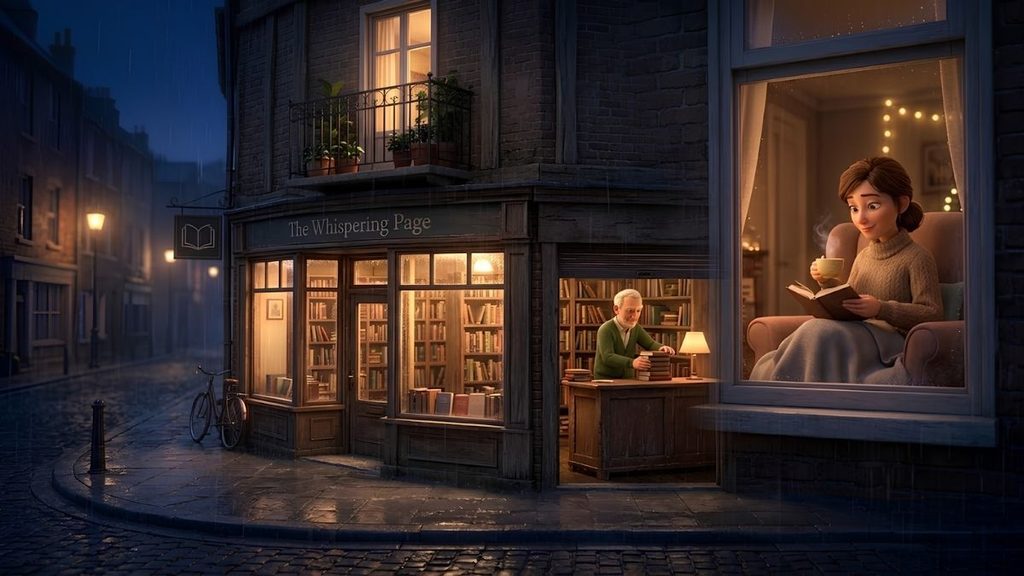
Type: Cozy Home & Everyday Comfort
When Sophie Martin first saw the apartment above the bookshop, she wasn’t sure whether to call it charming or inconvenient.
The staircase was narrow.
The hallway was slightly crooked.
The wooden floorboards made a soft creaking sound whenever she walked across them.
The kitchen was small enough that she could stand in the middle of it and almost touch both counters at once.
And the bedroom window looked directly onto a brick wall belonging to the building next door.
Still, the rent was reasonable.
The apartment was close to the train station.
And, most importantly, Sophie wanted somewhere that didn’t remind her of the life she had just left.
For five years, she had worked in a busy advertising agency in the center of the city.
Her days had been filled with meetings, deadlines, presentations, phone calls, messages, and endless revisions.
She had become very good at appearing busy.
Eventually, she had become tired of being busy.
So she resigned.
She packed her belongings.
And she moved into an apartment above a little bookshop called The Turning Page.
She told herself it was temporary.
She didn’t know yet that she had found a home.
Moving Day
Sophie arrived on a Saturday morning with six cardboard boxes, two suitcases, a desk lamp, three plants, and a collection of books that she immediately realized was far too heavy.
She carried the first box upstairs.
Then the second.
Then the third.
By the fourth, she was sitting halfway up the staircase, wondering whether she had made a terrible mistake.
A voice came from below.
“Need a hand?”
Sophie looked down.
An older man stood at the bottom of the stairs.
He was wearing a brown cardigan and holding a stack of books.
“I might,” Sophie admitted.
He smiled.
“I’m Daniel.”
“The shop owner?”
“Among other things.”
He took two boxes.
Sophie picked up another.
Together, they carried everything upstairs.
“Your books?” Daniel asked.
“Most of them.”
He looked at the remaining boxes.
“Ah.”
Sophie laughed.
“That’s exactly what I said.”
The Bookshop Below
After the final box had been carried upstairs, Sophie stood at the apartment doorway.
Below her, she could hear the quiet sounds of the bookshop.
A bell rang whenever someone entered.
Pages turned.
Someone laughed softly.
A chair moved across the floor.
She had never lived above a shop before.
It was different.
But perhaps different was what she needed.
Daniel pointed toward the ceiling.
“If the floorboards make noise, don’t worry.”
“They do.”
“They’re old.”
“So I noticed.”
“They complain when people walk.”
Sophie smiled.
“Do they ever stop?”
“Usually around midnight.”
That evening, Sophie unpacked until she was exhausted.
Then she sat on the floor surrounded by books.
She looked around.
There were boxes everywhere.
The apartment didn’t feel like hers yet.
It felt like somewhere she was temporarily staying.
She went to bed anyway.
The First Week
The first few days were strange.
Sophie had expected silence.
Instead, she discovered the bookshop had its own rhythm.
At eight in the morning, she heard Daniel unlock the front door.
At nine, the bell above the entrance began ringing.
Around lunchtime, customers came and went.
In the afternoon, there were longer periods of quiet.
And every evening, something interesting happened.
At exactly six thirty, Daniel began closing the shop.
Sophie would hear the front door lock.
Then came the sound of footsteps.
A chair being pushed into place.
The soft scrape of a broom.
Books being moved from one surface to another.
Then silence.
The sounds repeated every evening.
At first, Sophie found them distracting.
Then she began noticing them.
And eventually, she began expecting them.
A New Routine
Sophie had never been particularly good at routines.
Her old job had made every day unpredictable.
Some evenings she worked until nine.
Other nights she ate dinner at her desk.
Sometimes she forgot to go outside.
Now things were different.
At six thirty, she heard the shop closing.
At seven, she made tea.
At seven fifteen, she opened a book.
At eight, she watered her plants.
At nine, she washed the dishes.
Then she sat beside the window.
The routine was simple.
Almost boring.
And Sophie discovered that she liked boring.
Boring was peaceful.
The Sounds Below
One evening, Sophie was reading when she heard Daniel moving books downstairs.
She could tell when he was shelving them.
There was a particular rhythm.
Lift.
Turn.
Place.
Step.
Lift.
Turn.
Place.
Step.
It was strangely comforting.
Sophie smiled at her book.
She wondered whether Daniel realized that she could hear him.
Probably.
The building was old.
Sound traveled easily.
She could hear the shop.
And perhaps he could hear her kettle.
She liked the idea that two people could occupy the same building without needing to speak.
The Rain
The first real storm arrived three weeks after Sophie moved in.
It began in the afternoon.
By evening, rain was striking the windows so heavily that the glass seemed to tremble.
Sophie made tea.
She turned on a small lamp.
Then she sat in her favorite chair with a blanket over her legs.
Downstairs, the shop remained open.
Daniel had apparently decided to wait for the rain to weaken before closing.
At seven, it was still pouring.
At seven thirty, Sophie heard the familiar sound of books being moved.
The broom.
The chairs.
The lock.
Then footsteps.
But instead of fading away, the footsteps stopped outside the apartment door.
There was a knock.
Sophie looked up.
Nobody ever knocked.
She opened the door.
Daniel stood there.
“Everything all right?” Sophie asked.
He held two cups.
“I was making tea.”
Sophie smiled.
“Apparently I was too.”
Daniel laughed.
“I thought you might like some company.”
Tea in the Bookshop
Sophie followed him downstairs.
The shop looked completely different at night.
During the day, it was bright and busy.
Now it was quiet.
The lamps were low.
Rows of books disappeared into shadows.
Rain tapped against the front windows.
Daniel placed the cups on a small table near the back.
“I sometimes sit here after closing,” he said.
Sophie looked around.
“I didn’t know there was a table.”
“Most customers don’t.”
“Secret bookshop furniture?”
“Very important.”
Sophie laughed.
They sat together.
For a while, neither spoke.
The silence wasn’t uncomfortable.
Rain filled the room instead.
Eventually, Daniel asked, “Do you like the apartment?”
Sophie considered the question.
“I think I’m beginning to.”
“Beginning?”
“I didn’t like it at first.”
“Why?”
“It didn’t feel like mine.”
Daniel nodded.
“That takes time.”
A Conversation About Leaving
Sophie told him about her old job.
She explained how tired she had become.
“I kept thinking I’d feel better after the next project,” she said.
“Did you?”
“No.”
“The next one?”
“No.”
Daniel smiled.
“Sometimes there is always another next one.”
“Exactly.”
Sophie looked toward the rain-covered window.
“I think I forgot what an ordinary evening felt like.”
Daniel nodded.
“Ordinary evenings are underrated.”
She smiled.
“That’s what I’m learning.”
The Book Daniel Recommended
Before Sophie went upstairs, Daniel picked a book from a shelf.
“Read this.”
She looked at it.
“What is it?”
“A story about someone who moves to a strange town and thinks they don’t belong.”
Sophie raised an eyebrow.
“Is that a coincidence?”
“Absolutely.”
She laughed.
“I’ll return it tomorrow.”
“No hurry.”
She carried the book upstairs.
That night, she read three chapters.
Then four.
Eventually, she fell asleep with the book resting on her bedside table.
Small Changes
Over the following weeks, Sophie began changing the apartment.
She put photographs on the walls.
She arranged her books on the shelves.
She bought a soft rug for the living room.
She placed plants near the windows.
She found a secondhand wooden table for the kitchen.
The apartment slowly became hers.
But something else changed too.
She and Daniel began speaking more often.
Not every day.
Sometimes they simply nodded to each other.
Other times they talked for twenty minutes.
Daniel told her about books he loved.
Sophie told him about cities she wanted to visit.
They discussed terrible movies.
Good coffee.
Weather.
Plants.
Old buildings.
Nothing particularly important.
But the conversations became part of her routine.
A Quiet Friendship
One Sunday morning, Sophie went downstairs to buy a book.
Daniel was arranging a display.
“You don’t have to pay,” he said.
“I absolutely do.”
“You live upstairs.”
“So?”
“Discount for upstairs residents.”
“How much?”
“Five percent.”
“That’s not much.”
“Neither is the rent.”
Sophie laughed.
“Fair.”
She bought the book.
Daniel wrapped it in brown paper.
As she walked upstairs, she realized something.
She had entered the shop intending to buy a book.
But she had stayed because she wanted to talk.
That was when she understood that Daniel wasn’t simply her landlord.
He had become her friend.
The Winter Evening
Winter arrived.
The days became shorter.
Sophie began lighting a small lamp near her window before dinner.
Daniel continued closing the shop at six thirty.
The familiar sounds traveled upstairs.
Sweep.
Step.
Chair.
Lock.
Silence.
Sophie began to think of those sounds as a kind of evening bell.
They told her the day was finished.
Work was done.
The shop was closed.
The city was becoming quiet.
It was time to make tea.
One evening, she realized she had stopped checking the time.
That would have been impossible a few months earlier.
Now she simply knew when evening had arrived.
The Empty Apartment
One Friday, Daniel told Sophie he would be away for the weekend.
“Visiting my sister.”
“Nice.”
“I’ll be back Sunday.”
Sophie nodded.
“Have a good trip.”
That evening, Sophie returned to her apartment.
She expected the familiar sounds.
The broom.
The footsteps.
The chairs.
The lock.
Nothing happened.
The shop below remained completely silent.
Sophie sat in her chair.
She opened a book.
But the silence felt different.
She hadn’t realized how much she had grown accustomed to Daniel’s evening routine.
The next morning, she went downstairs.
The shop was empty.
She looked through the window.
Everything was exactly as it had always been.
Yet it felt strangely incomplete.
Daniel Returns
Daniel returned Sunday evening.
Sophie heard the front door open.
Then footsteps.
Boxes.
A suitcase.
He climbed the stairs.
There was a knock.
Sophie opened the door.
“How was your weekend?”
“Very good.”
“Good.”
There was a pause.
Then Sophie said:
“I missed the sound of the shop closing.”
Daniel smiled.
“I missed hearing your kettle.”
She laughed.
“That’s ridiculous.”
“Perhaps.”
But neither of them disagreed.
The Apartment Finally Becomes Home
A year after Sophie moved in, she found the original photograph of the apartment.
Daniel had given it to her.
It showed the building nearly seventy years earlier.
The bookshop sign was different.
The street looked quieter.
There were bicycles instead of cars.
The apartment windows were smaller.
Sophie looked at the photograph for a long time.
Then she realized something.
She no longer thought of herself as someone who lived above a bookshop.
She lived here.
This was her home.
The creaking staircase.
The narrow kitchen.
The brick wall outside the bedroom.
The sound of the shop below.
The evening tea.
The books.
The rain.
The conversations.
All of it belonged to her life now.
One Ordinary Evening
Years later, Sophie would remember that first rainy evening often.
Not because anything extraordinary happened.
There was no great adventure.
No dramatic revelation.
Just rain.
Tea.
Books.
And a quiet conversation between two people who had both learned that life did not always need to be exciting to be meaningful.
Sometimes happiness arrived quietly.
It arrived in routines.
In familiar sounds.
In someone remembering how you took your tea.
In a light left on downstairs.
In a book waiting beside your chair.
In the knowledge that another person was nearby.
That evening, Sophie sat beside her window.
The rain had returned.
Downstairs, Daniel began closing the bookshop.
She heard the familiar sounds.
The chairs.
The broom.
The footsteps.
The lock.
Then silence.
Sophie smiled.
She made herself a cup of tea.
She opened her book.
Outside, the city continued moving.
Cars passed.
People hurried home.
Lights appeared in distant windows.
But above the little bookshop, everything was calm.
Sophie turned a page.
She listened to the quiet.
And for the first time in her life, she didn’t feel that she needed to be somewhere else.
She was already home.
Core themes: belonging, simple routines, friendship, home, finding comfort in ordinary life.
3. The Dinner They Cooked Slowly

Type: Gentle Romance
Daniel had forgotten when dinner had stopped being dinner.
There had been a time when eating together meant sitting across from Clara at a small wooden table, talking about the day, laughing about something that had happened at work, and occasionally forgetting about the food because the conversation had become more interesting.
Those evenings had felt endless.
Now dinner usually happened somewhere between everything else.
A bowl of pasta beside an open laptop.
Takeout eaten while answering messages.
Soup reheated while Clara finished a phone call.
Sometimes they ate together, but one of them was always looking at a screen.
They still loved each other.
That was never the question.
They had simply become very good at being busy.
Daniel noticed it on a Thursday evening.
He and Clara were sitting at their kitchen table.
Clara was scrolling through her phone.
Daniel was reading an email.
Their dinner had been sitting between them for nearly fifteen minutes.
Neither had said more than a few words.
Daniel closed his laptop.
“Clara?”
She looked up.
“Yes?”
“When was the last time we actually had dinner?”
She smiled.
“We’re having dinner now.”
“I mean properly.”
Clara looked at the table.
Then at him.
She knew exactly what he meant.
“I don’t remember.”
Daniel smiled.
“Me neither.”
For a few seconds, neither spoke.
Then Clara put down her phone.
“Tomorrow.”
“Tomorrow what?”
“We cook dinner.”
Daniel raised an eyebrow.
“Cook?”
“Properly.”
“Without ordering anything?”
“Without ordering anything.”
“And without checking the time?”
Clara smiled.
“Especially that.”
Daniel held out his hand across the table.
“Deal.”
She took it.
“Deal.”
The Grocery List
On Friday afternoon, Daniel left work earlier than usual.
Clara arrived home twenty minutes later.
She walked into the kitchen carrying her handbag and found Daniel standing beside the refrigerator.
He was holding a notepad.
“What are you doing?”
“Making a list.”
“For dinner?”
“Apparently.”
Clara looked over his shoulder.
Tomatoes.
Mushrooms.
Garlic.
Basil.
Pasta.
Bread.
Olive oil.
Lemon.
Parmesan.
“That’s quite a lot.”
“It’s dinner.”
“We could make something simpler.”
Daniel looked at her.
“You promised.”
Clara laughed.
“I did.”
They put on their coats.
Outside, the evening was cool.
The city was beginning to glow with the soft lights of shops and cafés.
People were leaving offices.
Buses moved through the streets.
Friday evening had arrived.
But Daniel and Clara weren’t rushing home.
They walked toward the market.
The Market
The market was busy.
There were baskets of vegetables outside the stalls and crates of fruit stacked beneath striped awnings.
Daniel picked up a tomato.
“This one.”
Clara looked at it.
“It’s enormous.”
“That’s because it’s good.”
“It’s because it’s enormous.”
He picked up another.
“This one?”
“Too small.”
He looked at her.
“You are impossible.”
“You asked.”
They continued shopping.
They smelled fresh bread.
They sampled cheese.
They debated whether they needed mushrooms.
They absolutely did not need mushrooms.
Daniel bought them anyway.
At one stall, Clara found a bunch of basil that smelled so fresh she held it beneath Daniel’s nose.
“Smell this.”
He leaned closer.
“That’s basil.”
“I know.”
“So why did you make me smell it?”
“Because it smells wonderful.”
Daniel smiled.
“You’re strange.”
“You’ve known that for years.”
“I know.”
And there it was.
A small laugh.
Not hurried.
Not interrupted.
Just theirs.
Walking Home
They carried the groceries between them.
The shopping bag was heavier than expected.
Daniel tried to take both.
Clara refused.
“You always do that.”
“Do what?”
“Carry everything.”
“I can carry it.”
“I know you can.”
She took one of the bags from him.
“That’s not the point.”
“What is the point?”
“We’re doing this together.”
Daniel looked at her.
Then he smiled.
“Fair enough.”
They walked home side by side.
Neither of them noticed how slowly they were walking.
Neither seemed interested in getting there quickly.
The Kitchen
Their kitchen was small.
There wasn’t much space between the refrigerator, counter, stove, and table.
Two people cooking together usually meant bumping into each other.
Clara opened a cabinet.
Daniel opened the refrigerator.
They collided.
“Sorry.”
“You were in my way.”
“You were in my way.”
“I was standing here first.”
Daniel laughed.
“How do you know?”
“Because I am always right.”
“Of course.”
They began preparing dinner.
Daniel chopped tomatoes.
Clara washed the mushrooms.
Then Daniel realized he had forgotten to buy onions.
“Did we need onions?”
Clara looked at the recipe.
“Yes.”
“We don’t have any.”
“How did you miss that?”
“I didn’t miss it.”
“You wrote the list.”
“Exactly.”
“So?”
“I didn’t write onions.”
Clara stared at him.
Daniel smiled.
“We’ll survive.”
An Improvised Recipe
They decided to continue without onions.
Daniel heated the pan.
Clara added olive oil.
Garlic filled the kitchen with its warm smell.
They added tomatoes.
Then mushrooms.
Then basil.
The kitchen slowly became warmer.
Clara opened a bottle of sparkling water.
Daniel turned on music.
Not loud music.
Just something soft enough to fill the silence.
They moved around each other.
Sometimes they bumped shoulders.
Sometimes one had to step aside.
Once, Daniel accidentally dropped a mushroom.
Clara laughed.
“You dropped dinner.”
“It’s only one mushroom.”
“It’s still dinner.”
He picked it up.
“Five-second rule.”
“Absolutely not.”
He threw it away.
She smiled.
The Recipe Argument
The pasta was almost ready when Clara tasted the sauce.
She added salt.
Daniel frowned.
“I think it was fine.”
“It needed salt.”
“It didn’t.”
She tasted it again.
“Yes, it did.”
He tasted it.
Then paused.
“Maybe.”
“Maybe?”
“Definitely.”
She smiled.
“You can admit I’m right.”
“I just did.”
“No, you said maybe.”
Daniel looked at her.
“You’re enjoying this.”
“Very much.”
He laughed.
“I remember why I married you.”
Clara stopped.
“You remember?”
“Occasionally.”
She reached over and gently pushed his shoulder.
“Terrible.”
He kissed her forehead.
“Wonderful.”
Dinner
They carried the plates to the table.
There were no laptops.
No phones.
No television.
Only two plates of pasta, two glasses, a small bowl of salad, and a loaf of bread.
Daniel sat down.
Clara sat opposite him.
For a moment, they simply looked at the food.
Then Clara smiled.
“We made this.”
“We did.”
“Even without onions.”
“Especially without onions.”
She laughed.
They began eating.
The food wasn’t perfect.
The sauce was slightly too thick.
The mushrooms were a little overcooked.
The bread was excellent.
But neither cared.
The evening had already become something more than dinner.
The Question
Halfway through the meal, Daniel asked:
“What was your favorite dinner when you were a child?”
Clara looked surprised.
“My favorite dinner?”
“Yes.”
She thought about it.
“Chicken soup.”
“Really?”
“My grandmother used to make it.”
“Every Sunday?”
“Almost.”
“What made it special?”
Clara smiled.
“She always made too much.”
Daniel laughed.
“That’s your favorite part?”
“No.”
Clara leaned back.
“She would sit in the kitchen while it cooked. She never rushed.”
Daniel nodded.
“She sounds like she was good at evenings.”
“She was.”
Clara looked toward the window.
“Sometimes I used to sit beside her while she prepared everything.”
“What did you talk about?”
“Everything.”
“Like what?”
“I don’t remember.”
Daniel smiled.
“That’s interesting.”
“What?”
“You remember sitting with her. You remember the soup. But you don’t remember the conversations.”
Clara nodded.
“I think that’s what made them special.”
Daniel’s Memory
Clara asked him the same question.
“What about you?”
Daniel thought for a while.
“My father made pancakes on Sunday mornings.”
“Really?”
“He wasn’t very good.”
Clara laughed.
“How bad?”
“Terrible.”
“What was wrong with them?”
“They were always too thick.”
“Maybe he liked thick pancakes.”
“No. He just couldn’t cook.”
Clara laughed again.
Daniel smiled.
“But he tried.”
He looked down at his plate.
“I remember waking up and smelling them.”
“That sounds nice.”
“It was.”
“Do you miss it?”
“Sometimes.”
Clara reached across the table.
She placed her hand over his.
“I think that’s a good memory.”
Daniel squeezed her fingers.
“It is.”
The Forgotten Years
They continued talking.
One memory led to another.
They talked about childhood holidays.
First apartments.
Bad roommates.
University.
Their first jobs.
Their first trip together.
Daniel remembered the tiny café where they had first met.
Clara remembered that he had spilled coffee on himself.
“I did not.”
“You absolutely did.”
“I knocked over the cup.”
“Onto yourself.”
“It was windy.”
“Inside?”
Daniel laughed.
“Fine.”
“You were nervous.”
“I was not nervous.”
“You asked me the same question three times.”
“What question?”
“What I was studying.”
Clara smiled.
“You couldn’t remember.”
“I remembered.”
“You didn’t.”
He laughed.
“Maybe I was nervous.”
The First Apartment
Later, they talked about the first apartment they had shared.
It had been small.
The bedroom window wouldn’t close properly.
The kitchen sink leaked.
The heating worked only when it wanted to.
But they had loved it.
“Remember the blue sofa?” Clara asked.
“Of course.”
“It was horrible.”
“It was comfortable.”
“It was falling apart.”
“It was our sofa.”
Clara smiled.
“That’s true.”
Daniel remembered the evenings they had spent sitting on it.
They had been younger then.
They hadn’t had much money.
They had owned mismatched plates and secondhand furniture.
But they had had time.
Or perhaps they had simply believed they had time.
When Did Everything Become So Fast?
The question came quietly.
Clara asked it.
“When did everything become so fast?”
Daniel didn’t answer immediately.
He looked around their kitchen.
The same kitchen where they had eaten hundreds of meals.
“We probably allowed it to happen.”
“How?”
“One busy week.”
“Then another.”
“Then another.”
Clara nodded.
“We kept saying we’d slow down later.”
Daniel smiled sadly.
“Later is very popular.”
She laughed.
“Everyone seems to be waiting for later.”
They sat quietly.
Then Clara said:
“Maybe we shouldn’t.”
“Shouldn’t what?”
“Wait.”
Daniel understood.
Dessert
They had forgotten to buy dessert.
Clara opened the cupboard.
There was one packet of biscuits.
“Emergency dessert.”
Daniel nodded seriously.
“Excellent.”
They carried the biscuits to the table.
Neither bothered with plates.
They ate directly from the packet.
Clara poured more sparkling water.
Daniel turned the music down.
The apartment was quiet.
Outside, the city continued moving.
Inside, they remained at the table.
No Clock
Eventually, Clara looked toward the wall.
There was a clock.
She could see it from her chair.
Daniel noticed.
“What time is it?”
She smiled.
“I don’t know.”
“Good.”
She looked again.
“Actually, I think it’s almost eleven.”
Daniel looked surprised.
“Really?”
“Apparently.”
“We’ve been eating for four hours.”
“We’ve been talking.”
“About everything.”
“Almost.”
Daniel leaned back.
“I don’t remember the last time we did this.”
“Neither do I.”
He looked at her.
“We should do it again.”
“Tomorrow?”
“Maybe not.”
“Next Friday?”
“Deal.”
Cleaning the Kitchen
They stood together.
Daniel collected the plates.
Clara cleared the table.
They washed dishes side by side.
There was no argument about who should do what.
They simply moved around one another.
Daniel washed.
Clara dried.
He handed her a plate.
She placed it away.
The routine was ordinary.
But tonight, ordinary felt precious.
When the kitchen was clean, Daniel turned off the main light.
Only the small lamp above the counter remained.
Clara stood beside him.
The apartment was quiet.
“Good evening,” she said.
Daniel smiled.
“Very good evening.”
The Balcony
Before bed, they stepped onto the balcony.
The city was quieter now.
Not silent.
There were still cars.
Still distant voices.
Still lights in apartment windows.
But everything seemed softer.
Clara leaned against the railing.
Daniel stood beside her.
“Do you think we should do this more often?”
“Cook?”
“Slow down.”
Daniel thought.
“Yes.”
She smiled.
“Then let’s.”
They stood together without speaking.
There was nowhere else they needed to be.
The Next Friday
The following Friday, Daniel arrived home with a bag of groceries.
Clara was already in the kitchen.
She had put music on.
There was a candle on the table.
Daniel smiled.
“What are we making?”
“I don’t know.”
“You bought the groceries.”
“So?”
“Shouldn’t we know?”
Clara shook her head.
“No.”
Daniel laughed.
“All right.”
They began unpacking.
There were tomatoes.
Garlic.
Mushrooms.
Fresh bread.
And, finally, onions.
Daniel held them up.
“Look.”
Clara laughed.
“Progress.”
“Tonight, we cook with onions.”
“Slowly?”
“Very slowly.”
They kissed.
Then they began preparing dinner.
No clocks.
No deadlines.
No phones.
Just two people in a small kitchen, moving gently around each other, remembering that love was not always found in grand gestures.
Sometimes it was found in chopping vegetables.
In sharing a recipe.
In listening to an old story.
In remembering the people who had once cooked for them.
In laughing over burnt mushrooms.
In sitting across from someone you had loved for years and discovering that there were still memories you had never heard.
The dinner would not be extraordinary.
It didn’t need to be.
They had finally learned that an ordinary evening could be enough.
And sometimes, when two people give themselves permission to slow down, an ordinary evening becomes the kind of memory they carry for the rest of their lives.
Core themes: romantic connection, companionship, slowing down, everyday love, shared memories.
4. The Recipe in the Blue Notebook

Type: Nostalgic Memories
The blue notebook had been sitting in the kitchen drawer for almost twenty years.
Emma Collins had no idea it was there.
She discovered it on a quiet Saturday morning while helping her mother clear out her grandmother’s old house.
The house had belonged to Grandma Margaret for more than forty years.
It was the kind of house that seemed to contain a little piece of every decade it had survived.
There were photographs in wooden frames.
Old calendars tucked behind doors.
A radio that no longer worked.
A collection of porcelain cups nobody used anymore.
And in the kitchen, there were drawers filled with things that seemed too ordinary to throw away.
Rubber bands.
Clothespins.
Old shopping lists.
Buttons.
Takeaway menus from restaurants that had closed years ago.
Emma was sorting through one of those drawers when she found the notebook.
It was small.
The cover was faded blue.
One corner had been bent.
There was a faint white mark across the front.
Emma turned it over in her hands.
For a moment, she simply stared at it.
Then she opened it.
The First Page
The first page contained a recipe.
Saturday Tomato Soup
Underneath were the ingredients.
Tomatoes.
Onions.
Butter.
Salt.
Pepper.
Milk.
Nothing unusual.
But beside the ingredients was a handwritten sentence.
Emma likes hers with extra pepper.
Emma stopped.
She read it again.
Her name.
She was certain it was her grandmother’s handwriting.
“Mom?”
Her mother was standing near the kitchen window.
“What?”
“Look.”
Emma held up the notebook.
Her mother walked over.
The moment she saw it, she smiled.
“Oh.”
“You know this?”
“I haven’t seen that in years.”
Emma turned another page.
There were more recipes.
Some were carefully written.
Others were little more than notes.
Buy apples. John coming Sunday.
Don’t forget cinnamon.
Soup for Tuesday.
Emma’s birthday cake. Less sugar this year.
Emma smiled.
It wasn’t really a recipe book.
It was a diary disguised as one.
Ordinary Things
Emma sat at the kitchen table.
She turned the pages slowly.
There were recipes for pancakes, vegetable soup, roast chicken, apple pie, rice pudding, bread, and something called Grandma’s Winter Stew.
But between the recipes were fragments of family life.
Rain all afternoon. Children stayed inside.
John fixed the kitchen shelf. Finally.
Emma learned to ride her bicycle today. Fell twice. Got back up.
Sunday dinner. Six people. Need more potatoes.
Emma laughed.
“I remember this.”
Her mother looked over.
“What?”
“The bicycle.”
“You do?”
“Not falling. But I remember the bicycle.”
Her mother smiled.
“You were very proud of it.”
Emma looked back at the notebook.
The sentence was only a few words.
Yet somehow it brought the afternoon back.
The garden.
The old bicycle.
Her grandmother standing near the fence.
Her own small hands gripping the handlebars.
She hadn’t thought about that day in years.
The Decision
That afternoon, Emma took the notebook home.
She placed it on her kitchen counter.
For several minutes, she simply looked at it.
She could have put it safely on a shelf.
She could have kept it as a family keepsake.
Instead, she opened it to the first recipe.
Saturday Tomato Soup.
Emma smiled.
She decided to make it.
Not because she was hungry.
Because she wanted to know what it tasted like.
The First Recipe
Emma bought the ingredients.
She followed the instructions carefully.
The handwriting wasn’t precise.
There were no exact measurements for some ingredients.
Just:
A little butter.
Enough tomatoes for everyone.
Salt until it tastes right.
Emma laughed.
“Very helpful, Grandma.”
She cooked slowly.
The kitchen filled with the smell of tomatoes and butter.
When the soup was ready, she poured it into a bowl.
She added extra pepper.
Exactly as the notebook instructed.
Emma took the first spoonful.
She expected something extraordinary.
Instead, it tasted familiar.
She couldn’t explain why.
She had never made this soup before.
Yet the flavor reminded her of something.
A Sunday afternoon.
A wooden table.
Her grandmother’s kitchen.
Rain against the windows.
Her grandfather reading the newspaper.
Someone laughing in the next room.
Emma put the spoon down.
She closed her eyes.
And suddenly she remembered.
The Kitchen From Childhood
She had been eight years old.
Her grandmother had been standing at the stove.
Emma had been sitting on the counter despite repeated instructions not to.
“You’ll fall,” Grandma Margaret had said.
“I won’t.”
“You always say that.”
Emma had watched the soup simmer.
“Can I have some?”
“It’s not ready.”
“When will it be ready?”
“When I say.”
Emma had sighed dramatically.
Her grandmother had laughed.
“You’re very impatient.”
“I know.”
“I noticed.”
Emma smiled at the memory.
It wasn’t a major event.
Nothing important had happened.
But now, years later, it felt precious.
She understood something.
The notebook had not preserved the recipe.
It had preserved the moment.
The Second Weekend
The following Saturday, Emma chose the apple cake.
She called her mother.
“Do you remember Grandma’s apple cake?”
“Of course.”
“Do you remember why she made it?”
Her mother laughed.
“She made it because we had apples.”
Emma smiled.
“No special occasion?”
“No.”
“Just because?”
“Just because.”
Emma wrote that down.
Apple cake. No occasion. Just because.
She began wondering how many family memories had started that way.
A meal.
A visit.
A rainy afternoon.
A Sunday.
Nothing planned.
Nothing important.
And yet those were the moments people remembered.
The Phone Calls
Emma began calling relatives.
Her uncle remembered the winter stew.
Her aunt remembered the pancakes.
Her cousin remembered a chocolate cake that wasn’t even written in the notebook.
Every conversation brought another memory.
“Do you remember Grandpa’s old chair?”
“Yes.”
“The one with the broken arm?”
“That one.”
“He used to sit there every Sunday.”
“I remember.”
“What did he read?”
“The newspaper.”
Emma laughed.
“Of course.”
Sometimes she called someone simply to ask about a recipe.
But the conversation rarely stayed about food.
The recipe became an opening.
A doorway into the past.
The Shopping Lists
One evening, Emma discovered several shopping lists between the notebook pages.
They were not recipes at all.
One said:
Milk
Bread
Potatoes
Apples
Soap
Birthday candles
Another said:
Tea
Flour
Butter
Something for John
Emma smiled.
“Something for John?”
She called her mother.
“What was ‘something for John’?”
Her mother laughed.
“Probably biscuits.”
“Probably?”
“Your grandmother never wrote everything down.”
Emma imagined her grandmother standing in a shop decades earlier.
Pushing a shopping cart.
Thinking about dinner.
Remembering birthdays.
Wondering whether there was enough bread.
The thought made Emma smile.
Her grandmother had once been exactly where Emma was now.
Living an ordinary life.
Making ordinary decisions.
Never imagining that someone would one day treasure the shopping lists.
The Recipe With No Title
One page contained a recipe Emma couldn’t identify.
There was no title.
Only ingredients.
Potatoes.
Milk.
Butter.
Cheese.
Pepper.
At the bottom was a note.
Good for cold evenings.
Emma decided to make it.
She followed the instructions.
When it was finished, she tasted it.
It was simple.
Warm.
Creamy.
Comforting.
Emma immediately understood why her grandmother had written the note.
It wasn’t meant to impress anyone.
It was meant to make a cold evening feel warmer.
Emma looked out the window.
Rain was falling.
She smiled.
For the first time, she felt as though her grandmother had left her a message across time.
Not a grand message.
Just:
Here. Make this when it’s cold.
A Family Dinner
Several weeks later, Emma invited her family for dinner.
She prepared three recipes from the blue notebook.
Tomato soup.
Apple cake.
The unnamed potato dish.
Her mother brought bread.
Her uncle brought flowers.
Her aunt brought an old photograph.
They placed it on the table.
It showed Margaret standing in the same kitchen many years earlier.
She was younger than Emma remembered.
She was smiling.
Behind her was the old stove.
The same stove Emma had seen every weekend as a child.
Everyone became quiet.
Then her uncle laughed.
“Look at the cake.”
“What about it?” Emma asked.
“That’s the cake she made when we were kids.”
Emma looked closer.
“She wrote the recipe down.”
“No.”
He shook his head.
“She wrote that recipe because of us.”
“What do you mean?”
“We kept asking her to make it.”
Emma smiled.
“So you were responsible.”
“Partly.”
Everyone laughed.
Stories Around the Table
Dinner lasted much longer than expected.
People told stories.
Some Emma had heard before.
Others were completely new.
Her mother described a summer when the family had spent an entire afternoon in the garden.
Her uncle remembered getting lost on a bicycle.
Her aunt remembered Margaret singing while she cooked.
Emma listened.
The recipes remained on the table.
But they were no longer simply recipes.
Each one had a story attached.
The tomato soup belonged to rainy afternoons.
The apple cake belonged to ordinary Sundays.
The potato dish belonged to cold evenings.
The pancakes belonged to childhood mornings.
The notebook had become a map of family life.
The Missing Recipe
One day, Emma noticed something.
There was a blank page near the end.
At the top, her grandmother had written:
Emma’s favorite dinner.
Nothing else.
The rest of the page was empty.
Emma stared at it.
She called her mother.
“Do you know what this was supposed to be?”
Her mother thought.
“Maybe she hadn’t decided.”
“But she wrote my name.”
“Then perhaps she planned to ask you.”
Emma smiled.
She imagined her grandmother sitting at the kitchen table.
Perhaps she had planned to ask Emma what her favorite meal was.
Perhaps she had simply run out of time.
The blank page no longer felt incomplete.
It felt like an invitation.
Emma’s Recipe
Emma decided to fill the page herself.
She thought carefully.
What was her favorite meal?
She considered elaborate dishes.
Fancy desserts.
Restaurant meals.
Then she remembered something simple.
Pasta with tomatoes.
The first meal she had learned to cook by herself.
She wrote the ingredients.
Pasta.
Tomatoes.
Garlic.
Olive oil.
Basil.
Parmesan.
Then she added a note.
Best eaten slowly with people you love.
She looked at the handwriting.
It was different from her grandmother’s.
Of course it was.
But that was the point.
The notebook didn’t have to end with Margaret’s memories.
It could continue.
The Blue Notebook Grows
Emma began adding pages.
She wrote down recipes from relatives.
She added dates.
She included photographs.
She recorded little stories.
Sometimes she wrote things that had nothing to do with food.
Rainy Saturday. Mom told me about Grandma’s first apartment.
Uncle David says Grandpa hated mushrooms.
Aunt Claire remembers Grandma singing while making bread.
The notebook slowly became something new.
It still belonged to the past.
But it also belonged to the present.
Years Later
Years passed.
Emma moved to another apartment.
Then another city.
She took the blue notebook with her every time.
The cover became more worn.
Some pages became stained.
New recipes appeared.
New handwriting joined the old.
Eventually, Emma had children of her own.
One Saturday morning, her daughter found the notebook on a shelf.
“What’s this?”
Emma smiled.
“It’s a family recipe book.”
Her daughter opened it.
“Why are there all these notes?”
Emma sat beside her.
“Because they’re the important part.”
She explained the stories.
The soup.
The bicycle.
The apple cake.
The shopping lists.
The empty page.
Her daughter listened.
Then she asked:
“Can we make one?”
Emma smiled.
“Of course.”
Saturday Again
They chose the tomato soup.
Emma showed her daughter the original recipe.
“A little butter,” she read.
“How much?”
“I don’t know.”
“Grandma didn’t say?”
“No.”
“That’s not a very good recipe.”
Emma laughed.
“Maybe.”
They began cooking.
Her daughter added too much pepper.
Emma smiled.
“Grandma said I liked extra pepper.”
“Do you?”
“I do.”
Her daughter added a little more.
They tasted the soup.
It was warm.
Simple.
Familiar.
Emma looked at her daughter and realized that another ordinary moment had begun.
One day, perhaps, her daughter would remember it.
Not because the soup was extraordinary.
But because they had made it together.
What the Notebook Preserved
That night, Emma opened the blue notebook again.
She turned through the pages.
Her grandmother’s handwriting appeared beside her own.
Old recipes beside new ones.
Old memories beside recent ones.
Shopping lists.
Family jokes.
Photographs.
Small observations.
Ordinary things.
Emma finally understood what the notebook had really preserved.
Not cooking.
Not recipes.
Not even memories alone.
It had preserved the rhythm of a family.
The quiet Saturdays.
The Sunday dinners.
The birthdays.
The rainy afternoons.
The cold evenings.
The unexpected visitors.
The meals prepared simply because someone was hungry.
The conversations that nobody thought to record.
The people who had sat around the table.
The people who had eventually left it.
The people who came afterward.
Life had moved forward.
But the notebook had quietly carried pieces of it along.
The Last Page
Before closing the notebook, Emma wrote one final sentence beneath her daughter’s recipe.
Some things are worth remembering simply because they happened.
She closed the cover.
Outside, evening settled over the neighborhood.
The kitchen smelled faintly of tomatoes and basil.
Her daughter was laughing in the next room.
Emma smiled.
The blue notebook rested on the table.
It had begun as a collection of recipes.
Then it became a record of ordinary life.
And perhaps that was the greatest gift her grandmother had left behind.
Not instructions for making perfect meals.
But proof that a life does not have to contain grand adventures to be worth remembering.
Sometimes a family is built around a kitchen table.
Sometimes love is hidden inside a shopping list.
Sometimes a recipe carries the sound of a grandmother’s voice.
And sometimes the smallest memories survive the longest.
Emma turned off the kitchen light.
The notebook remained on the table.
Waiting for the next Saturday.
Waiting for the next recipe.
Waiting for another ordinary moment to become a memory.
Core themes: nostalgia, family memories, food, heritage, ordinary moments, remembrance.
5. The Gardener Who Planted Winter

Type: Nature & Seasons
Arthur Bell had always believed that a garden was supposed to be colorful.
He loved summer.
He loved the heavy scent of roses in July, the bright heads of sunflowers leaning toward the afternoon sky, the buzzing bees moving between lavender plants, and the long evenings when the last light remained in the garden long after dinner.
Summer made sense to Arthur.
A garden came alive in summer.
Spring was different, but still beautiful.
Spring meant new leaves, soft rain, tulips, daffodils, and the first signs that the cold months were finally disappearing.
Autumn had its own charm.
Arthur enjoyed the changing leaves and the smell of damp earth.
But winter?
Winter was simply the season when the garden stopped.
At least, that was what Arthur had always thought.
He was seventy-one now and had spent most of his life working with plants.
For more than forty years, he had designed gardens for other people.
He had planted orchards.
Built flower beds.
Pruned trees.
Grown vegetables.
Restored neglected gardens.
He could identify dozens of plants by the shape of their leaves alone.
He knew when roses needed cutting.
He knew which soil would suit lavender.
He could tell whether a tree was thirsty simply by looking at its branches.
Yet every winter, when the flowers disappeared, Arthur became impatient.
He waited for spring.
He always waited for spring.
Until one particular winter, when he began to notice something he had never really seen before.
The First Morning
The first frost arrived overnight.
Arthur woke early.
He made tea.
He put on his coat.
Then he looked through the kitchen window.
The garden was white.
Every flower bed seemed empty.
The lawn was stiff with frost.
The roses had been cut back.
The vegetable patch was bare.
Arthur sighed.
“Nothing to see,” he murmured.
He almost returned to his tea.
But something caught his attention.
A small bird was sitting on the fence.
It was perfectly still.
Its feathers were puffed against the cold.
Arthur watched it for a moment.
Then it flew toward the apple tree.
Arthur frowned.
The tree had no leaves.
Yet the bird had found something there.
Arthur put down his cup.
He pulled on his boots.
Outside, the air was cold enough to make him breathe carefully.
He walked toward the apple tree.
At first, he saw nothing.
Then he looked more closely.
Tiny buds covered the branches.
They had been there for weeks.
He had simply never noticed them.
Arthur touched one gently.
“Well,” he said.
The garden wasn’t completely asleep.
The Notebook
That afternoon, Arthur found an old notebook in a drawer.
It had a brown cover and several blank pages.
He carried it to the kitchen table.
He thought for a moment.
Then he wrote:
December 4
Frost this morning. One small bird in the apple tree. Tiny buds on the branches.
He looked at the sentence.
It seemed almost silly.
Why would anyone record something so ordinary?
Arthur closed the notebook.
But the next morning, he opened it again.
December Light
The following morning was cloudy.
Arthur walked outside.
The garden looked different.
The sky was pale gray.
The hedges were dark.
The bare branches made delicate patterns against the sky.
Arthur stood near the old pear tree.
He had seen that tree thousands of times.
But without leaves, its shape was completely different.
The branches twisted upward like lines drawn by a careful hand.
Arthur took out his notebook.
December 6
The pear tree has a beautiful shape without leaves. I had never noticed it.
He paused.
Then added:
The garden is quieter in winter.
That was true.
There were no bees.
No lawnmower.
No insects humming beneath the flowers.
Only birds.
Wind.
And occasionally the distant sound of a car passing along the road.
Arthur began to like the quiet.
The Winter Birds
A few days later, Arthur noticed more birds.
A robin appeared near the vegetable patch.
Two blackbirds searched beneath the hedge.
A pair of sparrows visited the old apple tree.
Arthur began leaving a small amount of bird food near the fence.
He sat nearby.
Sometimes the birds came immediately.
Sometimes they waited.
Sometimes they ignored him completely.
Arthur didn’t mind.
He enjoyed watching them.
He began learning their habits.
The robin arrived first.
The sparrows came in groups.
The blackbirds preferred the far corner of the garden.
Arthur wrote everything down.
His notebook slowly filled.
The Garden Without Flowers
One afternoon, Arthur walked through the garden and realized something strange.
He wasn’t missing the flowers.
Not as much as he expected.
The dried flower heads were beautiful in their own way.
The stems stood against the pale sky.
Some still held tiny seeds.
Frost collected on them in the morning.
When the sun appeared, the frost melted slowly.
Arthur watched one drop of water form at the end of a dried stem.
It grew.
It trembled.
Then it fell.
Arthur smiled.
He wrote:
December 18
Some plants remain beautiful after flowering. Perhaps I was only looking for the wrong kind of beauty.
A Visit From Clara
Arthur’s granddaughter Clara visited one Saturday.
She was twelve and usually preferred being indoors.
She liked drawing.
She liked books.
She liked watching films.
Gardening did not interest her much.
“Grandpa,” she said, looking through the kitchen window, “your garden looks dead.”
Arthur laughed.
“That’s what I used to think.”
“You don’t anymore?”
“No.”
“Why?”
Arthur picked up his notebook.
“Come outside.”
Clara put on her coat.
They walked into the garden.
Arthur showed her the buds on the apple tree.
Then the dried flowers.
Then the bird footprints in the frost.
Clara crouched beside them.
“Which bird?”
“Probably a blackbird.”
“How do you know?”
“I don’t.”
She looked at him.
Arthur smiled.
“I’m learning.”
Clara smiled too.
They walked farther.
Arthur showed her a tiny green shoot near the wall.
“What is that?”
“Something.”
“That’s not very scientific.”
“I haven’t identified it yet.”
Clara laughed.
The Snow
A week later, snow arrived.
Arthur woke before sunrise.
The garden was transformed.
Every hedge was covered.
The trees carried soft white layers.
The old bench disappeared beneath a blanket of snow.
Arthur stood at the window.
For once, he didn’t think the garden looked empty.
It looked peaceful.
He put on his boots.
Clara was visiting again.
She followed him outside.
They walked carefully.
Their footsteps made a soft crunching sound.
Arthur stopped near the flower beds.
“Look.”
Clara looked.
“What?”
Arthur pointed.
Tiny marks crossed the snow.
Bird tracks.
“Someone has been here.”
Clara smiled.
“Maybe they’re writing.”
Arthur laughed.
“Perhaps.”
A Snow Garden
Arthur began observing the garden differently after the snow.
The branches held snow in unusual shapes.
The fence cast long blue-gray shadows.
The old watering can had become almost invisible.
A few dried grasses pushed through the snow.
The garden had not stopped being alive.
It had simply changed its language.
Arthur wrote:
January 7
Winter doesn’t remove the garden. It reveals different parts of it.
He underlined the sentence.
Then he closed the notebook.
The Morning Ritual
By January, Arthur had developed a routine.
He woke at seven.
Made tea.
Put on his coat.
Walked through the garden.
Observed.
Wrote.
Then came inside.
Some mornings he wrote several pages.
Other mornings, only one sentence.
Sometimes he wrote nothing.
He simply watched.
The garden became his morning companion.
He began noticing tiny changes.
The sun rose a little earlier.
The days became slightly brighter.
The buds on the apple tree grew larger.
A few green shoots appeared near the stone wall.
Winter was moving.
Slowly.
Quietly.
But it was moving.
The Old Greenhouse
At the back of the garden stood a small greenhouse.
Arthur hadn’t used it in years.
The glass was dusty.
One door was difficult to open.
Inside were empty pots, old tools, and shelves covered in cobwebs.
One morning, Arthur decided to clean it.
He wasn’t sure why.
Perhaps he simply wanted another project.
He wiped the glass.
Cleared the shelves.
Repaired the door.
Then he placed his notebook on the workbench.
The greenhouse filled with pale winter light.
Arthur sat down.
He realized that he liked being there.
It was warmer than the garden.
But it still felt connected to it.
He began using the greenhouse as his observation station.
February
February arrived.
The cold remained.
But there were signs.
The first snowdrops appeared near the wall.
Arthur nearly missed them.
They were tiny.
White.
Delicate.
He knelt beside them.
He had planted them years earlier.
He had forgotten.
Arthur smiled.
“Hello.”
He wrote:
February 3
First snowdrops. Spring has apparently been here before I noticed.
That evening, he called Clara.
“Come on Saturday.”
“Why?”
“I have something to show you.”
“What?”
“I’ll tell you when you get here.”
The Little Snowdrops
On Saturday, Clara arrived.
Arthur led her directly to the garden.
She saw the snowdrops.
“They’re tiny.”
“Yes.”
“Are they flowers?”
“Yes.”
“Already?”
“Apparently.”
Clara crouched beside them.
“They’re pretty.”
Arthur smiled.
“That’s what I thought.”
She looked at him.
“You really like winter now.”
Arthur considered it.
“I think I like seeing what I used to miss.”
Clara thought about that.
Then she asked:
“Can I have a notebook?”
Arthur smiled.
“I might have one.”
Two Notebooks
Arthur gave Clara a blank notebook.
They walked around the garden together.
Clara wrote down the things she noticed.
A bird.
A broken twig.
A patch of moss.
A spider web.
A tiny green leaf.
Arthur noticed things too.
Sometimes they disagreed.
“That’s a sparrow.”
“No, Grandpa. That’s a finch.”
Arthur looked carefully.
She was right.
“All right.”
Clara smiled.
“You don’t know everything.”
“I never said I did.”
“You act like you do.”
Arthur laughed.
“Fair.”
The First Warm Afternoon
Toward the end of February, the weather changed.
The afternoon sun was warm enough that Arthur could sit outside without his coat.
He sat on the old bench.
The garden was still mostly brown and gray.
But the light had changed.
It was softer.
Brighter.
Arthur opened his notebook.
He turned through the pages.
December.
January.
February.
Birds.
Frost.
Snow.
Branches.
Seeds.
Buds.
He realized he had recorded an entire season.
And he had enjoyed it.
Spring Begins
March arrived quietly.
There was no dramatic moment when winter disappeared.
One morning, Arthur simply noticed that the garden looked different.
The grass had begun to brighten.
The apple tree buds were opening.
Small green leaves appeared along the branches.
The birds sang earlier.
The air smelled of wet earth.
Arthur stood in the middle of the garden.
He felt something unexpected.
He was happy.
But not because winter was ending.
He was happy because he had learned to see it.
He opened his notebook.
On a fresh page, he wrote:
March 12
Winter was never empty. I was simply looking for summer.
The Garden Tour
That spring, Arthur invited a few neighbors into the garden.
He showed them his notebook.
One neighbor was surprised.
“I never noticed half these things.”
“Neither did I.”
Another laughed.
“You’ve become a winter gardener.”
Arthur smiled.
“Perhaps.”
Clara stood nearby.
She had brought her own notebook.
She had continued writing.
The two notebooks sat side by side on the garden table.
One belonged to a retired gardener.
The other belonged to a twelve-year-old girl.
Both contained the same garden.
But they saw different things.
What Arthur Had Learned
Arthur spent most of his life believing that gardening meant helping things grow.
Planting.
Watering.
Pruning.
Feeding.
Protecting.
He had always thought the gardener’s job was to encourage life.
But winter had taught him another lesson.
Sometimes the gardener’s job was simply to watch.
To notice.
To wait.
To understand that not everything beautiful needed to bloom immediately.
A garden was not only flowers.
It was branches.
Seeds.
Birds.
Soil.
Rain.
Frost.
Silence.
And time.
Especially time.
The Notebook
By the end of spring, Arthur’s notebook was full.
The final page contained a simple list.
The things I almost missed:
The bird in the apple tree.
The shape of the pear tree.
Frost on dried flowers.
Tracks in the snow.
The first snowdrops.
The quiet of early mornings.
A twelve-year-old granddaughter learning to notice.
Arthur smiled.
Then he added one final sentence.
Every season has something to teach the person willing to look.
He closed the notebook.
Outside, the garden was beginning to bloom again.
Flowers were returning.
Bees would soon arrive.
The long evenings would return.
Arthur still loved summer.
He always would.
But summer no longer seemed like the only season worth waiting for.
Now, when winter approached, he wouldn’t be disappointed.
He would take out his notebook.
Put on his coat.
Walk into the garden.
And look.
Because he had finally learned that a garden never truly goes quiet.
Sometimes it whispers.
Sometimes it waits.
Sometimes it changes so slowly that only someone who stops to watch can see.
And sometimes, the most beautiful things are already growing beneath the surface, patiently waiting for their moment.
Arthur had spent seventy-one years learning how to grow a garden.
It had taken one winter to teach him how to see one.
Core themes: nature, seasons, patience, aging, observation, finding beauty in quiet moments.
6. The Night Train to Silver Pines

Type: Peaceful Travel & Quiet Companionship
Henry Wilson had not planned the journey very carefully.
That was part of the reason he had decided to take it.
For most of his adult life, Henry had been someone who planned everything.
He planned meetings.
He planned holidays.
He planned weekends.
He planned his finances, his work, his errands, and even the amount of time he expected to spend making dinner.
His phone contained reminders for things that most people simply remembered.
Buy coffee.
Call the plumber.
Send invoice.
Water plants.
Reply to Martin.
Pick up dry cleaning.
Renew insurance.
There was always something waiting to be done.
So when Henry found himself standing on Platform Six one cold December evening with a small suitcase in his hand, he felt slightly uncomfortable.
He had no business meeting waiting for him in Silver Pines.
No family gathering.
No appointment.
No reservation at an expensive hotel.
He had simply looked at a map two days earlier, noticed a small mountain town several hours away, and thought:
Why not?
That question had been unusual for him.
He had almost talked himself out of it.
Then he had bought the ticket.
Now he was waiting for the train.
Platform Six
The station was quieter than Henry expected.
Most of the daytime passengers had already gone home.
A few people waited beneath the station lights.
A couple stood beside a vending machine.
A student leaned against a pillar while wearing headphones.
A railway employee pushed a small cleaning cart along the platform.
Beyond the station roof, the evening sky was dark.
Henry checked his phone.
8:47 p.m.
The train was scheduled for 8:52.
He opened his email.
Then he stopped.
He looked at the screen for several seconds.
There were seventeen unread messages.
Normally, he would have opened them immediately.
Tonight, he locked the phone.
He put it back into his coat pocket.
The train arrived with a low metallic rumble.
Warm yellow light spilled from the windows.
Henry picked up his suitcase.
For the first time that day, he smiled.
The Empty Carriage
Henry found his carriage almost empty.
There were only three other passengers.
A young man was asleep near the far end.
A woman sat by the window reading a book.
An elderly woman occupied a seat on the opposite side of the aisle.
Henry checked his ticket.
Seat 18.
He placed his suitcase above the seat and sat down.
The carriage smelled faintly of coffee and clean fabric.
The doors closed.
A soft announcement came over the speakers.
Then the train began moving.
Slowly at first.
Then faster.
The station lights slipped away.
Henry watched them disappear through the window.
For a few minutes, he simply sat there.
No notifications.
No conversations.
No traffic.
No meetings.
Just the sound of wheels moving over rails.
It was strangely comforting.
Margaret
About half an hour into the journey, Henry noticed the elderly woman across the aisle looking out the window.
She had silver-gray hair and wore a dark green coat.
A knitted scarf rested loosely around her shoulders.
She had a small leather handbag on her lap.
She seemed completely comfortable.
Henry looked outside.
The countryside was mostly darkness.
Occasionally, a farmhouse appeared in the distance.
Then another disappeared behind them.
“You won’t see much tonight,” the woman said.
Henry looked at her.
“I’m sorry?”
“The view.”
She smiled.
“Most people take this train during the day because they want to see the mountains.”
Henry looked back toward the window.
“I’m not sure I came for the view.”
“Good.”
She returned her attention to the darkness.
Henry smiled.
“Why is that good?”
“Because then you won’t be disappointed.”
He laughed softly.
“I suppose that’s true.”
The woman introduced herself as Margaret.
Henry told her his name.
Neither asked the other anything else.
For several minutes, they listened to the train.
The Reason for the Journey
Eventually Margaret spoke again.
“First time?”
“First time to Silver Pines.”
“I thought so.”
“How?”
“You were looking at your ticket like it was a complicated legal document.”
Henry laughed.
“I’ve never been good at traveling without a plan.”
Margaret nodded.
“Then this is probably good for you.”
Henry looked at her.
“How do you know?”
“Because people who enjoy plans usually don’t take random night trains to mountain towns.”
Henry smiled.
“Fair point.”
Margaret turned toward the window.
“I’ve been taking this train every winter for thirty-two years.”
Henry raised his eyebrows.
“Every winter?”
“Almost every winter.”
“Why?”
Margaret thought for a moment.
“At first, because my husband and I used to visit Silver Pines.”
She paused.
“After he died, I kept going.”
Henry wasn’t sure what to say.
Margaret didn’t seem sad.
She simply looked outside.
“I suppose some journeys become habits,” she said.
The Lights Outside
The train continued through the countryside.
Occasional lights appeared outside the window.
A village.
A petrol station.
A small house.
A farmhouse with a porch light.
Then darkness again.
Henry realized how rarely he saw the countryside at night.
During the day, he usually traveled by car.
He drove quickly.
He watched road signs.
He checked traffic.
He thought about his destination.
He never really looked at the places between destinations.
On the train, there was nothing he could do about the distance.
He simply had to pass through it.
Margaret opened her handbag and took out a thermos.
“Tea?”
Henry hesitated.
“Thank you.”
She poured some into a small cup.
“Milk?”
“No, thank you.”
“Sensible.”
Henry smiled.
“Why?”
“Tea doesn’t need much interference.”
A Story About Silver Pines
Margaret began telling Henry about the town.
Silver Pines was small.
There was one main street.
A bakery opened early each morning.
There was a little cinema that showed old films on Saturday nights.
A bookstore occupied a narrow building beside the town square.
There was a lake beyond the town, though it froze during the coldest part of winter.
“And the mountains?” Henry asked.
“They’re still there.”
“That’s reassuring.”
Margaret laughed.
“You’ll see them in the morning.”
She described the town without exaggerating it.
There were no grand attractions.
No famous landmarks.
No luxurious resorts.
“Then why do you keep going?”
Margaret looked at him.
“Because I like the mornings.”
“What happens in the mornings?”
“Nothing.”
Henry smiled.
“I thought you were going to say something profound.”
Margaret shrugged.
“Sometimes nothing is exactly what I want.”
The City
Henry told Margaret about his life in the city.
He described his apartment.
His job.
The long commute.
The restaurants near his office.
The constant noise.
He spoke without realizing how tired he sounded.
Margaret listened.
She didn’t interrupt.
When he finished, she said:
“You sound like someone who has been running for a long time.”
Henry stared at the window.
“I suppose I have.”
“Do you know where you’re going?”
He smiled.
“Usually.”
“That’s not what I asked.”
Henry didn’t answer.
The train passed through a tunnel.
For several seconds, the window reflected their faces.
Henry looked at his reflection.
He suddenly realized that he couldn’t remember the last time he had gone somewhere simply because he wanted to.
Midnight
By midnight, most of the passengers were asleep.
The young man at the end of the carriage had not moved.
Henry had finished his tea.
Margaret was reading a small paperback book.
The overhead lights had been dimmed.
The train seemed to have become its own little world.
Henry looked outside.
There were stars.
Hundreds of them.
Perhaps thousands.
The city had made him forget how many stars existed.
Margaret closed her book.
“Beautiful, isn’t it?”
Henry nodded.
“I haven’t seen a sky like this in years.”
“You should look up more often.”
“I know.”
Margaret smiled.
“Knowing isn’t the same as doing.”
Henry laughed.
“You sound like my sister.”
“Your sister sounds sensible.”
“She is.”
The Station in the Dark
Around one in the morning, the train stopped at a small station.
Henry couldn’t see the name clearly.
Only a few lights were visible.
No passengers got on.
Nobody got off.
For a moment, everything was silent.
Then the doors closed.
The train started moving again.
Henry watched the station disappear.
“Does anyone live there?” he asked.
“Of course.”
“How do you know?”
“Because someone turns those lights on.”
Henry smiled.
Margaret looked pleased.
“People forget that.”
“What?”
“That every little light belongs to someone.”
Henry looked outside again.
A single house appeared on a hillside.
One window was illuminated.
Then it disappeared behind a row of trees.
He wondered who was awake inside.
The Night Gets Quieter
The hours passed slowly.
Henry stopped checking his phone.
He stopped thinking about emails.
He stopped worrying about what he would do when he returned to the city.
Instead, he watched the countryside.
The train climbed gradually.
The landscape became darker and more rugged.
The occasional lights were farther apart.
Mountains began appearing as enormous shadows against the night sky.
Henry felt strangely peaceful.
He had expected the trip to give him entertainment.
Instead, it was giving him silence.
He realized he had been treating silence as an empty space.
Now he understood that silence could be full.
Full of thoughts.
Memories.
Questions.
Possibilities.
Margaret’s Winter Tradition
Margaret told him about her first journey to Silver Pines.
She had been thirty-nine.
Her husband had surprised her with tickets.
They had arrived during a heavy snowfall.
The town had been covered in white.
They stayed at a small guesthouse.
“We had the tiniest room in the building,” Margaret said.
“Was it comfortable?”
“Not at all.”
Henry laughed.
“But we loved it.”
She told him how they had walked through the snow.
They had eaten soup at a little restaurant.
They had bought a wooden ornament from a local shop.
They had returned home two days later.
“It wasn’t a remarkable trip,” Margaret said.
“Then why remember it?”
“Because we were happy.”
Henry nodded.
That answer stayed with him.
Dawn Approaches
At five in the morning, the sky began to change.
At first, Henry barely noticed.
The darkness softened.
Then the horizon became a faint shade of gray.
Margaret had fallen asleep.
Henry sat by the window.
The mountains slowly emerged.
He could see snow-covered peaks in the distance.
Pine trees covered the lower slopes.
The sky above them was beginning to turn pale gold.
Henry watched silently.
Then Margaret woke.
“Almost there.”
Henry nodded.
“I can see the mountains.”
“I told you.”
She smiled.
The train rounded a curve.
The entire valley appeared.
Henry forgot to breathe for a moment.
Silver Pines
The town appeared just after sunrise.
Silver Pines was smaller than Henry had imagined.
A few streets.
A handful of buildings.
Snow along the sidewalks.
Smoke rising from chimneys.
Warm lights glowing behind windows.
The train slowed.
Henry gathered his suitcase.
Margaret put on her gloves.
The train came to a gentle stop.
The doors opened.
Cold mountain air entered the carriage.
Henry stepped onto the platform.
Margaret followed.
For a moment, neither moved.
Then Margaret looked at him.
“Enjoy your nothing.”
Henry laughed.
“I will.”
She walked toward the station exit.
Henry watched her go.
Then he realized he wanted to thank her.
“Margaret.”
She turned.
“Yes?”
“Thank you.”
“For what?”
Henry thought about it.
“For the tea.”
Margaret smiled.
“You’re welcome.”
Then she disappeared through the station doors.
The Morning Walk
Henry left the station.
He had no immediate plans.
That felt strange.
Wonderful.
He walked slowly through town.
The bakery was opening.
A man carried crates through a side door.
A woman swept snow from the pavement.
A dog sat outside a café waiting for its owner.
A bell rang somewhere in the distance.
Henry stopped at the town square.
There was a bench facing the mountains.
He sat down.
For the first time in months, perhaps years, he didn’t ask himself what he should be doing.
He simply watched the morning.
A Different Kind of Destination
Henry stayed in Silver Pines for three days.
He walked.
He read.
He drank coffee.
He visited the bookstore.
He sat beside the frozen lake.
He spoke to a few people.
He slept longer than usual.
Nothing remarkable happened.
And that was exactly what he needed.
On the third evening, Henry sat by the window of his small guesthouse.
His phone was on the table.
It contained dozens of messages.
He picked it up.
Then he put it down again.
He didn’t want to answer everything immediately.
He had discovered something during the journey.
Life did not always need to be optimized.
A day did not need to be productive to be worthwhile.
A journey did not need an exciting destination to matter.
Sometimes, simply leaving the familiar world for a little while could make familiar things look different.
The Journey Home
On the morning of his return, Henry boarded the train.
He found his seat.
The train began moving.
He looked out at the mountains.
Silver Pines slowly disappeared behind him.
Henry opened his notebook.
He had not written anything during his stay.
Now he wrote a single sentence:
Sometimes you don’t travel because you need to go somewhere. You travel because you need to see where you already are from a different distance.
He read it once.
Then closed the notebook.
Outside, the mountains became smaller.
The countryside opened before him.
And somewhere ahead was the city.
His emails would still be waiting.
His meetings would still exist.
His responsibilities had not disappeared.
But Henry felt different.
Not transformed.
Not suddenly wise.
Just quieter.
And perhaps that was enough.
As the train continued toward the city, he looked at the passing landscape.
A farmhouse.
A field.
A frozen stream.
A distant village.
A single light glowing in a window.
Henry smiled.
He remembered what Margaret had said.
Every little light belonged to someone.
And for the first time in a long while, Henry felt that he was paying attention.
Core themes: peaceful travel, companionship, reflection, mountains, night journeys, new perspectives.
Why Adults Enjoy Soothing Bedtime Stories
Bedtime stories are often associated with childhood, but adults can benefit from the same basic idea of creating a calm transition into sleep.
Adults experience different kinds of mental stimulation throughout the day.
Work emails, social media, news, family responsibilities, commuting, financial concerns, conversations, deadlines, and entertainment can leave the mind continuously occupied.
A soothing story provides a different type of experience.
Instead of asking: What do I need to do next?
the reader can simply wonder: What happens next in this gentle story?
That small shift can make bedtime feel less like an abrupt stop and more like a gradual transition.
The Importance of a Calm Atmosphere
The environment surrounding a bedtime story can influence the overall experience.
A relaxing bedroom, comfortable temperature, reduced lighting, and limited distractions can make the storytelling experience feel more peaceful.
The story itself can reinforce this atmosphere.
Descriptions of rain against windows, quiet streets, warm lamps, peaceful gardens, distant ocean sounds, or soft evening skies can create a strong sense of calm.
These settings work particularly well because they don’t require the reader to imagine complicated action.
Instead, they invite the imagination to slow down.
Common Themes in Soothing Bedtime Stories
There is no single formula for a relaxing bedtime story.
However, certain themes naturally lend themselves to peaceful storytelling.
1. Quiet Evening Walks
A character takes a slow walk through a peaceful neighborhood, village, park, or coastal town.
Nothing extraordinary has to happen.
They might notice illuminated windows, hear distant music, greet a familiar shopkeeper, or watch the sunset disappear behind the rooftops.
The pleasure comes from the atmosphere.
These stories can make the reader feel as though they are taking the walk alongside the character.
2. Cozy Homes
Home-based stories can create an especially comforting atmosphere.
A character might return home after a long day and prepare dinner.
They could make tea, organize a bookshelf, water plants, or sit near a window during rainfall.
The emphasis is on familiar details.
A warm lamp.
A soft blanket.
A quiet room.
The sound of rain.
These ordinary elements can make a story feel reassuring.
3. Gentle Romance
Romantic bedtime stories can also be soothing when they focus on affection rather than dramatic conflict.
A couple might share a quiet evening together.
They may cook dinner, walk through a peaceful town, watch the stars, or talk about memories.
The relationship provides emotional warmth without requiring suspense.
4. Nostalgic Memories
Nostalgia can be powerful in bedtime storytelling.
A character might return to a childhood neighborhood or rediscover an old photograph, letter, book, café, or family recipe.
The story can explore memories without becoming overly sad.
The emphasis can be on appreciation.
The character realizes that certain ordinary moments from the past have remained meaningful.
5. Peaceful Travel
Travel stories don’t always need adventure.
A soothing travel story could follow someone taking a slow train through the countryside.
They watch fields pass outside the window.
They stop at a small station.
They drink coffee.
They speak briefly with another traveler.
Eventually, they arrive somewhere peaceful.
The journey itself becomes the story.
6. Nature and Seasons
Nature provides endless material for relaxing narratives.
A story could take place during:
- A quiet snowfall
- A summer evening
- A rainy afternoon
- An autumn morning
- A spring garden walk
- A peaceful night beside a lake
- A slow sunrise over the countryside
Seasonal stories can be especially effective because they naturally encourage slower pacing.
The Role of Gentle Conflict
A soothing story doesn’t necessarily need to have absolutely no problem.
It can contain a small challenge.
Perhaps someone has lost an old photograph.
Maybe a character is nervous about visiting an old friend.
Perhaps a garden needs repairing before winter.
A character might be searching for a forgotten recipe.
These small problems give the story direction without creating significant tension.
The resolution should feel reassuring.
Instead of a dramatic confrontation, the problem might be solved through patience, conversation, kindness, or simple discovery.
This creates a satisfying narrative without disturbing the peaceful mood.
Why Predictability Can Be Comforting
Many forms of entertainment depend on surprise.
Bedtime stories can work differently.
A certain amount of predictability can actually make a story more relaxing.
Readers may already understand that the character will eventually return home, find what they were looking for, reconnect with someone, or resolve a small misunderstanding.
There is comfort in knowing that the story is heading toward a peaceful conclusion.
This doesn’t mean the story should be boring.
It means the narrative can prioritize emotional security over constant surprises.
The Importance of Storytelling Pace
Pacing is one of the most important characteristics of soothing bedtime stories.
A fast-moving story can encourage alertness.
A slow-moving story can encourage a quieter reading experience.
This does not mean every sentence needs to be extremely slow.
Instead, the story can use:
- Longer descriptive passages
- Gentle transitions
- Simple conversations
- Familiar environments
- Fewer sudden events
- Short periods of reflection
- Calm resolutions
The reader should have enough time to imagine each scene.
Language That Encourages Relaxation
Word choice matters.
Soothing stories generally benefit from gentle, sensory language.
For example, instead of describing a storm as violent and terrifying, a story might focus on rain tapping softly against a window.
Instead of emphasizing a crowded city, it might describe the final few pedestrians heading home beneath streetlights.
Instead of focusing on an exciting journey, it might describe the rhythmic movement of a train.
The goal isn’t to make every sentence poetic.
It is to create a consistent emotional atmosphere.
Avoiding Excessive Suspense
Suspense is useful in many genres, but it can work against the purpose of bedtime storytelling.
A soothing story generally shouldn’t end every section with a major unanswered question.
Similarly, it is usually better to avoid:
- Sudden frightening events
- Graphic descriptions
- Intense arguments
- High-stakes emergencies
- Unexpected violence
- Excessive emotional drama
- Disturbing imagery
The reader should feel safe continuing through the story.
Emotional Comfort Matters
A soothing bedtime story can provide more than a pleasant setting.
It can also create emotional reassurance.
Characters may experience loneliness, uncertainty, disappointment, or change.
But the story can remind readers that difficult feelings don’t necessarily last forever.
A character might reconnect with an old friend.
Someone may discover that they are appreciated.
A lonely evening may become meaningful.
A difficult day may end with a peaceful conversation.
These moments can make bedtime stories emotionally satisfying without becoming overly dramatic.
Stories About Ordinary People
One of the strengths of adult bedtime stories is that the characters don’t need extraordinary lives.
- A baker.
- A librarian.
- A teacher.
- A gardener.
- A retired musician.
- A hotel receptionist.
- A train passenger.
- A bookstore owner.
- A neighbor.
These characters can all have meaningful stories.
Perhaps the baker leaves fresh bread for an elderly neighbor.
Perhaps a librarian discovers that a particular book has been borrowed by the same family for decades.
Perhaps a traveler finds an old postcard at a railway station.
Small events can become memorable when they are told with warmth.
Bedtime Stories and Imagination
Reading a story before sleep gives the imagination a gentle task.
Instead of thinking about work or responsibilities, the reader imagines another environment.
A quiet café.
A moonlit garden.
A seaside cottage.
A train crossing the countryside.
A softly lit apartment.
A small bookstore closing for the evening.
This imaginative shift can make bedtime feel like a separate part of the day.
The story becomes a doorway between being awake and preparing to rest.
Short and Long Soothing Stories
Different readers prefer different lengths.
Short Stories
Short bedtime stories can work well when someone wants only a few minutes of reading before sleep.
They can focus on a single moment or simple emotional idea.
Examples include:
- A quiet walk home
- Finding an old letter
- A rainy evening
- A cup of tea with a friend
- Watching the first stars appear
Medium-Length Stories
Medium stories can develop a small plot while remaining easy to follow.
They might involve a character discovering something meaningful or reconnecting with someone.
Long Bedtime Stories
Longer stories can create an immersive nighttime experience.
They may contain several peaceful scenes connected by a simple narrative.
A character could travel through several locations or experience a series of gentle encounters throughout one evening.
The key is maintaining a consistent atmosphere.
Stories Designed for Listening
Soothing bedtime stories aren’t limited to reading.
Many adults enjoy listening to narrated stories while lying in bed.
Audio storytelling can make the experience even more passive.
The listener doesn’t need to hold a book or look at a screen.
A calm narrator can guide the listener through the story while the lights are low.
For this reason, stories written for audio often benefit from clear sentences, natural pauses, descriptive environments, and dialogue that is easy to follow.
Romantic Soothing Bedtime Stories
Romance is particularly suitable for bedtime when handled gently.
A romantic bedtime story doesn’t need dramatic declarations or complicated relationship conflicts.
Instead, it can focus on intimacy through ordinary experiences.
Two people preparing breakfast.
A couple walking through a quiet neighborhood.
Partners remembering their first meeting.
Someone leaving a thoughtful note beside a cup of tea.
A long-distance couple sharing the same sunset through a video call.
These stories can create warmth and connection without overwhelming the reader emotionally.
Funny but Relaxing Stories
Humor can also work in bedtime storytelling.
The comedy should generally be light rather than chaotic.
A character might accidentally buy the wrong cake.
A neighbor’s cat might repeatedly sit in the same unusual place.
Someone could spend an evening trying to assemble a piece of furniture while discovering they have lost the instructions.
These stories can make readers smile while maintaining a calm atmosphere.
The Value of Familiarity
Some people enjoy reading the same bedtime story repeatedly.
Familiar stories remove the pressure of discovering what happens next.
The reader already knows the characters.
They know the setting.
They know the ending.
This familiarity can become part of a nighttime routine.
New stories can provide variety, while familiar stories can provide comfort.
Both have a place in a collection of soothing bedtime stories for adults.
Creating a Personal Bedtime Routine
A bedtime story can become more effective as part of a consistent nighttime routine.
For example, an adult might:
- Finish work and evening responsibilities.
- Reduce bright lighting.
- Put away unnecessary devices.
- Prepare for bed.
- Spend a few quiet minutes reading.
- Listen to or read a soothing story.
- Allow the day to gradually come to an end.
The story becomes a signal.
It tells the mind that there is nothing else that needs immediate attention.
The day is finished.
Now it is time to slow down.
Choosing the Right Story
Not every soothing story will work equally well for every reader.
Someone who enjoys romance may prefer a gentle relationship story.
Someone who loves travel may enjoy a peaceful train journey.
Someone who likes nostalgia may prefer stories about memories.
Another reader may find stories about gardens, cafés, books, or quiet neighborhoods more comforting.
The best bedtime story is often the one that matches the reader’s emotional preference.
What Makes a Bedtime Story Truly Soothing?
A successful soothing bedtime story usually combines several elements.
- A peaceful setting: The environment should immediately feel comfortable.
- Gentle pacing: The story should not constantly rush toward the next event.
- Relatable characters: Readers should be able to recognize ordinary human emotions.
- Low-stakes conflict: Small problems can provide structure without creating anxiety.
- Emotional warmth: Kindness, friendship, family, romance, or personal reflection can give the story meaning.
- A satisfying ending: The conclusion should feel complete and reassuring.
- Sensory detail: Sounds, light, weather, textures, and familiar surroundings can make the story immersive.
Together, these elements create a story that feels less like entertainment demanding attention and more like a quiet companion at the end of the day.
Building a Collection of Soothing Bedtime Stories for Adults
A strong collection can include many different settings and emotional experiences.
For example, one story might take place in a quiet bookstore.
Another might follow a couple during a rainy evening.
Another could involve an elderly neighbor remembering a childhood summer.
Another might take place aboard a nearly empty night train.
Another could follow someone discovering a forgotten letter.
This variety prevents the collection from becoming repetitive while maintaining the same peaceful tone.
The important thing is that every story should feel appropriate for nighttime.
Final Thoughts
Soothing bedtime stories for adults can turn the final moments of the day into something more enjoyable and peaceful.
They don’t need complicated plots.
They don’t need dramatic twists.
They don’t need constant excitement.
Sometimes the most memorable bedtime story is simply about someone walking home beneath quiet streetlights, discovering an old letter, sharing tea with a friend, listening to rain against a window, or finding comfort in an ordinary evening.
The value lies in the atmosphere.
A good bedtime story gives the imagination somewhere gentle to go when the day has nowhere else to take it.
And as the final pages become quieter, the characters settle into their evening, the lights grow softer, and the story reaches its peaceful conclusion, the reader can gradually let go of the day’s unfinished thoughts.
The world can wait until morning.
For tonight, there is only a quiet story, a comfortable place to rest, and a little time to simply slow down.