

A peaceful bedtime can become one of the sweetest parts of a relationship. After a long day filled with work, responsibilities, messages, and distractions, sharing a quiet moment before sleep gives couples an opportunity to reconnect.
One simple way to make that moment special is through short bedtime stories for girlfriend.
A short bedtime story does not need to be complicated or dramatic. It can be a gentle romantic tale, a cute story about two people, a funny little adventure, or a comforting story that helps her relax before falling asleep.
The beauty of a short bedtime story is that it fits naturally into a nightly routine. You do not need an hour to tell a meaningful story. Sometimes, five to ten minutes is enough to create a warm moment that she remembers the next morning.
Whether you are together in the same room or talking through a late-night phone call, bedtime stories can give couples a simple way to express affection, imagination, appreciation, and emotional closeness.
What Are Short Bedtime Stories for Girlfriend?
Short bedtime stories for a girlfriend are brief, relaxing stories designed to be read, told, or listened to before sleep.
Unlike long stories with complicated plots and numerous characters, short bedtime stories usually focus on one central idea or emotional moment.
The story might be about:
- Two people meeting unexpectedly
- A couple sharing a quiet evening
- A thoughtful romantic gesture
- A funny misunderstanding
- A peaceful nighttime adventure
- A magical place discovered together
- A memory shared between two lovers
- Two people finding comfort during a difficult day
- A small act of kindness
- A couple imagining their future together
The goal is not necessarily to create an exciting plot.
The goal is to create a peaceful experience.
A good bedtime story should help the listener slow down, feel comfortable, and transition away from the stress of the day.
For a girlfriend, a story can also become a personal expression of affection. When the story includes warmth, tenderness, humor, or familiar relationship experiences, it can feel more meaningful than simply saying goodnight.
Short Bedtime Stories for Girlfriend
1. Romantic: The Umbrella at Platform Seven
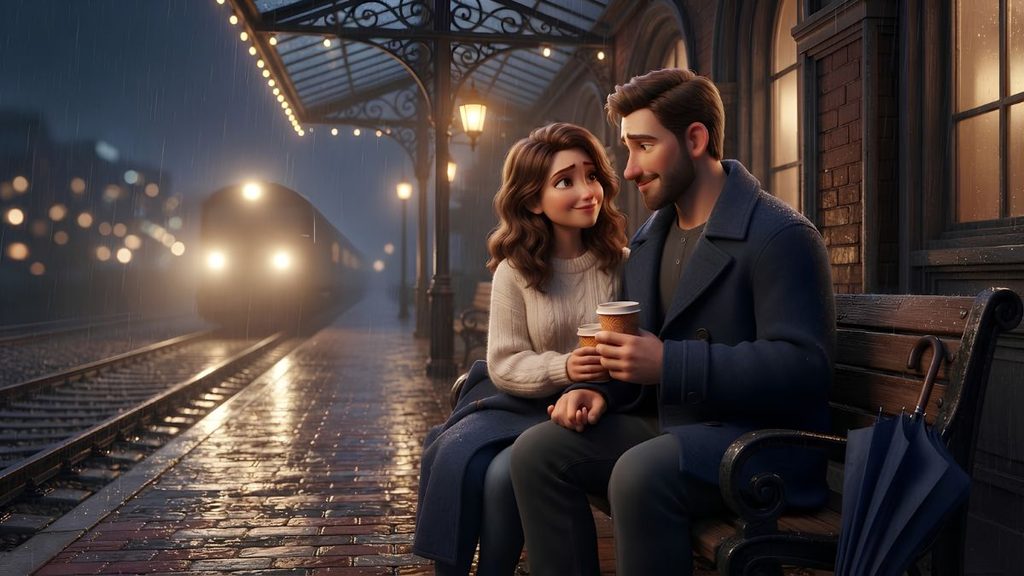
Characters: Olivia and Daniel
Theme: Unexpected meeting, rain, affection, meaningful small moments
Olivia had always liked train stations at night.
There was something comforting about them.
During the day, stations were full of hurried footsteps, ringing phones, rolling suitcases, announcements, and people constantly checking the time.
At night, everything seemed softer.
The crowds became smaller.
The voices became quieter.
The bright platforms seemed to stretch farther into the darkness, illuminated by rows of warm yellow lamps.
Olivia was sitting alone on Platform Seven one rainy Thursday evening, watching drops of water race down the glass roof above her.
Her train was supposed to arrive at 9:40.
It was now 9:52.
She checked the electronic display.
DELAYED
She sighed.
“Of course.”
It had already been a long day.
She had spent nine hours at the office, stayed late to finish a presentation, missed dinner, and then hurried through the rain to reach the station.
All she wanted now was to get home, make some tea, change into comfortable clothes, and disappear beneath her blanket.
She looked outside.
The rain had become heavier.
People on the opposite platform hurried beneath umbrellas.
Olivia reached into her bag.
She had forgotten hers.
“Perfect.”
She leaned back against the bench.
That was when she heard a familiar voice.
“You look like you’re having a wonderful evening.”
Olivia turned.
Daniel stood a few steps away.
He was holding a dark blue umbrella.
His hair was slightly wet, and his coat had small drops of rain on the shoulders.
Olivia smiled despite herself.
“Do I?”
“Absolutely.”
“That obvious?”
“Only to someone who’s been watching you stare at that departure board for the last five minutes.”
She laughed softly.
“You’ve been watching me?”
Daniel immediately looked embarrassed.
“That sounded worse than I intended.”
Olivia smiled.
“I know what you meant.”
She had known Daniel for almost eight months.
They worked in the same building, although not in the same company.
Their offices were on different floors.
They had first met in the building’s small coffee shop.
Daniel had accidentally picked up Olivia’s coffee.
They had both reached for the same cup.
He had looked at her.
She had looked at him.
Then he had said, “I think I’m holding your coffee.”
Olivia had replied, “I think you’re holding my entire morning.”
He had laughed.
Since then, they had spoken occasionally.
Sometimes in the elevator.
Sometimes in the coffee shop.
Sometimes in the lobby.
Never for very long.
But Olivia had noticed things about him.
He always carried a book.
He preferred tea when he was working late.
He held doors open for strangers.
And whenever someone looked lost inside the building, Daniel was usually the first person to help.
She had also noticed that he smiled differently when he was genuinely happy.
It was a small thing.
But she liked it.
“Your train is delayed too?” she asked.
Daniel nodded.
“Apparently.”
He looked at the empty seat beside her.
“Mind if I sit?”
“Not at all.”
He sat down.
For a moment, neither of them spoke.
They listened to the rain.
The station announcement echoed through the building.
“Attention passengers…”
Then came a message about signal problems.
Another twenty-minute delay.
Olivia closed her eyes.
Daniel smiled.
“Tea?”
She opened her eyes.
“What?”
He lifted a paper cup.
“I bought two.”
Olivia looked surprised.
“How did you know I drink tea?”
“I’ve seen you in the coffee shop.”
She smiled.
“You’ve been watching me too.”
“Apparently.”
She accepted the cup.
It was exactly how she liked it.
No sugar.
A little milk.
She looked at him.
“This is perfect.”
“I remembered.”
The words were simple.
But Olivia felt something warm inside her chest.
“You remembered?”
Daniel shrugged.
“It’s not difficult.”
“It is if nobody tells you.”
“I pay attention.”
She looked down at the tea.
For some reason, that sentence stayed with her.
The rain continued.
The station became quieter.
People gradually disappeared from the platform as some found alternative trains and others decided to wait inside the main hall.
Olivia and Daniel remained on Platform Seven.
They talked.
At first, about ordinary things.
Work.
Books.
The weather.
The terrible coffee shop sandwich Olivia had eaten that afternoon.
Then the conversation became easier.
They talked about childhood.
Daniel told her he had once wanted to become an astronomer.
Olivia told him she used to write stories in notebooks and hide them under her mattress.
“You never showed anyone?”
“No.”
“Why?”
“I thought they were terrible.”
“Maybe they weren’t.”
“Maybe.”
He smiled.
“You still write?”
“Sometimes.”
“What about?”
“People.”
“What kind of people?”
“The kind who don’t know what they’re looking for until they find it.”
Daniel looked at her for a moment.
“That sounds familiar.”
Olivia smiled.
The rain became heavier.
Thunder rolled somewhere beyond the station.
She moved slightly closer to the shelter.
Daniel noticed.
“You cold?”
“A little.”
He took off his coat.
“No.”
“Olivia.”
“I’m fine.”
“You are clearly cold.”
“I am not accepting your coat.”
“Why?”
“Because then you’ll be cold.”
“I have a sweater.”
“So do I.”
“Your sweater is losing.”
She laughed.
“That’s not how sweaters work.”
Daniel smiled.
“Just take it.”
Eventually she did.
The coat was warm.
It smelled faintly of rain and something clean, like soap.
She pulled it around herself.
“Thank you.”
“You’re welcome.”
For a while they sat quietly again.
Olivia looked at the rain.
“I actually like nights like this.”
Daniel turned toward her.
“Really?”
“Yes.”
“Even when your train is delayed?”
“Especially then.”
“Why?”
She thought about it.
“Because when things go wrong, people stop pretending they’re in a hurry.”
Daniel smiled.
“That’s a good answer.”
“What about you?”
He looked through the glass toward the platform.
“I like them because they make ordinary places feel different.”
“Like this station?”
“Exactly.”
Olivia looked around.
The platform was almost empty.
The lamps reflected against the wet floor.
Beyond the tracks, the city lights blurred in the rain.
“It does feel different.”
Daniel nodded.
“Maybe we’ll remember this.”
Olivia laughed.
“We’re sitting on a train platform waiting for a delayed train.”
“I didn’t say it was exciting.”
She looked at him.
“I think it might be.”
He smiled.
At 10:40, the announcement finally came.
The train would arrive in ten minutes.
People began gathering near the platform edge.
Olivia returned Daniel’s coat.
“Thank you.”
“You can keep it.”
“I’ll give it back.”
“I know.”
She smiled.
When the train finally appeared in the distance, its headlights glowing through the rain, Olivia suddenly felt disappointed.
She hadn’t expected that.
She had been waiting for the train for more than an hour.
Now that it was coming, she wished the evening could continue.
The train stopped.
The doors opened.
People stepped inside.
Olivia looked at Daniel.
“Which carriage?”
“Three.”
“Me too.”
They walked together.
Inside, the train was warm and quiet.
They found two seats beside the window.
Olivia sat by the glass.
Daniel sat beside her.
The train moved.
Outside, the station slowly disappeared.
For several minutes, neither spoke.
Olivia watched the rain streak across the window.
“Daniel?”
“Yes?”
“Can I ask you something?”
“Of course.”
“Why did you buy two teas?”
He looked at her.
“What do you mean?”
“You bought two before you knew we’d be sitting together.”
Daniel smiled.
“I was hoping.”
“Hoping for what?”
He looked down for a moment.
Then back at her.
“That I’d see you.”
Olivia’s heart seemed to skip.
“You were hoping I’d be here?”
“Yes.”
“Why?”
He took a breath.
“Because I like talking to you.”
Olivia smiled.
“That’s all?”
“No.”
The train moved through a tunnel.
For a moment, the window reflected their faces.
Daniel continued.
“I’ve wanted to ask you to dinner for weeks.”
Olivia looked at him.
“Why didn’t you?”
“I was afraid you’d say no.”
She laughed softly.
“Daniel.”
“Yes?”
“I’ve been waiting for you to ask.”
He stared at her.
“Seriously?”
“Seriously.”
“Why didn’t you ask me?”
“I was afraid you’d say no.”
They both laughed.
The train emerged from the tunnel.
The city lights returned.
Daniel shook his head.
“We’re ridiculous.”
“Probably.”
He smiled.
“Tomorrow?”
“For dinner?”
“Yes.”
Olivia pretended to think.
“I suppose I could consider it.”
“Could you?”
“Maybe.”
“That’s cruel.”
She laughed.
“Yes, tomorrow.”
Daniel smiled.
“Tomorrow.”
The next morning, Olivia woke up earlier than usual.
She lay in bed for a moment, thinking about the previous evening.
The rain.
The tea.
The empty platform.
Daniel’s coat around her shoulders.
His quiet confession on the train.
She smiled.
Her phone buzzed.
A message.
Daniel: Good morning. I hope your train ride home wasn’t too boring.
Olivia replied.
Olivia: It wasn’t.
A few seconds later:
Daniel: Good.
Then another message.
Daniel: Dinner tonight?
She smiled.
Olivia: Definitely.
Their dinner lasted three hours.
Then another dinner.
Then another.
The following months filled with small moments.
Walks after work.
Coffee on Sunday mornings.
Books exchanged between them.
Unexpected messages.
Rainy evenings.
Lazy breakfasts.
Long conversations.
They discovered that they liked many of the same things.
They also discovered that they disagreed about plenty.
Daniel believed pineapple belonged on pizza.
Olivia considered this a serious character flaw.
Olivia liked waking up early on weekends.
Daniel considered this deeply unreasonable.
But somehow, those differences made their days more interesting.
They learned each other’s habits.
Daniel learned that Olivia became quiet when she was worried.
Olivia learned that Daniel became unusually talkative when he was nervous.
He remembered how she liked her tea.
She remembered that he hated cold rooms.
He brought her pastries when she had difficult mornings.
She left small notes inside the books he was reading.
Their relationship grew through ordinary moments.
Not dramatic declarations.
Not grand gestures.
Just small things.
The things people sometimes overlook.
A year later, Olivia and Daniel returned to Platform Seven.
It was raining again.
They stood beneath the same glass roof.
Olivia looked at the departure board.
“Delayed.”
Daniel laughed.
“Some things never change.”
They sat on the same bench.
Daniel handed her a cup of tea.
She looked at it.
“No sugar.”
“A little milk.”
“Exactly.”
“You remembered.”
“I always remember.”
Olivia rested her head against his shoulder.
“Do you remember the first time we sat here?”
“Of course.”
“What were we talking about?”
“Books.”
“No.”
“Childhood dreams.”
“No.”
“Your terrible sandwich?”
She laughed.
“No.”
Daniel thought.
“What?”
“You said ordinary places feel different at night.”
“I remember that.”
Olivia looked around.
The station was nearly empty.
Rain tapped gently against the glass.
The lights reflected across the wet platform.
Everything looked almost exactly the same.
And yet, everything was different.
She reached for his hand.
“I think this is my favorite place.”
“Really?”
“Yes.”
“Even after all the places we’ve traveled?”
“Yes.”
Daniel smiled.
“Why?”
She looked at him.
“Because this is where we stopped being strangers.”
He squeezed her hand.
The announcement for their train echoed through the station.
Olivia smiled.
“Ready?”
Daniel stood.
“Always.”
They walked toward the train together.
Years later, Olivia would forget many details of that evening.
She might not remember exactly what they talked about.
She might forget what time the train finally arrived.
She might even forget the name of the book Daniel had been carrying.
But she would always remember the rain.
The warm cup of tea.
The dark blue umbrella.
The quiet platform.
And the moment she realized that sometimes love does not arrive with music or fireworks.
Sometimes it simply sits beside you on a rainy evening.
Sometimes it remembers how you take your tea.
Sometimes it offers you a coat when you’re cold.
And sometimes, while you’re waiting for a delayed train, you discover that the person you’ve been waiting for has been sitting beside you all along.
2. Sweet: The Cup Beside the Bed
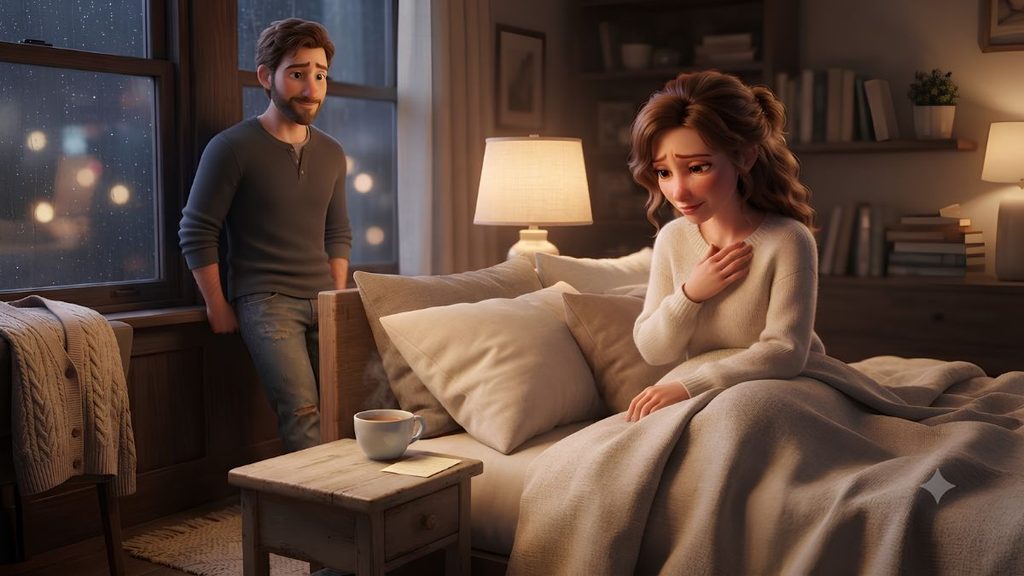
Characters: Emma and Lucas
Theme: Kindness, comfort, thoughtful gestures
Emma had always been good at saying she was fine.
She could say it with a smile.
She could say it while carrying three grocery bags.
She could say it while answering emails at midnight.
She could say it when she was exhausted, worried, disappointed, or simply running out of energy.
“I’m fine.”
Two words.
Easy.
Convincing.
Usually enough to make people stop asking questions.
But Lucas had been with her long enough to know that there were different kinds of “fine.”
There was Emma’s genuinely fine.
There was her I’m-fine-but-hungry.
Her I’m-fine-but-annoyed.
Her I’m-fine-and-don’t-want-to-talk-about-it.
And then there was the quiet “fine” she used when she was completely exhausted.
That was the one Lucas recognized immediately.
It had been a difficult week.
Monday had started with a meeting that ran nearly two hours longer than expected.
Tuesday brought a problem at work that should have been simple but somehow became complicated.
Wednesday was filled with messages, deadlines, phone calls, and a mistake that wasn’t even hers but somehow landed on her desk.
Thursday had been worse.
And by Friday evening, Emma had very little energy left.
She arrived home at 8:47 p.m.
Lucas heard the key turn in the front door.
He was in the kitchen making dinner.
“Hey,” he called.
No answer.
He looked toward the hallway.
Emma stood there with her bag still hanging from one shoulder.
Her coat was wet from the rain.
Her hair was slightly messy.
She looked tired.
Not ordinary tired.
Deeply tired.
Lucas walked toward her.
“Hey.”
Emma looked at him.
“Hi.”
“How was your day?”
She took a breath.
“Fine.”
Lucas smiled gently.
“That kind of fine?”
Emma managed a small smile.
“That kind.”
He didn’t ask anything else.
He simply took her bag.
“Go change.”
“I should help with dinner.”
“No.”
“But…”
“Emma.”
She looked at him.
“You’ve had a long week.”
She didn’t argue.
She took off her coat.
Lucas hung it by the door.
Then she walked upstairs.
Dinner was simple.
Lucas made pasta with vegetables and the sauce Emma liked.
He didn’t ask her to talk.
He didn’t ask what had happened at work.
He didn’t tell her that she needed to relax.
He simply put food on the table.
Emma came downstairs wearing comfortable pajamas and a large sweater.
She sat opposite him.
For a few minutes, they ate quietly.
“This is good,” she said.
“Good.”
She took another bite.
“Really good.”
“I’m glad.”
She looked at him.
“You don’t have to keep checking.”
“I’m not.”
“You are.”
“Maybe a little.”
She smiled.
“I appreciate it.”
Lucas nodded.
They continued eating.
After dinner, Emma helped him clear the plates despite his protests.
Then they sat on the sofa.
A movie played quietly on the television.
Neither of them paid much attention.
After twenty minutes, Emma’s head rested against Lucas’s shoulder.
He looked down.
Her eyes were closed.
“Sleepy?”
“Mmm.”
“Want to go upstairs?”
She nodded.
Lucas turned off the television.
They climbed the stairs.
Emma brushed her teeth and washed her face.
When she came into the bedroom, Lucas was already there.
He had pulled back the blankets.
Emma slipped into bed.
“I think I’m going to sleep immediately.”
“Good.”
She smiled faintly.
“Goodnight.”
“Goodnight.”
Lucas kissed her forehead.
Then he turned off the light.
Within minutes, Emma was asleep.
Or at least Lucas thought she was.
He waited.
Then he quietly got out of bed.
Downstairs, the kitchen was dark.
Lucas turned on the small light above the counter.
He opened the cupboard.
He took out Emma’s favorite mug.
It was pale blue with a tiny painted moon near the handle.
She had bought it years ago because she said it looked like something that belonged in a storybook.
Lucas filled the kettle.
While the water heated, he opened the drawer beside the refrigerator.
Inside was a collection of tea bags.
He found her favorite.
Chamomile with a little vanilla.
He placed it inside the mug.
Then he added the hot water.
A gentle fragrance filled the kitchen.
Lucas waited.
He knew Emma liked her tea warm but not too hot.
When it was ready, he added a little honey.
He stirred it.
Then he paused.
He looked around the quiet kitchen.
For a moment, he wondered whether he should leave it at her bedside.
Then he smiled.
Of course he should.
He took a small piece of paper.
He thought about writing something romantic.
Something beautiful.
Something she might keep.
But nothing felt right.
So he wrote the simplest thing.
You don’t have to be strong every day. Rest tonight.
He folded the paper once.
Then he carried the tea upstairs.
Emma was sleeping on her side.
Lucas placed the cup carefully on the bedside table.
He put the note beside it.
Then he turned toward her.
For a moment, he simply watched her sleep.
The tiredness on her face had softened.
She looked peaceful.
Lucas quietly climbed back into bed.
The next morning, Emma woke before her alarm.
For a few seconds, she didn’t know why.
Then she smelled something warm.
Tea.
She opened her eyes.
The pale blue mug sat beside the bed.
Steam still rose gently from it.
Next to it was a small folded piece of paper.
Emma picked it up.
She opened it.
She read the words.
You don’t have to be strong every day. Rest tonight.
She stared at the note.
Something inside her softened.
She smiled.
Then she noticed something else.
The laundry basket beside the bedroom door was empty.
She frowned.
She hadn’t done laundry.
She got out of bed.
In the hallway, she noticed her favorite cardigan hanging neatly on the chair.
It had been washed.
Her shoes were lined up near the door.
Her work bag was already packed.
She walked downstairs.
The kitchen was spotless.
The dishes from the night before were washed.
Her favorite mug sat clean beside the sink.
On the counter was another note.
Breakfast is in the fridge. Please eat before you become unreasonable.
Emma laughed.
“Lucas.”
No answer.
She opened the refrigerator.
Inside was a container of fruit, yogurt, and the small cinnamon rolls she liked.
She smiled.
Then she noticed something else.
Her lunch was packed.
A small note was attached to it.
For the middle of your day.
Emma stood still.
She looked around the kitchen.
Then she saw another note beside the coffee machine.
Drink some water. Yes, I’m serious.
She laughed again.
“Okay.”
She picked up her glass.
Lucas came downstairs a few minutes later.
Emma was standing in the kitchen holding three notes.
He stopped.
“Morning.”
She looked at him.
“How long have you been doing this?”
“Doing what?”
She held up the notes.
“This.”
Lucas smiled.
“It’s nothing.”
“It’s definitely something.”
He walked toward her.
“You’re tired.”
“I was.”
“You still are.”
“Maybe.”
He looked at her.
“I just wanted to make your morning easier.”
Emma looked down.
“These aren’t from just last night.”
Lucas didn’t answer.
She pointed toward the hallway.
“The laundry?”
“Yes.”
“My bag?”
“Yes.”
“The cardigan?”
“Yes.”
She narrowed her eyes.
“Did you clean the kitchen?”
“Possibly.”
“When?”
“Yesterday.”
“While I was working?”
“Yes.”
“Why?”
He shrugged.
“Because it needed cleaning.”
“Lucas.”
He smiled.
“Because you had enough to do.”
Emma was quiet.
Then she asked:
“How long have you been doing little things like this?”
He thought about it.
“All week, I suppose.”
“All week?”
“Monday I made your breakfast.”
“I thought I did.”
“You did the toast. I made everything else.”
Emma smiled.
“Tuesday?”
“I put gas in your car.”
“You did?”
“You were almost empty.”
“Wednesday?”
“I answered the delivery person because I knew you were in a meeting.”
“Thursday?”
“I put your favorite blanket in the dryer before you came home.”
Emma stared at him.
“Why didn’t you tell me?”
“Because you didn’t need to know.”
That answer made her quiet.
She looked at the notes in her hand.
Then at him.
“You noticed?”
Lucas looked confused.
“Noticed what?”
“That I was struggling.”
He smiled.
“Of course I noticed.”
Emma looked down.
She felt something warm behind her eyes.
She blinked quickly.
Lucas noticed.
He stepped closer.
“Hey.”
“I’m okay.”
“I know.”
She laughed softly through the tears.
“I really hate that you know me so well.”
“I like it.”
She looked at him.
“Why?”
“Because it means I know when you need someone to make tea.”
She smiled.
“That’s your answer?”
“Yes.”
He reached for her hand.
“Sometimes people don’t need advice.”
He squeezed her fingers.
“Sometimes they just need a warm cup beside the bed.”
Emma went to work that morning feeling different.
The problems hadn’t disappeared.
Her deadlines were still there.
Her difficult coworker was still difficult.
Her inbox was still full.
But something had changed.
She felt less alone inside all of it.
At lunchtime, she opened her bag.
Her lunch was there.
So was the little note.
For the middle of your day.
She smiled.
Then she found another note underneath.
She hadn’t noticed it before.
You’re doing better than you think.
She read it twice.
Then she folded it carefully and put it inside her wallet.
That evening, she came home earlier.
Lucas was sitting on the sofa reading.
He looked up.
“Hey.”
“Hey.”
She walked over and sat beside him.
Then she handed him something.
The pale blue mug.
“What?”
“I thought you might need tea.”
He smiled.
“Thank you.”
She leaned against him.
They sat quietly.
After a while, Emma said:
“I’ve been thinking.”
“That sounds dangerous.”
She laughed.
“I think I understand something now.”
“What?”
“Love isn’t always the big things.”
Lucas closed his book.
“No?”
“No.”
She looked toward the kitchen.
“Sometimes it’s washing someone’s cardigan.”
Lucas smiled.
“Sometimes.”
“Or remembering which tea they like.”
“Definitely.”
“Or packing their lunch.”
“Important.”
“Or leaving ridiculous notes everywhere.”
“Those are essential.”
Emma laughed.
Then she became quiet.
“I think I’ve been waiting for love to look impressive.”
Lucas listened.
“And maybe it doesn’t.”
She rested her head against his shoulder.
“Maybe love is just noticing.”
Lucas kissed the top of her head.
“Noticing what?”
“The little things.”
That night, Emma went upstairs first.
Lucas stayed downstairs for a few minutes.
When he finally entered the bedroom, he found something waiting on his pillow.
A small folded piece of paper.
He opened it.
Thank you for noticing.
He smiled.
The next morning, there was another note.
Your tea is beside the bed.
Lucas laughed.
The day after that:
Don’t forget your umbrella.
Then:
I love you. Even when you leave socks everywhere.
Then:
Especially when you leave socks everywhere.
Their notes became a habit.
Sometimes they were romantic.
Sometimes funny.
Sometimes only three words long.
I’m proud of you.
You made me smile.
Eat lunch.
Sleep well.
I’m here.
They began leaving them in unexpected places.
Inside coat pockets.
Between pages of books.
Beside toothbrushes.
Inside lunch bags.
On the steering wheel.
Under coffee cups.
The notes were never expensive.
They were never elaborate.
But they became a quiet language between them.
A language made from small acts.
Years later, Emma would still remember that difficult week.
She wouldn’t remember every meeting.
She wouldn’t remember every email.
She wouldn’t remember the details of the problems that had seemed so important at the time.
But she would remember the pale blue mug.
The warm tea.
The little note beside her bed.
And the realization that someone had noticed she was tired without asking her to explain.
Sometimes she would tell people that Lucas had taught her something about love.
They would ask what.
She would smile.
“That you don’t always have to say it.”
They would ask what she meant.
She would tell them about the notes.
The tea.
The laundry.
The cardigan.
The breakfast.
The small things.
And then she would say:
“Love is sometimes the person who notices that you’re exhausted before you have the words to say it.”
That night, many years after the first note, Emma and Lucas were getting ready for bed.
The house was quiet.
The lights were low.
Emma climbed beneath the blankets.
Lucas turned off the lamp.
Then Emma reached for his hand.
“Wait.”
She turned on the bedside light.
She reached into the drawer.
Inside was a small wooden box.
She opened it.
Hundreds of tiny folded notes filled it.
Some were old and faded.
Some were new.
She picked one.
The very first one.
You don’t have to be strong every day. Rest tonight.
Lucas smiled.
“You kept it.”
“Of course.”
She put it back.
Then she closed the box.
“Do you remember why you wrote that?”
“Yes.”
“Why?”
He looked at her.
“Because I loved you.”
Emma smiled.
“And you still do?”
“More than ever.”
She turned off the light.
The room became quiet.
Outside, the night moved gently through the trees.
Inside, Emma rested her head against Lucas’s shoulder.
There was nothing else they needed to say.
The day was over.
The house was peaceful.
And beside the bed, waiting quietly for morning, sat the pale blue cup.
Empty now.
But warm with the memory of all the little things that had filled their life together.
Because sometimes love does not arrive with grand speeches.
Sometimes it doesn’t announce itself.
Sometimes it simply notices.
It washes the cardigan.
It packs the lunch.
It remembers the tea.
It leaves a note.
And when the day has been too heavy, it sits quietly beside the bed and says:
You don’t have to be strong tonight.
Just rest.
I’m here.
3. Cute: The Wrong Table for Two

Characters: Sophie and Henry
Theme: Misunderstanding, humor, playful adventure
Sophie had been looking forward to Friday all week.
Not because anything particularly exciting was happening.
Quite the opposite.
She wanted a quiet evening.
A nice dinner.
A little conversation.
Maybe dessert.
And, most importantly, no phones buzzing with work messages.
“You said this place was quiet,” Sophie reminded Henry as they walked down a narrow street lined with small restaurants and warm yellow lights.
“It is quiet,” Henry said confidently.
“You’ve never been here.”
“I’ve walked past it.”
“That is not the same thing.”
Henry smiled.
“I’ve also looked at the menu online.”
“That is slightly better.”
“And I read three reviews.”
“Now I’m impressed.”
Henry held the restaurant door open for her.
“There. Your faith in me has been restored.”
“Temporarily.”
They stepped inside.
The restaurant was smaller than Sophie had expected. There were only a few tables in the main dining room, each covered with white cloth and decorated with tiny candles.
Soft music played somewhere in the background.
A waiter greeted them with a smile.
“Good evening. Table for two?”
“Yes,” Henry said.
The waiter glanced at a small reservation book.
“Sophie and Henry?”
“That sounds like us,” Henry replied.
The waiter smiled.
“Perfect. Right this way.”
He walked toward the back of the restaurant.
Sophie followed, looking around curiously.
Then the waiter stopped beside a table near the window.
“Here you are.”
“Thank you,” Sophie said.
The waiter placed two menus on the table and walked away.
Henry pulled out Sophie’s chair.
She sat down.
“This is nice,” she said.
“Told you.”
“Don’t get too proud.”
Henry sat opposite her.
A candle flickered between them.
For a few seconds, neither said anything.
Then Sophie looked around.
“It’s strange.”
“What?”
“There are only six tables in here, but this one feels very private.”
Henry looked toward the other diners.
“Maybe they designed it that way.”
“Maybe.”
A waiter returned almost immediately.
“Would you like some sparkling water?”
“Yes, please,” Sophie said.
“Still or sparkling?”
“Sparkling.”
Henry looked at her.
“You always choose sparkling water.”
“You know that.”
“I pay attention.”
Sophie smiled.
“I know.”
The waiter left.
Henry opened the menu.
“So. What are you having?”
“I don’t know yet.”
“You spent twenty minutes studying the menu before we came.”
“That was research.”
“Of course.”
Sophie laughed.
They began talking about their week.
Henry told her about an embarrassing moment at work when he accidentally sent a message meant for his brother to his manager.
Sophie nearly dropped her menu laughing.
“What did you write?”
“I can’t tell you.”
“You absolutely have to.”
“No.”
“Henry.”
“No.”
“Henry.”
He finally surrendered.
“I wrote, ‘Don’t forget to buy the ridiculous birthday hat.’”
Sophie stared at him.
“That doesn’t sound too bad.”
“It was followed by a photo.”
“What photo?”
Henry looked embarrassed.
“My brother wearing a pink birthday crown.”
Sophie covered her mouth.
“You sent that to your manager?”
“Accidentally.”
“What did he say?”
“He replied, ‘Noted.’”
Sophie burst out laughing.
The evening was already becoming exactly what she had wanted.
Simple.
Warm.
Unhurried.
Then the first plate arrived.
The waiter placed it in front of Henry.
Henry looked down.
Sophie looked at it.
They both looked at each other.
“This isn’t mine,” Henry said.
The waiter blinked.
“Oh.”
He looked at his notepad.
“Sorry.”
He picked up the plate.
Then he stopped.
“Actually…”
“Yes?”
The waiter looked confused.
“I’m sorry. This is supposed to be yours.”
Henry glanced at Sophie.
“But I ordered the mushroom pasta.”
The waiter looked at the plate.
“This is mushroom pasta.”
Henry looked down again.
It was indeed mushroom pasta.
He looked at Sophie.
“Okay.”
The waiter smiled.
“Enjoy.”
He walked away.
Sophie leaned forward.
“You forgot what you ordered?”
“No.”
“You sounded very certain.”
“I was testing him.”
“Of course.”
Henry picked up his fork.
“I’m hungry.”
They continued talking.
A few minutes later, another waiter arrived carrying a plate.
He placed it in front of Sophie.
She looked down.
It was grilled salmon.
She looked at Henry.
“I didn’t order this.”
The waiter looked surprised.
“You didn’t?”
“No.”
Henry leaned over.
“What did you order?”
“The vegetable risotto.”
The waiter looked at his notepad.
Then at the table.
Then at Sophie.
“I’ll check.”
He hurried away.
Sophie watched him disappear.
“This is becoming strange.”
Henry nodded.
“Very.”
A minute later, the waiter returned.
“I’m so sorry.”
He took the salmon away.
“Your risotto will be here shortly.”
“Thank you.”
He left again.
Sophie sighed.
“Maybe they’re having a difficult night.”
Henry nodded.
“Everyone has those.”
They smiled at each other.
Then another waiter approached.
“Excuse me.”
“Yes?” Sophie said.
“Are you celebrating something?”
Henry looked at Sophie.
“No.”
The waiter smiled.
“Are you sure?”
“Yes.”
The waiter looked disappointed.
“Oh.”
He walked away.
Sophie raised an eyebrow.
“What was that about?”
“I have no idea.”
A few moments later, a woman in a dark green apron approached.
She looked at them carefully.
“Are you Sophie and Henry?”
“Yes.”
She smiled.
“Wonderful.”
Then she looked around.
“Everything okay?”
“Yes,” Sophie said.
The woman nodded.
“Excellent.”
She walked away.
Henry watched her.
“Something is definitely happening.”
“I think so.”
“Should we ask?”
Sophie considered it.
“Maybe.”
Before they could call anyone over, a waiter arrived carrying two glasses of sparkling lemonade.
He placed one in front of each of them.
Henry stared at his glass.
“We didn’t order these.”
The waiter smiled.
“Compliments of the house.”
“Why?”
The waiter looked surprised.
“You don’t know?”
“No.”
He glanced toward the kitchen.
Then back at them.
“Enjoy.”
He left.
Sophie picked up her glass.
“This is either very romantic or very concerning.”
Henry laughed.
“Maybe the restaurant thinks we’re celebrating an anniversary.”
“Do we look married?”
Henry paused.
“That’s a dangerous question.”
Sophie smiled.
“Good answer.”
They clinked glasses.
“To whatever is happening.”
“To whatever is happening.”
The lemonade was excellent.
Their risotto eventually arrived.
Henry tasted his pasta.
Sophie tasted her risotto.
Both were delicious.
For a while, the mystery was forgotten.
They talked about places they wanted to visit.
Sophie wanted to see the northern coast someday.
Henry wanted to take a train through the mountains.
She told him about a childhood dream of owning a tiny bookstore.
He admitted he had once wanted to become a magician.
Sophie stared at him.
“A magician?”
“I was nine.”
“What happened?”
“I discovered I wasn’t very good at magic.”
“What was your greatest trick?”
Henry lowered his voice.
“Making a coin disappear.”
“Did it work?”
“Yes.”
“Where did the coin go?”
“I never found it.”
Sophie laughed so loudly that two people at another table turned around.
Henry smiled.
“See? This is why I told you.”
“You’ve been hiding this from me.”
“I was protecting my dignity.”
“Too late.”
They were still laughing when a waiter suddenly appeared beside their table.
“Your table is ready.”
Sophie blinked.
“Our table?”
“Yes.”
Henry looked around.
“We’re sitting at our table.”
The waiter looked confused.
“No.”
He looked at his reservation book.
“This isn’t your table.”
Sophie and Henry stared at him.
“Then whose table is this?” Sophie asked.
The waiter looked uncomfortable.
“It’s for another reservation.”
Henry slowly looked around the room.
“So we’ve been sitting at someone else’s table?”
The waiter nodded.
“For about an hour.”
Sophie covered her face with both hands.
“Oh no.”
Henry looked at the waiter.
“Then where are we supposed to sit?”
The waiter pointed toward a door at the back.
“Your table is outside.”
“Outside?”
“In the garden.”
Sophie lowered her hands.
“There is a garden?”
“Yes.”
Henry looked at Sophie.
She looked at him.
Then they both started laughing.
“So all of that…” Sophie said.
“The wrong food.”
“The mysterious lemonade.”
“The anniversary question.”
“The congratulations.”
Henry grinned.
“They thought we were the people at this table.”
The waiter smiled apologetically.
“I’m very sorry. There was a mix-up when you arrived.”
Sophie stood.
“It’s okay.”
Henry stood too.
“Honestly, this is the most entertaining dinner I’ve had in months.”
The waiter led them through the back door.
Sophie stepped outside.
She stopped.
The garden was tiny.
But beautiful.
A narrow stone path curved between small flower beds.
Tiny lights hung from wooden beams overhead.
There were only four tables, each tucked into its own little corner.
Their table stood beneath an old apple tree.
A small candle burned in the center.
Beyond the garden wall, the sounds of the city were barely audible.
Sophie looked at Henry.
“You knew about this?”
Henry shook his head.
“No.”
She smiled.
“I like it better.”
“So do I.”
They sat down.
The same waiter brought their drinks.
“Again, I’m sorry about the confusion.”
Sophie smiled.
“Don’t be. It made the evening memorable.”
Henry nodded.
“Definitely.”
The waiter left.
For a moment, they simply listened to the quiet.
A breeze moved through the branches above them.
A few leaves fell onto the table.
Sophie picked one up.
“This is much nicer than the original table.”
Henry smiled.
“I agree.”
“Maybe we were supposed to sit here all along.”
Henry looked at her.
“Maybe.”
Their dessert arrived later.
Chocolate cake for Sophie.
Vanilla cream tart for Henry.
They shared both.
Henry tried to steal the last piece of chocolate cake.
Sophie caught his hand.
“That is mine.”
“We’re sharing.”
“You already had half.”
“I’m checking the quality.”
“You’ve checked it six times.”
“Quality control is important.”
She pushed the plate away from him.
He reached for it again.
She moved it farther.
They stared at each other.
Then both started laughing.
The waiter passing nearby smiled.
“Everything okay?”
Sophie nodded.
“Perfect.”
When they finally left the restaurant, the street was quiet.
The rain had started.
Henry opened his umbrella.
Sophie stepped underneath.
They walked slowly toward the corner.
After a minute, Sophie said, “You know what?”
“What?”
“I think this was better than the quiet dinner we planned.”
Henry smiled.
“Even though we spent an hour sitting at the wrong table?”
“Especially because of that.”
Henry laughed.
“I was worried you’d be embarrassed.”
“I was.”
“Really?”
“Yes.”
She looked up at him.
“But then I realized something.”
“What?”
“We don’t have to be perfect at everything.”
Henry nodded.
“Good.”
“Because you’re definitely not.”
He laughed.
“Thank you.”
“I mean it lovingly.”
“Of course.”
They continued walking beneath the umbrella.
After a few steps, Henry stopped.
“What?”
He pointed back toward the restaurant.
“Should we come here again?”
Sophie smiled.
“Yes.”
“To the garden?”
“Yes.”
“And this time we’ll sit at the correct table?”
She pretended to think about it.
“Maybe.”
“Maybe?”
“I think getting the wrong table is part of the experience.”
Henry smiled.
“Then next time, we’ll intentionally sit at the wrong one.”
Sophie laughed.
“That sounds like a terrible plan.”
“Probably.”
She slipped her arm through his.
“But I like it.”
Years later, Sophie would still remember that first dinner.
Not because of the food.
Not because of the candlelight.
Not even because of the tiny garden hidden behind the restaurant.
She remembered it because nothing had gone according to plan.
They had sat at the wrong table.
They had received the wrong food.
The staff had mistaken them for another couple.
They had accidentally become part of someone else’s reservation.
And somehow, in the middle of all that confusion, they had found something better than the quiet evening they had planned.
They had found laughter.
They had found a little adventure.
And they had discovered that sometimes the best dates are not the ones where everything goes perfectly.
Sometimes they are the ones where you get lost, make mistakes, laugh until your stomach hurts, and end up somewhere you never expected.
Years later, whenever Sophie and Henry visited that restaurant, they always asked for the little garden table beneath the apple tree.
But once, when the waiter accidentally seated them at the wrong table again, Sophie looked at Henry.
Henry looked at Sophie.
Neither of them said anything.
They simply smiled.
And stayed.
Because by then they knew something important.
The wrong table could sometimes lead to the right evening.
And sometimes, a little misunderstanding was exactly where a beautiful memory began.
4. Funny: The Great Pancake Challenge
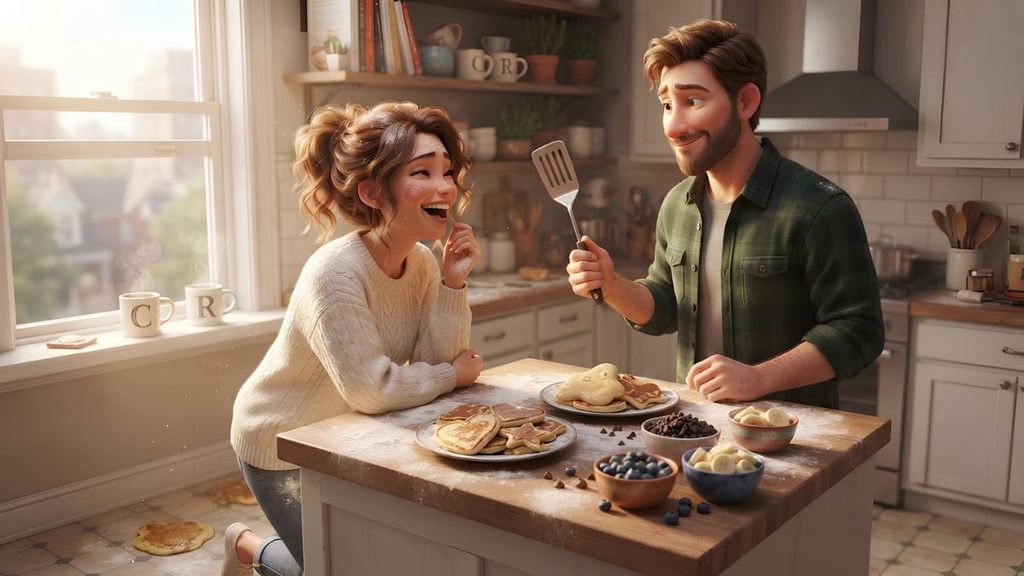
Characters: Chloe and Ryan
Theme: Silly competition, failed cooking, everyday romance
Chloe had always believed she made excellent pancakes.
Not good pancakes.
Not decent pancakes.
Excellent pancakes.
She had evidence.
At least, she believed she did.
Her pancakes were golden around the edges, soft in the middle, and usually shaped something close to a circle.
Ryan, however, had a different opinion.
“They’re fine,” he said one Saturday morning.
Chloe slowly lowered her fork.
“Fine?”
Ryan looked at the pancake on his plate.
“Yes.”
“You just called my pancakes fine?”
“They’re perfectly edible.”
“Perfectly edible?”
Ryan nodded.
“I don’t want to exaggerate.”
Chloe stared at him.
“You know what?”
Ryan smiled.
“What?”
“I can make better pancakes than you.”
Ryan stopped chewing.
The kitchen became strangely quiet.
Outside, morning sunlight was coming through the window. Somewhere downstairs, a neighbor was vacuuming. The coffee machine made a soft clicking sound.
Ryan put his fork down.
“I wasn’t going to say anything.”
“Say what?”
“That your pancakes are better than mine.”
“Because they’re not.”
“I know.”
Chloe narrowed her eyes.
“You’re enjoying this.”
“A little.”
She folded her arms.
“Fine.”
Ryan waited.
“Challenge accepted.”
His eyebrows rose.
“Really?”
“Really.”
“When?”
“Now.”
Ryan looked at the clock.
“It’s eight in the morning.”
“Exactly.”
“You’re challenging me before coffee?”
“I don’t need coffee to make pancakes.”
“I do.”
“That sounds like an excuse.”
Ryan stood.
“Fine.”
He rolled up his sleeves.
“Let the games begin.”
Chloe laughed.
“You’re ridiculous.”
“You started it.”
They moved around the kitchen like two professional chefs preparing for the most important culinary competition in history.
Chloe grabbed the flour.
Ryan grabbed another bowl.
“You need a separate bowl?”
“Obviously.”
“Why?”
“Because we’re competitors.”
“We’re making breakfast.”
“No.”
Ryan pointed dramatically toward the counter.
“We are making history.”
Chloe burst out laughing.
“Fine. History.”
They decided on rules.
Each person would make five pancakes.
They would be judged on appearance, texture, taste, creativity, and what Ryan called “overall pancake excellence.”
Chloe objected.
“That’s not a real category.”
“It is now.”
“Who is the judge?”
They looked at each other.
“You?” Chloe suggested.
“No. You’re biased.”
“You’re biased.”
They thought about it.
“We’ll judge each other,” Ryan said.
“That seems dangerous.”
“Exactly.”
The competition began.
Chloe carefully measured her flour.
Ryan watched.
“Too much.”
“What?”
“Flour.”
“You haven’t even seen how much I put in.”
“I can tell.”
“How?”
“I have pancake instincts.”
“You have absolutely no pancake instincts.”
Ryan ignored her.
He cracked an egg into his bowl.
Then another.
Then accidentally dropped a piece of shell inside.
Chloe pointed.
“Pancake instincts?”
Ryan removed the shell.
“Advanced pancake instincts.”
Chloe shook her head.
She mixed her batter slowly.
Ryan mixed his faster.
Soon both bowls were ready.
“Round one,” Ryan announced.
They poured their batter onto separate pans.
Chloe’s first pancake spread beautifully.
Ryan’s looked like a cloud.
Chloe smiled.
“That’s a strong start.”
Ryan stared at it.
“It’s artistic.”
“It looks like a map.”
“Exactly.”
“Of what?”
“Ireland.”
Chloe looked at the pancake.
“It doesn’t look like Ireland.”
“It will after I add the second half.”
He poured more batter onto the pan.
The shape became even stranger.
Chloe laughed.
“That looks like a dinosaur.”
Ryan studied it.
“A pancake dinosaur.”
“That’s worse.”
“It’s creative.”
“It’s unrecognizable.”
“Creativity requires imagination.”
“Cooking requires food.”
Ryan flipped his pancake.
It folded in half.
He stared at it.
Chloe tried not to laugh.
“You’re supposed to flip it, not fold it.”
“I know.”
“You made a pancake taco.”
Ryan lifted it carefully.
“I call this innovation.”
Chloe laughed so hard she had to put down her spatula.
Her own pancake was golden brown.
She flipped it perfectly.
Ryan looked impressed despite himself.
“Okay.”
“What?”
“That was good.”
Chloe smiled.
“Thank you.”
“Don’t get comfortable.”
She raised her spatula.
“Bring it.”
Round two was where things became suspicious.
Ryan secretly sprinkled cinnamon into his batter.
Chloe noticed.
“What’s that?”
“Nothing.”
“You added something.”
“Maybe.”
“What?”
“Secret ingredient.”
Chloe frowned.
She leaned over his bowl.
“Cinnamon?”
Ryan looked disappointed.
“You weren’t supposed to see that.”
Chloe smiled.
“Now I have to use one too.”
She reached into the cupboard.
Ryan watched.
“What are you doing?”
“Nothing.”
“You’re hiding something.”
“Maybe.”
She added a small spoonful of chocolate chips.
Ryan stared.
“Chocolate chips?”
“Secret ingredient.”
“That’s cheating.”
“You started it.”
“Fine.”
He opened the cupboard.
“What are you looking for?”
“Something unexpected.”
“Ryan.”
He pulled out a small jar.
Chloe stared at the label.
“Vanilla?”
“Yes.”
“That isn’t unexpected.”
“It’s unexpected if I use too much.”
“Please don’t.”
Ryan poured in a generous amount.
Chloe looked horrified.
“How much did you just add?”
“Enough.”
“Enough for what?”
“Victory.”
They cooked the second round.
Ryan’s pancake smelled strongly of vanilla.
Chloe’s was full of melted chocolate.
They tasted each other’s.
Ryan nodded.
“Okay. That’s good.”
Chloe smiled.
“Yours tastes like a candle.”
Ryan looked offended.
“A delicious candle.”
“Still a candle.”
Round three became more competitive.
They decided the pancakes had to be shaped.
Chloe made a heart.
Ryan made a star.
Chloe’s heart looked surprisingly good.
Ryan’s star looked like a badly injured octopus.
He stared at it.
“That’s not a star.”
“It was.”
“What happened?”
“Structural failure.”
Chloe laughed.
Then Ryan pointed at her pancake.
“Your heart is too perfect.”
“What does that mean?”
“It means you’re taking this too seriously.”
“You just made an injured octopus.”
“It was supposed to be a star.”
“That doesn’t help.”
Ryan grabbed the batter again.
“I can do better.”
His next pancake looked like a giant letter R.
Chloe looked impressed.
“That’s actually good.”
“I told you.”
“What does the R stand for?”
“Ryan.”
“Of course.”
Chloe poured batter onto her pan.
“I’ll make a C.”
She attempted a giant C.
It came out looking like a question mark.
Ryan smiled.
“That’s a C?”
“Yes.”
“It looks like you’re questioning your cooking ability.”
“Keep talking.”
She flipped it.
It broke into three pieces.
Ryan covered his mouth.
“Don’t laugh.”
“I wasn’t.”
“You are.”
“No.”
“You’re shaking.”
“I’m cold.”
“In August?”
“Very cold.”
Chloe threw a dish towel at him.
He caught it.
The towel knocked into the flour container.
The container tipped.
A small cloud of flour exploded across the counter.
They both froze.
There was flour on the counter.
Flour on the floor.
Flour on Ryan’s shirt.
A little flour had somehow landed in Chloe’s hair.
She slowly touched her head.
“Did you do that?”
Ryan looked at her.
“You threw the towel.”
“You knocked over the flour.”
“You made the C.”
“You made the octopus.”
They stared at each other.
Then they started laughing.
Neither could stop.
For several minutes, the pancake competition disappeared completely.
They were simply standing in the middle of the kitchen laughing like children.
Eventually Chloe wiped her eyes.
“Okay.”
Ryan nodded.
“Okay.”
“We need to finish.”
“Absolutely.”
Round four was supposed to be serious.
It lasted approximately thirty seconds.
Chloe made a pancake shaped like a smiley face.
Ryan made one shaped like a cat.
Then he added chocolate chips for eyes.
Chloe looked at it.
“Your cat is terrifying.”
“He’s misunderstood.”
“He has three eyes.”
“He’s special.”
She laughed.
Ryan pointed toward her pancake.
“Your smiley face has no nose.”
“It’s minimalist.”
“It’s incomplete.”
“It’s elegant.”
They continued.
Then Ryan whispered, “We need a secret weapon.”
Chloe looked at him.
“What?”
“Something nobody would expect.”
“Like what?”
Ryan looked around the kitchen.
His eyes landed on a banana.
Chloe followed his gaze.
“No.”
“Banana pancakes.”
“We are not making banana pancakes.”
“Why?”
“Because we’re supposed to be making normal pancakes.”
“We abandoned normal fifteen minutes ago.”
That was difficult to argue with.
Chloe sighed.
“Fine.”
They each added banana.
Then blueberries.
Then chocolate chips.
Then, for reasons neither of them could explain later, crushed cereal.
Their final pancakes were enormous.
They looked nothing like ordinary pancakes.
Ryan lifted his spatula.
“Behold.”
Chloe stared.
“What is that?”
“My masterpiece.”
“It looks like a breakfast accident.”
“It smells amazing.”
“That’s true.”
They carefully transferred the giant pancake onto a plate.
It was so large that it barely fit.
They stood back.
Ryan folded his arms.
“I think we may have invented something.”
Chloe nodded.
“Something dangerous.”
They were still admiring their creation when Ryan attempted to flip one final pancake.
He lifted the pan.
The pancake rose into the air.
For one glorious second, it looked perfect.
Then it rotated.
And kept rotating.
Ryan’s eyes widened.
“Oh.”
The pancake landed on the floor.
There was silence.
Chloe stared at it.
Ryan stared at it.
The pancake stared back in spirit.
Finally Chloe said, “That was your best one.”
Ryan nodded solemnly.
“I agree.”
“You should eat it.”
“I think the floor has won.”
They both laughed.
At this point the kitchen looked like a disaster zone.
Flour covered the counter.
Banana slices were scattered beside the cutting board.
There were blueberries near the sink.
Chocolate chips had somehow reached the refrigerator door.
A pancake sat sadly on the floor.
And there were at least seven different plates holding pancakes of different shapes and sizes.
Ryan looked around.
“Should we clean?”
Chloe looked at him.
“After breakfast.”
“Fair.”
They carried their pancakes to the table.
There was no longer enough room for anything else.
Coffee mugs were pushed to the side.
Butter sat beside a plate of blueberries.
Syrup stood between two bowls.
They each chose their best pancake.
Chloe took a bite.
Ryan waited.
“Well?”
She chewed.
“It’s good.”
“Really?”
“Yes.”
He smiled.
“Mine is better.”
She tasted his.
She thought about it.
Then shook her head.
“No.”
“What?”
“Mine is better.”
“You’re wrong.”
“You’re wrong.”
They looked at each other.
Then they laughed.
“So who wins?” Ryan asked.
Chloe looked at the table.
At the flour on the floor.
At the pancake pieces.
At the strange breakfast creation they had somehow produced.
“I don’t know.”
“Me neither.”
“Maybe we tie.”
Ryan nodded.
“That’s fair.”
They shook hands across the table.
“Congratulations,” Ryan said.
“Congratulations to you too.”
“Champion.”
“Champion.”
They both started laughing again.
After breakfast, they cleaned the kitchen together.
Ryan swept the flour while Chloe wiped the counter.
They discovered chocolate chips in places neither of them remembered putting them.
There was one blueberry behind the toaster.
Ryan found another inside a measuring cup.
“How did that happen?”
Chloe shrugged.
“Advanced cooking.”
Eventually the kitchen looked normal again.
They made fresh coffee.
Then they sat by the window.
The morning had become quieter.
Sunlight filled the room.
Chloe rested her head against Ryan’s shoulder.
“That was ridiculous.”
“Yes.”
“We wasted half the morning.”
“Yes.”
“We made terrible pancakes.”
“Yes.”
“One landed on the floor.”
“Yes.”
“And we didn’t even decide who won.”
Ryan smiled.
“No.”
Chloe was quiet for a moment.
Then she said, “It was fun.”
Ryan looked at her.
“Yeah.”
“I think that’s the best breakfast we’ve ever made.”
“The food was terrible.”
“Some of it was.”
“Most of it.”
She smiled.
“Still.”
Ryan wrapped an arm around her.
“You know what I learned?”
“What?”
“You’re very competitive.”
“You started it.”
“And you are terrible at drawing pancakes.”
“I am not.”
“Your C looked like a question mark.”
“You made a three-eyed cat.”
“He was beautiful.”
“He was horrifying.”
Ryan laughed.
Chloe smiled.
They stayed there for a while, drinking coffee and watching the sunlight move across the kitchen floor.
Neither of them knew that the pancake challenge would become a story they told for years.
They would eventually forget which pancake had tasted best.
They would forget who had added the cinnamon.
They would forget exactly how the pancake landed on the floor.
But they would remember the flour in each other’s hair.
They would remember laughing so hard they couldn’t speak.
They would remember sitting at the kitchen table with mismatched pancakes and cold coffee.
And they would remember that neither of them had really cared about winning.
The challenge had started because Chloe wanted to prove she was the better cook.
Ryan wanted to prove the same thing.
But somewhere between the first pancake and the flour explosion, the competition had changed.
It had become an excuse to spend the morning together.
Years later, when they were too busy to slow down, one of them would sometimes say, “Pancake challenge?”
And the other would know exactly what that meant.
It meant no phones.
No rushing.
No worrying about making breakfast perfect.
Just flour, laughter, music, and two people trying to make pancakes badly enough to remember the morning.
One night, long after that first competition, Chloe and Ryan were getting ready for bed.
The room was quiet.
The lights were low.
Chloe pulled the blanket up and smiled.
“Do you remember the pancake challenge?”
Ryan laughed softly.
“How could I forget?”
“The pancake that landed on the floor?”
“The cat pancake.”
“The cat pancake was terrible.”
“It was misunderstood.”
Chloe laughed.
“And the flour?”
“Everywhere.”
“And we never decided who won.”
Ryan turned toward her.
“I think we both did.”
She smiled.
“That’s cheesy.”
“I know.”
“But true.”
Ryan reached for her hand beneath the blanket.
“Sometimes the best mornings aren’t the ones where you make the best breakfast.”
“What are they?”
“The ones where you make a terrible breakfast with someone you love.”
Chloe smiled.
“That’s even cheesier.”
“I’m tired.”
“Good excuse.”
They laughed quietly.
Then Chloe closed her eyes.
“Next Saturday?”
Ryan smiled.
“Pancake challenge?”
“Obviously.”
“New rules?”
“No rules.”
“That sounds dangerous.”
“It is.”
They settled beneath the blankets.
The kitchen was clean.
The dishes were done.
The flour was gone.
But somewhere in their home, one tiny chocolate chip was still hiding.
Neither of them knew where.
And perhaps that was fitting.
Because some memories are like that.
They leave behind little pieces of themselves in unexpected places.
A laugh.
A photograph.
A smell.
A silly sentence.
A song.
Or the memory of a pancake flying through the air before landing on the kitchen floor.
Years from now, Chloe and Ryan might forget many ordinary mornings.
But they would never forget the great pancake challenge.
Because they had learned something that morning.
Love did not always look like grand gestures or perfect plans.
Sometimes love looked like sharing the last blueberry.
Sometimes it looked like wiping flour from someone’s hair.
Sometimes it looked like laughing at a terrible pancake.
And sometimes, the best way to spend a Saturday morning was simply to make a complete mess together.
At bedtime, Chloe whispered one final question.
“Ryan?”
“Hmm?”
“Who really won?”
Ryan thought about it.
Then he smiled.
“Breakfast did.”
Chloe laughed softly.
“Good night.”
“Good night.”
And with that, they closed their eyes, already looking forward to their next ridiculous morning together.
5. Emotional: The Day We Finally Said Thank You

Characters: Grace and Ethan
Theme: Gratitude, forgiveness, personal growth, quiet love
Grace and Ethan had been together for seven years.
They had said “I love you” thousands of times.
They had said it in the morning before leaving for work.
They had said it over the phone.
They had whispered it before falling asleep.
They had said it after arguments, after apologies, after good news, and during ordinary evenings when there was nothing particularly important to say.
“I love you” had become part of their language.
But there was another sentence they rarely said.
Thank you.
Not because they were ungrateful.
They simply assumed the other person knew.
Grace knew Ethan appreciated her.
Ethan knew Grace appreciated him.
At least, that was what they believed.
One Thursday evening, they discovered that knowing and saying were not always the same thing.
It had been a long week.
Nothing terrible had happened.
Nothing wonderful had happened either.
It was simply one of those weeks that seemed to leave a person tired without giving them a clear reason why.
Grace came home first.
She changed into comfortable clothes, made tea, and sat on the sofa.
Ethan arrived about twenty minutes later.
He dropped his keys into the bowl near the door.
“Hi.”
“Hi.”
He kissed her forehead.
“How was your day?”
“Long.”
“Mine too.”
He sat beside her.
For several minutes, neither spoke.
The television was on, but neither of them was watching it.
Grace looked at Ethan.
He looked tired.
His hair was slightly messy.
His shirt sleeves were rolled up.
There was a faint crease between his eyebrows that usually appeared when he had been thinking too much.
She reached for his hand.
“I love you.”
Ethan squeezed her fingers.
“I love you too.”
The words felt familiar.
Comforting.
True.
But somehow, that evening, they didn’t feel complete.
Grace looked toward the television.
“Do you ever think we say ‘I love you’ so often that we forget to explain what we mean?”
Ethan turned toward her.
“What do you mean?”
“I don’t know.”
She thought for a moment.
“I just mean… I love you is important. Obviously.”
“Obviously.”
“But sometimes I wonder if we should say the other things too.”
“What other things?”
Grace smiled.
“Thank you.”
Ethan was quiet.
Then he nodded.
“Maybe.”
Grace leaned back.
“Maybe we should.”
“For what?”
She laughed softly.
“That’s the problem.”
“What?”
“There are so many things.”
They looked at each other.
Ethan smiled.
“Okay.”
“Okay what?”
“Let’s do it.”
“Do what?”
“Tell each other what we’re grateful for.”
Grace smiled.
“Tonight?”
“Tonight.”
“Everything?”
“Everything.”
She laughed.
“That could take hours.”
“I have nowhere else to be.”
Neither did she.
So they made more tea.
They turned off the television.
Ethan put his phone on the table.
Grace did the same.
Then they sat facing each other.
Ethan took a breath.
“You first.”
Grace smiled.
“Why me?”
“Because I need time to think.”
“You’ve had seven years.”
“I know.”
She laughed.
Then she became quiet.
“Okay.”
She looked at him.
“Thank you for staying.”
Ethan’s expression changed.
“For staying?”
Grace nodded.
“There was a time when I wasn’t very easy to be around.”
“I remember.”
She smiled faintly.
“I know.”
Several years earlier, Grace had gone through a difficult period.
She had been overwhelmed by uncertainty.
Everything had seemed harder than it should.
She struggled to sleep.
Small problems felt enormous.
Some mornings she didn’t want to get out of bed.
She had often apologized to Ethan.
“I’m sorry.”
“For what?”
“For being like this.”
Ethan had always answered the same way.
“You don’t have to apologize for having a difficult time.”
Back then, she had not believed him.
She thought she was becoming a burden.
She thought perhaps Ethan would eventually become tired of waiting for her to feel better.
But he hadn’t left.
He had stayed.
He had made breakfast when she couldn’t.
He had sat beside her when she didn’t want to talk.
He had driven her to appointments.
He had listened to the same fears repeatedly without making her feel foolish.
He had learned when she wanted advice and when she simply needed someone to sit quietly beside her.
Grace looked down at their hands.
“You never tried to fix me.”
Ethan shook his head.
“I didn’t know how.”
“That was exactly what I needed.”
He smiled gently.
Grace continued.
“Thank you for sitting beside me on those nights when I couldn’t sleep.”
Ethan’s eyes softened.
“Thank you for never making me feel like I had to hurry.”
He reached across the space between them.
Grace took his hand.
“I remember one night,” she said.
“The night of the rain?”
She smiled.
“You remember?”
“Of course.”
It had rained heavily that night.
Grace had been sitting on the kitchen floor at two in the morning.
She couldn’t explain why she was upset.
She simply was.
Ethan had come into the kitchen, sat down beside her, and handed her a glass of water.
He hadn’t asked questions.
He hadn’t offered solutions.
He had simply stayed.
Grace smiled.
“That night meant more to me than you know.”
Ethan squeezed her hand.
“I wish you had told me.”
“I didn’t know how.”
They sat quietly.
Then Ethan said, “My turn.”
Grace nodded.
He looked at her.
“Thank you for making ordinary days easier.”
She smiled.
“That’s very general.”
“I have examples.”
“Good.”
Ethan leaned back.
“Thank you for remembering that I don’t like too much sugar in my tea.”
Grace laughed.
“That?”
“Yes.”
“You’re thanking me for tea?”
“Not just tea.”
He smiled.
“You notice things.”
Grace became quiet.
Ethan continued.
“You remember which shirt I like when I have an important meeting.”
“You don’t even know I do that.”
“I do.”
“You do?”
“Yes.”
“Go on.”
“Thank you for putting an umbrella beside the door when the weather forecast says rain.”
Grace smiled.
“That’s just practical.”
“Thank you for keeping snacks in the drawer beside my desk.”
“You eat all of them.”
“Exactly.”
She laughed.
Ethan looked at her.
“Thank you for making our apartment feel like home.”
Grace’s smile faded into something softer.
He continued.
“Thank you for asking about my day even when yours was worse.”
“Thank you for knowing when I don’t want to talk about mine.”
He nodded.
“Thank you for forgiving me.”
Grace looked at him.
“That one matters.”
Ethan nodded.
They had not always been perfect.
There had been arguments.
Misunderstandings.
Words they wished they could take back.
There had been evenings when one of them had slept on the sofa.
There had been mornings when they spoke only because they had to.
But somehow, they had learned.
Not immediately.
Not perfectly.
But slowly.
They had learned how to apologize.
How to listen.
How to say, “I was wrong.”
How to say, “I don’t understand yet, but I want to.”
Grace smiled.
“I forgive you too.”
“For what?”
“For the times you were stubborn.”
Ethan laughed.
“That’s a very long list.”
“It is.”
“I forgive you for being stubborn too.”
“Thank you.”
They laughed.
Then the room became quiet again.
Ethan looked toward the window.
“Do you know what I remember most?”
“What?”
“The first apartment we lived in.”
Grace smiled.
“The tiny one?”
“The ridiculously tiny one.”
“The kitchen was smaller than our current bathroom.”
“And the heater made that horrible noise.”
“It sounded like a train.”
“It sounded like a dying train.”
Grace laughed.
They remembered the old apartment.
The cheap furniture.
The secondhand table.
The mattress they had carried up three flights of stairs.
The first dinner they cooked together.
They had burned the vegetables.
The pasta had been undercooked.
They had eaten everything anyway.
“Thank you for making that place feel special,” Ethan said.
Grace smiled.
“You did that too.”
“I don’t think I did.”
“You brought home flowers.”
“Once.”
“More than once.”
“Okay. Three times.”
“Five.”
Ethan looked surprised.
“You counted?”
“Of course.”
They laughed.
The conversation continued.
One thank-you became another.
Thank you for waiting for me.
Thank you for calling when you know I’ve had a difficult day.
Thank you for making me laugh when I take myself too seriously.
Thank you for remembering my favorite song.
Thank you for holding my hand when we walk.
Thank you for giving me the last piece of dessert.
“That one isn’t true,” Grace said.
“It is.”
“You ate the last piece yesterday.”
“I was going to save it for you.”
“You ate it.”
“I changed my mind.”
Grace laughed.
“Thank you for admitting it.”
They kept going.
Some things were serious.
Some were silly.
Some were so small that they would have seemed meaningless to anyone else.
Thank you for warming my side of the bed.
Thank you for putting my phone on the charger when I forget.
Thank you for sending me pictures of dogs you see on the street.
Thank you for pretending not to notice when I sing badly.
Thank you for letting me choose the restaurant sometimes.
Thank you for making me feel safe enough to be quiet.
Thank you for making me feel safe enough to be honest.
That last one made Grace pause.
She looked at Ethan.
“That’s probably one of the biggest things.”
“What?”
“Being able to tell you the truth.”
Ethan nodded.
“I feel the same.”
She reached for his hand again.
“You know what I’ve realized?”
“What?”
“Our relationship isn’t made from the big things.”
Ethan thought about it.
“No.”
“It’s all these tiny things.”
He nodded.
“The tea.”
“The umbrella.”
“The phone charger.”
“The flowers.”
“The late-night conversations.”
“The burned pasta.”
“The terrible heater.”
“The pancake breakfast.”
Grace smiled.
“That one was your fault.”
“I still maintain it was good.”
“It was not.”
They laughed.
Then Ethan became thoughtful.
“Maybe that’s what love is.”
“What?”
“Doing something so small that you forget you did it.”
Grace looked at him.
“And then years later, someone remembers.”
She smiled.
“That sounds right.”
The clock on the wall moved past eleven.
They had been talking for nearly three hours.
The tea had gone cold.
The room had grown darker.
Outside, the street had become almost silent.
Grace rested her head against Ethan’s shoulder.
“I think we should do this more often.”
“Say thank you?”
“Yes.”
“Every week?”
“Maybe.”
“Every day?”
“That might become annoying.”
Ethan smiled.
“Fair.”
Grace closed her eyes.
“Maybe we don’t have to wait for a special occasion.”
“We shouldn’t.”
They stayed like that for a while.
Then Ethan said quietly, “Thank you for choosing me.”
Grace lifted her head.
He looked at her.
“Even after all these years.”
She smiled.
“I still choose you.”
He kissed her forehead.
“I choose you too.”
That night, when they finally went to bed, neither of them felt like they had done anything extraordinary.
They hadn’t gone anywhere.
They hadn’t celebrated anything.
They hadn’t bought each other gifts.
They had simply sat on their sofa and remembered.
But something had changed.
Not dramatically.
Quietly.
They had discovered that gratitude had been hiding inside their relationship all along.
It had been in the morning coffee.
The folded clothes.
The remembered birthdays.
The shared jokes.
The patient silences.
The apologies.
The second chances.
The hand reaching across the bed after an argument.
The message that said, “Did you get home safely?”
The blanket placed over sleeping shoulders.
The last cookie saved for later.
The quiet decision to stay.
The decision to try again.
They had spent years saying, “I love you.”
That night, they finally learned to say what that love was made of.
Months later, Grace found an old notebook in a drawer.
She opened it and smiled.
It was empty.
She brought it to Ethan.
“What should we do with this?”
He looked at the notebook.
“Write thank-yous.”
So they did.
Every Sunday evening, they wrote one thing they were grateful for.
Sometimes it was something important.
Sometimes it was something ridiculous.
Sometimes it was simply:
Thank you for making coffee.
Thank you for waiting.
Thank you for laughing with me.
Thank you for listening.
Thank you for coming home.
Thank you for staying.
Years passed.
The notebook became several notebooks.
They filled shelves.
Some pages contained long paragraphs.
Others contained only one sentence.
But every page carried something they might otherwise have forgotten.
A small moment.
A quiet kindness.
A day that had seemed ordinary.
A memory that might have disappeared.
One evening, many years after that first conversation, Grace and Ethan sat together again.
Their hair had begun to turn gray.
Their home had changed.
The furniture was different.
The walls held photographs from years they had almost forgotten.
Ethan opened one of their old notebooks.
He read a page.
Then another.
He smiled.
“We’ve been doing this for a long time.”
Grace leaned against him.
“Yes.”
“Do you still love me?”
She smiled.
“Every day.”
He nodded.
“Good.”
She looked at him.
“Do you still know why?”
Ethan thought for a moment.
Then he smiled.
“Yes.”
“Why?”
He closed the notebook.
“Because you still remember how I take my tea.”
Grace laughed softly.
“And because you still steal the last piece of dessert.”
“Sometimes.”
“Most of the time.”
“Fine.”
They sat together in comfortable silence.
After a while, Grace reached for his hand.
“Thank you.”
Ethan looked at her.
“For what?”
“For all of it.”
He squeezed her hand.
“Thank you too.”
They didn’t need to list everything anymore.
They had done that once.
And the list had never really ended.
Because love was still happening.
In small ways.
In ordinary moments.
In things so simple they were easy to overlook.
The truth was that their life together had never been built from one extraordinary moment.
It had been built from hundreds of ordinary ones.
Thousands, perhaps.
A cup of tea.
A hand held in silence.
A forgotten umbrella.
A shared laugh.
A difficult night.
A forgiven mistake.
A meal cooked badly.
A blanket pulled over someone’s shoulders.
A quiet “I’m here.”
A quiet “I understand.”
And a sentence they had finally learned not to save for special occasions.
Thank you.
That night, before turning off the light, Ethan reached for Grace’s hand.
“I love you.”
Grace smiled.
“I love you too.”
Then she whispered the words that had become just as important.
“Thank you for staying.”
Ethan squeezed her hand.
“Thank you for choosing me.”
And in the quiet room, with nothing extraordinary happening at all, they fell asleep beside each other.
Because sometimes the deepest kind of love is not found in grand gestures.
It is found in the small things two people keep doing for each other until those small things become a life.
And sometimes, after years of saying “I love you,” the most beautiful thing you can finally say is simply:
Thank you.
6. Magical: The Garden That Opened at Midnight

Characters: Amelia and Noah
Theme: Hidden garden, magical discovery, love and imagination
Amelia had discovered the garden by accident.
At least, that was what she told herself.
The first time she saw the door, it was almost midnight.
She had been walking home after a late dinner with a friend, carrying a small paper bag of leftover cake.
The neighborhood was quiet.
Most windows were dark.
The streetlights cast soft circles of golden light onto the pavement.
Amelia walked past the old brick wall on the corner of Willow Street.
She had walked past that wall hundreds of times.
It was nothing special.
It belonged to an abandoned building that had been empty for years.
There were climbing vines along one side.
A few cracks ran through the bricks.
Someone had painted a faded blue flower near the bottom.
But that night, something was different.
There was a door.
Amelia stopped.
She stared at it.
It was a narrow wooden door set directly into the brick wall.
She was certain it had never been there before.
The door was painted deep green.
A small brass handle caught the light.
Amelia looked behind her.
The street was empty.
She checked her phone.
11:59 p.m.
She looked at the door again.
For some reason, she reached for the handle.
It turned easily.
The door opened.
Beyond it was a garden.
Amelia forgot about the cake.
She forgot about the time.
She simply stood there.
The garden stretched farther than seemed possible.
Moonlight poured over winding paths.
Tall trees formed a silver canopy overhead.
Hundreds of flowers grew between the stones.
But the flowers were unlike anything Amelia had ever seen.
Some were pale blue.
Some were silver.
Some were soft gold.
And each one gave off a gentle glow.
Amelia stepped inside.
The moment her foot touched the garden path, the door closed behind her.
She turned.
The brick wall was still there.
But the door had disappeared.
She wasn’t frightened.
Strangely, she felt calm.
The garden smelled like rain, roses, and something sweet she couldn’t identify.
Amelia walked slowly along the path.
As she passed the first group of flowers, one of them suddenly brightened.
She stopped.
The flower glowed warm gold.
Then, somewhere nearby, she heard laughter.
Not real laughter.
A memory.
She heard herself laughing at a restaurant several years earlier.
She remembered sitting across from Noah.
They had only recently started dating.
Noah had tried to impress her by ordering a dish he couldn’t pronounce.
The waiter had misunderstood him.
The food had arrived completely different from what he expected.
Noah had stared at the plate.
Amelia had laughed so hard she nearly cried.
The memory lasted only a few seconds.
Then the flower slowly dimmed.
Amelia whispered, “What was that?”
The garden remained silent.
She continued walking.
Another flower brightened.
This time she remembered a rainy afternoon.
She and Noah had been trapped inside their apartment because the streets were flooded.
They had made coffee.
They had played cards.
They had ordered too much food.
Noah had lost every game.
He had accused Amelia of cheating.
She had denied it.
He had accused her again.
She had laughed.
The flower glowed brighter.
Amelia smiled.
“So that’s what you do.”
The flowers seemed to listen.
She walked deeper into the garden.
Every few steps, another flower came alive.
Each one carried a memory.
Their first walk through the city.
The day Noah surprised her with breakfast.
The afternoon they got lost while looking for a bookstore.
The first time he told her he loved her.
The night they watched the stars from the roof of their apartment building.
The morning Amelia had been nervous about an important decision and Noah had simply held her hand.
The memories were not grand.
That was what surprised her.
The garden didn’t show the biggest moments.
It showed the little ones.
The moments she had almost forgotten.
The way Noah had once tucked a blanket around her when she fell asleep on the sofa.
The way he had saved the last piece of her favorite cake.
The way they had danced in the kitchen while waiting for pasta to boil.
The way he had once sent her a photograph of a ridiculous-looking dog because he knew it would make her laugh.
Each memory became a flower.
Each flower gave off its own light.
Amelia continued walking.
Eventually, she reached a small stone bridge.
A stream flowed beneath it.
Tiny silver fish moved through the water.
She crossed the bridge.
On the other side stood a wooden bench.
Amelia recognized it immediately.
It was the same bench from the park where Noah had asked her to move in with him.
She sat down.
A nearby flower began to glow.
She remembered that afternoon.
Noah had been nervous.
Very nervous.
He had walked around the park three times before finally asking.
Amelia had pretended to think about it.
She had waited perhaps five seconds.
Then she had said yes.
The memory made her smile.
“Why are you showing me these?” she whispered.
A soft breeze moved through the garden.
The flowers shimmered.
Then Amelia heard footsteps behind her.
She turned.
Noah stood at the end of the path.
He was wearing the same dark jacket he had worn earlier that evening.
He looked confused.
“Amelia?”
She stood.
“Noah.”
“What is this place?”
She smiled.
“I was hoping you’d tell me.”
He looked around.
The glowing flowers caught his attention.
“What happened?”
“I don’t know.”
She told him everything.
The wall.
The door.
The garden.
The memories.
Noah listened without interrupting.
When she finished, he looked at the nearest glowing flower.
“So these show memories?”
“Yes.”
“Yours?”
“Ours.”
He smiled.
“That’s strange.”
“Very.”
He stepped closer to one flower.
It brightened.
A memory appeared.
Noah laughed.
“I remember that.”
Amelia smiled.
It was the day they had tried to assemble a bookshelf together.
They had spent three hours doing it wrong.
At the end, the bookshelf leaned slightly to the left.
They had decided it gave the room character.
Noah shook his head.
“We were terrible at that.”
“We still are.”
They laughed.
Another flower brightened.
This one showed a quiet morning.
Amelia was sitting at the kitchen table reading.
Noah was making coffee.
Neither of them was speaking.
Nothing special was happening.
Yet the flower glowed brighter than almost any other.
Noah looked at it.
“That’s one of my favorite memories.”
Amelia turned toward him.
“That morning?”
“Yes.”
“Why?”
He shrugged.
“I don’t know.”
He watched the memory.
“Everything felt right.”
Amelia smiled.
They continued through the garden together.
Now the flowers seemed to brighten more quickly.
Every few steps, another memory appeared.
Some made them laugh.
Some made them quiet.
One showed the first apartment they had shared.
Another showed them carrying boxes into their new home.
Another showed a terrible homemade dinner.
Another showed them sitting on the floor surrounded by books.
One showed them dancing in the kitchen.
One showed them arguing about which movie to watch.
Another showed them falling asleep on the sofa.
Noah stopped at that one.
“I remember this.”
“You were snoring.”
“I was not.”
“You absolutely were.”
“I was breathing peacefully.”
“You were snoring.”
He smiled.
“Fine.”
The flower glowed brighter.
Amelia noticed something.
The more they remembered, the brighter the garden became.
“It likes happy memories,” she said.
Noah looked around.
“Then we should keep remembering.”
They walked farther.
Eventually, the garden opened into a wide clearing.
At the center stood a tree.
It was enormous.
Its branches reached high into the darkness.
But instead of leaves, the tree was covered with tiny lights.
Thousands of them.
They looked like stars caught among the branches.
Amelia stopped.
Noah stood beside her.
“What are those?”
“I don’t know.”
They walked toward the tree.
As they approached, the lights began to move.
One descended slowly.
It hovered in front of Amelia.
Inside it was a picture.
A memory.
But it wasn’t one they had lived.
Amelia saw herself and Noah sitting beside an ocean.
They were older.
Their hair had changed.
They were laughing.
The image disappeared.
Another light floated down.
This one showed a small house surrounded by trees.
Another showed them standing beneath a snowfall.
Another showed them holding hands in a city Amelia didn’t recognize.
Another showed them sitting beside a fireplace.
Another showed a table surrounded by friends.
Another showed a long road disappearing into mountains.
Amelia looked at Noah.
“These aren’t memories.”
“No.”
“Then what are they?”
Noah watched another light drift downward.
“I think they’re possibilities.”
Amelia looked up at the tree.
“So every light is something we might experience?”
“Maybe.”
“How many?”
He looked around.
“Thousands.”
She smiled.
“That seems like a lot.”
“We have a lot of life left.”
Amelia leaned against him.
“What if we don’t experience all of them?”
“We won’t.”
“Then what’s the point?”
Noah thought about it.
“Maybe the point isn’t to experience every possibility.”
He took her hand.
“Maybe it’s knowing there are still things ahead of us.”
Amelia looked at the lights.
Some represented places.
Some represented celebrations.
Some represented ordinary moments.
A kitchen.
A garden.
A train station.
A small apartment.
A road.
A rainy afternoon.
A cup of coffee beside a window.
She realized something.
The tree wasn’t showing them a perfect future.
It was showing them possibilities.
There were difficult days too.
Days when the lights appeared dim.
Days they might disagree.
Days they might feel lost.
But even those lights were surrounded by hundreds of others.
The future wasn’t one fixed story.
It was a collection of moments waiting to become memories.
Noah squeezed her hand.
“Look.”
A small light had appeared directly above them.
It was brighter than the others.
Amelia reached toward it.
The light descended.
Inside was an image of the two of them walking through a garden at midnight.
Amelia laughed.
“That’s tonight.”
Noah smiled.
“So this is already becoming a memory.”
The light floated upward again.
Then something unexpected happened.
Another light appeared beside it.
This one was different.
It showed Amelia and Noah sitting together in their future home.
A small dog slept near their feet.
A bookshelf filled one wall.
Rain fell outside.
Noah looked at Amelia.
“Do you think that’s real?”
She smiled.
“I hope so.”
Another light appeared.
This one showed them sitting beside a lake.
Another showed them traveling by train.
Another showed them cooking together.
Another showed them laughing at something neither could hear.
Amelia felt tears in her eyes.
Not because she was sad.
Because she suddenly understood.
They had spent so much time worrying about the future.
Where they would live.
What they would do.
What would happen next.
Sometimes they had been so busy planning the future that they had forgotten to notice the present.
The garden had reminded them.
Their life wasn’t made only from major milestones.
It was made from evenings.
Mornings.
Coffee.
Rain.
Arguments.
Apologies.
Walks.
Meals.
Laughter.
Quiet moments.
The things they often considered too ordinary to remember.
Those were the things the garden had chosen to preserve.
Noah wrapped an arm around her.
“Are you okay?”
Amelia nodded.
“Yes.”
“What are you thinking?”
She looked at the glowing tree.
“I think I’ve been waiting for life to become more interesting.”
Noah listened.
“And now?”
“Now I think it already is.”
He smiled.
They stayed beneath the tree for a long time.
Eventually, the lights began to dim.
The flowers along the path softened.
The garden seemed to be growing quieter.
Noah looked toward the entrance.
“Do you think it’s time to go?”
Amelia nodded.
They walked back together.
As they passed each flower, they said goodbye.
The restaurant laughter.
The rainy afternoon.
The terrible bookshelf.
The kitchen dance.
The quiet morning.
The first apartment.
The old sofa.
The little moments.
Each flower gave one final glow.
At the edge of the garden, they reached the wooden door.
Amelia placed her hand on the handle.
“Do you think it’ll be here tomorrow?”
Noah smiled.
“Maybe.”
She opened the door.
They stepped through.
They were back on Willow Street.
The brick wall stood exactly as it always had.
No door.
No garden.
Just old bricks and climbing vines.
Amelia checked her phone.
12:47 a.m.
They stood beneath the streetlight.
Neither spoke for several seconds.
Then Noah said, “Do you still have the cake?”
Amelia looked at the paper bag.
She opened it.
The cake was slightly crushed.
She laughed.
“I think the garden adventure ruined it.”
“Then we’ll eat it anyway.”
They sat on a nearby bench.
They shared the cake.
It was messy.
It wasn’t particularly good anymore.
But they laughed while eating it.
And somehow, Amelia thought, that might become another memory worth keeping.
The next night, Amelia returned to the wall.
At exactly midnight, she waited.
Nothing happened.
She waited another minute.
Still nothing.
She returned the following night.
Again, nothing.
She began to wonder whether she had imagined everything.
But then, on the third night, just as the clock changed to midnight, she saw it.
The green door.
Amelia smiled.
She reached for the handle.
Before opening it, she looked at the wall.
Then she whispered, “Thank you.”
She opened the door.
The garden waited beyond it.
The flowers glowed softly.
The tree was still covered in tiny lights.
But this time, Amelia didn’t walk inside alone.
Noah was waiting beside her.
He had brought two cups of coffee.
“I thought you might want this.”
She smiled.
“You remembered.”
“I pay attention.”
She took the cup.
Together, they stepped into the garden.
They walked beneath the glowing flowers.
They laughed at old memories.
They discovered new ones.
And beneath the great tree of future possibilities, they watched the tiny lights shimmer above them.
Neither of them knew which future they would receive.
They didn’t know where they would live.
They didn’t know what journeys awaited them.
They didn’t know which dreams would come true.
But they knew something else.
Whatever happened, there would be moments.
Small moments.
Beautiful moments.
Difficult moments.
Funny moments.
Quiet moments.
Moments that would one day become memories.
And perhaps that was the real magic of the garden.
It wasn’t that it could show them the future.
It was that it taught them to notice the present.
Years later, Amelia would sometimes remember that first night.
She would remember the impossible door.
The glowing flowers.
The tree filled with stars.
She would remember Noah beside her.
But most of all, she would remember what he said as they walked home with the crushed cake.
“Maybe we don’t need to know what happens next.”
She had asked him why.
He had smiled.
“Because we haven’t lived it yet.”
And that was enough.
The future could remain mysterious.
The garden could keep its secrets.
There were still countless lights waiting above them.
For now, they simply had each other.
And sometimes, that was the most beautiful possibility of all.
7. Adventure: The Map in the Old Bookshop

Characters: Lily and Oliver
Theme: Mysterious map, unfamiliar town, gentle adventure
The rain had stopped just before Lily and Oliver arrived in Bellmere.
That was the first thing Lily noticed.
The second was how quiet the town was.
Their train had arrived just after four in the afternoon, leaving them with a few hours before their guesthouse check-in.
Bellmere was not a famous place.
It didn’t have grand monuments or crowded streets.
Instead, it had narrow lanes, old stone buildings, flower boxes beneath windows, and little shops with wooden signs.
Lily loved it immediately.
“This place feels like it belongs in a story,” she said.
Oliver looked around.
“Hopefully a story where we don’t get lost.”
Lily smiled.
“We always get lost.”
“That is not true.”
“It is.”
“We got lost twice.”
“Exactly.”
“That’s not always.”
“Twice in one weekend is enough.”
Oliver laughed.
They walked through the old town with their bags until Lily noticed a small bookshop.
Its sign read:
BELL & PINE BOOKS
The letters were faded.
A brass bell hung above the door.
Lily stopped.
“Please.”
Oliver sighed dramatically.
“We just arrived.”
“Exactly.”
“You said we were going to explore the town.”
“We are.”
“We’ve walked thirty meters.”
“And we’ve already found a bookshop.”
She pushed open the door.
The bell rang softly.
Oliver followed.
Inside, the shop was warm and smelled of old paper, wood, and dust.
Books covered nearly every wall.
Some shelves leaned slightly.
Others were so tall that a small wooden ladder rested against them.
An elderly man sat behind the counter reading a newspaper.
He looked up.
“Afternoon.”
“Hello,” Lily said.
“Take your time.”
Lily smiled.
“That was the plan.”
Oliver wandered toward a shelf marked TRAVEL AND HISTORY.
Lily moved toward another labeled OLD FICTION.
She ran her fingers along the spines.
Some books were beautifully preserved.
Others looked as though they had been opened hundreds of times.
She pulled out a thin green book.
There was no title on the cover.
She opened it.
The first few pages were empty.
Then she noticed something tucked between the pages.
A piece of paper.
Lily carefully pulled it out.
It was folded several times.
“Oliver?”
He looked over.
“What?”
“I found something.”
He walked toward her.
She unfolded the paper.
It was a map.
Not a modern map.
It was hand-drawn.
The paper was yellow with age.
Several streets were marked in faded ink.
A river curved around the edge.
There was a small railway line.
And near the top was a hill.
At the bottom of the map was a tiny drawing of a bench.
Lily’s eyes widened.
“What is that?”
Oliver leaned closer.
“A map.”
“Obviously.”
“Then why did you ask?”
“Because I want you to be impressed.”
“I am.”
She smiled.
The map had a dotted line beginning in the center of Bellmere.
It passed through several streets.
Then followed an old railway path.
Then climbed a hill.
At the very end was the little bench.
Beneath it were three words.
Follow the quiet road.
Oliver looked at Lily.
“You’re thinking it.”
“Yes.”
“No.”
“We haven’t even discussed it.”
“You want to follow it.”
“Yes.”
“Of course you do.”
Lily looked toward the shopkeeper.
“Excuse me?”
The old man looked up.
She held up the map.
“Do you know what this is?”
His expression changed.
He stood.
“Where did you find that?”
“In this book.”
He walked around the counter.
He studied the map carefully.
“I haven’t seen this in years.”
Lily looked at Oliver.
“You know what this means?”
Oliver smiled.
“We’re definitely getting lost.”
The shopkeeper laughed.
“That map belonged to a man named Arthur Bell.”
“Who was he?”
“He owned this shop before me.”
The old man pointed toward the walls.
“His grandfather started the business.”
Lily looked at the map again.
“Did he draw this?”
“Yes.”
“What’s at the end?”
The shopkeeper smiled.
“If I knew, I wouldn’t tell you.”
Oliver laughed.
“That sounds suspicious.”
“It is.”
The old man folded the map carefully.
“Bellmere has changed since Arthur made that map. Some paths are gone. Some streets have new names.”
“Did anyone ever follow it?” Lily asked.
The shopkeeper nodded.
“A few people.”
“And?”
He smiled.
“Most came back disappointed.”
Lily looked intrigued.
“Why?”
“They expected treasure.”
Oliver looked at her.
“There it is.”
“What?”
“The word you were waiting for.”
Lily grinned.
“Treasure.”
The shopkeeper laughed.
“Whatever you find, remember something.”
“What?”
“Maps tell you where to go. They don’t tell you what you’ll discover along the way.”
Lily folded the map.
“Thank you.”
They bought the old green book and left the shop.
Outside, the sun was beginning to lower.
Oliver looked at the map.
“Are we really doing this?”
“Yes.”
“We have bags.”
“We can leave them at the guesthouse.”
“We haven’t checked in.”
“Then we’ll check in quickly.”
“And if there’s no treasure?”
Lily smiled.
“Then we had an adventure.”
Oliver shook his head.
“That’s exactly what someone says before finding no treasure.”
They hurried to the guesthouse.
Twenty minutes later, they were back on the street.
The map led them down a narrow lane they would never have noticed otherwise.
They passed old houses with green shutters.
They crossed a small stone bridge.
They walked beside the river.
Every few minutes, Lily checked the map.
“This way.”
“You’re sure?”
“Mostly.”
“Mostly?”
“Don’t worry.”
“That’s never reassuring.”
They turned into another street.
A bakery was closing for the evening.
The baker stood outside carrying a tray.
Lily asked, “Excuse me. Do you know where the old railway path is?”
The baker pointed.
“Past the church. Take the second left.”
“Thank you.”
They continued.
A few minutes later, Oliver stopped.
“Second left?”
Lily checked the map.
“Yes.”
“There are two.”
She looked up.
There were indeed two narrow paths.
One went toward a row of houses.
The other disappeared between two stone walls.
Lily studied the map.
“The one between the walls.”
Oliver followed.
“Why?”
“It looks older.”
“That is your reasoning?”
“Yes.”
They entered the narrow passage.
The town slowly disappeared behind them.
The path opened into a grassy area.
Ahead was an abandoned railway line.
The old tracks were still visible beneath weeds and wildflowers.
Lily smiled.
“We found it.”
Oliver looked around.
“This is actually beautiful.”
The sun was lower now.
Golden light fell across the tracks.
Birds moved between the trees.
They walked along the old railway path.
Their footsteps were soft against the gravel.
For a while, neither spoke.
Then Oliver said, “You know what I like about this?”
“What?”
“You’re always curious.”
Lily looked at him.
“Is that a compliment?”
“Yes.”
“Good.”
“You make ordinary places interesting.”
She smiled.
“So do you.”
They continued walking.
The map showed the railway path eventually turning toward the hill.
They followed it.
The path became steeper.
Oliver offered Lily his hand.
She took it.
At the top, they found a wooden gate.
Beyond it was a narrow trail through the trees.
The map showed the trail continuing.
They entered.
The forest was quiet.
The evening light filtered through the branches.
At one point, Lily stopped.
“What?”
“Listen.”
Oliver listened.
There was nothing.
Exactly.
No traffic.
No voices.
No music.
Only leaves moving in the wind.
“This is the quiet road,” Lily whispered.
Oliver smiled.
“Maybe.”
They walked farther.
The trail climbed again.
Lily’s shoes became dusty.
Oliver’s jacket caught on a branch.
They laughed.
At one point, Oliver stepped into a muddy patch.
He looked down.
“Oh, come on.”
Lily tried not to laugh.
“You said you wanted adventure.”
“I wanted treasure.”
“You’re getting mud.”
“Not the same thing.”
She offered him her hand.
He took it.
Together, they continued.
Eventually, the trees began to thin.
A warm orange glow appeared ahead.
They reached the top of the hill.
Lily stopped.
Below them was Bellmere.
The entire town stretched across the valley.
The river reflected the sunset.
The church tower stood above the rooftops.
Lights were beginning to appear in windows.
The world looked peaceful from above.
Oliver stood beside her.
“Wow.”
Lily nodded.
“Yeah.”
They looked at the map.
The dotted line ended exactly where they were standing.
But there was no treasure chest.
No hidden door.
No ancient coins.
No mysterious box.
Only grass.
Trees.
Sunset.
And, a few meters away, an old wooden bench.
Lily walked toward it.
The bench was weathered.
The wood was dark with age.
A small inscription had been carved into the back.
She brushed away some dirt.
Then she read it aloud.
“Do not hurry to the end.”
Oliver stood beside her.
She continued.
“Some journeys are meant to be remembered one step at a time.”
They were silent.
Oliver looked at the map.
“So that’s it?”
Lily smiled.
“I think so.”
“No treasure?”
She shook her head.
“Maybe this is the treasure.”
Oliver looked at the view.
He smiled.
“That’s annoyingly meaningful.”
Lily laughed.
They sat on the bench.
For several minutes, they simply watched the sun disappear.
The sky changed from gold to pink.
Then from pink to deep blue.
The first stars appeared.
Oliver leaned back.
“You know what?”
“What?”
“I think I understand why people were disappointed.”
“Why?”
“They came looking for something valuable.”
“And found a bench.”
“Exactly.”
Lily looked at the town below.
“But they missed everything between here and the bookshop.”
Oliver smiled.
“The bakery.”
“The bridge.”
“The railway.”
“The muddy path.”
“The two identical paths.”
“You choosing the wrong one first.”
“I did not.”
“You did.”
He laughed.
“And the forest.”
“And the sunset.”
They looked at each other.
Lily smiled.
“And us.”
Oliver nodded.
“That too.”
They stayed until the sun had completely disappeared.
The air grew cooler.
Oliver took off his jacket and placed it around Lily’s shoulders.
She smiled.
“Thank you.”
“You’re welcome.”
They began walking back down the hill.
The return journey felt different.
They were no longer searching.
They knew where they were going.
But they still stopped several times.
They looked at the railway tracks beneath the moonlight.
They listened to the river.
They passed the bakery again.
The town was quieter now.
When they finally reached the bookshop, the lights were still on.
The old shopkeeper was closing the door.
He saw the map in Lily’s hand.
“Well?”
She smiled.
“We found the bench.”
He nodded.
“And?”
“No treasure.”
He smiled.
“I never said there was.”
Lily handed him the map.
He looked at it.
“You kept the map?”
“Yes.”
“You can keep it.”
She looked surprised.
“Really?”
He nodded.
“Arthur would have liked that.”
“Who was Arthur?”
The old man looked toward the shelves.
“My grandfather.”
He smiled.
“He used to say that people spent too much time asking where a journey ended.”
“What did he think mattered?”
“The things they noticed along the way.”
Lily smiled.
“That sounds familiar.”
The shopkeeper nodded.
“Good night.”
“Good night.”
Lily and Oliver walked back toward their guesthouse.
The streets were almost empty.
Oliver held Lily’s hand.
“You know what?”
“What?”
“I think that might have been the best treasure hunt I’ve ever been on.”
Lily smiled.
“There wasn’t any treasure.”
“Exactly.”
She laughed.
The next morning, they explored more of Bellmere.
They visited the bakery.
They crossed the bridge.
They walked beside the river.
They returned to the old railway path.
And before leaving town, they climbed the hill one more time.
They sat on the wooden bench.
The sky was bright blue.
The town below was awake.
People moved through the streets.
A train passed in the distance.
Lily took out the map.
She folded it carefully.
“We should keep this.”
Oliver nodded.
“Definitely.”
“What will we do with it?”
“Put it somewhere safe.”
“Why?”
“So we can forget about it.”
She laughed.
“And then find it again years later.”
“Exactly.”
They sat quietly.
The words carved into the bench were still there.
Do not hurry to the end.
Lily looked at Oliver.
“Do you think we do that too much?”
“What?”
“Hurry to the end.”
He thought about it.
“Sometimes.”
“We’re always thinking about the next thing.”
“The next trip.”
“The next job.”
“The next apartment.”
“The next weekend.”
“The next big plan.”
Oliver nodded.
“And sometimes we forget where we are.”
Lily leaned against his shoulder.
“Maybe that’s what the map was trying to teach us.”
“That the treasure is the journey?”
“Yes.”
He smiled.
“That’s very wise.”
“Thank you.”
“Don’t let it go to your head.”
She laughed.
They remained on the bench until the morning became warmer.
Then they stood and began walking back down the hill.
Neither knew where their next journey would take them.
They didn’t know what towns they would visit.
What roads they would follow.
What mistakes they would make.
What surprises would appear along the way.
But they knew they wanted to keep discovering things together.
Not because every destination would be extraordinary.
But because even an ordinary place could become special when shared with the right person.
Years later, Lily would keep the faded map in a wooden box.
Whenever life became too busy, she would take it out.
She would trace the dotted line with her finger.
The bookshop.
The narrow street.
The railway path.
The hill.
The bench.
She would remember the muddy shoes.
The wrong turn.
The bakery.
The quiet forest.
The sunset.
And Oliver beside her.
Sometimes he would sit next to her while she looked at the map.
“Remember this?” he would ask.
“Of course.”
“Worth the treasure hunt?”
She would smile.
“Every step.”
And that was the real treasure they had found in Bellmere.
Not something hidden in a box.
Not something buried beneath the hill.
Not something that could be sold or carried home.
It was the memory of walking beside someone you love without knowing exactly where the path would lead.
It was laughter when things went wrong.
It was holding hands through unfamiliar streets.
It was stopping to admire a view.
It was getting muddy.
It was getting lost.
It was discovering a quiet place neither of them knew existed.
And it was realizing, perhaps a little later than they should have, that the destination had never been the most important part.
The best part had been the journey.
Because they had taken every step together.
And sometimes, that is the greatest adventure of all.
Why Read a Short Bedtime Story to Your Girlfriend?
Bedtime stories can offer more than entertainment.
They can become a small relationship ritual that encourages couples to spend intentional time together.
They Create a Quiet Moment Together
Modern relationships often involve busy schedules.
You may spend the entire day exchanging messages without having a genuine conversation.
A short bedtime story creates a reason to pause.
For a few minutes, there is nothing to accomplish. There is no work deadline, no social media feed, and no need to rush.
There are simply two people sharing a story.
They Can Help Her Relax
A gentle story can provide something pleasant for the mind to focus on before sleep.
Instead of thinking about unfinished work, tomorrow’s schedule, or stressful conversations, she can listen to a calm narrative.
Soft storytelling can create a natural transition between being awake and preparing for rest.
They Strengthen Emotional Connection
Stories often communicate emotions indirectly.
A romantic story about two people supporting each other can express feelings that may be difficult to put into everyday words.
For example, a story about someone waiting patiently for the person they love can communicate loyalty.
A story about forgiveness can communicate understanding.
A story about two people growing together can communicate commitment.
They Make Goodnight Conversations More Meaningful
A simple “goodnight, sleep well” is sweet.
But telling her a short story before saying goodnight can turn an ordinary conversation into a memorable ritual.
Over time, she may begin to associate bedtime with the stories you share together.
They Can Work Well in Long-Distance Relationships
Physical distance does not have to prevent couples from sharing bedtime routines.
You can read the same story over a phone call or video call.
One person can read while the other listens.
You can even take turns choosing stories each night.
This creates a shared activity despite being in different locations.
Types of Short Bedtime Stories for Girlfriend
There is no single style that works for every couple.
Some nights call for romance.
Other nights are better suited to something funny or peaceful.
Having different types of stories allows you to match the story to her mood.
Romantic Short Bedtime Stories
Romantic bedtime stories focus on affection, emotional connection, meaningful moments, and the relationship between two people.
They do not need dramatic declarations of love.
Sometimes the most romantic stories are about ordinary things.
A couple sharing an umbrella in the rain, walking home after dinner, watching the sunrise together, or remembering their first meeting can make a beautiful bedtime story.
Romantic stories work especially well when they emphasize emotional closeness rather than complicated drama.
Sweet Bedtime Stories
Sweet stories are gentle, warm, and comforting.
They might feature small acts of kindness, thoughtful surprises, cozy evenings, or moments when one person helps another.
These stories are particularly suitable when your girlfriend has had a tiring or stressful day.
The purpose is to leave her with a feeling of warmth before she sleeps.
Cute Bedtime Stories
Cute stories can include playful situations, innocent misunderstandings, little adventures, and charming relationship moments.
A couple might accidentally order the wrong food, get lost while exploring a new neighborhood, compete over who makes the better breakfast, or adopt a stubborn cat.
Cute stories are light enough to create a smile without requiring much concentration.
Funny Bedtime Stories
Humor can be a wonderful way to end the day.
Funny bedtime stories can revolve around failed cooking experiments, embarrassing dates, silly competitions, unexpected accidents, or everyday relationship misunderstandings.
The humor should remain gentle.
The goal is to make her smile and relax, not to create a loud or stressful experience that works against bedtime.
Emotional Bedtime Stories
Emotional stories focus on love, gratitude, forgiveness, distance, patience, personal growth, and the challenges couples overcome together.
These stories can be especially meaningful when written with a calm and hopeful tone.
A good emotional bedtime story should not leave the listener feeling anxious or overwhelmed.
Even when the story explores sadness or difficulty, it can gradually move toward comfort, hope, or understanding.
Magical Bedtime Stories
Fantasy can add a wonderful sense of imagination to bedtime storytelling.
A romantic fantasy story might take place in:
- An enchanted forest
- A hidden garden
- A magical village
- A mysterious library
- A kingdom beneath the stars
- A town where dreams become visible
- A train that only travels at midnight
- A quiet lake with magical lanterns
Fantasy stories allow couples to temporarily step away from everyday life and imagine something impossible together.
Adventure Bedtime Stories
Adventure stories can involve mysterious maps, unfamiliar towns, forgotten paths, hidden rooms, nighttime journeys, or unexpected discoveries.
For bedtime, however, the adventure should remain relatively gentle.
Instead of danger and intense action, the story can focus on curiosity, discovery, companionship, and wonder.
What Makes a Good Short Bedtime Story for a Girlfriend?
A short story needs to accomplish a lot with relatively few words.
That means the writing should be focused.
Keep the Plot Simple
A bedtime story does not need several complicated twists.
One central situation is usually enough.
For example:
A woman discovers a tiny bookstore that only opens after midnight, and the owner tells her that every book contains a memory she has forgotten.
The idea is simple, but it creates room for emotion and imagination.
Use a Small Number of Characters
Too many characters can make a short story difficult to follow.
Two main characters are often enough.
For romantic stories, the couple can remain the emotional center of the story from beginning to end.
Create a Calm Atmosphere
Bedtime stories benefit from peaceful settings.
Consider locations such as:
- Quiet streets
- Small cafés
- Moonlit gardens
- Cozy apartments
- Lakeside cabins
- Old bookstores
- Train stations
- Seaside towns
- Snowy villages
- Warm kitchens
These environments naturally support a slower pace.
Include Emotional Warmth
A bedtime story should make the listener feel something.
That feeling might be happiness, comfort, affection, nostalgia, amusement, hope, or peacefulness.
The emotional experience is often more important than the plot.
Give the Story a Gentle Ending
Bedtime is usually not the right time for a shocking ending.
A satisfying conclusion might involve the characters finding each other, sharing a quiet moment, resolving a misunderstanding, discovering something meaningful, or simply returning home together.
The final paragraphs should gradually slow down.
How Long Should a Short Bedtime Story Be?
There is no universal ideal length.
The right length depends on how the story is being used.
A very short story might take two or three minutes to read.
A slightly longer bedtime story might take five to ten minutes.
For couples who enjoy storytelling as part of their nightly routine, stories of around 1,000 to 1,500 words can provide a more immersive experience while still feeling manageable.
The important thing is that the story should feel complete.
A short story should not feel like an unfinished chapter of a much longer novel.
Short Bedtime Stories for Girlfriend When You Are Apart
Long-distance couples can use bedtime stories as part of a shared nightly ritual.
For example, you might decide to read together every night at the same time.
One person can choose the story.
The other can simply listen.
You can also alternate nights.
On Monday, you read.
On Tuesday, she reads.
On Wednesday, you choose a story connected to something you experienced together.
This creates consistency.
Even though you may be sleeping in different cities, the ritual can make bedtime feel shared.
Another option is to record yourself reading a story.
Your girlfriend can listen to the recording before sleeping when your schedules do not match.
This can be especially useful when one person works late or lives in a different time zone.
Personalizing a Bedtime Story for Your Girlfriend
Personalization can make an ordinary story feel much more meaningful.
You do not need to use her real name if you prefer privacy.
Instead, you can include details inspired by your relationship.
Think about:
- Your first meeting
- Your favorite place together
- A memorable trip
- An inside joke
- A favorite food
- A song you both enjoy
- A place you want to visit
- A funny mistake you made together
- A difficult moment you overcame
- A small habit you love about her
For example, instead of writing about a random couple visiting a café, the story could feature two people who always order the same dessert whenever they visit a particular café.
The detail may seem insignificant.
But to the person listening, it can make the story feel personal.
Bedtime Stories Based on Real Memories
Real memories can provide excellent inspiration.
Think about moments that seemed ordinary when they happened.
Maybe you were caught in the rain together.
Maybe you missed a train.
Maybe you spent an entire afternoon doing nothing.
Maybe you cooked dinner together and completely ruined the recipe.
Maybe you got lost while looking for a restaurant.
These moments can become beautiful fictional stories.
You can change the location, characters, and circumstances while keeping the emotional idea.
This gives the story a personal foundation without simply retelling something that already happened.
Using Bedtime Stories to Say “I Love You” Without Saying It
Sometimes affection is more powerful when it is shown through a story.
Instead of repeatedly saying that you love her, you can create a story where the characters demonstrate patience, kindness, loyalty, and appreciation.
For example, a character might remember a tiny detail about someone they love.
Another might travel across town simply to return something important.
Another might stay awake during a difficult night because they do not want their partner to feel alone.
These actions communicate love naturally.
The story becomes an indirect expression of your own feelings.
How to Read a Bedtime Story to Your Girlfriend
The way you tell the story matters almost as much as the story itself.
Choose a Comfortable Time
Avoid starting when either person is rushing somewhere.
Bedtime storytelling works best when the day is already winding down.
Slow Down
There is no need to read quickly.
A slower pace gives the story a more relaxing quality.
Use Natural Pauses
Pause after emotional moments.
Give important sentences room to breathe.
You do not need to perform like a professional narrator.
A natural voice is often more comforting.
Keep Your Voice Gentle
A softer speaking voice can help establish the nighttime atmosphere.
You can lower your volume slightly and avoid dramatic changes that might make the story feel too energetic.
Let Her Interrupt
If she laughs, asks a question, or comments on something, let the conversation happen.
The story is not a performance.
It is a shared moment.
Creating a Bedtime Story Routine
A bedtime story can become more meaningful when it develops into a routine.
For example, you could establish a simple weekly pattern.
Monday: Romantic story
Tuesday: Cute story
Wednesday: Funny story
Thursday: Emotional story
Friday: Adventure story
Saturday: Fantasy story
Sunday: A story inspired by something you experienced together
The routine does not have to be strict.
Its purpose is simply to give you something to look forward to.
Over time, even the smallest ritual can become an important part of a relationship.
Short Bedtime Stories Can Become Relationship Memories
One of the most beautiful things about bedtime stories is that the stories themselves can eventually become memories.
Years later, you may remember the story about the fictional couple who missed their train.
You may remember laughing together over a silly character.
You may remember listening to a romantic story during a long-distance phone call.
You may remember falling asleep halfway through a story.
Those moments become part of the relationship.
The story may have been fictional.
The memory is real.
Common Mistakes to Avoid
Not every bedtime story works well before sleep.
There are a few things worth avoiding.
Avoid Overly Complicated Plots
Too many characters, locations, and twists can require too much concentration.
Avoid Excessive Conflict
Arguments, betrayal, violence, and intense suspense can make a story emotionally stimulating rather than relaxing.
Avoid Extremely Sad Endings
A thoughtful emotional story can be beautiful, but a deeply tragic ending may not create the peaceful mood you want before sleep.
Avoid Making Every Story About Romance
Romantic stories are wonderful, but variety keeps the experience interesting.
A funny story can be just as meaningful.
A fantasy story can create a sense of wonder.
A simple story about friendship or kindness can also be comforting.
Avoid Making the Story Feel Like a Test
The purpose is to enjoy the moment.
She does not need to analyze the story or remember every detail.
Let the experience remain relaxed.
Short Bedtime Stories vs. Long Bedtime Stories
Both formats have their place.
Short stories are ideal when you have limited time or want something simple before sleep.
Long stories are better when you want a deeper storytelling experience.
The difference is not necessarily quality.
It is about purpose.
A short story can capture one beautiful moment.
A long story can explore an entire relationship or journey.
For a nightly routine, short stories can be especially practical because they do not require a large time commitment.
Why Small Stories Can Have a Big Emotional Impact
A story does not have to be long to be meaningful.
A few pages can describe a moment that feels familiar.
A simple conversation can reveal affection.
A small gesture can communicate gratitude.
A quiet ending can leave a lasting impression.
This is particularly true for romantic bedtime stories.
The emotional impact often comes from recognition.
When your girlfriend hears a character remember someone’s favorite coffee, wait patiently in the rain, save an old photograph, or smile at an inside joke, she may recognize the same kinds of details that make your relationship special.
That familiarity creates emotional warmth.
Making Bedtime Stories Part of Your Relationship
Relationships are built through repeated small moments.
Big celebrations are memorable, but everyday rituals often become the foundation of emotional closeness.
A bedtime story can be one of those rituals.
It takes only a few minutes.
It does not require expensive plans.
It can happen almost anywhere.
You can tell one while sitting together at home, during a phone call, through a voice recording, or while traveling.
What matters is the intention behind it.
You are choosing to give each other a little time at the end of the day.
Final Thoughts
Short bedtime stories for girlfriend can turn an ordinary goodnight into something warmer and more memorable.
They can be romantic, sweet, cute, funny, emotional, adventurous, magical, or simply comforting.
The best stories do not need complicated plots.
They need a peaceful atmosphere, relatable emotions, gentle pacing, and a satisfying ending.
More importantly, the stories can become part of your relationship itself.
A few minutes spent listening together can become a nightly tradition. A fictional couple can remind you of your own relationship. A simple story can bring a smile after a difficult day.
And sometimes, the most meaningful bedtime story is not the one with the biggest adventure or the most dramatic romance.
It is the small story that makes her feel understood, appreciated, and loved before she closes her eyes.
Because at the end of a long day, sometimes all someone wants is a quiet voice, a gentle story, and the comforting feeling that they are not alone.