
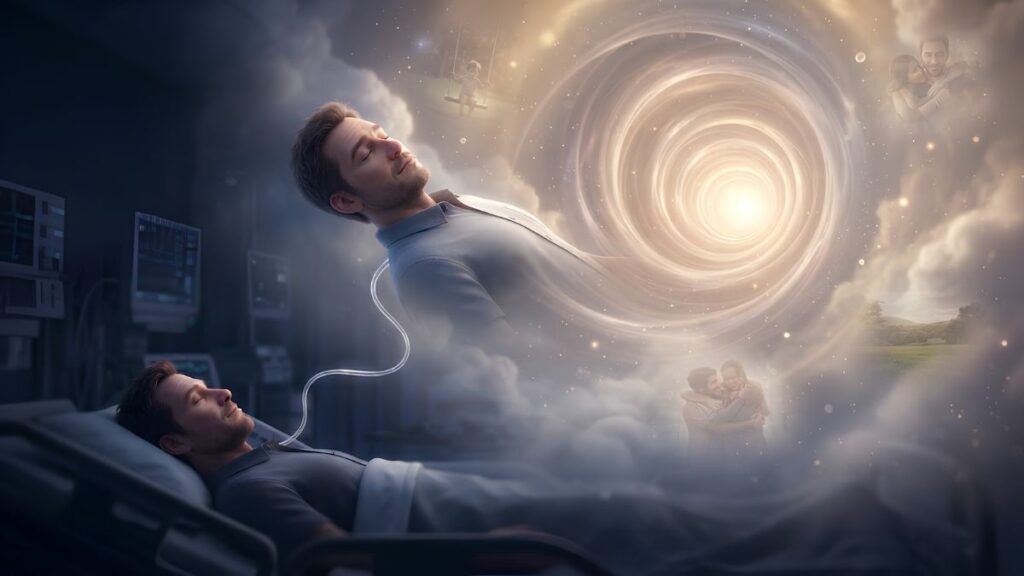
Near death experience stories have fascinated people for decades. They describe extraordinary moments reported by individuals who came close to death, survived a cardiac arrest, experienced a serious accident, underwent a medical emergency, or believed they were about to die.
Some people describe seeing a bright light. Others report traveling through a tunnel, feeling completely peaceful, meeting deceased relatives, observing their own body from above, experiencing a rapid review of their lives, or feeling as though they entered another realm.
For some, these experiences become deeply spiritual. For others, they raise questions about consciousness, memory, the brain, and what happens when the body is close to death.
Near-death experiences, commonly shortened to NDEs, are not necessarily evidence that a person has actually died and returned from an afterlife. They are experiences reported around life-threatening situations, and scientists continue to investigate how they arise. Modern research considers psychological, neurological, physiological, and cultural factors when studying them.
This article explores what near-death experiences are, why people report them, the common elements found in NDE accounts, possible scientific explanations, spiritual interpretations, and why these experiences can have such a lasting effect on someone’s life.
What Is a Near Death Experience?
A near-death experience is a profound subjective experience that occurs during or around a situation in which a person believes they are close to death.
The situation may involve cardiac arrest, a severe accident, drowning, surgery, serious illness, trauma, or another medical emergency.
Importantly, experiencing an NDE does not necessarily mean that a person was medically dead.
The term generally describes an experience associated with a life-threatening or perceived life-threatening event.
Researchers have found that NDE accounts can contain emotional, cognitive, spiritual, and unusual perceptual elements. A 2023 systematic analysis of case reports and qualitative research identified four broad categories of reported experiences: emotional, cognitive, spiritual or religious, and supernatural or metaphysical experiences.
This makes NDEs especially interesting because they sit at the intersection of medicine, psychology, neuroscience, philosophy, and spirituality.
Near Death Experience Stories
1. The Peace After the Storm
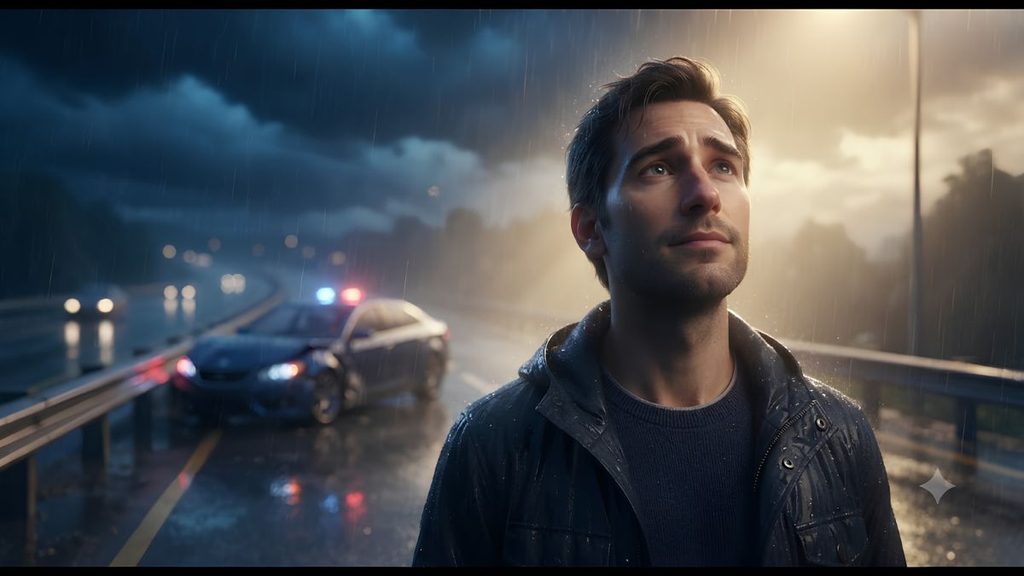
Theme: A Sense of Peace
Main Character: Daniel Carter
The Peace After the Storm
Rain had been falling for nearly two hours when Daniel Carter decided he had waited long enough.
He stood beneath the awning of a small roadside café, watching the highway disappear and reappear behind sheets of water. Cars moved slowly through the storm, their headlights glowing like pale stars behind the rain.
His phone showed 9:47 p.m.
He had promised his sister that he would be home before ten.
“Ten minutes,” he whispered.
The café owner, an elderly man named Walter, looked up from behind the counter.
“You sure you want to drive in that?”
Daniel glanced toward the road.
“I’ll be careful.”
Walter gave him the kind of look older people sometimes gave younger people when they knew an answer was already decided.
“Careful doesn’t always mean much when the road wants something else.”
Daniel smiled.
“I’ll see you tomorrow.”
“If the weather lets you.”
Daniel laughed softly, pulled his jacket around himself, and stepped into the rain.
He had driven this road hundreds of times.
It was a familiar stretch of highway surrounded by dark fields, scattered farmhouses, and long rows of trees. Under normal circumstances, it was an easy twenty-minute drive.
Tonight, the storm had transformed it into something unfamiliar.
Daniel gripped the steering wheel with both hands.
The windshield wipers moved back and forth.
Back and forth.
Back and forth.
For several minutes, nothing happened.
Then the lightning came.
A sudden white flash filled the sky.
Daniel slowed the car.
Another flash.
Thunder followed almost immediately.
He was approaching a bend when he saw red brake lights ahead.
A truck had slowed sharply.
Daniel pressed the brake.
The tires responded.
But the road was covered with water.
The car slid.
For one terrible second, Daniel felt the steering wheel become useless beneath his hands.
He turned it left.
The car moved right.
He corrected.
The rear of the car swung sideways.
There was a guardrail.
Then there was the sound of metal.
A violent impact.
Glass.
Darkness.
And then silence.
Daniel expected pain.
Instead, he felt nothing.
At first, he thought he had simply lost consciousness.
There was no road.
No rain.
No car.
No sound.
There wasn’t even darkness in the ordinary sense.
It was more like he had entered a space where darkness had no meaning.
He tried to move.
He couldn’t tell whether he had a body.
He tried to breathe.
He couldn’t tell whether breathing was necessary.
Then something changed.
The fear disappeared.
It did not slowly fade.
It simply vanished.
One moment he was frightened.
The next, he wasn’t.
Daniel had spent most of his adult life carrying a quiet background anxiety.
Bills.
Work.
Family.
Appointments.
Deadlines.
The future.
The things he had said.
The things he hadn’t said.
The things that might happen.
The things that probably wouldn’t.
There had always been something waiting around the corner of his mind.
But now there was nothing.
No unfinished task.
No question.
No responsibility.
No fear.
Only peace.
It was so complete that Daniel struggled to understand it.
He felt as though he had finally placed down a heavy suitcase he hadn’t realized he had been carrying.
He didn’t hear anyone speaking.
Yet he somehow felt reassured.
You are safe.
The thought appeared without words.
Daniel wondered where he was.
He wasn’t afraid to find out.
That surprised him.
He had always been afraid of dying.
Not because he considered death the worst thing imaginable, but because he hated the thought of leaving people behind.
His sister.
His mother.
His friends.
The small circle of people who had made his ordinary life meaningful.
Yet in this strange peaceful state, the thought of them did not hurt.
Instead, he felt connected to them.
Not physically.
Not through voices or images.
It was more like knowing they existed and knowing that love existed between them.
He remembered his sister laughing at something he had said that morning.
He remembered his mother calling him before work.
He remembered an old friend named Marcus who had moved to another state years earlier.
Small memories.
Ordinary memories.
Nothing dramatic.
And somehow, they seemed more important than everything else.
Daniel had spent years believing that important moments were supposed to be large.
Graduations.
Promotions.
Trips.
Celebrations.
Major achievements.
But now the small things seemed enormous.
A cup of coffee at the kitchen table.
His sister stealing food from his plate.
His mother leaving a light on for him when he came home late.
A quiet walk on a Sunday afternoon.
A conversation that lasted five minutes longer than necessary.
He realized how often he had been physically present without actually being there.
He had been looking at his phone during dinner.
Thinking about work while someone talked to him.
Planning tomorrow while living today.
The realization didn’t come with guilt.
There was no judgment.
Only understanding.
And then the peace became even deeper.
Daniel had the strange sensation that he did not need to understand anything.
He didn’t need an answer.
He didn’t need to know whether this place was real, imagined, neurological, spiritual, or something else entirely.
For the first time in his life, uncertainty did not frighten him.
He simply existed.
And existing was enough.
Far away, in another part of the same strange experience, Daniel suddenly remembered something.
A yellow kitchen.
His sister Emily standing near the refrigerator.
She was holding a birthday card.
Daniel had forgotten to buy one for her.
He remembered promising he would make it up to her.
“I’ll take you somewhere nice,” he had said.
“Anywhere?”
“Anywhere.”
“You’ll probably forget.”
“I won’t.”
She had smiled.
“You always say that.”
The memory faded.
Daniel felt warmth.
Not heat.
Something deeper.
Affection.
Gratitude.
Love.
Then he became aware of another feeling.
He wanted to go home.
The peace was beautiful.
He did not want to leave it.
But he wanted to see Emily.
He wanted to see his mother.
He wanted to hear ordinary sounds again.
He wanted to complain about the weather.
He wanted coffee.
He wanted to wake up on Monday morning and be annoyed by traffic.
He wanted his life.
The realization came with a strange contradiction.
He wasn’t afraid of death.
But he wasn’t ready to leave.
Then everything changed.
Daniel heard a sound.
At first it was distant.
A faint rhythm.
Beep.
Beep.
Beep.
He tried to understand it.
The peaceful space began to disappear.
The sound grew louder.
Beep.
Beep.
Beep.
Pain returned.
Cold returned.
Weight returned.
Daniel opened his eyes.
White lights.
A ceiling.
People moving quickly.
Someone was saying his name.
“Daniel? Daniel, can you hear me?”
He tried to speak.
Nothing came out.
A woman leaned closer.
“Daniel, you’re in the hospital. You’re safe.”
He closed his eyes again.
The peace was gone.
But he remembered it.
Daniel spent three days in the hospital.
His injuries were serious but not life-threatening after treatment.
A broken collarbone.
Several fractured ribs.
A concussion.
Deep cuts on his forehead and arm.
The doctors told him he was fortunate.
Daniel didn’t feel fortunate.
He felt different.
On the fourth morning, Emily came into his room carrying coffee.
She placed it on the table.
“You look terrible.”
Daniel smiled.
“You too.”
She rolled her eyes.
“Nice. Nearly die and immediately become funny.”
He looked at her.
The words came before he could think about them.
“I love you.”
Emily stopped.
She stared at him.
Daniel felt embarrassed.
“I mean… I know you know that.”
“I do.”
“But I don’t say it enough.”
Emily’s expression softened.
“No. You don’t.”
She sat beside him.
For a while, neither spoke.
Then she asked quietly:
“What happened?”
Daniel looked toward the window.
Rain was falling outside.
Not heavily.
Just a gentle spring rain.
“I don’t know exactly.”
“You don’t remember the crash?”
“I remember that.”
“What happened after?”
Daniel hesitated.
He knew how strange it would sound.
“I felt peaceful.”
Emily waited.
“Really peaceful.”
He told her what he remembered.
The absence of fear.
The feeling of being free from every responsibility.
The memories of ordinary moments.
The sense that he was safe.
He did not tell her that he had been in heaven.
He didn’t know that.
He didn’t tell her that he had left his body.
He wasn’t certain of that either.
He didn’t even say that what he experienced was definitely a near-death experience.
He simply described what he remembered.
Emily listened.
When he finished, she looked down at her hands.
“Were you scared?”
“No.”
“Even though you thought you might die?”
Daniel nodded.
“That was the strangest part.”
“What was it like?”
Daniel searched for a comparison.
“Imagine you’ve been holding your breath your whole life.”
Emily frowned.
“And then?”
“You finally breathe.”
She looked at him.
“And then you realize you didn’t know you were holding your breath.”
Daniel returned home several weeks later.
His life looked exactly the same.
His apartment.
His furniture.
His kitchen.
His books.
His old jacket hanging behind the door.
Yet everything seemed slightly different.
He began waking earlier.
Not because he had become disciplined.
He simply wanted to see the morning.
He started eating breakfast without checking his phone.
He called his mother more often.
He apologized to Marcus for losing touch.
He visited Emily every Sunday.
Sometimes they talked for hours.
Sometimes they sat in silence.
Daniel learned to enjoy the silence.
He also changed the way he worked.
Before the accident, he had treated every problem like an emergency.
Now he asked himself a simple question.
Will this matter five years from now?
The answer was usually no.
He still worked.
Still paid bills.
Still worried.
Still became irritated in traffic.
Still had bad days.
The accident had not turned him into someone permanently calm.
That would have been unrealistic.
But something had changed.
He no longer believed every thought deserved his attention.
When anxiety appeared, he noticed it.
When he became angry, he paused.
When someone he loved spoke, he tried to listen.
He started taking walks without his phone.
He cooked more.
He laughed more.
He began keeping a small notebook beside his bed.
On the first page, he wrote:
Do not miss your life while waiting for it to begin.
Months later, Daniel returned to the roadside café.
Walter was still there.
The old man looked at him for several seconds.
“Well,” he said, “the weather finally let you come back.”
Daniel smiled.
“I suppose it did.”
Walter poured him coffee.
“Still driving?”
“Sometimes.”
“More carefully?”
Daniel laughed.
“Definitely.”
They sat near the window.
Outside, the road stretched toward the horizon.
Daniel watched cars pass.
For a moment, he remembered the storm.
The impact.
The silence.
The strange peace.
He still didn’t know what had happened to him.
Perhaps his brain had created an extraordinary experience during a moment of extreme physical stress.
Perhaps his perception of time and fear had changed because of the accident.
Perhaps there was an explanation science would someday understand better.
Or perhaps there was something about consciousness that remained beyond his understanding.
Daniel no longer felt compelled to decide.
He had learned that uncertainty could be peaceful too.
Walter placed another cup of coffee on the table.
“You all right?”
Daniel nodded.
“Yeah.”
He looked through the window.
The sky was clear.
Sunlight rested on the wet road.
Everything looked ordinary.
And suddenly Daniel realized that ordinary was beautiful.
He thought about the life he had nearly lost.
Not the dramatic parts.
Not the achievements.
Not the plans.
The ordinary parts.
The morning calls.
The shared meals.
The stupid jokes.
The quiet evenings.
The people who knew him well enough to notice when he was pretending to be fine.
Those were the things he wanted now.
He didn’t need to know what waited at the end of life.
He only wanted to be present for the part he was living.
Daniel finished his coffee.
Then he stood.
Outside, the air smelled clean after the rain.
He walked toward his car.
Before opening the door, he stopped.
For several seconds, he simply stood there.
No phone.
No schedule.
No destination pressing against his thoughts.
Just sunlight.
Wind.
The sound of distant traffic.
And the quiet awareness that he was alive.
Daniel smiled.
Then he drove home.
Slowly.
Not because he was afraid anymore.
But because, for the first time, he wasn’t in such a hurry to get somewhere else.
2. The View From Above
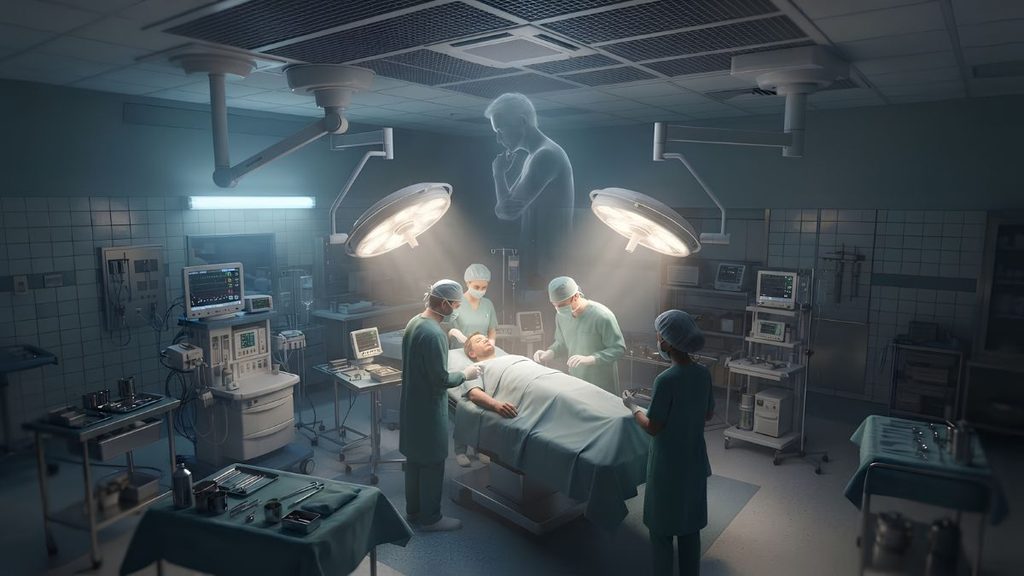
Theme: Feeling Separate From the Body
Main Character: Michael Bennett
Michael Bennett had never been particularly interested in mysteries.
He liked explanations.
If a car made a strange noise, he wanted to know which part was failing. If his phone stopped working, he wanted to know whether the battery, software, or charger was responsible. When people talked about ghosts, spirits, or unexplained experiences, Michael usually smiled politely and changed the subject.
He was a practical man.
At forty-six, he worked as an architectural project manager in Boston. His days were filled with plans, measurements, schedules, contractors, emails, and meetings.
He trusted things he could see.
He trusted things he could measure.
Most of all, he trusted the idea that the mind existed inside the brain.
Until the morning his own body became a mystery.
It began with a routine appointment.
Michael had been experiencing abdominal pain for several months. At first, he ignored it. Then it became frequent enough that he mentioned it to his doctor.
Tests followed.
Scans.
More tests.
Specialists.
Eventually, the doctors found a problem that required surgery.
“It should be straightforward,” the surgeon told him.
Michael appreciated those words.
Straightforward.
He liked straightforward.
The morning of the operation, he sat on the edge of the hospital bed wearing a pale blue gown while his wife, Laura, sat beside him.
“You’re nervous,” she said.
“No.”
She smiled.
“You’re tapping your foot.”
Michael looked down.
His right foot was moving rapidly against the floor.
“That’s not nervousness.”
“What is it?”
“Rhythmic thinking.”
Laura laughed.
“You’re impossible.”
Michael smiled.
A nurse came in and checked his information.
A doctor stopped by.
Then another nurse.
Everything happened according to a carefully organized routine.
Eventually, Laura stood.
“I’ll be waiting when you wake up.”
Michael reached for her hand.
“You’d better be.”
“I will.”
She leaned down and kissed his forehead.
Then she left.
Michael watched the door close.
For some reason, he suddenly felt very small.
The room was quiet.
The fluorescent lights hummed overhead.
A monitor beside him displayed numbers he didn’t fully understand.
He closed his eyes.
The operating room was cold.
Michael remembered that clearly.
He remembered bright lights.
He remembered people speaking.
He remembered someone adjusting something near his arm.
Then the anesthesiologist told him to relax.
“Take slow breaths.”
Michael inhaled.
The room seemed to become softer around him.
He heard a voice.
“Just keep breathing.”
He tried.
The ceiling blurred.
The sounds became distant.
Then everything disappeared.
Michael expected darkness.
Instead, he opened his eyes.
Or at least he thought he opened his eyes.
The first thing he noticed was that he could see.
Not normally.
There was no sensation of blinking.
No eyelids.
No head turning.
He simply saw.
Below him was the operating room.
He stared.
For a moment, he couldn’t understand what he was looking at.
There was the operating table.
There were several people around it.
There were machines.
Lights.
Cables.
Metal instruments.
And in the center of everything was a body.
His body.
Michael froze.
He tried to move.
Nothing happened.
He tried to look down at himself.
There was nothing to look down with.
Yet he could see the room from above.
He seemed to be suspended somewhere near the ceiling.
The perspective was impossible.
He could see the top of the operating lights.
He could see the arrangement of equipment.
He could see people moving around the table.
He could see a doctor leaning forward.
He could see the green surgical coverings.
And beneath them was him.
A thought appeared.
That’s me.
Michael felt no pain.
No pressure.
No difficulty breathing.
There was only an overwhelming sense of distance.
He was present.
But he was not inside his body.
At first, Michael assumed he was dreaming.
That seemed like the obvious explanation.
He had been given anesthesia.
Perhaps this was simply a vivid dream.
But it didn’t feel like a dream.
Everything appeared extraordinarily sharp.
He noticed details he wouldn’t normally pay attention to.
The shape of a ceiling panel.
A small reflection on a metal surface.
The movement of a nurse’s hands.
The positioning of equipment.
He tried to remember the room as it had looked before the anesthesia.
He couldn’t.
This was different.
The experience seemed more precise than ordinary memory.
Michael tried to speak.
“Hello?”
No sound came.
He attempted to move toward the operating table.
Instead, he seemed to drift.
There was no physical sensation of movement.
He simply changed position.
The room became larger.
Then smaller.
He moved closer to the ceiling.
He could see everything.
For a strange moment, Michael felt completely calm.
There was no fear.
He wasn’t worried about the surgery.
He wasn’t thinking about work.
He wasn’t thinking about Laura.
He wasn’t even thinking about whether he was alive.
He was simply observing.
Then a terrifying thought entered his mind.
What if I can’t go back?
The calm disappeared.
Michael tried to move toward his body.
Nothing happened.
He tried again.
Nothing.
His attention became fixed on the figure beneath the surgical lights.
His body looked strangely unfamiliar.
It was his face.
His hands.
His chest.
His body.
But he didn’t feel connected to it.
He had spent forty-six years thinking of himself as that body.
Now he was somewhere else.
Or at least it seemed that way.
Then Michael heard voices.
They were muffled.
Distant.
But somehow understandable.
Someone said something about his blood pressure.
Another voice responded.
A machine began making a different sound.
Michael watched the room change.
The people around the table became more active.
Someone moved quickly toward a machine.
Another person adjusted something.
The atmosphere suddenly felt urgent.
Michael didn’t understand what was happening.
He felt strangely powerless.
He could see.
But he couldn’t help.
He could hear.
But he couldn’t speak.
He wanted to tell them that he was there.
He wanted to tell them he could see everything.
But no words came.
He tried again.
Nothing.
Then he noticed something else.
He could hear a sound behind him.
A low, steady hum.
It seemed to come from everywhere.
The sound became louder.
The room began to fade.
Michael looked down one last time.
His body remained beneath the lights.
Then the distance between them disappeared.
He woke with a gasp.
His eyes opened.
The first thing he saw was Laura.
She was sitting beside the hospital bed.
Her face was tired.
Her eyes were red.
Michael tried to speak.
His throat felt dry.
“Laura?”
She immediately leaned forward.
“Michael?”
He swallowed.
“I’m here.”
She smiled through tears.
“You scared me.”
“What happened?”
“The doctors had some complications.”
Michael looked at her.
“What kind?”
She hesitated.
“They said your blood pressure dropped dangerously low for a while.”
Michael stared at the ceiling.
He remembered the operating room.
The view.
The body.
The strange feeling of floating.
He looked back at Laura.
“Can I ask you something?”
“Of course.”
“Where were you sitting during the surgery?”
She frowned.
“What?”
“Before they took me in. You waited in the surgical waiting area, right?”
“Yes.”
“Where exactly?”
She looked confused.
“Why?”
“Just tell me.”
Laura thought.
“Near the windows. Second row of chairs.”
Michael closed his eyes.
Something about that mattered to him.
He didn’t know why.
“What color was your sweater?”
Laura looked down.
“Gray.”
Michael opened his eyes.
“That isn’t what I remember.”
“What do you mean?”
“I remember you wearing blue.”
Laura smiled sadly.
“It was gray.”
Michael said nothing.
Maybe he had been wrong.
Maybe the memory had changed.
Maybe his mind had filled in something that wasn’t there.
But another detail remained.
During the experience, he remembered seeing the operating room from above.
He remembered specific objects.
Specific positions.
Specific movements.
He couldn’t explain them.
Over the next several weeks, Michael became obsessed with what had happened.
He searched through medical articles.
He read books about consciousness.
He watched interviews with people describing near-death experiences.
He learned that other people had reported feeling detached from their bodies.
Some described floating above themselves.
Some described seeing their bodies from unusual perspectives.
Others reported tunnels, lights, peaceful feelings, unfamiliar environments, or encounters with people they believed were deceased.
Michael read everything he could find.
But the more he learned, the less certain he became.
There were neurological explanations.
Changes in blood flow.
Effects of anesthesia.
Altered sensory processing.
Memory reconstruction.
Disturbances in the brain’s representation of the body.
Michael found one concept particularly fascinating.
The brain normally creates a sense of where the body is located in space.
It combines information from vision, touch, balance, and other senses.
If those systems become disrupted, the experience of being located inside the body might also become disrupted.
Michael found that explanation convincing.
At least partly.
But there was still one question he couldn’t let go.
Why had the experience felt so real?
Dreams could feel real.
Memories could feel real.
Hallucinations could feel real.
He knew that.
But knowing something intellectually was different from experiencing it.
Michael had spent decades believing that the sensation of being inside his body was unquestionable.
Now he knew it could change.
That realization affected him deeply.
One evening, several months after the surgery, Michael sat in his study.
Laura entered carrying two cups of tea.
“You’re still reading about consciousness.”
Michael smiled.
“Apparently.”
She handed him a cup.
“You know, normal people watch television.”
“I’ve tried.”
“You hate television.”
“Exactly.”
She sat opposite him.
After a moment, she asked:
“Do you still think you left your body?”
Michael considered the question.
“I don’t know.”
“You seemed very sure before.”
“I was sure about what I experienced.”
Laura nodded.
“But you’re not sure what caused it.”
“Exactly.”
He looked toward the window.
“I know I experienced myself somewhere above that room.”
“And you think that really happened?”
Michael smiled.
“That’s the problem.”
He paused.
“I don’t know what ‘really happened’ means anymore.”
Laura waited.
Michael continued.
“I know my body was on that operating table. I know I was experiencing something. I know it felt like I was somewhere above myself.”
He looked down at his tea.
“But whether my consciousness actually separated from my body… I don’t know.”
Laura reached across the table.
“Does that bother you?”
“No.”
That surprised her.
Michael smiled.
“Actually, it makes me curious.”
The experience changed him in subtle ways.
He became less certain.
But strangely, he also became more comfortable with uncertainty.
Before the surgery, Michael had thought that not knowing something meant there was a problem.
Now he saw uncertainty differently.
Some questions could remain open.
He began taking more walks.
He spent less time checking his phone.
He started noticing his surroundings.
The sensation of being inside his own body no longer felt automatic.
Sometimes he would stop while walking and notice his feet touching the ground.
He would notice his breathing.
The movement of his hands.
The sound of his heartbeat.
It wasn’t frightening.
It was fascinating.
His body, which he had once taken completely for granted, had become something he appreciated.
One afternoon, he visited the hospital where the surgery had taken place.
He stood outside the operating wing.
The hallway was quiet.
A nurse passed him.
A cart rolled by.
Everything looked ordinary.
Michael realized that the room where he had experienced the strangest moment of his life was probably being used for another operation.
Someone else was lying beneath those lights.
Someone else was waiting.
Someone else was trusting their body to strangers.
Michael felt a strange sense of humility.
He placed his hand against the wall.
For years, he had believed that consciousness was simple.
You were inside your body.
You looked through your eyes.
You heard through your ears.
You moved your arms and legs.
That was you.
Now he knew that the experience of being a person could be far more complicated.
Years later, Michael still remembered the view.
Sometimes he wondered whether it had been produced by his brain during an extreme physiological event.
Sometimes he wondered whether there was something about consciousness that science had not yet fully explained.
He refused to turn either possibility into certainty.
The experience had taught him something more important than an answer.
It had taught him how little he knew.
And instead of frightening him, that realization made life more interesting.
One night, Michael stood beside the window of his apartment.
Boston glittered below.
Thousands of windows.
Thousands of lives.
Thousands of people moving through ordinary evenings.
He looked down at his own hands.
For a moment, he remembered the operating room.
The impossible perspective.
The feeling of floating.
The strange separation.
Then he looked at Laura, who was sitting on the sofa reading.
She noticed him staring.
“What?”
Michael smiled.
“Nothing.”
“You’re doing that mysterious thing again.”
“What mysterious thing?”
“Looking like you’ve discovered the meaning of the universe.”
He laughed.
“I haven’t.”
“Good.”
She returned to her book.
Michael looked outside again.
He still didn’t know whether he had truly floated above his body.
He didn’t know whether consciousness could exist independently of the brain.
He didn’t know whether the experience had been a remarkable neurological event, a reconstruction of memory, an altered state of awareness, or something science had yet to understand.
But he knew one thing.
For a few extraordinary moments, his usual sense of self had disappeared.
And when it returned, he never again took it for granted.
Michael turned off the light.
The city remained glowing outside.
He closed his eyes.
He could feel his feet against the floor.
His hands at his sides.
His breath moving slowly in and out.
He was inside his body.
He knew that.
Or at least, he believed he did.
And for now, that was enough.
3. The Tunnel of Light
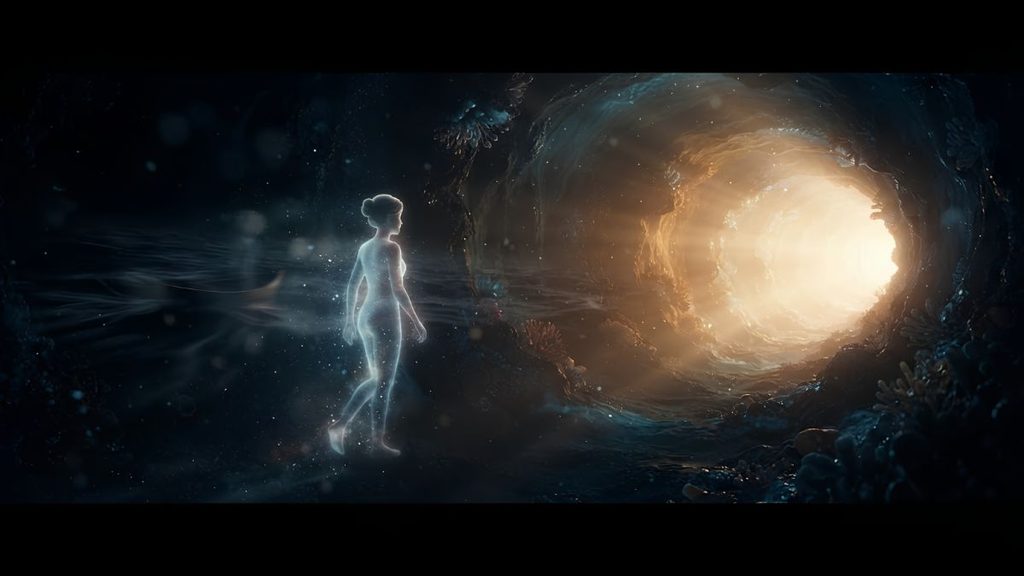
Theme: Moving Through a Tunnel
Main Character: Sophie Reynolds
Sophie Reynolds had always loved the water.
She loved the way a lake looked just before sunrise, when the surface was almost perfectly still and the world seemed to be holding its breath.
She loved the sound of waves against the side of a boat.
She loved the smell of rain arriving across open water.
Most of all, she loved the feeling of being somewhere with no traffic, no buildings, and no reminders of the busy world waiting on shore.
That was why she had agreed to spend the weekend on Lake Michigan with her older brother, Daniel, and two close friends.
It was supposed to be a simple trip.
Two days on the water.
Good food.
Music.
A little swimming.
Then home Sunday evening.
None of them expected the weather to change so quickly.
They had been on the lake for nearly three hours when Daniel noticed the clouds.
“Those weren’t there ten minutes ago.”
Sophie looked toward the horizon.
A line of dark clouds had appeared in the distance.
“They’re moving fast.”
Daniel nodded.
“We should head back.”
The others agreed.
The boat turned toward shore.
At first, the wind was only slightly stronger.
Then it became violent.
The surface of the lake changed from gentle waves into sharp, uneven ridges.
Rain began hitting the windshield.
Sophie moved toward the back of the boat and held onto the railing.
“Daniel!”
He turned.
“Stay inside!”
Another wave struck the boat.
Everyone lost their balance.
Sophie grabbed the railing with both hands.
Lightning flashed across the sky.
The sound of thunder came almost immediately.
Then another wave hit.
Harder.
The boat tilted.
Someone screamed.
Sophie felt herself slipping.
She reached for the nearest support.
Her fingers missed.
For a moment she was weightless.
Then she hit the side of the boat.
The world became noise.
Rain.
Wind.
Shouting.
Water.
Then darkness.
Sophie later learned that she had fallen into the lake.
Her friends had pulled her from the water.
Daniel had called for emergency assistance.
The rescue team had arrived quickly.
Her heart had continued beating, but she had lost consciousness and was not responding normally.
She was transported to the hospital.
According to the medical records, only a few minutes passed between the accident and the point when she began responding.
But Sophie remembered something very different.
She remembered a journey.
At first, there was nothing.
No sound.
No body.
No sensation of falling.
No water.
No fear.
Just darkness.
It wasn’t the darkness of a room at night.
It was deeper than that.
There was no sense of distance.
No floor.
No ceiling.
No direction.
Sophie couldn’t tell whether she was standing, lying down, or floating.
She tried to move.
She couldn’t.
She tried to speak.
There was no voice.
She wasn’t even sure she had a body.
Yet strangely, she wasn’t frightened.
The darkness felt empty.
But it didn’t feel threatening.
Sophie waited.
She didn’t know for how long.
Seconds.
Minutes.
Hours.
Time had stopped behaving normally.
Then she saw something.
A tiny point of light.
Far away.
So small that she initially thought she had imagined it.
She stared.
The light remained.
It was barely larger than a pinprick.
But it was there.
Sophie felt drawn toward it.
She didn’t consciously decide to move.
She simply began moving.
Slowly.
The darkness around her seemed to form a passage.
A tunnel.
At first, it was almost impossible to notice.
The edges were barely visible.
Sophie couldn’t see walls in the ordinary sense.
Instead, she sensed that she was moving through a narrow space.
The light remained ahead.
She moved toward it.
The farther she traveled, the more the darkness behind her seemed to disappear.
Something about the experience felt familiar.
Not familiar like a remembered place.
More like the feeling of returning somewhere.
Sophie tried to think about the accident.
She couldn’t.
She tried to think about Daniel.
His face appeared briefly.
Then disappeared.
She tried to remember her apartment.
Her work.
Her childhood.
Her parents.
Her friends.
Everything seemed distant.
She wasn’t forgetting them exactly.
It was more like they were becoming less important.
The light grew larger.
Sophie continued moving.
She felt strangely peaceful.
There was no urgency.
No pain.
No cold water.
No storm.
Only movement.
Forward.
The tunnel seemed endless.
Sophie couldn’t tell how long she had been traveling.
She began to wonder whether she was dreaming.
Perhaps this was the strange landscape of a sleeping mind.
Perhaps she had entered some kind of hallucination.
But the experience seemed more vivid than any dream she could remember.
Every part of it felt immediate.
She was aware of herself.
Aware of the light.
Aware of the movement.
Aware of the strange sense that she was leaving something behind.
She looked backward.
There was nothing.
The darkness stretched behind her.
She suddenly realized that she couldn’t remember the exact moment when she had entered the tunnel.
There was no beginning.
There was only the feeling of already being there.
She turned toward the light again.
It had become brighter.
Not painful.
Warm.
Soft.
Almost golden.
Sophie felt an overwhelming sense that she was approaching something.
Something important.
She couldn’t explain what.
She didn’t see a person.
She didn’t hear music.
She didn’t see a landscape.
There was simply the light.
And the closer she came, the more peaceful she felt.
Then memories began appearing.
Her first bicycle.
Her father’s old blue jacket.
Her mother teaching her how to swim.
Daniel carrying her home after she had fallen asleep during a family picnic.
The first apartment she had rented.
Her first serious job.
A rainy afternoon in Paris.
A dog she had loved as a child.
A conversation with a friend she hadn’t spoken to in years.
None of the memories lasted long.
They appeared like flashes.
Then disappeared.
Sophie realized something strange.
She wasn’t remembering the important events in the order they had happened.
They seemed to arrive without sequence.
A childhood memory.
Then a recent conversation.
Then a smell from a kitchen.
Then the sound of laughter.
Then her father’s voice.
It was as if her entire life had become a collection of moments rather than a timeline.
She felt herself moving farther away from all of it.
The thought frightened her.
For the first time since entering the darkness, she felt afraid.
She didn’t want to lose those memories.
She didn’t want to leave.
The light continued growing.
Sophie felt herself moving faster.
The tunnel seemed narrower.
The light filled more of her vision.
She could no longer see the darkness behind her.
She wondered what would happen if she reached it.
Would she wake?
Would she disappear?
Would there be something beyond it?
She didn’t know.
And for a moment, she wanted to find out.
Then she heard her name.
“Sophie.”
She stopped.
The voice was distant.
Almost impossible to hear.
She looked around.
Nothing.
“Sophie!”
The voice came again.
This time it was clearer.
Someone was calling her.
The tunnel seemed to shake.
The light flickered.
Sophie tried to answer.
“Who are you?”
No sound came.
Then she heard it again.
“Sophie!”
There was urgency in the voice now.
She knew it.
Daniel.
Her brother.
The realization was immediate.
The memories came rushing back.
The boat.
The storm.
The water.
Daniel.
Her friends.
The shore.
The hospital.
Her family.
Everything she had been leaving behind suddenly became important.
Sophie turned away from the light.
She didn’t want to.
But something inside her pulled her backward.
The tunnel began disappearing.
The light became smaller.
The darkness returned.
Daniel’s voice grew louder.
“Sophie, wake up!”
Then everything vanished.
Sophie opened her eyes.
The first thing she saw was a ceiling.
White.
Bright.
Blurry.
She tried to move.
A hand immediately grabbed hers.
“Sophie?”
She turned her head.
Daniel was standing beside the bed.
His hair was wet.
His face looked exhausted.
“You’re awake.”
Sophie tried to speak.
Her throat hurt.
“Where…?”
“Hospital.”
She closed her eyes.
The word echoed in her mind.
Hospital.
She remembered the boat.
The water.
Then the tunnel.
She opened her eyes again.
“How long?”
Daniel looked confused.
“How long what?”
“How long was I… gone?”
He hesitated.
“Not long.”
“How long?”
“Maybe four or five minutes before you started responding.”
Sophie stared at him.
Four or five minutes.
That couldn’t be right.
She had traveled through the tunnel for what felt like hours.
Maybe longer.
She remembered movement.
Memories.
The light.
The feeling of leaving everything behind.
She whispered:
“It felt like much longer.”
Daniel sat down.
“What did?”
“The tunnel.”
He looked at her.
“What tunnel?”
Over the next few days, Sophie told the doctors what she remembered.
She was careful with her words.
She didn’t say she had died.
She didn’t say she had entered another world.
She didn’t say she had traveled somewhere outside her body.
She simply described the experience.
Darkness.
A point of light.
Movement.
A tunnel.
A growing light.
Memories.
Her brother’s voice.
Then waking.
One doctor listened carefully.
“People can have very vivid experiences during periods of unconsciousness,” he explained.
Sophie nodded.
“I know.”
“Dreamlike experiences can also distort our sense of time.”
“I know.”
The doctor smiled.
“But that doesn’t make the experience meaningless.”
Sophie appreciated that.
She wasn’t looking for someone to tell her what had happened.
She wanted to understand it.
When she returned home, she began writing everything down.
She wrote the sequence exactly as she remembered it.
She drew the tunnel.
She described the light.
She wrote down every memory she could recall.
Then she wrote one question at the bottom of the page:
Why did it feel so long?
She researched subjective time.
She learned that the brain does not always experience time in the same way a clock measures it.
Dreams could contain complicated sequences that seemed to last much longer than the actual sleep period.
Memory could also compress or expand experiences.
Extreme physiological stress could affect perception.
None of this explained her experience completely.
But it gave her possibilities.
She found comfort in that.
She didn’t need one answer.
Three months after the accident, Sophie returned to the lake.
She almost didn’t go.
The first time she saw the water again, she felt her chest tighten.
Daniel noticed.
“We don’t have to stay.”
Sophie looked across the lake.
The surface was calm.
Almost perfectly calm.
“I want to.”
They sat on the dock.
For several minutes, neither spoke.
Then Daniel asked:
“Do you still think about it?”
“The tunnel?”
He nodded.
“Every day.”
“Do you think it was real?”
Sophie smiled.
“That’s a complicated question.”
“What do you think?”
She looked at the horizon.
“I think the experience was real.”
Daniel waited.
“But I don’t know what caused it.”
He nodded slowly.
“That sounds reasonable.”
Sophie looked at the water.
“I used to think there were only two possibilities. Either it was supernatural, or it was just a dream.”
“And now?”
“Now I think there are probably more possibilities than I understand.”
Daniel smiled.
“You’re becoming philosophical.”
“Don’t tell anyone.”
That night, Sophie slept badly.
She dreamed of the tunnel.
But this time, she wasn’t moving toward the light.
She was standing at its entrance.
The light was distant.
The darkness surrounded her.
She looked forward.
Then backward.
She realized something.
The tunnel no longer frightened her.
Neither did the light.
What frightened her was the idea of rushing through life without noticing it.
The accident had changed something inside her.
Before the accident, she had always thought of life as a long road leading somewhere.
She was always preparing for the next thing.
The next job.
The next trip.
The next achievement.
The next weekend.
The next year.
Now she thought differently.
Perhaps life wasn’t only about where you were going.
Perhaps it was also about noticing where you were.
The thought stayed with her after she woke.
Years passed.
Sophie never forgot the tunnel.
She eventually stopped trying to determine exactly what it meant.
Sometimes she thought about the neurological explanations she had studied.
Sometimes she wondered whether consciousness might be more complicated than anyone understood.
Sometimes she remembered the warmth of the light.
But she never claimed that the tunnel proved anything about an afterlife.
She couldn’t know that.
Nobody could tell her with certainty what had happened inside those few minutes.
What she could say was simpler.
She had experienced something extraordinary.
Something that felt longer than the time measured by the clocks around her.
Something that had made her reconsider her relationship with life.
One evening, many years after the accident, Sophie stood beside the lake again.
The sun was setting.
The water reflected a narrow line of golden light.
She watched it stretch across the surface.
For a moment, the scene reminded her of the tunnel.
The same warmth.
The same brightness.
The same feeling of moving toward something she could not name.
But this time she didn’t feel pulled toward it.
She simply stood there.
Present.
Breathing.
Listening to the water.
She thought about the voice that had called her back.
Daniel’s voice.
A simple human voice.
A familiar voice.
Perhaps that was what mattered most.
Whatever the tunnel had been, whatever the light had represented, whatever had happened inside her mind during those strange minutes, she had returned to the world she knew.
And she had returned with a new appreciation for it.
Sophie looked at the people walking along the shore.
A father holding his daughter’s hand.
Two friends laughing.
An elderly couple sitting together on a bench.
A child chasing a bird.
Ordinary moments.
The kind of moments she might once have ignored.
She didn’t ignore them now.
The lake became darker as evening arrived.
Sophie took a slow breath.
Then she smiled.
She still remembered the tunnel.
She still remembered the light.
She still remembered the impossible feeling that she had been traveling for hours when only minutes had passed.
But she had stopped asking whether she had reached somewhere beyond life.
Instead, she asked herself a different question.
What if the most important part of the journey wasn’t where she had been going?
What if it was where she had come back to?
Sophie turned toward home.
The first stars were appearing above the water.
She walked slowly along the shore.
Not toward another world.
Not away from this one.
Just forward.
One ordinary step at a time.
4. The Light That Knew Her Name

Theme: Seeing a Bright Light
Main Character: Eleanor Hayes
Eleanor Hayes trusted facts.
She trusted clocks because they told the same time for everyone.
She trusted maps because roads remained where maps said they were.
She trusted doctors because medicine was built on years of study, testing, failure, and evidence.
What she did not trust were stories that depended on feelings.
Ghost stories.
Premonitions.
Messages from the other side.
Near-death experiences.
Eleanor had heard plenty of them.
People described tunnels, lights, voices, relatives who had died years earlier, peaceful gardens, strange landscapes, and moments when they believed they had left their bodies.
Whenever someone told her such a story, Eleanor listened politely.
Then she usually said the same thing.
“The brain is capable of extraordinary things.”
She didn’t mean it cruelly.
She simply believed there was probably an explanation.
She had never felt the need to search for one.
Until the night she saw the light.
Eleanor was fifty-two when it happened.
It began on an ordinary Tuesday.
She had spent the day at work, answering emails, reviewing documents, and trying to finish a report before the end of the week.
That evening, she cooked pasta.
She watered the plants.
She called her daughter, Hannah.
They talked for twenty minutes about nothing particularly important.
Hannah complained about her landlord.
Eleanor complained about the price of groceries.
They laughed.
Before hanging up, Hannah said:
“Call me tomorrow.”
“I will.”
“You promise?”
“Of course.”
Eleanor smiled.
“Goodnight.”
“Goodnight, Mom.”
Those were the last ordinary words Eleanor remembered clearly.
The pain began later that night.
At first, she thought it was indigestion.
Then the pain became stronger.
She sat on the edge of the bed.
Something felt wrong.
Her heart was racing.
She became dizzy.
She tried to stand.
The room tilted.
Eleanor reached for the bedside table.
Her hand missed.
She fell.
She remembered hearing the sound of something breaking.
Then she remembered nothing.
The next thing Eleanor remembered was light.
Not a lamp.
Not sunlight.
Not headlights.
Something far larger.
She seemed to be surrounded by it.
At first, there was no shape.
No obvious source.
Just brightness.
Enormous brightness.
It filled everything.
There was no ceiling.
No floor.
No walls.
No horizon.
Eleanor tried to understand where she was.
She couldn’t.
She tried to move.
She wasn’t sure whether she had a body.
She tried to speak.
There was no voice.
Yet she was completely aware.
More aware than she had ever felt.
The light seemed to stretch endlessly in every direction.
It wasn’t harsh.
It didn’t hurt her eyes.
Instead, it felt warm.
Not physically warm.
Emotionally warm.
Eleanor felt surrounded by something she could not name.
Then came the strangest part.
She felt known.
Completely known.
Not watched.
Not judged.
Known.
It was as though every part of her life was visible.
Every mistake.
Every kindness.
Every secret fear.
Every selfish thought.
Every regret.
Every moment she had been proud.
Every moment she had been ashamed.
Nothing seemed hidden.
Eleanor’s first reaction was fear.
If something could see everything she had ever done, she thought, surely it would judge her.
But nothing happened.
There was no accusation.
No punishment.
No disappointment.
Only acceptance.
The realization overwhelmed her.
She had spent much of her life believing that love was conditional.
Be successful.
Be responsible.
Be useful.
Be kind.
Do the right thing.
Don’t make mistakes.
Don’t disappoint people.
Don’t become a burden.
She had carried those rules quietly for decades.
Now they seemed to disappear.
The light did not ask her to prove anything.
It didn’t ask her to explain herself.
It didn’t demand that she become better.
It simply seemed to accept that she was Eleanor.
Exactly as she was.
The feeling was so unfamiliar that she began to cry.
Except she couldn’t feel tears.
There was no body.
There was only emotion.
And then something even stranger happened.
She felt as though the light knew her name.
Not because someone spoke it.
No voice said Eleanor.
Instead, the knowledge arrived directly.
Eleanor.
She felt recognized.
She had no idea how.
She thought about her daughter.
Hannah appeared in her awareness immediately.
Eleanor remembered the first time she held her.
She remembered Hannah’s tiny fingers.
The sleepless nights.
The arguments during adolescence.
The first day of university.
The phone calls.
The birthdays.
The moments when Eleanor had worried without admitting she was worried.
She felt love.
Then regret.
There were things she wished she had said.
Apologies she had delayed.
Conversations she had avoided.
She suddenly understood that life was not measured only by accomplishments.
It was measured by relationships.
By moments.
By attention.
By whether you were truly present with another person.
The light remained.
It did not speak.
Yet Eleanor felt as though she understood something.
Not a sentence.
Not a lesson.
More like a realization.
She had spent too much time trying to become someone worthy of love.
Perhaps she had never needed to.
Then Eleanor noticed something else.
She was not afraid of dying.
That surprised her.
She had always assumed death would terrify her.
She had feared growing old.
She had feared illness.
She had feared the possibility of losing control.
Yet surrounded by the light, fear seemed unnecessary.
There was no sense of urgency.
No clock.
No appointment.
No deadline.
Nothing she needed to accomplish.
For the first time in her life, she felt completely free from expectation.
She wondered if this was what peace meant.
Not happiness.
Not excitement.
Not pleasure.
Peace.
The complete absence of resistance.
She felt as though she could remain there forever.
Then she remembered Hannah.
And suddenly she wanted to go back.
The realization was painful.
The light seemed to become more distant.
Eleanor felt herself moving.
She didn’t choose the direction.
She didn’t know what was happening.
The warmth began to fade.
The brightness softened.
Something was pulling her away.
She wanted to stay.
At the same time, she wanted to return.
Then she heard a sound.
A voice.
This time, it was unmistakably human.
“Eleanor.”
She recognized Hannah’s voice.
The light disappeared.
She woke in a hospital.
Her daughter was sitting beside her.
Hannah was crying.
Eleanor tried to speak.
“Hannah?”
Her daughter grabbed her hand.
“Mom.”
Eleanor looked around.
White walls.
Medical equipment.
A monitor.
A window.
Everything was painfully ordinary.
She closed her eyes.
For a moment, she could still feel the light.
Not see it.
Feel it.
Then it was gone.
The doctors explained what had happened.
Eleanor had experienced a severe medical crisis at home.
Her daughter had become concerned when Eleanor failed to answer her phone the next morning.
Hannah had gone to the apartment.
She found her mother unconscious and called emergency services.
Eleanor had been transported to the hospital.
The medical team had stabilized her.
She had been unconscious for a period of time.
The doctors answered many of her questions.
But Eleanor never asked the question she really wanted answered.
What was the light?
She didn’t know how to phrase it.
And she wasn’t sure anyone could answer.
For several weeks, Eleanor kept the experience to herself.
She returned home.
She recovered slowly.
She began walking every morning.
She ate more carefully.
She followed her doctor’s instructions.
She went to appointments.
She did everything a practical person was supposed to do.
But something inside her had changed.
She became more patient.
Not always.
She still became irritated.
She still complained.
She still worried.
But she noticed the moments differently.
If Hannah called, Eleanor stopped what she was doing.
If a friend told her a story, she listened more carefully.
When she sat with her morning coffee, she sometimes put her phone away.
She began noticing sunlight on the kitchen wall.
The sound of rain.
The smell of fresh bread.
The feeling of warm water on her hands.
Ordinary things seemed strangely precious.
Eventually, Eleanor told Hannah about the light.
They were sitting in the garden.
Hannah listened without interrupting.
When Eleanor finished, her daughter asked:
“Do you think you went somewhere?”
Eleanor looked at her.
“I don’t know.”
“Do you think it was heaven?”
“I don’t know.”
“Do you think you actually died?”
“No.”
Hannah smiled slightly.
“You’re still skeptical.”
Eleanor laughed.
“I suppose I am.”
Then she became serious.
“But I’m no longer certain that skepticism means refusing to believe something.”
Hannah waited.
“I think skepticism means admitting when you don’t know.”
That became one of the most important lessons Eleanor took from the experience.
Before that night, she had believed that every mystery was simply a problem waiting for an explanation.
Now she understood that some experiences could be meaningful even before their explanation was known.
Eleanor began reading about consciousness.
She read scientific papers.
She read accounts from people who had experienced near-death states.
She read about oxygen deprivation.
Brain activity.
Memory.
Perception.
Dreaming.
Anesthesia.
She found explanations that could potentially account for some aspects of what she experienced.
She found research suggesting that unusual brain states could produce vivid perceptions.
She learned that memories formed during extreme circumstances could be extraordinarily convincing.
She found discussions about how the brain constructs our sense of self and reality.
All of it fascinated her.
None of it completely erased the experience.
But she didn’t expect it to.
She realized she had been asking the wrong question.
She had been asking:
Was the light objectively real?
Perhaps a better question was:
What did the experience mean to me?
That question had an answer.
It meant everything.
One year after the medical crisis, Eleanor returned to the hospital.
She had an appointment with one of her doctors.
Before leaving, she walked down the corridor where she had once been treated.
The hallway was quiet.
A nurse pushed a cart past her.
A man sat beside a sleeping patient.
A child laughed somewhere behind a door.
Life was continuing.
Eleanor stopped beside a window.
Sunlight filled the glass.
For one brief moment, the brightness reminded her of the light.
She felt the old emotion return.
Peace.
Acceptance.
The feeling of being completely known.
She closed her eyes.
Then she opened them.
The hospital was still there.
The hallway was still there.
She was still Eleanor.
She didn’t need to escape the ordinary world to feel what she had felt that night.
She could carry some of it with her.
Years later, Eleanor still refused to call herself a believer.
People sometimes found that surprising.
“You had a near-death experience,” one friend told her. “Surely you believe there is something after this life.”
Eleanor smiled.
“Maybe.”
“Maybe?”
“Yes.”
“That’s all?”
“That’s all.”
Her friend laughed.
“You’re impossible.”
“I know.”
Eleanor had learned that certainty wasn’t always the goal.
Sometimes the most honest answer was uncertainty.
She could believe that her experience had been profound without claiming that she knew its ultimate cause.
She could respect scientific explanations without pretending they answered every philosophical question.
She could hold mystery and reason at the same time.
For Eleanor, that was enough.
One evening, she sat with Hannah on the porch.
The sun was disappearing behind the trees.
Hannah was older now.
Her own children were growing up.
They talked about family.
Work.
Old memories.
Things that no longer mattered.
Things that mattered enormously.
Eventually, Hannah became quiet.
“Mom?”
“Yes?”
“Are you still afraid of dying?”
Eleanor looked toward the sunset.
She thought about the light.
She thought about the darkness before it.
She thought about the moment she had felt completely accepted.
Then she smiled.
“I’m not eager to die.”
Hannah laughed.
“Good.”
“I love being here.”
She paused.
“But I’m less afraid of what I don’t know.”
Hannah nodded.
Eleanor took her daughter’s hand.
“That experience didn’t give me answers.”
“What did it give you?”
Eleanor thought for a moment.
“Permission.”
“Permission for what?”
“To stop trying to have every answer.”
The two sat quietly.
The sky became darker.
The first stars appeared.
Eleanor watched them.
She didn’t know what happened during those mysterious moments when she was unconscious.
She didn’t know whether the light came from her brain, from altered perception, from memory, or from something beyond anything she could explain.
She didn’t know whether the feeling of being known came from within herself or from somewhere else.
And she no longer felt pressured to decide.
The experience had changed her regardless of its cause.
It had made her gentler.
More attentive.
More grateful.
More willing to say what she felt before another day disappeared.
Most importantly, it had taught her that not understanding something did not make it meaningless.
Sometimes a mystery could remain a mystery and still change the person who experienced it.
Eleanor looked at Hannah.
“I love you.”
Hannah squeezed her hand.
“I love you too.”
The words were simple.
Ordinary.
Human.
And Eleanor smiled.
Because she had learned that ordinary moments could carry extraordinary meaning.
She didn’t need to know what waited beyond the light.
For now, she was grateful to be here.
And that was enough.
5. The Woman in the Garden
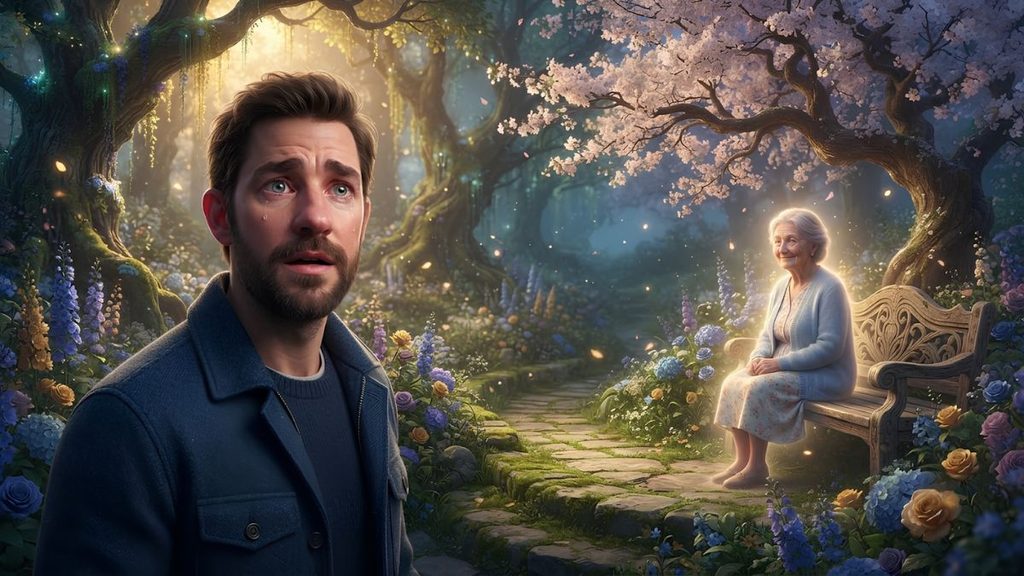
Theme: Meeting Familiar People
Main Character: Thomas Walker
Thomas Walker had never been afraid of death.
At least, that was what he told people.
He had attended funerals. He had stood beside hospital beds. He had watched grandparents, neighbors, friends, and eventually his own parents grow older and disappear from his life.
Death had always seemed like something distant but inevitable.
A fact.
Something that happened at the end of a long road.
He had never imagined that, one ordinary Tuesday afternoon, he would come close enough to it to wonder whether the road had actually ended.
Thomas was fifty-eight years old and had spent most of his adult life working as an architect. He liked things that could be measured, calculated, and explained.
Buildings had foundations.
Bridges had load limits.
Walls stood because someone had calculated the forces acting upon them.
Thomas liked that kind of certainty.
His wife, Margaret, sometimes teased him about it.
“You would probably want a blueprint for heaven,” she once told him.
Thomas had laughed.
“I’d want to know where the emergency exits are.”
Margaret had rolled her eyes.
That was the kind of man Thomas was.
Practical.
Quiet.
Reliable.
And deeply attached to the ordinary details of life.
On the afternoon it happened, Thomas had been sitting at his desk at home, reviewing drawings for a small community library.
Outside, rain tapped softly against the windows.
He had been feeling tired for several days, but he blamed it on work.
Then, without warning, a strange pressure appeared in the center of his chest.
Thomas stopped reading.
He sat back.
The pressure became pain.
It moved into his left arm.
Then his shoulder.
For a few seconds, he simply stared at the papers in front of him.
Something was wrong.
Very wrong.
He tried to stand.
His knees weakened.
He called for Margaret.
She came running from the kitchen.
“Thomas?”
He looked at her but could barely speak.
Margaret immediately reached for the phone.
The next few minutes became fragments.
A voice on the emergency line.
Margaret kneeling beside him.
The sound of rain.
A siren somewhere outside.
A paramedic saying his name.
Hands pressing against his chest.
A ceiling passing above him as he was wheeled into an ambulance.
Then everything disappeared.
There was no pain.
No sound.
No ambulance.
No rain.
Nothing.
And then Thomas opened his eyes.
He was standing in a garden.
For several seconds, he did not move.
He simply looked around.
The first thing he noticed was the light.
It was unlike sunlight.
There was no obvious sun in the sky, yet everything was illuminated.
The garden seemed to glow from within.
Flowers grew along winding paths.
Tall trees formed a green canopy overhead.
Small white blossoms covered bushes along the edges of a stone walkway.
There was a gentle breeze.
Thomas could hear birds somewhere in the distance.
The air smelled of grass after rain.
It was familiar.
Almost painfully familiar.
He looked down at himself.
He was standing upright.
He felt no pain.
No weakness.
No pressure in his chest.
He touched his shirt.
Everything seemed normal.
He turned around.
There was no hospital.
No ambulance.
No road.
No house.
Only the garden.
A strange calm settled over him.
Thomas had expected fear.
Instead, he felt something he could not immediately name.
Recognition.
It was as though he had entered a place he had never seen before and somehow remembered.
He began walking.
The path curved gently through the garden.
With every step, the feeling of familiarity grew stronger.
Then Thomas stopped.
Someone was standing at the other side of the garden.
An elderly woman.
She was wearing a pale blue cardigan and a simple floral dress.
Her gray hair was pulled back loosely.
She stood beside an old wooden bench beneath a flowering tree.
Thomas stared at her.
His heart seemed to stop for a different reason.
He knew her.
It was his grandmother.
Evelyn.
She had died when Thomas was sixteen.
For more than forty years, Thomas had carried only scattered memories of her.
Her kitchen.
Her laugh.
The sound of her footsteps.
The way she used to squeeze his hand when they crossed the street.
But standing there in the garden, Thomas did not see an old photograph of his grandmother.
He saw her exactly as she had been in his strongest memories.
Her face was younger than he remembered from the final years of her life.
Her eyes were bright.
Her smile was gentle.
She looked at him.
Thomas could not speak.
“Grandma?”
The word came out as a whisper.
She smiled.
She did not answer.
Thomas walked toward her.
He expected questions.
Where am I?
How are you here?
Am I dead?
What happens next?
But none of those questions seemed important.
The closer he came, the stronger the feeling became.
Love.
Not romantic love.
Not even the complicated love that exists between adults and their families.
It was something simpler.
Complete familiarity.
The feeling of being known without needing to explain yourself.
Thomas suddenly remembered being eight years old.
He was sitting at his grandmother’s kitchen table.
His knees barely reached the edge.
She had placed a warm bowl of soup in front of him.
He had been upset because his parents were arguing.
He remembered staring into the bowl.
He remembered his grandmother sitting beside him.
She had not asked what was wrong.
She had simply placed her hand over his.
The memory felt impossibly vivid.
Thomas looked at her now.
She was still smiling.
He tried to speak.
“I missed you.”
His grandmother tilted her head slightly.
There was sadness in her expression, but not fear.
Then something happened that Thomas could never fully explain.
She seemed to communicate without words.
It was not a voice.
It was not a sound.
Yet Thomas understood.
You are loved.
The realization moved through him like warmth.
He felt every person who had ever loved him.
His mother.
His father.
Margaret.
His children.
His friends.
Even people he had not thought about for years.
It was as if all the walls he had built around his emotions had quietly disappeared.
Thomas began to cry.
His grandmother remained where she was.
She did not come closer.
She did not need to.
Her presence was enough.
Thomas looked around the garden.
He noticed that some flowers seemed familiar.
One particular corner contained a row of small yellow flowers.
He could not remember their name.
But seeing them made him think of his grandmother’s backyard.
Then another memory appeared.
He was twelve years old.
It was summer.
His grandmother was sitting on a wooden chair in her garden.
Thomas had complained that he was bored.
She had laughed.
“Young people always think they’re bored when they haven’t learned how to look closely.”
At the time, he had thought it was an irritating thing for an old person to say.
Now, standing in the garden, Thomas understood what she had meant.
There was so much to notice.
The movement of leaves.
The tiny insects hovering over flowers.
The distant sound of birds.
The texture of the path beneath his feet.
The smell of damp earth.
For the first time in decades, Thomas was not thinking about the next thing.
He was simply there.
Present.
Completely present.
He turned back toward his grandmother.
She was looking at him.
Then she slowly raised one hand.
Thomas followed her gesture.
Beyond the trees, the garden seemed to open into a vast distance.
There was something there.
Thomas could not see it clearly.
Perhaps it was another path.
Perhaps it was simply light.
But he suddenly understood what his grandmother was telling him.
He had to go back.
“No,” Thomas said.
His grandmother smiled.
The feeling of love remained.
You have more time.
Thomas shook his head.
“I don’t want to leave.”
His grandmother looked at him with an expression that reminded him of childhood.
Patient.
Kind.
Certain.
She pointed again toward the distance behind him.
Thomas turned.
The garden began to fade.
The light became brighter.
The sounds became distant.
He heard his name.
Not his grandmother’s voice.
Not anyone else’s.
Just his name.
“Thomas.”
He turned back.
His grandmother was still standing beside the tree.
For one final moment, their eyes met.
Then everything went white.
Thomas woke to the sound of machines.
There was a sharp beeping beside him.
His chest hurt.
His mouth was dry.
He could barely open his eyes.
Someone was speaking.
“Thomas? Can you hear me?”
He tried to answer.
His throat felt rough.
“Margaret?”
A hand closed around his.
“Yes,” she whispered.
Thomas opened his eyes.
Margaret was sitting beside the hospital bed.
Her face was exhausted.
She had clearly been crying.
“You’re here,” she said.
Thomas stared at her.
The garden was gone.
But the feeling remained.
For several days, Thomas said almost nothing about what had happened.
Doctors explained that he had suffered a severe heart attack.
There had been a period when he had lost consciousness.
His condition had stabilized.
He was fortunate.
Very fortunate.
Thomas listened.
He asked questions.
He accepted the medical explanation.
But at night, when the hospital room became quiet, he returned to the garden in his thoughts.
Eventually, Margaret asked him.
“What happened?”
Thomas looked at her.
“What do you mean?”
“When you were unconscious.”
He hesitated.
Then he told her.
He described the garden.
The trees.
The flowers.
The strange light.
And finally, his grandmother.
Margaret listened without interrupting.
When Thomas finished, she squeezed his hand.
“You saw your grandmother?”
“Yes.”
“She looked like she did when you were young?”
Thomas nodded.
“Exactly.”
Margaret smiled through tears.
“She must have been beautiful.”
“She was.”
Thomas closed his eyes.
“There was something else.”
“What?”
“I remembered something.”
He stared toward the window.
“When I was a kid, Grandma had these little yellow flowers in her garden. I haven’t thought about them in decades.”
Margaret waited.
Thomas continued.
“She used to call them her little suns.”
Margaret smiled.
“That sounds like her.”
Thomas nodded.
But the memory became more detailed.
He remembered sitting beside his grandmother in the garden.
He remembered those yellow flowers.
And he remembered something he had completely forgotten.
His grandmother had once given him a small wooden box.
Inside was a collection of dried flowers.
She had told him to keep them because they were from the first garden she had planted after moving into her house.
Thomas had not thought about the box since he was a teenager.
He wondered whether it still existed.
Months later, after recovering enough to return home, Thomas searched through old family belongings.
He found the box.
It was in a cardboard container stored in the attic.
The wood was scratched.
The hinges were rusty.
Inside were several flattened, faded flowers.
And beneath them was a small handwritten note.
Thomas unfolded it carefully.
There were only a few words.
“Remember to notice the little things.”
Thomas sat on the attic floor for a long time.
He cried.
Not because he believed he had discovered proof of anything.
He knew there were explanations for unusual experiences during medical emergencies.
He knew memory could be strange.
He knew the human brain could create experiences that felt completely real.
He also knew that none of those explanations changed what the garden had meant to him.
Before the heart attack, Thomas had spent years rushing.
He worked too much.
He worried about deadlines.
He answered messages during dinner.
He postponed vacations.
He told himself there would always be time.
Afterward, he changed.
Not dramatically.
He did not sell his house or abandon his career.
He simply began paying attention.
He noticed morning light through the kitchen window.
He listened when Margaret talked.
He called his children without needing a reason.
He planted flowers in the backyard.
And every spring, he planted a row of small yellow flowers along the garden path.
Margaret asked him once why he kept choosing them.
Thomas smiled.
“They remind me of someone.”
Years passed.
Whenever people asked him what he believed had happened that day, Thomas never gave them a simple answer.
“I don’t know,” he would say.
Some people wanted him to say it was heaven.
Others wanted him to say it was nothing more than the brain.
Thomas refused both answers.
Maybe it was a neurological experience.
Maybe it was memory.
Maybe it was something he did not understand.
He had learned to live comfortably with uncertainty.
But there was one thing he no longer doubted.
His grandmother’s presence had reminded him of something he had forgotten while he was busy living.
Life was made of small things.
A hand resting on yours.
Rain against a window.
A bowl of soup.
A garden in summer.
A quiet conversation.
A row of yellow flowers.
One evening, many years after the heart attack, Thomas sat alone in his garden.
The sun was disappearing behind the trees.
The yellow flowers moved gently in the evening breeze.
Thomas closed his eyes.
For a moment, he imagined the garden from his experience.
The same path.
The same trees.
The same warm light.
And somewhere beyond the distance, he imagined his grandmother waiting.
He did not know whether she was really there.
He did not know whether he would ever see her again.
But he smiled anyway.
Because the memory had given him something more valuable than an answer.
It had taught him to look closely.
To notice.
To stay.
And to understand that sometimes the most important messages in life are never spoken aloud.
6. Every Moment
Theme: Life Review
Main Character: Richard Morgan
Richard Morgan had always believed that life could be measured.
He measured everything.
His income.
His savings.
The size of his house.
The number of clients he had.
The awards hanging on the wall of his office.
The schools his children attended.
Even the number of hours he worked each week.
To Richard, success was simple.
Move forward.
Achieve more.
Stay ahead.
When he was a boy, his father had told him something that Richard never forgot.
“Life rewards people who keep moving.”
Richard had taken those words seriously.
He studied hard.
He graduated near the top of his class.
He found a good job.
Then he found a better one.
Eventually, he started his own consulting company.
By forty-five, he had everything he had once imagined wanting.
A large house.
A comfortable car.
A successful business.
Two children.
A beautiful wife named Laura.
And a calendar that was almost always full.
People admired Richard.
They often told him how fortunate he was.
Richard agreed.
But there was something he rarely admitted.
He was tired.
Not the ordinary tiredness that disappeared after a good night’s sleep.
It was a deeper exhaustion.
The feeling that he was always running toward something that remained just beyond reach.
When he completed one goal, another appeared.
When he bought one thing, he wanted something better.
When his company reached a new level, he immediately began thinking about the next level.
There was always another mountain.
Richard rarely stopped to ask why he was climbing.
Then, on a cold autumn morning, everything changed.
He was driving home from a business meeting.
The sky was gray.
Rain had begun falling.
His phone buzzed on the passenger seat.
Richard glanced at it.
A message from one of his senior managers.
He reached toward the phone.
It was a decision he would later replay many times.
His attention left the road for only a few seconds.
A vehicle appeared ahead.
Richard turned the steering wheel.
The tires lost traction.
There was the sound of metal.
Glass.
A violent impact.
Then darkness.
At first, Richard thought he was unconscious.
There was no pain.
No sound.
No sense of his body.
He simply existed somewhere between awareness and nothingness.
Then a memory appeared.
He was six years old.
He was sitting on the floor of his parents’ living room.
His father was repairing a broken toy car.
Richard remembered the smell of his father’s aftershave.
He remembered the television playing quietly in the background.
He remembered feeling completely safe.
The memory disappeared.
Another appeared.
He was eight.
A boy named Samuel was sitting beside him at school.
Samuel was his first real friend.
They had shared a sandwich during lunch because Samuel had forgotten his.
Richard had not thought about that moment in decades.
But now he remembered everything.
The taste of the bread.
The sunlight coming through the classroom window.
Samuel’s smile.
Then something strange happened.
Richard did not merely remember the event.
He felt it.
He felt the happiness he had experienced as a child.
He felt the comfort of friendship.
He felt the simple pleasure of being noticed by another person.
The memory vanished.
Another took its place.
His mother was standing in the kitchen.
Richard was seventeen.
He had just received his university acceptance letter.
His mother was crying.
He had been too excited to understand why.
Now he felt it.
Her pride.
Her fear.
Her hope.
Her love.
Richard suddenly understood that the moment had never been only about him.
His mother had watched her son prepare to leave home.
She had been proud.
But she had also been afraid that their relationship would change.
Richard had never noticed that before.
The memory disappeared.
More came.
His first apartment.
His first paycheck.
His first promotion.
His first major mistake at work.
His wedding.
Laura walking toward him.
Their first dance.
Their honeymoon.
The birth of their daughter, Sophie.
The birth of their son, Daniel.
Each memory arrived with extraordinary clarity.
But there was something different about them.
Richard did not feel as though he was watching a film.
He was experiencing each moment again.
Every emotion.
Every sensation.
Every small detail.
He felt Laura’s hand trembling inside his.
He felt the overwhelming fear and joy when Sophie was born.
He felt the exhaustion of holding Daniel for the first time.
He felt laughter.
Love.
Pride.
Fear.
Regret.
Everything seemed connected.
Then the memories changed.
Richard saw himself in his office.
He was thirty-eight.
A young employee named Mark stood across from his desk.
Mark had made a mistake on an important project.
Richard remembered what he had said.
“You’re clearly not ready for responsibility.”
At the time, Richard had considered the comment necessary.
He believed pressure made people stronger.
Now he felt the moment from Mark’s perspective.
He felt embarrassment.
Humiliation.
Fear.
He felt Mark wondering whether he was good enough to remain in the company.
Richard saw what happened afterward.
Mark stopped speaking during meetings.
He avoided Richard.
Eventually, he resigned.
The memory disappeared.
Richard felt something he had rarely allowed himself to feel.
Regret.
Not because Mark had left the company.
Because Richard had never stopped to consider what his words might do to another person.
Another memory appeared.
Richard was forty-two.
He was walking through the office lobby when a cleaner dropped a box of supplies.
Everyone walked past.
Richard stopped.
He helped pick up the scattered items.
He remembered the woman’s name.
Margaret.
She had smiled and thanked him.
Richard had forgotten the incident almost immediately.
Now he experienced it again.
But this time, he felt what Margaret had felt.
She had been embarrassed.
Then relieved.
Then strangely grateful that someone had stopped.
The memory continued.
Later that evening, Margaret had told her husband about the man who had helped her.
She had said that most executives walked past people like they were invisible.
Richard felt a warmth he could not explain.
That tiny moment, which he had considered meaningless, seemed enormous now.
The memories continued.
His daughter, Sophie, standing at the front door with a school project.
“Dad, can you come tomorrow?”
Richard remembered saying:
“I’ll try.”
He had not gone.
There had been a business meeting.
He had promised himself there would be another opportunity.
Now he felt the disappointment on Sophie’s face.
He felt her trying not to show it.
He felt himself walking away.
Then another memory.
Daniel, age nine.
Sitting on Richard’s bed after a nightmare.
Richard had been exhausted.
He had an early meeting the next morning.
Daniel had whispered:
“Can I stay here?”
Richard had told him to go back to his room.
Now he felt the loneliness his son had experienced.
The memories became faster.
Faster.
His entire life seemed to unfold around him.
Every conversation.
Every argument.
Every embrace.
Every apology.
Every moment he had ignored someone.
Every moment he had helped someone.
Richard saw his career.
He saw the deals he had closed.
The awards he had received.
The offices he had built.
But none of those achievements carried the weight he had expected.
They were simply moments.
Important at the time.
Then gone.
The moments involving people felt different.
His father’s hand on his shoulder.
His mother’s smile.
Laura laughing during their first date.
Sophie’s tiny fingers wrapped around his thumb.
Daniel asleep against his chest.
Samuel sharing half a sandwich.
Margaret smiling in the office lobby.
Mark looking down at the floor after Richard’s careless words.
The life review seemed to be showing him something.
Richard did not hear a voice explaining it.
There was no judge.
No score.
No list of rewards and punishments.
Instead, he seemed to understand.
Every moment mattered.
Not because every moment was dramatic.
But because every moment touched something else.
A sentence could stay with someone for years.
A small kindness could become a memory someone carried for decades.
A missed conversation could become a regret.
A few minutes of attention could make someone feel important.
Richard saw his life differently.
For years, he had thought his achievements were the structure holding his life together.
Now they seemed more like decorations.
The real structure had been made of relationships.
Then he saw Laura.
It was their twentieth anniversary.
Richard had taken her to an expensive restaurant.
He had given her an expensive necklace.
He remembered the evening as a success.
But now he saw another part of it.
Laura had wanted to talk.
She had been worried about her mother.
She had tried to tell him.
Richard had spent most of dinner checking messages under the table.
He had been physically present.
But emotionally, he had been somewhere else.
Richard felt her disappointment.
He felt the loneliness she had hidden behind a smile.
Then the memory changed.
Another anniversary.
Much simpler.
They had been married for twenty-five years.
There had been no expensive restaurant.
They had ordered takeaway.
A power outage had darkened the entire neighborhood.
Richard and Laura had sat on the balcony with candles.
They talked for hours.
About their children.
Their childhoods.
Their fears.
Their dreams.
They laughed until midnight.
Richard remembered thinking afterward that it had been an ordinary evening.
Now it felt like one of the most valuable moments of his life.
The memories slowed.
Richard found himself standing in a place he could not describe.
There was no clear floor.
No sky.
No walls.
Only darkness filled with countless points of light.
Each light seemed to contain a memory.
He understood that he could continue.
He could see everything.
Every forgotten moment.
Every person.
Every choice.
For a strange instant, Richard wanted to remain there.
There was no pressure.
No deadlines.
No meetings.
No expectations.
Then he thought of Laura.
His children.
His parents.
The life he had left unfinished.
He felt a pull toward them.
And then he remembered something his father had told him when Richard was young.
Life rewards people who keep moving.
For the first time, Richard wondered if his father had meant something different.
Perhaps moving forward did not mean achieving more.
Perhaps it meant becoming better.
The darkness disappeared.
There was a violent sensation.
Noise.
Pain.
Light.
Someone shouting.
Richard opened his eyes.
He was in a hospital.
His body felt impossibly heavy.
A machine beeped beside him.
Laura was standing near the bed.
She covered her mouth when she realized he was awake.
“Oh, Richard.”
She leaned over him.
He tried to speak.
His voice was barely audible.
“I love you.”
Laura began to cry.
Richard had survived.
The doctors explained that the accident had been severe.
He had suffered significant injuries.
There had been a period when he was unconscious.
They could not tell him exactly what he had experienced during that time.
Richard did not tell them everything either.
He knew there were neurological explanations for vivid experiences during periods of unconsciousness.
He knew memory was complicated.
He knew the brain could create extraordinary experiences under extreme conditions.
He did not claim to have visited another world.
He did not claim to have seen the afterlife.
He only knew what the experience had felt like.
And he knew it had changed him.
Recovery took months.
Richard returned to work eventually.
But he was different.
The first change happened during a meeting.
An employee made a mistake.
Richard felt the familiar irritation rise inside him.
Then he remembered Mark.
He paused.
Instead of criticizing the employee, he asked:
“What happened?”
The man explained.
Richard listened.
The meeting continued.
Nothing dramatic happened.
But when the employee left the room, Richard noticed something.
The man looked relieved.
Richard understood.
That was a moment too.
A small one.
But it mattered.
He began making other changes.
He stopped checking his phone during dinner.
He attended school events.
He called his mother every Sunday.
He apologized to people he had hurt.
Some apologies were accepted.
Some were not.
He learned to accept that too.
One afternoon, he found Mark’s old contact information.
Richard stared at the number for several minutes.
Then he called.
Mark answered cautiously.
They talked for nearly an hour.
Richard apologized for what he had said all those years ago.
Mark was silent.
Finally, he said:
“I remembered that for a long time.”
Richard closed his eyes.
“I know.”
There was a pause.
“I’m glad you called,” Mark said.
It was not a dramatic reconciliation.
There was no perfect ending.
Just two people acknowledging something that had happened years earlier.
Richard considered that enough.
Years later, when people asked him whether the accident had changed his definition of success, he smiled.
“Yes.”
“What is success now?”
Richard usually looked around before answering.
At Laura.
At his children.
At the people sitting nearby.
Then he would say:
“I think success is leaving people with more light than you found them with.”
He never explained the garden-like darkness filled with memories.
He never tried to convince anyone that his experience proved anything.
He simply lived differently.
He still worked.
He still enjoyed beautiful things.
He still set goals.
But he no longer believed that achievements were the measure of a life.
One evening, Richard sat on the porch with Laura.
The sun was setting.
Their children had gone home after dinner.
The house was quiet.
Laura rested her head against his shoulder.
Richard looked at her.
For a moment, he remembered their twenty-fifth anniversary.
The candles.
The power outage.
The laughter.
He smiled.
“What are you thinking about?” Laura asked.
Richard took her hand.
“Nothing important.”
She laughed.
“That usually means you’re thinking about something important.”
Richard looked toward the fading light.
“I was just thinking about how many moments we don’t realize are important until they’re already gone.”
Laura squeezed his hand.
“Then let’s notice this one.”
Richard smiled.
He did.
The evening breeze moved through the trees.
A bird called somewhere beyond the garden.
The sky slowly turned gold.
Richard did not reach for his phone.
He did not think about tomorrow’s meeting.
He did not calculate what came next.
For once, there was nowhere else he needed to be.
He simply sat beside the woman he loved.
And he paid attention.
Every moment.
7. The Place Where There Was No Time

Theme: A Sense of Timelessness
Main Character: Claire Donovan
Claire Donovan had always been obsessed with clocks.
Not in a sentimental way.
She simply liked knowing what time it was.
Her watch was always on her wrist.
There was a clock above the kitchen door, another beside her desk, and one on the wall of her bedroom.
She kept appointments carefully.
She arrived early for meetings.
She disliked being late.
To Claire, time was one of the few things in life that could not be negotiated.
You could lose money and earn it again.
You could lose a job and find another.
You could make mistakes and sometimes repair them.
But you could not recover an hour that had already passed.
Time moved forward.
Always.
At least, that was what Claire believed.
She was forty-six when everything she believed about time began to feel uncertain.
It happened during a winter that seemed colder than usual.
Claire had been feeling unwell for several days.
At first, she assumed it was exhaustion.
Then came the fever.
The weakness.
The dizziness.
One evening, while preparing dinner, she suddenly dropped the spoon in her hand.
Her husband, David, looked up.
“Claire?”
She tried to answer.
The kitchen seemed to move around her.
The walls blurred.
The floor tilted.
David rushed toward her.
“I can’t…”
Those were the last words she remembered saying.
Then everything disappeared.
When Claire later tried to describe what happened next, she found the experience almost impossible to explain.
There was no moment when she opened her eyes.
No clear transition.
She simply became aware.
She was standing somewhere.
The first thing she noticed was that she was not afraid.
The second thing she noticed was the silence.
Not an empty silence.
A peaceful one.
She stood on a wide grassy plain surrounded by distant hills.
The landscape was beautiful.
A narrow river moved through the valley.
Trees covered the hillsides.
Wildflowers grew everywhere.
The sky was pale and luminous.
But something was wrong.
Or perhaps something was missing.
There was no sun.
There was no moon.
No shadows moved across the ground.
Claire looked upward.
The sky appeared almost perfectly still.
She looked down at her hands.
They looked normal.
She touched her face.
She felt no fever.
No weakness.
No pain.
She turned around.
There was no road.
No house.
No city.
No person.
Just the landscape.
Claire began walking.
At first, she expected to find a way out.
She followed the river.
It curved between the hills.
She crossed a meadow filled with white flowers.
She climbed a gentle slope.
The farther she walked, the calmer she became.
Eventually, she realized something strange.
She had no idea how long she had been there.
She stopped.
Normally, Claire would have checked her watch.
But she wasn’t wearing one.
She looked around.
There was no clock.
No shadow.
No changing light.
Nothing that could tell her whether an hour had passed or a day.
Claire continued walking.
The landscape seemed endless.
She discovered a small wooden cabin beside the river.
The door was open.
Inside, there was a table.
A chair.
A fireplace.
A bookshelf filled with books.
Claire walked toward the shelves.
She reached for one.
The cover was blank.
She opened it.
The pages contained no words.
Instead, they seemed to hold images.
Her childhood home.
Her father carrying her on his shoulders.
Her mother laughing in the kitchen.
Her first day at school.
Her first friendship.
Her first heartbreak.
Claire closed the book.
Another book was beside it.
She opened that one.
David.
Their first meeting.
Their first apartment.
Their wedding.
Their first vacation.
The argument they had about money.
The night they stayed awake talking until sunrise.
Claire smiled.
She had forgotten some of those moments.
Not completely.
They had simply become buried beneath years of ordinary life.
She opened another book.
Her career.
Her mistakes.
Her successes.
People she had known.
People she had forgotten.
Moments when she had been kind.
Moments when she had been impatient.
Things she had said and later regretted.
Things others had said that had shaped her.
Claire closed the book.
She walked outside.
The river continued flowing.
She sat beside it.
There was no hunger.
No thirst.
No tiredness.
No need to sleep.
And there was still no sense of time.
Eventually, Claire stopped trying to measure it.
She simply explored.
She followed the river to a forest.
Inside the forest, everything was quiet.
She discovered a field where hundreds of small blue flowers grew.
She found a hill overlooking the valley.
She sat there and watched the landscape.
She thought about her life.
Not with regret.
Not exactly.
More like someone looking at an old photograph.
She thought about how quickly everything had gone.
At twenty, she had believed forty was impossibly far away.
At thirty, she had believed there was plenty of time.
At forty, she had begun saying things like, “Maybe next year.”
Maybe next year for the trip.
Maybe next year for the book she wanted to write.
Maybe next year for visiting old friends.
Maybe next year for learning the piano.
Maybe next year for taking a month away from work.
She had always assumed there would be a next year.
Sitting on that hill, Claire wondered why people treated time as though it belonged to them.
It did not.
It moved whether they noticed it or not.
She thought about David.
She thought about her parents.
She thought about the ordinary evenings she had once considered unimportant.
Cooking together.
Falling asleep on the couch.
Driving through the countryside.
Sharing coffee on Sunday mornings.
None of those moments had seemed extraordinary when they happened.
But now they felt precious.
Claire remained on the hill.
She did not know whether minutes passed.
Or hours.
Or months.
At some point, she became convinced that she had been there for years.
The strange thing was that she did not feel lonely.
The place seemed to exist outside ordinary life.
She could walk without becoming tired.
She could think without distraction.
She could remember without pain.
She began to feel that she had somehow grown older there.
Not physically.
Something inside her had changed.
She felt as though she had lived another lifetime.
One day, she returned to the cabin.
A new book was waiting on the table.
Claire opened it.
There was only one image.
David.
He was sitting beside her hospital bed.
His face was wet with tears.
Claire touched the page.
Suddenly, she felt an intense longing.
She wanted to go home.
She wanted to hear David’s voice.
She wanted to feel the weight of an ordinary blanket.
She wanted to drink coffee from her favorite mug.
She wanted to complain about the cold.
She wanted all the small, imperfect things she had once taken for granted.
Claire closed the book.
For the first time, she felt afraid.
She stood.
The landscape seemed to change.
Not visibly.
There was no sudden movement.
But she understood that she could not remain.
She walked toward the river.
Then she heard something.
A voice.
Far away.
“Claire.”
She turned.
There was nobody there.
“Claire!”
The voice became louder.
The peaceful landscape began to fade.
Claire looked at the river.
At the trees.
At the hills.
At the cabin.
She felt grief.
It was the grief of leaving a place that had felt like home.
She did not know whether she would ever return.
Then everything disappeared.
Claire opened her eyes.
Bright hospital lights filled her vision.
She heard machines.
Someone was crying.
“Claire?”
David.
She turned her head.
He was beside the bed.
He grabbed her hand.
“Oh, thank God.”
Claire tried to speak.
Her throat hurt.
“How long?”
David stared at her.
“What?”
“How long was I…”
She couldn’t finish.
David looked toward the doctor.
The doctor answered gently.
“You’ve been unconscious for a little over an hour.”
Claire stared at him.
“An hour?”
“Yes.”
She looked at David.
“I was there for years.”
Neither of them spoke.
Claire closed her eyes.
The landscape returned immediately.
The river.
The hills.
The cabin.
The books.
Years.
She had experienced what felt like years.
Yet only a little more than an hour had passed in the hospital.
For weeks after recovering, Claire tried to understand it.
She read everything she could find about subjective time.
She learned that human beings do not experience time like clocks do.
A minute can feel endless when someone is afraid.
Hours can disappear during a fascinating conversation.
Dreams can seem long even when they occur during a much shorter period of sleep.
Memory itself can distort the sense of duration.
Claire understood all of this.
But understanding the science did not make the experience feel less mysterious.
There was another problem.
She could remember the place in astonishing detail.
She remembered the landscape.
She remembered walking.
She remembered sitting beside the river.
She remembered the cabin.
She remembered the books.
Most importantly, she remembered how time had disappeared.
There had been no waiting.
No anticipation.
No feeling that one moment followed another.
There simply was.
Claire began wondering whether ordinary human time was only one way of experiencing existence.
Perhaps the brain constructed the feeling of sequence.
Perhaps consciousness could experience events differently under unusual circumstances.
Perhaps the experience had been created entirely by her brain during a period of critical illness.
Or perhaps there was something about consciousness that science did not yet understand.
Claire did not know.
She stopped trying to force the experience into a single explanation.
Months passed.
She returned to work.
She resumed ordinary life.
But her relationship with time had changed.
She stopped wearing her watch everywhere.
She removed the clock from her bedroom.
She still arrived on time.
She still kept appointments.
But she no longer felt the same urgency.
One Saturday morning, David woke early and found Claire sitting beside the kitchen window.
She was drinking coffee.
“What are you doing?” he asked.
“Nothing.”
David smiled.
“You’ve been sitting there for twenty minutes.”
“I know.”
“Are you waiting for something?”
Claire shook her head.
“No.”
She looked outside.
Snow was beginning to fall.
Each snowflake disappeared against the dark garden.
Claire smiled.
“I just wanted to watch.”
David sat beside her.
They remained there together.
No conversation.
No television.
No phones.
No schedule.
After a while, David asked:
“Do you ever think about that place?”
“All the time.”
“Do you think you’ll ever understand what happened?”
Claire considered the question.
“I don’t think I need to.”
David looked at her.
Claire continued.
“I used to think time was something I had to control. Now I think maybe it’s something I have to experience.”
David nodded.
She rested her head against his shoulder.
Years later, Claire still dreamed about the valley.
Sometimes she dreamed of the river.
Sometimes the cabin.
Sometimes the hill covered with blue flowers.
But she never saw the books again.
She wondered if that was because the memories they contained had become part of ordinary life.
She began taking more trips.
She visited old friends.
She learned to play the piano.
She traveled with David.
She called her sister more often.
She spent afternoons doing absolutely nothing.
People occasionally asked why she had changed.
Claire would smile.
She never knew how much of the story to tell.
Because how could she explain that, for what felt like years, she had lived in a place where there was no morning and no evening?
A place where nothing was late.
Nothing was early.
Nothing was before.
Nothing was after.
There was only the moment itself.
One evening, Claire sat in her garden as the sun disappeared.
David was watering the flowers.
The light slowly faded.
For a brief moment, Claire looked at the garden and thought she recognized something.
The shape of the trees.
The curve of the path.
The stillness of the air.
It reminded her of the valley.
She closed her eyes.
She listened.
A breeze moved through the leaves.
Somewhere nearby, a bird sang.
Claire opened her eyes.
The sun was gone.
The first stars were appearing.
She looked at the clock on the house.
It was almost eight.
Once, she would have been thinking about what she needed to do at eight.
Now she simply watched the sky.
She understood something she had never understood before.
Time could be measured.
Minutes could be counted.
Years could be recorded.
Clocks could tell you exactly how long something lasted.
But the meaning of a moment was different.
A moment could feel like a lifetime.
A lifetime could disappear like a moment.
And perhaps the strangest thing about being alive was not that time moved forward.
It was that, while it did, people rarely noticed they were living inside it.
Claire looked at David.
He smiled at her.
She smiled back.
Neither of them spoke.
For a few seconds, the world seemed perfectly still.
There was no past.
No future.
No clock.
Only the two of them, sitting together in the fading light.
And for Claire, that was enough.
Every moment felt complete.
As though time had briefly forgotten to move.
8. Beyond the Door
Theme: A Feeling of Being Somewhere Else
Main Character: James Whitmore
James Whitmore had never been particularly interested in mysteries.
He liked explanations.
If a light flickered, there was a reason.
If a strange sound came from the walls, there was a pipe, a loose connection, or an animal somewhere nearby.
If someone told him they had experienced something impossible, James usually listened politely and then looked for the practical explanation.
He was not cynical.
He simply believed that reality made sense if you understood enough of it.
For most of his fifty-two years, that belief had served him well.
Then came the accident.
It happened on a clear afternoon.
James was driving home after visiting a client several hours away. The road was dry, the traffic light, and the radio played quietly in the background.
His daughter, Emma, had called earlier.
She wanted to know whether he would be home in time for dinner.
James had promised he would try.
He remembered smiling after the call.
Emma was twenty-two, but she still occasionally asked him questions as though he were the only person in the world who could solve them.
He enjoyed that.
As James approached an intersection, another vehicle suddenly crossed the center line.
There was no time to react.
James turned the steering wheel.
The sound of the collision was enormous.
Metal folded.
Glass shattered.
The world spun.
Then everything became silent.
He remembered thinking one thing.
Emma.
Then darkness.
When awareness returned, James was somewhere else.
He could not explain how he knew he was conscious.
There was no body.
No sensation of breathing.
No heartbeat.
No weight.
Yet he was aware.
Completely aware.
He seemed to be standing on a surface, although the surface did not look like earth.
It was smooth and pale.
Beyond it stretched a landscape that James could not describe.
He tried.
Even years later, he would struggle to find words.
There were structures in the distance, but they were not buildings.
There were shapes that seemed almost like trees, but they did not have branches in any familiar sense.
The horizon appeared to curve strangely.
The sky was neither blue nor gray.
It seemed to contain colors James had seen before but never in combination.
There were shades of violet, gold, green, and something else.
Something for which he had no word.
The colors seemed to change when he looked directly at them.
James stood still.
He should have been frightened.
Instead, he felt an overwhelming sense of recognition.
He had never been there.
Yet something inside him whispered:
You are where you were meant to be.
He looked around.
A distant sound filled the air.
It reminded him of music.
But there was no melody.
No rhythm.
It was more like the memory of music.
James thought of his childhood home.
For some reason, the sound reminded him of his mother humming while cooking.
But it was not her voice.
He listened again.
The sound changed.
Now it reminded him of rain against a bedroom window.
Then a train passing somewhere far away.
Then laughter.
None of those sounds were actually present.
Yet somehow they were all contained within it.
James began walking.
The landscape seemed to respond to him.
When he moved toward a distant structure, it appeared closer.
When he stopped, everything became still.
There was no wind.
No obvious source of light.
No visible sun.
And yet everything could be seen perfectly.
He passed through an area filled with tall, translucent shapes.
They looked almost like trees made of glass.
Light moved inside them.
James reached out and touched one.
It felt warm.
The moment his fingers touched its surface, he experienced a memory.
His daughter was five years old.
She was sitting on his shoulders at a beach.
She was laughing.
James could feel the weight of her small hands around his head.
He could smell saltwater.
He could hear waves.
He could feel the sun on his skin.
The memory lasted only a moment.
Then it disappeared.
James looked at the strange tree.
He understood nothing.
He continued walking.
The farther he went, the more familiar the impossible place became.
That was the strangest part.
Nothing looked familiar.
But everything felt familiar.
It was like remembering a dream from childhood that you had forgotten until the exact moment you needed it.
James reached a wide open plain.
At the far end stood a doorway.
There was no wall around it.
No building.
Just a doorway standing by itself.
It was tall and narrow.
The frame appeared to be made of a material James could not identify.
It seemed to glow softly.
James stopped.
For some reason, he knew the doorway was important.
He could not explain why.
He began walking toward it.
With every step, the feeling of recognition became stronger.
He thought of his parents.
His childhood.
His marriage.
Emma.
The birth of his daughter.
The first time she had called him Dad.
The night she had left for college.
Every memory seemed to exist around him without actually appearing.
James reached the doorway.
He stood before it.
There was no handle.
He simply knew how to open it.
His hand moved forward.
Just before his fingers touched the door, he heard a voice.
“Dad?”
James froze.
Emma.
It was unmistakably his daughter’s voice.
He turned around.
The landscape stretched behind him.
There was no one there.
“Dad?”
The voice came again.
This time it sounded frightened.
James took a step backward.
“Emma?”
The moment he said her name, the entire landscape changed.
The colors began to disappear.
The distant sounds became louder.
The doorway seemed to move farther away.
James felt himself being pulled backward.
He tried to hold on.
There was nothing to hold.
The strange world vanished.
Then came pain.
Sound.
Light.
A terrible pressure in his chest.
James opened his eyes.
Someone was shouting.
“James! James, can you hear me?”
He tried to breathe.
Machines beeped beside him.
Bright hospital lights filled his vision.
A nurse leaned over him.
James stared at her.
“Where…”
His voice failed.
“You’re in the hospital,” she said.
James looked around.
Everything was ordinary.
White walls.
Medical equipment.
A curtain.
A clock.
He stared at the clock.
He did not know why.
The second hand moved.
Tick.
Tick.
Tick.
He closed his eyes.
The other place was still there.
Not physically.
But in his memory.
The impossible colors.
The strange landscape.
The doorway.
The voice.
Emma.
He opened his eyes again.
“How long?”
The nurse looked at the doctor.
“You’ve been unconscious since the accident.”
James swallowed.
“How long?”
“About eleven minutes after the ambulance arrived.”
Eleven minutes.
James could hardly believe it.
The experience had felt much longer.
Not necessarily hours.
Not days.
Something different.
There had been no clear sense of duration.
But he had felt as though he had traveled a considerable distance.
He had explored.
He had remembered.
He had stood before the door.
It felt impossible that all of it could have happened within such a short period.
His family arrived later.
Emma came into the room first.
James stared at her.
She looked exactly as she had before the accident.
Alive.
Safe.
Real.
He reached for her.
She hugged him carefully.
“I thought I was going to lose you.”
James closed his eyes.
Her voice sounded exactly like the voice in the strange place.
He wondered whether his mind had created the entire experience because he had been thinking about her.
Perhaps.
That explanation made sense.
It was the kind of explanation James would normally accept.
But then something bothered him.
The place had not felt like a dream.
Dreams were strange.
Dreams changed.
They skipped.
They mixed people together.
They ignored ordinary logic.
This experience had been different.
It had been impossible, but somehow coherent.
He remembered the landscape with extraordinary clarity.
The sounds.
The colors.
The feeling of recognition.
And the doorway.
Especially the doorway.
Over the following months, James tried to understand what had happened.
He read about near-death experiences.
He read about altered states of consciousness.
He learned that people sometimes reported seeing unfamiliar landscapes, encountering deceased relatives, experiencing unusual sensations of time, or feeling that they had entered another realm.
He also learned that intense experiences during medical emergencies could potentially involve complex interactions between brain activity, memory, perception, emotion, and physiological stress.
James found those explanations reassuring.
They gave him something solid to hold.
But none of them completely erased the mystery.
He could accept that his brain might have created the experience.
What he could not explain was why the experience had felt so meaningful.
The place had seemed to contain a message.
Not a spoken message.
Something deeper.
You belong here.
Not in the sense that he was supposed to die.
Rather, it felt like the strange world had been saying that there was a part of existence he had never noticed.
A part beyond his ordinary assumptions.
James did not tell many people about the doorway.
He worried they would misunderstand.
Some would insist he had seen heaven.
Others would tell him it was only a hallucination.
He did not want either conclusion.
He had no proof of heaven.
He had no proof that it was merely a hallucination.
All he had was the memory.
And the memory was enough.
Several years passed.
James returned to driving.
He returned to work.
He watched Emma get married.
He became a grandfather.
Life continued.
Yet sometimes, late at night, he would remember the doorway.
He would wonder what had been behind it.
That question never disappeared.
Once, Emma asked him about the experience.
They were sitting together on his porch.
The evening was quiet.
“You’ve never told me everything,” she said.
James looked at her.
“What do you mean?”
“I know you saw something.”
He smiled.
“You’re very observant.”
“I’m your daughter.”
“That explains it.”
She laughed.
Then she became serious.
“What did you see?”
James thought for a moment.
“A place.”
“What kind of place?”
He shook his head.
“I don’t know.”
“Was it heaven?”
James smiled.
“I don’t know that either.”
“Was it a dream?”
“I don’t know.”
Emma looked disappointed.
“You don’t know anything?”
James laughed softly.
“I know that it felt real.”
She waited.
“What else?”
James looked toward the horizon.
“I know that there was a door.”
Emma smiled.
“Did you open it?”
“No.”
“Why?”
“Because I heard your voice.”
Emma became quiet.
James looked at her.
“You called me back.”
Emma stared at him.
“I didn’t call you.”
“I know.”
Neither spoke for several seconds.
Then Emma reached across the table and took his hand.
James squeezed it.
He never told her how much that moment had stayed with him.
Not because he believed she had literally called him from another world.
He knew there were countless possible explanations.
Perhaps he had heard her voice because he had been thinking about her.
Perhaps his brain had created the sound.
Perhaps the memory of her voice had been so deeply connected to his emotions that it became part of the experience.
Perhaps.
But there was still the doorway.
That was what James could never explain.
He had been certain that something was waiting beyond it.
He had felt that certainty more strongly than he had ever felt anything in ordinary life.
Yet he had never discovered what was there.
Sometimes he imagined that behind the door was another landscape.
Sometimes he imagined his parents.
Sometimes he imagined nothing.
Just darkness.
Sometimes he wondered whether the door represented death itself.
Other times, he wondered whether it represented something much simpler.
The unknown.
The part of life humans could never fully understand.
One winter evening, nearly fifteen years after the accident, James stood outside his house watching snow fall.
He was older now.
His hair had turned almost completely white.
His granddaughter was asleep upstairs.
Emma and her husband were visiting.
The house was warm.
The lights were soft.
James looked through the window at his family.
For a moment, he remembered the impossible place.
The colors.
The distant sounds.
The strange landscape.
The door.
He realized that he no longer needed to know what had been behind it.
The mystery had become part of his life.
Before the accident, James had believed that uncertainty was a problem.
After the accident, he began to understand that uncertainty could also be beautiful.
There were things humans could measure.
There were things they could explain.
There were things they could observe repeatedly.
And then there were experiences that remained somewhere between memory and mystery.
James did not need to turn them into proof.
He did not need to dismiss them either.
He could simply remember.
He went upstairs.
His granddaughter was sleeping peacefully.
James stood beside her bed for a moment.
She stirred.
“Grandpa?”
“I’m here.”
She opened her eyes briefly.
Then she smiled and went back to sleep.
James stood there listening to her breathing.
The sound reminded him of the strange place.
Not because it was mysterious.
Because it was familiar.
He smiled.
Years earlier, he had stood before a door he could not explain.
He had reached for it.
Then he had heard his daughter’s voice.
He had turned around.
And he had returned.
Maybe the door had been real.
Maybe it had been created by a brain under extraordinary stress.
Maybe it represented something humans had not yet learned to understand.
James would never know.
But perhaps that was the point.
Some doors are not meant to be opened.
Some questions are not meant to be answered.
Sometimes, simply knowing that the door exists is enough to make you look differently at everything on your side of it.
James switched off the bedroom light.
As he walked down the hallway, he glanced toward the window.
Snow continued falling.
For a brief second, the world outside seemed strangely luminous.
James stopped.
He smiled.
Then he kept walking.
He was home.
Why Are Near Death Experience Stories So Fascinating?
People have always been interested in what happens when life approaches its end.
Near-death experience stories are particularly compelling because they often come from people who were not simply thinking about death. They were experiencing an actual crisis.
A person might suddenly lose consciousness during a medical emergency and later describe a detailed experience.
Another person might survive an accident and remember a powerful feeling of peace.
Someone else might describe seeing a familiar person who had already died.
These accounts can feel deeply personal and emotionally convincing to the person who experienced them.
They can also raise larger questions:
- What happens to consciousness during extreme physiological stress?
- Why do some people report similar experiences?
- Why do some NDEs feel peaceful while others are frightening?
- Why do people sometimes report seeing themselves outside their bodies?
- Why can an experience lasting only a short period feel extremely long?
- Why do some people experience major changes in their values afterward?
- Can neuroscience explain everything reported during an NDE?
- How much do personal beliefs and culture influence interpretation?
There are no simple answers to all of these questions.
That uncertainty is one reason NDE research remains an active field.
Common Elements of Near Death Experience Stories
Although individual accounts vary considerably, researchers have identified recurring themes.
Not every person experiences every element.
An NDE is not a fixed sequence of events.
Instead, different people report different combinations of experiences.
1. A Sense of Peace
One of the most commonly discussed features is an intense feeling of calmness or peace.
Some people describe suddenly feeling free from physical pain or fear.
A person who had been experiencing an extremely frightening medical emergency may later remember a profound sense of tranquility.
This can be difficult for people to understand because the physical situation may have been dangerous while the subjective experience was described as peaceful.
2. Feeling Separate From the Body
Some people report the sensation of leaving their physical body.
They may describe observing themselves from above or feeling as though their consciousness is located somewhere outside their body.
This is often called an out-of-body experience, or OBE.
Some accounts describe seeing the surrounding environment from an unusual perspective.
The experience can feel completely real to the person who experienced it.
Researchers continue to investigate how altered body perception can occur during extreme physiological or psychological conditions.
3. Moving Through a Tunnel
Another frequently reported feature is the sensation of moving through a tunnel or narrow passage.
The person may describe darkness surrounding them while moving toward a bright area.
Some interpret this as movement toward an afterlife.
Others view it as a possible consequence of changes in visual processing during extreme physiological stress.
A 2023 systematic review found that tunnel experiences were among the recurring elements reported across NDE research.
4. Seeing a Bright Light
Bright or unusually vivid light is another well-known feature.
People may describe the light as warm, comforting, intelligent, or deeply meaningful.
Some associate it with God, a spiritual presence, or another form of consciousness.
Others interpret it as a neurological phenomenon associated with changes in brain function.
The interpretation often depends on the individual’s personal worldview.
5. Meeting Familiar People
Some NDE accounts include encounters with deceased relatives, friends, spiritual figures, or unfamiliar beings.
The person may feel that the figure is welcoming them or communicating without spoken words.
These experiences can have profound emotional significance.
However, researchers distinguish between the fact that someone reports such an experience and the separate question of what objectively caused it.
An account can be psychologically meaningful without automatically establishing a particular supernatural explanation.
6. Life Review
Some people report experiencing memories from different periods of their lives.
Rather than remembering one isolated event, they may describe a rapid sequence of important memories.
In some accounts, the person feels as though they are reviewing their actions and relationships.
They may experience emotions connected to events they had forgotten.
Life review experiences can become especially important after the person returns to normal consciousness.
7. A Sense of Timelessness
Time can feel very different during unusual states of consciousness.
Some people report that an experience lasted an enormous amount of time even though the medical event itself was relatively brief.
Others describe having no sense of time at all.
This raises interesting questions about how the brain constructs our ordinary perception of time.
8. A Feeling of Being Somewhere Else
Some people describe entering a beautiful landscape, a peaceful environment, or another realm.
These descriptions vary considerably.
Some are religious.
Others are more abstract.
Some people describe landscapes, colors, sounds, or feelings that they find impossible to explain using ordinary language.
Such accounts are often described as ineffable, meaning that the person feels ordinary language cannot fully communicate what happened.
Positive and Negative Near Death Experiences
Not every NDE is peaceful.
This is an important point when discussing near-death experience stories.
Popular culture often focuses on beautiful lights, peaceful landscapes, and encounters with loved ones.
However, some people report frightening or disturbing experiences.
Positive NDEs
Positive experiences may involve:
- Peace
- Love
- Warmth
- Light
- Joy
- Connection
- Encounters with loved ones
- A sense of unity
- Freedom from physical pain
- A feeling of returning home
These experiences can sometimes lead to major changes in how a person views life.
Distressing NDEs
Some people describe:
- Fear
- Isolation
- Darkness
- Confusion
- A feeling of being trapped
- Anxiety
- Unpleasant environments
- Emotional distress
- A sense of separation from loved ones
These experiences may be difficult to discuss because people sometimes assume that all NDEs are positive.
Research into the aftereffects of NDEs indicates that positive experiences can be associated with greater appreciation for life, reduced fear of death, spirituality, and compassion, while distressing experiences can sometimes lead to confusion, emotional distress, or lasting psychological difficulties.
What Does Science Say About Near Death Experiences?
One of the most important questions surrounding NDEs is whether they can be explained by changes in the brain and body.
There is currently no single universally accepted explanation.
Instead, researchers have proposed multiple mechanisms.
A 2025 review in Nature Reviews Neurology proposed an integrated neuroscientific model involving physiological changes, altered brain activity, neurotransmitter systems, psychological processes, and evolutionary responses to extreme threat.
Reduced Blood Flow to the Brain
During cardiac arrest or severe physiological crisis, blood pressure can fall dramatically.
The brain depends on continuous circulation of oxygen and nutrients.
Reduced cerebral blood flow can therefore affect consciousness and perception.
Hypoxia, meaning insufficient oxygen, and hypercapnia, meaning elevated carbon dioxide, can also influence brain function.
These physiological changes may contribute to altered perception, unusual sensations, confusion, or vivid experiences.
Changes in Brain Activity
Extreme physiological conditions can change how different brain networks function.
The 2025 neuroscientific review discusses changes involving brain networks, neuronal excitability, and neurotransmitter systems as possible contributors to the phenomenology of NDEs.
This does not necessarily mean that one specific brain region creates an entire NDE.
The experience may result from multiple processes occurring together.
Neurotransmitters
Neurotransmitters are chemical messengers involved in communication between nerve cells.
During extreme physiological stress, the balance of several neurotransmitter systems may change.
Researchers are investigating whether these changes could contribute to features such as unusual perceptions, emotional calmness, altered self-awareness, vivid imagery, and mystical feelings.
The current scientific approach is increasingly interested in NDEs as complex experiences rather than trying to explain every feature with one single mechanism.
Psychological Factors
The brain is not the only consideration.
Psychological processes may also influence NDEs.
People differ in their tendencies toward imagination, dissociation, memory formation, expectations, and interpretation.
The circumstances surrounding the event can also influence how an experience is later remembered.
This means that two people experiencing similar physiological circumstances may report different experiences.
Are Near Death Experiences Proof of an Afterlife?
This is one of the most debated questions.
The scientific evidence does not currently establish that NDEs prove the existence of an afterlife.
At the same time, science has not completely solved every question surrounding consciousness during extreme physiological states.
It is therefore important to distinguish between three different statements:
“People report NDEs.”
There is substantial documentation of people reporting these experiences.
“NDEs have profound psychological effects.”
Research supports this, including studies documenting changes in attitudes, spirituality, fear of death, and appreciation of life.
“NDEs prove that consciousness survives bodily death.”
That remains an unresolved philosophical and scientific claim.
A person’s interpretation of an NDE may be deeply spiritual and personally meaningful, but personal meaning and scientific proof are not necessarily the same thing.
Why Do Different People Report Similar Experiences?
This is one of the most interesting aspects of NDE research.
Some themes appear repeatedly across different accounts.
These can include:
- Bright light
- Peace
- Out-of-body sensations
- Movement through a tunnel
- Encounters with beings or deceased people
- Life review
- Heightened perception
- A sense of unity
- Returning to the body
A systematic analysis of case reports and qualitative studies found recurring common elements while also noting differences in how people interpret them.
There are several possible reasons.
Shared Human Biology
Humans have similar nervous systems.
Extreme changes in oxygenation, blood flow, brain activity, and neurotransmitter systems may therefore produce overlapping experiences.
Shared Psychology
Humans also share certain cognitive processes.
Fear, memory, self-awareness, perception, and emotional responses may follow recognizable patterns during extreme situations.
Cultural Influence
Culture may affect how people interpret what they experience.
For example, two people could report a powerful sense of presence but interpret that presence differently according to their religious or cultural background.
This is why researchers distinguish between the experience itself and the interpretation placed on the experience.
Near Death Experiences and Consciousness
NDEs are particularly important to consciousness research.
Under ordinary circumstances, we experience consciousness as connected to our body.
We see through our eyes.
We hear through our ears.
We experience touch through our skin.
We know where our body is located.
But unusual neurological conditions can disrupt this normal relationship.
People can experience changes in their sense of self, location, body ownership, and time.
NDE reports therefore provide researchers with another way of studying how consciousness is constructed.
The major question is not simply:
“What happens after death?”
It is also:
“How does the human brain generate the experience of being conscious, especially under extreme conditions?”
That question can be investigated scientifically even when larger spiritual questions remain open.
Why Do People Change After a Near Death Experience?
One of the most interesting aspects of NDEs is what happens afterward.
The experience may last only a short time, but its psychological impact can continue for years.
People sometimes report:
- Less fear of death
- Greater appreciation for life
- Stronger relationships
- Increased compassion
- Greater interest in spirituality
- Reduced concern about material possessions
- A stronger desire to help others
- Changes in career priorities
- Greater willingness to discuss mortality
- A feeling that life has a deeper purpose
Recent systematic research on NDE aftereffects has found recurring associations with increased spirituality, reduced fear of death, greater appreciation for life, and compassion, while also recognizing that distressing NDEs can create difficulties requiring emotional support.
Why NDE Stories Can Feel More Real Than Dreams
Many people who report NDEs say the experience did not feel like an ordinary dream.
They may describe it as unusually clear, vivid, structured, and emotionally powerful.
This distinction is important.
Dreams can also feel extremely realistic while they are happening.
However, people often describe NDE memories as having a different quality from ordinary dreams.
Some report remembering specific details decades later.
This does not by itself establish whether the experience came from an external spiritual reality or from altered brain processes.
It does show how powerful these experiences can be.
NDEs, Dreams, Hallucinations, and Medical Delirium
Near-death experiences should not automatically be treated as identical to dreams or hallucinations.
At the same time, researchers need to consider overlapping mechanisms.
A person experiencing severe illness, medication effects, oxygen deprivation, anesthesia, or neurological changes may experience unusual perceptions.
The challenge is determining which features belong specifically to NDEs and which may be shared with other altered states of consciousness.
Modern research therefore examines NDEs using multiple perspectives rather than assuming a single explanation.
What Makes a Near Death Experience Story Compelling?
When reading NDE accounts, readers are often interested in more than the dramatic elements.
The most meaningful stories usually contain a personal journey.
A compelling account may explain:
- What happened before the medical emergency.
- What the person experienced during the crisis.
- What they remember afterward.
- How they interpreted the experience.
- How the experience changed their life.
- What questions remained unanswered.
This structure makes an NDE story more meaningful than simply listing unusual experiences.
The human element matters.
A person may return from an NDE with a completely different attitude toward family, work, relationships, mortality, or everyday life.
How to Read Near Death Experience Stories Critically
NDE stories can be fascinating, but they should be approached thoughtfully.
A personal account is evidence that a person experienced something.
It is not automatically proof of what caused the experience.
When reading an NDE story, consider the difference between:
Experience: What the person says happened.
Memory: How the person remembers the event later.
Interpretation: What the person believes the experience means.
Explanation: What researchers believe may have caused it.
These are four different things.
Keeping them separate allows readers to appreciate the experience without making claims that the available evidence cannot support.
Are All Near Death Experience Stories the Same?
No.
NDEs vary considerably.
Some are peaceful.
Some are frightening.
Some involve religious imagery.
Others contain no obvious religious elements.
Some include deceased relatives.
Others involve unfamiliar figures.
Some involve an out-of-body sensation.
Others do not.
This variation is important because there is no universal NDE script.
Researchers are interested both in the similarities and differences.
Similarities may reveal common features of human consciousness.
Differences may reveal the influence of individual psychology, culture, expectations, and circumstances.
Near Death Experience Stories Across Cultures
NDE research has increasingly considered cultural diversity.
The way people describe and interpret extraordinary experiences can be influenced by cultural background.
A person raised within a particular religious tradition may interpret a figure, location, or experience through that tradition.
Another person may interpret a similar experience in completely different terms.
A systematic review of NDE case reports and qualitative research emphasized the importance of examining experiences among people with different religious and cultural backgrounds.
This makes cross-cultural research especially valuable.
It can help researchers distinguish potentially universal features from culturally shaped interpretations.
The Difference Between NDE Stories and Afterlife Stories
These terms are sometimes used interchangeably online, but they are not identical.
A near-death experience story describes an experience reported around a life-threatening event.
An afterlife story generally involves a belief or narrative about what happens after death.
An NDE story may contain an afterlife interpretation, but the experience itself does not automatically establish that the person literally entered an afterlife.
This distinction is useful when creating or reading content about the subject.
Why People Remember NDEs for So Long
Ordinary memories can fade.
Yet some NDE survivors report unusually persistent memories.
The emotional intensity of an experience may contribute to its importance.
When something feels extremely significant, people may repeatedly think about it, discuss it, and integrate it into their personal identity.
Over time, the memory can become part of the person’s understanding of who they are.
This may help explain why an experience that occurred during a short medical crisis can influence someone’s worldview for decades.
The Emotional Side of Returning to Ordinary Life
Coming back from an NDE can sometimes be emotionally complicated.
A person may feel grateful to be alive.
At the same time, they may struggle to explain what happened.
Family members may not understand.
Friends may dismiss the experience.
The person may find it difficult to return to their previous priorities.
Some survivors describe feeling that ordinary concerns seem less important afterward.
Others may experience confusion or distress.
This is why NDEs should not be treated only as fascinating supernatural stories.
For some people, they are deeply significant psychological events.
Can NDEs Change Fear of Death?
One frequently reported aftereffect is a reduction in fear of death.
Some people say that their experience made death feel less frightening.
Others become more spiritual or philosophical.
However, not every person responds in the same way.
Some may become anxious or confused.
A 2025 systematic review of NDE aftereffects found that reduced fear of death and increased appreciation of life are among the recurring positive changes reported in the literature, while distressing experiences can have more difficult consequences.
What Researchers Still Do Not Know
Despite decades of interest, major questions remain.
Researchers still want to understand:
- Exactly when NDEs occur during a medical crisis
- How memory is formed during periods of altered consciousness
- Which brain processes contribute to specific NDE features
- Why some people report NDEs while others do not
- Why experiences differ between individuals
- How cultural expectations influence interpretation
- How long specific experiences actually last
- Why some NDEs are positive while others are distressing
- How consciousness behaves during cardiac arrest and recovery
- Whether all reported features can eventually be explained through known neurological mechanisms
A 2025 neuroscientific review argues that evidence from several areas of neuroscience is beginning to converge on a model involving interacting physiological and psychological processes, but this remains an area of active research rather than a final explanation of every NDE report.
The Importance of Keeping an Open Mind
Near-death experiences can easily become an argument between two extremes.
One extreme says:
“Every NDE proves the afterlife.”
The other says:
“Every NDE is simply a hallucination.”
Neither statement adequately captures the complexity of the subject.
A more useful approach is to acknowledge what we know and what we do not know.
We know that people report powerful experiences around life-threatening situations.
We know that many NDEs share recurring themes.
We know that these experiences can produce long-lasting psychological changes.
We know that neuroscience offers several plausible mechanisms that may contribute to NDE features.
We also know that researchers continue to debate unresolved questions about consciousness and the exact timing and mechanisms of these experiences.
The unanswered questions are part of what makes the subject so interesting.
Why Near Death Experience Stories Continue to Matter
Near-death experience stories are ultimately stories about the human experience of mortality.
They remind us that life can change suddenly.
They also show how people search for meaning when confronted with something they cannot easily explain.
For some people, an NDE strengthens spiritual beliefs.
For others, it creates an interest in neuroscience and consciousness.
For others, it simply creates a greater appreciation for ordinary life.
The most valuable part of an NDE story may therefore not be whether it proves one particular explanation.
It may be what the experience teaches the person about living.
Someone who once took family for granted may begin spending more time with loved ones.
Someone focused entirely on career success may reconsider their priorities.
Someone afraid of death may become less frightened.
Someone who felt disconnected from life may discover a renewed sense of purpose.
In this way, near-death experiences can have effects that extend far beyond the original medical event.
Final Thoughts
Near death experience stories occupy a unique space between science, psychology, spirituality, philosophy, and personal storytelling.
They describe some of the most intense experiences people say they have ever encountered.
Common themes include peace, bright light, tunnel-like experiences, out-of-body sensations, encounters with people or beings, life reviews, altered time perception, and powerful feelings of connection.
Science is investigating how changes in blood flow, oxygen levels, brain activity, neurotransmitters, psychological processes, and other factors may contribute to these experiences. Modern research increasingly views NDEs as complex events that may involve several interacting mechanisms rather than one simple cause.
At the same time, the personal significance of these experiences should not be overlooked.
For many survivors, an NDE becomes a turning point.
It may change how they think about love, relationships, purpose, mortality, spirituality, and the value of everyday life.
Whether someone interprets an NDE through a scientific, psychological, spiritual, religious, or philosophical perspective, these experiences raise an enduring question:
What happens to the human experience of consciousness when we come as close as possible to the boundary between life and death?
That question remains one of the most intriguing mysteries in the study of human consciousness.
And while researchers continue searching for answers, the personal accounts of those who have survived extraordinary circumstances continue to give us another reason to appreciate something much simpler:
being alive.