
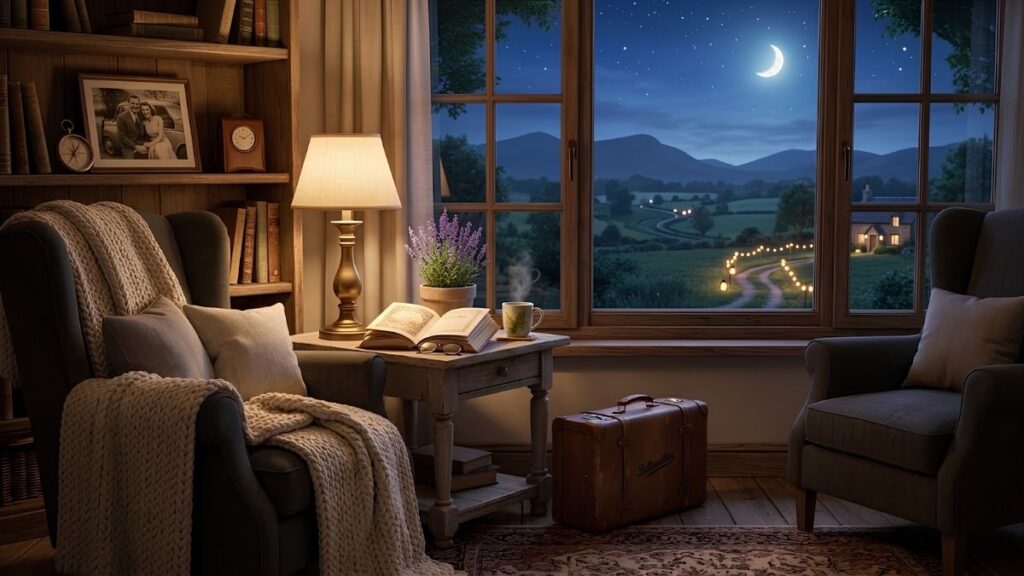
Long bedtime stories for adults offer a gentle way to slow down at the end of a demanding day. Unlike short stories designed to deliver a quick ending, longer bedtime stories give readers time to settle into a setting, become familiar with characters, and gradually move away from the noise of everyday life.
For many adults, bedtime is not simply the moment when they turn off the lights. It is a transition between an active day and a quieter state of mind. Work, responsibilities, conversations, plans, worries, and unfinished tasks can continue occupying the mind even after the day is technically over.
A well-written long bedtime story can create a bridge between those two states.
Instead of requiring intense concentration, a relaxing story can provide a steady stream of gentle imagery, familiar emotions, and unhurried events. The reader can follow along without feeling pressured to remember complicated details or anticipate constant twists.
This makes long bedtime stories particularly suitable for adults who enjoy immersive storytelling but want something calmer than a thriller, dramatic novel, or fast-paced adventure.
What Are Long Bedtime Stories for Adults?
Long bedtime stories for adults are extended narratives specifically suited to nighttime reading or listening.
They may be several thousand words long and can explore a character, relationship, journey, place, memory, or everyday experience in greater detail than a typical short bedtime story.
The defining feature isn’t simply word count.
A story can be long without being relaxing.
For bedtime, length works best when combined with a calm narrative structure.
A long bedtime story might follow someone spending a quiet week in a coastal village, returning to their childhood home, taking a slow train through the countryside, discovering an old bookstore, reconnecting with a friend, or gradually settling into a new home.
The story can contain events and emotional development, but the pacing remains gentle.
There is usually little need for dramatic conflict.
The purpose is to create an atmosphere that feels comfortable enough for the reader to gradually become sleepy.
Long Bedtime Stories for Adults
1. The Last Ferry to Bellweather Island

Type: Quiet Travel & Peaceful Companionship
Oliver Hayes had spent most of his adult life believing that journeys were supposed to have a purpose.
There had to be a reason for leaving home.
A meeting.
A holiday.
A family visit.
A work assignment.
A destination written on a ticket.
Even his weekend trips were carefully planned. He liked knowing where he would sleep, where he would eat, which roads he would take, and how long it would take to return.
Perhaps that was why, when he heard that the old Bellweather Inn was closing, he felt an unexpected desire to visit it one last time.
He had stayed there only once.
Twenty years earlier.
It had been a short holiday during a difficult period of his life, and he had almost forgotten about it.
Almost.
The memory had remained somewhere in the background, like a melody heard through a distant wall.
A quiet island.
A white lighthouse.
A wooden inn overlooking the harbor.
And a ferry crossing beneath a sky filled with evening clouds.
Now the inn was closing permanently.
Oliver discovered this through a small article in the local newspaper.
He read it twice.
Then he folded the newspaper and placed it beside his coffee.
For several minutes, he simply sat there.
He wasn’t sure why the news bothered him.
The inn wasn’t his.
He hadn’t visited it in decades.
He didn’t even know whether the room he had stayed in still existed.
Yet something about the closing felt like the disappearance of a small piece of his own past.
That afternoon, Oliver looked up the ferry schedule.
There was one final evening crossing to Bellweather Island.
He bought a ticket.
He didn’t make a hotel reservation.
He didn’t plan dinner.
He didn’t even decide how long he would stay.
For once, he simply wanted to go.
The ferry terminal was almost empty when Oliver arrived.
It was a little after five in the afternoon.
The summer crowds had disappeared weeks earlier, and the tourist season was nearly finished.
A cool wind moved across the harbor.
Gulls circled above the water.
Beyond the terminal, the sea stretched toward a horizon painted pale silver by the setting sun.
Oliver carried only a small overnight bag.
As he waited, he noticed an elderly woman sitting on a bench near the boarding gate.
She wore a long gray coat and held a small suitcase beside her.
A paperback book rested in her lap.
She seemed completely comfortable with the waiting.
Oliver checked the departure board.
Then he looked at her.
“Is this the Bellweather ferry?” he asked.
The woman smiled.
“Unless they’ve changed the island overnight.”
Oliver laughed.
“I suppose that would be inconvenient.”
“Very.”
She returned to her book.
A few minutes later, the ferry arrived.
Its engines rumbled gently as it approached the dock.
The passengers boarded.
Oliver found a seat beside a large window.
The elderly woman sat several rows ahead.
As the ferry pulled away, the town slowly became smaller.
The harbor lights appeared.
The buildings along the waterfront turned into silhouettes.
Oliver watched until the last familiar shape disappeared.
Then he looked toward the open sea.
The crossing had begun.
The ferry was quieter than Oliver expected.
There were perhaps fifteen passengers.
A young couple sat near the café.
A fisherman slept with his arms folded across his chest.
Two university students shared headphones.
The elderly woman from the terminal sat alone near the window.
Oliver bought a cup of tea and returned to his seat.
For the first half hour, nothing happened.
And he liked it.
There was something wonderfully uncomplicated about sitting on a boat without having anything to accomplish.
The engine created a steady vibration beneath his feet.
The sea moved in long, dark waves.
Occasionally, the ferry passed another boat.
A few birds followed them.
Oliver found himself relaxing.
He hadn’t realized how rarely he allowed himself to do nothing.
After another twenty minutes, the woman from the terminal walked toward the café.
She stopped beside his table.
“May I?”
Oliver looked at the empty chair.
“Of course.”
She sat down.
“I’m Margaret,” she said.
“Oliver.”
“I’ve been coming to Bellweather every autumn since I was twenty-seven.”
Oliver raised his eyebrows.
“That’s a long time.”
“Longer than some marriages.”
He smiled.
“Do you have family there?”
“No.”
“Friends?”
“Not exactly.”
“Then why keep coming?”
Margaret looked through the window.
“Because I like the way the island feels.”
Oliver understood that answer immediately.
There was no need to ask anything else.
They sat quietly for a while.
Then Margaret said, “What brings you there?”
Oliver thought about it.
“The inn.”
“The Bellweather Inn?”
“Yes.”
Margaret nodded.
“It’s closing.”
“I know.”
“I stayed there once.”
“When?”
“Twenty years ago.”
Margaret smiled.
“Then you’re going back to say goodbye.”
Oliver looked at her.
“I suppose I am.”
The ferry moved farther into the evening.
Clouds gathered over the water.
The sky changed from silver to blue, then from blue to a deep violet.
Margaret told Oliver about the island.
She described the small bakery near the harbor.
The old lighthouse.
The walking trail through the northern woods.
The little grocery store that had been operated by the same family for three generations.
She also told him about the island’s winter.
“It becomes very quiet,” she said.
“Too quiet?”
“No. The right kind of quiet.”
Oliver smiled.
“What’s the difference?”
Margaret considered the question.
“Too much quiet makes you aware of every sound.”
She paused.
“The right kind makes you aware of the sounds you normally ignore.”
Oliver looked out the window.
The ferry’s wake glowed faintly behind them.
He thought about that.
The right kind of quiet.
Perhaps that was what he had been missing.
A little later, fog appeared.
At first it was barely noticeable.
A pale mist rested on the water.
Then it became thicker.
The ferry slowed.
A soft announcement explained that the captain was reducing speed because visibility had dropped.
Nobody seemed particularly concerned.
The passengers simply settled back.
Margaret returned with two cups of tea.
“I thought you might want one.”
“Thank you.”
They watched the fog swallow the horizon.
The world outside the window became almost completely white.
The ferry seemed to be moving through a cloud.
Oliver found it strangely beautiful.
“What happens if we can’t reach the island?” he asked.
“We will.”
“And if we don’t?”
Margaret shrugged.
“Then we’ll have an interesting story.”
He laughed.
“You aren’t worried?”
“About what?”
“Being delayed.”
“I’ve been delayed before.”
“Doesn’t it bother you?”
Margaret looked at him.
“Oliver, we’re on a boat in the middle of the sea. There isn’t much we can do about the fog.”
She took a sip of tea.
“So we might as well enjoy the tea.”
Oliver laughed again.
He began to understand why he liked talking to her.
The fog lasted nearly an hour.
During that time, the two strangers continued talking.
Oliver told Margaret about his work, his apartment, and the city he had lived in for most of his adult life.
He told her that he had recently begun feeling tired of the noise.
The traffic.
The constant messages.
The endless appointments.
The expectation that every hour needed to be productive.
Margaret listened.
She didn’t offer advice.
Instead, she told him about her own life.
She had been a librarian for forty years.
She had raised two children.
She had traveled very little.
She had once planned to visit Europe, but the trip never happened.
She didn’t sound regretful.
“Do you wish you’d gone?” Oliver asked.
“Sometimes.”
“Then why didn’t you?”
“Life kept offering me other things.”
Oliver smiled.
“Good things?”
“Mostly.”
She looked toward the fog.
“Life doesn’t always give us the life we planned.”
She paused.
“But sometimes it gives us a life we didn’t know we wanted.”
Oliver remembered those words.
Eventually, the fog began to thin.
A small light appeared in the distance.
Then another.
Then several.
Bellweather Island.
The ferry approached slowly.
The lighthouse stood above the harbor, its beam sweeping through the darkness.
Oliver felt something inside him settle.
He had expected excitement.
Instead, he felt calm.
When the ferry docked, the passengers gathered their belongings.
Margaret stood beside him.
“Are you staying at the inn?” she asked.
“If it’s still open.”
“It is.”
“I haven’t booked anything.”
“You might be lucky.”
Oliver smiled.
“And you?”
“I have a little cottage.”
“Of course you do.”
Margaret laughed.
They walked down the ramp together.
The harbor was quiet.
A bakery sign glowed on the opposite side of the street.
The air smelled of salt and wood smoke.
Oliver stopped for a moment.
He remembered being here twenty years earlier.
The same harbor.
The same lighthouse.
But he was different.
He had been younger then.
Impatient.
Worried about the future.
Always rushing toward something.
Now he simply stood there.
The Bellweather Inn looked smaller than he remembered.
Its white paint had faded.
Several windows were dark.
The wooden sign creaked softly in the wind.
Inside, an elderly man named Peter greeted Oliver.
When Oliver mentioned that he had stayed there twenty years earlier, Peter searched an old guest register.
After several minutes, he found the entry.
“Oliver Hayes,” he read.
Oliver laughed.
“I wrote my name very badly.”
“You were probably in a hurry.”
“I usually am.”
Peter looked at him.
“Not tonight, though.”
Oliver smiled.
“No.”
He wasn’t.
Peter gave him a key to a small room overlooking the harbor.
The room wasn’t the same one Oliver had stayed in before.
But it didn’t matter.
He opened the window.
The harbor lights shimmered below.
A bell rang somewhere in the distance.
He sat beside the window for a long time.
The next morning, Oliver woke before sunrise.
He walked down to the harbor.
Margaret was already there.
She was sitting on a bench with a thermos.
“You always wake up this early?” Oliver asked.
“On Bellweather.”
“Why?”
She looked toward the horizon.
“Because the island looks different before everyone wakes up.”
She poured him some coffee.
They watched the sun rise.
The sea turned from gray to silver.
Then gold.
Fishing boats moved slowly across the horizon.
A few gulls appeared above the harbor.
Neither spoke for several minutes.
There was nothing to say.
And for once, Oliver didn’t feel the need to fill the silence.
He spent the rest of the day walking around the island.
He visited the lighthouse.
He bought bread from the bakery.
He walked through the northern woods.
He found the small stone wall he vaguely remembered from his first visit.
He sat beside it.
He thought about the person he had been twenty years earlier.
That younger Oliver had been desperate to know what his life would become.
Career.
Home.
Relationships.
Success.
He had believed that if he planned carefully enough, he could prevent uncertainty.
But life hadn’t worked that way.
There had been unexpected changes.
Missed opportunities.
People who left.
People who arrived.
Plans that worked.
Plans that didn’t.
And somehow, he had continued.
The thought didn’t make him sad.
It made him strangely peaceful.
That evening, Oliver returned to the inn.
The dining room was nearly empty.
Margaret sat at a corner table.
She waved.
He joined her.
They talked about ordinary things.
The bakery.
The weather.
Books.
The ferry.
A cat that belonged to the grocery store owner.
Nothing important.
Everything important.
After dinner, they walked toward the harbor.
The lighthouse beam moved slowly across the water.
“I think I’m glad I came,” Oliver said.
Margaret smiled.
“You sound surprised.”
“I am.”
“Why?”
“Because I didn’t really know why I was coming.”
Margaret looked at him.
“Maybe you didn’t need to.”
They stopped near the pier.
The water moved quietly below them.
Oliver looked back at the inn.
“I thought I was coming to say goodbye.”
“To the inn?”
“Yes.”
“And now?”
He considered it.
“Maybe to an old version of myself.”
Margaret nodded.
“That sounds more useful.”
Oliver stayed on Bellweather Island for three days.
He never made a schedule.
He woke when he woke.
He ate when he was hungry.
He walked when he wanted to walk.
He talked to people.
Sometimes he sat alone.
He watched the fishing boats return.
He listened to the wind.
He read a book beside the harbor.
On his final morning, he packed his small bag.
Margaret met him at the ferry terminal.
“Going home?”
“Eventually.”
She smiled.
The ferry arrived.
Oliver boarded.
Before entering the cabin, he turned around.
Margaret was standing on the dock.
He lifted a hand.
She waved.
Then the ferry moved away.
The island slowly became smaller.
Oliver stood at the window.
For once, he didn’t think about what waited for him at the other end.
He didn’t think about work.
Or schedules.
Or tomorrow.
He simply watched the island disappear into the morning light.
The journey home was quiet.
And for the first time in many years, Oliver realized that he didn’t mind not knowing exactly what came next.
Sometimes a journey didn’t need to change your life.
Sometimes it only needed to give you a few quiet days in which to see your life differently.
The ferry continued toward the mainland.
The sea stretched endlessly around him.
And somewhere behind him, Bellweather Island waited beneath the morning sun.
Oliver smiled.
He knew he would return someday.
Not because he needed to.
Simply because he wanted to.
Core themes: quiet travel, companionship, coastal landscapes, reflection, letting go.
2. The House With Seven Blue Windows

Type: Cozy Domestic Life & Everyday Comfort
Daniel Foster had moved twelve times in fourteen years.
He knew how to pack quickly.
He knew which boxes needed thick tape and which ones could survive with a single strip.
He knew that books should never be placed in large boxes unless he wanted to spend the next morning carrying something that felt like a piece of furniture.
He knew exactly how many shirts could fit into one suitcase.
Most importantly, he knew how not to become attached to a place.
That last skill had taken him years to learn.
Apartments were temporary.
Walls were temporary.
Neighbors were temporary.
Even the little cafés where he eventually learned the names of the staff were temporary.
Whenever he moved, Daniel told himself the same thing.
This is just another place to live.
It made leaving easier.
Then, at thirty-nine, Daniel bought a house.
It was not the kind of house he had imagined owning when he was younger.
There was no dramatic entrance.
No enormous garden.
No polished kitchen.
No perfect white walls.
The house stood on a quiet residential street beneath two old maple trees.
It had peeling cream-colored paint, a crooked wooden gate, and seven windows painted a faded shade of blue.
Daniel noticed the windows before anything else.
They were different from the rest of the house.
The blue paint had faded in places, revealing layers beneath it.
One window had a small crack near the bottom corner.
Another had a curtain that didn’t quite close.
The seventh window, which belonged to the upstairs bedroom, reflected the sky so beautifully that Daniel stood outside looking at it for several minutes.
The real estate agent called the house “a charming renovation opportunity.”
Daniel privately thought this meant “a house that needs almost everything.”
Still, he bought it.
He signed the papers on a cold Thursday morning.
By Friday afternoon, he had the keys.
And for the first time in his life, Daniel had nowhere else to move.
The first night was strange.
There was almost no furniture.
Daniel had brought a mattress, a folding table, two chairs, a kettle, three boxes of books, and a lamp.
That was all.
He made tea.
Then he sat on the floor of the living room.
The room smelled faintly of old wood and dust.
Outside, someone walked past with a dog.
A car moved slowly along the street.
Somewhere nearby, a wind chime made three soft notes.
Daniel looked around.
“This is mine,” he said quietly.
The words sounded unfamiliar.
He wasn’t sure whether he liked them.
His phone contained several messages from friends asking how the move had gone.
He replied:
Settled in.
It wasn’t entirely true.
But he didn’t know how else to describe it.
The next morning, Daniel made a list.
The list was very long.
Paint the exterior.
Repair the roof.
Replace the kitchen cabinets.
Fix the bathroom.
Sand the floors.
Repair the garden gate.
Replace the light fixtures.
Clear the backyard.
Repair the upstairs window.
Install shelves.
He stared at the list.
Then added another item.
Buy curtains.
By lunchtime, he had convinced himself that the entire house could be renovated within three months.
He would work every evening.
Every weekend.
He would hire people for the difficult jobs.
He would finish quickly.
Then he could finally relax.
It was a sensible plan.
At least, that was what Daniel thought.
On Monday evening, he began removing an old cabinet from the kitchen.
The cabinet had probably been there for decades.
The wood was scratched and the handles were dull.
When Daniel pulled it away from the wall, he noticed something beneath it.
A series of pencil marks.
He crouched down.
There were several horizontal lines drawn directly onto the wall.
Beside them were dates.
Each mark had a name.
Daniel smiled.
Someone had been measuring a child’s height.
He traced one of the lines with his finger.
The smallest mark was almost at floor level.
The highest reached above his shoulder.
For some reason, the discovery made the kitchen feel different.
This wasn’t just an old house.
Children had grown here.
Families had celebrated birthdays here.
Someone had stood in this exact room decades earlier and wondered how tall their child would become.
Daniel took a photograph.
Then he put the cabinet back.
For the first time, his renovation plan slowed down.
Only slightly.
A few days later, Daniel met his neighbor.
He was trying to repair the garden gate when an elderly man appeared on the other side of the hedge.
“You’ll have trouble with that hinge,” the man said.
Daniel looked at it.
“I’ve already discovered that.”
The man smiled.
“My name is Arthur.”
“Daniel.”
“I know.”
Daniel raised an eyebrow.
“How?”
Arthur pointed toward the moving boxes still visible through the front window.
“The delivery people have been talking about you for three days.”
Daniel laughed.
“That sounds promising.”
“They say you’re fixing the place.”
“Trying to.”
Arthur looked at the house.
“You’ll never finish.”
Daniel smiled.
“That’s encouraging.”
Arthur laughed.
Then he reached through the hedge.
“Give me that screwdriver.”
Daniel handed it over.
Arthur examined the hinge.
“Wrong screw.”
Twenty minutes later, the gate worked perfectly.
Daniel invited Arthur inside for tea.
Arthur accepted.
They sat at the folding table.
“You bought the old Miller house,” Arthur said.
“Was it the Miller house?”
“Before them, it was the Harris house.”
“How long has it been here?”
“Since 1948.”
Daniel looked around.
“I didn’t know that.”
Arthur nodded.
“Most people don’t.”
He told Daniel that the house had belonged to several families.
The first owner had been a carpenter.
The next family had run a bakery.
Another owner had taught music lessons in the front room.
A woman named Margaret had lived there for almost thirty years.
“She painted the windows blue,” Arthur explained.
“Why?”
Arthur shrugged.
“She liked blue.”
That was all.
Daniel liked that answer.
As the weeks passed, Daniel began discovering more traces of the house’s previous residents.
Behind a loose floorboard in the hallway, he found an old brass key.
It didn’t fit any lock in the house.
He placed it in a small bowl near the entrance.
Inside a kitchen drawer, he found a handwritten grocery list.
Bread.
Milk.
Apples.
Soap.
Tea.
Nothing extraordinary.
Yet Daniel found himself staring at it.
Someone had written that list.
Someone had walked to a shop.
Someone had returned with those groceries.
Perhaps someone had made tea in this same kitchen.
Perhaps someone had stood at the window while waiting for the kettle to boil.
Ordinary life had happened here.
A lot of it.
Daniel began wondering why that felt so meaningful.
One Saturday morning, Arthur knocked on the door.
“I found something,” he said.
He handed Daniel a small envelope.
Inside was an old photograph.
The house looked almost the same.
But the garden was full of flowers.
A young woman stood near the blue windows.
“Margaret,” Arthur said.
Daniel looked at the photograph.
“She lived here?”
“Thirty years.”
“Did you know her?”
Arthur smiled.
“Everyone knew Margaret.”
He told Daniel stories.
Margaret had loved gardening.
She had kept roses along the fence.
She had painted the front door green.
She had once organized a neighborhood picnic that was remembered for years.
“She also hated noisy lawnmowers,” Arthur added.
Daniel laughed.
“She sounds sensible.”
“She was.”
Daniel placed the photograph on his mantel.
He didn’t know why.
He simply wanted it there.
His original three-month renovation plan slowly disappeared.
The roof still needed work.
The kitchen still looked old.
The hallway still had scratches.
But Daniel stopped trying to fix everything at once.
Instead, he chose one project each weekend.
First, he repaired the garden gate properly.
Then he painted the kitchen shelves.
The following weekend, he planted rosemary, mint, and basil beside the back door.
The weekend after that, he repaired the loose step near the entrance.
The work became enjoyable.
There was no deadline.
No rush.
He discovered that he liked seeing small improvements accumulate.
One evening, he stood in the garden holding a watering can.
The sun was going down.
The seven blue windows reflected the orange sky.
Daniel realized he had been outside for almost an hour without checking his phone.
That had never happened before.
His mornings changed too.
At his old apartments, Daniel had always woken up to an alarm.
He would check his phone before getting out of bed.
Then email.
News.
Messages.
Traffic.
Weather.
Work.
By eight o’clock, his mind was already crowded.
In the new house, things gradually became different.
He began waking earlier.
He opened the kitchen window.
He put water on the stove.
He made coffee.
Then he stood outside while the garden woke up.
Birds appeared in the maple trees.
A delivery van passed.
Someone opened their curtains across the street.
Arthur occasionally waved from his porch.
Daniel began recognizing the rhythms of the neighborhood.
The woman who walked her dog at seven.
The bakery delivery that arrived at eight.
The schoolchildren who passed at eight-thirty.
The old man who watered his plants every morning.
None of these things had been part of Daniel’s life before.
Now they were.
One rainy afternoon, Daniel was cleaning the upstairs bedroom when he noticed the seventh blue window.
Rain ran down the glass.
He opened the curtain.
On the windowsill was a small indentation in the wood.
He looked closer.
Someone had carved initials into it.
M.H.
Margaret Harris.
Daniel smiled.
He didn’t know when she had carved them.
Perhaps she had been young.
Perhaps she had been old.
Perhaps it had happened during an ordinary afternoon when she had been waiting for something.
Daniel touched the initials.
Then he closed the curtain.
He decided not to sand them away.
The first person Daniel invited to dinner was Arthur.
He cooked pasta.
It was nothing impressive.
Arthur brought bread.
They ate at the small kitchen table.
“You’re becoming domestic,” Arthur said.
Daniel laughed.
“Is that bad?”
“Not at all.”
They talked about the house.
About the neighborhood.
About Margaret.
About how much things had changed.
After dinner, Arthur stood by the kitchen window.
“She’d like what you’ve done.”
Daniel looked at him.
“Really?”
“She’d probably complain about the garden.”
“That’s comforting.”
Arthur laughed.
Winter arrived.
The garden became quiet.
The herbs stopped growing.
Leaves covered the lawn.
Daniel bought a thick rug for the living room.
He added a bookshelf.
Then another.
He bought a comfortable chair and placed it beside the window.
For the first time, the house began to look like his.
But he didn’t remove all traces of the past.
The height marks remained.
The initials remained.
The old brass key remained in its bowl.
Margaret’s photograph remained on the mantel.
The handwritten grocery list was framed and placed in the kitchen.
Daniel didn’t know why he wanted to preserve these things.
Perhaps because he had spent so many years leaving places behind.
This time, he wanted to stay.
One Sunday morning, Daniel woke to sunlight.
There was no alarm.
No urgent appointment.
No moving boxes.
No list of apartments to inspect.
He made coffee.
Opened the kitchen window.
Then walked through the house.
Seven blue windows.
He counted them.
One in the kitchen.
Two in the living room.
Two upstairs.
One near the staircase.
One at the back of the house.
Seven.
He had never realized how much he liked that number.
He opened each curtain.
Light filled the rooms.
Then he went outside.
The garden gate creaked softly.
He had been meaning to fix that.
Instead, he smiled.
Not everything needed fixing immediately.
Some things could simply be lived with.
Spring came slowly.
Tiny green shoots appeared beside the back door.
The maple trees grew leaves.
Birds returned.
Arthur planted tomatoes.
Daniel planted flowers.
One Saturday afternoon, several neighbors gathered outside.
Someone brought lemonade.
Someone else brought cake.
Children played in the street.
Daniel stood near the garden fence watching everyone.
A year earlier, he hadn’t known any of these people.
Now he knew their names.
He knew which house belonged to the retired teacher.
He knew which neighbor made excellent bread.
He knew Arthur’s favorite chair.
He knew that the family across the street had a dog named Winston.
The house had changed.
But so had he.
That evening, Daniel sat alone in the living room.
The windows were open.
A soft breeze moved the curtains.
The neighborhood slowly became quieter.
He looked around.
The repaired floor.
The bookshelf.
The old photograph.
The framed grocery list.
The bowl containing the brass key.
The seven blue windows.
He thought about all the apartments he had lived in.
He remembered their addresses.
Their rooms.
Their furniture.
But he could barely remember how they had felt.
This house was different.
It wasn’t perfect.
The kitchen still needed work.
The roof would eventually need replacing.
The garden gate occasionally stuck.
One upstairs window still had a crack.
But Daniel loved it.
Not because it was flawless.
Because it had become familiar.
It contained his mornings.
His dinners.
His books.
His conversations.
His mistakes.
His quiet evenings.
His growing garden.
It contained pieces of other people’s lives too.
That made it feel older than him.
And somehow, more complete.
A few months later, Daniel found himself packing a small box.
For a moment, the familiar instinct returned.
He wondered if he was preparing to move again.
Then he laughed.
The box contained something completely different.
It held a photograph of the house.
A note about the seven windows.
A few pictures of the garden.
And a small card on which Daniel had written:
The house isn’t finished.
Underneath, he added:
I don’t think it needs to be.
He placed the box in the attic.
Perhaps someone would find it someday.
Perhaps they would wonder who had lived there.
Perhaps they would discover the height marks.
The old key.
The initials.
The photograph.
Maybe they would learn his name.
Maybe they wouldn’t.
Daniel didn’t mind.
The house had already taught him something important.
A home wasn’t created simply by buying a building.
It wasn’t created by expensive furniture or perfect renovations.
It was created slowly.
Through mornings.
Through meals.
Through familiar voices.
Through neighbors who stopped by.
Through plants that grew.
Through windows that let in the evening light.
Through small memories accumulating quietly until one day you looked around and realized that you belonged there.
Daniel turned off the downstairs lights.
Outside, the seven blue windows reflected the moonlight.
He climbed the stairs.
Before going to bed, he paused beside the seventh window.
The neighborhood was quiet.
A few houses still had their lights on.
Somewhere in the distance, a dog barked once.
Then everything became still again.
Daniel smiled.
He had spent years learning how to leave.
Now, finally, he was learning how to stay.
And the old house with seven blue windows seemed perfectly happy to let him.
Core themes: belonging, home, simple routines, neighborhood friendship, everyday comfort.
3. The Umbrella They Shared

Type: Gentle Romance
Rain had been falling since four in the afternoon.
By six-thirty, the city seemed to have surrendered to it.
Water ran along the edges of the sidewalks. Car headlights stretched across the wet streets in long, trembling reflections. People hurried beneath umbrellas, holding coats over their heads, while buses moved slowly through the traffic.
Emily Carter stood beneath the narrow awning outside her office building and watched the rain.
She had forgotten her umbrella.
Again.
She checked her phone.
6:34 p.m.
Her train was scheduled for 6:52.
The station was only a twelve-minute walk away on a dry evening.
Tonight, however, the journey looked considerably less pleasant.
Emily sighed.
“You’re going to need more than determination.”
She turned.
Thomas Reed was standing a few feet away.
They worked in neighboring offices on the same floor of the building. Emily knew him well enough to recognize his voice and face, but not well enough to know what he did on weekends or what he drank when he went to a café.
They had exchanged perhaps a hundred polite greetings over the years.
Nothing more.
Thomas held a dark blue umbrella.
He looked toward the rain.
Then toward Emily.
“I’m heading toward the station,” he said. “You can share mine if you want.”
Emily hesitated.
“I don’t want to inconvenience you.”
“You won’t.”
“Are you sure?”
Thomas smiled.
“It’s a large umbrella.”
Emily looked at it.
It was, in fact, large.
“All right,” she said. “Thank you.”
They stepped into the rain together.
At first, they walked in silence.
The umbrella covered them both, but only just.
Emily tried to stay on her side.
Thomas noticed.
“If you keep moving that far away, you’re going to get soaked.”
“I’m trying not to crowd you.”
“I’d rather have a slightly crowded umbrella than a completely useless one.”
She laughed.
It was the first time she had heard him make a joke.
“Fair enough.”
They walked closer.
The rain drummed softly against the fabric above them.
Their shoes splashed through shallow puddles.
For several minutes, neither said anything.
Then Emily noticed the book sticking out of Thomas’s bag.
“Are you reading that?”
Thomas looked down.
“Yes.”
“I’ve been meaning to read it.”
“You can borrow it when I’m finished.”
Emily looked at him.
“You’d lend it to someone you’ve barely spoken to?”
“Technically, we’ve spoken quite a lot.”
“Have we?”
“We’ve said good morning at least forty times.”
She smiled.
“That’s true.”
They continued walking.
The conversation became easier.
Books led to films.
Films led to music.
Music led to travel.
Travel led to food.
By the time they reached the station entrance, Emily realized something.
She had enjoyed the walk.
Even in the rain.
They reached the platform at 6:48.
Emily checked the electronic board.
Then she frowned.
“Delayed.”
Thomas looked.
“How delayed?”
The number changed.
Cancelled.
Emily stared at it.
“You’ve got to be kidding.”
Thomas laughed softly.
“Apparently the rain has other plans.”
“There’s another train in forty minutes.”
“That’s not too bad.”
“No,” Emily said. “It’s not.”
They left the station.
Neither of them suggested going their separate ways.
A small café stood across the street.
Its windows were fogged from the warmth inside.
Emily pointed toward it.
“Coffee?”
Thomas nodded.
“Coffee.”
The café was nearly empty.
They found a table beside the window.
Emily ordered tea.
Thomas ordered coffee.
Outside, the rain continued.
Inside, the café was warm and quiet.
A soft song played from somewhere behind the counter.
Emily looked at the clock.
7:18.
“We’ve still got twenty minutes.”
Thomas smiled.
“Then we have exactly twenty minutes to solve all the world’s problems.”
“I think that’s ambitious.”
“All right. Just the important ones.”
She laughed again.
They talked.
Twenty minutes became forty.
Forty became an hour.
Neither noticed.
Thomas discovered that Emily loved visiting weekend markets.
Emily discovered that Thomas made homemade bread.
He was embarrassed when she found this surprising.
“You make bread?”
“Sometimes.”
“What kind?”
“Mostly bread that looks better than it tastes.”
“That’s a very specific category.”
“I’ve perfected it.”
She laughed.
He told her about the first loaf he had made.
She told him about the time she had tried making soup and accidentally used cinnamon instead of cumin.
They talked about embarrassing mistakes.
Childhood memories.
Favorite breakfasts.
Places they wanted to visit.
Small things.
Ordinary things.
Things people usually discovered only after knowing someone for a long time.
At 9:06, Emily finally checked her phone.
She stared at the screen.
“Oh.”
“What?”
“It’s been two hours.”
Thomas looked at the clock.
“I thought it was maybe eight.”
“So did I.”
Neither immediately moved.
The rain had become lighter.
Emily smiled.
“This was nice.”
“It was.”
She picked up her bag.
“I suppose I should go.”
“Probably.”
They walked toward the station.
This time, neither needed the umbrella.
The next morning, Thomas arrived at work carrying a small paper bag.
He waited until Emily came out of the elevator.
“Morning.”
“Morning.”
He held out the bag.
“I brought you something.”
Emily looked surprised.
Inside was a small loaf of bread.
She laughed.
“Your famous bread?”
“Don’t get your expectations too high.”
She smiled.
“Thank you.”
It was still warm.
That evening, Emily sent him a message.
The bread was good.
Thomas replied:
You’re being polite.
I’m not.
Then I’ll have to make another one.
She smiled at her phone.
That was how it began.
Not with a grand confession.
Not with a dramatic first date.
Just rain.
An umbrella.
A cancelled train.
And a conversation neither of them expected.
Their first proper weekend together happened almost by accident.
Emily mentioned that she was planning to visit a farmers’ market.
Thomas said he liked farmers’ markets.
So she asked:
“Do you want to come?”
He said yes.
They walked between stalls beneath a pale Saturday sky.
They bought apples.
Thomas examined different kinds of bread.
Emily bought flowers she didn’t need.
They drank coffee from paper cups.
They stopped to listen to a street musician.
At one stall, Thomas bought a jar of honey.
“Why that one?”
He shrugged.
“It looked good.”
Emily smiled.
“You make decisions based on labels?”
“Sometimes.”
“That’s dangerous.”
“Only when buying honey.”
She laughed.
They walked for three hours.
At the end, neither wanted to leave.
So they found a small restaurant.
Then they walked home.
Their relationship developed slowly.
There was no moment when everything suddenly changed.
Instead, there were dozens of small moments.
Thomas learned that Emily liked her tea with very little milk.
Emily learned that Thomas always read the last page of a book before deciding whether he liked it.
He learned that she hated noisy restaurants.
She learned that he couldn’t sleep if a cupboard door was slightly open.
He discovered her habit of leaving books beside the bed.
She discovered his habit of making too much breakfast.
Some weekends they went out.
Other weekends they stayed home.
They cooked.
They read.
They watched old movies.
They walked through quiet neighborhoods.
Sometimes they talked for hours.
Sometimes they sat together without saying much at all.
The silence never felt uncomfortable.
That was one of the things Emily loved most.
One winter evening, they were walking home after dinner.
Snow had begun falling.
Thomas looked at Emily.
“Do you remember the first time we actually talked?”
She smiled.
“The umbrella.”
“And the cancelled train.”
“And the café.”
“And your cinnamon soup.”
Emily laughed.
“I told you about that once.”
“I remember everything.”
She looked at him.
“Everything?”
“Important things.”
She slipped her hand into his.
“Was that evening important?”
Thomas squeezed her hand.
“Very.”
Years passed.
They eventually moved into a small apartment together.
It had tall windows and an old wooden dining table.
They bought plants.
Too many plants.
They filled shelves with books.
They learned which grocery store sold the best bread.
They argued occasionally about whose turn it was to wash the dishes.
They celebrated birthdays.
They traveled.
They stayed home.
They built a life out of ordinary days.
And somewhere in a closet was the old umbrella.
The dark blue one.
The same umbrella Thomas had carried that rainy evening years earlier.
It had become faded.
One of the ribs was slightly bent.
The handle had a small scratch.
Thomas eventually bought a new umbrella.
Emily refused to throw the old one away.
“It’s broken,” he said.
“It’s sentimental.”
“It’s barely functional.”
“It still opens.”
“Mostly.”
“That’s enough.”
So it stayed.
One rainy evening many years later, Emily found it while looking for a suitcase.
She pulled it from the back of the closet.
The fabric was faded.
She opened it.
The umbrella struggled into shape.
Thomas walked into the room.
“You found that?”
“Yes.”
“You should throw it away.”
Emily shook her head.
“Absolutely not.”
“It looks terrible.”
She smiled.
“It took me somewhere.”
“Where?”
She looked at him.
“Here.”
Thomas understood.
He walked over and stood beside her.
Outside, rain tapped against the windows.
Emily leaned her head against his shoulder.
“Do you ever think about that evening?”
“Sometimes.”
“I do.”
“What do you remember?”
She thought for a moment.
“The rain.”
“The café.”
“The cancelled train.”
“The bread.”
“Your terrible jokes.”
“They weren’t terrible.”
“They were.”
He laughed.
Emily looked down at the old umbrella.
“I remember thinking that I had missed my train.”
She smiled.
“I didn’t realize I’d found something else.”
Thomas kissed the top of her head.
“Neither did I.”
They stood together for a while.
The rain continued outside.
Neither hurried to turn it off.
The umbrella eventually became part of their home.
Not because they needed it.
Not because it was useful.
But because it reminded them of something simple.
Some of the most important moments in life don’t announce themselves.
They arrive disguised as inconveniences.
A forgotten umbrella.
A delayed train.
A table in a nearly empty café.
A conversation that lasts longer than expected.
A person you thought you knew only as a familiar face.
And sometimes, when life slows down for reasons you didn’t choose, you discover that the unexpected pause was exactly what you needed.
Emily never forgot that evening.
Years later, whenever rain began falling, she sometimes stood by the window and watched the streets turn silver beneath the lights.
Then she would look toward the old umbrella hanging near the door.
And she would smile.
Because she knew something now that she hadn’t known when she was standing beneath that office awning.
Love did not always arrive dramatically.
Sometimes it simply offered you half an umbrella.
And asked whether you’d like to walk together.
Core themes: gentle romance, companionship, rainy evenings, emotional connection, everyday love.
4. The Record Player in Room Twelve
Type: Nostalgic Memories
Samuel Grant had not taken a holiday in almost three years.
Not a proper one, anyway.
He had taken long weekends.
He had stayed home on public holidays.
Once, he had spent four days in a coastal town while answering emails every morning from his hotel room.
He called that a break.
His sister called it “working somewhere with better curtains.”
Samuel had laughed when she said it.
But lately, he had begun to suspect she was right.
At forty-one, Samuel had become very good at staying busy.
His weekdays were filled with meetings, schedules, messages, deadlines, and phone calls.
His evenings were quieter, but even then he usually found something to do.
Laundry.
Groceries.
Emails.
Bills.
Cleaning.
Planning.
There was always something waiting.
So when an old friend suggested that he take a few days in the countryside, Samuel initially dismissed the idea.
Then, one Thursday evening, he found himself staring at his computer screen without remembering what he had been working on.
He closed the laptop.
The next morning, he booked a room.
He didn’t choose a famous hotel.
He didn’t choose a resort.
He found a small countryside guesthouse called Willowmere House.
The website showed an old stone building surrounded by trees, with twelve guest rooms and a garden that appeared to stretch behind the house toward a distant meadow.
The description promised nothing remarkable.
“Quiet rooms. Homemade breakfast. Walking trails. Books. Records.”
Samuel stopped at that last word.
Records.
He wasn’t sure why.
Perhaps that was why he booked it.
The journey took almost three hours.
The city gradually disappeared behind him.
Buildings became smaller.
Traffic became lighter.
Eventually, there were fields on both sides of the road.
Samuel turned off his phone’s navigation when he reached a narrow country lane.
He drove slowly.
There were no shops.
No traffic lights.
Only hedges, trees, stone walls, and occasional houses.
Willowmere House appeared around a bend.
It was larger than Samuel had expected.
Gray stone walls covered in ivy.
Tall windows.
A dark green door.
A small garden in front.
An old wooden sign beside the entrance.
WILLOWMERE HOUSE
Samuel parked.
Before getting out of the car, he sat for a moment.
The silence felt strange.
There were no horns.
No construction.
No distant sirens.
Only birds.
He smiled.
“All right,” he said to himself.
“Let’s see if I can actually relax.”
The owner was a woman named Margaret Bell.
She appeared to be in her late sixties and wore a knitted cardigan despite the mild afternoon.
“Samuel?”
“Yes.”
“Welcome.”
She shook his hand.
“You found us.”
“Eventually.”
Margaret laughed.
“Everyone gets lost the first time.”
She carried his bag upstairs.
“Breakfast is from seven-thirty until nine.”
“All right.”
“Tea whenever you want it.”
“Good.”
“And there’s a record player in your room.”
Samuel stopped.
“Really?”
Margaret smiled.
“You saw that on the website?”
“I did.”
“Room Twelve has the old one. It’s been there longer than I have.”
“Can I use it?”
“Of course.”
She continued upstairs.
“The records are in the cabinet. You can choose whatever you like.”
Samuel followed her.
For some reason, he was suddenly more interested in the record player than the room itself.
Room Twelve was at the end of the hallway.
It had a large window overlooking the garden.
A wooden bed.
A small writing desk.
A reading chair.
A wardrobe.
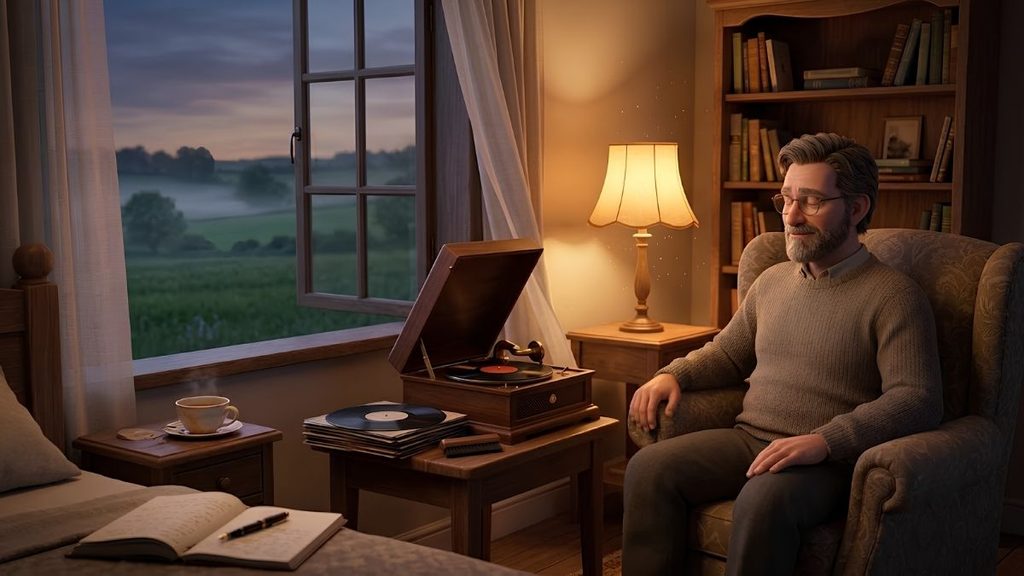
And, beside the bookshelf, an old record player.
Samuel walked over.
It was beautiful.
Dark wood.
Brass-colored controls.
A clear plastic cover that had yellowed slightly with age.
Beside it stood a wooden cabinet filled with records.
Margaret placed his bag near the bed.
“Most guests choose something eventually.”
“Do you know what’s in the collection?”
“Some of it.”
“How old are they?”
“Some are older than you.”
Samuel smiled.
“That’s not particularly difficult.”
Margaret laughed.
“Have a look.”
She left.
Samuel unpacked.
Then he opened the record cabinet.
There were dozens of albums.
Classical music.
Jazz.
Old popular songs.
Instrumental recordings.
Christmas records.
Soundtracks.
He ran his fingers along the sleeves.
He eventually chose one without thinking.
He lifted the record carefully.
Then froze.
He recognized the title.
He didn’t remember why.
Samuel placed the record on the player.
The needle settled.
A soft crackle filled the room.
Then the music began.
Samuel sat down.
Within seconds, he knew.
His father had played this song.
Every Sunday morning.
Samuel was eight years old again.
Not literally.
But memory had a strange way of making time disappear.
He could see the kitchen.
The curtains were open.
Sunlight spread across the wooden table.
His father stood near the stove.
Pancakes were cooking.
Samuel’s mother was making coffee.
His younger sister was still asleep upstairs.
The record player sat in the corner.
The same melody played through the room.
Samuel remembered sitting at the table with his feet not quite touching the floor.
He remembered waiting for the pancakes.
He remembered his father pretending to toss one and nearly dropping it.
He remembered his mother’s laugh.
He remembered the smell of butter.
He remembered rain against the kitchen window.
He remembered absolutely nothing important.
And yet, suddenly, it felt precious.
Samuel opened his eyes.
He was back in Room Twelve.
The record was still playing.
He didn’t move.
When it finished, he lifted the needle.
The room became silent.
Samuel looked at the record.
He hadn’t thought about those Sunday mornings in years.
Not properly.
He remembered his childhood, of course.
But usually he remembered birthdays.
School.
Holidays.
Family trips.
Big events.
He had forgotten the pancakes.
The curtains.
The music.
The rain.
The ordinary Sunday.
That evening, Samuel went downstairs.
Margaret was sitting near the fireplace with a book.
“You found something familiar,” she said.
Samuel smiled.
“How did you know?”
“People always look different when they come downstairs after finding a memory.”
Samuel sat opposite her.
“My father used to play that record.”
“Ah.”
“Every Sunday.”
Margaret closed her book.
“Then it was a good choice.”
“Completely accidental.”
“Those are often the best choices.”
Samuel told her about the pancakes.
Margaret listened.
She didn’t interrupt.
When he finished, she said:
“Do you miss those mornings?”
Samuel thought about it.
“I don’t know.”
“That’s all right.”
He looked at her.
“I miss something.”
“Perhaps you miss how little you needed to notice back then.”
Samuel smiled.
“Maybe.”
The next morning, breakfast was waiting downstairs.
Fresh bread.
Fruit.
Eggs.
Pancakes.
Samuel stared at them.
Margaret noticed.
“Something wrong?”
“No.”
He smiled.
“Nothing wrong.”
He ate slowly.
He didn’t check his phone.
That was unusual.
The phone remained in his room.
For the first time in months, perhaps years, Samuel ate breakfast without looking at a screen.
Afterward, he walked through the garden.
The morning was cool.
Mist rested above the meadow.
A bird hopped along the stone wall.
Samuel sat on a wooden bench.
He stayed there for twenty minutes.
There was nothing to accomplish.
Nothing to solve.
Nothing to organize.
He simply sat.
That afternoon, he returned to Room Twelve and opened the record cabinet.
This time, he chose carefully.
A jazz record.
He placed it on the player.
The music was unfamiliar.
But after a few minutes, Samuel began imagining a different memory.
Not his own.
Perhaps someone else had once listened to this record in this very room.
A couple on their honeymoon.
A teacher on holiday.
A grandmother traveling alone.
A young man who had come here after leaving university.
A woman celebrating her fiftieth birthday.
The records had been here for years.
They had witnessed countless quiet evenings.
Samuel wondered how many people had listened to the same music while thinking about completely different things.
Over the next few days, he developed a routine.
Morning breakfast.
A walk.
Lunch in the garden.
A book in the afternoon.
A record in the evening.
He began choosing one at random.
Each record seemed to unlock a different memory.
One reminded him of a family road trip.
Another reminded him of the music playing in a small shop his mother used to visit.
One brought back the memory of his first apartment.
Another reminded him of a college friend he hadn’t spoken to in fifteen years.
The memories weren’t always clear.
Sometimes they lasted only seconds.
A hallway.
A voice.
A smell.
A rainy window.
A particular chair.
A bicycle.
A kitchen.
A Sunday afternoon.
Samuel began keeping a small notebook beside the record player.
He wrote down whatever came to mind.
Not essays.
Just fragments.
Dad humming while cooking.
Blue curtains.
The sound of rain on the roof.
My sister stealing the crispy pancake.
Mother laughing.
Sunday newspaper.
Warm socks.
The smell of coffee.
He filled several pages.
On his final evening, Samuel sat beside the window.
The sun had disappeared behind the trees.
He chose no record.
Instead, he simply listened to the room.
The ticking clock.
The wind outside.
The occasional creak of the old building.
He realized something.
He had spent years thinking that nostalgia meant wanting to return.
Back to childhood.
Back to family.
Back to a simpler time.
But he didn’t want to be eight again.
He didn’t want his childhood responsibilities.
He didn’t want to live without modern conveniences.
He didn’t want to go backward.
What he missed was attention.
As a child, he noticed small things because he wasn’t constantly rushing toward the next thing.
Pancakes mattered.
Rain mattered.
Music mattered.
Sunlight on a kitchen table mattered.
His father’s humming mattered.
The ordinary parts of life had seemed large because he was present for them.
Perhaps adulthood hadn’t made those moments disappear.
Perhaps he had simply stopped looking.
The next morning, Samuel thanked Margaret.
“Did you enjoy your stay?”
“More than I expected.”
“That’s good.”
Samuel hesitated.
“Can I ask you something?”
“Of course.”
“Why do you keep the records?”
Margaret looked toward the cabinet.
“My husband loved music.”
Samuel waited.
“He died many years ago.”
“I’m sorry.”
She smiled.
“Thank you.”
“He used to say that music makes ordinary rooms remember.”
Samuel looked at the record player upstairs.
“I think I understand that now.”
Margaret smiled.
“Good.”
Samuel drove home on Sunday afternoon.
The city looked different.
Not dramatically.
The buildings were still there.
Traffic was still heavy.
People were still rushing.
His phone had several notifications waiting.
He ignored them.
Instead, he stopped at a small music shop.
He bought a record player.
Then he spent nearly an hour choosing his first record.
He didn’t choose the song from Willowmere House.
Not yet.
He wanted to start something new.
The following Sunday morning, Samuel woke early.
He opened the curtains.
Sunlight entered the kitchen.
He made coffee.
Then he made pancakes.
The first one was terrible.
He laughed.
The second was better.
He placed three pancakes on a plate.
Then he found the record player.
He put on a record.
Music filled the kitchen.
Samuel stood still.
The scene wasn’t the same as his childhood.
His father wasn’t there.
His mother wasn’t there.
The old house was gone.
His sister lived in another city.
The kitchen was different.
The curtains were different.
Everything was different.
And yet, something about the morning felt familiar.
Samuel sat at the table.
He listened.
He ate.
He watched the sunlight move slowly across the floor.
He didn’t take a photograph.
He didn’t write about it.
He didn’t check his phone.
He simply allowed the morning to happen.
Months later, Samuel returned to Willowmere House.
Margaret recognized him immediately.
“Room Twelve?”
“If it’s available.”
“It is.”
She handed him the key.
That evening, Samuel opened the record cabinet.
He found the record he had played on his first visit.
He carried it to the player.
Before placing it on the turntable, he smiled.
Then the familiar crackle began.
The melody filled the room.
But this time, Samuel didn’t feel as though he were being transported backward.
He simply listened.
He thought about his father.
He thought about pancakes.
He thought about the old kitchen.
Then he thought about the Sunday mornings he had created for himself.
Different.
New.
His own.
The song continued.
Outside, evening settled over the countryside.
Samuel sat by the window.
For once, there was nowhere else he needed to be.
And perhaps that was the real gift the record player had given him.
Not his childhood back.
Not a way to stop time.
Just a reminder that ordinary moments were still waiting for him.
They had been waiting all along.
He only needed to slow down enough to hear them.
Core themes: nostalgia, music, family memories, childhood, ordinary moments, new traditions.
5. The Lanterns Along the Orchard Path

Type: Nature & Seasons
When Clara Bennett first saw the cottage, she noticed the apples.
Not the house.
Not the garden.
Not the old stone chimney leaning slightly to one side.
The apples.
They were everywhere.
Some still clung to the branches of the orchard behind the cottage, while others lay scattered across the grass beneath the trees. A few had already begun to soften, their bright red skins darkening beneath the cool autumn air.
Clara stood at the edge of the orchard with her hands in her coat pockets.
“This will take longer than I thought,” she murmured.
She had inherited the cottage from her aunt six weeks earlier.
It had been years since Clara had visited.
Her aunt had loved the place, but after her death, the responsibility had passed to Clara.
At first, Clara had made a simple plan.
Spend two or three weeks there.
Sort through the furniture.
Arrange the necessary repairs.
Find an estate agent.
Sell the property.
Return to the city.
It seemed straightforward.
The cottage was beautiful in an old-fashioned way, but Clara had no intention of becoming a country homeowner.
She had a job in the city.
An apartment.
Friends.
A busy schedule.
A life.
The cottage was simply something that had unexpectedly become part of it.
At least, that was what she thought.
The first evening was cold.
Clara unpacked a few things, made tea, and stood by the kitchen window.
Beyond the glass, the orchard was already becoming dark.
She could see the outlines of the trees.
The branches looked almost black against the fading sky.
A few apples remained visible.
Clara watched one fall.
It landed softly in the grass.
She smiled.
Then she went upstairs.
The next morning, she began cleaning.
The cottage had belonged to her aunt for almost thirty years.
There were boxes everywhere.
Books.
Photographs.
Old kitchenware.
Gardening tools.
Letters.
Clara worked through them slowly.
Every drawer seemed to contain something unexpected.
A collection of postcards.
A bundle of recipes.
A pair of gardening gloves.
An old radio.
A small wooden bird.
A notebook filled with weather observations.
She found herself reading some of the notes.
First frost: October 19.
First blossom: March 31.
Heavy rain today.
Three fox tracks near the orchard.
The handwriting was unmistakably her aunt’s.
Clara smiled.
Her aunt had always been observant.
Even as a child, Clara remembered her pointing out things other people overlooked.
A bird’s nest.
A particular flower.
The first star after sunset.
The sound of rain on the greenhouse roof.
Clara had usually been too impatient to stop and look.
Now she found herself wondering what her aunt had seen in the orchard.
On her fourth evening, Clara walked outside.
She wasn’t planning to.
She simply needed some fresh air.
The temperature had dropped.
She put on her coat and walked toward the orchard.
There was a narrow path between the trees.
Leaves covered most of it.
Clara followed it slowly.
The path ended near an old wooden bench.
She sat down.
The orchard was quiet.
A few birds moved through the branches.
Wind passed through the leaves.
Somewhere beyond the property, a dog barked once.
Clara checked her phone.
Then she put it away.
For ten minutes, she did nothing.
She watched the trees.
She noticed the final apples.
She noticed the way the branches moved.
She noticed the smell of damp earth.
When she returned to the cottage, it was nearly dark.
The walk had taken twenty minutes.
She decided to do it again the next evening.
The next evening became another.
Then another.
Clara began walking the orchard path every day.
Sometimes before dinner.
Sometimes after.
She never went very far.
She simply followed the same route.
The first week, she noticed the apples.
The second week, she noticed the leaves.
Then she noticed small changes.
The ground became softer.
The mornings became colder.
The branches became emptier.
The sky seemed to darken earlier.
One afternoon, she found an apple beneath a tree that was unusually perfect.
She picked it up.
It was cold.
She carried it inside.
That evening, she baked it with cinnamon.
It was delicious.
She laughed at herself.
“I came here to sell the place.”
The cottage offered no response.
Only the sound of wind against the windows.
One afternoon, an elderly woman appeared at the garden gate.
Clara recognized her from the neighboring property.
“You’re Margaret’s niece,” the woman said.
“Yes.”
“I’m Helen.”
They shook hands.
“I live next door.”
“I’ve seen you walking.”
Helen smiled.
“I’ve seen you walking too.”
“Apparently I have a reputation.”
“Only a small one.”
Clara laughed.
Helen looked toward the orchard.
“You’re spending more time there than I expected.”
“I’m surprised too.”
“Your aunt did the same.”
Clara looked at her.
“She walked every evening?”
“Almost every evening.”
Helen paused.
“Especially in spring.”
“Why?”
Helen smiled.
“You’ll see.”
Winter arrived quietly.
The final apples were gone.
The trees became bare.
The grass turned pale.
One morning, Clara woke to find the orchard covered in frost.
She put on boots and went outside.
The trees looked completely different.
Without leaves, she could see the shape of every branch.
The morning sun touched the frost and made tiny points of light appear across the orchard.
Clara walked slowly.
Halfway down the path, she noticed tracks.
Small ones.
She crouched.
A fox, perhaps.
Or a rabbit.
She followed them for a few meters before they disappeared beneath a bush.
Clara returned home and opened her aunt’s notebook.
She found an entry from several years earlier.
Fox tracks after the first heavy frost.
Clara smiled.
She added her own note beneath it.
Fox or rabbit. Still investigating.
The winter continued.
Clara stopped thinking about selling the cottage immediately.
Not because she had made a decision.
She simply hadn’t made the decision yet.
There were other things to notice.
The morning light.
The changing weather.
The birds.
The trees.
The sound of rain.
She began cooking more.
She repaired a loose shelf.
She cleaned the fireplace.
She bought a better chair.
She even began reading in the evenings.
Her city life felt strangely distant.
Not bad.
Just far away.
One March morning, Clara saw something she had been waiting for without realizing it.
A tiny white blossom.
She stood beneath one of the apple trees.
There it was.
Small.
Delicate.
Almost hidden among the branches.
She called Helen.
“Come here.”
Helen walked over.
“What happened?”
“Look.”
Helen smiled.
“First blossom.”
“Is it?”
“Yes.”
Clara looked at the tree.
“I thought spring would feel more dramatic.”
Helen laughed.
“It usually doesn’t.”
That evening, Clara walked the orchard again.
She noticed another blossom.
Then another.
The next day, there were dozens.
Within a week, the orchard looked completely different.
White and pale pink flowers covered the branches.
Bees appeared.
Birds returned.
The air smelled faintly sweet.
Clara stood at the end of the path.
She suddenly understood why her aunt had loved spring.
It wasn’t because spring arrived all at once.
It arrived gradually.
Almost secretly.
You had to pay attention.
One evening, Helen came over for tea.
They sat in the kitchen.
Clara asked about the orchard.
“How long has it been here?”
“Longer than either of us.”
“Who planted it?”
“Your aunt’s husband planted some of the younger trees.”
“Did she plant any?”
“A few.”
Clara smiled.
Helen stirred her tea.
“There’s something else.”
“What?”
“Have you ever seen the lanterns?”
Clara frowned.
“What lanterns?”
Helen smiled.
“The spring lanterns.”
She explained.
Years earlier, Clara’s aunt had started placing small lanterns along the orchard path on the first warm evening of spring.
Not for any special event.
Just because she liked how the path looked at dusk.
“She did it every year?”
“Almost.”
“Why didn’t anyone tell me?”
“Perhaps she expected you to discover it.”
Clara laughed.
“That sounds like her.”
A few days later, Clara found the lanterns.
They were stored in an old wooden box in the shed.
There were eleven.
Small glass lanterns with metal handles.
Some were rusty.
One had a cracked pane.
Clara cleaned them carefully.
She replaced the candles.
Then she waited.
The first warm evening arrived in April.
The air felt different.
The wind was soft.
The orchard was filled with blossom.
Clara carried the lanterns outside.
One by one, she placed them along the path.
At the entrance.
Beside the first apple tree.
Near the bench.
Along the bend.
Near the stone wall.
At the far end.
She lit each candle.
Then she stepped back.
The lanterns formed a gentle line of warm light beneath the trees.
Clara stood quietly.
Helen appeared at the garden gate.
She smiled.
“Beautiful.”
Clara nodded.
“She was right.”
“About what?”
“Spring.”
Helen smiled.
“Yes.”
They walked the path together.
The lanterns flickered softly.
Above them, the blossoms moved in the evening breeze.
Summer arrived.
The orchard changed again.
The flowers disappeared.
Tiny green apples appeared.
The days grew longer.
Clara began spending mornings outside.
She watered the garden.
She read beneath the trees.
She learned which birds visited regularly.
She started keeping a notebook.
Not because she intended to create a scientific record.
She simply wanted to remember.
June 4: first ripe strawberry.
June 11: rain after three hot days.
June 19: heard an owl after midnight.
July 2: first red apple.
She began understanding the rhythm of the place.
Nothing happened quickly.
The trees did not rush.
The apples did not appear overnight.
The seasons simply moved forward.
Quietly.
Patiently.
By August, the orchard was heavy with fruit.
Clara invited Helen over.
Together, they picked apples.
They filled baskets.
They talked.
They laughed.
Clara made pies.
Helen made jam.
Neighbors came by.
Someone brought bread.
Someone brought cheese.
The orchard became busy for several days.
Then, slowly, the fruit was gone.
Autumn returned.
The leaves changed.
The first apples fell.
Clara walked the path again.
She had now completed one entire year.
Autumn.
Winter.
Spring.
Summer.
Back to autumn.
She stopped beside the old bench.
She realized that when she had first arrived, she had wanted to finish everything as quickly as possible.
She had viewed the cottage as a task.
A responsibility.
A property.
Now she thought of it differently.
It was a place that had taught her how to notice time.
One afternoon, Clara called the estate agent.
She expected to feel nervous.
Instead, she felt calm.
“I’ve decided not to sell.”
There was a pause.
“Are you sure?”
“Yes.”
“That’s quite a change.”
“I know.”
She looked toward the orchard.
“I think I want to stay.”
The next spring, Clara placed the lanterns along the path again.
This time, she added one more.
A new lantern.
Twelve in total.
Helen noticed.
“Where did that one come from?”
“I bought it.”
“Why?”
Clara smiled.
“I thought the tradition could grow.”
The following year, she added another.
Then another.
Eventually, the path held many lanterns.
Some were old.
Some were new.
Some had small scratches.
Some had been repaired.
None matched perfectly.
Clara liked that.
Years passed.
The cottage became part of her life.
She still visited the city.
She still worked.
She still traveled occasionally.
But she always returned.
And every spring, she waited for the first warm evening.
She would take the lanterns from the shed.
Clean the glass.
Check the candles.
Then walk the orchard path.
Sometimes Helen joined her.
Sometimes neighbors did.
Sometimes Clara walked alone.
She never felt lonely.
The orchard had become familiar.
She knew which tree blossomed first.
Which one produced the sweetest apples.
Where rabbits sometimes appeared.
Where the fox tracks crossed the path.
Where the sunset looked best.
She knew the sound of rain on the leaves.
She knew the smell of autumn.
She knew the silence of winter.
She knew the first signs of spring.
She knew summer by the weight of the branches.
And she had learned that none of these things stayed.
That was precisely what made them worth noticing.
One evening, many years after arriving at the cottage, Clara stood at the beginning of the orchard path.
The lanterns were glowing.
The apple trees were covered in fresh blossoms.
The sky was turning lavender.
She remembered the woman who had arrived years earlier with a plan to sell the house.
That woman had been impatient.
She had wanted everything decided.
Everything organized.
Everything finished.
Clara smiled.
She no longer felt that way.
She had learned that some of the best things in life could not be hurried.
An apple needed a season.
A tree needed years.
A friendship needed time.
A home needed memories.
And sometimes, discovering beauty simply required walking the same path often enough to notice that it had changed.
Clara lifted one of the lanterns slightly.
Its warm light reflected in the glass.
She looked down the orchard.
One by one, the lanterns stretched into the distance.
The first lantern had belonged to someone else.
So had the second.
And the third.
But the newest ones belonged to her.
That felt right.
She wasn’t simply preserving a tradition.
She was adding to it.
The way every season added something to the orchard.
The way every year added another layer to a life.
Clara began walking.
Slowly.
There was no destination.
There didn’t need to be.
The lanterns illuminated the path.
The blossoms moved gently overhead.
Somewhere in the distance, a bird called.
And as evening settled over the orchard, Clara continued along the familiar path, noticing everything she could.
The soft light.
The cool air.
The flowers.
The trees.
The quiet.
And the comforting knowledge that tomorrow, the orchard would be different again.
She would be there to notice.
Core themes: nature, seasons, patience, changing landscapes, quiet traditions, finding beauty in time.
Why Adults Enjoy Longer Bedtime Stories
Adults often experience bedtime differently from children.
After a busy day, many people don’t necessarily want another stimulating activity.
At the same time, complete silence can sometimes leave too much room for thoughts to wander.
A story provides something in between.
It gives the mind a simple narrative to follow without demanding intense attention.
A Gentle Transition From Day to Night
The transition from work or daily responsibilities into sleep can sometimes feel abrupt.
One moment, someone is answering emails or finishing household tasks.
The next, they are expected to fall asleep.
A long story can make that transition gradual.
The reader follows a character through a sequence of peaceful events, allowing the pace of the narrative to become slower as the story progresses.
Immersion Without Intensity
Long stories provide enough detail to create a world without requiring the excitement of an action-oriented plot.
A quiet village can become familiar.
A fictional apartment can begin to feel like home.
A train journey can unfold over several hours.
A character’s routine can become comforting.
This sense of familiarity is one reason longer narratives can work particularly well at bedtime.
A Break From Everyday Thoughts
A person’s mind can become occupied with tomorrow’s responsibilities when they lie down.
A story offers an alternative focus.
Instead of thinking about unfinished work, the reader may be imagining rain against a cottage window, a train passing through a mountain valley, or someone preparing tea in a quiet kitchen.
The story doesn’t need to solve the reader’s problems.
It simply gives the mind somewhere peaceful to rest for a while.
What Makes a Long Bedtime Story Relaxing?
Not every long story is suitable for nighttime.
A successful bedtime story usually combines several characteristics.
Slow and Consistent Pacing
The narrative should move forward without rushing.
Characters can walk, talk, cook, travel, explore, remember, or observe their surroundings.
There is no need for every scene to introduce a major development.
Small moments can be meaningful.
A character opening a window.
Rain beginning outside.
A cup of tea being prepared.
A quiet conversation between friends.
A walk through an empty street.
These details give the story rhythm without creating tension.
Comfortable Settings
Setting plays an important role in long bedtime storytelling.
Some settings naturally create a relaxing atmosphere.
Examples include:
- Small coastal towns
- Quiet mountain villages
- Country cottages
- Cozy apartments
- Independent bookshops
- Old railway stations
- Lakeside cabins
- Peaceful gardens
- Small cafés
- Countryside inns
- Rainy city neighborhoods
- Winter homes
The setting should feel safe and inviting.
Readers should be able to imagine themselves there.
Low-Stakes Conflict
Long stories still benefit from a little conflict.
Without any tension at all, the narrative can become difficult to follow.
However, bedtime stories usually work better when the conflict is gentle.
A character might be deciding whether to move.
Someone may be trying to reconnect with an old friend.
A forgotten family recipe might need to be recreated.
A small shop might be preparing for an important local event.
Someone may be learning to appreciate a new stage of life.
These situations create movement without making the reader anxious.
Predictable Emotional Direction
A relaxing bedtime story doesn’t necessarily need to be completely predictable.
However, readers generally benefit from knowing that the emotional atmosphere is safe.
The story can contain uncertainty, but it should gradually move toward comfort, understanding, connection, or peaceful reflection.
Popular Themes in Long Bedtime Stories for Adults
Long-form bedtime storytelling provides room to explore themes that would feel rushed in shorter narratives.
Quiet Travel
Travel is particularly suitable for longer bedtime stories.
A character might board an evening train and spend the night traveling through the countryside.
They could meet another passenger, observe unfamiliar landscapes, stop at small stations, and eventually arrive somewhere peaceful.
The destination doesn’t have to be extraordinary.
The journey itself becomes the experience.
Cozy Domestic Life
Stories about ordinary home life can also become surprisingly immersive.
A character might move into an old apartment.
They slowly unpack their belongings.
They discover a nearby bakery.
They develop a morning routine.
They become familiar with their neighbors.
Over several weeks, an unfamiliar place gradually becomes home.
The appeal comes from watching ordinary life become meaningful.
Gentle Romance
Romantic bedtime stories for adults can focus on companionship rather than dramatic relationships.
A couple might spend an entire evening cooking together.
They could take a late-night walk.
They might revisit a place they haven’t visited in years.
They could talk about their hopes for the future.
The romance comes from small gestures and shared experiences.
Nostalgia
Long stories provide enough space to explore memories.
A character might find an old photograph, letter, recipe book, suitcase, record collection, or childhood toy.
The discovery could lead them back into memories of another period in their life.
Rather than focusing exclusively on loss, the story can emphasize gratitude for the experiences that shaped them.
Nature and Seasons
Nature offers an almost endless supply of peaceful imagery.
A long story could take place across an entire season.
A character might observe a garden throughout autumn.
Someone could spend winter in a mountain cabin.
Another story could follow a person living near the coast through spring and summer.
The gradual passage of time naturally supports long-form storytelling.
The Importance of Ordinary Moments
One of the most effective characteristics of long bedtime stories is the ability to make ordinary experiences interesting.
A story doesn’t always need a major event.
Consider a character returning home after work.
They remove their coat.
Put a kettle on.
Open a window.
Water a plant.
Prepare dinner.
Turn on a small lamp.
Read a few pages of a book.
On paper, almost nothing has happened.
Yet detailed writing can transform these actions into a comforting experience.
The reader begins to notice the sounds, textures, smells, lighting, and emotions surrounding the routine.
This is especially useful for bedtime because the story doesn’t demand constant excitement.
Instead, it encourages the reader to slow down alongside the character.
Long Bedtime Stories and Emotional Comfort
Adults often seek bedtime stories for more than entertainment.
They may want something emotionally reassuring.
A story can provide feelings of companionship, belonging, nostalgia, hope, or peaceful solitude.
A character who finds a new home can represent belonging.
A friendship that survives years of separation can represent connection.
A traveler discovering a quiet town can represent renewal.
An older character rediscovering an old passion can represent possibility.
These themes can make a story emotionally satisfying without becoming overly dramatic.
How Long Should a Bedtime Story Be?
There is no universal ideal length.
Different readers prefer different experiences.
A short story might take five or ten minutes.
A medium story might take twenty or thirty minutes.
A long bedtime story can continue for forty-five minutes, an hour, or longer depending on reading or listening speed.
The important consideration is whether the story maintains a comfortable rhythm.
A long story should not feel long simply because additional paragraphs have been added.
Each section should contribute atmosphere, character development, setting, reflection, or gentle progression.
Structure of an Effective Long Bedtime Story
A longer bedtime story benefits from a clear but unobtrusive structure.
A Calm Beginning
The opening should immediately establish the atmosphere.
Introduce the main character and setting without unnecessary urgency.
For example, a character might arrive at a small town during the evening.
The reader should quickly understand where they are and why the place feels different from ordinary life.
Gradual Discovery
The middle section can allow the character to become familiar with the environment.
They meet people.
Discover places.
Develop routines.
Recall memories.
Notice small details.
This creates immersion.
Gentle Emotional Development
The character should experience some kind of internal change.
They might become more confident.
Learn to forgive someone.
Understand an old memory differently.
Discover a new friendship.
Or simply learn to appreciate a slower way of living.
A Peaceful Resolution
The ending should ideally reduce rather than increase stimulation.
The final scenes can take place during nighttime, early morning, rainfall, snowfall, sunset, or another naturally calming moment.
The character reaches a sense of comfort.
The story feels complete.
The reader is left with a peaceful final image.
Why Repetition Can Work
Repetition is often considered something writers should avoid.
In bedtime storytelling, controlled repetition can actually be effective.
A character may repeatedly visit the same café.
A train may pass the same mountain each morning.
A grandmother may prepare the same tea every evening.
A garden may be visited at the same time each day.
These repeated elements create familiarity.
Familiarity can make a fictional world feel safe.
The reader begins recognizing patterns and can relax into them.
The repetition should still contain subtle variation so that the story doesn’t become monotonous.
The Role of Sensory Details
Long bedtime stories become more immersive when they use sensory description carefully.
Sound
The sound of rain.
Distant traffic.
A train moving along the tracks.
Wind through trees.
A kettle beginning to boil.
A clock ticking quietly.
Sight
Warm lamps.
Moonlight.
Snow-covered rooftops.
Autumn leaves.
Candlelight.
Morning fog.
Smell
Fresh bread.
Coffee.
Rain.
Wood smoke.
Books.
Dinner cooking in the kitchen.
Touch
A warm blanket.
Cool evening air.
A wooden table.
A wool scarf.
The warmth of a ceramic cup.
These details help readers imagine the environment without requiring a complicated plot.
Long Bedtime Stories for Different Moods
Different nights call for different kinds of stories.
- When You Want Comfort: Choose stories involving cozy homes, friendship, family, familiar routines, and welcoming communities.
- When You Want Reflection: Nostalgic stories involving memories, old photographs, forgotten places, and second chances can work well.
- When You Want Escape: Quiet travel stories can transport the reader to mountains, seaside towns, countryside villages, or distant cities.
- When You Want Romance: Choose stories centered on companionship, gentle conversations, shared meals, and affectionate everyday moments.
- When You Want Nature: Seasonal stories featuring gardens, forests, lakes, rain, snow, or quiet countryside settings can create a peaceful atmosphere.
Listening to Long Bedtime Stories
Long bedtime stories aren’t limited to reading.
Many adults prefer listening to them.
An audio story can be especially convenient when someone is already lying in bed.
The listener doesn’t need to hold a book or look at a screen.
A calm narrator, gentle pacing, and soft background ambience can make the experience even more immersive.
However, the narration should remain understated.
An overly energetic voice can defeat the purpose of a bedtime story.
Writing Long Bedtime Stories for Adults
Creating an effective long bedtime story requires more than simply making a short story longer.
The additional length should provide room for atmosphere and emotional development.
A useful approach is to expand the world gradually.
Instead of immediately moving from one event to another, allow characters to experience their surroundings.
Let conversations breathe.
Describe meaningful routines.
Introduce supporting characters naturally.
Allow memories to surface.
Give the protagonist time to reflect.
The result should feel like spending time inside another world rather than rushing through a sequence of events.
What to Avoid in Bedtime Stories
Some storytelling techniques are better suited to daytime reading.
- Excessive Suspense: Constant cliffhangers can keep the reader alert.
- Violent Conflict: Intense confrontations can create emotional stimulation rather than relaxation.
- Complicated Plots: Too many characters, timelines, mysteries, and twists can require excessive concentration.
- Abrupt Endings: A sudden conclusion can feel unsatisfying after a long narrative.
- Constant Dialogue: Dialogue is useful, but long bedtime stories also benefit from quiet descriptive passages.
- Excessive Emotional Intensity: Stories can be touching without becoming overwhelmingly sad or dramatic.
Long Bedtime Stories as a Nighttime Ritual
A story can become part of a consistent evening routine.
Someone might turn off the main lights.
Make a warm drink.
Get comfortable.
Put away their phone.
Then read or listen to a long story.
Over time, these repeated actions can become associated with winding down.
The story itself becomes part of the transition from daytime activity to nighttime rest.
This is one reason consistency can be more useful than constantly searching for the most exciting story.
A familiar style, narrator, setting, or recurring theme may become comforting.
Creating a Collection of Long Bedtime Stories
A strong collection can include different categories while maintaining a consistent relaxing atmosphere.
Possible categories include:
- Long romantic bedtime stories
- Long cozy bedtime stories
- Long travel stories
- Long nature stories
- Long nostalgic stories
- Long friendship stories
- Long family stories
- Long inspirational stories
- Long rainy-night stories
- Long winter bedtime stories
- Long countryside stories
- Long stories about starting over
- Long stories about peaceful journeys
- Long stories about finding home
- Long stories about everyday life
This variety allows readers to choose a story based on their mood.
The Appeal of Slow Storytelling
Modern entertainment often moves quickly.
Films cut rapidly between scenes.
Social media presents constant new information.
Notifications compete for attention.
Even books sometimes rely on rapid pacing to keep readers engaged.
Bedtime storytelling can offer the opposite experience.
Slow storytelling gives the reader permission to stay in one place.
A character can sit beside a window for several paragraphs.
A train can travel through the night.
A garden can be observed across changing seasons.
A conversation can unfold without rushing toward a dramatic conclusion.
This slower rhythm is part of what makes long bedtime stories distinctive.
Final Thoughts
Long bedtime stories for adults offer something increasingly valuable: time to slow down.
They don’t need dramatic adventures or complicated mysteries.
Sometimes the most memorable story is about someone taking a train through the countryside, preparing dinner with someone they love, returning to an old neighborhood, tending a winter garden, discovering a forgotten letter, or simply finding comfort in a place that gradually begins to feel like home.
The beauty of a long bedtime story lies in its pace.
It allows readers to remain inside a peaceful world for a little longer.
There is no need to rush toward the ending.
The journey itself can be the comforting part.
And as the story gradually becomes quieter, the characters settle into their evening, the lights grow softer, and the final pages approach, the reader can simply let the narrative slow with them.
Sometimes, after a long and demanding day, that is exactly what a bedtime story should provide: a quiet place for the mind to rest before sleep.