

After a busy day, bedtime can become one of the most peaceful moments for a couple. The noise of work, responsibilities, messages, and everyday worries finally begins to fade. It is also a wonderful time to slow down and reconnect with someone you love.
Good bedtime stories for girlfriend can make that quiet part of the day feel even more special. A thoughtful story can help her relax, smile, imagine something beautiful, or simply enjoy a few peaceful minutes with you before falling asleep.
Bedtime stories are not only for children. Adults can enjoy them too, especially when a story is written around emotions, relationships, dreams, gentle adventures, humor, memories, and the comfort of being close to someone.
For couples, a bedtime story can become a small nightly ritual. You can read it aloud, send it as a message, record it as a voice note, or take turns creating stories for each other.
The goal is not necessarily to tell a complicated story. Sometimes the best bedtime story is simply one that makes your girlfriend feel cared for.
What Are Good Bedtime Stories for a Girlfriend?
Good bedtime stories for a girlfriend are relaxing, affectionate, emotionally engaging stories designed to create a peaceful mood before sleep.
They can take many forms.
A story might be about two people meeting under unusual circumstances. Another might follow a couple taking a quiet trip to the seaside. One could be funny and lighthearted, while another could focus on dreams about the future.
The best stories usually avoid unnecessary tension.
Bedtime is different from other times of the day. A story that is exciting enough to hold attention can be enjoyable, but it should not leave the listener feeling anxious or emotionally overwhelmed.
A good bedtime story should gradually create a sense of comfort.
It should feel like a gentle transition from the busy day into a quieter night.
Good Bedtime Stories for Girlfriend
The Balcony Where the Stars Waited

The city always looked different at night.
During the day, it was loud and restless. Cars moved through crowded streets, people hurried along sidewalks, and shop windows reflected the constant movement of life. But after midnight, everything seemed to soften.
The traffic became distant.
The buildings became quiet.
Even the lights seemed gentler.
For Claire, there was one place in the city that felt especially peaceful.
It was the small balcony outside her apartment.
The balcony was barely large enough for two chairs and a little round table, but Claire loved it. She had placed several pots of lavender along the railing, hung tiny warm lights around the doorway, and kept a soft blanket folded over one of the chairs.
She often sat there before going to bed.
Sometimes she read.
Sometimes she listened to music.
And sometimes she simply looked at the stars.
Her boyfriend, Ethan, knew how much she loved that little balcony.
He also knew that lately she had been tired.
Work had been demanding. Her mornings started early, her evenings ended late, and even when she finally climbed into bed, her mind seemed determined to continue working.
One Thursday evening, Ethan noticed it again.
They were sitting together on Claire’s sofa.
Claire had her head against his shoulder, but instead of relaxing, she was checking her phone.
“I have three emails left,” she said.
Ethan looked at her.
“You said that twenty minutes ago.”
“I know.”
“And you’ve checked those same three emails four times.”
Claire sighed.
“I know that too.”
He gently took the phone from her hand.
“Ethan.”
“Yes?”
“I need that.”
“You need sleep.”
“I need both.”
He smiled.
“Fair argument.”
Claire reached for the phone.
But Ethan stood up and placed it on the bookshelf.
“I’ll give it back to you tomorrow.”
She stared at him.
“You are becoming dangerously confident.”
“I’ve been practicing.”
She laughed despite herself.
That was exactly what Ethan wanted.
“Come on,” he said.
“Where?”
“Outside.”
“It’s cold.”
“I brought your blanket.”
She narrowed her eyes.
“Are you planning something?”
“Maybe.”
“What kind of something?”
“The peaceful kind.”
Claire finally smiled.
“Fine.”
They stepped onto the balcony.
The night air was cool.
Ethan wrapped the blanket around Claire’s shoulders before sitting beside her.
For several moments, neither of them said anything.
Below them, the city continued its quiet nighttime rhythm.
A taxi moved through an intersection.
A distant train passed between buildings.
Somewhere nearby, a dog barked once and then became silent.
Claire leaned against Ethan.
“I love this,” she whispered.
“The balcony?”
“The quiet.”
Ethan looked up at the sky.
“Me too.”
Claire followed his gaze.
There were only a few visible stars because of the city lights.
“Do you ever wish we lived somewhere quieter?” she asked.
“Sometimes.”
“Where?”
Ethan thought about it.
“Somewhere with a little house.”
Claire smiled.
“That sounds dangerously serious.”
“I’m serious.”
“What would the house look like?”
Ethan leaned back in his chair.
“Small.”
“How small?”
“Small enough that we don’t spend our lives cleaning it.”
Claire laughed.
“Good start.”
“It would have a kitchen with a big window.”
“Why?”
“So we could see the garden.”
“You want a garden?”
“Of course.”
“What would we grow?”
“Tomatoes.”
“Only tomatoes?”
“And flowers.”
Claire looked at him.
“You don’t know anything about flowers.”
“I know you like them.”
She smiled.
“That’s different.”
“What would you grow?”
“Lavender.”
“I knew that.”
“And roses.”
“That’s ambitious.”
“You’re supposed to support my dreams.”
“I support them completely. I just don’t want our garden to become a battlefield.”
Claire laughed softly.
Then she became quiet.
“What else?”
Ethan looked at her.
“In our future house?”
“Yes.”
He thought for a moment.
“A wooden table.”
“Big?”
“Big enough for friends.”
Claire nodded.
“Bookshelves.”
“Definitely.”
“A bedroom with windows facing east.”
“So the sunlight wakes us up?”
“Exactly.”
“I don’t know if I want sunlight waking me up.”
“You’ll survive.”
“I need curtains.”
“Fine.”
“Very thick curtains.”
“Fine.”
“And a coffee machine.”
“Absolutely.”
Claire smiled.
“What about the balcony?”
Ethan looked around their tiny balcony.
“This one?”
“No. Our future one.”
“What about it?”
“I want it to be bigger.”
“How big?”
“Big enough for two chairs.”
“We already have two chairs.”
“And a table.”
“We have a table.”
“And plants.”
“We have plants.”
Claire looked at him.
“So maybe this is already perfect.”
Ethan smiled.
“Maybe.”
They sat quietly again.
After a while, Claire said, “Do you ever get scared?”
“Of what?”
“The future.”
Ethan didn’t answer immediately.
“Sometimes.”
“Me too.”
“What scares you?”
Claire looked down at her hands.
“That everything will change.”
Ethan listened.
“People change. Jobs change. Cities change. We get older. Things happen.”
She paused.
“Sometimes I wonder if we’ll still have nights like this.”
Ethan turned toward her.
“What do you mean?”
“This.”
She gestured toward the balcony.
“Us sitting together. Talking about stupid things. Making plans we don’t know we’ll keep.”
Ethan smiled.
“I don’t think those are stupid plans.”
“You know what I mean.”
“I do.”
He reached for her hand.
“I can’t promise that everything will stay the same.”
Claire looked at him.
“But I can promise something else.”
“What?”
“I’ll keep making room for you.”
She stayed quiet.
Ethan continued.
“Maybe our apartment will change. Maybe we’ll move somewhere else. Maybe we’ll have different jobs. Maybe we’ll have children someday, or maybe we won’t. Maybe we’ll live in a city or somewhere far away.”
He squeezed her hand.
“But wherever we are, I want there to be a place where we can sit together and talk about our day.”
Claire’s eyes softened.
“And if we don’t have a balcony?”
“Then we’ll find a window.”
“And if we don’t have a window?”
“A doorstep.”
“And if we don’t have a doorstep?”
Ethan smiled.
“Then we’ll sit in the car.”
Claire laughed.
“That’s not very romantic.”
“Then we’ll make it romantic.”
She rested her head against his shoulder again.
“I like that answer.”
“I had time to prepare.”
“Obviously.”
They stayed there for a long time.
The blanket covered both of them now.
The little lights around the doorway glowed softly.
Claire’s breathing gradually became slower.
Ethan noticed.
“You tired?”
“A little.”
“You should sleep.”
“I don’t want to go inside yet.”
“Why?”
“Because I’m happy.”
Ethan smiled.
“That’s a good reason.”
She closed her eyes.
“Tell me something.”
“What?”
“Tell me about our future house again.”
Ethan looked toward the sky.
“Okay.”
He began slowly.
“It has a blue front door.”
“Why blue?”
“Because you like blue.”
“I do.”
“There are flowers beside the entrance.”
“Lavender?”
“Of course.”
“And roses.”
“And roses.”
“Keep going.”
“There’s a kitchen with a big wooden table.”
“How many chairs?”
“Six.”
“Why six?”
“So friends can come over.”
“Good.”
“There’s a little garden behind the house.”
“What grows there?”
“Tomatoes.”
“Only tomatoes?”
“And strawberries.”
Claire smiled.
“Better.”
“There are bookshelves in the living room.”
“Lots of books?”
“Too many.”
“Can there ever be too many books?”
“Probably not.”
“Correct.”
Ethan continued.
“There’s a bedroom upstairs.”
“Windows facing east.”
“Yes.”
“Thick curtains.”
“Very thick.”
She smiled.
“And the balcony?”
“The balcony is at the back of the house.”
“How big?”
“Big enough for two chairs.”
“Just two?”
“And a table.”
“Good.”
“And a blanket.”
“One blanket?”
“Two, if it’s cold.”
Claire opened her eyes.
“And what happens there?”
Ethan looked at her.
“Every night?”
“Every night.”
“We sit there.”
“Doing what?”
“Talking.”
“About?”
“Everything.”
Claire smiled.
“Even stupid things?”
“Especially stupid things.”
She closed her eyes again.
“What about the stars?”
Ethan looked upward.
“They’ll be waiting.”
“For us?”
“For us.”
Claire became silent.
A few minutes passed.
Then Ethan realized she had fallen asleep against his shoulder.
He carefully adjusted the blanket around her.
He didn’t wake her.
Instead, he stayed there.
The city continued moving below them.
But on that little balcony, time seemed to pause.
Ethan looked at Claire sleeping peacefully beside him and thought about the house they had imagined.
He knew they might never find exactly that house.
Life rarely followed the pictures people created in their minds.
There would be difficult days.
Unexpected changes.
Plans that would need to be rewritten.
But perhaps that wasn’t the point.
The house wasn’t really a house.
The balcony wasn’t really a balcony.
The garden wasn’t really a garden.
They were simply symbols of something else.
A promise to keep creating small peaceful places together.
A promise to sit down when life became too busy.
A promise to listen.
A promise to laugh.
A promise to remember that love wasn’t only found in grand gestures.
Sometimes it was found in taking someone’s phone away because they had worked too long.
Sometimes it was found in remembering which blanket they liked.
Sometimes it was sitting quietly beside them when there was nothing that needed to be said.
And sometimes it was imagining a future together, even when neither person knew exactly what tomorrow would bring.
Ethan gently kissed Claire’s forehead.
“Goodnight,” he whispered.
She didn’t wake.
He smiled.
Then he looked toward the sky one more time.
Only a handful of stars were visible through the city lights.
But somehow, they seemed brighter than before.
Perhaps because Claire had once told him that stars didn’t need the whole sky to be beautiful.
One was enough.
Ethan thought that was true of love too.
It didn’t need a perfect life.
It didn’t need a perfect house.
It didn’t need perfect days.
Sometimes, one quiet evening was enough.
One person beside you.
One blanket shared between two sleepy people.
One little balcony.
And the simple feeling that, wherever life took them, they would keep finding their way back to each other.
The next morning, Claire woke up in bed.
She had no memory of Ethan carrying her inside.
On the bedside table, she found a small piece of paper.
She picked it up.
It said:
Our future balcony still has two chairs.
Claire smiled.
Underneath, Ethan had added one more line.
And the stars are still waiting.
She folded the note carefully and placed it inside the drawer beside her bed.
She knew she would keep it.
Not because it was a promise that everything would happen exactly as they had imagined.
But because it reminded her of something better.
The future didn’t have to be known to be beautiful.
Sometimes, it was enough to know who you wanted beside you when you arrived there.
And that night, when Claire and Ethan sat together on the balcony again, she looked at him and smiled.
“Do you remember our future house?”
Ethan smiled back.
“Of course.”
“Tell me again.”
So he did.
And above them, the stars waited patiently.
The Little Bakery That Opened After Midnight

Every evening, just before midnight, Nora walked past the same little bakery on her way home.
She had noticed it during her first week in the neighborhood.
The bakery was called The Golden Crumb, although the sign above the door was so old that half the letters had faded.
During the day, the shop was ordinary.
People bought bread.
Children pressed their noses against the window.
Office workers stopped for coffee.
But after eleven at night, something strange happened.
The bakery always looked warmer.
The lights inside became softer, the windows glowed golden, and the smell of freshly baked bread seemed to drift all the way down the quiet street.
Nora had always wondered why.
One Thursday night, she finally found out.
She was walking home after a particularly long day at work when she saw the bakery door open.
She stopped.
The clock on her phone said 11:47 p.m.
Nora looked through the window.
An elderly man stood behind the counter, arranging small pastries on a tray.
He noticed her.
“You’ve been staring at my bakery for three months,” he called through the open door.
Nora froze.
“I have not.”
The man smiled.
“You have.”
She looked embarrassed.
“Maybe a little.”
“Come inside.”
Nora hesitated.
“Are you still open?”
The man looked at the clock.
“Technically, no.”
“Then why is the door open?”
“Because technically, I don’t always follow the rules.”
Nora smiled.
She stepped inside.
The bakery was even cozier than it looked from outside.
There were wooden shelves filled with bread and pastries.
A small brass bell hung above the counter.
A coffee machine sat in the corner.
And near the window were two tiny tables with mismatched chairs.
“What do you sell this late?” Nora asked.
“Whatever is left.”
He pointed toward the counter.
There were cinnamon rolls, lemon cakes, chocolate croissants, apple tarts, and tiny strawberry pastries.
Nora’s eyes widened.
“That is what is left?”
The man shrugged.
“People underestimate midnight.”
She laughed.
“What is your name?”
“Arthur.”
“I’m Nora.”
“I know.”
She raised an eyebrow.
“You know my name?”
Arthur pointed toward the small paper bag she was carrying.
Her name was printed on the receipt.
“Oh.”
Arthur smiled.
“Don’t worry. I’m not secretly watching everyone.”
“That’s exactly what someone secretly watching everyone would say.”
Arthur laughed.
Nora bought a cinnamon roll.
Arthur put it into a small paper bag.
Then he added another one.
“I only ordered one.”
“I know.”
“Then why did you give me two?”
Arthur leaned closer.
“Because nobody should eat a cinnamon roll alone at midnight.”
Nora smiled.
“That’s a strange rule.”
“It’s an important one.”
She took the bag and left.
The next night, she came back.
Arthur was there.
He didn’t seem surprised.
“Two cinnamon rolls?”
Nora asked.
“One for you.”
“And the second?”
Arthur pointed toward the empty chair across from her.
“For whoever you’re waiting for.”
“I’m not waiting for anyone.”
“Then you should eat both.”
Nora laughed.
She sat down.
Arthur made her a cup of tea.
She ate one cinnamon roll.
Then half of the second.
“You’re right,” she admitted.
“About?”
“Midnight cinnamon rolls.”
Arthur nodded seriously.
“They’re scientifically superior.”
“Scientifically?”
“Absolutely.”
“Who conducted the research?”
“Me.”
“How many subjects?”
“One.”
“That isn’t research.”
“It is if you’re confident.”
Nora laughed again.
She realized she hadn’t laughed that much all day.
After that, the bakery became part of her routine.
Every few nights, she would stop by after work.
Sometimes she bought something.
Sometimes she only had tea.
Sometimes Arthur would tell her stories about people who had visited the bakery over the years.
There was the man who bought the same blueberry pie every Friday.
The woman who came every winter for hot chocolate.
The musician who once paid for a loaf of bread with a song.
And then there was Ethan.
Nora’s boyfriend.
Ethan lived across town, and because both of them had busy schedules, they didn’t always get to see each other during the week.
But Nora had told him about The Golden Crumb.
One Saturday evening, she brought him there.
Arthur looked at Ethan.
Then at Nora.
Then back at Ethan.
“So you’re the reason for the second cinnamon roll.”
Ethan looked confused.
Nora laughed.
“Don’t ask.”
Arthur handed them two cinnamon rolls.
“One each.”
Ethan accepted his.
“I like this place already.”
“You should,” Arthur said. “She’s been spending all your money here.”
Nora stared at him.
“I have bought six cinnamon rolls.”
“Eight.”
“Arthur!”
Ethan laughed.
“Eight?”
“Maybe.”
Ethan looked at her.
“You’re secretly addicted.”
“I am not.”
Arthur nodded.
“She is.”
Nora crossed her arms.
“I can leave.”
“No, you can’t,” Ethan said.
“Why?”
“Because I want a cinnamon roll.”
She smiled.
“Traitor.”
They sat at the little table by the window.
Outside, the street was quiet.
Inside, the bakery was warm.
Ethan reached across the table and took Nora’s hand.
“This is nice.”
“It is.”
“Why didn’t you bring me here sooner?”
“Because I wanted to keep it for myself.”
Ethan smiled.
“Fair.”
Arthur was busy at the counter, pretending not to listen.
Nora looked around the bakery.
“Do you know what I like most?”
“What?”
“Nothing here matches.”
Ethan looked around.
“What do you mean?”
“The chairs are different.”
She pointed.
“That table doesn’t match the other one.”
“The cups are all different.”
“And look at those plates.”
Ethan smiled.
“They’re all different too.”
“Exactly.”
“Why do you like that?”
Nora thought for a moment.
“Because it feels like someone didn’t try too hard to make everything perfect.”
Ethan squeezed her hand.
“I think you’d like our apartment more if you stopped trying to organize it.”
“I do not try to organize it.”
“Yesterday you alphabetized the spice rack.”
“That was necessary.”
“We own five spices.”
“Exactly.”
He laughed.
Nora smiled.
Then she noticed something on the wall.
There were dozens of tiny paper stars pinned around a large wooden clock.
“What are those?”
Arthur looked over.
“Ah.”
He smiled.
“The stars.”
“Why are they there?”
Arthur walked over.
“Every person who visits the bakery after midnight gets to write something on a star.”
“Anything?”
“Anything.”
Nora picked one from the empty box.
“What do people write?”
“Things they want to remember.”
She looked at Ethan.
“What would you write?”
He thought about it.
Then he picked up a pencil.
“Tonight.”
Nora smiled.
“That’s all?”
“That’s enough.”
She took another star.
She wrote:
The night I learned that cinnamon rolls taste better when someone steals half of yours.
Ethan laughed.
“I did not steal it.”
“You did.”
“I was sharing.”
“You ate my half.”
“You weren’t eating it.”
“I was thinking about eating it.”
“That’s not the same thing.”
Nora pinned the star to the wall.
Arthur watched them.
“Very important memory.”
“Extremely.”
Ethan picked up another star.
He wrote something.
Then folded it.
Nora tried to see.
“What did you write?”
“Nothing.”
“Let me see.”
“No.”
“Ethan.”
He shook his head.
“You’ll find out later.”
She narrowed her eyes.
“I don’t like surprises.”
“You’ll like this one.”
Arthur smiled quietly.
The bakery grew even quieter as midnight passed.
A few customers came in.
Most stayed only a few minutes.
One man bought bread.
A woman ordered tea.
A young couple shared a piece of chocolate cake.
Eventually, everyone left.
Only Nora, Ethan, and Arthur remained.
The clock showed 12:36 a.m.
Arthur turned down the lights.
“You two should go home.”
Nora stood.
“Are you closing?”
“Yes.”
She looked at the bakery.
“I wish you stayed open later.”
Arthur smiled.
“Then it wouldn’t feel like midnight anymore.”
Nora understood.
Some places were special because they didn’t exist all the time.
She put on her coat.
Ethan opened the door.
Before leaving, Nora turned back.
“Goodnight, Arthur.”
“Goodnight, Nora.”
“See you soon.”
Arthur smiled.
“I know.”
Outside, the air was cold.
Ethan took Nora’s hand.
They walked slowly down the street.
After a minute, Nora remembered something.
“You never showed me your star.”
Ethan smiled.
“I told you. Later.”
“How much later?”
He stopped walking.
Then reached into his coat pocket.
He pulled out the folded paper star.
Nora opened it.
There were only a few words.
I hope we keep finding little places like this together.
Nora looked up at him.
“That’s it?”
Ethan smiled.
“That’s it.”
She folded the star again.
“I like it.”
“I hoped you would.”
They continued walking.
A few minutes later, Nora noticed something.
“Ethan.”
“Yes?”
“Why are we walking toward the river?”
He looked innocent.
“Am I?”
“Yes.”
“Maybe I got lost.”
“You never get lost.”
“Tonight I did.”
She laughed.
They reached the river.
The water reflected the city lights.
There was a small wooden bench beneath a tree.
Ethan sat down.
Nora sat beside him.
For a while, they watched the water.
No big conversation was necessary.
No plans.
No promises.
Just the two of them sitting together in the quiet.
Nora leaned against his shoulder.
“I had a terrible day today.”
“I know.”
“How?”
“You told me.”
“I don’t remember telling you.”
“You said, ‘Today was terrible.'”
Nora smiled.
“That’s not exactly a detailed report.”
“I understood.”
She closed her eyes.
“Sometimes I think I want life to be more exciting.”
“More exciting?”
“Yes.”
She looked at the river.
“Then I have nights like this and realize maybe I don’t.”
Ethan looked at her.
“What do you want?”
Nora thought.
“More nights where nobody needs anything from me.”
“Except me?”
She smiled.
“Except you.”
“Good.”
She rested her head against him again.
“I want little things.”
“Like cinnamon rolls?”
“Exactly.”
“Tea?”
“Yes.”
“Late-night walks?”
“Definitely.”
“Bad jokes?”
“Unfortunately.”
Ethan smiled.
“I can provide those.”
“I know.”
The river moved quietly in front of them.
The city lights shimmered across the water.
Nora felt the tiredness of the day finally leaving her.
Not completely.
But enough.
And perhaps that was what she liked about small moments.
They didn’t have to solve everything.
They only had to make things feel a little lighter.
A few minutes later, Ethan stood.
“Ready?”
“Yes.”
They walked home together.
When they reached Nora’s building, Ethan kissed her forehead.
“Goodnight.”
“Goodnight.”
She started toward the entrance.
Then turned around.
“Ethan?”
“Yes?”
“Tomorrow?”
“What about tomorrow?”
“Can we go back to the bakery?”
He smiled.
“Of course.”
“Two cinnamon rolls?”
“Two.”
She smiled.
“Good.”
She disappeared through the door.
Ethan waited until the light in her apartment turned on.
Then he walked home.
The next night, Nora arrived at The Golden Crumb just before midnight.
Arthur was waiting.
He placed two cinnamon rolls on the counter.
“Right on time.”
Nora smiled.
“Where’s Ethan?”
“He’ll be here.”
“How do you know?”
Arthur pointed toward the window.
Outside, Ethan was walking down the street.
He was carrying something.
Nora watched as he entered the bakery.
“What did you bring?”
Ethan smiled.
“A chair.”
She stared at him.
“A chair?”
“For our table.”
Arthur laughed.
“Finally.”
Nora looked at the two mismatched chairs near the window.
Then at Ethan’s new chair.
It didn’t match either of them.
It was old.
A little scratched.
And slightly crooked.
Nora smiled.
“It doesn’t match.”
Ethan sat down.
“Good.”
Arthur placed two cups of tea on the table.
The clock moved toward midnight.
The bakery lights glowed warmly.
Outside, the city became quiet.
And inside The Golden Crumb, three mismatched chairs sat around a small wooden table.
Nothing was perfect.
Nothing needed to be.
There were cinnamon rolls.
There was tea.
There were paper stars waiting to be written on.
And there were two people who had discovered that sometimes the happiest memories were not the ones you planned.
They were the ones you found.
Usually late at night.
Usually when you were tired.
Usually in a tiny place with warm lights.
And sometimes, if you were lucky, they came with cinnamon rolls.
Nora took a bite of hers.
She looked at Ethan.
“You know what?”
“What?”
“This might be my favorite place.”
Ethan smiled.
“Mine too.”
Arthur called from behind the counter.
“Don’t get too comfortable.”
Nora laughed.
“Why?”
“Because next week I’m adding another table.”
“Why?”
Arthur smiled.
“Because midnight is getting crowded.”
And that was how The Golden Crumb became Nora and Ethan’s favorite little secret.
Not because it was magical.
Not because it was perfect.
But because it gave them something every busy day seemed to take away.
A quiet place.
A warm light.
A little sweetness.
And someone to share it with.
Sometimes, that was more than enough.
The Jar of Little Goodnights
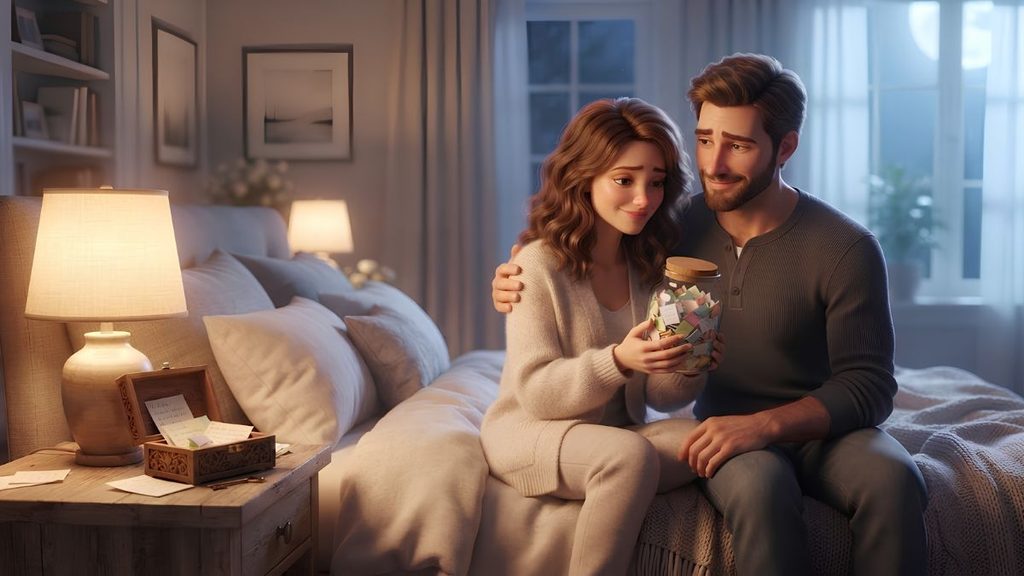
Every evening, just before going to sleep, Emily wrote one sentence in a small notebook.
She didn’t write about her day.
She didn’t write about work.
She didn’t write about things she needed to remember.
She wrote about something she was grateful for.
Sometimes the sentence was simple.
I am grateful for the smell of rain today.
Sometimes it was funny.
I am grateful that Daniel finally admitted he cannot cook rice without burning it.
And sometimes it was about something so small that another person might not have noticed it at all.
I am grateful that Daniel remembered I don’t like too much ice in my water.
She had been doing it for almost a year.
Daniel knew about the notebook.
He just didn’t know why she did it.
One evening, they were sitting together on the sofa.
Emily was writing.
Daniel looked over.
“Another entry?”
She closed the notebook.
“Yes.”
“What did you write?”
“It’s private.”
“Are you writing about me?”
“Maybe.”
“Is it good?”
“Mostly.”
“Mostly?”
Emily laughed.
“You don’t want to know.”
Daniel pretended to be offended.
“I think I deserve to know if I’m the subject.”
“You do not.”
He leaned back.
“Fine.”
A few minutes later, Emily put the notebook away.
Daniel noticed something.
“Can I ask you something?”
“Of course.”
“Why do you write in that thing every night?”
Emily looked at the notebook.
“Because days disappear.”
Daniel waited.
“What do you mean?”
“We wake up, go to work, answer messages, finish things, worry about things, make dinner, clean up, get tired, and suddenly it’s bedtime.”
She smiled gently.
“Sometimes I feel like if I don’t stop and notice something, the whole day disappears.”
Daniel nodded.
“So you write one thing down.”
“One thing.”
“Even on bad days?”
“Especially on bad days.”
Daniel thought about that.
“I like that.”
“I know.”
“How?”
“You’ve started doing it too.”
Daniel looked embarrassed.
“Once.”
“Three times.”
“That’s not enough to call it a habit.”
“It’s a beginning.”
He smiled.
Emily leaned against him.
“I like beginnings.”
That night, after Emily fell asleep, Daniel stayed awake for a while.
He looked at the little notebook on the bedside table.
He knew he shouldn’t open it.
So he didn’t.
Instead, he got out of bed quietly.
He went into the kitchen.
Then he found an empty glass jar in a cupboard.
It was one of those jars Emily had kept because she always believed empty containers might become useful someday.
Daniel washed it.
Dried it.
Then found a small stack of colored paper.
He cut the paper into tiny squares.
He sat at the kitchen table.
And began writing.
The first note said:
Goodnight, Emily. I love the way you laugh when you’re trying not to laugh.
He folded it.
Placed it in the jar.
The second said:
Goodnight. Thank you for making ordinary days feel less ordinary.
Into the jar.
The third:
Goodnight. You make tea better, even though you don’t actually make the tea better. You just make me want to drink it with you.
Into the jar.
Daniel smiled.
He wrote another.
And another.
When he finished, there were twelve little notes inside.
He put the lid on the jar.
Then he placed it on the kitchen counter.
The next morning, Emily found it.
She picked it up.
“What is this?”
Daniel looked innocent.
“Nothing.”
She shook the jar.
Paper rattled inside.
“This is definitely not nothing.”
“Open it.”
She removed the lid.
“What am I supposed to do?”
“Take one.”
She pulled out a folded piece of paper.
Opened it.
Read it.
Then looked at Daniel.
“You wrote this?”
“Yes.”
She smiled.
“It’s sweet.”
“I can be sweet.”
“Occasionally.”
“Thank you.”
She laughed.
Daniel pointed at the jar.
“One note every night.”
“Really?”
“Until they’re gone.”
Emily looked inside.
“How many are there?”
“Twelve.”
“Twelve?”
“Yes.”
She smiled.
“Why twelve?”
“I ran out of paper.”
She laughed.
“Romantic.”
“I try.”
That evening, Emily sat on the edge of the bed.
Daniel handed her the jar.
She took one note.
It said:
Goodnight. I hope tomorrow gives you something worth smiling about.
Emily folded the note carefully.
“Can I keep these?”
“Of course.”
“Even after I read them?”
“Especially after.”
She put the note inside her bedside drawer.
The next night, another.
Goodnight. Don’t forget that you’re allowed to have an imperfect day.
The night after that:
Goodnight. I’m proud of you for everything you managed today, even the things nobody noticed.
Emily became quiet after reading that one.
“What’s wrong?”
“Nothing.”
“You’re crying.”
“I’m not.”
“You are.”
She wiped her eyes.
“That was a nice one.”
Daniel smiled.
“Then it worked.”
She leaned over and hugged him.
“Thank you.”
“For what?”
“For noticing.”
Daniel held her.
“Always.”
The notes continued.
Some were romantic.
Some were funny.
Some were incredibly simple.
Goodnight. Please stop stealing the blanket.
Emily laughed when she read that one.
Another said:
Goodnight. I still think you’re beautiful when you’re half asleep and angry about the alarm.
Another:
Goodnight. Your smile is one of my favorite places to be.
Another:
Goodnight. Tomorrow doesn’t have to be perfect. We just have to get through it together.
Every night, Emily kept the note.
She placed them in a small wooden box.
Soon, the box began filling.
Then one evening, something unexpected happened.
Emily had a terrible day.
Her project at work had gone wrong.
She had made a mistake.
Her manager had criticized her.
Then her train was delayed.
By the time she got home, she was exhausted.
She dropped her bag beside the door.
Daniel came out of the kitchen.
“Hey.”
She didn’t answer.
He knew immediately.
“Bad day?”
She nodded.
He didn’t ask for details.
He simply walked over and hugged her.
Emily closed her eyes.
For a few seconds, she let herself relax.
Then Daniel said, “Dinner is almost ready.”
“I don’t feel like eating.”
“I know.”
She looked at him.
“So?”
“So I made something simple.”
“What?”
“Soup.”
She smiled faintly.
“You made soup?”
“Yes.”
“Is it edible?”
“Probably.”
She laughed quietly.
“That’s not reassuring.”
“I tasted it.”
“And?”
“I’m still alive.”
She laughed again.
“Okay.”
They ate together.
Daniel didn’t try to solve her work problem.
He didn’t tell her she was overreacting.
He didn’t say that everything happened for a reason.
He simply listened.
When Emily finished talking, he said, “That sounds really difficult.”
She nodded.
“It was.”
“You don’t have to figure it all out tonight.”
“I know.”
“Tonight you just need to rest.”
Emily looked at him.
“You’re good at this.”
“At soup?”
“At being here.”
Daniel smiled.
After dinner, they cleaned the kitchen together.
Then they sat on the sofa.
No television.
No phones.
Just quiet.
When it was time for bed, Daniel handed Emily the jar.
She took out a note.
Opened it.
There were only five words.
Tomorrow is another morning.
Emily stared at it.
Then smiled.
“Did you write this one?”
“No.”
“You didn’t?”
“No.”
She turned the note over.
There was nothing else.
“Then who did?”
Daniel shrugged.
“Maybe the jar did.”
Emily laughed.
“You’re ridiculous.”
“Maybe.”
She placed the note in her wooden box.
Then she looked at Daniel.
“Can I tell you something?”
“Yes.”
“I think I understand why you did this.”
“Why?”
“Because sometimes love isn’t about making someone’s problems disappear.”
Daniel listened.
“It’s about making sure they don’t have to carry them alone.”
He smiled.
“That’s exactly what I wanted.”
She leaned her head against his shoulder.
“Then you succeeded.”
A week later, the jar was empty.
Emily placed the final note in the wooden box.
She looked at Daniel.
“That’s all.”
“Yes.”
“I’m going to miss it.”
“So am I.”
“Are you going to make more?”
Daniel smiled.
“Maybe.”
“Maybe?”
“Maybe.”
She narrowed her eyes.
“You’re learning from me.”
“What do you mean?”
“You’re making me wait.”
He laughed.
That night, Emily went to bed.
Daniel turned off the lights.
“Goodnight.”
“Goodnight.”
They kissed.
Emily closed her eyes.
A few minutes later, she heard Daniel get out of bed.
She opened one eye.
“Where are you going?”
“Nowhere.”
“Daniel.”
He stopped.
She sat up.
“What are you doing?”
He reached behind the bedside table.
Then brought out another jar.
This one was bigger.
Emily stared at it.
“Where did that come from?”
“I’ve been preparing.”
She laughed.
“You had another jar this whole time?”
“Yes.”
She opened it.
There were dozens of folded notes inside.
She picked one.
Goodnight. I hope you remember how loved you are.
Another:
Goodnight. If today was hard, tomorrow can be gentle.
Another:
Goodnight. I would choose you on the ordinary days too.
Emily looked at him.
“How long have you been writing these?”
Daniel smiled.
“Since the first jar.”
She laughed.
“You planned this.”
“I had to.”
“Why?”
“Because you taught me something.”
“What?”
He sat beside her.
“That days disappear if we don’t notice them.”
He took her hand.
“So I started noticing.”
Emily squeezed his fingers.
“What did you notice?”
Daniel thought for a moment.
“I noticed how you hum when you’re making coffee.”
She smiled.
“I noticed you always check the door twice before going to bed.”
“I do not.”
“You do.”
She laughed.
“I noticed you leave the last piece of chocolate for me even when you want it.”
Her smile softened.
“I noticed you always move closer to me when you’re asleep.”
She looked down.
“And I noticed that no matter how busy life becomes, I like it best when the day ends with you.”
Emily’s eyes filled with tears.
“That’s more than one note.”
“I know.”
“You’re supposed to write one sentence.”
“I broke the rules.”
“Again.”
“Apparently.”
She leaned into him.
For a while, they sat together in the dark.
Outside, the city was quiet.
A distant car passed.
The refrigerator hummed softly in the kitchen.
Everything was ordinary.
And that was what made the moment beautiful.
There was no grand surprise.
No expensive gift.
No perfect setting.
Just two people sitting together at the end of an ordinary day.
Emily eventually whispered, “You know what I’m going to write tonight?”
“What?”
She smiled.
“I’ll show you tomorrow.”
Daniel laughed.
“That’s unfair.”
“Now you know how it feels.”
The next morning, Emily left a folded note beside his coffee.
Daniel opened it.
It said:
Good morning. Thank you for making me feel noticed.
He smiled.
Underneath, she had added another line.
And yes, I love you even when your soup is questionable.
Daniel laughed.
He kept the note.
Years later, the jars changed.
The first one became a decoration on a bookshelf.
The wooden box became full.
There were notes from difficult days.
Notes from birthdays.
Notes from rainy evenings.
Notes from holidays.
Notes from ordinary Tuesdays.
Some were only a few words.
Some were long.
But Emily kept every one.
Because the notes had taught them something neither of them had expected.
Love wasn’t only found in the moments people remembered for years.
Sometimes love was hidden inside the smallest details.
A cup of tea.
A blanket pulled over tired shoulders.
A meal made after a difficult day.
A hand reaching across the bed.
A quiet “I’m here.”
A little note waiting beside a coffee cup.
And sometimes, the sweetest thing you could give someone was simply the reminder that their ordinary life was worth noticing.
That night, Emily and Daniel went to bed.
The lights were off.
The room was quiet.
Emily reached for his hand beneath the blanket.
Daniel held it.
“Goodnight,” she whispered.
“Goodnight.”
She smiled in the darkness.
“I love you.”
“I love you too.”
And before they fell asleep, neither of them needed to write anything down.
They had already remembered the moment.
The Great Midnight Pancake Experiment

At 11:42 on a Saturday night, Sophie announced that she was hungry.
This was not unusual.
Sophie often became hungry at inconvenient times.
She could be completely satisfied at dinner and then, three hours later, suddenly remember that food existed.
Tonight, however, Daniel had already fallen asleep on the sofa.
He was lying under a blanket with one arm hanging over the edge.
Sophie looked at him.
Then she looked toward the kitchen.
Then back at him.
She whispered, “Pancakes.”
Daniel did not move.
“Daniel.”
Nothing.
“Daniel.”
He opened one eye.
“What?”
“I want pancakes.”
He closed his eye again.
“There’s cereal.”
“I don’t want cereal.”
“There’s bread.”
“I don’t want bread.”
“There’s an apple.”
“I definitely don’t want an apple.”
Daniel opened both eyes.
“What do you want?”
“Pancakes.”
He stared at her.
“At midnight?”
“It’s 11:42.”
“That’s basically midnight.”
“Technically, it’s not.”
“Technically, you woke me up to discuss pancakes.”
Sophie smiled.
“Yes.”
Daniel sighed.
“Do you know how to make pancakes?”
“Of course.”
He sat up.
“Do you?”
“Yes.”
“Because the last time you made pancakes, we had to throw away the pan.”
“That was one time.”
“You melted the spatula.”
“That was an accident.”
“How do you melt a spatula?”
“I don’t know.”
Daniel rubbed his eyes.
“Fine.”
Sophie smiled.
“Really?”
“Yes.”
“You’re making pancakes?”
“No.”
He stood up.
“I’m supervising.”
Sophie laughed.
“That’s basically helping.”
“It is absolutely helping.”
They walked into the kitchen.
Daniel turned on the light.
Sophie opened a cupboard.
“We need flour.”
Daniel pointed.
“Top shelf.”
She opened the wrong cupboard.
“Here?”
“No.”
Another.
“No.”
Another.
“Maybe?”
“No.”
Sophie turned around.
“You live here too.”
“Yes.”
“Then why don’t you know where the flour is?”
“Because you reorganize everything.”
“I organize.”
“You reorganize.”
“It’s called improving.”
“You moved the plates three times last month.”
“They were in the wrong place.”
“They were plates.”
Sophie laughed.
Finally, she found the flour.
“Got it.”
Daniel looked at the ingredients.
“Do we have eggs?”
Sophie opened the refrigerator.
“Three.”
“Milk?”
“Yes.”
“Butter?”
“Yes.”
“Maple syrup?”
She paused.
“No.”
Daniel stared at her.
“You want pancakes without maple syrup?”
“We have honey.”
“Honey is acceptable.”
“Good.”
Sophie placed everything on the counter.
“See?”
Daniel nodded.
“Looks promising.”
She smiled.
“I told you I knew what I was doing.”
Ten minutes later, the kitchen looked like a baking competition had gone terribly wrong.
Flour covered the counter.
A small amount had somehow reached the floor.
There was batter on the edge of the bowl.
And Sophie had a streak of flour across her cheek.
Daniel noticed it.
“You’re wearing flour.”
“Where?”
He pointed.
She wiped the wrong side.
“No.”
She wiped her forehead.
“No.”
“Other side.”
She wiped her nose.
Daniel laughed.
“How are you this bad at wiping your own face?”
“Stop laughing.”
“I’m trying.”
“You aren’t.”
“I’m not.”
She looked at him.
He was clearly laughing.
She dipped one finger into the pancake batter.
Then touched his nose.
Daniel froze.
“Sophie.”
She smiled.
“Now we’re even.”
He touched his nose.
“That’s war.”
“What are you going to do?”
Daniel picked up a little flour.
Sophie stepped backward.
“Don’t.”
He smiled.
“Don’t?”
“Daniel.”
He took one step toward her.
She ran.
He followed.
They moved around the kitchen, laughing quietly so they wouldn’t wake the neighbors.
Sophie hid behind the refrigerator door.
Daniel stood in the middle of the kitchen.
“Come out.”
“No.”
“I know you’re there.”
“You don’t.”
“I can see your foot.”
Sophie looked down.
Her foot was sticking out.
She pulled it back.
Daniel laughed.
“You are terrible at hiding.”
“Go away.”
“No.”
She peeked around the refrigerator.
He was holding a little pinch of flour.
“You wouldn’t.”
“I would.”
“Daniel.”
He grinned.
She ran.
He caught her before she reached the living room.
A tiny cloud of flour appeared between them.
Sophie stared at him.
Then both of them started laughing.
“You ruined my hair.”
“You ruined my nose.”
“You started it.”
“You woke me up for pancakes.”
“That’s not related.”
“It is absolutely related.”
Eventually, they returned to the kitchen.
They cleaned themselves up.
Then Sophie looked at the bowl.
“Okay.”
Daniel nodded.
“Let’s make the pancakes.”
She poured batter into the pan.
It spread unevenly.
Daniel looked at it.
“That’s not a pancake.”
“What is it?”
“A map.”
Sophie stared.
“It looks like a pancake.”
“It looks like the continent of Australia.”
“How do you know what Australia looks like?”
“Internet.”
“You’re impossible.”
She waited.
Then tried to flip it.
The pancake flew into the air.
For one beautiful second, it looked perfect.
Then it landed on the floor.
Silence.
Daniel looked at Sophie.
Sophie looked at Daniel.
They looked at the pancake.
“Five-second rule,” Sophie whispered.
“No.”
“Three-second rule?”
“No.”
“It barely touched the floor.”
“No.”
She sighed.
“Fine.”
They threw it away.
The second pancake stayed in the pan.
The third was slightly burnt.
The fourth was too thick.
The fifth was almost perfect.
Sophie held it up proudly.
“Look.”
Daniel inspected it.
“That’s a pancake.”
“I told you.”
“I’m impressed.”
“Thank you.”
“Don’t let it go to your head.”
She made another.
Then another.
Soon there was a small stack on a plate.
Sophie looked at it.
“We did it.”
Daniel nodded.
“We survived.”
“We made pancakes.”
“Technically, we made pancakes.”
Sophie smiled.
She poured honey over the top.
Then added sliced bananas.
Daniel looked at the plate.
“That actually looks good.”
“Actually?”
“Very good.”
“Thank you.”
They carried the plate to the dining table.
It was almost 12:30 a.m.
The apartment was quiet.
The city outside their window had become still.
They sat across from each other.
Sophie took the first bite.
She closed her eyes.
“Perfect.”
Daniel tried one.
He nodded.
“Not bad.”
“Not bad?”
“Very good.”
“Better.”
They ate in silence for a while.
Then Sophie said, “You know what I like?”
“What?”
“Doing ridiculous things with you.”
Daniel smiled.
“Like making pancakes at midnight?”
“Exactly.”
“Even when we make a mess?”
“Especially then.”
Daniel looked around the kitchen.
“That’s good, because this place looks terrible.”
Sophie laughed.
“I’ll clean it.”
“We’ll clean it.”
She looked at him.
“Together?”
“Together.”
They finished their pancakes.
Then they cleaned the kitchen.
It took longer than expected.
Every time one of them found another spot covered in flour, they laughed.
Eventually, everything was clean.
Daniel turned off the kitchen light.
They returned to the sofa.
Sophie curled up beside him.
“That was fun.”
Daniel pulled the blanket over them.
“It was.”
“Would you do it again?”
“Absolutely not.”
She laughed.
“Why?”
“Because next time we’re ordering pancakes.”
She poked his arm.
“That’s not romantic.”
“Neither is washing flour out of your hair.”
She laughed.
“Fair.”
They sat quietly.
Sophie rested her head against his chest.
After a few minutes, she whispered, “Daniel?”
“Yes?”
“Are you asleep?”
“No.”
“Can I ask you something?”
“Sure.”
“Why did you agree to make pancakes?”
Daniel thought about it.
“Because you wanted them.”
“That’s it?”
“That’s it.”
She smiled.
“You didn’t think it was stupid?”
“No.”
“Even at midnight?”
“Especially at midnight.”
“Why?”
Daniel looked down at her.
“Because someday we’ll probably look back and forget what we did that week.”
Sophie listened.
“We’ll forget what we watched on television. We’ll forget what we ate for dinner. We’ll forget what we talked about.”
He smiled.
“But we’ll probably remember that one night when you woke me up because you wanted pancakes and somehow we covered the kitchen in flour.”
Sophie laughed softly.
“You’re right.”
“And I’ll probably remember that you burned the third pancake.”
“I did not burn it.”
“You did.”
“It was golden.”
“It was black.”
“Dark golden.”
Daniel laughed.
Sophie smiled.
“Maybe you’re right.”
She closed her eyes.
The apartment became quiet.
The clock on the wall moved past one.
Daniel gently adjusted the blanket.
“You tired?”
“Yes.”
“Ready for bed?”
“In a minute.”
She stayed where she was.
Daniel didn’t move.
They listened to the quiet apartment.
Outside, a car passed on the street below.
A soft breeze moved the curtains.
Sophie whispered, “Do you think we’ll still do silly things when we’re old?”
Daniel smiled.
“I hope so.”
“What kind?”
“Maybe we’ll wake up at two in the morning because you want pancakes.”
“That sounds good.”
“And I’ll complain.”
“Of course.”
“But I’ll make them.”
“Even when you’re eighty?”
“Especially when I’m eighty.”
She smiled.
“Then I’ll still burn one.”
“Definitely.”
“And you’ll still eat it?”
Daniel pretended to think.
“Maybe.”
“Daniel.”
“Fine.”
He kissed her forehead.
“I’ll eat the burnt one.”
Sophie smiled.
“Good.”
They finally went to bed.
Before turning off the light, Sophie looked at him.
“Daniel?”
“Yes?”
“Tomorrow, can we have pancakes for breakfast?”
He stared at her.
“Tomorrow?”
“Yes.”
“We just spent an hour making pancakes.”
“I know.”
“And now you want pancakes again?”
“Yes.”
Daniel laughed.
“Okay.”
“Really?”
“Really.”
She smiled.
“You’re the best.”
“I know.”
“Don’t get too confident.”
“Too late.”
She switched off the light.
The room became dark.
Sophie moved closer to him.
“Goodnight.”
“Goodnight.”
A few seconds passed.
Then Daniel heard her whisper.
“Daniel?”
He opened his eyes.
“What?”
“Do we have enough flour?”
He laughed into his pillow.
“I have no idea.”
Sophie smiled in the darkness.
“We’ll check tomorrow.”
And finally, they fell asleep.
The next morning, the kitchen was quiet.
Sunlight came through the window.
The flour was back in the cupboard.
The pan was clean.
The honey was on the counter.
And on the refrigerator was a small piece of paper Sophie had stuck there before bed.
It read:
Midnight Pancake Experiment: Success.
Underneath, Daniel had written:
Evidence is questionable.
Sophie added one more line.
But the company was excellent.
Daniel smiled when he saw it.
He took a pen and wrote:
Repeat experiment soon.
And beneath that:
Preferably before midnight.
Years later, neither of them remembered what movie had been playing that Saturday night.
They didn’t remember what they had talked about earlier that day.
They didn’t remember why Sophie had suddenly wanted pancakes.
But they remembered the flour.
They remembered the laughter.
They remembered the pancake that landed on the floor.
They remembered sitting together after midnight, sharing the imperfect ones.
And they remembered something simple.
Sometimes the sweetest nights weren’t carefully planned.
Sometimes happiness was a messy kitchen, a silly argument, a little laughter, and the person you loved sitting beside you when the whole world had gone quiet.
And sometimes, love tasted a little like pancakes.
Even the slightly burnt ones.
The Letter for the Hard Days
Maya had always believed that difficult days were easier when they ended quietly.
She didn’t need someone to solve everything.
She didn’t need long conversations.
Sometimes she only needed to come home, take off her shoes, make a cup of tea, and sit beside someone who understood that she wasn’t ready to talk yet.
Fortunately, she had Lucas.
Lucas had been her boyfriend for almost three years.
He knew when she wanted to talk.
He knew when she wanted silence.
And, most importantly, he knew the difference between the two.
But there was one thing Lucas didn’t know.
Maya was afraid of becoming the kind of person who always had to be strong.
She had spent years convincing herself that she could handle everything.
Work.
Family responsibilities.
Unexpected problems.
Disappointments.
Changes.
She rarely asked for help.
When people asked how she was, she usually smiled and said, “I’m fine.”
Sometimes she was.
Sometimes she wasn’t.
One rainy evening in November, she came home later than usual.
Lucas was sitting in the living room reading.
He looked up when she entered.
“Hey.”
“Hi.”
He immediately noticed something was wrong.
Not because she looked sad.
Maya didn’t look sad.
She looked normal.
That was what worried him.
She put her bag down.
Removed her coat.
Placed her keys on the table.
Everything was perfectly ordinary.
Too ordinary.
Lucas closed his book.
“How was your day?”
“Fine.”
He smiled gently.
“That’s the word you use when it wasn’t.”
Maya looked at him.
“Can I just sit?”
“Of course.”
She sat beside him.
Lucas didn’t ask another question.
He simply moved closer.
Maya leaned against his shoulder.
For ten minutes, they said nothing.
Rain tapped against the window.
A clock ticked quietly on the wall.
Lucas occasionally turned a page.
Maya eventually whispered, “Today was difficult.”
“I know.”
“I made a mistake at work.”
“Okay.”
“My manager wasn’t happy.”
“I’m sorry.”
“And I couldn’t stop thinking about it.”
Lucas listened.
“I kept thinking maybe I’m not good enough.”
He closed the book.
“Maya.”
“I know.”
“No.”
She looked at him.
“I don’t think you do.”
He took her hand.
“One bad day doesn’t get to decide who you are.”
She looked down.
“What if there are lots of bad days?”
“Then we’ll have lots of evenings like this.”
Maya smiled faintly.
“You make it sound easy.”
“It’s not easy.”
“Then why do you say it like that?”
“Because you don’t have to make everything easy before you’re allowed to rest.”
She became quiet.
Lucas squeezed her hand.
“You’re allowed to have a difficult day.”
Maya nodded.
“I know.”
“And you’re allowed to not know what to do next.”
She nodded again.
“And you’re allowed to need someone.”
This time, she didn’t answer.
Lucas didn’t push her.
Instead, he made tea.
He brought two cups.
They sat together again.
After a while, Maya said, “Do you ever worry that I’ll change?”
Lucas looked surprised.
“Of course you’ll change.”
“No.”
She smiled sadly.
“I mean… change in a way that makes you stop loving me.”
Lucas put down his cup.
“Where did that come from?”
“I don’t know.”
She looked toward the rain-covered window.
“Sometimes I think people love you when you’re easy to love.”
Lucas waited.
“When you’re happy. When you’re confident. When you’re fun.”
She paused.
“But what happens when you’re tired all the time?”
“What happens when you’re scared?”
“What happens when you don’t know what you’re doing?”
She looked at him.
“What happens then?”
Lucas didn’t answer immediately.
Then he stood.
“Come with me.”
“Where?”
“Bedroom.”
“Why?”
“You’ll see.”
Maya followed him.
Lucas opened the bottom drawer of his bedside table.
Inside was a small wooden box.
He took it out.
Maya looked confused.
“What’s that?”
“Something I’ve been keeping.”
He opened it.
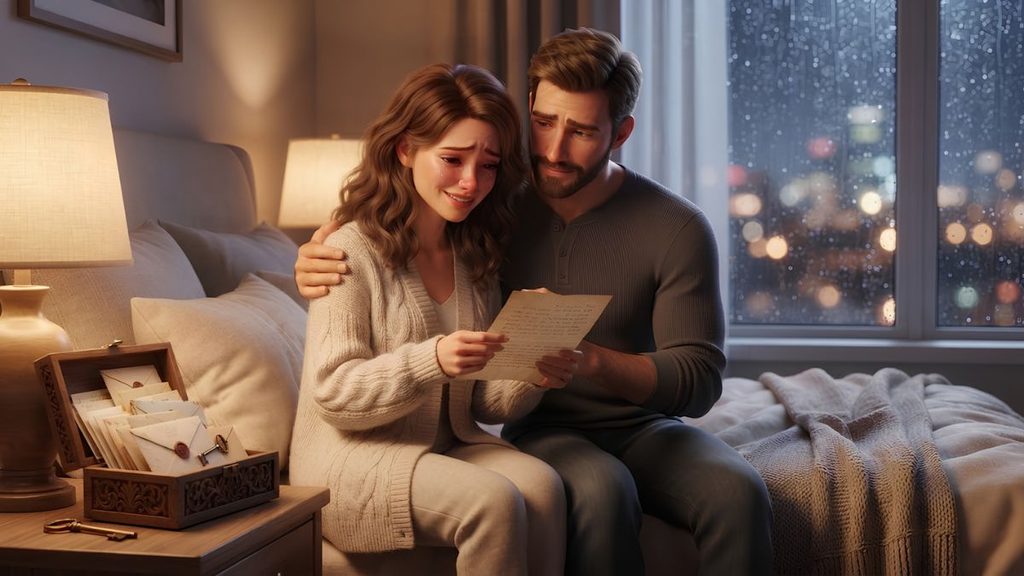
Inside was a stack of envelopes.
Maya picked one up.
It had her name on it.
“What are these?”
“Letters.”
“For me?”
“Yes.”
She looked at him.
“When did you write them?”
“Over the last year.”
“Why?”
Lucas sat on the edge of the bed.
“Because I know there are things I can’t always say at the right moment.”
Maya looked at the envelopes.
Each one had a small handwritten label.
For the day you doubt yourself.
For the day you feel lonely.
For the day everything goes wrong.
For the day you need to remember how far you’ve come.
And one envelope simply said:
For a hard day.
Maya touched it gently.
“You wrote all these?”
Lucas nodded.
“You weren’t supposed to see them yet.”
“When was I supposed to?”
“When you needed one.”
She smiled.
“I need one now.”
Lucas handed her the envelope marked For a hard day.
She opened it.
Inside was a single sheet of paper.
She began reading.
Maya,
If you’re reading this, I’m guessing today wasn’t kind to you.
She smiled slightly.
Maybe something went wrong. Maybe someone disappointed you. Maybe you’re disappointed in yourself. Maybe you simply woke up tired and stayed tired all day.
Whatever happened, I want you to remember something.
You do not have to earn my love by having good days.
Maya stopped reading.
Her eyes filled with tears.
She continued.
I love you when you’re laughing.
I love you when you’re excited about something.
I love you when you have a plan.
But I also love you when you’re confused.
I love you when you need reassurance.
I love you when you don’t have the energy to talk.
I love you when you’re not sure what comes next.
She wiped her eyes.
Lucas remained silent.
The letter continued.
You don’t have to be impressive for me.
You don’t have to be strong every day.
You don’t have to know exactly where your life is going.
You can simply be yourself and let tomorrow arrive when it arrives.
Maya’s tears fell onto the paper.
Then she read the final paragraph.
And if you ever forget how much you mean to me, come sit beside me. You don’t need to explain anything. Just sit down. I’ll remember for both of us.
At the bottom, Lucas had written:
Love, Lucas
Maya lowered the letter.
For several seconds, she said nothing.
Then she looked at him.
“Why didn’t you tell me about these?”
“Because I didn’t want them to become something you needed.”
She frowned.
“What do you mean?”
“I wanted you to know that I love you without needing a letter to prove it.”
He smiled.
“The letters are just reminders.”
Maya looked down at the paper.
“I think I needed this.”
“I know.”
She laughed softly through her tears.
“How did you know?”
“I’ve been paying attention.”
She folded the letter.
Then suddenly hugged him.
Lucas wrapped his arms around her.
She cried quietly against his shoulder.
He didn’t tell her to stop.
He didn’t tell her everything would be fine.
He simply held her.
Eventually, Maya whispered, “I’m scared.”
“I know.”
“I’m scared I’m going to fail.”
“You might.”
She pulled away and looked at him.
“That’s not comforting.”
He smiled.
“I’m not saying you will.”
“But you said I might.”
“Everyone fails sometimes.”
He took her hand.
“Failure isn’t the opposite of being loved.”
Maya stared at him.
“You really thought about these letters.”
“I had time.”
She laughed.
Then she cried again.
But this time, the tears felt different.
They weren’t the tears of someone trying to hold everything together.
They were the tears of someone who had finally put something down.
That night, they went back to the living room.
Maya placed the letter on the coffee table.
“Can I keep it?”
“Of course.”
“Even though it’s supposed to stay in the box?”
“That was the original plan.”
“Plans can change.”
Lucas smiled.
“Apparently.”
She folded the letter carefully and placed it beside her.
Then she looked at the wooden box.
“What’s the next one?”
Lucas laughed.
“You can’t open another one.”
“Why?”
“Because you don’t need it.”
“How do you know?”
“Because you’re smiling.”
Maya smiled.
“Maybe I need the one for when I’m smiling.”
“There isn’t one.”
“You should write one.”
“About what?”
“About being happy.”
Lucas nodded.
“I can do that.”
The following morning, Maya woke before Lucas.
Rain still covered the windows.
The room was quiet.
She looked at the wooden box on the bedside table.
Then she noticed a blank envelope beside it.
She picked up a pen.
On the front, she wrote:
For Lucas.
She thought for a moment.
Then underneath, she added:
For the day you forget that you are loved too.
She placed it beside the box.
Then she went to make coffee.
When Lucas woke, he found the envelope.
He smiled.
He opened it.
Inside was a short letter.
Lucas,
You once told me I don’t have to be strong every day.
I want you to know that you don’t either.
You don’t always have to know what to say.
You don’t always have to know how to help.
Sometimes sitting beside me is enough.
Sometimes holding my hand is enough.
Sometimes being here is enough.
And if you ever wonder whether you are doing enough, please remember this:
You are one of the safest places I have ever known.
Love, Maya
Lucas read it twice.
Then he found her in the kitchen.
She was standing by the window, waiting for the coffee machine.
He walked up behind her.
“Thank you.”
She turned.
“For what?”
He held up the letter.
“You know.”
She smiled.
“You’re welcome.”
He hugged her.
She rested her head against him.
For a while, they stayed like that.
Neither of them said anything.
They didn’t need to.
Months passed.
The letters continued.
Sometimes Lucas wrote one.
Sometimes Maya did.
They added new envelopes to the box.
For the day you need courage.
For the day you’re proud of yourself.
For the day you miss home.
For the day you need a reminder.
For the day we disagree.
That last one became Maya’s favorite.
Lucas had written:
If we’re reading this because we’re angry, let’s remember that being right is less important than being kind.
Underneath, Maya had added:
Especially when I’m right.
Lucas wrote:
Especially when you’re wrong.
Maya crossed it out.
Then wrote:
This letter has been rejected.
They laughed about it for weeks.
Years later, the wooden box was still there.
It had become heavier.
Not because of the box itself, but because of everything inside it.
Memories.
Apologies.
Encouragement.
Little reminders.
Pieces of ordinary life.
One evening, much later, Maya found herself sitting beside Lucas again.
She had had another difficult day.
Not as difficult as that November evening years earlier.
But difficult enough.
She didn’t say anything.
She simply sat beside him.
Lucas looked at her.
“Hard day?”
She nodded.
He didn’t ask what happened.
He didn’t need to.
He reached for her hand.
“Want a letter?”
Maya smiled.
“Maybe.”
He brought the box.
She searched through it.
After a moment, she found the oldest envelope.
The paper had become soft at the edges.
The handwriting was still familiar.
She opened it.
For a hard day.
She read it again.
The same words.
The same message.
But somehow, they meant something different now.
Because she was no longer the woman who had been afraid that being imperfect would make her unlovable.
She had lived through difficult days.
She had made mistakes.
She had changed.
She had failed.
She had succeeded.
She had become stronger.
And she had learned something important.
Being loved didn’t mean someone promised that life would never hurt.
It meant that when life did hurt, you didn’t have to pretend it didn’t.
Maya folded the letter.
Lucas looked at her.
“Still works?”
She smiled.
“Every time.”
He kissed her forehead.
“Good.”
She rested her head against his shoulder.
Outside, rain began tapping against the window.
The same sound.
The same quiet.
But they were different people now.
Older.
Changed.
Still together.
Maya closed her eyes.
“Lucas?”
“Yes?”
“Do you still have blank envelopes?”
He smiled.
“Why?”
“I think we need some.”
“For what?”
She thought for a moment.
“For all the days we haven’t lived yet.”
Lucas squeezed her hand.
“That’s a lot of letters.”
“Then we’d better start writing.”
He smiled.
“Tomorrow?”
Maya shook her head.
“Tonight.”
So they sat together beneath the warm light of the living room.
Two people writing letters to versions of themselves they hadn’t met yet.
Letters for difficult days.
Letters for happy days.
Letters for uncertain days.
Letters for ordinary days.
And somewhere between the rain, the quiet, and the soft scratch of pen against paper, they understood something neither of them had known when they first met.
Love wasn’t a promise that life would always be gentle.
Love was knowing that when life wasn’t gentle, there would still be a hand reaching for yours.
A place to sit.
A person willing to listen.
And, sometimes, a little letter waiting to remind you that you were never required to be strong alone.
That night, when they finally went to bed, Maya placed the newest envelope on the bedside table.
Lucas turned off the lamp.
“Goodnight.”
“Goodnight.”
She reached for his hand.
He held it.
And before they fell asleep, Maya whispered the words she had once needed to hear most.
“You don’t have to be strong tomorrow.”
Lucas smiled in the darkness.
“Neither do you.”
And together, they closed their eyes.
Tomorrow could wait.
Tonight, they were safe.
The Midnight Grocery Mission

At exactly 10:18 on a Tuesday evening, Olivia sent her boyfriend a message.
Ethan, we have a problem.
Ethan was sitting on his sofa, watching television.
He immediately picked up his phone.
What happened?
Three dots appeared.
Disappeared.
Appeared again.
Then Olivia replied.
We have no snacks.
Ethan stared at the message.
He looked toward the kitchen.
There was a half-empty packet of crackers.
Two apples.
A jar of peanut butter.
And something in the refrigerator that he had stopped trying to identify.
He typed:
We have crackers.
Olivia replied immediately.
Those are not snacks.
They are literally snacks.
No.
What are they?
Emergency food.
Ethan laughed.
What’s the difference?
Snacks are food you want. Emergency food is food you eat when there is nothing else.
He thought about it.
So we’re in an emergency?
A moment later:
Yes.
Then another message appeared.
Come over.
Ethan smiled.
Olivia lived only ten minutes away.
He put on his shoes.
Before leaving, he looked into his refrigerator again.
He took two bottles of water.
Then he grabbed the last chocolate bar.
He hesitated.
It was his favorite.
He sighed.
“Love requires sacrifice.”
He put it in his pocket.
Ten minutes later, he knocked on Olivia’s door.
She opened it wearing pajamas, fluffy socks, and a serious expression.
“Thank goodness.”
Ethan held up the chocolate bar.
“I brought supplies.”
Olivia’s eyes widened.
“You found chocolate?”
“The last one.”
She took it.
“You may enter.”
“Thank you.”
He stepped inside.
Olivia immediately closed the door.
“What’s the plan?”
Ethan looked at her.
“What plan?”
“The snack plan.”
“We could order something.”
She shook her head.
“No.”
“Why?”
“Because we always order food.”
“So?”
“So tonight we go to the grocery store.”
Ethan stared at her.
“It’s 10:31.”
“Exactly.”
“Why exactly?”
“Because nobody will be there.”
“That’s your reason?”
“Yes.”
She grabbed her coat.
“We’re going.”
Ethan sighed.
“Fine.”
They walked down the stairs.
Outside, the night was cool and quiet.
The grocery store was about fifteen minutes away on foot.
They could have driven.
But Olivia insisted that walking would make the mission more exciting.
Ethan wasn’t convinced.
“Do we have a list?” he asked.
Olivia nodded.
She pulled out her phone.
“Yes.”
“What’s on it?”
She showed him.
The list had seven items.
Chocolate.
Popcorn.
Cookies.
Ice cream.
Strawberries.
Chips.
And something called “that cereal.”
Ethan pointed.
“What cereal?”
“I don’t know.”
“Then why is it on the list?”
“Because you know the one.”
“I don’t.”
“The one in the blue box.”
“There are probably twenty cereals in blue boxes.”
“Not twenty.”
“How many?”
“Maybe four.”
“That’s not helpful.”
“We’ll recognize it.”
Ethan shook his head.
“This is already a disaster.”
They reached the grocery store.
The automatic doors opened.
The store was almost empty.
A tired-looking employee pushed a cart down one aisle.
A man stood near the vegetables.
An elderly woman was carefully comparing two brands of tea.
Olivia whispered, “Perfect.”
Ethan looked at her.
“What are you planning?”
She smiled.
“Nothing.”
They grabbed a cart.
Ethan pushed it.
Olivia walked beside him.
“Chocolate first.”
They reached the chocolate aisle.
Olivia picked up a large bar.
Ethan picked up a smaller one.
She looked at him.
“Why?”
“Because we’re supposed to buy snacks, not build a chocolate house.”
“It’s on sale.”
“That is not a reason.”
“It is.”
She put the large bar in the cart.
Ethan removed it.
She put it back.
He removed it.
She put it back.
They stared at each other.
“Olivia.”
“Ethan.”
“We don’t need this much chocolate.”
“Speak for yourself.”
He laughed.
“Fine.”
They moved on.
Next came popcorn.
Olivia picked up three bags.
“Three?”
“One for tonight.”
“Okay.”
“One for tomorrow.”
“Fine.”
“And one for emergencies.”
Ethan nodded.
“That makes sense.”
“Finally.”
“You’ve convinced me.”
They added the popcorn.
Then cookies.
Then ice cream.
Then strawberries.
The cart was beginning to look like they had prepared for a month-long snowstorm.
Ethan looked at the list.
“We still need chips.”
Olivia nodded.
“And the cereal.”
They reached the cereal aisle.
There were dozens of boxes.
Olivia looked around.
“Where is it?”
Ethan sighed.
“I told you.”
“The blue one.”
“There are eight blue ones.”
“No.”
She walked slowly down the aisle.
“This isn’t it.”
She picked one up.
“No.”
Another.
“No.”
Another.
“Maybe.”
Ethan looked at it.
“That’s chocolate cereal.”
“I like chocolate.”
“You don’t eat chocolate cereal.”
“I could.”
“You said it was that cereal.”
“I know.”
“Then this isn’t it.”
She put it back.
They continued.
A few minutes later, Olivia stopped.
“There.”
She pointed.
Ethan followed her finger.
The box was blue.
It had a cartoon tiger on it.
He stared.
“That’s the cereal?”
“Yes.”
“You said that like I should have known.”
“I thought you did.”
“I have never seen this in my life.”
“Yes, you have.”
“No.”
“You ate it at my apartment.”
“When?”
“Last month.”
Ethan thought.
“That was cereal?”
“What did you think it was?”
“I thought it was granola.”
Olivia stared at him.
“You ate a bowl of cereal and thought it was granola?”
“It was dark.”
“We were having breakfast.”
“Morning darkness.”
“It was 9 a.m.”
“Very mysterious morning.”
She laughed.
They put the cereal in the cart.
Then they went for chips.
Ethan picked up one bag.
Olivia picked up another.
“Which one?”
“Both.”
“We don’t need both.”
“We do.”
“Why?”
“Because one is spicy.”
“And?”
“The other is cheesy.”
“We can choose.”
“No.”
She placed both bags in the cart.
Ethan gave up.
They continued.
At the end of the aisle, Olivia noticed a small display of tiny cakes.
She stopped.
“Ethan.”
“No.”
“You don’t even know what I’m going to say.”
“I know.”
“You don’t.”
“You’re going to say we need those.”
“We need those.”
He laughed.
“You’ve become predictable.”
She picked up a box.
“They’re cute.”
“They are tiny cakes.”
“Exactly.”
“They’re also unnecessary.”
Olivia put them in the cart.
“Now they’re necessary.”
Ethan shook his head.
“Fine.”
They finally reached the checkout.
The cashier looked at their cart.
Then at them.
Then back at the cart.
“Big night?”
Olivia nodded seriously.
“Very.”
The cashier scanned the chocolate.
Popcorn.
Cookies.
Ice cream.
Strawberries.
Chips.
Cereal.
Tiny cakes.
Then she looked at the total.
Ethan looked at Olivia.
Olivia looked at Ethan.
“We may have gone too far.”
Ethan nodded.
“Maybe.”
The cashier smiled.
“At least you’ll have snacks.”
Olivia smiled.
“That’s the plan.”
They paid.
Then discovered another problem.
They had bought too much to carry.
Ethan held two bags.
Olivia held two.
They looked at the remaining bags.
“How many trips?” Ethan asked.
“One.”
“Impossible.”
“You’re strong.”
“That isn’t how strength works.”
“You go to the gym.”
“Occasionally.”
“Exactly.”
They somehow managed to carry everything.
They walked home slowly.
Halfway there, one of the bags broke.
A packet of chips fell onto the sidewalk.
Olivia gasped.
“No!”
Ethan picked it up.
“It’s okay.”
She checked the packet.
“Is it damaged?”
“No.”
She hugged it.
“Thank goodness.”
Ethan laughed.
“You’re acting like it survived a war.”
“It did.”
They continued.
Five minutes later, another bag broke.
This time, the strawberries rolled across the pavement.
Olivia ran after them.
One rolled toward a parked car.
Another toward a tree.
Another somehow traveled downhill.
Ethan chased it.
He caught it just before it reached a storm drain.
He held it up proudly.
“Got it.”
Olivia clapped.
“Hero.”
“Thank you.”
They gathered everything.
Then they noticed something.
They were both laughing.
Not politely.
Not quietly.
They were laughing so hard that neither could speak.
A passing cyclist looked at them.
Ethan tried to stop laughing.
He failed.
Olivia leaned against him.
“We’re terrible at grocery shopping.”
“We’re excellent.”
“Our bags broke twice.”
“Minor technical difficulties.”
“We almost lost a strawberry.”
“But we didn’t.”
“Because you saved it.”
“Exactly.”
They finally reached Olivia’s apartment.
They placed everything on the kitchen counter.
Then they looked at the mess.
Chocolate.
Cookies.
Popcorn.
Chips.
Ice cream.
Cereal.
Strawberries.
Tiny cakes.
Olivia crossed her arms.
“We succeeded.”
Ethan nodded.
“Completely.”
“What should we eat first?”
“Chocolate.”
“Obviously.”
She opened the large chocolate bar.
Ethan reached for a piece.
She pulled it away.
“Wait.”
“What?”
“We need to make a proper snack plate.”
“A snack plate?”
“Yes.”
“Why?”
“Because we’re adults.”
Ethan stared at the pile of snacks.
“Adults don’t need a snack plate.”
“Adults absolutely need snack plates.”
She found a large plate.
Then arranged everything carefully.
Chocolate in one section.
Cookies in another.
Strawberries.
Chips.
Tiny cakes.
Popcorn.
Ethan watched.
“This looks ridiculous.”
“It’s beautiful.”
“It’s a plate of chaos.”
“It’s art.”
She stepped back.
“Perfect.”
Ethan took a photograph.
“What are you doing?”
“Documenting this achievement.”
She laughed.
They sat on the sofa.
The snack plate was between them.
Olivia put on a movie.
Ethan took a cookie.
Then another.
Olivia looked at him.
“You just ate two.”
“They’re small.”
“That’s not how counting works.”
“They’re emotionally small.”
“What does that mean?”
“I don’t know.”
She laughed.
They watched the movie.
Twenty minutes later, Olivia reached for the popcorn.
Her hand touched the empty bowl.
“Where did it go?”
Ethan looked at the bowl.
“You ate it.”
“I did not.”
“You did.”
“When?”
“During the opening.”
“No.”
“You were very focused.”
“I don’t remember.”
“That’s because you ate it.”
She looked at the popcorn bag.
There was still some left.
She poured more.
Then reached for the chocolate.
Ethan took it first.
“Hey.”
“Sharing.”
“Give it back.”
“No.”
She tried to take it.
He moved away.
“Ethan.”
“You have cookies.”
“I want chocolate.”
“You already had chocolate.”
“I want more.”
He smiled.
“Okay.”
He broke off a piece.
Then handed it to her.
She took it.
“Thank you.”
“You’re welcome.”
They continued watching.
Eventually, the movie ended.
Neither of them had paid much attention.
Olivia looked at the clock.
1:47 a.m.
“Oh.”
“What?”
“It’s late.”
Ethan nodded.
“We should sleep.”
She looked at the remaining snacks.
“But we still have food.”
“We can eat it tomorrow.”
“Promise?”
“Promise.”
She smiled.
They cleaned the living room.
Then put everything away.
The ice cream went into the freezer.
The cookies went into the cupboard.
The cereal went onto the shelf.
The strawberries went into the refrigerator.
The tiny cakes were placed carefully on the counter.
Olivia turned off the kitchen light.
They walked toward the bedroom.
Then Ethan stopped.
“Wait.”
“What?”
He walked back to the kitchen.
Olivia watched.
“What are you doing?”
He opened the cupboard.
Then took out the emergency crackers.
He brought them to her.
She stared.
“What?”
“You said these aren’t snacks.”
“They aren’t.”
“Then what are they?”
“Emergency food.”
Ethan smiled.
“And what’s happening now?”
Olivia looked at the clock.
1:53 a.m.
She looked at the crackers.
Then at him.
She laughed.
“Absolutely nothing.”
“Good.”
He put them away.
They went to bed.
Olivia climbed under the blanket.
Ethan turned off the lamp.
For a few seconds, everything was quiet.
Then Olivia whispered:
“Ethan?”
“Yes?”
“Did we buy everything?”
“Yes.”
“Chocolate?”
“Yes.”
“Popcorn?”
“Yes.”
“Cookies?”
“Yes.”
“Ice cream?”
“Yes.”
“Strawberries?”
“Yes.”
“Chips?”
“Yes.”
“Cereal?”
“Yes.”
“Tiny cakes?”
“Yes.”
She was quiet.
Then:
“Did we forget something?”
Ethan sighed.
“I don’t know.”
“Think.”
He thought.
“We have everything on the list.”
“No.”
“What?”
“I think we forgot…”
She paused.
“…to buy more crackers.”
Ethan started laughing.
Olivia laughed too.
The next morning, they found the grocery receipt on the kitchen counter.
At the very bottom was the final item.
It read:
Emergency crackers.
Olivia stared at it.
“Ethan.”
“Yes?”
“You added that.”
“Did I?”
“Yes.”
“When?”
“At the checkout.”
He smiled.
“See?”
She shook her head.
“You’re becoming responsible.”
“Don’t worry.”
He kissed her forehead.
“I’ll try not to make it a habit.”
She smiled.
Outside, the morning sun filled the kitchen.
The apartment was quiet.
The grocery bags were gone.
The snacks were safely stored.
And on the refrigerator was a small handwritten note.
Midnight Grocery Mission: Successful.
Underneath, Ethan had added:
Next mission: remember why we went shopping.
Olivia wrote below it:
We went for snacks.
Then she added:
We came home with everything except self-control.
Ethan laughed when he saw it.
And somehow, that became the part they remembered most.
Not the movie.
Not the shopping list.
Not even the mountain of snacks.
They remembered walking home at midnight, chasing runaway strawberries down the pavement, laughing over broken grocery bags, and realizing that ordinary life became much more fun when there was someone beside you who could turn a simple trip to the store into an adventure.
Years later, whenever they found themselves wandering through a grocery store late at night, one of them would look at the other and say:
“Do we need anything?”
And the answer was always the same.
“Probably.”
Then they would smile.
Because they both knew they were about to buy far more than they needed.
And probably forget something important.
But that was okay.
They had learned that the best part of a midnight grocery mission was never the groceries.
It was having someone to laugh with when the bags broke.
Someone to share the chocolate with.
Someone who would chase a strawberry down the sidewalk.
And someone who could make even a completely ordinary Tuesday night feel like a memory worth keeping.
The Lanterns Along Willow Street

The first lantern appeared on a cold November evening.
It hung outside a small blue house on Willow Street, glowing softly above the front door.
Amelia noticed it while walking home from work.
She stopped beneath the tree beside the pavement and looked up.
The lantern was simple. It had a warm golden light inside and a small metal frame around it. Nothing about it was particularly impressive.
Still, Amelia stood there for almost a minute.
There was something peaceful about it.
The rest of the street was dark.
Windows were beginning to glow with evening lights. A few cars moved slowly along the road. Somewhere nearby, someone was cooking dinner, and the smell of baked bread drifted through the cold air.
But the little lantern seemed to make its own quiet world.
The next evening, there were two lanterns.
One hung outside the blue house.
The other appeared across the street, above the doorway of a narrow brick home.
Amelia smiled.
By Friday, there were seven.
By the following week, there were twelve.
Nobody had put up a sign explaining them.
Nobody seemed to know exactly who had started the tradition.
But every evening, another lantern appeared somewhere along Willow Street.
Some were hanging from doorways.
Some stood on small hooks beside garden gates.
One particularly beautiful lantern had been placed beneath an old maple tree, where its light made the fallen leaves look like little pieces of gold.
Amelia began looking for them during her evening walks.
It became a habit.
After work, instead of taking the quickest route home, she would walk along Willow Street.
Sometimes she counted the lanterns.
Sometimes she simply enjoyed finding the new ones.
One evening, she found number eighteen.
It was hanging outside a tiny music shop.
The shop had been closed for years.
The sign above the door read:
Miller’s Music
The windows were dusty, and behind the glass were faded photographs of musicians and old instruments.
The lantern hanging above the entrance was beautiful.
It had tiny stars cut into its metal sides.
Amelia stood there looking at it when someone spoke behind her.
“That’s my favorite.”
She turned.
A man was standing a few steps away.
He was holding a paper bag in one hand and wearing a dark green coat.
He looked familiar.
Amelia thought for a moment.
Then she remembered.
“You live near the corner, don’t you?”
He smiled.
“Two houses down.”
“The house with the yellow door?”
“That’s the one.”
She smiled.
“I’ve seen you walking around.”
“I’ve seen you counting lanterns.”
Amelia laughed.
“I’m not counting.”
“You were at eighteen yesterday.”
She looked surprised.
“You noticed?”
“I notice important things.”
She raised an eyebrow.
“Are lanterns important?”
“Apparently.”
He held out his hand.
“I’m Henry.”
“Amelia.”
They shook hands.
“Nice to meet you.”
“Likewise.”
They stood together for a moment.
The lantern above them flickered gently.
“Do you know who is putting them up?” Amelia asked.
Henry shook his head.
“No idea.”
“Do you think it’s one person?”
“Maybe.”
“Or maybe everyone is doing it.”
“That’s possible.”
“Why?”
Henry looked up at the lantern.
“Maybe people need something warm to look at.”
Amelia smiled.
“That’s a very thoughtful answer.”
“I’ve been told I have my moments.”
She laughed.
They walked in the same direction.
For the next few minutes, they talked about nothing particularly important.
The cold weather.
The terrible traffic.
The little bakery at the end of the street.
The fact that the city always seemed louder in the morning than it did at night.
When they reached Amelia’s building, Henry stopped.
“I guess this is you.”
“Yes.”
“Goodnight, Amelia.”
“Goodnight, Henry.”
She went inside.
But before closing the door, she looked back.
Henry was still standing beneath the streetlight.
He lifted a hand.
She smiled.
Then she went upstairs.
The next evening, Amelia found another lantern.
It was outside Henry’s yellow-doored house.
She stood there for a moment.
Then Henry opened the door.
“Looking for number nineteen?”
She smiled.
“Maybe.”
“It’s number twenty.”
“Really?”
“Yes.”
“Then I’ve lost count.”
“I’ll forgive you.”
He stepped outside.
“I made tea.”
Amelia looked at him.
“Are you inviting me in?”
“If you’d like.”
She smiled.
“I’d like.”
Inside, Henry’s home was warm and comfortable.
There were bookshelves along one wall.
A small record player sat beside the window.
A plant stood on the kitchen counter, leaning slightly toward the glass.
“It feels nice here,” Amelia said.
Henry handed her a cup of tea.
“Thank you.”
They sat near the window.
Outside, another lantern glowed across the street.
“Do you live alone?” Henry asked.
“Yes.”
“Me too.”
Amelia looked around.
“Do you like it?”
“Most days.”
“And the other days?”
He smiled.
“Those are the days I make too much tea.”
She laughed.
They talked until nearly midnight.
They talked about childhood memories.
Favorite books.
Places they wanted to visit.
Foods they couldn’t cook.
Amelia admitted that she once tried making homemade pasta and somehow turned the kitchen into a flour-covered disaster.
Henry confessed that he had once attempted to fix a broken chair and made it worse.
“How much worse?” she asked.
“I couldn’t sit on it.”
“So you failed.”
“Completely.”
She laughed.
The evening felt easy.
There was no pressure to impress each other.
No awkward silence that needed to be filled.
They simply talked.
When Amelia finally stood to leave, Henry walked her to the door.
“Thank you for the tea.”
“Thank you for coming.”
She stepped outside.
Then stopped.
“Henry?”
“Yes?”
“I like the lanterns.”
He smiled.
“So do I.”
She walked home beneath the soft lights.
And somewhere between the first lantern and the last, Amelia realized she was looking forward to seeing him again.
Their friendship grew slowly.
There was no dramatic beginning.
No sudden declaration.
No perfect moment.
Instead, there were small things.
Henry started leaving his door open when he was reading in the evening.
Amelia began bringing him pastries from the bakery.
They started taking walks together.
Sometimes they talked.
Sometimes they didn’t.
One evening, they walked for twenty minutes without saying a word.
At the end of the street, Amelia looked at him.
“Was that strange?”
“What?”
“That we didn’t talk.”
Henry smiled.
“No.”
“Why not?”
“Because I wasn’t uncomfortable.”
She smiled.
“Neither was I.”
They kept walking.
The lanterns continued appearing.
Soon there were too many to count.
The whole street seemed different at night.
People who rarely spoke during the day began greeting each other.
Children decorated a few lanterns with tiny paper stars.
An elderly woman named Margaret placed a chair beneath the largest lantern outside her home.
She often sat there in the evenings, knitting and watching people walk by.
Henry and Amelia started saying hello to her.
One night, Margaret waved them over.
“You two.”
They stopped.
“Yes?”
She pointed to the empty chair beside her.
“Sit.”
They sat.
Margaret continued knitting.
“Do you know why the lanterns are here?”
Amelia looked at Henry.
“We’ve been wondering.”
Margaret smiled.
“Many years ago, there was a man who lived on this street.”
“Who?”
“Thomas Miller.”
Henry looked toward the old music shop.
“Miller’s Music?”
Margaret nodded.
“He owned it.”
“What happened to him?”
“He passed away.”
She paused.
“Thomas believed that every neighborhood needed a little light.”
Amelia smiled.
“Did he start the lantern tradition?”
“Not exactly.”
Margaret looked down the street.
“Years ago, during a particularly difficult winter, he started hanging lanterns outside his shop. He said that people should be able to find their way home even when the nights felt long.”
“What happened after he died?” Henry asked.
“People continued.”
Margaret smiled.
“One lantern became two. Two became ten. Eventually, nobody remembered who was responsible.”
Amelia looked at the glowing street.
“So everyone just kept doing it?”
“Yes.”
“Why?”
Margaret shrugged.
“Because it made people happy.”
She returned to her knitting.
“Sometimes that’s enough reason.”
Winter arrived.
The evenings became colder.
Amelia and Henry began spending more time indoors.
They cooked together.
Sometimes badly.
One night, they attempted a complicated vegetable soup.
Henry added too much salt.
Amelia added too much pepper.
Then they both tried to fix it.
The final result was almost impossible to eat.
They sat at the table, staring at their bowls.
“This is terrible,” Amelia said.
Henry nodded.
“Absolutely.”
They looked at each other.
Then both started laughing.
Eventually they ordered sandwiches.
Another evening, Amelia brought a stack of old photographs from her childhood.
Henry sat beside her on the sofa.
“That’s you?”
“Yes.”
“You had very serious hair.”
“I was six.”
“Still.”
She pushed his shoulder.
He laughed.
Then she found a photograph of herself standing beside her parents in front of their old house.
Her expression softened.
“I miss that place.”
Henry looked at her.
“What do you miss most?”
She thought about it.
“The kitchen.”
“The kitchen?”
“My mother used to make pancakes on Sunday mornings.”
“Good pancakes?”
“The best.”
“Better than mine?”
“You haven’t made pancakes.”
“That’s true.”
He stood.
“Wait here.”
“Why?”
“I’m making pancakes.”
“At nine at night?”
“Why not?”
Twenty minutes later, the kitchen smelled wonderful.
They ate pancakes at the small table while snow began falling outside.
Through the window, the lanterns along Willow Street glowed through the snow.
Amelia looked at Henry.
“This is nice.”
He smiled.
“Yeah.”
She looked outside.
“It feels like home.”
Henry became quiet.
Then he reached across the table and took her hand.
“I was hoping you’d say that.”
She looked at him.
“Why?”
“Because I want you to feel at home here.”
Amelia squeezed his hand.
“I do.”
Spring came slowly.
The snow disappeared.
Small flowers appeared beside the sidewalks.
The lanterns remained.
Some had become weathered.
Some had been repaired.
A few had been replaced.
But every evening, they still glowed.
By then, Amelia and Henry were no longer simply neighbors.
They were together.
They had their own routines.
Saturday morning coffee.
Sunday walks.
Wednesday evening dinners.
Friday nights when they watched old movies and argued about which actor was best.
Their lives began fitting together naturally.
Not perfectly.
Naturally.
There were disagreements.
There were stressful days.
There were mornings when one of them was too tired to talk.
But they learned something important.
Love wasn’t about never having difficult days.
It was about knowing someone would still be there when those days arrived.
One evening, Amelia came home after a particularly exhausting day.
She dropped her bag near the door.
Henry was in the kitchen.
“Bad day?”
She nodded.
He didn’t ask for details.
He simply walked over and hugged her.
She rested her head against his shoulder.
After a moment, she whispered:
“I don’t need advice.”
“Okay.”
“I just need five minutes.”
“You can have ten.”
She smiled.
“Thank you.”
They stood there quietly.
Outside the window, a lantern glowed.
After a while, Amelia pulled away.
“I’m better.”
Henry smiled.
“Tea?”
“Please.”
He made it exactly the way she liked.
That night, they sat beside the window.
Neither of them said much.
They didn’t need to.
Years passed.
The lanterns continued.
Some residents moved away.
New families arrived.
The old music shop was eventually renovated.
It became a small café with wooden tables and shelves filled with records.
The lantern with the tiny stars remained above the door.
Margaret grew older.
She eventually stopped sitting outside every evening.
But someone always placed a chair beneath her favorite lantern.
Amelia and Henry continued walking down Willow Street.
Sometimes they walked quickly.
Sometimes slowly.
Sometimes holding hands.
Sometimes carrying groceries.
Sometimes talking about their future.
One evening, Henry said:
“Do you ever wonder who puts up the new lanterns?”
Amelia smiled.
“All the time.”
“What if it’s not one person?”
“Maybe it’s everyone.”
“Maybe.”
They stopped beneath the old maple tree.
The lantern above them was one of the oldest on the street.
Its light was softer now.
Amelia leaned against Henry.
“I think I understand why people keep doing it.”
“Why?”
She looked down the street.
“Because everyone needs a little light sometimes.”
Henry kissed the top of her head.
“I think you’re right.”
On their tenth winter together, something unusual happened.
One evening, Amelia noticed a new lantern outside their own home.
She stopped.
“Henry.”
He looked up.
“What?”
“Was that there yesterday?”
He shook his head.
“No.”
They walked closer.
The lantern was small and beautifully made.
Tiny stars were cut into its metal sides.
Just like the lantern that had once hung outside Miller’s Music.
Amelia touched it gently.
There was a small envelope attached to the handle.
She opened it.
Inside was a handwritten note.
It said:
For the people who make this street feel like home.
Amelia looked at Henry.
“Who left this?”
He smiled.
“I don’t know.”
She narrowed her eyes.
“You know something.”
“I don’t.”
“Henry.”
“I swear.”
She laughed.
They stood beneath the lantern.
The street was quiet.
Snow was falling again.
A warm light glowed from their window.
Amelia suddenly remembered the first time she had seen a lantern on Willow Street.
The blue house.
The cold November evening.
The stranger who had stood behind her and said that perhaps people needed something warm to look at.
She smiled.
“What?”
Henry asked.
“I was just remembering.”
“What?”
“The first time we met.”
“You were counting lanterns.”
“I was not.”
“You were.”
“I wasn’t.”
“You were at eighteen.”
She laughed.
“Maybe I was.”
Henry took her hand.
“Do you know what I remember?”
“What?”
“Thinking that you looked lonely.”
Amelia looked at him.
“Did I?”
“A little.”
“And now?”
He smiled.
“Now you look home.”
She felt her eyes becoming warm.
“That’s a very unfairly sweet thing to say.”
“I’ve been practicing.”
She laughed.
Then she rested her head against his shoulder.
They stood together while the snow fell around them.
Later that night, they went inside.
Amelia made tea.
Henry lit a small lamp beside the sofa.
They sat together beneath a blanket.
The house was quiet.
Outside, the lantern continued glowing.
Amelia looked through the window.
There were dozens of lanterns along Willow Street.
Some were old.
Some were new.
Some were hanging from homes that had been there for generations.
Others belonged to families who had arrived only recently.
Each lantern was different.
Yet together, they made the same warm path through the darkness.
Amelia smiled.
“Do you think we’ll ever leave Willow Street?”
Henry looked at her.
“Maybe.”
She raised an eyebrow.
“Maybe?”
“Life changes.”
She nodded.
“I know.”
He took her hand.
“But wherever we go, we’ll need a lantern.”
She smiled.
“Why?”
“So we know how to find our way home.”
Amelia leaned closer.
“I thought home was a place.”
Henry shook his head.
“Sometimes.”
“And sometimes?”
He looked at her.
“Sometimes it’s a person.”
She smiled.
Then she kissed him.
Outside, another lantern appeared at the end of the street.
No one knew who had hung it.
By morning, everyone would have a different guess.
Perhaps it was one of the neighbors.
Perhaps it was a new family.
Perhaps it was someone who had lived there for years.
Nobody really knew.
But that was part of the magic.
The lanterns did not belong to one person.
They belonged to everyone.
They were small reminders that even in the coldest seasons, even after difficult days, even when the road ahead was uncertain, there would always be little lights along the way.
And if you were lucky, there would be someone walking beside you.
Someone to share the quiet with.
Someone to laugh with.
Someone to hold your hand when the night felt long.
Someone who could turn an ordinary street into a place you never wanted to leave.
And on Willow Street, beneath all those warm golden lanterns, Amelia and Henry discovered that perhaps the most beautiful kind of love was not the love that promised everything would always be perfect.
It was the love that quietly said:
Whatever the night brings, we will find our way home together.
Five Minutes Before Midnight

Ella looked at the clock.
11:55 p.m.
She was lying beneath the blanket, almost asleep, when Noah quietly opened the bedroom door.
“Are you awake?”
Ella opened one eye.
“Unfortunately.”
He smiled.
“Come with me.”
“Where?”
“It’s a surprise.”
She pulled the blanket closer.
“It’s five minutes before midnight.”
“Exactly.”
“That’s usually when people stay in bed.”
“I know.”
He held out his hand.
“Come on.”
Ella sighed dramatically.
“You are disturbing my very serious sleeping schedule.”
“I’m willing to take the risk.”
She laughed and took his hand.
They walked quietly into the living room.
Noah had turned off all the lights.
Only the small lamp beside the window was glowing.
Outside, the city was peaceful.
A few apartment windows were still illuminated.
The streets below were almost empty.
Ella looked at him.
“What are we doing?”
Noah pointed toward the window.
“Five minutes.”
“For what?”
“Nothing.”
She smiled.
“That’s your surprise?”
“Yes.”
They sat together beside the window.
Ella leaned her head against his shoulder.
11:56.
For a while, neither spoke.
11:57.
Noah reached for her hand.
11:58.
Ella whispered, “This is actually nice.”
“I told you.”
“Don’t get too proud.”
He laughed softly.
11:59.
They watched the city.
Ella thought about the year behind them.
The good days.
The difficult days.
The ordinary mornings.
The unexpected laughter.
The dinners they had cooked together.
The evenings when they had fallen asleep while talking.
The little disagreements that had seemed enormous at the time but were already forgotten.
Then the clock changed.
12:00.
Noah looked at her.
“Happy midnight.”
Ella smiled.
“Happy midnight.”
He kissed her forehead.
“Make a wish.”
She closed her eyes.
For a moment, she thought about wishing for something big.
More money.
More travel.
More success.
More exciting days.
But instead, she opened her eyes and looked at Noah.
“I already have mine.”
He smiled.
“What did you wish for?”
She squeezed his hand.
“More ordinary nights like this.”
Noah was quiet for a moment.
Then he smiled.
“That’s a good wish.”
Ella rested her head on his shoulder again.
Outside, the city continued moving.
Cars passed in the distance.
A train sounded somewhere far away.
Lights flickered in windows.
Nothing extraordinary happened.
And that was exactly what made the moment beautiful.
They simply sat together.
Two people.
One quiet room.
One new minute beginning.
And enough love to make an ordinary midnight feel special.
After a few minutes, Ella yawned.
Noah laughed.
“Ready for bed?”
“Yes.”
“Was the surprise worth staying awake for?”
She stood and took his hand.
“Definitely.”
They walked toward the bedroom.
Just before turning off the light, Ella looked back at the window.
The city was still glowing.
She smiled.
Sometimes the happiest moments weren’t the loud ones.
Sometimes they were only five quiet minutes before midnight, spent beside the person who made you feel completely at home.
And that night, Ella fell asleep with Noah’s hand in hers.
The clock quietly moved forward.
And tomorrow waited.
But for now, they were exactly where they wanted to be.
Why Tell Your Girlfriend a Bedtime Story?
There are many reasons couples enjoy bedtime stories.
They Create a Sense of Closeness
Reading or telling a story together gives couples dedicated time without the distractions of everyday life.
Even a short story can create a moment where both people are focused on the same thing.
If you are telling the story yourself, your girlfriend also hears your voice and experiences the story through your personality.
That can make a simple story feel personal.
They Can Help Her Relax
A calming story gives the mind something gentle to focus on.
Instead of thinking about tomorrow’s tasks, unfinished work, difficult conversations, or daily responsibilities, she can simply follow the characters and setting.
A peaceful story can help create a smoother transition toward sleep.
They Make Ordinary Nights Feel Special
Romance does not always require a special occasion.
You do not need a birthday, anniversary, expensive dinner, or elaborate surprise to show affection.
Sometimes something as simple as saying, “I found a story I think you’ll like,” can make an ordinary evening feel different.
Small rituals often become meaningful memories.
They Give You Another Way to Express Love
Some feelings are difficult to express directly.
A story can make those emotions easier to communicate.
A character might say something that reminds you of your girlfriend. A fictional couple might share qualities similar to your relationship. A story about finding home might quietly communicate how much she means to you.
You can use storytelling to express affection without making the moment feel overly serious.
They Can Become a Couple’s Tradition
Imagine ending each evening with ten minutes of storytelling.
One night you read.
The next night she reads.
Another night you make up a story together.
Over time, this can become a small tradition that belongs only to the two of you.
That tradition can become especially meaningful during stressful periods or when life becomes busy.
What Makes a Bedtime Story Good for a Girlfriend?
Not every romantic story works well at bedtime.
A good bedtime story usually has a combination of several qualities.
A Peaceful Setting
The setting can immediately influence the mood.
Consider places such as:
- A quiet seaside town
- A small bookstore at night
- A cozy café during rainfall
- A cabin beside a forest
- A train traveling through the countryside
- A garden under the moon
- A peaceful apartment during a storm
- A small village covered in evening snow
- A balcony overlooking city lights
- A quiet harbor before sunrise
These settings naturally create a slower atmosphere.
Warm Characters
Characters should feel relatable and emotionally believable.
They do not have to be perfect.
In fact, small imperfections often make them more interesting.
A character might forget an umbrella, burn dinner, get lost on a train, or struggle to say what they are feeling.
Those small details can make a romantic story feel natural rather than artificial.
Gentle Conflict
Stories can have a little tension.
Perhaps someone is worried about an upcoming change. Maybe two people are temporarily separated. Perhaps one character is afraid to express their feelings.
But bedtime stories usually work better when the conflict is comforting rather than frightening.
The story should eventually move toward reassurance, understanding, connection, or peace.
Emotional Warmth
Romance does not need to be dramatic.
A warm blanket.
A shared cup of tea.
A handwritten note.
A quiet walk.
A favorite song.
A remembered birthday.
A hand held during a difficult moment.
These small details can communicate affection more effectively than exaggerated declarations.
A Satisfying Ending
The ending is particularly important in a bedtime story.
Instead of ending with unanswered danger or intense suspense, the story can gradually become quieter.
The characters might return home.
They might watch the sunrise.
They might fall asleep together.
They might make a simple promise.
Or they might realize that the place they were searching for was already beside them.
A peaceful ending helps maintain the bedtime atmosphere.
Different Types of Good Bedtime Stories for Girlfriend
There is no single type of bedtime story that every girlfriend will enjoy.
Different moods call for different stories.
Romantic Bedtime Stories
These focus on love, affection, emotional connection, and the relationship between two people.
They can include dates, unexpected meetings, shared memories, future dreams, and quiet expressions of love.
Romantic stories are ideal when you want the story to feel directly connected to your relationship.
Cute Bedtime Stories
Cute stories are lighter and often include funny or charming situations.
For example, a couple might attempt to cook dinner together, adopt an unusually stubborn pet, get lost while exploring a new town, or discover an old letter.
These stories are especially useful when you want to make your girlfriend smile before she sleeps.
Sweet Bedtime Stories
Sweet stories focus on kindness and emotional comfort.
They might involve someone preparing a surprise, remembering a small detail, helping their partner through a difficult day, or creating a peaceful evening.
The romance is often subtle.
Funny Bedtime Stories
Humor can be a wonderful way to end the day.
A funny bedtime story does not need to contain complicated jokes.
Everyday situations can be enough.
A couple getting into an argument over the correct way to make pancakes can become surprisingly entertaining.
The key is keeping the humor gentle.
Emotional Bedtime Stories
Emotional stories can explore deeper feelings such as missing someone, overcoming uncertainty, growing together, or supporting each other through change.
These stories can be meaningful, but they should generally end with reassurance rather than sadness.
Long Bedtime Stories
Long stories are useful when your girlfriend enjoys listening for 15, 20, or even 30 minutes before sleeping.
They provide enough space for detailed characters, beautiful settings, relationship development, and a satisfying conclusion.
Long stories work particularly well when read aloud.
Short Bedtime Stories
Sometimes neither of you has much time.
A short story can take only a few minutes.
It can focus on one moment, such as a late-night conversation, a surprise visit, a walk under the stars, or a simple act of affection.
Short stories are ideal for busy evenings.
Bedtime Stories Based on Her Mood
The same story will not work every night.
Pay attention to how your girlfriend is feeling.
If She Had a Stressful Day
Choose something calm and reassuring.
Avoid complicated plots.
A story about a quiet café, peaceful garden, rainy evening, or relaxing vacation can work well.
If She Is Feeling Sad
Choose a story centered on comfort and companionship.
The main character should not necessarily solve every problem.
Sometimes simply having someone stay beside you is the most comforting message.
If She Is Happy
A playful or funny story can match her mood.
You can even create a fictional version of something funny that happened during your day.
If She Is Tired
Keep the story simple.
Long descriptions, complicated characters, and dramatic plot twists can require too much attention.
A slow, gentle story is better.
If She Cannot Sleep
Choose a story with predictable movement.
A quiet train journey, peaceful walk, slow evening at home, or gentle journey through nature can help create a relaxing rhythm.
How to Tell a Bedtime Story to Your Girlfriend
The way you tell a story matters almost as much as the story itself.
Read Slowly
There is no need to rush.
Allow small pauses between paragraphs or important moments.
A slower pace naturally creates a calmer atmosphere.
Use a Soft Voice
If you are reading aloud, keep your voice relaxed.
You do not need to sound like a professional narrator.
Your natural voice can actually make the experience feel more personal.
Avoid Constantly Looking at Your Phone
If you are together, put distractions aside.
The point is to create a few quiet minutes together.
Let Her Interrupt
If she laughs, asks a question, or comments on something in the story, let the conversation happen.
The story does not have to be performed perfectly.
The shared moment matters more.
Make It Personal
You can quietly incorporate details from your relationship.
Maybe your girlfriend loves rainy evenings.
Maybe she has always wanted to visit a particular city.
Maybe she loves books.
Maybe she has a favorite dessert.
Including familiar details can make a fictional story feel as though it was created especially for her.
Bedtime Stories Through Text Messages
You do not always need to be together physically.
A bedtime story can also work through messages.
You can send the story in small sections instead of one enormous block of text.
For example, you might begin with:
“Once upon a quiet evening, a girl discovered a tiny café that only appeared after sunset…”
Then continue the story gradually.
This creates anticipation without requiring a long message all at once.
For long-distance couples, this can become a nightly ritual.
One person can write the first half.
The other can continue it.
Eventually, you may end up creating a story that belongs entirely to the two of you.
Bedtime Stories as Voice Notes
Voice notes can make bedtime stories feel even more intimate.
Your girlfriend can listen while lying in bed without having to read.
Speak naturally.
Do not worry about making every sentence perfect.
A calm voice, gentle pacing, and a thoughtful story are enough.
You can also end the recording with a simple goodnight message.
That final moment can become part of the ritual.
How Long Should a Bedtime Story Be?
The ideal length depends on the listener.
2 to 5 Minutes
Best for very tired nights or busy schedules.
5 to 10 Minutes
A good everyday length.
It provides enough time for a small story without keeping someone awake too long.
10 to 20 Minutes
Ideal for a more detailed romantic story.
There is enough room for characters, setting, emotion, and a satisfying ending.
20 to 30 Minutes
Best when your girlfriend specifically enjoys long stories.
These can feel almost like small audio dramas when read aloud.
The important thing is not the word count.
It is how the story makes her feel.
Romantic Themes That Work Well at Bedtime
Some themes naturally fit the nighttime atmosphere.
Finding Home in Another Person
A story can explore the idea that home is not necessarily a building.
It can be the person who makes you feel safe.
Choosing Each Other Again
Long relationships change.
A romantic story can show two people continuing to choose each other through different stages of life.
Small Acts of Love
Sometimes love appears through ordinary gestures.
Making tea.
Saving the last piece of dessert.
Remembering an important appointment.
Leaving a note.
Waiting at the door.
These details can make a story feel authentic.
Dreams for the Future
Future dreams can be especially soothing before sleep.
A couple might imagine a peaceful home, a garden, travel, slow mornings, or growing older together.
Love Through Distance
Stories about distance can acknowledge missing someone while focusing on hope and connection.
Unexpected Moments
A surprise meeting, forgotten letter, old photograph, mysterious book, or chance encounter can provide a gentle sense of adventure without making the story frightening.
How to Create Your Own Bedtime Story for Her
You do not have to be an experienced writer.
A simple structure can help.
Start with a peaceful setting.
Then introduce two characters.
Give them a small problem, wish, or goal.
Let them spend time together.
Add a few personal details.
Then gradually resolve the situation.
Finally, end with something peaceful.
For example:
Setting: A quiet seaside town.
Characters: A couple taking an evening walk.
Problem: One of them is worried about an upcoming change.
Journey: They revisit places connected to their relationship.
Realization: They understand that change does not have to mean losing each other.
Ending: They watch the sunrise together.
This simple structure can become a complete bedtime story.
Using Memories in Bedtime Stories
Some of the most meaningful stories can come from real experiences.
Think about:
- Your first date
- Your first trip together
- A funny mistake
- A favorite restaurant
- A rainy evening
- A memorable birthday
- Your first “I love you”
- A difficult day you handled together
- A place you both want to visit
- A dream you share for the future
You do not have to reproduce the memory exactly.
You can turn it into fiction.
A real café can become a magical café.
A normal train journey can become an overnight adventure.
A rainy evening can become the beginning of a romantic story.
This allows you to combine reality and imagination.
Things to Avoid in a Girlfriend’s Bedtime Story
Even a romantic story can become unsuitable for bedtime if it creates too much stimulation.
Avoid excessive suspense.
Avoid unnecessarily frightening scenes.
Avoid extremely complicated plots.
Avoid constant conflict between the main characters.
Avoid endings that are extremely sad or unresolved.
Avoid making the characters unrealistically perfect.
Most importantly, avoid making the story feel like an obligation.
The purpose is connection and relaxation.
Good Bedtime Stories Can Strengthen Everyday Romance
Romance is often associated with major gestures.
Flowers.
Trips.
Gifts.
Special dinners.
But lasting relationships are also built through ordinary moments.
A bedtime story belongs to that category.
It takes only a little time.
It costs nothing.
It does not require elaborate planning.
Yet it can communicate something important:
I want to spend a few quiet minutes with you before the day ends.
That message can mean a lot.
Making Bedtime Stories a Regular Couple’s Ritual
If you enjoy bedtime stories, consider creating a simple routine.
Choose a regular time.
Turn down bright lights.
Put phones aside.
Get comfortable.
Choose a story.
Read slowly.
Talk about your favorite part.
Then end the evening naturally.
You can alternate who chooses the story.
You can also create a shared collection of stories.
Over time, you may have stories that remind you of specific periods in your relationship.
Some might make you laugh.
Some might remind you of a difficult time you overcame.
Others might remind you of dreams you once had.
That collection can become a record of your relationship in an unusual and meaningful form.Sometimes the most beautiful story is about two people who have learned how to make ordinary life feel special.
The Best Bedtime Stories Feel Personal
There are countless stories available online.
But the stories your girlfriend may remember most are often the ones that contain something personal.
A favorite place.
A shared joke.
A familiar habit.
A dream for the future.
A moment only the two of you understand.
You can take an ordinary detail and turn it into the heart of a story.
That is where bedtime storytelling becomes more than entertainment.
It becomes a way of saying, “I notice you.”
Final Thoughts
Good bedtime stories for girlfriend do not need complicated plots or dramatic romance.
They need warmth.
They need emotional connection.
They need a peaceful atmosphere.
And most importantly, they need to make the person listening feel cared for.
A bedtime story can help your girlfriend relax after a long day. It can make her laugh, remind her of a beautiful memory, or let her imagine a future filled with peaceful moments.
Whether you choose a short funny story, a sweet romantic tale, an emotional journey, a long fantasy-inspired adventure, or a simple story about two people sharing an ordinary evening, the intention matters most.
The best bedtime story is often the one that leaves her feeling a little calmer than she was before.
Sometimes, the entire story can be built around one simple idea:
The day is over.
You are here.
You are loved.
And for tonight, everything else can wait.