

Romantic bedtime stories for adults offer a gentle way to end the day with warmth, affection, and emotional connection. Unlike dramatic romance novels that often depend on conflict, misunderstandings, or intense twists, bedtime romance works best when the storytelling gradually becomes quieter.
The goal is not necessarily to create a story filled with dramatic declarations of love. Instead, romantic bedtime stories can focus on the small moments that make relationships meaningful: a shared meal, a late-night conversation, an unexpected meeting, a familiar smile, a handwritten note, a peaceful walk, or simply the comfort of being beside someone who understands you.
For adults, these stories can be particularly appealing because romance is often portrayed through experiences that feel familiar and emotionally believable.
A couple may already be together.
Two people may slowly discover that their friendship has become something more.
Someone may meet an old love again.
Another character may simply spend an evening remembering the person they love.
These quieter situations allow romance to develop naturally while maintaining the peaceful atmosphere that makes bedtime storytelling enjoyable.
What Are Romantic Bedtime Stories for Adults?
Romantic bedtime stories for adults are stories designed to combine romantic themes with a calm, relaxing narrative style.
They can explore relationships, affection, companionship, emotional intimacy, memories, longing, reconciliation, or the beginning of a new relationship.
However, the defining feature is their atmosphere.
A good bedtime romance generally avoids excessive suspense and emotionally exhausting conflict. Instead, it creates a comfortable environment in which readers can gradually relax.
The setting might be:
- A quiet apartment during rainfall
- A small coastal town
- A countryside cottage
- A late-night café
- A train traveling through the countryside
- A peaceful city neighborhood
- A garden during summer
- A bookstore after closing
- A hotel overlooking the sea
- A home filled with warm evening light
The romance becomes part of the atmosphere rather than overwhelming it.
Romantic Bedtime Stories for Adults
1. The Balcony Garden Next Door

Type: Gentle First Meeting | Neighbors & Slow-Building Romance
The Balcony Garden Next Door
Type: Gentle First Meeting | Neighbors & Slow-Building Romance
Laura Hayes had always believed that moving was supposed to feel exciting.
At least, that was what people told her.
A new apartment meant a new beginning. A new job meant new possibilities. A different neighborhood meant unfamiliar cafés, different streets, new faces, and perhaps unexpected friendships.
But during her first week in the city, Laura discovered that a new beginning could also feel remarkably quiet.
Her apartment was on the fourth floor of an old brick building on Willow Street. It had tall windows, wooden floors, narrow hallways, and a tiny balcony that overlooked the courtyard.
The apartment was perfectly pleasant.
It was also completely unfamiliar.
There were still boxes stacked against the walls. Her books had not yet found their shelves. Her kitchen contained only three plates, two cups, and a saucepan she had bought because it was on sale.
Every evening after work, Laura returned home, changed into comfortable clothes, made tea, and stood on the balcony.
The city looked different from there.
During the day, the streets were busy with buses, bicycles, pedestrians, and delivery vans.
At night, everything softened.
Windows became squares of golden light.
The traffic became a distant hum.
Somewhere nearby, someone occasionally played a piano.
And directly across the courtyard was a balcony filled with plants.
Laura noticed it on her fourth evening.
She had been standing outside with her tea when she saw a man carefully watering a row of small pots.
There were herbs, flowering plants, climbing vines, and several containers Laura couldn’t identify.
The man moved slowly from one plant to another.
He seemed to know exactly how much water each needed.
He was wearing a gray sweater with the sleeves rolled up.
Every few minutes, he stopped to examine a leaf.
Laura watched for longer than she intended.
Then she realized she was staring.
She stepped back inside.
“Very subtle,” she whispered to herself.
The next evening, she saw him again.
And the evening after that.
Eventually, she began recognizing his routine.
He watered the plants just before sunset.
He removed dry leaves.
He occasionally moved pots into different positions.
Sometimes he sat in a wooden chair with a book.
Laura became curious.
She wondered whether he lived alone.
She wondered what he did for work.
She wondered how someone managed to keep so many plants alive in an apartment courtyard.
Most importantly, she wondered why she had begun looking toward his balcony every evening.
They had never spoken.
They hadn’t even properly met.
Yet his presence had somehow become part of her new surroundings.
One Saturday morning, Laura was unpacking a box of kitchen things when she noticed a small plant sitting among the belongings.
She had forgotten about it.
It was a basil plant her grandmother had given her before she moved.
The plant looked terrible.
Its leaves were drooping, and several had turned brown.
Laura carried it to the balcony.
She placed it beside the railing and stared at it.
“You survived the move,” she said. “That’s something.”
She searched online for instructions.
Too much water.
Not enough sunlight.
Maybe the pot was too small.
Maybe the plant was simply unhappy.
Laura tried moving it.
Nothing improved.
The following evening, she noticed the man across the courtyard watering his plants.
She hesitated.
Then she picked up a piece of paper.
She wrote:
Do you know how to save a dying basil plant?
She stared at the sentence.
It felt ridiculous.
She almost threw the paper away.
Instead, she folded it into a small square and placed it on the railing.
Then she waited.
Nothing happened.
Ten minutes passed.
Twenty.
The man didn’t notice.
Laura eventually went inside.
The next morning, she found a small piece of paper attached to her balcony railing.
Don’t drown it. More sunlight. Smaller amounts of water. Trim the dead leaves.
Underneath was another line.
And don’t give up too quickly.
Laura smiled.
She looked across the courtyard.
The man’s balcony was empty.
She wrote back.
Thank you. I’ll try.
That evening, another note appeared.
I’m Michael, by the way.
Laura laughed quietly.
She wrote:
Laura. Nice to meet you.
The following morning:
Nice to meet you too, Laura.
That was how they met.
Not with a handshake.
Not at a party.
Not in a café.
Just two handwritten notes passed between balconies.
Over the next few weeks, the notes continued.
Sometimes they were about plants.
Sometimes they weren’t.
Laura learned that Michael worked as an architect and often worked from home.
Michael learned that Laura had recently started working for a publishing company.
He discovered that she loved old novels.
She discovered that he hated cilantro.
He asked whether she liked coffee.
She answered that she preferred tea.
He informed her that this was “a serious character flaw.”
She replied that his opinion had been noted and ignored.
Their conversations slowly became longer.
Eventually, they stopped using paper.
One evening, Laura stepped onto her balcony and called across the courtyard.
“Michael?”
He looked up.
“Yes?”
“What’s that plant?”
He smiled.
“Which one?”
“The one with the purple flowers.”
“That’s lavender.”
“I thought lavender was supposed to smell stronger.”
“It does.”
“Then why can’t I smell it?”
“Because you’re on the wrong balcony.”
Laura laughed.
Michael laughed too.
It was the first time she had heard his laugh clearly.
After that, they spoke almost every evening.
Their conversations were rarely important.
That was part of what made them comfortable.
They talked about the weather.
Books.
Food.
Work.
Neighbors.
Plants.
The strange cat that occasionally appeared in the courtyard.
They discovered that they both liked walking after dinner.
They discovered that both of them preferred quiet cafés.
They discovered that neither liked crowded restaurants.
One evening, Michael asked, “Why did you move here?”
Laura looked toward the city.
“Work.”
“That’s the official answer.”
She smiled.
“What do you mean?”
“There’s usually another answer.”
Laura was quiet for a moment.
“I needed somewhere different.”
Michael nodded.
He didn’t ask why.
That made her appreciate the question more.
After a pause, she asked, “What about you?”
“I’ve lived here for six years.”
“Why?”
“I like the plants.”
She laughed.
“That’s not an answer.”
“It’s my answer.”
Over time, Laura’s basil plant recovered.
New leaves appeared.
She became strangely proud of it.
Michael celebrated its first healthy branch as if it were a major achievement.
“You see?” he called across the courtyard.
“You didn’t give up.”
Laura touched the leaves gently.
“Neither did you.”
He smiled.
Summer arrived.
The courtyard became greener.
Laura began spending more time outside.
She bought two small pots and planted mint and rosemary.
Michael gave her a tomato plant.
She gave him a book she thought he would like.
He returned it with a note tucked inside.
You were right. I liked it. Unfortunately, this means you can now recommend more books.
Laura kept the note.
She wasn’t sure why.
Maybe because it felt personal.
Maybe because it was part of the strange little history they were creating.
One Friday evening, Michael suggested that they finally meet properly.
They could have met months earlier.
They both knew that.
But somehow the balconies had become their comfortable distance.
“There’s a café around the corner,” he said.
“You’re asking me out?”
“I’m asking you for coffee.”
“That’s suspiciously similar.”
He smiled.
“Seven o’clock?”
Laura pretended to consider it.
“Fine.”
At seven, they met outside the building.
For the first few seconds, neither knew what to say.
It was strange.
They had spoken for weeks.
Yet standing face-to-face made everything suddenly feel new again.
Michael looked almost exactly as he had from the balcony.
Only closer.
Laura noticed the small scar near his eyebrow.
He noticed that she wore a silver necklace.
They walked to the café.
The conversation quickly became easier.
They talked for two hours.
Then three.
By the time they left, the streets were quiet.
“That went well,” Michael said.
Laura smiled.
“It did.”
“Same time tomorrow?”
“Maybe.”
“That’s not very encouraging.”
She laughed.
“Tomorrow.”
After that, their relationship changed gradually.
There was no sudden declaration.
No dramatic realization.
They simply began spending more time together.
Saturday mornings became walks through the neighborhood.
Sunday afternoons became visits to markets.
Sometimes Michael cooked.
Sometimes Laura cooked.
They discovered that Michael was an excellent gardener but an impatient cook.
Laura was a terrible gardener but surprisingly good at baking.
They argued about music.
They recommended books to each other.
They sat on the balcony when the weather was warm.
Sometimes they talked for hours.
Sometimes they said almost nothing.
One evening, several months after they first met, a summer storm moved across the city.
The wind became strong.
Rain struck the courtyard.
Laura rushed outside to bring her plants indoors.
Michael was already moving his pots away from the railing.
“Take the basil!” he shouted.
“I’ve got it!”
The rain became heavier.
They worked together, carrying plants through the doors.
When the storm finally passed, the courtyard was shining with water.
Leaves covered the ground.
Several smaller plants had fallen over.
Laura looked at Michael.
“Are they okay?”
“Most of them.”
They spent the next hour fixing what they could.
It was nearly midnight when they finished.
Laura made tea.
Michael sat beside her.
Her balcony was crowded with rescued plants.
The city was quiet.
“Do you remember the first note?” Laura asked.
“Of course.”
“The basil question.”
“You were very dramatic about that plant.”
“I was trying to save it.”
“You were trying to save a plant you had nearly killed.”
She smiled.
“Still counts.”
Michael looked around the balcony.
The basil was now tall and healthy.
“You did save it.”
Laura looked at him.
“No,” she said softly.
“You taught me how.”
Michael smiled.
There was a quiet pause.
Then he reached across the small table and took her hand.
Nothing dramatic happened.
No music started.
No fireworks appeared over the city.
He simply held her hand.
And somehow, that was enough.
Months passed.
The balconies changed with the seasons.
The plants that had filled Michael’s balcony during summer slowly disappeared indoors.
Laura’s basil became part of her kitchen.
She learned how to grow herbs properly.
Michael learned to appreciate tea.
They began spending more evenings together than apart.
One winter night, Laura stood at the balcony railing.
The courtyard was covered in a thin layer of snow.
Michael’s plants were mostly inside now.
Only a few hardy ones remained outdoors.
He stepped beside her.
“It’s cold,” he said.
“I know.”
“Why are we outside?”
Laura smiled.
“Tradition.”
Michael looked at her.
“Since when?”
“Since the first evening I noticed you.”
He smiled.
“You noticed me before I noticed you.”
“Obviously.”
“How long?”
Laura considered lying.
“Long enough.”
He laughed.
They stood together in silence.
The city lights reflected faintly against the snow.
Laura thought about the woman who had arrived in the apartment months earlier.
She had been surrounded by boxes.
She had eaten dinner alone.
She had known no one.
She had looked at the unfamiliar streets and wondered whether she had made the right decision.
Now the apartment felt different.
There were books everywhere.
Plants on the windowsill.
Two mugs beside the sink.
A photograph of Michael on the refrigerator.
A small herb garden on the balcony.
And somewhere across the courtyard was the place where their story had begun.
Not with a dramatic encounter.
Not with love at first sight.
Just a balcony.
A dying basil plant.
A handwritten question.
And someone patient enough to answer.
Laura leaned her head against Michael’s shoulder.
“Do you think plants know when they’re home?” she asked.
Michael looked at the warm windows around them.
“Maybe.”
“What makes you think so?”
He squeezed her hand.
“Because they grow differently when they find the right place.”
Laura smiled.
The snow continued falling.
Neither of them hurried inside.
For once, there was nowhere else they needed to be.
And in the quiet winter night, beneath two balconies filled with sleeping plants, the city seemed to give them exactly what they had both been looking for.
A place to stay.
A person to share it with.
And enough time to let something beautiful grow.
Core themes: first meetings, neighbors, patience, gardening, emotional connection, slow-burn romance.
2. The Key Under the Flowerpot

Type: Long-Term Relationship | Marriage & Rediscovery
For twenty-six years, David and Helen Morris had shared the same house, the same kitchen, the same garden, and most of the ordinary details that made up a life.
They knew how the other took coffee.
They knew which side of the bed belonged to whom.
They knew which cupboard door needed an extra push to close properly.
They knew the sound of each other’s footsteps on the stairs.
They knew when the other was tired without having to ask.
And, like many couples who had been together for a long time, they sometimes forgot how extraordinary that knowledge was.
Their children had grown up and moved into homes of their own.
The house, once filled with school bags, music, arguments, laughter, and doors being opened and closed every few minutes, had become quiet.
David and Helen had not noticed the transition immediately.
It happened gradually.
One child left.
Then another.
A bedroom became a study.
Another became a guest room.
The dining table that had once been crowded with homework and plates gradually became a place where David read the newspaper and Helen sorted mail.
Their evenings developed a predictable rhythm.
David usually sat in the living room with a book.
Helen watched television or worked on crossword puzzles.
Sometimes they talked.
Sometimes they didn’t.
There was no bitterness between them.
No major disagreement.
No secret disappointment.
They loved each other.
They simply had become comfortable.
Perhaps too comfortable.
One Saturday afternoon in early spring, Helen decided to tidy the garden.
Winter had left the flowerbeds untidy.
The soil was damp, small green shoots were beginning to appear, and several terracotta pots had been moved by the wind.
Helen carried a pair of gardening gloves outside.
She began clearing dead leaves.
Near the back wall stood an old ceramic flowerpot.
It was one of the pots David had bought years earlier.
Helen couldn’t remember when.
She moved it aside to clear the soil beneath it.
Something metallic caught the sunlight.
She bent down.
A small brass key lay half buried in the earth.
Helen picked it up.
It was old and slightly tarnished.
She turned it between her fingers.
There was a tiny number stamped into the metal.
17.
She carried it inside.
David was sitting at the kitchen table reading.
“Look what I found.”
He glanced up.
“What is it?”
“A key.”
He reached for it.
The moment his fingers touched it, his expression changed.
Helen noticed immediately.
“What?”
David turned the key over.
For several seconds he said nothing.
Then he smiled.
“I know this.”
“From where?”
He looked at her.
“Summerhill Cottage.”
Helen stared at him.
She hadn’t heard the name in years.
The memory arrived suddenly.
A tiny rented cottage.
A crooked wooden fence.
A bedroom so small that opening the wardrobe door required standing sideways.
A kitchen with one working burner.
A garden that had been more weeds than flowers.
And a summer when they had been twenty-eight and twenty-nine, newly married and convinced they had everything figured out.
“You kept the key?” Helen asked.
“I thought we lost it.”
“Apparently not.”
David laughed.
“Apparently not.”
They sat at the kitchen table.
Neither of them returned to their afternoon plans.
The key rested between them.
Helen looked at it.
“Do you remember the cottage?”
David smiled.
“I remember you burning the pancakes.”
“I did not burn them.”
“You set off the smoke alarm.”
“There was no smoke alarm.”
“Exactly. That’s how bad it was.”
Helen laughed.
The sound surprised her.
Not because she rarely laughed.
She laughed often.
But this was different.
It was the laugh of someone remembering herself at another age.
“Do you remember the first night?” she asked.
David leaned back.
“How could I forget?”
They had arrived late.
The journey had taken longer than expected because they had missed a turn and spent nearly an hour driving along country roads without knowing exactly where they were.
When they finally found the cottage, it was nearly dark.
The key had stuck in the lock.
David had pushed.
Helen had pulled.
Neither had worked.
Eventually, David had leaned against the door with his shoulder.
The door opened suddenly.
He had fallen forward.
Helen had fallen against him.
They had both landed on the hallway floor laughing.
“You were so embarrassed,” Helen said.
“I was trying to make an impressive entrance.”
“You knocked yourself over.”
“It was memorable.”
“It was.”
They smiled.
Then Helen asked the question that had been quietly forming in her mind.
“Do you know if the cottage is still there?”
David looked at her.
“I have no idea.”
“Could we find out?”
He hesitated.
Then he smiled.
“Why don’t we?”
That evening, they searched online.
The cottage had changed owners several times.
The surrounding village had changed too.
Some roads had been widened.
A few old buildings had disappeared.
But Summerhill Cottage still existed.
It was now part of a small holiday property.
Helen looked at the photographs.
The cottage appeared larger than she remembered.
“Everything looks smaller in memory,” she said.
“Except your pancakes.”
She pushed his shoulder.
“You’re still talking about those?”
“Twenty-six years later.”
She smiled.
“Then I suppose they were memorable.”
They booked the cottage for the following weekend.
It was only a two-hour drive.
They packed lightly.
David brought a small suitcase.
Helen brought another.
On Friday evening, they sat in the living room preparing for the journey.
Their children called.
Their daughter asked where they were going.
“Back to the cottage where we spent our first summer together,” Helen said.
There was a pause.
“Seriously?”
“Seriously.”
Their son laughed.
“Are you two having a romantic weekend?”
David looked at Helen.
Helen smiled.
“Maybe.”
After the calls ended, the house became quiet again.
David turned off the television.
“Ready?”
Helen nodded.
But before they went upstairs, she looked at the brass key sitting on the table.
She picked it up and placed it in her handbag.
The drive the next morning was peaceful.
The city gradually disappeared behind them.
Buildings became fields.
Traffic became lighter.
The landscape turned green.
David drove with one hand resting comfortably on the steering wheel.
Helen sat beside him, looking through the window.
For the first hour, they talked about ordinary things.
Their children’s plans.
The garden.
A restaurant they had recently discovered.
Then the conversation shifted.
“Do you remember what you wanted to be when we were twenty-eight?” Helen asked.
David thought about it.
“Rich.”
She laughed.
“That’s not true.”
“It was definitely one of my goals.”
“You wanted to open your own business.”
“Right.”
“And you were convinced we’d live near the sea.”
David smiled.
“I remember.”
Helen looked out at the fields.
“I wanted to write a book.”
“You still can.”
She glanced at him.
“I know.”
It was a simple sentence.
But it stayed with her.
They had spent years talking about the future.
Then one day, without realizing it, they had started talking mostly about practical things.
Appointments.
Bills.
Family.
Repairs.
Shopping.
Schedules.
The future had become something they managed rather than imagined.
The cottage gave them a reason to remember the people they had once been.
They arrived in the afternoon.
The building stood at the end of a narrow lane.
Helen recognized the fence immediately.
“The fence is still here.”
David parked.
“You’re sure?”
“Absolutely.”
They stepped out.
The cottage looked both familiar and strange.
The windows had been replaced.
The walls had been repainted.
The garden was much tidier.
But the shape of the building was unmistakable.
They stood quietly for a moment.
Then Helen laughed.
“What?”
“It looks tiny.”
David smiled.
“We thought this place was enormous.”
Inside, the changes were even more obvious.
The kitchen had been renovated.
The old wooden floor had been replaced.
The bedroom looked larger.
Yet there were traces of the past everywhere.
The window where Helen had once sat reading.
The fireplace where David had tried to cook dinner.
The narrow staircase where they had carried their luggage.
They unpacked.
Then they went for a walk.
The village had changed less than they expected.
There was still a small bakery.
A church stood at the end of the main street.
The old bridge crossed the stream.
They walked slowly.
At the bakery, Helen noticed a display of fruit tarts.
“Do you remember?”
David looked at them.
“The terrible pie?”
“The terrible pie.”
During their first summer, they had tried making a fruit pie.
Neither knew how to cook properly.
They had used too much flour.
Then too much water.
Then they had forgotten to add sugar.
They had eaten it anyway.
“That was the worst dessert I’ve ever had,” David said.
“You ate two pieces.”
“I was hungry.”
They bought two pastries.
They sat outside.
Helen took a bite.
“This is much better.”
“Standards have improved.”
“Or our cooking has.”
“Speak for yourself.”
They laughed again.
That evening, they returned to the cottage.
There was a fireplace.
They made tea.
David found an old board game on a shelf.
They played it badly.
Neither remembered all the rules.
Eventually, Helen closed the box.
“I don’t care who won.”
“You lost.”
“I don’t care.”
“You definitely lost.”
She smiled.
They sat near the window.
The evening light faded.
For a while, neither spoke.
It wasn’t uncomfortable.
It was the same kind of silence they had shared for decades.
But tonight, they noticed it.
David reached for Helen’s hand.
She looked at him.
“What?”
“Nothing.”
He squeezed her fingers.
“I was just thinking.”
“About what?”
“Us.”
Helen smiled.
“So was I.”
He looked toward the dark window.
“Do you think we changed?”
“Of course.”
“Do you think we changed too much?”
Helen considered the question.
“No.”
She paused.
“We changed together.”
David looked at her.
“When we were young, I thought love meant feeling excited all the time.”
Helen smiled.
“So did I.”
“Now I think it’s knowing someone well enough that you can sit in silence and still feel close.”
Helen rested her head against his shoulder.
“I think it’s remembering to notice that closeness.”
The next morning, they woke early.
They walked through the garden.
The grass was wet with dew.
Birds moved through the hedges.
The morning air smelled of damp earth.
Helen found herself thinking about how quickly twenty-six years had passed.
It seemed impossible.
There had been so many days.
So many ordinary mornings.
So many dinners.
So many birthdays.
Arguments about small things.
Apologies.
Celebrations.
Illnesses.
Holidays.
Bills.
Moves.
Children growing up.
Family photographs.
Christmas mornings.
Quiet Sundays.
Thousands of moments that had seemed insignificant when they happened.
Together, they had become a life.
Helen turned toward David.
“Do you ever wish we could go back?”
He knew what she meant.
“Sometimes.”
“Me too.”
He looked at her.
“But I don’t think I’d want to stay there.”
Helen smiled.
“Neither would I.”
They returned home that afternoon.
The drive back felt shorter.
When they arrived, the house seemed different.
It was exactly the same.
The same furniture.
The same kitchen.
The same garden.
The same quiet rooms.
But they were looking at it differently.
Helen placed the brass key on a shelf beside a framed family photograph.
David went outside.
He moved the old flowerpot back into its place.
Then he stopped.
“Why don’t we do something?”
Helen stepped outside.
“What?”
“Fix the garden.”
She looked around.
“The garden is fine.”
“I know.”
He smiled.
“Let’s change it anyway.”
So they did.
Not all at once.
They planted herbs.
They repaired the fence.
They added two wooden chairs.
They cleared an overgrown corner.
They planted flowers along the path.
And every evening, they spent a little more time outside together.
Sometimes they talked about the past.
Sometimes about the future.
Sometimes about absolutely nothing.
Helen eventually began writing again.
She bought a notebook and started filling it with memories.
David began planning the small business he had once abandoned.
Neither of them knew where those plans would lead.
That no longer mattered.
They had spent years believing that the important parts of life would arrive as major events.
Marriage.
Children.
Careers.
Retirement.
But perhaps they had misunderstood.
A life was mostly made of smaller moments.
A cup of coffee.
A hand held across a table.
A walk after dinner.
A shared joke.
A flower planted in spring.
A forgotten key beneath a flowerpot.
One evening, months after their weekend away, Helen found David sitting in the garden.
She brought two cups of tea.
He took one.
“Thank you.”
She sat beside him.
The sun was disappearing behind the houses.
Their garden looked beautiful.
Not perfect.
But theirs.
David looked toward the flowerpot.
“Funny.”
“What?”
“That key was sitting there for twenty-six years.”
Helen smiled.
“Maybe it was waiting.”
“For what?”
“For us to notice it.”
David took her hand.
They sat quietly.
The house behind them was warm with evening light.
The garden was beginning to darken.
Nothing extraordinary happened.
And perhaps that was the point.
They didn’t need to fall in love again.
They had never stopped.
They had simply become so familiar with their love that they had forgotten to look at it.
The old key had reminded them.
Sometimes love does not disappear.
Sometimes it becomes hidden beneath ordinary life.
And sometimes all it takes is one small discovery to uncover it again.
That night, before going upstairs, Helen placed the brass key beside their bed.
David looked at it.
“Why there?”
“So we don’t forget.”
“Forget what?”
Helen smiled.
“To notice.”
David reached for her hand.
And together they turned off the light.
Outside, the garden rested beneath the stars.
The flowerpot stood quietly where it had always been.
And beneath it, there was nothing left to find.
The key had already opened the door it was meant for.
Not a cottage.
Not a forgotten room.
But a memory.
And, more importantly, a reminder that even after twenty-six years, there were still new ways for two people to discover each other.
Core themes: long-term love, marriage, memories, rediscovery, companionship, growing together.
3. The Postcard That Arrived Twenty Years Late

Type: Second-Chance Romance | Lost Connection & New Beginnings
Rebecca Lane had always believed that the past stayed where it belonged.
There were memories, of course.
Everyone had them.
Some were bright and easy to revisit. Others had softened with time until they were little more than impressions: a particular song playing in a café, the smell of rain on pavement, the sound of someone laughing from another room.
Rebecca had learned not to disturb most of them.
She was forty-three now.
Her life was comfortable, though not particularly dramatic. She lived in a quiet neighborhood, worked as an editor for a small publishing company, and had developed a fondness for evenings that required nothing from her.
She liked making tea after dinner.
She liked reading near the window.
She liked walking through the neighborhood when the streets were quiet.
Her life was not empty.
It was simply settled.
Then, on an ordinary Tuesday morning in October, a postcard arrived.
Rebecca was standing in her kitchen when the doorbell rang.
The mail carrier handed her a small stack of envelopes.
“One of these looks like it has been traveling for a while,” he joked.
Rebecca smiled.
She carried the mail inside.
Most of it was ordinary.
A bank statement.
A magazine.
A letter from her insurance company.
Then she saw the postcard.
It was cream-colored and slightly faded.
There was no printed image on the front.
Instead, someone had drawn a simple picture of a lake surrounded by mountains.
Rebecca turned it over.
Her breath caught.
The address was her childhood home.
The handwriting was familiar.
She knew it immediately.
Andrew Collins.
She sat down.
For several seconds, she simply stared at the name.
Andrew.
Twenty years disappeared.
She was back at university.
Back in a small campus café where they had spent countless afternoons talking about books, travel, music, and the lives they imagined they would have.
Andrew had been funny without trying to be.
He listened carefully.
He remembered small details.
He once brought her coffee exactly the way she liked it without asking.
Rebecca had loved him.
She had never said so.
Neither had he.
At least, not directly.
There had been hints.
Long walks.
Late conversations.
A weekend trip to a lake outside the city.
A moment when they had almost kissed.
Then Andrew had received an opportunity to work abroad.
He had planned to leave within weeks.
Rebecca remembered waiting for him to say something.
Anything.
He never did.
Eventually, he left.
She never heard from him again.
Now, twenty years later, his handwriting was sitting in her kitchen.
Her hands trembled slightly as she read the postcard.
There were only a few lines.
He wrote about the lake they had visited together.
He remembered the small wooden dock.
He remembered that Rebecca had complained about the cold.
And then came the final sentence.
“If you ever want to see this place again, I’ll be there Saturday.”
Rebecca read it twice.
Then a third time.
The postcard had been stamped twenty years earlier.
Somehow, it had never reached her.
She looked at the date.
The Saturday mentioned on the postcard had been twenty years ago.
Rebecca laughed softly.
Then she shook her head.
“Of course.”
She placed the postcard on the table.
She should have put it away.
Instead, she kept looking at it.
All day, the memory returned.
Andrew sitting across from her in the university café.
Andrew carrying two cups of coffee.
Andrew laughing when she tried to pronounce the name of a French author.
Andrew standing beside the lake.
The last time she saw him.
She wondered what might have happened if the postcard had arrived on time.
Would she have gone?
Would she have told him how she felt?
Would they have stayed together?
Would they have eventually discovered that they were completely wrong for each other?
There was no way to know.
That was the strange thing about the past.
It contained an infinite number of lives that never happened.
That evening, Rebecca searched Andrew’s name online.
There were several people with the same name.
She almost gave up.
Then she found him.
Andrew Collins.
Writer.
Photographer.
Living only a few hours away.
Rebecca stared at the screen.
She could have closed the laptop.
Instead, she sent a short message.
Hello, Andrew. I received your postcard. Twenty years late.
She immediately regretted it.
“What have I done?”
She stood up.
Made tea.
Forgot about the tea.
Returned to the computer.
A reply arrived forty minutes later.
Rebecca?
She sat down.
Another message appeared.
I can’t believe it.
Rebecca smiled.
They exchanged a few messages that evening.
Nothing dramatic.
They talked about the postcard.
Andrew explained that he had sent it before leaving the country.
He had assumed Rebecca had received it.
“When you didn’t come,” he wrote, “I thought you didn’t want to.”
Rebecca stared at the sentence.
Her heart felt unexpectedly heavy.
She typed:
I never received it.
There was a long pause.
Then:
I wish I had known.
Rebecca closed her eyes.
Twenty years.
All because a postcard had disappeared somewhere along the way.
But perhaps it wasn’t only the postcard.
Perhaps they had both been waiting for the other person to speak.
Andrew suggested meeting for coffee.
Rebecca agreed.
They chose a quiet café halfway between their homes.
On the day they met, Rebecca arrived early.
She ordered tea.
Then changed her mind and ordered coffee.
She checked the door several times.
When Andrew finally walked in, she recognized him immediately.
And yet she didn’t.
He had aged.
Of course he had.
His hair was streaked with gray.
There were lines around his eyes.
He carried himself differently.
But his smile was the same.
“Rebecca?”
“Andrew.”
They hugged awkwardly.
Then laughed.
“That was strange,” Andrew said.
“Very.”
They sat down.
For the first ten minutes, they talked about safe things.
Work.
Travel.
The weather.
The café.
Eventually, Andrew looked at her.
“So.”
Rebecca smiled.
“So.”
“The postcard.”
“Yes.”
“I suppose I owe you an explanation.”
“You do.”
He laughed.
“I wrote it because I was leaving the next week.”
“I remember.”
“I didn’t know how to tell you.”
Rebecca looked at him.
“Tell me what?”
Andrew hesitated.
Then smiled.
“That I didn’t want to leave without seeing you.”
Rebecca looked down at her cup.
“I wish you had told me.”
“I wish I had.”
Neither spoke for a while.
The silence wasn’t uncomfortable.
It was simply full.
Andrew eventually asked, “Were you in love with me?”
Rebecca laughed softly.
“That’s a dangerous question.”
“I’ve waited twenty years.”
She looked at him.
“Yes.”
Andrew smiled.
“So was I.”
There was no dramatic music.
No sudden embrace.
No declaration that changed everything.
Just two people sitting in a café, realizing that something they had once been afraid to say had remained true in some quiet corner of memory.
They talked for two hours.
Then three.
They discovered that their lives had been very different.
Rebecca had stayed in the city.
Andrew had traveled extensively.
Rebecca had built a career in publishing.
Andrew had become a photographer and writer.
He had married once.
The marriage had ended several years earlier.
Rebecca had been engaged in her thirties, but the relationship had ended before marriage.
Neither described their past as a failure.
They simply described it honestly.
“I thought I knew where my life was going,” Rebecca said.
“So did I.”
“Turns out neither of us did.”
Andrew smiled.
“Maybe that’s the problem with being twenty-three.”
“What?”
“You think you’re supposed to know.”
They met again the following weekend.
Then again.
Their meetings became walks.
Walks became dinners.
Dinners became Sunday mornings.
They visited a bookstore where Rebecca found a novel Andrew had once recommended.
They returned to the lake from the postcard.
This time, they were older.
The wooden dock was still there.
The water looked different.
Or perhaps they did.
Rebecca stood beside the lake.
“I remember this being enormous.”
Andrew laughed.
“We were twenty-three.”
“Everything looked enormous.”
They walked along the shore.
Andrew pointed toward a hill.
“Do you remember climbing that?”
Rebecca smiled.
“We got lost.”
“You got us lost.”
“You were holding the map.”
“Exactly.”
They sat on a bench.
The afternoon was quiet.
Rebecca took the postcard from her bag.
She had brought it with her.
Andrew looked at it.
“I can’t believe this survived.”
“So much of life doesn’t.”
He looked at her.
“Are you glad it arrived?”
Rebecca considered the question.
“Yes.”
“Even twenty years late?”
“Especially twenty years late.”
Andrew smiled.
Their relationship developed slowly.
Neither wanted to pretend they were still twenty-three.
They didn’t want to recover something that belonged to another time.
They wanted to discover whether the people they had become could build something together.
There were awkward moments.
There were differences.
Rebecca liked quiet mornings.
Andrew liked spontaneous trips.
She planned meals.
He often forgot them.
She preferred books.
He preferred photographs.
But they learned each other’s rhythms.
Andrew began leaving notes beside Rebecca’s coffee cup.
Rebecca began keeping an extra camera battery in her kitchen drawer.
He learned how she liked her tea.
She learned that he always became thoughtful when it rained.
Their affection grew through ordinary things.
One evening, they cooked dinner together.
Andrew chopped vegetables badly.
Rebecca laughed.
“You’ve learned nothing since university.”
“I’ve improved.”
“You cut that carrot into three pieces.”
“It’s artistic.”
She smiled.
After dinner, they washed dishes together.
Rebecca looked at him.
“Do you ever think about what would have happened if the postcard had arrived twenty years ago?”
Andrew dried a plate.
“Sometimes.”
“And?”
He thought for a moment.
“Maybe we would have married.”
Rebecca smiled.
“Maybe.”
“Maybe we’d have discovered after three years that we were terrible at being married.”
“Also possible.”
“Maybe we’d have had completely different lives.”
“Probably.”
Andrew put the plate away.
“But I don’t think about it as much anymore.”
“Why?”
“Because I like this version.”
Rebecca smiled.
“So do I.”
Months passed.
Winter arrived.
They spent Christmas together.
Spring followed.
They planted herbs in Rebecca’s garden.
Summer brought long evenings.
Autumn returned.
One evening, Rebecca found the postcard in the drawer beside her bed.
She took it out.
The paper had become softer from being handled so often.
She read Andrew’s twenty-year-old message again.
Once, she had thought the postcard represented a lost opportunity.
A door that had opened too late.
A life that might have been.
Now she saw it differently.
The postcard didn’t represent the love they had lost.
It represented the possibility that life sometimes gives people another page.
Not always.
Not perfectly.
But sometimes.
She placed it back in the drawer.
Andrew walked into the room.
“What are you doing?”
“Remembering.”
He sat beside her.
“Anything important?”
“Very.”
She handed him the postcard.
He read it again.
Then he smiled.
“Twenty years.”
“Twenty years.”
“And you still came.”
Rebecca leaned against his shoulder.
“I was a little late.”
“Better late than never.”
She laughed.
Outside, rain began tapping gently against the window.
Andrew closed the drawer.
They sat together in the quiet room.
Neither of them needed to say anything.
They had already learned that some of the most meaningful conversations in life don’t happen through grand speeches.
Sometimes they happen through a postcard.
Sometimes through a cup of coffee.
Sometimes through a walk beside a lake.
And sometimes through two people who finally meet again after twenty years and realize that they don’t need to return to the past.
They only need to decide what to do with the time they have now.
Rebecca smiled.
“Coffee?”
Andrew nodded.
“Always.”
They went downstairs together.
The old postcard remained safely in the drawer.
Not as a reminder of what might have been.
But as a reminder of what still could be.
And that, Rebecca thought, was a much better reason to keep it.
Core themes: second chances, lost love, time, maturity, nostalgia, new beginnings.
4. The Baker Who Remembered Her Order
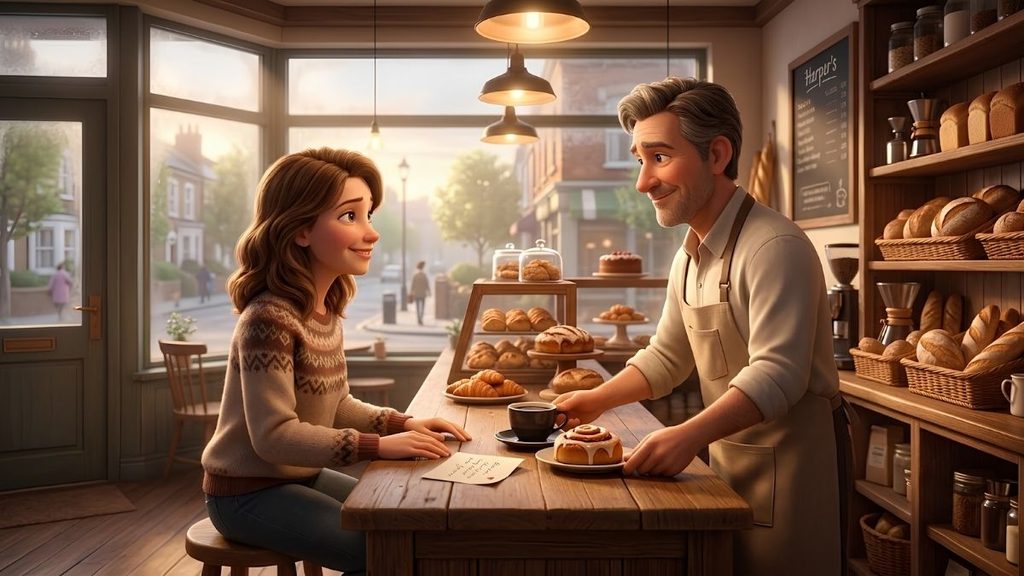
Type: Love Through Everyday Actions | Café Romance
Every morning at 7:18, Sophie Bennett walked through the blue-painted door of Harper’s Bakery.
She had been doing it for almost a year.
Not every morning without exception.
There were holidays.
There were weekends.
There were mornings when rain was so heavy that she worked from home.
But on ordinary weekdays, when the city was waking slowly and the sidewalks were beginning to fill with commuters, Sophie could almost always be found walking toward the bakery with her canvas work bag over one shoulder.
She ordered the same thing every time.
“Black coffee. One cinnamon roll.”
That was all.
At least, that was all it had been in the beginning.
The bakery was small.
It occupied the corner of an old brick building between a florist and a shop that repaired watches.
Inside, there were six small tables, a long wooden counter, and shelves filled with bread.
The windows fogged slightly during winter.
In summer, the door was usually left open.
The smell of butter, cinnamon, coffee, and warm bread seemed to follow customers into the street.
The owner, Daniel Harper, opened the bakery every morning at six.
He was thirty-eight and had inherited the business from his father.
Daniel had grown up above the bakery.
As a child, he had learned to knead dough before he had learned to ride a bicycle.
As an adult, he had briefly considered leaving the neighborhood.
He had even accepted a job in another city once.
But his father became ill, and Daniel stayed.
Years passed.
The bakery became his life.
He didn’t mind.
There was something satisfying about making things that people needed every day.
Bread.
Coffee.
Breakfast.
A place to sit.
A familiar face.
Sophie had been one of those faces for nearly a year before Daniel learned her name.
At first, she had simply been the woman who ordered coffee and cinnamon rolls.
He recognized her because of her routine.
7:18.
Black coffee.
Cinnamon roll.
No sugar.
No milk.
Usually reading something on her phone while waiting.
Sometimes wearing headphones.
Sometimes looking as though she had not slept enough.
Daniel didn’t think much of it.
People had routines.
He had his own.
Then one rainy morning, Sophie walked into the bakery at 7:21.
Daniel looked at the clock.
“You’re late.”
She looked up.
“What?”
He immediately realized what he had said.
“I mean…”
He smiled.
“Good morning.”
Sophie laughed.
“Did you just tell me I’m late?”
“I didn’t.”
“You definitely did.”
“I was observing.”
“That’s a dangerous habit.”
Daniel handed her coffee.
“Black coffee. Cinnamon roll.”
She looked at the cup.
“Already?”
“I know your order.”
Something about the sentence made her smile.
“Apparently you do.”
She paid and walked toward her usual table.
Daniel watched her sit down.
Three minutes later, she left.
The next morning, she returned.
7:18.
She looked at him.
“Am I on time?”
Daniel nodded seriously.
“Exactly.”
She laughed.
That was the first real conversation they had.
It lasted less than ten seconds.
But after that, things changed slightly.
Not dramatically.
Just enough to become noticeable.
Daniel learned that Sophie worked at a publishing company two blocks away.
She learned that the bakery had been opened by Daniel’s father thirty-two years earlier.
She learned that Daniel liked old jazz records.
He learned that Sophie preferred cinnamon rolls with more cinnamon and less icing.
She learned that he hated waste.
He learned that she always read the last page of a book before deciding whether to buy it.
“I don’t understand how you can do that,” he told her one morning.
“Why?”
“It ruins the ending.”
“It helps me decide whether I care about the ending.”
“That’s terrible.”
“You bake bread for a living. You don’t get to judge me.”
He laughed.
Their conversations remained short.
A few sentences.
Sometimes less.
But they became part of the morning.
Then Daniel began preparing her coffee before she reached the counter.
The first time she noticed, she stopped.
“You made it already?”
“You always come at 7:18.”
“That’s slightly unsettling.”
“Would you prefer I forget?”
“No.”
She smiled.
“I suppose it’s convenient.”
He nodded.
“Convenience is underrated.”
After that, Sophie began arriving at 7:17.
Then 7:16.
Then 7:15.
Daniel noticed.
He didn’t say anything.
She didn’t either.
She simply liked having an extra minute to talk.
One morning, Daniel placed a small piece of paper beside her coffee.
Sophie picked it up.
It said:
The rain finally stopped.
She looked toward the window.
The clouds had opened.
A narrow strip of blue sky was visible above the buildings.
She looked at Daniel.
“You wrote this?”
He shrugged.
“You seemed to be looking outside.”
She smiled.
The next morning, there was another note.
Try the new bread today.
She did.
It was excellent.
A week later:
You look tired. Take the cinnamon roll. It’s on me.
Sophie frowned.
“Are you calling me tired?”
“Concerned.”
“That’s worse.”
“Eat the cinnamon roll.”
She did.
Their little notes became a quiet habit.
They were never romantic.
At least not openly.
Sometimes Daniel wrote:
Cold morning.
Sometimes:
New coffee beans today.
Once:
The watch shop owner says spring is coming. I don’t trust him.
Sophie replied beneath it:
I don’t trust watchmakers either.
The following day Daniel wrote:
Fair point.
The notes accumulated.
Sophie kept them in the side pocket of her work bag.
She didn’t know why.
They were insignificant.
Just a few words on scraps of paper.
But they made her smile.
And somehow, that mattered.
Months passed.
Their friendship grew in small increments.
Daniel discovered that Sophie hated crowded restaurants.
Sophie discovered that Daniel liked walking home instead of taking the bus whenever the weather was good.
They began having lunch together occasionally.
Then coffee after work.
Then walks.
Nothing was announced.
Nothing was defined.
They simply began spending time together outside the bakery.
One Saturday, Sophie asked him why he had never opened another bakery.
“You could.”
Daniel shrugged.
“Maybe.”
“You don’t want to?”
“I like this one.”
“Because it’s your father’s?”
“Partly.”
“And the other part?”
Daniel looked through the bakery window.
“Because people know me here.”
Sophie smiled.
“People know you because you remember their orders.”
“That’s part of it.”
She looked at him.
“Do you remember everyone’s?”
Daniel shook his head.
“No.”
She raised an eyebrow.
“Why?”
“Some orders are easier to remember.”
She smiled.
“Mine?”
“Yours.”
She didn’t ask what that meant.
She already knew.
Then, one Monday morning, Sophie didn’t come.
Daniel noticed the clock.
7:18.
No Sophie.
7:25.
Still no Sophie.
He told himself it was nothing.
People missed mornings.
At 8:00, he had almost forgotten about it.
Almost.
The next day, she didn’t come.
Then Wednesday.
Then Thursday.
By Friday, Daniel found himself looking toward the door every few minutes.
He prepared her usual coffee anyway.
It sat behind the counter.
Eventually, he drank it himself.
On Monday, he made another.
He didn’t know why.
The week continued.
Sophie didn’t appear.
Daniel wondered whether he should call.
He didn’t have her number.
They had never exchanged numbers.
That realization surprised him.
They had talked for months.
They had shared coffee.
They had walked through the city.
But they had somehow never crossed that small line.
He considered asking one of her colleagues.
Then decided against it.
If she wanted to tell him where she was, she would.
So he waited.
Two weeks passed.
The bakery remained busy.
Life continued.
But something was missing.
The 7:18 customer.
The black coffee.
The cinnamon roll.
The notes.
The quick smile.
Daniel began noticing how much of his morning had been shaped around her.
He had never considered himself a sentimental person.
Yet he had started listening for her footsteps.
He had started glancing toward the door when the clock approached 7:18.
He had started saving the seat near the window.
Not officially.
He would never admit that.
But he did.
One evening, after closing, Daniel sat alone at one of the tables.
He looked at the empty chair by the window.
He realized something uncomfortable.
He missed her.
Not because she bought coffee.
Not because she was part of his routine.
He missed her.
Her questions.
Her dry humor.
Her habit of tapping her fingers against the cup while reading.
The way she smiled when she tried not to.
He wished he had told her that.
Then he remembered that he had never told her anything important.
He had simply remembered.
Her order.
Her favorite bread.
The kind of mornings she disliked.
The fact that she preferred the table by the window.
Maybe that was how he had learned to care.
Quietly.
Without announcing it.
Three weeks after Sophie disappeared, the bakery door opened at 7:19.
Daniel looked up.
It was her.
She stood near the entrance wearing a dark coat.
Her hair was slightly damp.
She looked tired.
But she was smiling.
Daniel froze for half a second.
Then he said the only thing that came to mind.
“You’re late.”
Sophie laughed.
“I know.”
She walked toward the counter.
“I’m sorry.”
“You don’t have to apologize.”
“I had to go away unexpectedly.”
“Everything okay?”
She nodded.
“My mother wasn’t well. I went home for a while.”
Daniel’s expression softened.
“I’m sorry.”
“She’s doing better now.”
“Good.”
They stood quietly.
Then Sophie looked at the counter.
“Can I still get my usual?”
Daniel smiled.
“Of course.”
He turned around.
The coffee was ready.
The cinnamon roll was waiting.
He placed both in front of her.
Sophie looked at them.
“You remembered.”
Daniel smiled.
“I saved your place.”
She looked toward the table by the window.
Her usual chair was empty.
For a moment, she simply stood there.
Then she smiled.
“Thank you.”
She carried her coffee to the table.
Daniel returned to work.
But that morning felt different.
Sophie didn’t rush away.
She stayed for nearly an hour.
They talked.
Really talked.
She told him about her mother.
He told her about the bakery.
They talked about books.
Music.
Travel.
Family.
Fear.
Plans.
The things they wanted.
The things they had postponed.
The things they had never told anyone.
When Sophie finally stood to leave, she looked at Daniel.
“Do you know what I missed most while I was away?”
He shook his head.
“The coffee?”
She smiled.
“No.”
She looked at the little stack of handwritten notes beside the register.
“Those.”
Daniel laughed softly.
“They’re terrible.”
“I kept all of them.”
“You did?”
She nodded.
“They made my mornings better.”
He looked at her.
“So did you.”
The words came out before he could reconsider them.
Sophie smiled.
“I know.”
After that morning, their relationship changed.
Not suddenly.
Not dramatically.
It simply became more honest.
Sophie began coming earlier.
Daniel sometimes closed the bakery a little early on Sunday afternoons so they could walk through the neighborhood.
They discovered that they liked farmers’ markets.
They cooked together.
They argued about which books were overrated.
They shared music.
They sat in cafés.
They learned that romance did not always begin with fireworks.
Sometimes it began with someone remembering that you preferred black coffee.
Sometimes it began with a chair quietly being saved.
Sometimes it began with a piece of paper saying:
The rain finally stopped.
Years later, Sophie would still tell people that she didn’t remember exactly when she fell in love with Daniel.
There wasn’t a particular moment.
No grand declaration.
No dramatic first kiss beneath the rain.
No perfect evening.
There were simply hundreds of small moments.
A warm coffee waiting at 7:18.
A cinnamon roll.
A handwritten note.
A chair beside the window.
A walk home.
A conversation that lasted five minutes longer than expected.
Then another.
Then another.
And perhaps that was the kind of love that suited them best.
A love built from noticing.
Daniel remembered her order.
Sophie remembered the jazz records he liked.
He remembered when she had a difficult day.
She remembered when he needed encouragement.
They learned that affection was often hidden inside ordinary attention.
Years later, the bakery still stood between the florist and the watch repair shop.
The windows still fogged in winter.
The smell of cinnamon still drifted onto the sidewalk.
And every morning, Daniel still prepared two coffees before opening.
One for himself.
One for Sophie.
Because some routines were worth keeping.
And some people were worth remembering every day.
Core themes: everyday romance, small gestures, routine, companionship, kindness, quiet affection.
5. The Call at 11:47

Type: Long-Distance Relationship | Night Conversations
Type: Long-Distance Relationship | Night Conversations
Every night at exactly 11:47, Anna Wilson’s phone rang.
It had become the most familiar sound in her apartment.
Not the kettle clicking off in the kitchen.
Not the rain against the windows.
Not the buses moving along the street below.
The phone.
One short vibration.
A pause.
Then another.
Anna always smiled before answering.
“Hello.”
“Hi.”
James Carter’s voice came through the speaker.
Sometimes it sounded tired.
Sometimes cheerful.
Sometimes distracted.
Sometimes so quiet that Anna could almost imagine he was sitting beside her.
But it was always James.
And that was enough.
They had been together for almost four years when James accepted a year-long work assignment overseas.
It wasn’t supposed to be a difficult decision.
At least, that’s what they told each other.
The project was important.
It would advance James’s career.
The company would pay for his accommodation and travel.
He would be home after twelve months.
“One year,” Anna had said.
“One year,” James repeated.
They had stood at the airport holding hands.
Neither wanted to make the goodbye more emotional than necessary.
They promised to call.
They promised to visit when possible.
They promised that twelve months would pass quickly.
Then James disappeared through security.
Anna watched him until she couldn’t see him anymore.
The first week was manageable.
They exchanged messages constantly.
James sent photographs of his temporary apartment.
Anna sent pictures of the breakfast she made.
They joked about the time difference.
But after a few weeks, reality became more complicated.
James’s mornings began when Anna was still asleep.
His meetings often continued until late afternoon.
By the time he finished work, Anna was already preparing for bed.
Their schedules seemed determined to keep them apart.
Some days, their entire conversation consisted of messages.
How was your day?
Busy. Yours?
Busy too.
Eat something.
You too.
Goodnight.
It wasn’t that they had stopped caring.
Quite the opposite.
They cared so much that the short messages began to feel insufficient.
They were sharing information without sharing their lives.
One Sunday evening, Anna called James unexpectedly.
He answered after several rings.
“Hey.”
“Did I wake you?”
“No.”
“You sound asleep.”
“I wasn’t asleep.”
“You definitely were.”
James laughed.
“Maybe a little.”
Anna smiled.
They talked for twenty minutes.
Then forty.
Neither noticed the time.
Eventually, James said, “I have to sleep.”
“Okay.”
“Goodnight.”
“Goodnight.”
The next evening, James called.
It was 11:47 in London.
Anna looked at the screen.
“Why 11:47?”
“I don’t know.”
“Why not 11:45?”
“Too ordinary.”
She laughed.
“You’re ridiculous.”
“Thank you.”
From then on, 11:47 became theirs.
The time difference meant that James had worked out exactly when he needed to finish his evening so he could call.
Anna began expecting it.
She didn’t set an alarm.
She didn’t need one.
At 11:40, she usually finished whatever she was doing.
At 11:45, she made tea.
At 11:47, the phone rang.
Their first calls were practical.
“What did you eat?”
“Soup.”
“Again?”
“I like soup.”
“You’ve had soup three days in a row.”
“It’s efficient.”
“That’s not a food philosophy.”
James laughed.
Then he asked about her day.
Anna told him about work.
He told her about meetings.
They complained about people who sent emails marked urgent when they weren’t.
They discussed grocery prices.
They talked about the weather.
Sometimes they spent ten minutes discussing something completely unimportant.
And slowly, the calls changed.
One night, Anna mentioned an elderly man who sat outside her apartment every morning.
“He feeds birds.”
“Every day?”
“Every day.”
“How many birds?”
“I don’t know.”
“You should count them.”
“Why?”
“For science.”
“You’re working too much.”
James laughed.
The following night, Anna said, “There are twelve.”
“Birds?”
“Yes.”
“I knew it.”
She smiled.
“What did you know?”
“That there would be twelve.”
“You had no idea.”
“I had faith.”
She rolled her eyes.
The next night, James described the view from his apartment.
There was a tall building opposite his window.
At night, only a handful of its windows remained illuminated.
“I like watching them,” he said.
“Why?”
“It makes me feel like I’m not the only person awake.”
Anna understood.
She began looking at the windows outside her own apartment.
She realized that every night, there were people awake in buildings all around her.
Someone reading.
Someone working.
Someone feeding a baby.
Someone watching television.
Someone probably missing somebody.
The world was full of quiet lives continuing behind illuminated windows.
Their calls became longer.
Sometimes they lasted an hour.
Sometimes two.
Sometimes they forgot they were supposed to say goodnight.
They started reading together.
Anna chose a novel.
James bought the same edition.
They read a chapter each night.
Sometimes they disagreed about characters.
Sometimes one of them fell behind.
“You said you’d finish chapter six.”
“I was tired.”
“You promised.”
“I’ll catch up tomorrow.”
“You’d better.”
Another evening, James played music while Anna prepared dinner.
She put her phone on the kitchen counter.
“Can you hear that?”
“A little.”
“What are you cooking?”
“Pasta.”
“Again?”
“Don’t criticize my food choices.”
“I’m not.”
“You are.”
“I miss your cooking.”
Anna stopped stirring.
She smiled.
“I miss cooking for you.”
The conversation went quiet.
Neither wanted to make the moment heavier.
So James asked, “How much garlic?”
“Too much.”
“Good.”
They continued talking.
Sometimes they weren’t even talking about anything.
One night, Anna was folding laundry while James worked on his laptop.
They stayed on the call for nearly an hour without saying more than a few sentences.
“You still there?” Anna asked.
“Yeah.”
“You haven’t said anything.”
“Neither have you.”
“I’m folding towels.”
“I’m answering emails.”
“Romantic.”
“Very.”
She smiled.
The silence returned.
It felt surprisingly comfortable.
That was when Anna realized something.
When they had first started dating, silence had sometimes felt awkward.
They had worried about keeping conversations going.
Now silence itself had become a form of companionship.
James didn’t have to entertain her.
Anna didn’t have to entertain him.
They could simply exist together.
One rainy evening, the city outside Anna’s window disappeared behind a curtain of water.
She sat on the sofa with a blanket around her shoulders.
James was sitting at his desk thousands of miles away.
Neither had had a particularly good day.
They had nothing interesting to tell each other.
Anna sighed.
“Today was awful.”
James leaned back.
“Mine too.”
“What happened?”
“Nothing worth explaining.”
“Same.”
They remained quiet.
Rain tapped against Anna’s window.
James’s room was silent.
Eventually, he said, “Do you want me to stay?”
Anna smiled.
“Yes.”
So he stayed.
They didn’t talk.
For twenty minutes, neither said anything.
Anna listened to the rain.
James typed occasionally.
Eventually, James spoke.
“You know what I’ve realized?”
“What?”
“I used to think distance was measured in miles.”
Anna looked toward the window.
“What do you think now?”
“How long you go without hearing someone’s voice.”
She smiled.
“That’s a good one.”
“I’ve been thinking.”
“Careful.”
He laughed.
“I miss ordinary things.”
“Like what?”
“You asking me what I want for dinner.”
“You never know what you want.”
“Exactly.”
She laughed.
“I miss arguing about which movie to watch.”
“You always choose.”
“Because you take twenty minutes.”
“I like options.”
“You like indecision.”
“Same thing.”
Anna smiled.
“I miss those things too.”
They stayed on the call until both became sleepy.
“Goodnight,” James said.
“Goodnight.”
Neither hung up immediately.
Finally, Anna whispered, “I’ll see you tomorrow.”
“11:47.”
“11:47.”
The year continued.
Spring became summer.
Summer became autumn.
The calls remained.
Sometimes they were joyful.
Sometimes difficult.
Sometimes silly.
Sometimes quiet.
There were evenings when one of them was too tired to talk.
There were days when they argued.
There were moments when the distance felt much longer than twelve months.
But they kept calling.
James began sending Anna photographs of small things.
A cup of coffee.
A street corner.
A strange sign.
A sunset.
A book he found in a shop.
Anna did the same.
They created a shared folder called Things We Would Have Seen Together.
It filled quickly.
A bakery window.
A dog sleeping beneath a table.
A bicycle covered in flowers.
A train station.
A bowl of soup.
A cloudy sky.
A street musician.
Nothing extraordinary.
Everything meaningful.
Three months before James was due home, Anna started counting the days.
She tried not to.
But she did.
One hundred.
Ninety-nine.
Ninety-eight.
James laughed when she told him.
“You’re counting?”
“No.”
“You just said ninety-eight.”
“I was estimating.”
“You’re counting.”
“Maybe.”
He smiled.
“I’m counting too.”
When there were thirty days left, Anna bought something.
A small notebook.
She filled the first page with a sentence:
Things I want to tell you when you’re here.
She began writing.
She wrote about books.
Meals.
Work.
Her neighbors.
The weather.
Small things she had wanted to tell him but had forgotten during their calls.
James was doing something similar.
They didn’t know it.
On the final week, their calls became strange.
They were excited.
They were nervous.
They had been apart so long that seeing each other again felt almost unreal.
“What if it’s awkward?” Anna asked.
“It will be.”
“That’s reassuring.”
“We haven’t shared a room in almost a year.”
“True.”
“What if you hate me?”
“I’ve survived your soup opinions.”
“Fair.”
The night before his flight, James called at 11:47.
Neither spoke for a while.
“Tomorrow,” Anna said.
“Tomorrow.”
“Are you nervous?”
“Yes.”
“Me too.”
“What time will you be at the airport?”
“Ten.”
“My flight lands at nine-thirty.”
“I know.”
“You’ll be there?”
“I’ll be there.”
The next morning seemed endless.
Anna arrived early.
She stood near the arrivals area watching people come through the doors.
Families embraced.
Friends shouted.
Children ran toward parents.
Suitcases rolled across the floor.
Then she saw him.
James looked tired.
He was carrying a suitcase and a backpack.
For a moment, neither moved.
Then he smiled.
Anna walked toward him.
They hugged.
Neither said anything.
They didn’t need to.
After a few seconds, James whispered, “Hi.”
“Hi.”
“You look exactly the same.”
“You don’t.”
“I know.”
She laughed.
They left the airport together.
That evening, they cooked dinner.
Nothing special.
Pasta.
Salad.
Bread.
James complained about the amount of garlic.
Anna told him he had missed it.
They sat at the kitchen table.
They talked.
Not about important things.
About ordinary things.
The bread.
The weather.
A book.
A neighbor.
A funny story from work.
At some point, Anna looked at the clock.
11:47.
She smiled.
James noticed.
“What?”
“It’s 11:47.”
He looked at the clock.
For a moment, they were quiet.
Then James reached across the table and took her hand.
“Feels strange.”
“What does?”
“Being here at 11:47.”
Anna smiled.
“Good strange?”
“Very good strange.”
Later that night, they sat by the window.
There was no phone between them.
No time difference.
No poor connection.
No countdown.
No need to schedule another call.
They were simply together.
James rested his head against the sofa.
Anna leaned against him.
“You know what I learned?” she asked.
“What?”
“That I don’t need to talk to you all the time.”
James smiled.
“That’s good.”
“But I like knowing you’re there.”
He kissed her forehead.
“I’m always there.”
Outside, the city was quiet.
Some windows were dark.
Others remained illuminated.
People were still awake.
Some were working.
Some were reading.
Some were talking to people they loved.
And somewhere in that city, someone was probably waiting for a familiar voice.
Anna closed her eyes.
For a year, 11:47 had been the time that connected two distant lives.
Now it was simply another moment they shared.
And perhaps that was what the calls had taught them.
Closeness wasn’t always measured by physical distance.
Sometimes it was measured by attention.
By remembering.
By listening.
By staying on the phone when there was nothing left to say.
By making room for another person’s ordinary life.
Love, they discovered, did not always need grand gestures.
Sometimes it was simply this:
A familiar voice at the end of a long day.
A quiet “Are you still there?”
A promise to call tomorrow.
And, every night at 11:47, the knowledge that somewhere in the world, someone was waiting to hear you say hello.
Core themes: long-distance love, nighttime conversations, emotional intimacy, patience, connection, reunion.
6. The Photograph in the Attic

Type: Romantic Nostalgia | Memories & Lasting Love
The attic had always been the room Thomas avoided.
It wasn’t because it was frightening.
There were no ghosts, no mysterious noises, and no locked trunks hiding secrets.
It was simply full of things that belonged to another version of his life.
Old Christmas decorations.
Boxes of schoolbooks.
A broken lamp.
His father’s fishing equipment.
His mother’s collection of porcelain birds.
Photographs.
Too many photographs.
After his mother’s death, Thomas had promised himself that he would sort through everything before putting the house on the market.
He had expected the work to take a weekend.
It took three weeks.
Every room seemed to contain another memory.
A chipped blue mug reminded him of Sunday breakfasts.
A wool scarf brought back winters when his mother insisted he wear something warmer.
A wooden chair reminded him of his father reading newspapers by the window.
The house had been quiet since his mother’s funeral.
Sometimes Thomas found the silence comforting.
Other times, it seemed to amplify everything he had lost.
On a cloudy Saturday afternoon, he finally climbed the narrow stairs to the attic.
Dust floated through the light coming from the small window.
Thomas switched on the lamp.
Nothing happened.
He sighed.
“Of course.”
He opened the curtains instead.
Gray daylight filled the room.
For the next hour, he worked through boxes.
He threw away old newspapers.
He packed books into cartons.
He found a collection of postcards his mother had kept for decades.
Then, behind an old suitcase, he noticed a small wooden box.
It was darker than the other boxes.
Thomas pulled it toward him.
There was no label.
He lifted the lid.
Inside were photographs.
Some were familiar.
His parents when they were young.
His father beside an old car.
His mother standing in a garden.
Thomas as a child.
His first bicycle.
His university graduation.
He smiled at some of them.
Then he found one he had never seen before.
He turned it over.
Nothing was written on the back.
He looked at the front.
And stopped.
The photograph showed a younger version of himself.
Twenty-four years old.
Standing beside a woman.
Clara.
Thomas sat down on the attic floor.
For a long moment, he simply stared.
The photograph had been taken during the summer of 1996.
He remembered the day.
He remembered the sunlight.
He remembered Clara laughing because he had insisted on wearing a ridiculous straw hat.
He remembered the small coastal town where they had spent the summer.
He remembered the smell of salt in the air.
He remembered believing, with the absolute confidence of someone in his twenties, that life would somehow remain exactly as it was.
Thomas turned the photograph over again.
Still nothing.
He looked at Clara’s face.
Thirty years disappeared for a moment.
Then they returned.
Slowly.
He put the photograph on his knee.
“What happened to you?” he whispered.
It was an ordinary question.
But it stayed with him for the rest of the day.
Thomas and Clara had met at university.
They weren’t supposed to become a serious couple.
At least, that wasn’t how it began.
They were friends first.
They studied together.
They drank cheap coffee.
They argued about books.
They walked home after evening classes.
Clara had a habit of stopping whenever she saw an interesting shop window.
Thomas would pretend to be impatient.
“You’ve looked at that lamp for five minutes.”
“It’s a beautiful lamp.”
“It’s a lamp.”
“You don’t understand design.”
“I understand electricity.”
She would laugh.
That laugh had once been one of his favorite sounds.
During their final summer before graduation, they traveled together.
Nothing about the trip was luxurious.
They stayed in a small rented cottage near the sea.
The roof leaked.
The kitchen was tiny.
The bed was uncomfortable.
They loved it.
They spent mornings walking along the shore.
Afternoons reading.
Evenings cooking simple meals.
Sometimes they did absolutely nothing.
Those were often their favorite days.
One evening, they bought a cheap camera from a small shop.
Clara insisted on taking photographs of everything.
The cottage.
The beach.
A bicycle.
Their breakfast.
A dog that followed them for half a mile.
Thomas complained.
“You’ll fill the entire camera.”
“That’s the idea.”
“You’ll never look at these again.”
Clara smiled.
“Maybe not.”
Then she raised the camera.
“Smile.”
The photograph in Thomas’s attic was one of those pictures.
After that summer, life changed.
Thomas accepted a job in another city.
Clara received an opportunity abroad.
Neither wanted to admit that their plans were moving in different directions.
They tried to maintain the relationship.
For several months, they called.
Then the calls became less frequent.
Work became demanding.
Travel became difficult.
Messages were answered late.
Eventually, there was an argument.
Not a dramatic one.
There was no betrayal.
No terrible secret.
Just two young people exhausted by distance and uncertainty.
They ended the relationship.
Thomas remembered saying:
“Maybe someday.”
Clara had smiled sadly.
“Maybe.”
There was no someday.
At least, not for a very long time.
That night, Thomas placed the photograph on his kitchen table.
He made tea.
He didn’t drink it.
He searched Clara’s name online.
There were too many results.
He added the name of their university.
Then the city where she had grown up.
Then the name of the company where she had once worked.
Nothing.
He closed the laptop.
The next morning, he searched again.
This time he found something.
A professional profile.
Clara Reed.
No.
That wasn’t right.
He opened it.
The photograph was different, but the face was unmistakable.
Clara.
She lived only an hour away.
Thomas stared at the screen.
He closed it.
He opened it again.
He spent several days thinking about whether to contact her.
What would he say?
Hello, I found a photograph of us.
Hello, I was cleaning my mother’s attic and suddenly remembered thirty years of my life.
Hello, do you remember me?
Every version sounded strange.
Finally, he wrote a short message.
He didn’t mention the photograph.
He simply said:
“I hope you’re well. I came across something that reminded me of you. If you’d ever like to have coffee, I’d be glad to catch up.”
He read it three times.
Then he sent it.
Immediately, he regretted it.
For two days, there was no reply.
Thomas told himself it didn’t matter.
He continued sorting the house.
He packed dishes.
He called the estate agent.
He arranged for furniture to be donated.
Then, on Wednesday evening, his phone buzzed.
He looked at the screen.
Clara had replied.
“Coffee sounds nice.”
Thomas smiled.
They met on a Saturday afternoon.
The café was small and quiet.
Thomas arrived early.
He chose a table near the window.
Five minutes later, the door opened.
Clara walked inside.
For one brief second, Thomas saw the twenty-four-year-old woman from the photograph.
Then he saw the woman standing in front of him.
Older.
Calmer.
Different.
And somehow familiar.
“Hi, Thomas.”
“Hi, Clara.”
They hugged.
It was slightly awkward.
They laughed about that.
“I wasn’t sure whether we were supposed to shake hands,” Clara said.
“I considered it.”
“That would have been strange.”
“Very.”
They sat down.
For the first few minutes, they talked about safe things.
Work.
The weather.
The café.
Traffic.
Then Clara asked about his mother.
Thomas told her.
Clara became quiet.
“I’m sorry.”
“Thank you.”
He told her about the house.
“The attic is full of things.”
“Still?”
“Apparently my mother believed everything was worth keeping.”
Clara smiled.
“She always liked memories.”
Thomas looked at her.
“You remember that?”
“Some things.”
The conversation became easier.
They talked for two hours.
Clara had married once.
The marriage had ended years earlier.
Thomas had been married too.
His marriage had also ended.
Neither spoke bitterly about it.
They talked about careers.
Travel.
Mistakes.
Books they had read.
People they had lost.
The lives they had built.
Eventually, Clara asked:
“Why did you contact me?”
Thomas smiled.
“I found a photograph.”
She looked at him.
“Of us?”
“Yes.”
“Do you have it?”
“I do.”
He showed her a photograph on his phone.
Clara stared at it.
Then she laughed.
“Oh, that hat.”
“You remember?”
“I hated that hat.”
“You told me it made me look sophisticated.”
“I was being polite.”
Thomas laughed.
For a while, neither spoke.
Then Clara said quietly:
“We were very young.”
“Yes.”
“Do you ever think about that summer?”
“Sometimes.”
“Me too.”
They finished their coffee.
Neither suggested they should leave.
Eventually, Clara said:
“We should do this again.”
Thomas smiled.
“I’d like that.”
They did.
The next meeting was at a weekend market.
Then a walk.
Then lunch.
Then another coffee.
There was no declaration.
No sudden realization.
No attempt to recreate the relationship they had once shared.
Instead, they slowly learned about each other again.
Clara discovered that Thomas now preferred tea to coffee.
Thomas learned that Clara had become an early riser.
She loved gardening.
He had learned to cook.
She still stopped to look at shop windows.
He still pretended to be impatient.
“You haven’t changed,” he told her one afternoon.
“Neither have you.”
“That’s not true.”
“No?”
“You haven’t seen my cooking.”
She laughed.
They began visiting places from their old photographs.
The beach.
The old bookshop.
The café that had once been a grocery store.
The road where they had taken long evening walks.
Some places had disappeared.
Others had changed completely.
The little cottage was still there.
They stood outside it one autumn afternoon.
The paint was different.
The garden had changed.
The windows had been replaced.
Thomas looked at Clara.
“Do you want to go inside?”
She shook her head.
“No.”
“Why?”
“I think I like remembering it the way it was.”
Thomas understood.
They walked away.
They didn’t need to enter.
The memory was enough.
Months passed.
Thomas finished clearing his mother’s house.
On the final evening, he returned to the attic.
The wooden box was still there.
He picked up the photograph.
He thought about the strange journey it had taken him on.
A photograph had brought back a memory.
The memory had brought back a question.
The question had brought back Clara.
But what had surprised him most was that he didn’t actually want to return to the past.
He didn’t want to be twenty-four again.
He didn’t want the tiny cottage.
He didn’t want the uncertainty.
He didn’t want to repeat the mistakes they had made.
He wanted something different.
Something quieter.
Something built by two people who understood that life rarely follows the plans made when they are young.
Thomas placed the photograph carefully inside a new frame.
He didn’t put it away.
He placed it on a shelf.
The next morning, Clara came to help him finish packing.
She looked around the empty house.
“It feels strange.”
“It does.”
“Are you sad?”
“A little.”
“That’s okay.”
Thomas smiled.
They carried the last box outside.
Then they stood in the garden.
The house was ready to belong to someone else.
Thomas looked at Clara.
“Would you like to have dinner tonight?”
She smiled.
“I’d like that.”
They drove into town.
The evening was cool.
Streetlights reflected on the wet pavement.
At the restaurant, they talked for hours.
About nothing important.
About everything important.
When they left, Clara slipped her hand into Thomas’s.
It was a small gesture.
But Thomas understood it.
Not as a return to the past.
As a beginning.
Years later, Thomas would still occasionally look at the photograph.
Sometimes he wondered what would have happened if the postcard had arrived earlier.
If one of them had made a different decision.
If they had stayed together.
But he no longer spent much time imagining alternate lives.
The life they had actually lived was enough.
They had both changed.
They had both experienced loss.
They had both made mistakes.
They had both learned things they could not have understood at twenty-four.
And now, when they sat together on quiet evenings, they sometimes talked about the summer that had once seemed like the beginning of everything.
It wasn’t.
It had been one beautiful chapter.
A chapter that ended.
But endings, Thomas eventually realized, did not make a chapter meaningless.
Some memories were not invitations to go backward.
They were reminders of how much life had given you.
The photograph remained on the shelf.
The young Thomas and Clara smiled from another century.
Beside the frame sat a newer photograph.
Thomas and Clara, older now, standing beside the sea.
Their hair was gray.
Their clothes were different.
Their smiles were quieter.
But their eyes held something the old photograph could never have contained.
The knowledge of everything that had happened between those two pictures.
One evening, Clara looked at both photographs.
“I like the new one better,” she said.
Thomas smiled.
“Why?”
“Because we know what comes after it.”
He looked at her.
“And what comes after it?”
She took his hand.
“We’ll find out.”
Outside, evening settled gently over the town.
Thomas looked once more at the old photograph.
He no longer saw a life he had lost.
He saw a young man who had once loved someone deeply.
And he felt grateful for him.
Grateful for the summer.
Grateful for the years that followed.
Grateful for the unexpected path that had brought Clara back into his life.
Most of all, he understood something he hadn’t known when the photograph was taken.
Love did not always mean holding on to the same story forever.
Sometimes love meant remembering.
Sometimes it meant letting go.
And sometimes, after enough years had passed, it meant opening the door to a new chapter without pretending the old one had never existed.
The photograph stayed on the shelf.
The memories stayed with them.
And the story, after thirty years, quietly continued.
Core themes: romantic nostalgia, lost connection, maturity, memories, second beginnings, enduring affection.
Why Romance Works Well at Bedtime
Romance naturally involves emotions such as affection, comfort, trust, belonging, and companionship.
These emotions can create a soothing reading experience when handled gently.
After a stressful day, many adults do not necessarily want another complicated story demanding constant attention.
They may prefer something emotionally warm.
A story where two people cook together can be enough.
A conversation between longtime partners can become meaningful.
A character remembering their first meeting with someone they love can create a nostalgic atmosphere.
The story does not have to solve a major problem.
Sometimes, the absence of major conflict is precisely what makes a romantic bedtime story relaxing.
The Importance of Emotional Comfort
The strongest romantic bedtime stories often create a sense of emotional safety.
Readers should feel that the characters are gradually moving toward comfort rather than uncertainty.
This does not mean every relationship must be perfect.
Real relationships contain misunderstandings, disagreements, distance, and difficult periods.
However, bedtime romance can focus on how people communicate, reconnect, forgive, support each other, and appreciate their relationship.
For example, a couple might realize that they have been spending too much time working and too little time together.
Instead of creating a dramatic argument, the story could follow them through one quiet evening in which they cook dinner, talk, laugh, and rediscover how much they enjoy each other’s company.
The emotional resolution can be simple.
They decide to protect more time for one another.
That small decision can feel more intimate than a dramatic declaration.
Popular Themes in Romantic Bedtime Stories
Romantic bedtime stories can explore many different forms of love.
1. Gentle First Meetings
The beginning of a relationship can provide beautiful material for bedtime storytelling.
Two people might meet:
- In a bookstore
- On a train
- During a rainy evening
- At a farmers’ market
- In a neighborhood café
- At a community event
- While walking their dogs
- Through a mutual friend
The meeting doesn’t need to be dramatic.
A simple conversation can be enough.
Perhaps one character recommends a book.
Maybe someone offers to share an umbrella.
Perhaps two people repeatedly encounter each other at the same coffee shop.
These small interactions allow attraction to develop naturally.
2. Long-Term Relationships
Romance doesn’t have to focus on people falling in love.
Established couples can be equally compelling.
A story might follow two people who have been together for ten, twenty, or thirty years.
They may have developed familiar routines.
One prepares coffee in the morning.
The other remembers to water the plants.
They have favorite restaurants and familiar walking routes.
They may occasionally disagree about insignificant things.
But underneath those routines is a deep understanding.
Bedtime stories can explore how love changes over time without becoming less meaningful.
3. Second Chances at Love
Second-chance romance can be particularly emotional for adult readers.
A character may reconnect with someone from their past after many years.
They may meet unexpectedly in their hometown.
They might discover an old letter.
Perhaps they return to a place associated with their younger years.
The story can explore how people change with time.
A second chance does not necessarily mean recreating the past.
Instead, it can mean discovering whether two people can build something new with the people they have become.
4. Love Through Everyday Actions
Some of the most believable romantic stories focus on ordinary gestures.
A character might leave breakfast ready before their partner wakes.
Someone may remember exactly how the other person takes their tea.
A partner might repair a broken lamp.
Someone could bring home flowers without a special occasion.
These details communicate affection without requiring lengthy declarations.
The message is simple:
Love often appears in the things people quietly do for one another.
5. Long-Distance Relationships
Distance provides another emotional setting.
Two people might maintain a relationship through:
- Phone calls
- Letters
- Video conversations
- Shared playlists
- Photographs
- Care packages
- Planned visits
A bedtime story could follow one evening when the couple stays on a video call longer than expected.
Or perhaps one person writes a letter before going to sleep.
The physical distance remains, but emotional closeness becomes the focus.
6. Romantic Nostalgia
Memories can create a particularly peaceful romantic atmosphere.
A character might find:
- An old photograph
- A movie ticket
- A handwritten note
- A dried flower
- An old book
- A restaurant receipt
- A piece of jewelry
- A forgotten postcard
The object brings back a memory.
Instead of becoming overwhelmingly sad, the story can explore gratitude for the relationship and the moments that shaped the characters.
Romantic Settings That Create a Relaxing Atmosphere
The setting plays an important role in bedtime romance.
A peaceful environment can slow down the narrative naturally.
A Rainy Evening
Rain provides an ideal background.
The sound of rainfall against windows can accompany a couple preparing dinner, reading together, or talking late into the evening.
A Quiet Beach
A couple walking along an almost empty beach at sunset provides opportunities for reflection and conversation.
The ocean creates a natural rhythm that complements slow storytelling.
A Small Bookshop
Two characters working in or visiting a bookshop can gradually become acquainted through shared literary interests.
The setting provides warmth, quietness, and endless opportunities for gentle interactions.
A Countryside Cottage
A cottage allows the story to move away from the noise of city life.
Characters can garden, cook, walk through nearby fields, watch the sunset, and enjoy simple routines.
A Night Train
A night train creates a naturally intimate setting.
Two people can sit beside a window while the landscape passes quietly outside.
The journey itself can become a metaphor for their relationship.
Romance Without Excessive Drama
A common mistake in romantic storytelling is assuming that romance requires constant conflict.
For bedtime stories, excessive drama can have the opposite effect.
Arguments, betrayals, jealousy, breakups, and misunderstandings can make a story emotionally intense.
That doesn’t mean they can never appear.
Instead, they should be handled carefully.
A minor misunderstanding might be resolved through conversation.
A couple may realize they have been neglecting each other.
A character may overcome a fear of vulnerability.
A former couple may finally discuss something they never understood about their past.
The conflict should support emotional development rather than dominate the story.
The Role of Conversation
Conversation is particularly important in adult romance.
Adults often connect through shared experiences, memories, ambitions, fears, and observations about life.
A quiet conversation can therefore carry an entire romantic story.
Two characters might talk about:
- Their childhood homes
- Places they want to visit
- Books they love
- Career dreams
- Family memories
- Favorite foods
- Mistakes they have made
- Things they are grateful for
- Their hopes for the future
These conversations help readers understand why the characters are attracted to one another.
Romance becomes more convincing when people connect emotionally rather than simply because the story says they are in love.
Slow-Burn Romance
Slow-burn romance is especially appropriate for bedtime storytelling.
Instead of making characters fall in love immediately, the relationship can develop over time.
Perhaps they meet several times before becoming friends.
Then they begin sharing personal stories.
Eventually, they realize that they look forward to seeing one another.
The first romantic moment might be extremely subtle.
A lingering conversation.
A hand briefly touching another hand.
A shared laugh.
A decision to stay together a little longer.
The gradual development creates anticipation without requiring dramatic tension.
Stories About Married Couples
Married couples can provide some of the most comforting romantic bedtime stories.
Their relationship may already be established, allowing the story to focus on appreciation rather than courtship.
A couple might celebrate an anniversary.
They could revisit the restaurant where they first met.
They might clean an old room together and discover forgotten belongings.
They could take an unplanned evening drive.
They may simply sit together on a balcony during a summer night.
These stories remind readers that romance doesn’t necessarily end when people commit to one another.
It can continue through ordinary life.
The Connection Between Love and Routine
Routine can be surprisingly romantic.
People sometimes associate romance with extraordinary experiences.
But long-term relationships often become meaningful through repeated small actions.
A person who always makes coffee for their partner.
Someone who checks that the doors are locked.
A couple who takes the same evening walk.
Two people who read beside each other before sleeping.
A shared Sunday breakfast.
These routines create familiarity.
And familiarity can become one of the deepest forms of intimacy.
A bedtime story can make these ordinary moments feel special by slowing down and noticing them.
Romantic Stories About Reconnecting
Reconnection can happen between partners who have become distant.
Perhaps work has consumed their attention.
Maybe raising children has left little time for their relationship.
Perhaps they simply became accustomed to living beside each other without really talking.
A quiet evening can change that.
They may rediscover an old tradition.
They might cook a meal they haven’t made in years.
They could revisit a favorite place.
They may sit together and remember why they fell in love.
Such stories can be emotionally satisfying because they show that relationships sometimes need attention rather than dramatic rescue.
The Importance of Vulnerability
Romantic connection often deepens when characters allow themselves to be vulnerable.
One person might admit that they are afraid of failing.
Another may talk about loneliness.
Someone might reveal an old dream.
A character may finally explain why they have been distant.
These moments create emotional intimacy.
For bedtime stories, vulnerability should generally lead toward understanding and comfort rather than prolonged emotional distress.
The reader should feel that the characters are becoming closer.
Romantic Bedtime Stories and Imagination
One reason people enjoy fictional romance before sleep is that storytelling allows them to temporarily enter another world.
Readers can imagine:
A quiet apartment overlooking a rainy street.
A candlelit dinner.
A walk beside the sea.
A train moving through the countryside.
Two people talking beneath a streetlamp.
A small cottage surrounded by flowers.
The imagery encourages the imagination to slow down.
The story becomes less about discovering what happens next and more about experiencing the atmosphere.
Keeping Adult Romance Mature and Meaningful
Romantic stories for adults can explore mature emotions without becoming explicit.
The strongest material often comes from emotional complexity.
Characters have histories.
They have responsibilities.
They have experienced disappointment.
They understand that relationships require communication.
They know that love involves compromise.
This gives adult romance a different quality from simple fairy-tale romance.
The central question may not be:
“Will they fall in love?”
Instead, it might be:
“How will they make space for love in the lives they already have?”
That question creates opportunities for richer storytelling.
How to Make Romantic Bedtime Stories Relaxing
Several storytelling techniques can make romance more suitable for bedtime.
Use a Slow Narrative Pace
Allow scenes to breathe.
Describe the setting.
Let characters talk.
Don’t rush from one major event to another.
Use Gentle Sensory Details
Describe:
- Warm tea
- Rain against glass
- Fresh bread
- Soft evening light
- Cool evening air
- The smell of books
- The sound of footsteps
- Distant city sounds
These details help readers visualize the environment.
Keep Conflict Manageable
Small emotional challenges are usually enough.
There is no need for constant suspense.
Give Characters Time Together
Romance develops through interaction.
Allow characters to cook, walk, talk, travel, read, and simply sit together.
End With Emotional Warmth
The ending should ideally leave readers feeling peaceful.
A couple might fall asleep beside one another.
Someone may watch their partner sleeping and feel grateful.
Two people may make plans for tomorrow.
A character may return home knowing that they are loved.
The ending doesn’t need to be dramatic.
Sometimes a quiet final image is more effective.
Romantic Bedtime Stories Can Be About Many Forms of Love
Although romantic relationships are the primary focus, romance can encompass different stages and experiences.
Stories can explore:
- First love
- Mature love
- Married love
- Long-distance love
- Second chances
- New relationships
- Lifelong companionship
- Reconnecting after separation
- Quiet affection
- Emotional healing
- Shared dreams
- Growing old together
This variety prevents a collection from becoming repetitive.
Each story can have its own setting, characters, emotional journey, and atmosphere.
Why Small Romantic Moments Matter
The most memorable romantic moments are not always dramatic.
Sometimes they are almost invisible.
Someone remembering your favorite dessert.
A partner saving the last cup of tea.
Two people laughing about something nobody else would understand.
A handwritten note left beside the bed.
A walk taken simply because neither person wants the evening to end.
A familiar hand reaching across the table.
A shared silence that doesn’t feel uncomfortable.
These moments communicate something important about love.
Romance is not always about extraordinary events.
Often, it is about finding extraordinary meaning in ordinary time.
Creating a Peaceful Bedtime Reading Experience
For readers using romantic stories as part of their nighttime routine, consistency can make the experience more enjoyable.
A comfortable reading environment can include:
- Soft lighting
- A quiet room
- A comfortable chair or bed
- Reduced screen brightness
- A warm drink
- A few uninterrupted minutes
- A story with a gentle pace
The purpose is not to force sleep.
Instead, the story can become a transition between the activity of the day and the quietness of night.
Final Thoughts
Romantic bedtime stories for adults can offer much more than traditional tales about falling in love.
They can explore companionship, vulnerability, trust, memory, forgiveness, second chances, and the quiet happiness found in everyday relationships.
The best stories do not need extravagant settings or dramatic declarations.
A rainy evening can be enough.
A shared meal can be enough.
A conversation can be enough.
A familiar walk can be enough.
When romance is written with patience and emotional warmth, even an ordinary evening can become meaningful.
That is what makes romantic bedtime stories particularly suited to adults. They remind readers that love is not always found in extraordinary moments.
Sometimes it is sitting quietly beside someone at the end of a long day, knowing that neither person needs to say anything at all.