

Long bedtime stories for your girlfriend can turn an ordinary evening into a warm, meaningful experience. Whether you are lying together in the same room or talking from different cities, a well-told story can create a peaceful moment where both of you can slow down, laugh, imagine, and feel closer.
A long bedtime story does not have to be complicated. It can be romantic, sweet, funny, emotional, adventurous, magical, or simply comforting. What matters most is the feeling it creates.
For couples, bedtime storytelling can become more than entertainment. It can become a small nightly tradition that gives both partners something to look forward to at the end of the day.
What Are Long Bedtime Stories for Girlfriend?
Long bedtime stories for girlfriends are extended stories designed to be enjoyed during a relaxing nighttime routine. They usually have more characters, settings, dialogue, emotional development, and plot than very short bedtime stories.
A long story might take 15, 20, 30, or even more minutes to read aloud, depending on its length and reading speed.
These stories can follow many different themes.
Some focus on romance and emotional connection. Others involve funny relationship situations, unexpected adventures, magical places, meaningful memories, or long-distance love.
The best stories are usually gentle enough to enjoy before sleep while still being interesting enough to keep the listener engaged.
Long Bedtime Stories for Girlfriend
1. Romantic Long Bedtime Story
The Balcony Across the Street

Characters: Nora and Julian
ora first noticed the balcony across the street on a Tuesday morning in early spring.
She had been standing outside with a cup of coffee, waiting for the water in her small watering can to warm slightly beneath the morning sun. Her balcony was narrow, barely wide enough for the little wooden chair she had found at a secondhand shop and the collection of plants she kept insisting would eventually become a garden.
Across the street stood another apartment building, nearly identical to hers.
Six floors.
Cream-colored walls.
Tall windows.
Small balconies with metal railings.
For years, Nora had barely paid attention to it.
That morning, however, a man stepped onto the fourth-floor balcony across the street.
He carried a book in one hand and a mug in the other.
He wore a gray sweater, dark trousers, and the slightly distracted expression of someone who had forgotten what time it was.
Nora looked at him for a second.
Then she looked away.
She watered her basil.
A minute later, she glanced back.
The man was reading.
She smiled faintly.
There was something peaceful about seeing someone else beginning their morning in exactly the same quiet way.
She did not know his name.
She did not know anything about him.
So Nora simply returned to her plants.
The next morning, he was there again.
This time, Nora noticed that he had a different book.
The morning after that, she noticed he drank coffee before opening his book.
A week later, she realized she had started expecting him.
She did not think of it as waiting.
At least, that was what she told herself.
The man across the street had a name.
Julian.
Nora eventually learned it by accident.
One Saturday afternoon, a delivery driver stood outside Julian’s building holding a large cardboard box.
“Julian Mercer?” the driver called.
Nora happened to be watering her plants.
She looked up.
The man across the street appeared at the entrance.
“That’s me.”
He signed for the package and carried it upstairs.
Nora returned to her plants.
Julian, meanwhile, had no idea that someone had just learned his name from across the street.
But he had noticed Nora too.
He had noticed her long before she noticed him.
He remembered the first time he saw her.
She had been struggling with a large terracotta pot, trying to move it across her balcony without dropping it.
Julian had almost laughed.
Not because she looked foolish.
Because she was clearly refusing to admit that the pot was too heavy.
She eventually managed to move it.
Then she sat in her wooden chair and looked at the pot with an expression of deep satisfaction.
Julian had smiled from behind his book.
After that, he began noticing her.
She watered her plants every morning.
She usually drank coffee while doing it.
She sometimes wore her hair loose.
On colder mornings, she wrapped herself in a cream-colored cardigan.
On Sunday afternoons, she read.
And whenever she finished a book she loved, she would close it slowly and sit quietly for a few minutes, as though she needed time to leave the world she had just visited.
Julian had never spoken to her.
But somehow, he knew these little things.
Weeks passed.
Spring became warmer.
The plants on Nora’s balcony began to grow.
The basil survived.
The rosemary survived.
The small lavender plant that she had nearly given up on suddenly produced its first purple flowers.
Nora was so pleased that she stepped outside one evening just to look at it.
Across the street, Julian was watering a plant too.
Nora had never seen him do that before.
She watched as he poured water into a small ceramic pot.
Then he looked up.
Their eyes met.
For one second, neither moved.
Julian smiled.
Nora smiled back.
It was the first time they had ever acknowledged each other.
Then both looked away.
Nora laughed quietly to herself.
It was ridiculous.
They lived less than fifty meters apart.
They had probably passed each other in the neighborhood dozens of times.
Yet somehow, a smile across a street felt strangely important.
The next morning, Nora stepped onto her balcony with her coffee.
Julian was already there.
He lifted his mug slightly.
Nora lifted hers.
That became their first conversation.
It lasted approximately two seconds.
But somehow, it was enough.
After that, the balcony became a place of small greetings.
A raised hand.
A smile.
A nod.
Sometimes Julian would point at a book Nora was reading.
She would hold it up so he could see the cover.
Sometimes Nora would notice him struggling with one of his plants and shake her head dramatically.
Julian would pretend to look offended.
They still did not speak.
Their buildings were separated by a busy street, and during the day the sounds of buses, cars, bicycles, and pedestrians made conversation nearly impossible.
But they had developed a strange little language.
Coffee meant good morning.
A raised book meant, “I’m having a quiet day.”
A watering can meant, “The plants are winning again.”
A shrug meant, “Long day.”
A smile meant everything was fine.
Nora began to realize that she liked this.
There was no pressure.
No awkward introductions.
No expectation.
Just the gentle familiarity of knowing that someone was there.
One Thursday evening, Nora came home exhausted.
Work had been difficult.
Her manager had changed a deadline without warning.
Two meetings had gone badly.
She had forgotten to eat lunch.
By the time she reached her apartment, she had no energy left for anything.
She made tea and stepped onto the balcony.
Julian was there.
He looked up.
Nora gave him a small smile.
Then she rested her arms on the railing.
Julian watched her for a moment.
He raised his mug.
Nora raised hers.
Then Julian pointed toward her balcony.
Specifically, toward the lavender plant.
Nora looked at it.
She understood.
She smiled.
The lavender was blooming.
She nodded.
Julian gave her a thumbs-up.
Nora laughed.
For the first time that day, she felt better.
She did not know why something so small could change her mood.
Perhaps it was because someone had noticed.
Someone had remembered.
Someone across the street knew that the little lavender plant mattered to her.
And somehow, that was comforting.
Summer arrived quietly.
The evenings became longer.
Nora began eating dinner on the balcony.
Julian did the same.
They would sit on opposite sides of the street, sometimes reading, sometimes looking at the sky.
Occasionally, they would wave.
They still had not spoken.
Until the storm.
It came one evening without much warning.
The sky turned dark before sunset.
Wind moved through the trees.
Nora hurried outside to bring her smaller plants closer to the wall.
Across the street, Julian was doing the same.
The first drop of rain landed on Nora’s arm.
Then another.
Then suddenly the sky opened.
Rain poured over the street.
Nora laughed as she tried to rescue the lavender.
Julian shouted something.
She could not hear him.
“What?”
He pointed toward the plant.
“Put it inside!”
“I know!”
He laughed.
“You don’t have to tell me!”
“I wasn’t!”
“You were!”
The rain was so loud that both were practically shouting.
And then lightning flashed.
A second later, thunder rolled between the buildings.
Nora laughed again.
Julian laughed too.
They stood on opposite balconies, soaked by the edges of the storm, laughing like two people who had known each other for years.
When the rain finally weakened, Nora looked across the street.
“Are you okay?” she called.
Julian nodded.
“You?”
“Yes.”
He looked at her.
Then he said, “I’m Julian.”
Nora smiled.
“I know.”
He laughed.
“How?”
She pointed toward the entrance of his building.
“The delivery driver.”
Julian shook his head.
“That’s slightly embarrassing.”
“I’m Nora.”
“I know.”
Now it was her turn to be surprised.
“How?”
He pointed toward her mailbox.
Her apartment number was visible from the street.
Nora laughed.
“So we’ve technically known each other’s names for weeks.”
“Apparently.”
The rain continued falling softly.
Neither went inside.
After that evening, everything changed.
Not dramatically.
There were no sudden declarations.
No grand romantic gestures.
Instead, something much quieter happened.
They started talking.
First for a few minutes.
Then ten.
Then twenty.
They learned that Julian worked as an architect and often read late at night because it helped him stop thinking about work.
Nora worked for a publishing company and loved stories because they made ordinary days feel larger.
Julian loved thunderstorms.
Nora hated thunder but loved rain.
Nora liked early mornings.
Julian preferred late evenings.
She loved plants.
He was terrible at keeping them alive.
He admitted that he had once forgotten to water a cactus.
Nora laughed for nearly a minute.
“How do you forget to water a cactus?”
“I was busy.”
“It’s a cactus.”
“I know.”
They began teasing each other.
They talked about books.
Music.
Food.
Childhood memories.
Places they wanted to visit.
Things they were afraid of.
Things they hoped would happen someday.
The street between them remained busy.
But somehow, it no longer felt like a distance.
One evening in September, Nora stepped onto the balcony and noticed Julian was not there.
She waited.
Five minutes.
Ten.
Nothing.
The following morning, he was absent again.
Nora told herself not to worry.
People had lives.
People traveled.
People became busy.
Still, she found herself looking across the street more often than usual.
On the third evening, she saw him.
He stepped onto the balcony carrying two cups.
Nora immediately smiled.
“Where have you been?”
Julian held up one finger.
“Wait.”
He disappeared inside.
A moment later, he returned holding a small paper bag.
Then he pointed toward the street.
“Come downstairs.”
Nora blinked.
“What?”
“Come downstairs.”
“Why?”
“I want to show you something.”
She hesitated.
Then she smiled.
“Okay.”
They met for the first time on the sidewalk between their buildings.
Julian handed her one of the cups.
“Coffee.”
Nora took it.
“You’re finally buying me coffee?”
“I’ve been waiting for the right occasion.”
“What occasion?”
He looked around.
“The fact that we’ve been talking across a street for months without realizing how strange that is.”
Nora laughed.
They began walking.
There was no particular destination.
They simply walked.
The city felt different from the sidewalk.
The buildings that had once seemed like separate worlds now felt like parts of the same neighborhood.
Julian pointed out a tiny bookstore he liked.
Nora showed him a bakery where she bought bread on Saturday mornings.
They discovered a small park neither had noticed before.
They sat on a bench beneath a tree.
For the first time, they talked without having to shout.
Nora looked at him.
“It feels strange.”
“What does?”
“Talking to you from this close.”
Julian smiled.
“I was thinking the same thing.”
She looked across the street toward their buildings.
“All those months.”
“What about them?”
“We were right there.”
“I know.”
“And we didn’t know each other.”
Julian was quiet.
Then he said, “I think we did.”
Nora turned toward him.
“Did we?”
“Not properly.”
He smiled.
“But enough to notice.”
Their relationship grew slowly.
They did not rush.
They kept their balcony tradition.
Morning coffee remained morning coffee.
Books still appeared on the railings.
Plants still needed watering.
Storms still brought them outside.
But now, when Nora wanted to talk to Julian, she simply called him.
And when Julian had something to tell her, he knocked on her door.
They cooked together.
They watched movies.
They took long evening walks.
Sometimes they sat silently on the balcony.
They learned that love did not always arrive with fireworks.
Sometimes it arrived quietly.
Sometimes it looked like remembering someone’s favorite flower.
Sometimes it was noticing that someone had had a difficult day.
Sometimes it was saving the last piece of cake.
Sometimes it was sending a message that said, “Did you get home safely?”
Sometimes it was simply being there.
One year after their first real conversation, another storm approached the city.
Nora stood on her balcony watching the clouds gather.
Julian stepped outside across the street.
He looked at her.
She looked at him.
Then he raised his coffee.
She raised hers.
The same little gesture they had shared hundreds of times.
Only now, they were no longer strangers.
Julian called across the street.
“Do you remember the first time we talked?”
Nora smiled.
“The storm?”
“Yes.”
“You were yelling.”
“So were you.”
“I couldn’t hear you.”
“I couldn’t hear you either.”
They laughed.
Lightning appeared far away.
Nora looked at the darkening sky.
“You know what I think?”
“What?”
“I think we noticed each other before we ever met.”
Julian nodded.
“I think so too.”
“Maybe that’s why it took us so long.”
“Why?”
She smiled.
“Because we were already comfortable.”
Julian looked at her for a moment.
Then he said, “I like that.”
“What?”
“The idea that I knew something about you before I knew your name.”
Nora rested her hands on the railing.
“What did you know?”
Julian thought for a moment.
“I knew you cared about your plants.”
She laughed.
“Anything else?”
“You always finished your coffee before you went inside.”
“That’s true.”
“You smiled whenever the lavender bloomed.”
Nora became quiet.
“And you?”
She asked.
“What did I notice about you?”
Julian smiled.
“You always looked at the sky before deciding whether to take an umbrella.”
She laughed.
“I still do.”
“I know.”
The first drops of rain began to fall.
Nora looked across the street.
Julian looked back.
Neither hurried inside.
For a moment, the entire city seemed to grow quiet around them.
Two balconies.
Two cups of coffee.
One street.
And two people who had discovered that sometimes the beginning of love was not a dramatic meeting.
Sometimes it was simply noticing.
A person reading a book.
A hand raised in greeting.
A plant that needed watering.
A smile across the street.
A quiet presence that slowly became familiar.
And then, one day, realizing that the person you had been looking for might have been there all along.
Nora smiled.
“Goodnight, Julian.”
“Goodnight, Nora.”
She went inside.
Julian did too.
But neither felt alone.
Because across the street, behind another warm window, someone was thinking of them.
And sometimes, that was the most peaceful feeling in the world.
Theme: Unexpected connection, quiet romance, noticing someone before truly knowing them.
2. Sweet Long Bedtime Story

The Little Bakery at Closing Time
Characters: Clara and Benjamin
Clara discovered the little bakery on an ordinary Thursday evening.
She had not been looking for it.
She had simply been walking home after work, tired enough that she had stopped noticing the traffic, the shop windows, and even the cold wind moving between the buildings.
Then she smelled cinnamon.
She stopped.
The bakery stood halfway down a narrow street, squeezed between a flower shop and an old bookstore. Its windows glowed with warm yellow light, and a small wooden sign above the door read:
Mabel’s Bakery
Clara looked at her phone.
6:47 p.m.
The bakery’s closing time was 7:00.
She hesitated.
Then she opened the door.
A little bell rang above her head.
“You’re just in time,” said a voice from behind the counter.
Clara looked up.
An elderly woman with silver hair and round glasses was arranging pastries inside a glass display.
“Just in time for what?”
“Before everything disappears.”
Clara smiled.
“I hope I’m not too late.”
“Never too late for something sweet.”
Clara looked through the display.
There were fruit tarts, chocolate rolls, small cakes, almond biscuits, and several kinds of bread.
Then she saw it.
A small cinnamon pastry shaped like a spiral, covered with a thin layer of sugar.
“That one,” Clara said.
Mabel smiled.
“Excellent choice.”
Clara paid for it and carried the pastry home.
She ate it at her kitchen table.
It was warm.
Soft.
Sweet without being too sweet.
For the first time that day, Clara stopped thinking about work.
She smiled.
She did not know it yet, but Mabel noticed.
The following Thursday, Clara returned.
And the Thursday after that.
Soon, Thursday became bakery evening.
It was not that Clara disliked the other days.
She simply needed Thursdays.
Her job had become demanding over the previous few months. Deadlines seemed endless. Meetings ran too long. Emails arrived late at night. People asked for things urgently and then changed their minds.
By Thursday evening, Clara often felt as though she had spent the entire week carrying a bag that nobody else could see.
The bakery helped.
Not because it solved anything.
It simply gave her twenty quiet minutes.
The smell of fresh bread.
The warmth of the lights.
The soft music playing near the counter.
The little bell above the door.
And that cinnamon pastry.
Mabel began recognizing her.
“Thursday again,” she would say.
Clara would smile.
“Thursday again.”
Then Mabel would reach beneath the counter.
“I saved one.”
Clara would look surprised every time.
“You did?”
“I knew you’d come.”
Clara would laugh.
“You can’t know that.”
Mabel would point toward the clock.
“6:52.”
“That’s hardly evidence.”
“It is when you have watched someone arrive at exactly 6:52 for six weeks.”
Clara smiled.
“Fair enough.”
Mabel handed her the pastry.
And Clara’s difficult week always seemed a little lighter.
Benjamin eventually became curious.
He was Clara’s boyfriend.
He had noticed the bakery bag long before he knew what was inside it.
Every Thursday, Clara came home carrying the same small brown paper bag.
Sometimes she was tired.
Sometimes she was quiet.
But when she opened the bag, her expression changed.
One evening, Benjamin watched her take out the cinnamon pastry.
“That’s the famous Thursday pastry?”
Clara looked at him.
“Famous?”
“You’ve been buying it for months.”
“I have?”
“You talk about it.”
“I do not.”
“You absolutely do.”
Clara laughed.
“Maybe I mention it occasionally.”
Benjamin sat across from her.
“What’s so special about it?”
Clara broke off a piece.
“I don’t know.”
She thought about it.
“It’s just nice.”
“That’s a very serious review.”
“I mean it.”
She handed him a piece.
Benjamin tasted it.
He nodded thoughtfully.
“That’s good.”
“Right?”
“Very good.”
Clara smiled.
Benjamin watched her for a moment.
Then he noticed something else.
She was smiling.
Not her polite work smile.
Not the smile she used when someone made a joke she did not find funny.
This was different.
Small.
Relaxed.
Real.
Benjamin had seen that smile before.
Usually on mornings when they had nowhere to be.
Or when Clara found a beautiful old book.
Or when she saw a dog wearing a raincoat.
It was the smile of someone who had finally stopped carrying the day.
Benjamin looked at the pastry.
Then at Clara.
He began to understand.
The pastry was not really the important part.
A few weeks later, Benjamin walked Clara home from work.
They passed the bakery.
The lights were still on.
Clara looked toward the window.
“I’ll see you later,” she said.
Benjamin smiled.
“Later?”
“Thursday tradition.”
“I know.”
Clara went inside.
Benjamin continued walking.
But after a few steps, he stopped.
He looked back.
Through the window, he could see Clara talking with Mabel.
Mabel reached beneath the counter.
She brought out the cinnamon pastry.
Clara smiled.
Benjamin smiled too.
Then an idea appeared.
It was not a grand idea.
There was no complicated plan.
He simply thought:
What if I helped?
The next afternoon, Benjamin returned to the bakery.
Mabel was standing behind the counter.
She looked up.
“You’re not Clara.”
“No.”
“Then you’re either lost or you’re here for something interesting.”
Benjamin laughed.
“I’m Clara’s boyfriend.”
Mabel smiled immediately.
“Ah.”
She leaned against the counter.
“Benjamin.”
“You know my name?”
“Clara talks.”
Benjamin smiled.
“I wanted to ask you something.”
Mabel raised an eyebrow.
“Does she know you’re here?”
“No.”
“Good.”
Benjamin lowered his voice.
“I want to make her a special pastry.”
Mabel’s expression softened.
“Why?”
“She’s been having difficult weeks.”
Mabel nodded.
“I know.”
Benjamin looked surprised.
“You noticed?”
“Of course.”
She pointed toward the clock.
“People tell you a lot without speaking.”
Benjamin smiled.
“That’s what I thought.”
Mabel folded her hands.
“What kind of pastry?”
“I don’t know.”
“Then we have a problem.”
Benjamin laughed.
“I was hoping you could help.”
Mabel considered him for a moment.
Then she disappeared into the kitchen.
She returned with flour, cinnamon, butter, sugar, apples, and a small jar of orange zest.
“We’ll experiment.”
Benjamin learned quickly that baking was not as simple as it looked.
His first attempt at pastry dough was too dry.
His second was too sticky.
His third looked like something that had lost an argument.
Mabel laughed.
Benjamin stared at it.
“That’s not a pastry.”
“No,” Mabel agreed.
“What is it?”
“I think it’s asking for help.”
They tried again.
This time, Benjamin learned to work the dough gently.
They added cinnamon.
Then finely chopped apples.
A little orange zest.
A touch of brown sugar.
Mabel shaped the dough into small spirals.
“Why spirals?” Benjamin asked.
“Because Clara likes them.”
“How do you know?”
“Because she always turns the pastry around before taking the first bite.”
Benjamin laughed.
“I never noticed that.”
Mabel smiled.
“That’s why you came here.”
They spent three evenings experimenting.
The pastry slowly changed.
The first version was too sweet.
The second was too dry.
The third needed more cinnamon.
Finally, Mabel took one from the oven.
It was golden brown.
The sugar on top had melted into a delicate glaze.
The apples gave the pastry a soft sweetness.
Benjamin took a bite.
He looked at Mabel.
“I think this is it.”
Mabel nodded.
“I think so too.”
They decided to call it the Thursday Spiral.
Benjamin wanted to pay for everything.
Mabel refused.
“Consider it a contribution to the happiness of someone who comes here every week.”
Benjamin smiled.
“I’ll bring her Thursday.”
“Good.”
The following Thursday, Clara arrived at 6:52.
As always.
She opened the bakery door.
The bell rang.
Mabel smiled.
“You’re right on time.”
Clara laughed.
“Of course.”
She looked at the display.
Her familiar cinnamon pastries were there.
But beside them was something new.
A golden spiral pastry with small pieces of apple visible beneath the glaze.
Clara pointed.
“What’s that?”
Mabel looked innocent.
“Something new.”
“Is it good?”
“Very.”
Clara narrowed her eyes.
“You’re hiding something.”
“I’m an old woman. I’m allowed to have secrets.”
Clara laughed.
“I’ll take one.”
Mabel placed it in a small paper bag.
“Actually, this one is already paid for.”
Clara looked confused.
“By whom?”
Mabel simply smiled.
“Take it home.”
Clara walked through the door twenty minutes later.
Benjamin was sitting on the sofa.
She held up the bag.
“Something strange happened.”
Benjamin tried to look surprised.
“What?”
“Mabel had a new pastry.”
“Really?”
“Yes.”
“Interesting.”
“And she said someone had already paid for it.”
Benjamin shrugged.
“People do mysterious things.”
Clara studied him.
“You know something.”
“I know nothing.”
“You are terrible at lying.”
“I am excellent at lying.”
“You just smiled.”
Benjamin touched his face.
“I did not.”
“You did.”
She opened the bag.
The smell of cinnamon and apples filled the room.
Benjamin watched her take a bite.
Clara became quiet.
She took another.
Then she smiled.
It was the same smile he had seen before.
Only this time, it lasted longer.
“This is really good.”
Benjamin nodded.
“Yeah?”
“Really good.”
She looked at him.
“Did you do this?”
Benjamin smiled.
“Maybe.”
Clara stared at him.
Then she laughed.
“You did.”
“Maybe.”
“You absolutely did.”
Benjamin finally admitted it.
“Okay. Yes.”
Clara put the pastry down.
“Why?”
Benjamin looked at her.
“Because I noticed.”
She waited.
He continued.
“I noticed that Thursdays are difficult for you.”
Clara’s expression softened.
“I didn’t tell you that.”
“I know.”
“You noticed?”
“I notice you.”
The room became quiet.
Clara looked down at the pastry.
For a moment, she seemed unsure what to say.
Then she leaned toward him.
“Thank you.”
Benjamin smiled.
“You’re welcome.”
She rested her head against his shoulder.
“You know what I like most?”
“The pastry?”
She shook her head.
“No.”
“What?”
“You didn’t try to fix my week.”
Benjamin looked at her.
“You just made Thursday a little nicer.”
Clara smiled.
“That’s better.”
After that, the Thursday Spiral became a tradition.
But something else changed too.
Benjamin began paying more attention.
Not in an anxious way.
Not by trying to solve every difficult moment.
He simply noticed.
When Clara came home unusually quiet, he made tea.
When she had a long day, he warmed dinner.
When she seemed tired, he turned the lights down and suggested they sit on the balcony.
Sometimes he left a small note beside her laptop.
One difficult day doesn’t make a difficult life.
Sometimes it simply said:
I’m glad you’re home.
Clara noticed too.
She began doing small things for Benjamin.
She kept his favorite biscuits in the cupboard.
She sent him pictures of interesting buildings because she knew he liked architecture.
She once bought him a ridiculous pair of socks covered in tiny bicycles.
He wore them proudly.
Their love was not built from dramatic gestures.
It was built from noticing.
One winter evening, snow began falling outside.
Clara arrived at the bakery later than usual.
7:03.
The lights were almost off.
She opened the door.
Mabel was locking the display case.
“You’re late.”
“I know.”
“Bad day?”
Clara nodded.
“Very.”
Mabel looked toward the kitchen.
Then she smiled.
“I saved something.”
She brought out a Thursday Spiral.
Even after closing.
Clara looked at it.
Then at Mabel.
“You didn’t have to.”
“I know.”
Clara smiled.
She took the pastry.
“Thank you.”
When she got home, Benjamin was waiting.
She placed the pastry between them.
“Mabel saved one.”
“Of course she did.”
Clara broke it in half.
She gave him one piece.
They ate together.
Outside, snow covered the street.
Inside, the apartment was warm.
Clara leaned against Benjamin.
“I think I’m starting to understand something.”
“What?”
“Sometimes people don’t need you to make everything better.”
Benjamin smiled.
“What do they need?”
“Someone to notice that things are hard.”
He nodded.
“And maybe make them a little softer.”
Clara looked at him.
“Exactly.”
Years later, the bakery remained on the same narrow street.
Mabel eventually retired and passed the bakery to a younger baker she had trained.
The Thursday Spiral stayed on the menu.
Clara and Benjamin still visited.
Sometimes they brought friends.
Sometimes they came together.
Sometimes Clara arrived alone.
The tradition remained.
Not because the pastry was magical.
It wasn’t.
It was simply flour, butter, cinnamon, apples, sugar, and time.
What made it special was everything surrounding it.
The first bakery visit.
The difficult Thursdays.
The conversations.
The secret experiments.
The three failed batches.
The laughter.
The small surprise.
The realization that love did not always need to announce itself.
Sometimes love was waiting at the end of a difficult day.
Sometimes it was a warm pastry in a paper bag.
Sometimes it was someone remembering what made you smile.
And sometimes, love was simply a person sitting beside you in a quiet kitchen, sharing the last bite of something sweet.
On a snowy Thursday evening, Clara and Benjamin walked home from the bakery.
She held the little brown paper bag between them.
Benjamin reached for her hand.
Clara squeezed his fingers.
Neither said anything.
They did not need to.
They both knew.
The best kind of love was often made of very small things.
A cup of tea.
A favorite pastry.
A note beside a laptop.
A hand held across the table.
A person who noticed when your smile disappeared.
And someone who quietly tried to bring it back.
The street was peaceful.
The bakery lights glowed behind them.
Snow continued falling softly.
Clara looked back once.
Then she smiled.
Benjamin noticed.
And this time, he did not ask why.
He simply held her hand a little tighter as they walked home together.
Theme: Thoughtfulness, everyday kindness, quiet acts of love.
3. Cute Long Bedtime Story

The Two Names on the Coffee Cups
Characters: Lucy and Oliver
Lucy and Oliver had been going to the same café for so long that they had stopped thinking of it as a café.
It was simply part of their lives.
The little place was called Maple & Bean, although Lucy always called it “our café.”
It stood on the corner of a quiet street, between a bookstore and a flower shop. There were six tables inside, three small tables outside, and a large window through which the afternoon sun turned the wooden floor golden.
They had first discovered it during their second month together.
Oliver had ordered a black coffee.
Lucy had ordered a vanilla latte.
Neither had known then that they would eventually become regulars.
But they did.
Soon the baristas knew their orders.
“Black coffee for Oliver.”
“Vanilla latte for Lucy.”
Eventually, they barely had to say anything.
They could walk through the door, smile at the person behind the counter, and wait.
Their coffees would appear.
It was one of those tiny routines that couples rarely notice until they realize how much they would miss it.
One Saturday morning, Lucy and Oliver arrived at Maple & Bean just after nine.
The café was unusually busy.
A line stretched almost to the door.
The regular barista, Mia, was working quickly.
“Your usual?” she asked.
“Yes,” Lucy said.
“Definitely,” Oliver added.
Mia nodded.
“Coming right up.”
A few minutes later, two cups appeared on the counter.
One had LUCY written on it.
The other had OLIVER.
They picked them up and walked toward their usual table.
Lucy took a sip.
She immediately frowned.
“This isn’t mine.”
Oliver took a sip from his cup.
He frowned too.
“This isn’t mine either.”
They looked at each other.
Then they looked at the cups.
Then back at each other.
Mia had accidentally switched the names.
Lucy smiled.
“I think you’re drinking my coffee.”
Oliver raised an eyebrow.
“And you’re drinking mine.”
Lucy took another sip.
“Interesting.”
Oliver tasted hers again.
“Very interesting.”
They could have simply walked back to the counter.
They could have corrected the mistake.
Instead, Lucy looked at Oliver.
“What if we don’t?”
“Don’t what?”
“Correct it.”
Oliver stared at her.
“Why?”
She smiled.
“What if, for one day, we pretend we’re each other?”
Oliver laughed.
“You want me to pretend to be you?”
“Yes.”
“And you want to pretend to be me?”
“Exactly.”
“Why?”
“Because it sounds funny.”
Oliver thought about it.
Then he smiled.
“Fine.”
Lucy held out her hand.
“Deal.”
They shook hands across the table.
And that was how the strangest Saturday of their relationship began.
“Okay,” Oliver said. “What are the rules?”
Lucy considered this.
“We have to behave like each other.”
“How accurately?”
“As accurately as possible.”
“What does that mean?”
“It means you have to order lunch like me.”
Oliver nodded.
“Easy.”
“And you have to talk like me.”
He looked offended.
“I do not know how you talk.”
Lucy smiled.
“You’ve been dating me for two years.”
“That doesn’t mean I understand you.”
She narrowed her eyes.
“Careful.”
Oliver laughed.
“Okay. What’s my first challenge?”
Lucy pointed toward the café counter.
“Order another drink.”
Oliver stood.
He walked toward the counter.
Then he stopped.
He turned around.
“What do you usually say?”
Lucy stared at him.
“You’ve heard me order a thousand times.”
“Yes, but now there’s pressure.”
She whispered dramatically.
“Vanilla latte. Oat milk. Extra hot. No foam.”
Oliver nodded.
He walked toward the counter.
A moment later, he returned.
“Done.”
Lucy looked at him.
“Did you get it right?”
“I think so.”
“Let’s see.”
The barista handed him the drink.
Lucy tasted it.
She looked surprised.
“Perfect.”
Oliver smiled proudly.
“I know you.”
Lucy pointed at him.
“One point.”
Oliver’s first challenge was easy.
Lucy’s first challenge was not.
“Your turn,” Oliver said.
He handed her his phone.
“What am I supposed to do with this?”
“Order something online.”
“What?”
“Anything.”
Lucy looked at his phone.
She opened his food delivery app.
Then she laughed.
“You have seventeen saved restaurants.”
“So?”
“You always tell me you don’t know where you want to eat.”
“I don’t.”
“You clearly do.”
“I like options.”
She scrolled.
Then she selected the restaurant he ordered from most often.
“Okay.”
She looked at him.
“Chicken sandwich?”
Oliver nodded.
“Exactly.”
“No vegetables?”
“Correct.”
“Extra sauce?”
“Yes.”
Lucy smiled.
“I know you too.”
“One point.”
They continued.
Soon they had invented a scoreboard.
Lucy had three points.
Oliver had four.
The competition became surprisingly serious.
Their next challenge was about music.
Lucy connected Oliver’s phone to the café’s small speaker.
“Choose a song you think I would pick.”
Oliver thought carefully.
He selected one.
Lucy listened.
She smiled.
“That’s actually one of my favorite songs.”
Oliver looked pleased.
“Two points?”
“One.”
“Why?”
“Because you knew that.”
“Exactly.”
“Knowing your girlfriend’s favorite song shouldn’t count as a challenge.”
Oliver considered this.
“Fair.”
Then Lucy selected a song.
Oliver immediately recognized it.
“That’s the song you listen to when you’re cleaning.”
Lucy looked surprised.
“How do you know that?”
“You always play it when you’re cleaning.”
She laughed.
“You’ve noticed?”
“Of course.”
For a moment, the game became quieter.
Lucy smiled.
Maybe the whole experiment was revealing something neither of them had expected.
They knew each other’s habits.
Not because they had memorized them.
Because they had been paying attention.
By noon, the game had moved beyond the café.
Lucy and Oliver decided to walk around the neighborhood while continuing their experiment.
Their first stop was a bookstore.
“Pick a book for me,” Oliver said.
Lucy walked through the shelves.
She selected a mystery novel.
Oliver smiled.
“That’s exactly what I would choose.”
“Of course.”
“Your turn.”
Oliver searched.
He found a large collection of short stories.
Lucy looked at him.
“Why that?”
“You like books that you can finish in one sitting.”
She stared at him.
“I do.”
“I know.”
They looked at each other.
Then Lucy smiled.
“You’re getting too good at this.”
Oliver laughed.
“I’ve been studying.”
At lunch, they decided to make things harder.
They ordered for each other.
“I’ll have what Lucy would want,” Oliver told the waiter.
Lucy watched.
Oliver ordered her favorite soup, bread, and a small salad.
Then Lucy ordered Oliver’s meal.
When the food arrived, they exchanged plates.
Oliver tasted Lucy’s soup.
“Perfect.”
Lucy tasted Oliver’s meal.
“Perfect.”
They looked at each other.
“Are we boring?” Oliver asked.
“Why?”
“We know everything about each other.”
Lucy shook her head.
“I don’t think that’s possible.”
“Really?”
“No.”
She smiled.
“I think you can know someone’s habits without knowing everything about them.”
Oliver nodded.
“That’s true.”
They continued eating.
Then Lucy suddenly asked:
“What is something you think I don’t know about you?”
Oliver became quiet.
He thought about it.
“I get nervous before every presentation at work.”
Lucy blinked.
“I didn’t know that.”
“I know.”
“Why didn’t you tell me?”
“I don’t know.”
She reached across the table.
“I wish you had.”
Oliver smiled.
“What about you?”
Lucy thought.
“I sometimes worry that I’m not doing enough.”
“Enough for what?”
“Everything.”
She looked down at her plate.
“My work. Our relationship. My family. My plans.”
Oliver gently squeezed her hand.
“You don’t have to do everything perfectly.”
Lucy smiled.
“I know.”
The game had suddenly become something else.
Still playful.
Still silly.
But deeper.
They were discovering that knowing someone’s coffee order was only one small part of knowing them.
In the afternoon, they created their most difficult challenge.
They would imitate each other’s habits for an hour.
“Everything,” Lucy said.
“Everything?”
“Everything.”
Oliver nodded.
“Fine.”
The first five minutes were easy.
Then things became ridiculous.
Lucy copied the way Oliver checked his watch even when he had nowhere to be.
Oliver copied the way Lucy rearranged objects on tables without realizing it.
Lucy copied his habit of saying “interesting” whenever he didn’t know what else to say.
Oliver copied her habit of beginning a sentence, stopping halfway through, and saying, “Actually, never mind.”
Lucy laughed.
“Do I really do that?”
“All the time.”
“Interesting.”
Oliver laughed.
“You just did it.”
She covered her face.
“This is terrible.”
They walked down the street imitating each other.
People passing by probably thought they were slightly strange.
Neither cared.
At a small park, they sat beneath a tree.
Oliver looked at the scoreboard.
“Lucy, I think you’re winning.”
She looked at it.
“You have twelve points.”
“I know.”
“I have eleven.”
“Exactly.”
She smiled.
“You can’t win now.”
“Why not?”
“Because I’ve studied you.”
Oliver laughed.
“Then I’ll have to surprise you.”
He stood.
“I have one final challenge.”
“What?”
“You have to guess where I’m taking you.”
Lucy thought.
“The bookstore?”
“No.”
“The café?”
“No.”
“The flower shop?”
“No.”
“Then where?”
Oliver smiled.
“Somewhere you’ve never been.”
Lucy stood.
“That sounds dangerous.”
“It’s not.”
They walked for ten minutes.
Eventually, they reached a small courtyard hidden behind an old building.
At the center was a tiny outdoor garden.
Lucy stopped.
“I didn’t know this existed.”
“I found it last week.”
She looked around.
There were flowers, wooden benches, and little strings of lights hanging between the trees.
“Why didn’t you tell me?”
Oliver shrugged.
“I wanted to bring you here.”
Lucy smiled.
“You planned this?”
“A little.”
She looked at him.
“Then you weren’t really pretending to be me.”
“No.”
“You’re still Oliver.”
“Definitely.”
She laughed.
They sat on a bench.
The afternoon sunlight filtered through the leaves.
Lucy looked at the scoreboard.
“You know what?”
“What?”
“I think we misunderstood the game.”
Oliver nodded.
“I think so too.”
“We were trying to prove how well we know each other.”
“Yes.”
“But we already knew.”
Oliver looked at her.
“Then what did we discover?”
Lucy thought about the day.
The coffee.
The music.
The books.
The nervousness before presentations.
The worry about not doing enough.
The hidden garden.
“That there are still things we don’t know.”
Oliver smiled.
“That’s a good thing.”
“Why?”
“Because it means we can keep discovering each other.”
Lucy leaned against his shoulder.
“I like that.”
By evening, they returned to Maple & Bean.
The café was nearly empty.
Mia was cleaning the counter.
When she saw them, she laughed.
“So, did you two survive?”
Lucy nodded.
“Barely.”
Oliver placed the scoreboard on the counter.
“We need to report the results.”
Mia looked at it.
“Twelve to twelve?”
Lucy frowned.
“Wait.”
Oliver looked too.
Somewhere during the afternoon, he had accidentally added a point to Lucy.
She had forgotten to count one of his.
They stared at the scoreboard.
Then they laughed.
“Draw,” Oliver said.
Lucy nodded.
“Perfect.”
Mia looked at the cups from that morning.
“Maybe I should mix up your names more often.”
Lucy and Oliver looked at each other.
“No,” they said together.
Mia laughed.
They sat at their usual table.
Two fresh coffees arrived.
This time, the names were correct.
LUCY.
OLIVER.
Lucy looked at her cup.
Then at Oliver’s.
“It feels different.”
“Why?”
“Because now I know how much I like your coffee.”
Oliver smiled.
“And I know how much I like yours.”
They exchanged cups.
“Just for a sip,” Lucy said.
“Of course.”
They tasted each other’s drinks.
Then they exchanged them back.
The café grew quieter.
Outside, evening settled over the street.
The flower shop closed.
The bookstore switched off its lights.
Cars passed slowly beneath the streetlamps.
Lucy reached across the table.
Oliver took her hand.
“Today was fun.”
“It was.”
“We should do it again.”
“Pretend to be each other?”
“Maybe.”
Oliver smiled.
“Or we could just keep finding new things about each other.”
Lucy nodded.
“I prefer that.”
He kissed her hand.
She smiled.
And as they sat together beneath the warm café lights, Lucy realized something.
A relationship was not about eventually knowing everything about another person.
It was about continuing to notice.
The little things.
The strange habits.
The quiet worries.
The favorite songs.
The forgotten dreams.
The things someone said casually and the things they found difficult to say.
Love was not a finished puzzle.
It was a picture that kept changing.
And perhaps that was what made it beautiful.
You could spend years with someone and still discover a hidden garden.
Still learn a new favorite song.
Still find out that they were nervous before every presentation.
Still laugh at the same silly mistake.
Still be surprised.
Lucy looked across the table.
Oliver was watching her.
“What?” she asked.
“Nothing.”
“You’re staring.”
“I was just thinking.”
“About what?”
He smiled.
“That I know your coffee order.”
Lucy laughed.
“That’s what you’re thinking about?”
“No.”
“What then?”
Oliver squeezed her hand.
“That I want to keep learning.”
Lucy smiled.
“So do I.”
They finished their coffee slowly.
There was no reason to hurry.
The day had begun with two names written on the wrong cups.
It ended with two people realizing that perhaps the names had not been the only things that had been mixed up.
They had thought they were playing a game about pretending to be each other.
Instead, they had discovered something much sweeter.
They had learned that even when you think you know someone by heart, there are always little corners of them waiting to be discovered.
And sometimes, all it takes is one ordinary morning, two coffee cups, and a tiny mistake to remind you.
Theme: Playfulness, relationship habits, discovering new things about someone you already know.
4. Funny Long Bedtime Story

The Day We Tried to Be Fancy
Characters: Sophie and Henry
Sophie had an idea.
That was how the trouble began.
It was a perfectly ordinary Wednesday evening when she came home, dropped her handbag onto the chair, and announced to Henry that they were going to have the most sophisticated date of their lives.
Henry looked up from the sofa.
“How sophisticated?”
Sophie thought about it.
“Very.”
“That’s not a measurement.”
“It will be.”
Henry smiled.
“What are we doing?”
Sophie sat beside him.
“We’re going to dress properly, go to an expensive restaurant, eat something we’ve never heard of, talk about important things, and behave like elegant adults.”
Henry stared at her.
“We are adults.”
“I know.”
“Then why do we have to behave like them?”
Sophie laughed.
“Because we’ve been together for three years and our idea of a fancy date is ordering pizza and using the plates instead of eating from the box.”
Henry considered this.
“That’s pretty sophisticated.”
“No, it isn’t.”
“It could be.”
She pointed at him.
“Friday night. We’re doing this.”
Henry sighed dramatically.
“Fine.”
By Friday afternoon, Sophie had planned everything.
She had booked a table at a restaurant called The Aurelia Room, one of the most expensive restaurants in their city.
She had looked at the menu online.
She had searched words she did not recognize.
She had watched a short video about formal dining etiquette.
She had even practiced how to hold a wineglass.
Henry had contributed by agreeing to wear a suit.
That was all.
At five thirty, Sophie stood in front of the mirror.
Her dress was elegant and simple.
Her hair was carefully arranged.
She looked at herself and smiled.
“This is going to be wonderful.”
Henry walked out of the bedroom.
He was wearing a dark suit.
His tie was slightly crooked.
Sophie fixed it.
“Tonight,” she said, “we are sophisticated.”
Henry nodded seriously.
“Extremely.”
“Remember, no silly jokes.”
“Understood.”
“No talking about embarrassing stories.”
“Of course.”
“No making fun of the food.”
“Absolutely.”
“And please don’t say anything like, ‘What is this tiny thing on my plate?'”
Henry looked offended.
“I would never.”
Sophie smiled.
“Good.”
He opened the door.
“Shall we?”
She took his arm.
“Yes.”
They walked downstairs.
Both were trying very hard not to laugh.
The restaurant looked exactly like the sort of place where people whispered.
The entrance had tall glass doors.
Inside were soft lights, polished tables, flowers in narrow vases, and waiters who moved so quietly that Sophie wondered whether they had learned to walk without making sounds.
Henry leaned toward her.
“Don’t laugh.”
“I’m not.”
“You are.”
“I’m nervous.”
“Why?”
“I don’t know what half the things on the menu mean.”
Henry smiled.
“You researched.”
“I researched the internet.”
“Same thing.”
They were shown to their table.
A waiter handed them two menus.
Sophie opened hers.
Henry opened his.
Silence.
Sophie looked at the first page.
Then the second.
Then the third.
Henry looked at her.
“Do you understand any of this?”
She whispered, “No.”
He whispered back, “Excellent.”
The waiter approached.
“Good evening. May I tell you about tonight’s menu?”
Sophie smiled politely.
“Of course.”
He explained several dishes.
The ingredients sounded impressive.
The names sounded even more impressive.
Henry nodded as though he understood everything.
Sophie did the same.
The waiter finished.
“Would you like a few more minutes?”
“Yes, please,” Sophie said.
He left.
Henry immediately leaned forward.
“What did he say?”
Sophie stared at him.
“I have no idea.”
“Neither do I.”
“What did you hear?”
“Something about duck.”
“I heard seaweed.”
“I heard truffle.”
“I don’t even know what truffle is supposed to taste like.”
Henry whispered, “Probably expensive.”
Sophie covered her mouth to stop herself laughing.
They looked around.
Everyone else appeared serious.
She lowered her voice.
“We can do this.”
Henry nodded.
“We’re sophisticated.”
“Exactly.”
After several minutes, they decided.
Sophie ordered something with a name she could not pronounce.
Henry ordered a dish that included three ingredients he had never heard of.
The waiter smiled.
“Excellent choices.”
Henry smiled back.
“Thank you.”
As soon as he walked away, Henry whispered:
“What did you order?”
Sophie told him.
“What is it?”
“I don’t know.”
They both started laughing.
Sophie quickly looked around.
“We have to stop.”
Henry nodded.
“You’re right.”
They composed themselves.
A few minutes later, their first course arrived.
It was beautiful.
It was also tiny.
Sophie looked at the plate.
Henry looked at his.
There was a carefully arranged collection of ingredients in the center.
Henry leaned closer.
“Is that the entire meal?”
Sophie whispered, “It’s the first course.”
“How many courses?”
“I don’t know.”
He looked concerned.
“I ate more during the cooking.”
Sophie nearly laughed again.
She picked up her fork.
“Just eat.”
The food was actually delicious.
That surprised both of them.
Sophie took a bite.
Her eyes widened.
“This is good.”
Henry nodded.
“Very.”
They ate quietly.
For a few minutes, everything went perfectly.
Then Henry decided to demonstrate how sophisticated he had become.
He lifted his fork carefully.
He took a small bite.
He nodded thoughtfully.
Then he said:
“Interesting.”
Sophie looked at him.
“What does that mean?”
“I don’t know.”
She laughed.
“You sound like a food critic.”
“I feel like one.”
He took another bite.
“This has… layers.”
Sophie raised an eyebrow.
“Layers?”
“Definitely.”
“What kind?”
Henry looked at his plate.
“Food layers.”
Sophie laughed so loudly that two people at the next table glanced over.
She immediately covered her mouth.
“Sorry.”
Henry smiled.
“It’s fine.”
They tried to become serious again.
It lasted about thirty seconds.
Then came the main course.
Henry’s dish arrived.
Sophie watched him.
He stared at the plate.
“What?”
“Nothing.”
“Why are you looking at me?”
“Because you ordered it.”
“I know.”
“You look confused.”
“I’m not confused.”
“You are.”
Henry pointed at the plate.
“This isn’t what I thought it would look like.”
Sophie looked at it.
“What did you think?”
“I thought it would be bigger.”
She shook her head.
“You can’t say that.”
“Why?”
“Because we’re sophisticated.”
Henry nodded.
“Right.”
He took a bite.
Then he looked at Sophie.
“I made a mistake.”
“What?”
“I ordered the wrong thing.”
She smiled.
“You did?”
“Yes.”
“What did you think you ordered?”
He told her.
Sophie looked at his plate.
Then she started laughing.
“What?”
“You ordered something completely different.”
“I know.”
“What did you think that word meant?”
“I don’t know.”
She was laughing too hard to answer.
Henry sighed.
“This is going badly.”
Sophie tried to rescue the evening.
“It’s okay.”
“Is it?”
“Yes.”
“Are you sure?”
“Of course.”
She reached for her water.
At exactly that moment, Henry’s elbow accidentally touched the table.
Sophie moved her hand.
The glass tipped.
She caught it.
But a small spoonful of sauce flew from her plate.
It landed directly on her dress.
Silence.
Sophie stared down.
Henry stared too.
A dark red spot had appeared near her waist.
“Oh no.”
“I’m sorry.”
“You didn’t do it.”
“I feel responsible.”
Sophie grabbed her napkin.
She dabbed at the stain.
It became slightly larger.
Henry tried to help.
“Don’t.”
He stopped.
“Okay.”
She looked at herself in the reflection of a nearby window.
“I cannot believe this.”
Henry smiled sympathetically.
“It’s not too bad.”
She looked at him.
“Henry.”
“Yes?”
“There is sauce on my dress.”
“I see that.”
“I look ridiculous.”
“No.”
“You can laugh.”
“I’m not laughing.”
“You want to.”
“A little.”
She stared at him.
Then she started laughing herself.
Henry laughed too.
They both tried to stop.
Neither succeeded.
The waiter returned.
“Everything all right?”
Sophie smiled.
“Perfect.”
Henry nodded.
“Absolutely perfect.”
The waiter looked at the stain.
Then at Henry.
Then at Sophie.
He politely said nothing.
“May I offer you a fresh napkin?”
“Please.”
He brought one.
Sophie thanked him.
Henry whispered:
“We’re doing very well.”
She smiled.
“Extremely.”
After the main course, they decided to explore the restaurant.
Sophie remembered that their reservation included access to a private dining room.
“I want to see it,” she said.
Henry looked at her.
“Why?”
“Because apparently sophisticated people have private dining rooms.”
“Do they?”
“Yes.”
They found a small sign.
Private Dining Room
Sophie opened the door.
Then froze.
Henry walked into her.
“What?”
She pointed.
The room was full of balloons.
There were colorful decorations everywhere.
A large cake stood on a table.
About twenty people were singing.
“Happy birthday to you…”
Sophie quietly closed the door.
Henry stared at her.
“What happened?”
“I think we’re in the wrong room.”
They hurried away.
The moment they reached the hallway, Henry began laughing.
Sophie covered her face.
“We almost crashed a birthday party.”
“You opened the door.”
“I didn’t know.”
“We’re sophisticated.”
“Stop saying that.”
Henry laughed.
They returned to their table.
The fancy evening had officially become a disaster.
Sophie looked at Henry.
“Do you want to leave?”
He looked surprised.
“Do you?”
She thought about it.
Then smiled.
“Actually…”
She looked at the expensive menu.
Her stained dress.
His confused main course.
The birthday party.
The tiny portions.
The whispered laughter.
And suddenly she realized something.
She was having fun.
Maybe more fun than she had expected.
“No,” she said.
“We stay.”
Henry smiled.
“Good.”
“But I want something.”
“What?”
“I want a sandwich.”
Henry’s face lit up.
“Me too.”
They paid their bill.
Then they left the restaurant.
The evening air was cool.
The city lights reflected off the pavement.
Sophie and Henry walked several blocks in their formal clothes.
Eventually, they found a small café that was still open.
Henry looked at her.
“Sophisticated sandwich?”
She smiled.
“Very.”
They ordered two sandwiches and found a bench in a quiet park nearby.
Sophie sat down carefully so she would not stain her dress any further.
Henry removed his jacket and placed it beneath her.
She looked at him.
“That’s sweet.”
“I’m trying to recover my reputation.”
“You don’t have one.”
“Exactly.”
She laughed.
They ate their sandwiches.
The park was quiet.
A few lamps illuminated the walking paths.
Trees moved gently in the breeze.
Somewhere nearby, someone was playing a guitar.
Sophie looked at Henry.
“You know what?”
“What?”
“This is better.”
He smiled.
“Better than the expensive restaurant?”
“Yes.”
“Really?”
“Really.”
She took another bite.
“There’s something nice about not worrying whether we’re behaving correctly.”
Henry nodded.
“I agree.”
They sat quietly for a moment.
Then he looked at the stain on her dress.
“Still worth it?”
Sophie smiled.
“Definitely.”
They began talking.
Not sophisticated conversation.
Real conversation.
They talked about their first date.
The time Henry had gotten lost on the way to meet her.
The terrible movie they had watched together.
The trip they still wanted to take.
The apartment they dreamed about someday.
The little things they loved about each other.
Sophie told him that she loved the way he always remembered small details.
Henry told her that he loved the way she could turn ordinary days into memories.
She leaned against his shoulder.
“I think I was trying too hard tonight.”
“To be fancy?”
“Yes.”
Henry smiled.
“You don’t have to.”
“I know.”
“You’re already wonderful.”
She looked at him.
“Even with sauce on my dress?”
“Especially with sauce on your dress.”
She laughed.
They stayed in the park until the sandwiches were gone.
Then they walked home.
Their formal clothes suddenly felt funny.
Sophie carried her heels in one hand.
Henry had loosened his tie.
They looked nothing like the sophisticated couple who had entered the restaurant earlier.
And neither cared.
At the entrance to their building, Sophie stopped.
“Henry?”
“Yes?”
“Would you do this again?”
“The fancy date?”
“Yes.”
He smiled.
“Absolutely.”
“Really?”
“Of course.”
“Even though everything went wrong?”
“Especially because everything went wrong.”
Sophie laughed.
They went upstairs.
At home, they changed into comfortable clothes.
Then they sat on the sofa.
Henry ordered pizza.
Sophie looked at him.
“We just ate.”
“I know.”
“We had sandwiches.”
“I know.”
“You’re ordering pizza?”
He nodded.
“Now that’s sophistication.”
She threw a cushion at him.
He caught it.
They both laughed.
Years later, they would still remember that evening.
Not because of the restaurant.
Not because of the expensive food.
Not because they had successfully behaved like sophisticated adults.
They remembered it because they had learned something much better.
They had learned that romance did not need perfect clothes.
It did not need expensive tables.
It did not need complicated menus or elegant conversations.
Sometimes romance was laughing when the plan failed.
Sometimes it was helping someone clean sauce from a dress.
Sometimes it was quietly leaving a restaurant because the evening had become too serious.
Sometimes it was sharing sandwiches on a park bench while dressed like you were attending a royal ceremony.
And sometimes, the best dates were the ones that did not go according to plan.
Sophie looked back on that evening as one of her favorite memories.
Whenever she wore the dress, she remembered the stain.
Whenever they passed the restaurant, Henry would whisper:
“Interesting.”
And Sophie would laugh.
They never became the sophisticated couple they had imagined that night.
They became something better.
They became the couple who could laugh when things went wrong.
The couple who could turn embarrassment into a story.
The couple who could leave an expensive restaurant and happily share a sandwich under a park lamp.
And whenever life became too serious, they remembered that Friday evening.
The evening they tried to be fancy.
The evening everything went wrong.
And the evening they discovered that being completely themselves was far more romantic than pretending to be anyone else.
Theme: Dating disasters, affectionate embarrassment, finding romance in imperfect moments.
5. Emotional Long Bedtime Story
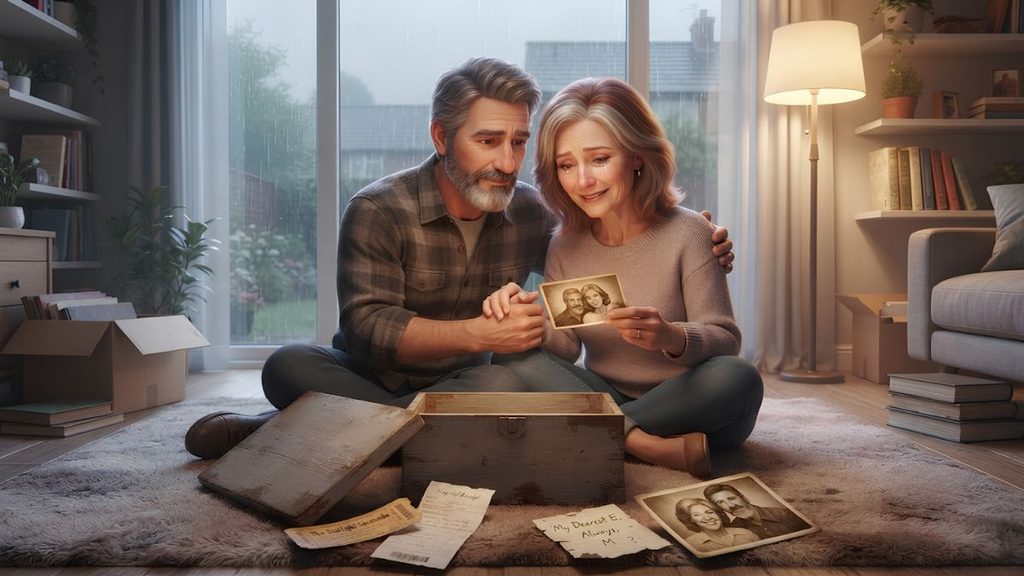
The Box of Things We Never Said
Characters: Eleanor and Matthew
The wooden box had been sitting in the back of the closet for almost nine years.
Eleanor knew that because she remembered buying it.
She and Matthew had been living in their first apartment then, a small place with thin walls, uneven floors, and windows that rattled whenever the wind became too strong.
They had been young.
They had been hopeful.
And they had been completely convinced that loving each other would make everything easy.
It hadn’t.
Love had made many things beautiful.
But it had not made them immune to misunderstandings, exhaustion, fear, disappointment, or the ordinary difficulties of sharing a life with another person.
Over the years, they had learned.
Slowly.
Sometimes painfully.
Mostly together.
And somehow, the wooden box had followed them through every home.
It had moved from the first apartment to the second.
From the second to the house they eventually bought.
Nobody knew exactly what was inside.
Not even Eleanor.
Until a rainy Saturday afternoon when she decided to clean the closet.
“I don’t understand how we have accumulated so much stuff,” Eleanor said.
Matthew was sitting on the floor surrounded by old books.
“You keep everything.”
“I do not.”
He held up a receipt.
“You kept this.”
“That’s different.”
“How?”
“I don’t know.”
Matthew smiled.
Eleanor opened another box.
Old photographs.
Christmas decorations.
A broken lamp.
A scarf neither of them remembered buying.
Then, at the back of the closet, she found the wooden box.
She pulled it forward.
Dust covered the lid.
She wiped it with her sleeve.
Matthew looked over.
“What is that?”
“I don’t know.”
He laughed.
“It’s yours.”
“It might be yours.”
“You bought it.”
Eleanor looked at him.
“How do you remember that?”
“You said it was beautiful.”
She smiled.
“I probably did.”
She placed the box between them.
There was no lock.
Just a small brass clasp.
Eleanor opened it.
And immediately became quiet.
The first thing she saw was a movie ticket.
Old.
Faded.
Almost colorless.
She picked it up.
“What is this?”
Matthew looked.
Then his expression changed.
“Oh.”
Eleanor looked at him.
“You remember?”
“Yes.”
She turned the ticket over.
A date was printed on it.
Eight years earlier.
They had gone to see a movie.
It had been their first serious argument.
Not their first disagreement.
Their first serious argument.
They had fought about something neither could remember clearly anymore.
But Eleanor remembered the feeling.
She had felt unheard.
Matthew had felt misunderstood.
They had sat in the car afterward without speaking.
Neither had known how to make the first move.
Eventually, Matthew had said:
“I’m sorry.”
Eleanor had replied:
“For what?”
“I don’t know yet.”
She laughed despite herself.
Then they talked.
For hours.
The movie had been forgotten.
The argument had remained.
Eleanor placed the ticket on the floor.
“I didn’t know this was here.”
“Neither did I.”
She looked at him.
“Why would we keep it?”
Matthew shrugged.
“Maybe we didn’t mean to.”
Under the ticket was a receipt.
Eleanor picked it up.
A hospital receipt.
She stared at the date.
Her face softened.
“I remember this.”
Matthew nodded.
It had been five years earlier.
Eleanor had been sick.
It had not been life-threatening.
But it had been frightening.
Matthew had spent the entire night beside her hospital bed.
He had brought her water.
He had called her mother.
He had sat awake even after Eleanor fell asleep.
The receipt represented a difficult night.
But when Eleanor looked at it now, she remembered something else.
Matthew had been afraid too.
She had been so focused on being frightened that she had not realized it.
“You were scared,” she said.
Matthew looked down.
“Very.”
“You never told me.”
“I didn’t want you to worry.”
Eleanor touched his hand.
“I was already worried.”
“I know.”
“Why didn’t you tell me?”
He smiled faintly.
“I thought I was supposed to be the calm one.”
Eleanor laughed softly.
“You were terrible at pretending.”
“I know.”
They sat quietly.
The receipt remained between them.
The next object was a folded piece of paper.
Eleanor unfolded it carefully.
She recognized her own handwriting.
Her heart tightened.
It was a note.
A very short one.
I don’t know how to say this without making it worse. I just feel lonely tonight.
She read it twice.
Matthew looked away.
“You wrote that.”
“I know.”
“Do you remember?”
She nodded.
It had been one of the loneliest evenings of their marriage.
Matthew had been working constantly.
Eleanor had been overwhelmed.
They had shared the same house but barely shared a conversation.
She had written the note and left it on the kitchen counter.
Then she had gone to bed.
The next morning, Matthew had found it.
He had come into the bedroom and sat beside her.
They had talked.
Not easily.
Not perfectly.
But honestly.
“I remember that night,” Matthew said.
“So do I.”
“I felt terrible.”
“I know.”
“I thought I was providing for us.”
“You were.”
“But I didn’t realize I was disappearing.”
Eleanor looked at him.
“I didn’t realize how lonely you were either.”
Matthew nodded.
The room was quiet.
Then he said:
“I wish we had known how to say things earlier.”
Eleanor smiled sadly.
“Maybe we were learning.”
At the bottom of the box was a photograph.
Eleanor picked it up.
She almost dropped it.
It showed the two of them sitting on the steps outside their first apartment.
They were not smiling.
They looked exhausted.
Eleanor remembered the day.
They had been close to breaking up.
Not because they stopped loving each other.
Because they had become tired of hurting each other.
They had spent months misunderstanding one another.
Arguments had become routine.
Silence had become easier than conversation.
They had talked that evening about ending the relationship.
Eleanor remembered packing a small bag.
Matthew remembered standing beside the door.
Neither had wanted to leave.
But neither knew how to stay.
Eventually, Eleanor had said:
“I don’t want to keep doing this.”
Matthew had answered:
“Neither do I.”
There had been a long silence.
Then he had said:
“But I don’t want to stop choosing you.”
That sentence had changed everything.
They had not magically solved their problems.
They had gone to counseling.
They had learned to apologize.
They had learned to listen.
They had learned that being right was sometimes less important than being kind.
They had learned that forgiveness was not pretending something had never happened.
It was deciding that something that happened would not control everything that came afterward.
Eleanor looked at the photograph.
“We looked so unhappy.”
Matthew nodded.
“We were.”
“Do you ever regret staying?”
He looked at her.
“Never.”
She smiled.
“Not even then?”
“Especially not then.”
They placed all four objects on the floor.
The movie ticket.
The hospital receipt.
The lonely note.
The photograph.
For a long time, neither spoke.
The rain tapped gently against the windows.
The house smelled faintly of coffee.
Dust floated through a beam of afternoon light.
Finally, Eleanor said:
“We kept all the difficult things.”
Matthew smiled.
“Apparently.”
“Where are the happy things?”
He looked around.
“Everywhere else.”
She laughed.
Maybe that was true.
Their happy memories were on shelves.
In photo albums.
On walls.
In their phones.
In stories they told friends.
The difficult memories were different.
They had been placed in a box.
Perhaps because they were harder to look at.
Perhaps because they had never known what to do with them.
Or perhaps because some memories need time before they can be understood.
Eleanor picked up the movie ticket.
“I was angry with you that night.”
“I know.”
“I thought you didn’t care about what I wanted.”
“I did care.”
“I know that now.”
Matthew looked at her.
“What changed?”
“You listened.”
He nodded.
“And you explained.”
“I should have done that sooner.”
“So should I.”
She smiled.
“Forgiveness works better when both people participate.”
Matthew laughed.
“That sounds like something you read in a book.”
“Maybe.”
She picked up the hospital receipt.
“I remember being scared.”
“I remember.”
“But I don’t remember seeing how scared you were.”
Matthew was quiet.
“I was terrified.”
Eleanor took his hand.
“You didn’t have to hide that.”
“I know that now.”
They sat closer.
Sometimes people believed strength meant hiding fear.
But Eleanor had learned that real strength could also mean saying:
“I’m frightened.”
“I don’t know what to do.”
“I need you.”
“I need help.”
There was no weakness in those words.
Only honesty.
Then she picked up the note.
“I wish I had told you instead of leaving this on the counter.”
Matthew smiled.
“It was dramatic.”
“I was dramatic.”
“You still are.”
She pushed his shoulder.
He laughed.
“But it worked.”
“It did.”
“That’s what matters.”
Eleanor looked at him.
“What did you feel when you found it?”
Matthew thought.
“That I had missed something important.”
“What?”
“You.”
She became quiet.
He continued.
“I thought I was working hard for our future. But I had forgotten to be present in our present.”
Eleanor squeezed his hand.
“I think we both did that sometimes.”
“I know.”
Finally, the photograph.
Eleanor looked at it for a long time.
“That was the closest we ever came.”
“Yes.”
“Did you know we would make it?”
Matthew shook his head.
“No.”
“Me neither.”
She looked at the photograph again.
“Then why did we?”
He thought about it.
“Because we stopped asking whether the relationship was easy.”
“And what did we ask?”
“Whether it was worth learning how to do better.”
Eleanor smiled.
That was the answer.
Not perfection.
Not certainty.
Not a promise that nothing painful would ever happen again.
Just the willingness to learn.
Again and again.
The afternoon slowly became evening.
They had forgotten about cleaning.
The closet remained half-empty.
The boxes were still scattered around the room.
But neither cared.
They made tea.
Then they returned to the wooden box.
“I think we should keep it,” Eleanor said.
Matthew nodded.
“Definitely.”
“But maybe we should add something.”
“What?”
Eleanor stood and walked to the bookshelf.
She returned with a small photograph.
It had been taken only a month earlier.
They were standing in their kitchen.
Matthew was holding a birthday cake.
The cake was slightly crooked.
Eleanor was laughing.
They placed the photograph inside the box.
Matthew looked at it.
“That’s a happy one.”
“Yes.”
“Why put it with the difficult ones?”
Eleanor smiled.
“Because it’s part of the same story.”
Matthew understood.
Their marriage was not a collection of perfect days.
It was everything.
The laughter.
The arguments.
The apologies.
The fear.
The forgiveness.
The quiet mornings.
The difficult nights.
The moments when they almost gave up.
The moments when they chose to stay.
The ordinary days that nobody photographed.
The small gestures that nobody else saw.
All of it mattered.
Before closing the box, Eleanor found one more empty piece of paper.
She looked at Matthew.
“What should we write?”
He thought.
Then he said:
“Something we never said.”
Eleanor smiled.
She handed him a pen.
Matthew wrote first.
I was scared more often than I admitted.
He passed the paper to her.
Eleanor added:
I loved you even when I didn’t know how to show it.
Matthew read it.
Then he added:
I’m glad we learned.
Eleanor wrote beneath it:
Me too.
They folded the paper.
Placed it inside.
Then closed the box.
That night, Eleanor and Matthew sat together on the sofa.
The house was quiet.
The rain had stopped.
The streets outside reflected the lights of passing cars.
Matthew rested his head against the back of the sofa.
Eleanor leaned against him.
“Do you think we’re done learning?”
He smiled.
“I hope not.”
“Why?”
“Because if we’re still learning, we’re still growing.”
She nodded.
After a moment, she said:
“I’m glad we didn’t throw the box away.”
“So am I.”
“What do you think it means?”
Matthew looked toward the closet.
“I think it means we survived things we once thought might break us.”
Eleanor smiled.
“Not just survived.”
“What then?”
“We became different because of them.”
Matthew took her hand.
They sat quietly.
There was nothing left to explain.
Nothing left to fix that night.
The past could remain where it belonged.
Not forgotten.
Not feared.
Simply understood.
The wooden box would go back into the closet.
Years from now, perhaps they would open it again.
Maybe there would be more difficult memories.
Maybe more happy ones.
Maybe another photograph.
Another note.
Another little reminder of something they had once struggled to understand.
And perhaps that was okay.
Because love was not the absence of difficult moments.
Love was what people did with those moments.
Whether they listened.
Whether they apologized.
Whether they forgave.
Whether they grew.
Whether they chose kindness when anger felt easier.
Whether they reached for each other’s hands after the argument was over.
Whether they stayed curious about one another even after years together.
Eleanor looked at Matthew.
“Goodnight.”
“Goodnight.”
She turned off the lamp.
The room became softly dark.
Outside, the last drops of rain fell from the trees.
Inside, two people sat close together.
They had once been strangers.
Then lovers.
Then partners.
Then, through years of ordinary life, they had become something deeper.
Two people who knew that love was not about never hurting each other.
It was about learning how to heal.
And sometimes, the strongest love stories were not built from perfect memories.
They were built from difficult ones that had been met with courage.
Arguments that ended in understanding.
Loneliness that led to honesty.
Fear that was answered with presence.
Mistakes that became lessons.
And moments when two people could have walked away, but instead looked at each other and quietly said:
Let’s try again.
The box remained closed.
The past was safe.
Tomorrow would bring another ordinary day.
And for Eleanor and Matthew, that was enough.
Because after everything they had learned, they knew something simple.
They did not need a perfect love story.
They only needed one that was honest.
One that allowed them to grow.
One that gave them reasons to forgive.
And one that, at the end of every difficult day, still gave them a reason to reach for each other’s hands.
Theme: Forgiveness, vulnerability, resilience, choosing each other through difficult moments.
6. Adventure Long Bedtime Story

The Lighthouse at the End of the Road
Characters: Emily and Thomas
Emily had always believed that the best places were the ones you were not looking for.
Thomas, on the other hand, preferred maps.
He liked knowing where a road began, where it ended, and how long it would take to get there. He carried folded maps in his backpack even when his phone had a perfectly good navigation app.
Emily liked turning down roads simply because they looked interesting.
So, naturally, their coastal holiday involved a little disagreement.
“I think we’re supposed to stay on the main road,” Thomas said.
Emily looked through the windshield.
The road ahead was narrow, winding between tall grass and low stone walls. Beyond it, she could see flashes of blue where the sea appeared between the hills.
“That road looks much more interesting.”
Thomas glanced at his map.
“It isn’t on here.”
“Exactly.”
He smiled.
“That’s not normally a reason to drive somewhere.”
“For me, it is.”
They had been staying in the seaside village of Bellweather for four days. It was a small place with white cottages, blue doors, a harbor filled with fishing boats, and a long promenade where people walked in the evenings.
They had spent the first few days doing everything tourists were expected to do.
They visited the harbor.
They ate fish and chips beside the water.
They climbed the old church tower.
They bought postcards.
They walked along the beach until the sun disappeared behind the cliffs.
But that morning, they had decided to explore the countryside beyond the village.
They had no particular destination.
And that was how they found the road.
It appeared just after a bend.
There was no sign pointing toward it.
Only an old wooden post stood beside the entrance, its paint almost completely worn away.
Emily leaned forward.
“Look.”
Thomas stopped the car.
“What?”
“There’s something carved into the post.”
They got out.
The carving was faint, but they could make out three words.
KEEP WALKING WEST.
Thomas looked at Emily.
“That sounds suspicious.”
Emily smiled.
“It sounds promising.”
They left the car beside the stone wall and continued on foot.
The road was barely wide enough for two people walking side by side. Grass grew through cracks in the old surface, and wildflowers leaned into the path.
The farther they walked, the quieter everything became.
The village disappeared behind them.
Soon they could hear only the wind and the sea.
After twenty minutes, Emily noticed something above the cliffs.
A narrow white tower stood against the sky.
She stopped.
“Thomas.”
He followed her gaze.
There, on a distant headland, was a lighthouse.
Tall.
White.
Silent.
Thomas immediately unfolded his map.
“There isn’t supposed to be a lighthouse there.”
Emily laughed softly.
“Apparently, the lighthouse didn’t get your map.”
They continued walking.
The road climbed gently until they reached an old iron gate.
Beyond it stood a small stone cottage.
Its windows were dusty, but the roof was still mostly intact.
A rusted sign beside the door read:
LIGHTHOUSE KEEPER’S COTTAGE
Emily looked toward the lighthouse.
“Do you think anyone lives here?”
Thomas shook his head.
“Probably not.”
The cottage door was slightly open.
They hesitated.
“Should we go inside?” Emily asked.
Thomas looked at the empty path behind them.
“We should probably not.”
Emily nodded.
They stood quietly.
Then the wind pushed the door open another few inches.
A strange feeling passed through Emily.
Not fear.
Something closer to curiosity.
She stepped inside.
Thomas followed.
The cottage smelled of old wood and salt.
There was a small fireplace, a wooden table, two chairs, a narrow bed, and shelves filled with empty jars.
Everything looked as though someone had simply walked out one afternoon and never returned.
On the table sat an old journal.
Thomas carefully picked it up.
The leather cover was cracked.
There was no name on it.
He opened the first page.
Most of the writing had faded, but one sentence was still clear.
If you have found this place, you have already done what most people never do. You followed a road without knowing where it would lead.
Emily smiled.
“Keep reading.”
Thomas turned the page.
The journal belonged to a lighthouse keeper named Arthur Bell.
He had worked at the lighthouse for thirty-two years.
His entries described storms, passing ships, visiting fishermen, and quiet mornings when the sea looked almost completely still.
But several pages contained something different.
Arthur wrote about a place called the High View.
According to the journal, it was a hidden viewpoint above the sea.
From there, he could see the lighthouse, the village, and the distant islands.
But the path to the viewpoint was difficult to find.
Arthur had left clues for anyone curious enough to search.
Thomas became interested immediately.
“Now this,” he said, “is something I can get behind.”
Emily laughed.
“You have a map.”
“I have a map.”
“Does your map show the High View?”
Thomas unfolded it.
“No.”
“Then we’re equal.”
They continued reading.
The first clue was simple.
When the road ends, look for the garden that remembers spring.
They stepped outside.
The road ended at the cottage.
Beyond it was only grass and cliff.
They searched the area.
Nothing.
Then Emily noticed an opening between two stone walls.
They followed it.
Behind the cottage was a forgotten garden.
It was almost completely overgrown.
Wild roses climbed over an old wooden arch.
Lavender grew beside broken flower beds.
A stone fountain stood in the center, dry and covered with moss.
Emily walked slowly through it.
“Look.”
Near the fountain stood a small stone bench.
Carved into its surface were more words.
FOLLOW THE FLOWERS THAT FACE THE SEA.
They looked around.
Several patches of wild flowers grew throughout the garden.
Most faced different directions.
But one line of pale yellow flowers seemed to form a path toward the far wall.
They followed it.
Behind a bush, they discovered a narrow opening.
Beyond it was a descending path.
Thomas looked at Emily.
“Well.”
She smiled.
“Keep walking.”
The path led toward the cliffs.
The wind became stronger.
Below them, waves moved slowly against the rocks.
The sea was enormous.
Blue and silver beneath the afternoon sun.
Emily stopped several times just to look.
Thomas did too.
Neither felt the need to speak.
Eventually, they reached a small wooden bridge crossing a narrow stream.
On the other side stood another stone marker.
This one carried a single sentence.
THE SEA SHOWS THE WAY WHEN THE LAND HIDES IT.
Thomas frowned.
“What does that mean?”
Emily looked toward the water.
The tide was coming in.
Far below, the waves moved around a cluster of dark rocks.
Something white flashed between them.
“There.”
Thomas followed her gaze.
A piece of white stone stood on the cliffside below.
They climbed carefully down a winding path.
At the bottom, they discovered an old stone staircase.
It led upward again.
At the top was a narrow coastal trail.
They followed it.
The trail twisted around the cliff.
Sometimes it disappeared beneath grass.
Sometimes they had to step carefully around fallen stones.
But the view grew more beautiful with every turn.
The lighthouse appeared behind them.
The village looked tiny in the distance.
And far beyond the horizon, several islands floated like faint shadows.
After nearly an hour, Emily saw something ahead.
A wooden gate.
Beyond it stood a small grassy plateau.
They had reached the High View.
Emily walked through the gate.
She stopped immediately.
“Thomas.”
He came beside her.
Neither spoke.
The viewpoint was breathtaking.
The lighthouse stood below them on the edge of the cliff.
The sea stretched endlessly beyond it.
The village looked peaceful in the distance.
Clouds moved slowly across the sky.
And the setting sun had begun turning the water gold.
Thomas took off his backpack and sat on the grass.
“I understand why Arthur kept this place secret.”
Emily sat beside him.
“Maybe he didn’t want it to become crowded.”
They opened the journal again.
The final pages contained Arthur’s last entries.
He wrote about retiring from the lighthouse.
He wrote about leaving Bellweather.
And then, on the final page, he wrote:
There are many treasures people search for because they believe they can own them. Gold. Silver. Old coins. Precious stones.
But there are other treasures that become more valuable when they are shared.
If you have followed all my clues, you have reached the place I loved most.
Look beneath the stone where the sea first appears beyond the western cliff.
Emily looked around.
At the western edge of the plateau stood a large flat stone.
They walked toward it.
Thomas knelt.
There was a small metal box beneath the stone.
It was old but carefully sealed.
Inside they found several things.
A bundle of letters.
A small brass compass.
A collection of black-and-white photographs.
And one final note.
Emily opened it carefully.
The handwriting was Arthur’s.
To whoever found this place,
I hope you came here because you were curious.
Curiosity is one of the quietest forms of courage. It asks us to leave the familiar road and discover what might be waiting beyond it.
The compass belonged to my father. The photographs show this coast as it looked many years ago. The letters are from people who passed through Bellweather and found something important here.
Please take one thing with you. Leave the rest for the next traveler.
And if you can, add something of your own.
Emily looked at Thomas.
“One thing.”
Thomas examined the box.
“What should we take?”
Emily picked up the brass compass.
Then she shook her head.
“No.”
She looked at the photographs.
“Maybe one of these.”
Thomas smiled.
“You choose.”
Emily selected a photograph showing the lighthouse during a winter storm.
Then she looked at the letters.
“We should leave something too.”
Thomas reached into his backpack.
He pulled out a small notebook.
They had been using it during their holiday to write down places they wanted to remember.
Emily opened to a blank page.
She wrote:
We came looking for a lighthouse that wasn’t on our map.
We found a garden, a hidden path, a beautiful view, and a story left behind by someone who believed curiosity mattered.
We were here together.
Thomas added one sentence beneath hers.
And we’re glad we kept walking.
They placed the notebook inside the box.
Then they carefully closed it and returned it beneath the stone.
The sun was lower now.
They sat together on the grass.
For a while, they simply watched the lighthouse.
Its white tower stood quietly against the evening sky.
“Do you think Arthur ever knew someone would find this?” Thomas asked.
“Maybe.”
“What if nobody had?”
Emily looked at the old lighthouse.
“Then it would still have been beautiful.”
Thomas nodded.
That answer felt right.
They stayed until the first light appeared in the lighthouse window.
Then they began the journey back.
The trail seemed different in the evening.
Softer.
The flowers moved in the wind.
The sea reflected the fading sunlight.
When they reached the cottage, Emily looked back.
The lighthouse beam slowly swept across the water.
Once.
Then again.
A quiet rhythm in the darkness.
They walked back through the forgotten garden.
At the edge of the old road, Thomas unfolded his map.
Emily laughed.
“What are you doing?”
“I’m marking something.”
He drew a small circle on the map.
“You’re adding the lighthouse?”
“Yes.”
“Even though we don’t know its official name?”
Thomas smiled.
“We know enough.”
They reached the car as twilight settled over the hills.
Before getting inside, Emily looked toward the lighthouse one last time.
It was now only a small white shape in the distance.
“Do you know what I like most?” she asked.
“What?”
“We didn’t find treasure.”
Thomas smiled.
“We found something better.”
They drove back toward Bellweather.
Neither of them spoke much.
The road seemed quieter than before.
But Emily kept thinking about Arthur’s words.
Curiosity is one of the quietest forms of courage.
She wondered how many beautiful places existed simply because someone had been willing to wonder what was beyond the next turn.
When they reached the village, the harbor lights were glowing.
They parked near the water and walked along the promenade.
The evening was cool.
Boats moved gently against their ropes.
Somewhere nearby, someone was playing a quiet song on a piano.
Thomas slipped his hand into Emily’s.
“Tomorrow,” he said, “we should probably follow the tourist map.”
Emily smiled.
“Probably.”
They walked a little farther.
Then Thomas looked at her.
“Unless you see another road.”
Emily laughed.
“Then we’ll see where it goes.”
And far beyond the village, beyond the cliffs and the darkening sea, the lighthouse continued its slow and patient work.
Its beam moved across the water.
Guiding ships.
Marking the shore.
Keeping watch over the quiet coast.
And somewhere beneath an old stone on a grassy cliff, a small wooden box waited patiently for another curious traveler.
Someone who might one day find an old road.
Someone who might wonder where it led.
Someone willing to keep walking.
Theme: Exploration, discovery, old secrets, beautiful coastal landscapes.
7. Fantasy Long Bedtime Story

The Kingdom Beneath the Sleeping City
Characters: Isabelle and Adrian
At exactly midnight, when the last bus had disappeared from the avenue and the lights in most apartment windows had gone dark, the city changed.
During the day, it was ordinary.
People hurried along crowded sidewalks.
Cars filled the streets.
Cafés opened their doors.
Bicycles moved through narrow lanes.
Office buildings hummed with elevators and telephones.
Children went to school, workers went to work, and shopkeepers arranged their windows for another busy morning.
But at midnight, something happened that almost nobody knew about.
The city went to sleep.
And beneath it, another city woke up.
It had always been there.
Waiting.
Listening.
Dreaming.
Isabelle discovered it on a Tuesday night.
She had been walking home after finishing a late shift at the library. The streets were unusually quiet, and a light rain had begun falling.
She took a shortcut through an old building she had visited many times before.
The building was nearly two hundred years old.
It had a grand staircase, faded wallpaper, tall windows, and wooden floors that creaked whenever someone walked across them.
Isabelle reached the staircase.
Then she heard something.
A tiny sound.
Like a bell.
She stopped.
The sound came again.
Ting.
She looked around.
There was nobody there.
Then she noticed something beneath the staircase.
A small golden door.
It was no larger than the door of a dollhouse.
Isabelle had walked past that staircase hundreds of times.
She had never seen it before.
She crouched down.
The door had a tiny brass handle.
Above it was a symbol shaped like a crescent moon surrounded by seven stars.
Isabelle touched the handle.
It turned.
The door opened.
Warm golden light spilled onto the floor.
She stared into the opening.
Beyond it was not a wall.
There was a staircase.
A very long staircase.
It descended into darkness.
Isabelle should have closed the door.
Instead, she stepped through.
The moment she did, the little golden door disappeared behind her.
She stood on the staircase.
The air smelled of rain, flowers, and something sweet she couldn’t identify.
Far below, she could see lights.
Thousands of them.
They moved like stars.
Isabelle slowly descended.
The staircase seemed to go on forever.
But after several minutes, she heard music.
Soft music.
Like someone playing a music box somewhere far away.
Then she reached the bottom.
And stopped.
Before her was a kingdom.
A real kingdom.
It stretched beneath the city like a secret dream.
Buildings with curved golden roofs stood beside glowing rivers.
Tiny bridges crossed streams of blue light.
Trees with silver leaves grew beside winding paths.
Hundreds of clocks hung from towers, walls, trees, and bridges.
Some were enormous.
Others were smaller than teacups.
And everywhere Isabelle looked, strange but friendly creatures moved through the streets.
There were rabbits wearing tiny waistcoats.
Foxes carrying lanterns.
Birds with feathers that shimmered like moonlight.
Little people with round spectacles and long coats.
And creatures Isabelle couldn’t name at all.
One of them noticed her.
It was a small fox with golden fur.
It walked toward her carrying a lantern.
“You are awake,” it said.
Isabelle blinked.
“You can talk.”
The fox tilted its head.
“So can you.”
“I suppose that’s true.”
The fox smiled.
“My name is Rowan.”
“I’m Isabelle.”
“I know.”
Isabelle stared.
“How?”
Rowan pointed toward the kingdom.
“We know the names of people who still wonder.”
Isabelle looked around.
“Where am I?”
Rowan raised the lantern.
“Below your city.”
“How?”
“That is a very large question.”
“And you have an answer?”
“Several.”
Isabelle laughed.
The fox turned and began walking.
“Come. The kingdom has been waiting.”
They walked through the streets.
Isabelle saw things she could hardly believe.
A bakery where the bread floated gently above the ovens.
A garden where flowers opened only when someone told them a happy memory.
A river filled with tiny glowing boats.
A clockmaker’s shop where the clocks did not measure hours.
They measured moments people wished could last longer.
There was a clock for first kisses.
One for childhood summers.
One for rainy afternoons.
One for the feeling of coming home.
Isabelle stood in front of it for a long time.
“What is this place?” she whispered.
Rowan looked up at her.
“The Kingdom of Reverie.”
“Why have I never heard of it?”
“Because humans stopped looking.”
They continued walking.
Eventually, Rowan brought Isabelle to a great stone palace.
Its walls were covered in vines.
Above the entrance was the same crescent moon symbol she had seen on the little golden door.
Inside, the palace was warm and quiet.
A woman sat beside a large fireplace.
She appeared elderly, but her eyes were bright.
Her hair was silver.
She wore a deep blue dress covered with tiny stars.
“Isabelle,” she said.
Isabelle approached carefully.
“Who are you?”
“I am Queen Aurelia.”
“Am I dreaming?”
The queen smiled.
“Not exactly.”
“Then how is this possible?”
Aurelia pointed toward a window.
Through it, Isabelle could see the sleeping city far above.
“Every city has a hidden kingdom.”
“Every city?”
“Every place where people once believed that impossible things might be possible.”
Isabelle thought about that.
“What happened to yours?”
The queen’s smile faded.
“It is dying.”
Isabelle looked around.
The kingdom still appeared beautiful.
But now she noticed something.
Some lights were dim.
Some flowers were closed.
Several clocks had stopped.
Even the glowing river seemed darker than it should have been.
“Why?”
Aurelia looked toward the city above.
“People stopped dreaming.”
“People still dream.”
“Of course they do. But fewer people dream while awake.”
Isabelle didn’t understand.
Aurelia explained.
“Children once imagined castles in clouds. Adults imagined journeys they had never taken. Artists imagined worlds that did not exist. Old people remembered dreams they had once been too afraid to follow.”
She looked at the fading lights.
“People still dream at night. But they have begun forgetting how to wonder during the day.”
“And that affects this place?”
“It created this place.”
The queen touched the arm of her chair.
“Every time someone imagines something beautiful, a light appears here.”
Isabelle looked toward the darkening kingdom.
“And when people stop?”
“The lights disappear.”
Aurelia stood.
“There is one light remaining.”
She led Isabelle through a long hallway.
At the end was a circular room.
In the center stood a small glass sphere.
Inside it burned a tiny golden flame.
“The First Light,” Aurelia said.
Isabelle approached.
It flickered.
“Can it be restored?”
“Yes.”
“How?”
The queen looked at her.
“Someone must remind the city how to wonder.”
Isabelle swallowed.
“Me?”
“You found the door.”
“That was an accident.”
“Wonder often begins that way.”
The queen handed her a small silver key.
“Come back tomorrow night.”
“What am I supposed to do?”
“Bring someone who still believes.”
The next evening, Isabelle told Adrian.
Adrian was her closest friend.
He was practical, patient, and generally suspicious of anything that could not be explained.
When Isabelle told him about the golden door, he listened carefully.
When she finished, he was silent.
“So,” he said, “there is a secret kingdom underneath the city.”
“Yes.”
“With talking foxes.”
“Yes.”
“Magical clocks.”
“Yes.”
“Glowing rivers.”
“Yes.”
“And a queen who says the kingdom is dying because people have forgotten how to wonder.”
“Exactly.”
Adrian considered this.
Then he asked:
“When do we leave?”
Isabelle smiled.
“Midnight.”
At eleven fifty-nine, they stood beneath the staircase.
At exactly twelve, the golden door appeared.
Adrian stared.
“I believe you now.”
They entered.
Rowan was waiting.
“You brought someone.”
“This is Adrian.”
The fox looked at him carefully.
“Do you still wonder?”
Adrian hesitated.
“I think I used to.”
“Then we have work to do.”
They followed Rowan into the kingdom.
That night, Isabelle and Adrian learned about the fading lights.
Each light was connected to something people above had once imagined.
A forgotten song.
A dream of traveling.
A story someone wanted to write.
A garden someone hoped to grow.
A friendship someone wished to repair.
A person who wanted to begin again.
The lights did not require extraordinary dreams.
They needed sincere ones.
Simple ones.
Human ones.
The kingdom had been created by them.
And now it was fading because people had begun believing that dreams had to be practical to matter.
Isabelle and Adrian decided to help.
They could not force anyone to dream.
So they searched for something else.
A forgotten source of wonder.
The queen told them about an old library hidden beneath the kingdom.
“It contains the first dreams ever brought here,” she said.
“If you find the original story, you may discover how to relight the First Light.”
Isabelle and Adrian entered the library.
It was enormous.
Shelves curved into darkness.
Books floated through the air.
Some whispered.
Some laughed.
Some changed their titles whenever Isabelle looked away.
They searched for hours.
Eventually, Adrian found a small book with no title.
He opened it.
The pages were blank.
“That’s strange.”
Isabelle touched the first page.
Words appeared.
What would you imagine if nobody told you it was impossible?
They looked at each other.
Adrian smiled.
“I think I know.”
He closed his eyes.
For a moment, he said nothing.
Then he described a place.
A house beside a quiet sea.
A garden filled with lemon trees.
A wooden table where friends gathered for long dinners.
A room with shelves of books.
A small boat tied to the shore.
A place where nobody hurried.
As he spoke, a tiny light appeared above them.
Isabelle looked up.
Then she understood.
The kingdom did not need grand dreams.
It needed people to remember that imagination was still theirs.
She began describing her own dream.
A library open all night.
A garden on its roof.
Children reading beneath trees.
Old people telling stories.
Music playing in the rain.
People entering because they were curious and leaving because they had discovered something wonderful.
Another light appeared.
Then another.
Then dozens.
Across the kingdom, lights began glowing.
The river brightened.
The flowers opened.
The clocks began ticking.
The distant towers shimmered.
But the First Light was still weak.
They returned to the palace.
Queen Aurelia was standing beneath the great dome.
“You found it.”
“The answer?”
“The beginning.”
The queen pointed upward.
Above the city, thousands of lights were appearing.
People were dreaming.
Somewhere, an artist had begun painting.
Someone had opened an old notebook.
A child was building a cardboard castle.
A man was planning a journey.
A woman was finally learning the piano.
Someone had called an old friend.
Someone else had looked out of a window and wondered what might exist beyond the horizon.
Every small act of imagination sent another light into the kingdom.
The First Light grew brighter.
Then it suddenly flared.
Golden light rushed through the palace.
Across the kingdom, every lamp ignited.
The glowing river became brilliant blue.
The trees shimmered.
The clocks rang together.
The tiny creatures cheered.
Rowan jumped into the air.
“We’re alive!”
Isabelle laughed.
Adrian looked at the kingdom.
“It was never really gone.”
Queen Aurelia nodded.
“No.”
She looked toward the sleeping city.
“It was only waiting to be remembered.”
Before dawn, Isabelle and Adrian returned to the staircase.
Rowan walked with them.
“Will we see you again?” Isabelle asked.
“You will.”
“When?”
“Whenever you wonder.”
The golden door appeared.
Isabelle looked back.
The kingdom was glowing behind them.
She suddenly realized something.
“Can other people find this place?”
Rowan smiled.
“They always could.”
Then the door closed.
The next morning, the city seemed different.
Nothing had physically changed.
The buses still ran.
People still hurried to work.
Cafés still opened.
Cars still filled the streets.
But Isabelle noticed something.
People seemed to be looking up more often.
A man stood outside a shop sketching something in a notebook.
A woman was teaching her daughter a song.
Two elderly friends sat together planning a trip.
A child was drawing a castle on the pavement with chalk.
And in the library, Isabelle found something waiting on her desk.
A small golden envelope.
Inside was a note.
The kingdom is brighter tonight.
She smiled.
That evening, Adrian called.
“Do you remember the house beside the sea?”
“Of course.”
“I’ve been thinking about it.”
“The dream?”
“Yes.”
“Me too.”
They talked for hours.
Not about practical plans.
Not about schedules.
Not about things that had to happen.
They talked about places they wanted to see.
Books they wanted to write.
Gardens they wanted to grow.
Meals they wanted to share.
Things they wanted to learn.
The kind of life they might create if they stopped asking whether every dream was sensible.
At midnight, beneath the old staircase, the golden door appeared again.
This time, Isabelle did not enter.
She simply smiled.
She knew the kingdom was awake.
Far below the sleeping city, rivers glowed.
Flowers opened.
Clocks measured beautiful moments.
Friendly creatures carried lanterns through quiet streets.
And Queen Aurelia stood on the palace balcony, watching thousands of lights rise from the world above.
The kingdom would never remain bright forever.
Dreams faded.
People forgot.
Life became busy.
That was natural.
But now the kingdom had remembered something important.
Wonder did not need to be permanent.
It only needed to be rediscovered.
Again and again.
Whenever someone paused to imagine.
Whenever someone chose hope.
Whenever someone believed that tomorrow could hold something beautiful.
And somewhere beneath the city, a tiny golden door waited beneath an old staircase.
Waiting for the next curious person.
Waiting for the next dream.
Waiting for someone willing to open it.
Theme: Imagination, dreams, hidden worlds, love, restoring wonder.
8. Long-Distance Long Bedtime Story
The Apartment We Built in Our Dreams
Characters: Lily and Ethan
Every night at nine o’clock, Lily and Ethan built a home.
They did not own it.
They had never seen it.
They did not even live in the same country.
But every evening, when the sun was beginning to disappear outside Lily’s window and the streets were becoming quiet outside Ethan’s apartment, they opened their phones, started a video call, and entered the apartment they had created together.
It began as a joke.
Then it became a habit.
Eventually, it became the place where they met.
Lily lived in a small city surrounded by hills.
Ethan lived thousands of kilometers away in a busy coastal city.
Between them were oceans, time zones, expensive flights, different work schedules, and the uncomfortable reality that neither of them could afford to move yet.
They had talked about living together many times.
They had imagined it.
They had even looked at apartment listings.
But whenever they calculated the costs, the dream seemed to move farther away.
Rent.
Moving expenses.
Furniture.
Visas.
Travel.
Deposits.
Everything seemed to require money they did not yet have.
One evening, after another conversation about the future, Lily sighed.
“I wish we could just have an apartment.”
Ethan smiled.
“We could.”
“Really?”
“In our imagination.”
She laughed.
“That doesn’t count.”
“Why not?”
“Because imaginary rent is suspiciously affordable.”
Ethan nodded seriously.
“Fine. I’ll be the landlord.”
“You would be terrible at it.”
“Why?”
“You’d probably charge me in hugs.”
“That sounds reasonable.”
Lily smiled.
“Okay.”
“Okay what?”
“Let’s build one.”
And that was how the apartment began.
The first night, they chose the location.
Lily wanted a quiet neighborhood.
Ethan wanted somewhere close to a train station.
Lily wanted trees.
Ethan wanted cafés.
They compromised.
Their imaginary apartment would be on a quiet street lined with trees, ten minutes from a train station and surrounded by small cafés.
“Does it have a balcony?” Lily asked.
“Obviously.”
“Big?”
“Very.”
“Enough for two chairs?”
“Four.”
“Why four?”
“Friends.”
Lily smiled.
“Good answer.”
The next night, they designed the bedroom.
Lily wanted a large window.
Ethan wanted curtains that blocked out morning sunlight.
Lily wanted white sheets.
Ethan wanted dark blue blankets.
They argued for ten minutes.
Then they decided on white sheets, a dark blue blanket, and curtains that could be opened completely when they wanted sunlight.
“See?” Ethan said.
“We’re good at this.”
“We haven’t actually bought anything.”
“Details.”
The third night was the kitchen.
This took much longer.
Ethan wanted a large refrigerator.
Lily wanted open shelves.
Ethan wanted an enormous coffee machine.
Lily said they didn’t need one.
“It will be useful.”
“You don’t even drink that much coffee.”
“I will.”
“Since when?”
“Since we have a kitchen.”
Lily laughed.
They designed a wooden table for two.
Then they added two extra chairs.
“Again?” Lily asked.
“We need somewhere for friends.”
“Fine.”
They added a small window above the sink.
Lily imagined standing there in the morning.
Ethan imagined cooking breakfast while she made coffee.
Neither said much after that.
Sometimes the imaginary apartment became strangely real.
They could picture it.
Not because it actually existed, but because they were creating it together.
One night, they argued about the sofa.
This was their biggest disagreement yet.
“I want something soft,” Lily said.
“I want something practical.”
“Soft is practical.”
“No. Practical is practical.”
“You sound like a furniture salesman.”
“You sound like someone who would buy a sofa because it looked nice in a photograph.”
“It would look beautiful.”
“And be impossible to clean.”
“It would still be beautiful.”
They stared at each other through their screens.
Then Lily laughed.
Ethan laughed too.
“Fine,” he said.
“What?”
“Your sofa.”
“Our sofa.”
“Your sofa.”
“Our sofa.”
“Fine.”
The imaginary apartment now had a large, soft sofa.
Then came the plants.
Lily wanted plants everywhere.
Ethan claimed he knew nothing about plants.
“You don’t have to know anything.”
“Plants need water.”
“So do you.”
“That’s not helpful.”
They chose a tall plant for the living room.
Small herbs for the kitchen.
A flowering plant for the balcony.
And a tiny plant for the bathroom.
“Why does the bathroom need a plant?” Ethan asked.
“Because it’s lonely.”
Ethan shook his head.
“Fine.”
The plant stayed.
Their imaginary apartment slowly filled with details.
A bookshelf.
A round mirror near the entrance.
A basket for blankets.
A small wooden cabinet.
Photographs on the walls.
A reading lamp.
A rug beneath the coffee table.
A shelf for things they collected while traveling.
They even chose a place for their shoes.
Ethan insisted there should be a strict rule.
“No shoes in the living room.”
Lily disagreed.
“Sometimes I want to walk around in slippers.”
“Slippers are allowed.”
“Then we’re fine.”
Every night, they added something.
Sometimes they talked for an hour.
Sometimes only fifteen minutes.
Sometimes they were too tired to design anything.
On those nights, they simply sat together on video.
Lily might read while Ethan worked.
Ethan might cook while Lily told him about her day.
They weren’t really doing anything.
But they were together.
That was enough.
Months passed.
The apartment became a kind of secret language between them.
If Lily had a difficult day, Ethan would say:
“Come home.”
And she knew exactly what he meant.
They would imagine walking through the front door.
Taking off their shoes.
Putting their bags down.
Sitting on the sofa.
Sometimes they would spend the entire call there.
No plans.
No serious conversations.
Just the imaginary comfort of being home.
One night, Lily said, “We need a reading corner.”
Ethan looked concerned.
“We already have a bookshelf.”
“That’s not the same.”
“What does a reading corner require?”
“A chair.”
“One chair?”
“A comfortable chair.”
“A lamp?”
“Of course.”
“A table?”
“Small.”
“A blanket?”
“Definitely.”
“Plant?”
Lily smiled.
“Obviously.”
So they built the reading corner.
It was beside the largest window.
The chair faced the glass.
The lamp gave off warm yellow light.
A small wooden table held a cup of tea.
The plant beside it had long green leaves.
Lily imagined reading there on rainy evenings.
Ethan imagined sitting on the floor beside her.
“What would we read?” he asked.
“Anything.”
“Even my terrible books?”
“You don’t have terrible books.”
“You haven’t seen some of them.”
“I trust you.”
That answer stayed with him.
There were nights when the distance felt heavier.
Flights were expensive.
Work schedules were difficult.
Sometimes one of them needed to cancel a call.
Sometimes they went several days without having a proper conversation.
One winter evening, Ethan had particularly bad news.
The job he had been hoping for had not worked out.
It was a position that might have made moving easier.
He called Lily and told her.
She listened quietly.
Then she asked:
“Do you want to sit in the apartment?”
Ethan smiled despite himself.
“Yes.”
They opened the imaginary front door.
They walked inside.
They sat on the sofa.
For a while, neither spoke.
Then Lily said:
“Maybe it will take longer.”
“I know.”
“Maybe we can’t move this year.”
“I know.”
“Maybe not next year.”
“I know.”
She looked at him.
“But it doesn’t mean never.”
Ethan nodded.
“No.”
They stayed there together.
In a home that didn’t exist.
And somehow, that night, it felt like the safest place either of them could have been.
Another year passed.
They continued building.
They designed the balcony.
It had two chairs and a small round table.
There were plants along the railing.
They decided that the balcony would face west.
“Why west?” Ethan asked.
“Sunsets.”
“Good reason.”
They imagined watching sunsets there.
Sometimes with tea.
Sometimes with music.
Sometimes without speaking.
They designed a tiny storage room.
A guest room.
A hallway filled with photographs.
A kitchen drawer where they would keep takeout menus.
A small box near the entrance for keys.
“Who gets the side of the bed near the window?” Ethan asked one night.
“Me.”
“Why?”
“I chose the window.”
“You chose the window months ago.”
“Exactly.”
“This is unfair.”
“You can have the side near the door.”
“Why would I want that?”
“So you can protect us from imaginary burglars.”
Ethan laughed.
“I accept.”
Then Lily became quiet.
“What?” Ethan asked.
“I’m thinking.”
“About?”
“How strange it is.”
“What is?”
“We’ve spent so much time designing a place we’ve never seen.”
Ethan smiled.
“I’ve seen it.”
“Where?”
“In here.”
He touched his chest.
Lily smiled.
“That’s very cheesy.”
“I know.”
“But I like it.”
Eventually, the day they had been waiting for finally arrived.
It wasn’t dramatic.
There were no fireworks.
No perfect movie moment.
It simply began with an email.
Then a phone call.
Then another.
A job opportunity had opened.
The salary was enough.
The timing worked.
The paperwork was possible.
For the first time, the numbers made sense.
They could live together.
Lily called Ethan.
He answered immediately.
“We can do it,” she said.
Silence.
Then:
“Really?”
“Really.”
“Together?”
“Together.”
They laughed.
Then Lily started crying.
Ethan did too.
They spent that evening in their imaginary apartment.
But this time, they didn’t design anything.
They simply sat on the sofa.
“We’re going to have to find a real place,” Ethan said.
“I know.”
“It probably won’t look like this.”
“I know.”
“The kitchen might be terrible.”
“I know.”
“The sofa might be uncomfortable.”
“I know.”
“The balcony might face a wall.”
Lily laughed through her tears.
“It might.”
“But we’ll figure it out.”
“Yes.”
They began searching.
The first apartment they visited was too expensive.
The second was too small.
The third had a strange smell.
The fourth had beautiful windows but no balcony.
The fifth was affordable but had a kitchen so tiny that Ethan called it “a hallway with a sink.”
They kept looking.
Finally, they found a small apartment on a quiet street.
It had trees.
It was near a train station.
There was a café around the corner.
Lily liked it immediately.
Ethan liked the price.
The living room was smaller than their imaginary one.
The kitchen shelves were completely different.
The bedroom window was on the wrong wall.
There was no reading corner.
The balcony was tiny.
The bathroom plant would have to live somewhere else.
And the sofa they bought was definitely not the sofa they had argued about.
It was practical.
And slightly uncomfortable.
Ethan loved it.
Lily pretended not to.
On their first evening there, they sat among boxes.
There were dishes stacked on the floor.
Books waiting to be unpacked.
Clothes still inside suitcases.
A lamp leaning against the wall.
They looked around.
“This isn’t our apartment,” Ethan said.
Lily smiled.
“No.”
He looked disappointed.
She took his hand.
“That’s okay.”
“Why?”
“Because this one is real.”
They began unpacking.
The bookshelf went near the window.
The plants found places in the living room.
The photographs went along the hallway.
The little wooden box for keys went near the entrance.
The reading corner appeared beside the largest window.
It wasn’t exactly the one they had imagined.
But it was there.
The kitchen table was smaller.
The balcony had only enough room for two chairs.
The sunset wasn’t visible from it.
But one evening, the sky turned pink between two buildings.
Lily called Ethan outside.
“Look.”
He stood beside her.
For a moment, neither spoke.
“It’s not west,” he said.
“No.”
“It’s not the sunset we planned.”
“No.”
He smiled.
“I like it.”
“Me too.”
Later that night, they sat on their real sofa.
Lily put her feet beneath a blanket.
Ethan held two cups of tea.
The apartment was quiet.
Not perfect.
Not finished.
But theirs.
Ethan looked around.
“Do you remember the imaginary apartment?”
“Of course.”
“We got almost everything wrong.”
Lily laughed.
“The sofa was better.”
“Definitely not.”
“The balcony was bigger.”
“True.”
“The kitchen was nicer.”
“Much nicer.”
“The reading chair was better.”
“Yes.”
They laughed.
Then Ethan looked at her.
“But we got one thing right.”
Lily knew what he meant.
They had built it together.
Not the walls.
Not the furniture.
Not the rooms.
Something underneath all of those things.
A habit of imagining.
A willingness to wait.
A promise to keep building even when the future was uncertain.
They had learned how to create a shared place before they had a shared address.
Their apartment had existed first in conversations.
Then in hopes.
Then in plans.
And finally, imperfectly, in the real world.
Lily leaned against Ethan.
“Do you think we’ll ever stop changing it?”
“No.”
“Good.”
They sat quietly.
Outside, the city moved through another evening.
A train passed somewhere in the distance.
A café door closed.
Someone laughed on the street below.
Inside their small apartment, two people who had spent years living far apart were finally sitting together.
The home they had imagined was gone.
And something better had taken its place.
Not because it looked the same.
Not because everything had worked out exactly as planned.
But because every room contained something they had learned during the years of waiting.
The bookshelf carried books they had discussed through video calls.
The plants reminded them of old imaginary arguments.
The tiny reading corner had finally become real.
The balcony held two chairs.
The kitchen held their first shared dinner.
And beside the entrance sat the little wooden box for keys.
Their keys.
Together.
That night, before going to sleep, Lily turned off the lights.
Ethan closed the curtains.
They stood for a moment in the quiet bedroom.
“Ready?” he asked.
“For what?”
“Our first night in the real apartment.”
Lily smiled.
“Yes.”
They climbed into bed.
The room was different from everything they had imagined.
The walls were the wrong color.
The window was in the wrong place.
The curtains weren’t the ones they had chosen.
But when Ethan reached for Lily’s hand beneath the blanket, everything suddenly felt familiar.
Because the most important part of their home had never been the sofa.
Or the kitchen.
Or the balcony.
It had always been the person waiting on the other side of the call.
The person who listened.
The person who stayed.
The person who kept dreaming.
The person who said, even when the future seemed impossibly far away:
We’ll build it together.
And now they had.
Not perfectly.
Not quickly.
Not according to the original plan.
But together.
And sometimes, that was the most beautiful kind of home there was.
Theme: Long-distance love, patience, shared dreams, building a future together.
Why Read Long Bedtime Stories to Your Girlfriend?
There are many reasons couples enjoy reading stories together at night.
1. It Creates Quality Time
Modern relationships can become busy.
Work, studies, household responsibilities, social media, entertainment, and daily routines can leave couples with very little uninterrupted time.
Reading a story together creates a dedicated period where both people can simply be present.
There is no need to multitask.
You can put the phone aside, get comfortable, and enjoy the story together.
2. It Can Strengthen Emotional Connection
A good romantic story can naturally encourage conversations about feelings, dreams, memories, and relationships.
A story about two people supporting each other may remind you of a time when your girlfriend supported you.
A story about a long-awaited reunion might lead to a conversation about places you want to visit together.
A story about an ordinary couple appreciating small moments might remind you of the little things you love about each other.
This makes storytelling an enjoyable way to create emotional connection without forcing a serious conversation.
3. It Helps Create a Relaxing Bedtime Routine
A predictable nighttime routine can make the transition from a busy day to bedtime feel calmer.
You might have dinner, finish your evening activities, get comfortable, and then spend a few minutes reading a story together.
Over time, the story becomes part of the routine.
The familiar rhythm can make bedtime feel more peaceful and intentional.
4. It Gives You Something to Share
Couples often remember experiences they enjoy together.
A particular story can become an inside reference between partners.
You may remember a funny character, a ridiculous situation, a beautiful fictional location, or a romantic line from a story long after you finish reading it.
These shared references can become part of your relationship’s unique language.
Different Types of Long Bedtime Stories for Girlfriend
There is no single formula for a long bedtime story.
Different couples enjoy different moods, so it helps to explore several types.
Romantic Long Bedtime Stories
Romantic stories focus on affection, emotional connection, meaningful conversations, unexpected meetings, memorable dates, and loving gestures.
They can involve couples discovering something new about each other or appreciating a relationship they have built over time.
Romance does not need to be dramatic.
A story about making breakfast together, taking an evening walk, watching the rain, or remembering an important day can be deeply romantic when written with warmth.
Sweet Bedtime Stories
Sweet stories focus on kindness, comfort, affection, thoughtfulness, and everyday moments.
A character might quietly help their partner after a difficult day.
Someone might leave a thoughtful note beside a cup of tea.
A couple might create a small tradition that becomes meaningful over the years.
These stories are especially suitable when you want a gentle and comforting bedtime atmosphere.
Cute Bedtime Stories
Cute stories add playful situations and lighthearted relationship moments.
They might involve silly misunderstandings, unexpected adventures, funny habits, playful competitions, or amusing attempts to surprise one another.
Cute stories can be romantic without becoming overly serious.
They are often ideal when the goal is to make your girlfriend smile before she falls asleep.
Funny Bedtime Stories
Funny bedtime stories can involve cooking disasters, failed dates, embarrassing situations, pets causing chaos, or couples competing over something completely unimportant.
The humor should feel warm rather than cruel.
The goal is to laugh together, not make one person feel uncomfortable.
A funny ending can leave your girlfriend relaxed and happy before sleep.
Emotional Bedtime Stories
Emotional stories explore deeper feelings such as gratitude, forgiveness, sacrifice, personal growth, distance, uncertainty, and appreciation.
These stories can be meaningful for couples because they reflect experiences that many relationships encounter.
However, emotional bedtime stories work best when they eventually move toward comfort, hope, understanding, or love.
The purpose is not to leave the listener distressed before sleep.
Adventure Bedtime Stories
Adventure stories introduce movement and discovery.
A couple might take a spontaneous road trip, discover an unfamiliar village, follow an old map, explore a quiet trail, or stumble upon an unexpected destination.
Adventure stories can provide imagination without requiring frightening or stressful situations.
For bedtime, gentle adventures often work better than stories filled with danger or suspense.
Fantasy Bedtime Stories
Fantasy stories allow couples to step into an imaginative world.
A story might include an enchanted forest, a mysterious library, a hidden garden, a magical village, talking animals, or an imaginary kingdom.
Romantic fantasy can combine wonder with emotional warmth.
The magical elements provide escapism while the relationship between the characters keeps the story emotionally relatable.
Long-Distance Bedtime Stories
Long bedtime stories can be particularly meaningful for couples who live apart.
A shared story can become part of a nightly video call or phone conversation.
Both partners can listen to the same story while being in different places.
This can create a sense of shared space even when physical distance makes traditional bedtime routines difficult.
What Makes a Good Long Bedtime Story?
Length alone does not make a story enjoyable.
A story can be 3,000 words long and still feel boring if nothing meaningful happens.
A strong long bedtime story should have a clear structure.
A Gentle Beginning
The opening should create a comfortable atmosphere.
Instead of beginning with excessive action or complicated explanations, the story can introduce the characters and setting naturally.
A quiet evening, a cozy apartment, a peaceful town, a countryside road, or a softly lit café can immediately establish the right mood.
Relatable Characters
The main characters should feel believable.
Readers should understand their personalities, habits, hopes, and small imperfections.
For romantic stories, the relationship between the characters should feel natural rather than perfect.
Realistic imperfections often make fictional couples more lovable.
A Simple Central Problem
Long stories still need a reason to continue.
The characters might be trying to find something, solve a small mystery, reach a destination, plan a surprise, repair a relationship, or overcome an everyday problem.
The conflict does not have to be dangerous.
A small problem can be enough when the characters’ reactions are interesting.
Emotional Development
The story should change the characters in some way.
Perhaps they understand each other better.
Maybe they learn to appreciate something they previously overlooked.
They might discover that an ordinary moment is more valuable than an elaborate plan.
This emotional development gives a long story meaning.
A Comforting Ending
Bedtime stories usually benefit from peaceful endings.
The characters might return home, sit together under the stars, share a quiet conversation, laugh about the day’s events, or fall asleep feeling grateful for each other.
A satisfying ending allows the listener to relax rather than remain worried about what happens next.
How Long Should a Bedtime Story for Your Girlfriend Be?
The ideal length depends on your routine.
5 to 10 Minutes
Shorter long-form stories can work when you have limited time.
They are useful on busy evenings when you still want to maintain the storytelling tradition.
10 to 20 Minutes
This is a comfortable range for many couples.
There is enough time for a proper beginning, middle, and ending without making bedtime feel too long.
20 to 30 Minutes
Longer stories provide more room for character development, emotional moments, adventures, and detailed settings.
They can be especially enjoyable on relaxed weekends.
30 Minutes or More
Very long bedtime stories can be divided across multiple nights.
This creates an ongoing storytelling tradition.
You can stop at a natural point and continue the following evening.
This approach can make the story feel like a small shared series.
Long Bedtime Stories for a Long-Distance Girlfriend
Distance can make ordinary relationship routines more difficult.
You cannot always share the same room, make tea together, or fall asleep beside each other.
Storytelling can provide an alternative.
Choose a regular time.
Start a voice call or video call.
Make yourself comfortable.
Then read the same story together.
You can alternate between paragraphs or pages so both people participate.
Another option is for one person to read while the other simply listens.
The important part is consistency.
A ten-minute story every night can sometimes feel more meaningful than an occasional long conversation squeezed between busy schedules.
Personalizing a Long Bedtime Story
One of the best ways to make a bedtime story special is to personalize it.
You can borrow small details from your relationship without copying real events exactly.
For example, you might include:
- A favorite café
- A memorable vacation
- A shared joke
- A favorite food
- A meaningful song
- A place you both want to visit
- A favorite season
- A memorable first date
- A shared hobby
- A nickname
- A dream for the future
These details make a fictional story feel more personal.
You can also create fictional versions of yourselves.
Instead of reproducing your real relationship, imagine yourselves as travelers, artists, explorers, writers, shop owners, or characters in a magical world.
This gives you the familiarity of your relationship while still allowing plenty of imagination.
Turning Everyday Moments Into Stories
You do not need extraordinary experiences to create meaningful bedtime stories.
Everyday life can provide excellent inspiration.
A grocery trip can become a funny adventure.
A rainy commute can become the beginning of a romantic story.
A forgotten umbrella can lead to an unexpected meeting.
A broken kitchen appliance can become a comedy.
A quiet evening at home can become a story about appreciating small moments.
The key is to add imagination.
Ordinary life provides the foundation.
Storytelling turns it into something memorable.
Stories About Appreciation
Stories about appreciation can be particularly meaningful in relationships.
Instead of focusing only on dramatic romance, they can highlight the small things partners do for one another.
Someone remembers how their partner takes their coffee.
Someone leaves a blanket ready before their partner comes home.
Someone notices that their partner has had a difficult day and quietly makes dinner.
Someone remembers an important detail from a conversation months earlier.
These moments demonstrate that love often appears through attention.
A bedtime story can remind couples that affection is not always expressed through grand gestures.
Stories About Future Dreams
Another effective theme is the future.
A couple might imagine living near the sea.
They might dream about traveling through Europe.
They might imagine owning a small house with a garden.
They could dream about opening a café, writing a book, learning something together, or taking a long road trip.
These stories can be especially comforting because they allow couples to imagine possibilities together.
They do not need to predict the future.
They simply give partners a chance to explore the dreams they share.
Bedtime Stories for Special Occasions
Long bedtime stories can also be adapted for special occasions.
Birthdays
A birthday story can celebrate the relationship and the qualities you appreciate in your girlfriend.
Anniversaries
An anniversary story can incorporate fictional versions of important relationship milestones.
Valentine’s Day
Romantic storytelling can make Valentine’s Day feel personal without relying entirely on traditional gifts.
After an Argument
A gentle story about understanding, forgiveness, or communication can provide a calm transition after a difficult day.
However, storytelling should not replace a genuine conversation when an important relationship issue needs to be addressed.
Before a Trip
An adventure story can build excitement for an upcoming vacation or weekend getaway.
How to Read a Long Bedtime Story to Your Girlfriend
The way you read the story can matter as much as the story itself.
Slow Down
There is no need to rush.
A relaxed pace makes the story easier to follow and creates a calmer atmosphere.
Use Natural Expression
You do not need to perform every character dramatically.
Small changes in tone can make dialogue feel more natural.
Pause Occasionally
Short pauses allow emotional moments to settle.
They can also make the story feel more intimate.
Make Yourself Comfortable
Choose a comfortable place.
Dim the lights.
Keep phones away when possible.
Use pillows and blankets.
A calm environment helps make storytelling feel like a genuine bedtime ritual.
Let Her Interrupt
Your girlfriend may want to comment on something funny or ask what happens next.
That is perfectly fine.
The goal is shared enjoyment rather than delivering a formal reading.
Creating a Nightly Storytelling Ritual
A consistent routine can make bedtime stories even more enjoyable.
You might choose a specific time each night.
For example:
10:00 PM: Finish the day’s activities.
10:10 PM: Make tea or another favorite drink.
10:15 PM: Get comfortable.
10:20 PM: Begin the story.
10:35 PM: Talk briefly about your favorite part.
10:40 PM: Say goodnight and relax.
The exact schedule does not matter.
Consistency matters more.
Even a simple ritual can become something both partners look forward to.
Using Voice Calls for Storytelling
For long-distance couples, voice calls can make bedtime stories feel especially personal.
Instead of sending the story as a message, read it aloud.
Hearing your partner’s voice can create a stronger sense of connection than reading silently.
You can also alternate.
One night, you read.
The next night, she reads.
This turns the activity into something both people contribute to.
Combining Stories With Conversation
A bedtime story can naturally lead into a conversation.
After finishing, you might ask:
- Which character did you like most?
- What would you have done differently?
- Which place in the story would you want to visit?
- What was your favorite moment?
- Did the story remind you of anything?
- If we were the characters, what would we do?
- What dream from the story would you like us to experience someday?
These questions should remain optional.
The goal is not to turn bedtime into an interview.
Sometimes the best response to a story is simply a smile, a hug, and goodnight.
How to Keep Long Stories Interesting
Long stories need variety.
Avoid spending too many pages describing the same thing.
Move the characters through different scenes.
Introduce new discoveries.
Use dialogue.
Add small surprises.
Allow characters to make mistakes.
Create moments of humor.
Most importantly, keep the emotional purpose of the story clear.
A long story should feel like a journey rather than a collection of unrelated events.
Common Mistakes to Avoid
Not every story is suitable for bedtime.
Avoid excessive violence, frightening scenes, complicated plots, constant suspense, or emotionally exhausting endings if your goal is relaxation.
Avoid making every romantic moment overly dramatic.
Real affection often feels more believable when expressed through simple details.
Also avoid making the story unnecessarily long.
The purpose of a long bedtime story is not to reach a specific word count.
It is to create an enjoyable experience.
If the story feels complete after 15 minutes, there is no need to stretch it to 30.
Long Bedtime Stories Versus Short Bedtime Stories
Both have a place in a couple’s routine.
Short stories are convenient on busy nights.
Long stories are better when you want more immersion.
A short story might focus on one moment.
A long story can explore an entire journey.
You can even alternate between them.
Read a short story on weekdays and save longer stories for weekends.
This prevents the routine from becoming repetitive.
Building a Collection of Long Bedtime Stories
Creating a personal collection can make storytelling easier.
Organize stories by mood.
For example:
Romantic: Stories about affection and emotional connection.
Sweet: Gentle stories about kindness and care.
Funny: Lighthearted relationship adventures.
Emotional: Stories about gratitude, forgiveness, and personal growth.
Adventure: Journeys and discoveries.
Fantasy: Magical worlds and imaginative settings.
Long-distance: Stories designed for couples who live apart.
Having different categories allows you to choose a story based on the mood of the evening.
Why Small Details Make Stories More Romantic
Romance often becomes stronger when it is specific.
Instead of saying a character “loved her very much,” show what that love looked like.
Maybe he remembered that she disliked cold mornings.
Maybe she knew exactly how he liked his coffee.
Maybe they kept an old movie ticket from their first date.
Maybe they always walked on the same side of the street.
Specific details make fictional relationships feel real.
The same principle applies to real relationships.
The small things you notice about your girlfriend can become some of the most meaningful parts of a story.
Making Your Girlfriend Feel Like the Main Character
A personalized story can make your girlfriend feel especially appreciated.
You can create a fictional heroine who shares some of her positive qualities.
She might be thoughtful, determined, funny, curious, creative, patient, adventurous, or caring.
You can also give her fictional strengths that she may not always recognize in herself.
The story becomes a gentle way of saying:
“I notice who you are.”
That can be more meaningful than a generic romantic story.
The Emotional Comfort of Bedtime Stories
A good bedtime story can provide emotional comfort.
After a stressful day, people often need a transition period before they can fully relax.
A gentle story gives the mind something pleasant to focus on.
Instead of replaying unfinished conversations or tomorrow’s responsibilities, the listener can temporarily enter another world.
For couples, the experience also carries the comfort of companionship.
You are not simply listening to a story.
You are sharing the moment with someone you care about.
The Best Stories Do Not Need Perfect Characters
Perfect characters can sometimes feel unrealistic.
A better romantic story allows characters to make mistakes.
They misunderstand each other.
They forget something.
They become nervous.
They disagree.
They occasionally say the wrong thing.
What matters is how they respond.
They learn.
They communicate.
They apologize.
They forgive.
They grow.
These imperfections can make a fictional relationship feel much closer to real life.
Creating a Story Around Your Relationship
One creative approach is to take a real relationship memory and transform it.
Start with something that actually happened.
Then ask:
What if something unexpected had happened?
What if the location had been different?
What if the characters had discovered something unusual?
What if the ordinary day became an adventure?
You can keep the emotional truth while changing the fictional details.
This creates stories that feel personal without simply retelling your memories.
Long Bedtime Stories as a Love Language
For some couples, storytelling becomes a way of expressing affection.
The effort matters.
Someone has chosen to spend time creating or reading something specifically for their partner.
It says:
“I wanted to make your evening a little nicer.”
That simple intention can be meaningful.
You do not need professional storytelling skills.
A sincere voice, a comfortable setting, and a thoughtful story are enough.
A Simple Formula for Creating Your Own Story
If you want to create a long bedtime story for your girlfriend, you can use a simple structure.
- Beginning: Introduce the couple and establish a peaceful setting.
- Small Problem: Give them something to solve or discover.
- Journey: Let them explore the situation together.
- Emotional Moment: Give them an opportunity to understand or appreciate each other.
- Resolution: Allow the problem to be resolved naturally.
- Comforting Ending: Return to a peaceful setting and end with warmth, hope, or affection.
This structure is simple enough for beginners but flexible enough for many different genres.
Final Thoughts
Long bedtime stories for your girlfriend can be much more than something to read before sleeping.
They can become a shared ritual.
They can create laughter after a difficult day, provide comfort when you are tired, inspire conversations about your relationship, and give couples a reason to slow down together.
The best stories do not necessarily involve dramatic romance or extraordinary adventures.
Sometimes the most meaningful stories are about two people sitting together during a quiet evening, discovering something small, laughing at something silly, remembering an old moment, or imagining the future.
Whether your story is romantic, sweet, funny, emotional, adventurous, magical, or designed for a long-distance relationship, the most important ingredient is genuine connection.
A long bedtime story gives you time to pause, listen, imagine, and enjoy being together.
And sometimes, after the final sentence, the best ending is simply turning off the light, getting comfortable, and falling asleep knowing that someone you love is right there beside you.