
There is something uniquely calming about reading a meaningful story before going to sleep. After a busy day filled with responsibilities, conversations, decisions, and unfinished thoughts, a quiet story can create a gentle transition from activity to rest.
Bible bedtime stories for adults can offer that experience while also providing opportunities for reflection. Biblical narratives contain themes of faith, forgiveness, patience, courage, uncertainty, compassion, hope, loss, restoration, and trust. These themes can speak to adults because they often reflect situations that remain relevant long after childhood.
Unlike children’s Bible stories, bedtime stories for adults can explore these themes with greater emotional depth. They can focus not only on what happened in a biblical narrative but also on the feelings, questions, relationships, and personal lessons that surround it.
This article explores what makes Bible bedtime stories suitable for adults, how they can support peaceful nighttime reading, the themes that work particularly well, and how to approach biblical storytelling thoughtfully and respectfully.
What Are Bible Bedtime Stories for Adults?
Bible bedtime stories for adults are calming retellings or reflections based on stories, characters, themes, and teachings found in the Bible.
They are designed to be read during the evening or before sleep rather than presented primarily as academic Bible study.
A good bedtime story usually has a slower rhythm.
It does not need constant action or dramatic suspense.
Instead, it can allow the reader to spend time with a character, setting, conversation, or meaningful moment.
For adults, this can create a more contemplative reading experience.
A story about a journey through the wilderness, for example, can become an opportunity to think about uncertainty and patience.
A story involving forgiveness can encourage reflection on relationships.
A story about waiting can resonate with someone experiencing a period in life when answers have not arrived yet.
The purpose is not necessarily to provide a solution to every problem.
Sometimes the value lies simply in slowing down and considering a familiar biblical theme from a quieter perspective.
Bible Bedtime Stories for Adults
1. The Potter’s Unfinished Jar
Type: Faith During Uncertainty

5
Jeremiah had always believed that clay was honest.
It never pretended to be something it wasn’t.
If it was too dry, it cracked.
If it was too wet, it collapsed.
If a potter pressed too hard, the clay remembered.
And if the wheel turned too quickly, even the most carefully shaped vessel could become crooked.
Jeremiah liked that about clay.
People were harder to understand.
They could smile when they were worried.
They could say they were certain when they were afraid.
They could promise tomorrow would be better without knowing whether tomorrow would bring anything different at all.
Clay never made such promises.
It simply waited for the hands that shaped it.
Jeremiah had spent most of his adult life at a wooden wheel inside a small workshop near the edge of Jerusalem.
His father had taught him the trade.
His father had learned it from his father.
And though Jeremiah had never considered himself particularly important, he had become known among the local merchants for making sturdy jars.
Water jars.
Oil jars.
Storage vessels.
Small lamps.
Cooking pots.
Nothing remarkable.
Nothing that would make anyone tell stories about him.
But his work lasted.
That was enough.
For many years, his life followed a comfortable rhythm.
He woke before sunrise.
He swept the workshop.
He prepared the clay.
He worked at the wheel until midday.
After a short meal, he continued until the afternoon heat became too strong.
Then he would sit outside and watch the street.
Children ran past carrying baskets.
Merchants argued over prices.
Travelers came and went.
Neighbors stopped to speak.
Sometimes someone would buy a jar.
Sometimes someone would ask Jeremiah to repair one.
The work was ordinary.
The days were ordinary.
Jeremiah liked ordinary days.
Then one year, everything became uncertain.
It began with the clay.
The first batch arrived unusually dry.
Jeremiah added water and kneaded it longer than usual.
Still, several vessels cracked while drying.
He frowned when he saw them.
“Too much sun,” he told himself.
The next batch cracked too.
Then a third.
Soon he was losing nearly a quarter of everything he made.
The merchants noticed.
One stopped ordering.
Another asked whether Jeremiah could lower his prices.
Jeremiah shook his head.
“If I lower them any further, I cannot afford the clay.”
The merchant shrugged.
“Then perhaps another potter can.”
The words stayed with Jeremiah long after the man had left.
Another potter.
Jeremiah had never imagined that he might have to compete for work he had always considered secure.
He went home that evening quieter than usual.
His wife, Miriam, noticed.
“What happened?”
“Nothing.”
She looked at him.
Jeremiah smiled faintly.
“That is the problem.”
She waited.
Finally, he told her.
Miriam listened without interrupting.
When he finished, she said, “You have worked with clay for thirty years.”
“Thirty-two.”
“Then you know what to do when clay doesn’t behave.”
Jeremiah sighed.
“Do I?”
“You try again.”
He smiled.
“That sounds simple.”
“It is simple.”
“Not easy.”
“No,” Miriam said. “Not always.”
That night, Jeremiah slept poorly.
He woke several times thinking about the workshop.
About the cracked jars.
About the merchants.
About money.
About the future.
He wondered how long their savings would last.
He wondered whether he should find another kind of work.
He wondered whether his hands were simply getting too old.
Most of all, he wondered whether the life he had built so carefully could disappear without warning.
The following morning, he went back to the workshop.
He worked.
But the uncertainty followed him.
Weeks became months.
The situation did not improve.
Jeremiah tried different clay.
He changed the amount of water.
He changed the drying location.
He experimented with the kiln.
Some things helped.
Others didn’t.
But the losses continued.
Then one afternoon, a large merchant who had purchased Jeremiah’s jars for years arrived with bad news.
“I won’t need another shipment.”
Jeremiah looked at him.
“For how long?”
The merchant lowered his eyes.
“I don’t know.”
Jeremiah nodded.
He wanted to ask what had happened.
Instead, he already knew.
People were buying fewer things.
Travelers were fewer.
Money was tighter.
Everyone was uncertain.
The merchant left.
Jeremiah sat alone beside the wheel.
For the first time in thirty-two years, he did not know what he would make the next morning.
He stared at the clay.
Then something caught his eye.
Behind an old wooden shelf stood a small jar covered in dust.
Jeremiah frowned.
He hadn’t seen it in years.
He pulled it out.
The jar was imperfect.
Its neck leaned slightly to one side.
One side was thicker than the other.
The surface had a shallow indentation.
Jeremiah turned it over.
His father’s mark was carved into the bottom.
He remembered it.
He had made the jar when he was young.
Perhaps seventeen.
Maybe eighteen.
He remembered being embarrassed by it.
He had tried to make something elegant.
Instead, it had become crooked.
His father had examined it for a long time.
Then he had smiled.
“You don’t like it?”
“No.”
“Why?”
“It isn’t straight.”
His father had turned the jar slowly in his hands.
“Does it hold water?”
“Yes.”
“Then perhaps it isn’t as useless as you think.”
Jeremiah had laughed.
His father had placed the jar on the shelf.
“Keep it.”
Jeremiah had forgotten about it.
Until now.
He carried it to the workbench.
He wiped away the dust.
The jar looked exactly as he remembered.
Imperfect.
But intact.
Jeremiah sat beside it for a long time.
That evening, he told Miriam about it.
“Your father’s jar?”
Jeremiah nodded.
“I had forgotten it.”
“What made you remember?”
“I don’t know.”
Miriam smiled.
“Perhaps you needed to.”
Jeremiah looked toward the window.
“I don’t understand why everything is happening.”
“Neither do I.”
“I keep asking what I’m supposed to do.”
“And?”
“Nothing.”
Miriam placed her hand over his.
“Perhaps you don’t need to know yet.”
Jeremiah looked at her.
“How can I continue without knowing?”
She smiled gently.
“You have been doing that your whole life.”
He frowned.
“I don’t understand.”
“You planted nothing this morning knowing exactly what the harvest would be.”
Jeremiah said nothing.
“You made no promise that every jar would survive.”
“No.”
“You married me without knowing every year that would come.”
He smiled.
“That was different.”
“Was it?”
Jeremiah laughed softly.
Miriam squeezed his hand.
“We spend so much time believing faith means knowing what comes next.”
She looked toward the small jar.
“Perhaps sometimes faith simply means continuing to shape what is in your hands.”
Jeremiah looked at the jar again.
He didn’t answer.
But he remembered her words.
The next morning, Jeremiah returned to the workshop.
He did not suddenly know what would happen.
The merchants had not returned.
The cracked clay had not magically become perfect.
His savings were still limited.
The future was still uncertain.
But something inside him had become quieter.
He began working differently.
Instead of trying to produce as many vessels as possible, he began experimenting.
He studied the clay.
He noticed small differences between batches.
He changed the way he prepared it.
He tested new shapes.
He made smaller vessels that required less material.
Some failed.
Some survived.
One morning, he produced a particularly beautiful oil jar.
The neck was narrow.
The body was rounded.
The surface was smooth.
Jeremiah turned it in his hands.
For the first time in months, he felt proud.
He placed it on the shelf.
The next day, someone bought it.
Then another.
Slowly, his work began changing.
He made smaller vessels for households.
He repaired old jars.
He taught a young apprentice how to prepare clay.
He accepted work he might once have considered too small.
He stopped measuring each day only by how much money it produced.
Instead, he began measuring it by whether he had done the work faithfully.
That did not make hardship disappear.
But it made hardship feel different.
One afternoon, Jeremiah’s young apprentice asked him a question.
“Master?”
“Yes?”
“Why do you keep that crooked jar?”
Jeremiah looked toward the shelf.
His father’s old jar sat there.
“I made it.”
The boy laughed.
“You made that?”
“Long ago.”
“It isn’t very good.”
Jeremiah smiled.
“No.”
“Then why keep it?”
Jeremiah thought for a moment.
“Because it reminds me that something can be unfinished without being worthless.”
The boy looked confused.
“It isn’t unfinished.”
Jeremiah touched the rim.
“No. But when I made it, I thought it was.”
The apprentice returned to his work.
Jeremiah watched him.
He wondered how many times people made the same mistake.
How often they looked at their lives and saw only what was missing.
A better job.
More money.
A repaired relationship.
A clearer future.
An answered prayer.
A finished plan.
They forgot that life itself was often still being shaped.
That winter was difficult.
Rain came late.
Food prices increased.
Several families in the neighborhood struggled.
Jeremiah himself had to use much of his savings.
There were days when he wondered whether he had been foolish to remain hopeful.
Faith, he discovered, was not always a warm feeling.
Sometimes it was simply getting up.
Opening the workshop.
Preparing the clay.
Doing the next necessary thing.
Then doing it again the following day.
Some nights he prayed for certainty.
He did not receive it.
Some mornings he prayed for an easy answer.
None came.
But gradually, he began asking for something different.
“Give me enough wisdom for today.”
That prayer felt more honest.
He could not see the entire road.
But perhaps he did not need to.
One evening, a traveler entered the workshop.
He was older than Jeremiah and carried a worn leather bag.
“I was told you make good jars.”
“I try.”
The man examined several vessels.
Then he noticed the old crooked jar.
“That’s an unusual one.”
Jeremiah smiled.
“It’s not for sale.”
“Why?”
“Because I made it when I was young.”
The traveler picked it up carefully.
“Do you still remember making it?”
“Yes.”
“Then it has done something more important than holding water.”
Jeremiah looked at him.
“What?”
“It has held a memory.”
The traveler placed it back.
He purchased two other jars before leaving.
Jeremiah watched him disappear into the evening street.
He thought about the strange sentence.
A vessel could hold water.
Oil.
Grain.
But perhaps it could also hold memory.
And perhaps a life could hold uncertainty without being destroyed by it.
Spring eventually came.
The days became warmer.
The workshop filled with sunlight.
The merchants slowly returned.
Not all of them.
But enough.
Jeremiah’s business began improving.
He did not become wealthy.
He did not suddenly receive a great fortune.
His problems did not disappear as if they had never existed.
Instead, life simply became manageable again.
And Jeremiah noticed something surprising.
He was less afraid of uncertainty than before.
He knew now that certainty had never really existed.
He had only imagined it.
For years, he had believed that because tomorrow had usually resembled yesterday, tomorrow was guaranteed.
Now he understood differently.
A life could change.
A business could struggle.
A plan could fail.
A season could become difficult.
Yet a person could still wake up and shape what was in their hands.
Many years later, Jeremiah’s workshop would become known for a particular style of pottery.
The jars were practical.
Beautiful.
Slightly imperfect.
People liked them.
One day, his apprentice, now a skilled potter himself, asked Jeremiah why he never tried to make every vessel perfectly symmetrical.
Jeremiah smiled.
“Because perfect isn’t always the same as useful.”
Then he looked at the old crooked jar.
“And sometimes the thing we almost throw away becomes the thing that teaches us how to continue.”
That evening, Jeremiah sat outside the workshop.
The sun was setting over the city.
The streets were becoming quiet.
He thought about all the things he had once feared.
Most had never happened.
Some had.
Others had happened differently.
He had spent years asking God to show him the entire path.
Now he understood that perhaps faith was not being shown the whole path.
Perhaps faith was being willing to take the next step.
The future remained hidden.
But it no longer frightened him in quite the same way.
He looked at his hands.
They were older now.
The fingers were stiff.
The skin was rough.
Yet they still knew clay.
They still knew how much pressure to use.
When to wait.
When to begin again.
When to stop.
Jeremiah smiled.
Tomorrow would bring something he could not yet see.
That was true.
But tomorrow did not need to be explained tonight.
Tonight, there was work enough.
There was bread.
There was home.
There was Miriam.
There was the old jar his father had made him keep.
And there was another morning waiting somewhere beyond the darkness.
Jeremiah stood.
He carried the crooked jar inside.
Before closing the workshop, he placed it carefully beside the newer vessels.
Then he extinguished the lamp.
The room became dark.
But Jeremiah was no longer afraid of the darkness.
He had learned that not seeing the road ahead did not mean there was no road.
Sometimes it simply meant that the next step was all he was being asked to take.
And for tonight, that was enough.
2. The Fig Tree at the Edge of the Field
Type: Patience and Waiting

Eliab had learned, over many years, that the earth did not respond well to impatience.
A field could not be ordered to produce grain simply because a farmer needed it.
Rain could not be persuaded to fall because the clouds looked promising.
Seeds could be planted carefully, watered faithfully, and protected from birds, yet still fail.
And trees, perhaps more than anything else, demanded patience.
Eliab knew this.
He had known it since childhood.
Yet there was one tree that tested his patience more than all the others.
It stood at the far edge of his field.
A fig tree.
It was old, broad, and twisted, with a trunk that divided into several thick branches before spreading over the ground like an open hand.
When Eliab was a boy, the tree had seemed enormous.
His father used to sit beneath it during the hottest part of the afternoon.
Sometimes Eliab would bring him water.
Sometimes his father would call him over and hand him a ripe fig.
“Eat slowly,” his father would say.
Eliab would usually eat it quickly.
His father would laugh.
“You always think there will be no figs tomorrow.”
“I want this one.”
“There will be another.”
“There might not.”
His father would shake his head.
“There is always something we think we must have immediately.”
Eliab had not understood those words then.
He understood them better now.
For years, the fig tree had produced fruit reliably.
Not enormous harvests.
Not enough to make Eliab wealthy.
But enough.
Each summer, its branches would become heavy with green fruit.
As the weeks passed, the figs would soften and darken.
Eliab’s family would gather them in baskets.
Some were eaten fresh.
Some were dried.
Some were shared with neighbors.
The tree was simply part of life.
Until one year, it stopped producing.
At first, Eliab wasn’t concerned.
Trees had difficult years.
The following spring, he examined the branches carefully.
New leaves appeared.
The tree looked healthy.
He waited.
Nothing.
No fruit.
“Perhaps next year,” he told himself.
The next year came.
Again, leaves.
Again, flowers.
Again, nothing.
By the third year, Eliab had stopped making excuses for the tree.
His neighbor Malachi stood beside him one morning, looking toward the branches.
“Cut it down.”
Eliab frowned.
“It still has leaves.”
“So?”
“It isn’t dead.”
“It might as well be.”
Eliab didn’t answer.
Malachi pointed toward the field.
“You could plant another tree.”
“I know.”
“You could grow something useful there.”
“I know.”
“Then why keep it?”
Eliab looked at the old trunk.
He wasn’t sure.
Perhaps because his father had loved it.
Perhaps because it had been there longer than he had.
Perhaps because cutting it down felt like admitting that something which had once given so much had become worthless.
Malachi shrugged.
“You are a patient man, Eliab.”
“I try to be.”
“Too patient sometimes.”
Then he walked away.
That evening, Eliab sat beneath the tree.
The field around him was quiet.
The sun was sinking.
A few birds moved through the branches.
Eliab leaned against the trunk.
“You are making this difficult,” he said aloud.
The tree, naturally, said nothing.
He smiled at himself.
“You know that, don’t you?”
A breeze moved through the leaves.
For a moment, Eliab remembered his father sitting in the same place.
He remembered the sound of his father’s voice.
There will be another.
Eliab closed his eyes.
“What if there isn’t?”
The question surprised him.
He wasn’t really asking the tree.
He was asking himself.
What if there wasn’t another harvest?
Another opportunity?
Another season?
Another chance to repair something?
Another morning when things might change?
As he grew older, Eliab had discovered that adults carried many invisible questions.
They worried about children.
Money.
Crops.
Homes.
The future.
Things they could not control.
And sometimes, waiting was harder than working.
When a problem demanded action, a person could act.
But when there was nothing left to do except wait, the mind became restless.
Eliab understood that feeling.
The following spring, he decided to give the tree one final year.
He would not simply leave it alone.
He would care for it properly.
He cleared weeds from around the trunk.
He loosened the soil.
He added compost.
He removed several dead branches.
He inspected the bark.
He studied the leaves.
He asked an older farmer for advice.
“Sometimes trees need time,” the farmer said.
“How much?”
The old man smiled.
“More than we prefer.”
Eliab laughed.
That answer was not particularly helpful.
But it stayed with him.
He began visiting the tree every morning.
At first, he expected to see fruit.
Every morning.
Nothing.
He became irritated.
Then he noticed something.
A small bird had built a nest in one of the branches.
He had never seen it before.
He watched the bird gather grass.
Then feathers.
Then small pieces of dry plant material.
The nest took several days.
Eliab began noticing other things too.
Tiny insects moved along the bark.
A lizard rested in the morning sun.
Wildflowers appeared beneath the tree.
The shade remained cooler than the rest of the field.
Children from a nearby house occasionally came to sit beneath the branches.
The tree was not producing figs.
But it was still doing something.
Eliab wondered how many useful things he had overlooked simply because he was waiting for one particular result.
One afternoon, his daughter Miriam found him beneath the tree.
“Father?”
“Yes?”
“What are you doing?”
“Watching.”
She looked around.
“Watching what?”
“The tree.”
She smiled.
“It isn’t doing anything.”
Eliab laughed.
“That’s what I used to think.”
Miriam sat beside him.
They remained quiet.
After a while she asked, “Do you think it will grow figs?”
“I don’t know.”
“You usually know everything about trees.”
“Usually.”
“Does that bother you?”
Eliab considered the question.
“Yes.”
“Why?”
“Because I want to know.”
Miriam smiled.
“Maybe you don’t have to.”
Eliab looked at her.
She shrugged.
“Sometimes you tell me that.”
He laughed.
“So now you are giving my own advice back to me?”
“Perhaps.”
They sat together beneath the tree until sunset.
Summer arrived.
The tree remained green.
Still no figs.
Eliab began accepting the possibility that there might never be another harvest.
Strangely, once he accepted that possibility, his disappointment became lighter.
He no longer inspected every branch.
He no longer counted leaves.
He stopped asking the tree to prove itself.
Instead, he simply cared for it.
One morning, while clearing the soil around the trunk, he noticed something unusual.
A tiny green shape.
He leaned closer.
Another.
Then another.
He stood completely still.
Figs.
Small.
Hardly larger than the tip of his thumb.
But unmistakably figs.
Eliab sat down.
He laughed.
Then, unexpectedly, he began to cry.
Not because the harvest would be large.
It probably wouldn’t.
Not because his problems were suddenly solved.
They weren’t.
He cried because for three years he had believed that nothing was happening.
And yet something had been happening.
Quietly.
Beneath the surface.
In ways he could not see.
He told Miriam.
“There are figs.”
She smiled.
“How many?”
“I don’t know.”
“Enough?”
“I don’t know.”
She laughed.
“You have become very fond of that answer.”
Eliab smiled.
“I think I have.”
The figs grew slowly.
Eliab resisted the temptation to interfere.
He watered the tree when necessary.
He protected the soil.
He waited.
Some figs fell.
Some were damaged by insects.
Others continued growing.
Eventually, enough ripened to fill a small basket.
Eliab carried them home.
His family gathered around the table.
Miriam picked up one fig.
“Who gets the first one?”
Eliab thought about his father.
He picked up the fig and handed it to his youngest grandson.
The boy looked surprised.
“For me?”
“For you.”
He took a bite.
His face brightened.
Eliab smiled.
He suddenly remembered himself as a child beneath the same tree.
His father handing him a fig.
Eat slowly.
Eliab laughed quietly.
“What?” Miriam asked.
“Nothing.”
He watched his grandson eating.
“There will be another.”
The harvest that year was modest.
There was no reason to celebrate it as a great agricultural success.
Eliab did not become wealthy.
The tree did not suddenly produce hundreds of figs.
But something had changed.
He no longer measured the tree only by its fruit.
He had learned to notice the shade.
The birds.
The flowers.
The insects.
The memories.
The place where his family gathered.
And most importantly, he had learned something about waiting.
Waiting was not always doing nothing.
Sometimes waiting meant continuing to care.
Sometimes it meant preparing without knowing whether the result would come.
Sometimes it meant accepting that the timing of life was not ours to command.
Years passed.
The fig tree grew older.
Eliab grew older too.
His children became adults.
His grandchildren grew tall.
The field changed.
Some crops came and went.
Some seasons were generous.
Others were difficult.
But the tree remained.
Every summer, it produced some fruit.
Not always the same amount.
Not always at the same time.
But enough.
One evening, Eliab’s oldest grandson sat beneath it.
He had been worried about a decision.
He was considering leaving the village to begin a new life somewhere else.
“I don’t know what to do,” the young man said.
Eliab looked at him.
“Do you want my advice?”
“Yes.”
Eliab smiled.
Then he looked at the tree.
“When I was young, I thought patience meant waiting for something to happen.”
His grandson listened.
“Now I think patience means caring for what is in front of you while accepting that you cannot control when the result will come.”
The young man looked toward the branches.
“What happened to this tree?”
“It stopped producing fruit for three years.”
“And you kept it?”
“I almost didn’t.”
“Why?”
Eliab smiled.
“Because I thought it was finished.”
He paused.
“Then I realized I didn’t know enough to make that decision.”
His grandson remained silent.
Eliab continued.
“Sometimes we mistake silence for failure.”
The young man looked at him.
“How do we know when to stop waiting?”
Eliab thought carefully.
“That is the difficult part.”
He didn’t offer an easy answer.
Instead, he said, “You keep learning. You keep caring. And when the time comes to act, you act.”
His grandson nodded.
Neither of them spoke for a while.
A warm breeze moved through the branches.
A ripe fig dropped softly into the grass.
That night, Eliab returned home slowly.
The sky was clear.
Stars appeared one by one.
He thought about all the things he had once demanded answers for.
He had wanted to know whether the rains would come.
Whether the crops would survive.
Whether his children would be safe.
Whether his business would succeed.
Whether difficult seasons would end.
He had wanted certainty.
But life had rarely offered it.
Instead, life had offered something quieter.
Another morning.
Another field.
Another opportunity to work.
Another chance to forgive.
Another reason to hope.
Another season.
Eliab understood now that waiting was not an empty space between important events.
Waiting was part of life itself.
The tree had taught him that.
For years, he had looked at its branches and seen only the absence of fruit.
He had not noticed everything else.
The tree had been alive.
It had been growing.
It had been providing shade.
It had been sheltering birds.
It had been holding memories.
And beneath the soil, where no one could see, it had been preparing for another season.
Eliab smiled.
Perhaps people were like that too.
Perhaps there were seasons when nothing seemed to change.
Prayers that seemed unanswered.
Plans that remained unfinished.
Dreams that appeared dormant.
Yet beneath the visible surface, something might still be happening.
Not always.
Not guaranteed.
But sometimes.
And perhaps faith was not the belief that everything would happen exactly as we wished.
Perhaps faith was the willingness to keep tending the soil.
To keep doing what was good.
To keep showing up.
To keep hope alive without demanding a timetable from it.
Before going to sleep, Eliab stepped outside once more.
The moon illuminated the distant field.
The fig tree stood quietly at its edge.
He walked toward it.
His hand rested against the old trunk.
“You took your time,” he whispered.
The branches moved gently in the night breeze.
Eliab smiled.
“So did I.”
Then he turned toward home.
There would be another morning.
There would be work.
There would be uncertainty.
There would be things he could not control.
But he no longer felt the same need to know everything in advance.
Some things could only be learned by living through them.
Some answers required time.
Some seasons required patience.
And some trees needed to be given another year.
Eliab walked home beneath the stars, grateful not only for the figs that had finally appeared, but for the years when they had not.
Those years had taught him something the harvest never could.
Sometimes the most important growth is the growth we cannot yet see.
And sometimes, when we are willing to wait, the future quietly places a small green fig in our hands and reminds us:
Not everything that is silent is still.
3. The Road Back to the Well
Type: Forgiveness
Nathan had not intended to stay away for so many years.
When he first left the village, he told himself he would return after a few weeks.
Then a few months.
Then perhaps after the next harvest.
But time has a strange way of turning temporary decisions into permanent distances.
One year became two.
Two became five.
And eventually, Nathan stopped telling himself he would return.
He built a life elsewhere.
He found work.
He rented a small house.
He learned the streets of another town and the names of people who had never known him as a boy.
Yet there was one place he never stopped remembering.
The old village well.
And one person he never stopped trying not to remember.
His older brother, Elias.
Nathan and Elias had once been inseparable.
They were different in almost every way.
Elias was patient.
Nathan was impatient.
Elias thought before speaking.
Nathan often spoke first and regretted it later.
Elias preferred staying close to home.
Nathan dreamed of distant places.
Yet when they were young, those differences seemed to make them stronger.
They worked together in their father’s fields.
They carried water together.
They climbed the olive trees behind the house.
They raced along the road leading to the village well.
When one brother was punished, the other usually stood nearby.
When one was praised, the other smiled.
At least, that was how Nathan remembered it.
Memory, he would later learn, was not always a perfect historian.
It kept certain moments carefully.
It blurred others.
And sometimes it repeated a painful sentence so often that the sentence began to feel more important than the years surrounding it.
The argument began over something ordinary.
That was what made it worse.
Their father had grown older and wanted the brothers to decide what to do with part of the family land.
Elias wanted to keep it.
Nathan wanted to sell it.
They argued.
At first, quietly.
Then loudly.
Old disagreements surfaced.
Old frustrations.
Old comparisons.
Words that had been waiting years for an opportunity finally found one.
Nathan said something cruel.
Elias answered with something even crueler.
Then Nathan walked away.
He expected Elias to come after him.
Elias didn’t.
That evening, Nathan packed a small bag.
By sunrise, he had left.
Neither brother stopped him.
Years later, Nathan could no longer remember every word that had been spoken.
But he remembered the feeling.
The anger.
The humiliation.
The certainty that he had been right.
And beneath all of it, something more difficult.
Hurt.
Nathan had always believed that Elias should have apologized first.
Every time he considered returning, the same thought appeared.
Why should I be the one to go back?
So he didn’t.
Instead, he built a life around the absence.
The summer drought changed everything.
Rain had been scarce for months.
Fields turned pale.
Small streams disappeared.
Wells that had once been dependable became shallow.
Travelers began using older roads to find water.
One morning, Nathan joined a group heading toward an old well several days away.
The road was familiar.
Too familiar.
As they approached the hills surrounding his childhood village, Nathan recognized landmarks he had not seen in years.
A crooked olive tree.
A low stone wall.
A hill where he and Elias had once raced each other.
His heart tightened.
He told himself it was only memory.
Then he saw the well.
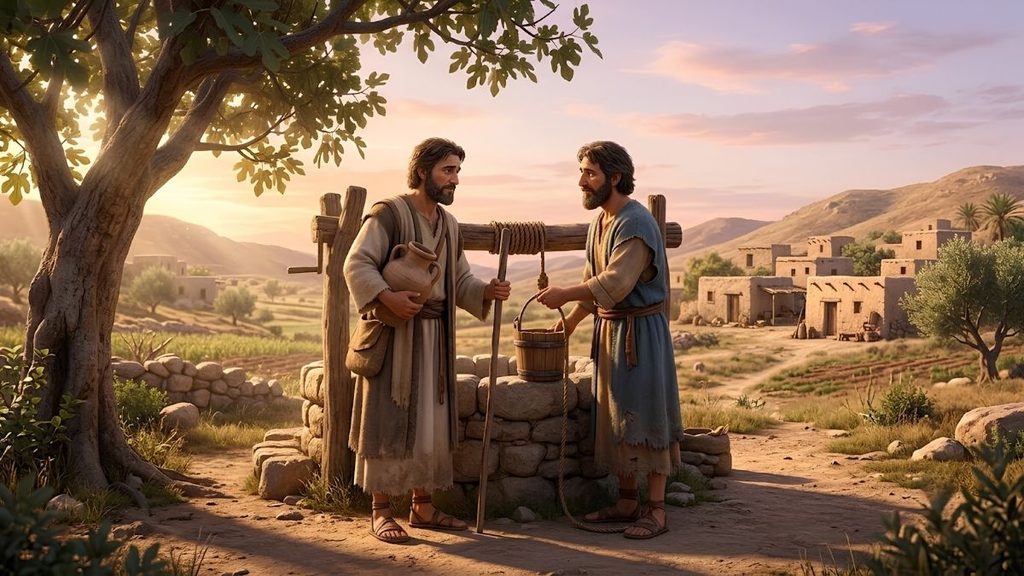
And beside it stood a man carrying two clay jars.
Nathan stopped walking.
The man turned.
For several seconds, neither moved.
Elias.
Older.
Thinner.
His hair streaked with gray.
But unmistakably his brother.
Nathan had imagined this moment many times.
In some versions, Elias apologized immediately.
In others, Nathan delivered a perfect speech.
Sometimes they embraced.
Sometimes they shouted.
Reality offered none of those things.
Elias simply looked at him.
Nathan looked back.
Finally, Elias said,
“The road is difficult this year.”
Nathan nodded.
“Yes.”
“There isn’t much water.”
“I heard.”
Elias looked toward Nathan’s empty water jar.
“You should fill yours first.”
Nathan shook his head.
“You were here first.”
“I have enough.”
Neither brother mentioned the past.
They worked beside the well in silence.
The rope creaked.
The bucket descended.
Water echoed far below.
Nathan watched Elias pull the bucket upward.
His brother’s hands looked different.
Older.
The hands that had once pulled him up a steep hill when he was a child now trembled slightly from the effort.
Nathan wanted to say something.
Anything.
Instead, he asked,
“How is Mother?”
Elias looked at him.
“She died three winters ago.”
Nathan’s heart sank.
He had known she was getting older.
But he had not known.
“Why didn’t anyone tell me?”
Elias lowered his eyes.
“We didn’t know where to send the message.”
Nathan swallowed.
“I see.”
Silence returned.
Then Elias said quietly,
“She spoke about you.”
Nathan looked at him.
“What did she say?”
“That she hoped you were well.”
Nathan turned away.
He didn’t trust his voice.
They sat beneath the shade of an old fig tree near the well.
The other travelers had gone ahead.
For the first time in years, the brothers were alone.
Nathan looked at the ground.
“I should have come back.”
Elias didn’t answer immediately.
“Perhaps,” he said eventually.
Nathan nodded.
“I was angry.”
“I know.”
“I thought you should apologize.”
Elias looked at him.
“I thought the same about you.”
Nathan almost laughed.
It was a strange thing to hear.
After all those years, the truth sounded almost simple.
“I don’t even remember everything we said,” Nathan admitted.
“Neither do I.”
“I remember being angry.”
“So do I.”
“I remember thinking you didn’t care about me.”
Elias looked toward the well.
“I cared.”
Nathan said nothing.
Elias continued.
“I was angry because I thought you were leaving us with everything.”
“I thought you were keeping me from having a life of my own.”
“I know.”
“You could have told me.”
“You could have asked.”
Nathan smiled sadly.
There it was.
The truth neither had wanted to admit.
They had both been hurt.
And both had believed their own pain was the entire story.
The afternoon grew warmer.
A breeze moved through the leaves.
Nathan looked at his brother.
“Why didn’t you come after me?”
Elias took a long breath.
“Because I thought you wanted to leave.”
“I did.”
“I thought if I followed you, you would only become more angry.”
Nathan nodded slowly.
“I wanted you to follow.”
Elias looked surprised.
“Why?”
“Because I wanted to know you still cared.”
His brother looked away.
For several moments, neither spoke.
Then Elias said,
“I wish I had known.”
Nathan closed his eyes.
So many years.
So many imagined conversations.
So many nights believing that the other person had understood exactly what he meant.
And perhaps neither of them had.
Nathan expected forgiveness to feel dramatic.
It didn’t.
There was no sudden warmth.
No perfect resolution.
No moment when the past disappeared.
Instead, forgiveness began with something much smaller.
Nathan stopped trying to prove that he had been the only one who was hurt.
He began listening.
Elias did the same.
They talked for hours.
They spoke about their father.
Their mother.
The land.
Their childhood.
The argument.
The years apart.
Some memories made them laugh.
Others made them uncomfortable.
They did not agree about everything.
They didn’t need to.
Nathan eventually said,
“I was wrong about some things.”
Elias nodded.
“So was I.”
Nathan looked at him.
“That’s all?”
Elias smiled faintly.
“What were you expecting?”
“I don’t know.”
“Neither do I.”
They laughed.
It was the first time they had laughed together in years.
Before sunset, Nathan stood beside the well.
He lowered the bucket.
The rope slid through his hands.
The sound reminded him of childhood.
He remembered being eight years old, racing Elias to see who could draw water faster.
Elias had always won.
Nathan smiled.
His brother noticed.
“What?”
“Nothing.”
“You are smiling.”
“I remembered something.”
“What?”
“The first time you let me win.”
Elias laughed.
“I never let you win.”
“You did.”
“I didn’t.”
“You did.”
“You were faster that day.”
Nathan shook his head.
“You let me think I was.”
Elias smiled.
“Perhaps.”
The bucket reached the water.
Nathan pulled.
For a moment, he felt the weight.
Then Elias took the rope beside him.
Together, they lifted it.
The next morning, Nathan prepared to leave.
He had no intention of pretending that everything was suddenly the same.
Too much time had passed.
There were things they had missed.
Conversations that could never happen.
Years that could not be recovered.
But perhaps forgiveness was not about recovering lost years.
Perhaps it was about refusing to lose the years that remained.
Elias stood beside the road.
“Will you come again?”
Nathan looked toward the village.
“Yes.”
“When?”
Nathan smiled.
“Before another drought.”
Elias laughed.
“That could be a long time.”
“I won’t wait that long.”
They embraced.
It was awkward at first.
Then it wasn’t.
Nathan stepped away.
He looked at his brother.
“I am sorry.”
Elias nodded.
“So am I.”
No elaborate speech.
No attempt to determine who had been more wrong.
Just two brothers acknowledging what they should have acknowledged years earlier.
Nathan returned to his town several days later.
His life had not changed overnight.
He still had work.
Bills.
Responsibilities.
Ordinary worries.
But something inside him had become lighter.
He had spent years carrying the argument as if it were a stone.
He had polished it through memory.
Turned it over repeatedly.
Remembered every insult.
Every silence.
Every reason he believed Elias was wrong.
He had thought he was preserving the truth.
Now he understood that he had also been preserving his anger.
Forgiveness had not erased what happened.
It had not declared the argument unimportant.
It had not made every wound disappear.
It had simply allowed Nathan to put the stone down.
Months later, rain finally came.
Nathan stood outside his house watching water collect along the road.
He thought about the old well.
The dry summer.
The journey.
His brother.
He wondered how many people spent years waiting for someone else to make the first move.
How many families became distant because everyone was waiting to be forgiven before offering forgiveness.
How many friendships ended because pride was easier to carry than vulnerability.
Nathan knew there were situations where distance was necessary.
Forgiveness did not mean forgetting boundaries.
It did not mean trusting someone immediately.
It did not mean pretending that harmful behavior had never happened.
But in his case, the wall between two brothers had been built mostly from silence.
And silence had lasted far longer than anger deserved.
A year later, Nathan returned to the village.
This time, the road was green.
The fields had recovered.
The well was full.
Elias was waiting beneath the fig tree.
Nathan brought bread.
Elias brought olives.
They sat together until sunset.
They talked about ordinary things.
A neighbor’s new donkey.
The harvest.
A broken gate.
A child who had recently learned to read.
Nothing remarkable.
And yet Nathan felt something he had not felt in years.
Peace.
Not because the past had disappeared.
But because the past no longer demanded his attention every moment.
He could remember the argument without reliving it.
He could remember his anger without becoming angry again.
He could remember leaving without believing that leaving had been the end of the story.
The road back to the well had taught him something he wished he had understood much earlier.
Sometimes forgiveness is not a door that suddenly opens.
Sometimes it is a road.
You walk it slowly.
You carry your memories.
You carry your pride.
You carry your questions.
And somewhere along the way, you realize that you have been walking toward freedom all along.
That evening, Nathan and Elias drew water together.
The bucket rose between them.
Neither brother let go.
And as the sun disappeared behind the hills, the old well reflected the last light of day.
Nathan looked down into the water.
For years, he had thought he was returning to a place.
Now he understood.
He had been returning to a relationship.
And perhaps, in some quiet way, he had also been returning to himself.
4. The Lamp in the Upper Room
Type: Hope
Themes: Hope, perseverance, faith, light, community, encouragement
Jerusalem was quieter than Miriam remembered.
There had been a time when the streets outside her home seemed to carry a thousand sounds at once.
Merchants called to customers.
Donkeys complained beneath their burdens.
Children hurried through narrow lanes.
Neighbors spoke from doorways.
Travelers asked for directions.
Cooking fires sent ribbons of smoke into the evening air.
But that year, the city seemed to hold its breath.
Difficult seasons had a way of changing ordinary things.
A market that once remained busy until sunset closed early.
A neighbor who had always sat outside his doorway stopped appearing there.
Families spoke in softer voices.
People counted their bread more carefully.
Those who could leave sometimes did.
Those who remained learned to live with uncertainty.
Miriam noticed these changes because she had always noticed small things.
She was a widow, and her husband, Eliab, had been gone for nearly a year.
His absence had changed the shape of her days.
When he had been alive, mornings had begun with conversation.
Now they began with silence.
When evening came, she sometimes caught herself listening for his footsteps on the stairs.
Then she remembered.
There would be no footsteps.
There was only the quiet house.
And the little room upstairs.
That room had become Miriam’s favorite place.
It had one small window overlooking the rooftops.
From there, she could see the walls of neighboring houses and, beyond them, the changing colors of the evening sky.
Eliab had loved that room.
He used to sit beside the window after supper and watch the city settle into darkness.
One evening, years before his death, Miriam had complained about how quickly night seemed to arrive.
Eliab had smiled.
“Darkness feels different when there is even one small light nearby,” he had told her.
At the time, Miriam had laughed.
“You always have something wise to say.”
“Not wise,” he had replied. “Just true.”
She had forgotten the conversation for many years.
Then, after Eliab died, she remembered it.
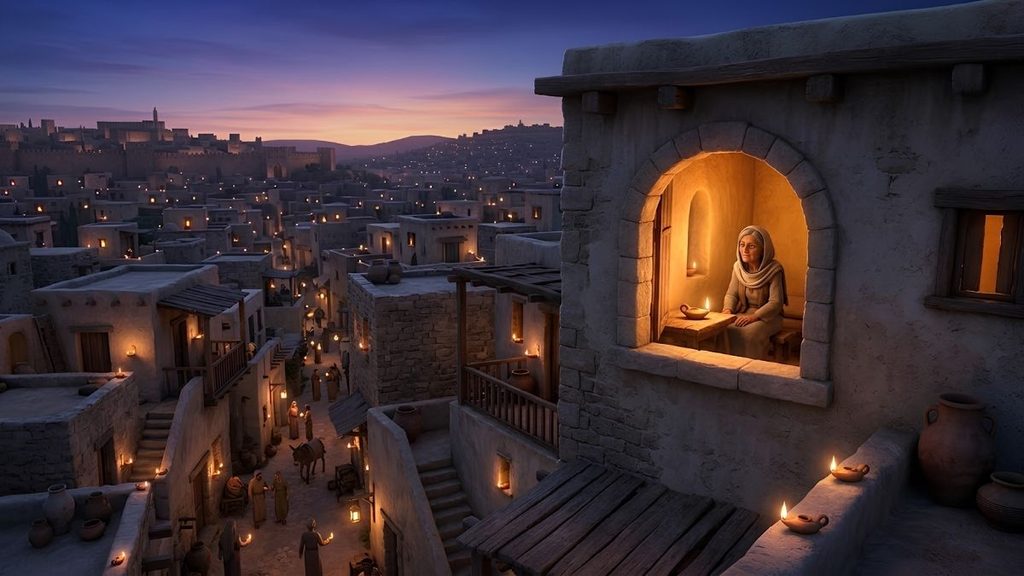
And one evening, she climbed the stairs to the upper room and found a small clay oil lamp.
She filled it.
Trimmed the wick.
And lit it.
The flame was tiny.
It did not illuminate the whole room.
It did not change the darkness outside.
But it was there.
Miriam sat beside it for a while.
Then she whispered,
“You’re right.”
From that evening onward, Miriam lit the lamp every night.
At first, nobody noticed.
Why would they?
It was an ordinary household lamp in an ordinary upper room.
She lit it when the sun disappeared.
She let it burn while she prepared supper.
She sometimes read beside it.
Sometimes she simply sat and watched the flame.
Then she extinguished it before going to sleep.
The routine became comforting.
It gave her evening a beginning and an end.
Morning still brought uncertainty.
The day might bring disappointing news.
A friend might arrive with a worried expression.
Someone might ask for help she could barely afford to give.
But evening always contained one small certainty.
Miriam would climb the stairs.
She would fill the lamp.
She would light it.
And for a little while, the upper room would glow.
As the months passed, the difficult season continued.
A family two houses away began selling possessions.
Miriam watched them carry away furniture.
A few weeks later, the house was empty.
Another neighbor left for the countryside.
Then another.
The streets became less crowded.
One evening, Miriam stood at her window and noticed how many windows remained dark.
She wondered how many homes had once contained conversations like hers.
How many families had once gathered around tables.
How many people had believed they would always remain where they were.
Now many of those rooms were empty.
Miriam felt sadness settle over her.
She almost didn’t light the lamp that evening.
“What difference does one lamp make?” she whispered.
She remained downstairs.
The sky darkened.
The first stars appeared.
Still, she did not move.
Then she remembered Eliab.
Darkness feels different when there is even one small light nearby.
Miriam slowly climbed the stairs.
She lit the lamp.
The flame trembled.
She smiled.
“One is enough for tonight.”
A few evenings later, a boy named Samuel noticed the light.
Samuel lived with his mother and younger sister in a small house farther down the street.
He had been carrying water home when he saw the glow.
It was faint.
Just a small yellow point against the darkening city.
He stopped.
“Mother,” he said when he returned home, “there is a lamp in the upper room of the house near the corner.”
His mother glanced toward the window.
“Many people light lamps.”
“No,” Samuel said. “This one is different.”
“How?”
“I don’t know.”
His mother smiled.
“Then perhaps you should stop trying to explain it.”
Samuel laughed.
But the next evening, he looked for the lamp again.
It was there.
The evening after that, it was there again.
Soon, Samuel began using it as a marker.
When he could see the lamp, he knew he was almost home.
When he couldn’t see it because of rain or darkness, he felt strangely disappointed.
He never told Miriam.
She didn’t know anyone was watching.
One night, a traveler came through the neighborhood.
He had been walking for hours.
His clothes were dusty.
His sandals were worn.
He carried a small bundle over one shoulder.
The road ahead was unfamiliar.
He stopped near the edge of the city and looked around.
There were few people outside.
Most windows were dark.
Then he noticed Miriam’s lamp.
It was small, but visible from the road.
He walked toward it.
Not because he expected help.
Not because he knew who lived there.
Simply because a light suggested that someone was awake.
As he approached the house, an elderly neighbor saw him.
“Are you looking for somewhere to stay?” she asked.
“If there is a place.”
“There may be.”
She directed him toward a nearby home that sometimes welcomed travelers.
The man thanked her.
Before continuing, he looked once more at the lamp.
For reasons he couldn’t explain, it made the road feel less lonely.
Miriam eventually learned about the traveler.
The neighbor mentioned him the following morning.
“He said he saw your lamp.”
Miriam looked surprised.
“My lamp?”
“He said it made him feel that someone was awake.”
Miriam smiled.
“It is only a lamp.”
“Perhaps,” the neighbor replied.
Then she paused.
“But sometimes people need only a little light.”
Miriam thought about that for the rest of the day.
The neighborhood slowly began changing.
Not because the difficult season suddenly ended.
It didn’t.
But people began responding to one another differently.
A woman whose family had little bread found a loaf waiting outside her door.
A carpenter repaired a broken stool without asking for payment.
A young man carried water for an elderly neighbor.
Children began sharing their games in the street.
None of these things was dramatic.
There were no speeches.
No celebrations.
No great announcement.
Kindness simply began appearing in small places.
And every evening, Miriam’s lamp continued to burn.
Then one night, Samuel brought something to her door.
Miriam opened it and found the boy holding a small clay lamp.
“What is this?” she asked.
“My family made it.”
Miriam looked at the lamp.
“Why?”
Samuel seemed embarrassed.
“Because you have yours.”
Miriam smiled.
“I have mine.”
“We wanted one too.”
She understood.
“Do you light it every evening?”
Samuel nodded.
His face brightened.
“Yes.”
Miriam touched the little lamp gently.
“Then take good care of it.”
Samuel hesitated.
“Why do you light yours?”
Miriam looked toward the stairs.
“Because someone once told me that darkness feels different when there is even one small light nearby.”
Samuel considered this.
“Was he right?”
Miriam smiled.
“Very.”
Soon another household began lighting a lamp.
Then another.
Nobody organized it.
There was no rule.
People simply noticed.
A lamp appeared in one window.
Then another.
Then another.
The neighborhood slowly developed a quiet evening rhythm.
When the sun went down, small lights appeared.
Some burned brightly.
Some were barely visible.
Some were extinguished early because oil was scarce.
Others remained lit late into the night.
But together they changed the streets.
The darkness was still there.
Yet it no longer seemed absolute.
One evening, Miriam climbed the stairs and stopped beside the window.
She could see several lamps across the neighborhood.
She remembered when there had been only hers.
For a moment, she thought about Eliab.
She wished he could see them.
She wished she could tell him what his simple words had become.
A single sentence had survived him.
Then it had become a habit.
The habit had become a signal.
The signal had become encouragement.
And encouragement had become a shared tradition.
Miriam sat beside her lamp.
“Darkness does feel different,” she whispered.
Years passed.
The difficult season eventually ended.
Markets became busy again.
Families returned.
Children grew older.
New houses appeared.
Old houses were repaired.
Life resumed its ordinary movement.
But the lamps remained.
People continued lighting them.
Not because they were afraid of darkness.
Not because they believed a lamp could solve every problem.
They lit them because they remembered.
They remembered the evenings when the streets had been quiet.
They remembered uncertainty.
They remembered the families who had left.
They remembered those who had stayed.
And they remembered that even difficult nights could contain something warm.
Samuel grew older.
Eventually, he became the one who told younger children the story.
They would ask him why people lit lamps on certain evenings.
He would point toward Miriam’s old house.
“Because someone started it.”
“Who?”
“A woman named Miriam.”
“Why?”
“Because her husband once told her that darkness feels different when there is even one small light nearby.”
The children would look at the lamps.
“Did she know people would copy her?”
Samuel would smile.
“No.”
“Then why did she do it?”
He would answer,
“Because hope doesn’t always begin with knowing what will happen.”
Miriam grew old.
Her hands became slower.
Her eyesight weakened.
Eventually, she could no longer climb the stairs easily.
One evening, Samuel, now a grown man, came to visit.
He found her sitting downstairs.
“The lamp,” she said.
“I’ll light it.”
Samuel climbed the stairs.
He filled the lamp carefully.
Trimmed the wick.
And lit it.
Then he carried it toward the window.
From there, he could see the neighborhood.
Hundreds of small lights glowed in the darkness.
He stood silently.
Miriam called from below.
“Is it beautiful?”
Samuel looked out at the evening.
“Yes.”
“How many?”
He counted.
Then stopped.
“There are too many to count.”
Miriam laughed softly.
“Good.”
Samuel carried the lamp downstairs.
“Do you still remember what Eliab told you?”
“Every evening.”
“What did he mean?”
Miriam thought for a moment.
“I used to think he meant that light makes darkness smaller.”
Samuel waited.
“But I think he meant something else.”
“What?”
“That when we see one light, we know someone is still there.”
Samuel looked toward the window.
Miriam continued.
“And sometimes knowing that is enough to help us keep walking.”
That night, Samuel stayed beside her.
Outside, lamps continued appearing one by one.
A light in a doorway.
A light beside a window.
A light above a narrow street.
A light in a home where a family had once been afraid.
A light in a house where a child was learning to read.
A light beside an elderly man’s chair.
A light above a traveler resting for the night.
None of them was powerful enough to defeat the night.
None needed to be.
Together, they offered something simpler.
A reminder.
Someone was there.
Someone remembered.
Someone cared.
Someone had chosen to light a lamp.
And perhaps that was what hope really was.
Not certainty.
Not the promise that tomorrow would be easy.
Not the belief that darkness would never return.
Hope was sometimes much quieter.
It was waking up after a difficult night.
It was opening the door.
It was helping someone carry water.
It was sharing bread.
It was forgiving.
It was waiting.
It was lighting a small flame even when you did not know who might see it.
Miriam had once believed she was lighting the lamp for herself.
Later, she realized that she had been part of something larger.
Her little flame had crossed the darkness.
Not through its brightness.
Through its constancy.
And every evening, somewhere in Jerusalem, another lamp answered.
Then another.
Then another.
Until the night itself seemed dotted with tiny promises.
The darkness remained.
But so did the light.
And for many people, that was enough.
5. The Shepherd Who Stayed Behind
Type: Courage
Themes: Courage, responsibility, fear, wisdom, perseverance, compassion
The hills beyond the village had never frightened Amos when he was young.
As a boy, he had climbed them barefoot, carrying nothing but a wooden staff and a piece of bread tucked into his tunic.
He knew which paths were safe.
He knew where wild herbs grew after rain.
He knew which rocks warmed first beneath the morning sun.
Most of all, he knew the sheep.
That knowledge had grown slowly over the years.
He could recognize the sound of a hungry lamb.
He could tell when a ewe was tired.
He knew which animals were likely to wander and which preferred staying close to the flock.
But as Amos grew older, he learned something else.
Knowing the hills did not mean controlling them.
A familiar path could become dangerous after a storm.
A harmless slope could crumble beneath a careless foot.
And sometimes, the wisest shepherd was not the one who moved fastest.
It was the one who knew when to wait.
That year, the weather had been unusually harsh.
The rains had come late.
The grass had grown thin.
The wells were lower than usual.
Every morning, Amos led his flock farther from the village in search of pasture.
The sheep followed him across dry valleys and stony fields.
Among them were old animals that moved slowly, young lambs that became distracted easily, and several strong ewes that seemed determined to explore every corner of the hills.
Amos knew their habits.
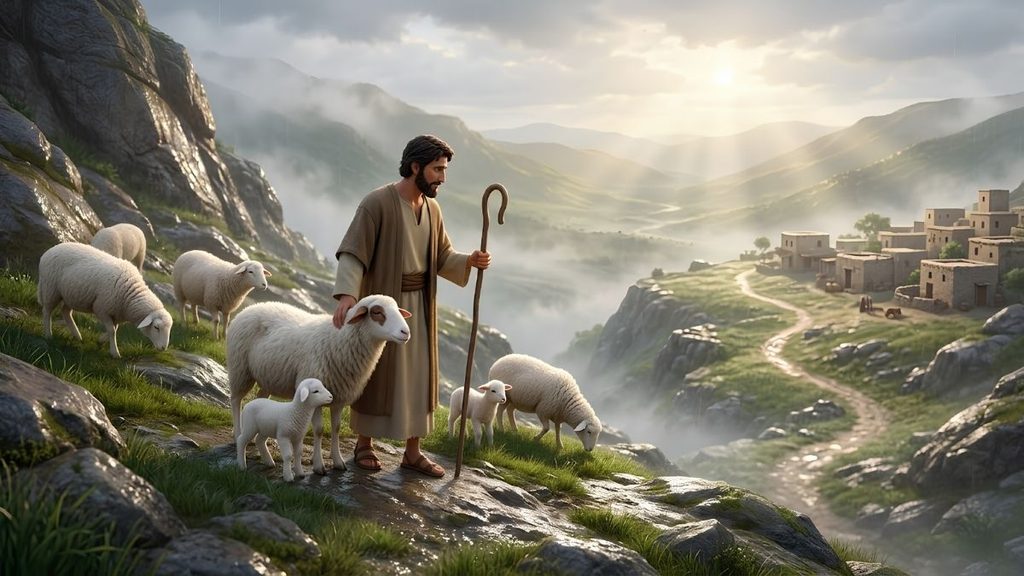
One particular sheep, a white ewe with a brown patch above one eye, was especially stubborn.
Amos called her Cedar.
Cedar had a talent for finding places she had no business being.
If the flock went left, Cedar sometimes went right.
If the others rested, Cedar wandered.
If Amos turned his back for even a moment, she seemed to discover another hill to investigate.
“You will give me gray hair,” Amos often told her.
Cedar never seemed concerned.
One evening, clouds gathered unexpectedly.
Amos looked toward the horizon.
The sun was already low.
The other shepherds were calling their animals together.
“We should return,” one of them said.
Amos nodded.
“Yes.”
The flock began moving down the familiar path.
Then Amos heard a strange sound.
A faint bleating.
He turned.
Several sheep were missing.
His heart tightened.
He counted quickly.
Then counted again.
Seven.
Seven sheep had wandered away.
Among them were two young lambs.
And Cedar.
“Where are they?” another shepherd asked.
Amos pointed toward the ridge.
“They went toward the eastern slope.”
The shepherd looked at the darkening sky.
“That slope?”
Amos nodded.
The man shook his head.
“We cannot go there tonight.”
Another shepherd joined them.
“He’s right. The rocks are dangerous after rain.”
Amos looked toward the ridge.
The sheep were barely visible.
Small pale shapes moving against the dark stone.
One lamb cried out.
Then the sound disappeared into the wind.
“We should leave them,” one shepherd said.
Amos remained silent.
“They may find their way back.”
“Perhaps,” Amos said.
“And if they don’t?”
The shepherd looked at him.
“Then we lose them.”
The words sounded simple.
But Amos knew they weren’t.
A shepherd carried responsibility for animals that could not always understand danger.
The flock depended on him.
Yet responsibility did not mean rushing blindly into danger.
Amos had seen people injured on those rocks before.
A loose stone could send a person tumbling.
A narrow ledge could become impassable.
The safest thing might be to leave the animals and return at dawn.
But Amos also knew what would happen if he walked away.
He would spend the night imagining the lambs stranded on the slope.
He would hear their cries in his memory.
And when morning came, he might discover that he had abandoned animals he could have saved.
He looked at the ridge again.
“I won’t go up tonight,” he said.
The others looked relieved.
“But I won’t leave them either.”
The shepherds stared at him.
“What will you do?”
“Wait.”
“For what?”
“Morning.”
One man frowned.
“And if the sheep wander farther?”
“They may.”
“And if they fall?”
Amos tightened his grip on his staff.
“I know.”
He looked toward the slope.
“I am frightened of that.”
The others were quiet.
Amos rarely admitted fear.
But there was no shame in it.
Fear was not a stranger to shepherds.
It walked beside them through storms.
It waited in dark valleys.
It appeared whenever an animal disappeared into unfamiliar ground.
Amos had simply learned not to confuse fear with a command.
Fear could warn him.
It could tell him to be careful.
But it did not always have to tell him to run away.
The shepherds eventually returned to the village.
Amos stayed.
He found a sheltered place beneath a rock overhang and settled there for the night.
The wind grew stronger.
Clouds covered the stars.
Amos could hear occasional bleating from the ridge.
He wanted to move.
Every part of him wanted to climb toward the animals.
But he remained where he was.
He listened.
He studied the slope.
He watched the clouds.
He waited.
Hours passed.
Nothing happened.
Then rain began.
At first, only a few drops.
Then more.
The rocks became dark.
Water ran between them.
Amos stared at the slope.
Now he understood why the other shepherds had warned him.
Going up there in darkness would have been foolish.
He had wanted to act because action felt better than waiting.
But waiting had revealed something important.
Sometimes courage required doing less, not more.
Morning arrived slowly.
The rain stopped.
A pale light appeared behind the hills.
Amos stood.
His legs were stiff.
His clothes were damp.
He looked toward the sheep.
They had moved.
Not farther upward.
They had gathered near a narrow shelf halfway down the slope.
Amos smiled with relief.
“They waited too.”
He began studying the terrain.
There was a narrow path along the western side.
It was longer than the direct route.
But it appeared stable.
Amos walked several steps.
Stopped.
Tested the ground with his staff.
Then continued.
He did not hurry.
Every movement was deliberate.
He reached the first sheep.
The animal looked at him.
Amos rested his hand gently against its neck.
“There you are.”
The sheep bleated.
The sound almost made Amos laugh.
“You frightened me.”
He turned toward the others.
The lambs were huddled together.
Cedar stood behind them.
She looked completely unconcerned.
Amos stared at her.
“You.”
Cedar blinked.
“Of course it was you.”
The rescue took most of the morning.
Amos did not attempt to force the flock down the steepest path.
Instead, he moved one animal at a time.
He blocked dangerous openings.
He used his staff to test loose stones.
When a lamb became frightened, he waited.
When one sheep refused to move, he stood beside it until it calmed.
There were moments when Amos’s heart beat quickly.
Once, a stone slipped beneath his sandal.
He froze.
The rock rolled down the slope.
It disappeared into a ravine.
Amos breathed slowly.
He waited until his hands stopped shaking.
Then he continued.
He did not pretend nothing could happen.
He simply refused to let fear make every decision for him.
By midday, six sheep had reached the safe ground.
Only Cedar remained.
Of course.
Amos looked at her.
Cedar stood near a narrow patch of grass.
She was eating.
Amos sighed.
“After everything we’ve been through, you are having breakfast.”
Cedar continued eating.
Amos walked closer.
She stepped backward.
He stopped.
He knew better than to chase her.
Instead, he waited.
After several minutes, Cedar looked at him.
Amos held out his hand.
“Come.”
She didn’t move.
He lowered his hand.
“All right.”
He sat down.
Cedar looked at him suspiciously.
Amos waited.
Eventually, curiosity overcame stubbornness.
Cedar took one step.
Then another.
She came toward him.
Amos stood slowly.
“That’s it.”
Together, they walked down the safe path.
When Amos returned to the village, the other shepherds were waiting.
They saw the sheep first.
Then they saw Amos.
One of the shepherds laughed with relief.
“You actually brought them back.”
Amos nodded.
Another man approached.
“How?”
Amos looked toward the hills.
“I waited.”
The shepherd smiled.
“That doesn’t sound very brave.”
Amos smiled too.
“No.”
Then he looked at his damp clothes and scraped hands.
“But it was probably the bravest thing I could have done.”
That evening, Amos sat outside his home.
The village had become quiet.
The sheep rested nearby.
Cedar was asleep.
Amos watched the sunset spread across the hills.
He thought about the night before.
There had been no heroic moment.
No dramatic battle.
No sudden victory over fear.
He had simply been afraid.
Then he had waited.
Then he had studied the land.
Then he had chosen the safest path.
Perhaps that was courage.
Not the absence of fear.
Not pretending danger did not exist.
Not proving that you were stronger than everyone else.
Perhaps courage was simply being willing to remain responsible while fear sat beside you.
Later that night, a young boy named Micah approached him.
“Amos?”
“Yes?”
“Father said you stayed with the sheep all night.”
“I did.”
“Weren’t you scared?”
Amos smiled.
“Very.”
Micah looked surprised.
“But you stayed.”
“Yes.”
“Why?”
Amos looked toward the sleeping flock.
“Because being frightened doesn’t mean you have to abandon what matters.”
Micah thought about that.
“Does courage make fear disappear?”
“No.”
“Then what does it do?”
Amos looked at the hills.
“It teaches you how to keep walking carefully while fear is still there.”
Micah nodded.
He seemed satisfied.
Then he ran home.
Amos remained outside.
Years later, Micah would remember that conversation.
He would remember the old shepherd who had taught him that courage did not always look impressive.
Sometimes it looked like waiting through a storm.
Sometimes it looked like asking for help.
Sometimes it looked like admitting that you were afraid.
Sometimes it meant choosing the longer road because the shorter one was dangerous.
And sometimes courage meant caring enough to stay, but being wise enough not to rush.
Amos never became famous.
Nobody built a monument for him.
The story of the seven sheep was never told in great gatherings.
But among the shepherds, it became a small story passed from one generation to another.
Whenever someone faced a difficult decision, an older shepherd might say,
“Remember Amos.”
And the younger person would know what it meant.
Be careful.
Don’t confuse bravery with recklessness.
Don’t let fear make you careless.
Don’t let pride make you foolish.
And when something important depends on you, remain.
Many years later, when Amos was old, he walked those hills one final time.
His steps were slower.
His staff was polished smooth from years of use.
The slopes looked different to him now.
Perhaps they had always looked different.
He stopped beside the path where he had rescued the sheep.
The wind moved gently through the grass.
Below him, the village rested beneath the afternoon sun.
Amos smiled.
He thought about the night when he had been afraid.
He remembered the rain.
The darkness.
The distant cries of the sheep.
And the temptation to act simply because standing still felt unbearable.
He had learned something important that night.
There are moments when courage asks us to move.
There are moments when courage asks us to speak.
And there are moments when courage asks us to wait.
The wise person learns the difference.
Amos turned toward home.
The road was familiar.
The evening was peaceful.
And for the first time in many years, he realized that he no longer needed to prove anything to himself.
He had learned what he needed to know.
Fear could walk beside him.
It simply did not have to lead.
6. The Stranger at the Olive Press
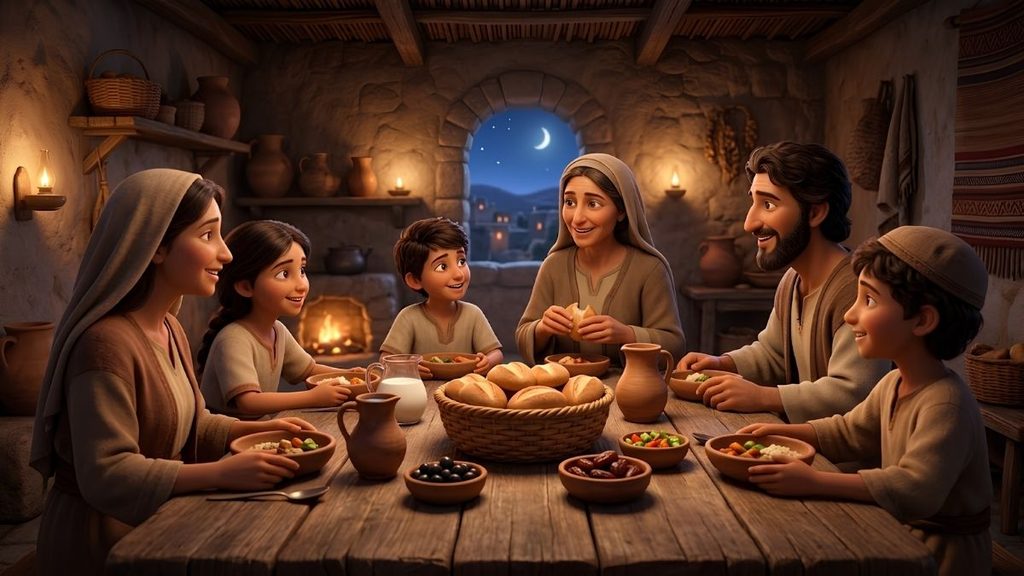
Type: Gratitude
Core Themes: Gratitude, generosity, abundance, community, sharing, contentment
The village of Beth-Maresh rested between two low hills where the land became dry during the hottest months of the year.
It was not a wealthy village.
The houses were small, built from stone and clay, with wooden doors that had been repaired many times.
There were olive trees on the slopes, a few vegetable gardens near the wells, and fields of grain that depended heavily on the rains.
When the harvest was good, everyone celebrated.
When the harvest was poor, everyone became careful.
People measured flour.
They counted dates.
They saved oil.
They learned to make ordinary meals stretch farther than seemed possible.
Hannah had lived in the village all her life.
She had learned early that abundance did not always mean having a great deal.
Sometimes abundance meant having enough.
Enough bread for the evening.
Enough water for tomorrow.
Enough wood for one more fire.
Enough strength to finish the day’s work.
And, most importantly, enough people nearby to share the difficult days.
Still, there were times when Hannah worried.
That year was one of them.
The rains had been disappointing.
The grain harvest had been smaller than expected.
Many families had begun reducing their meals.
Nobody complained openly.
They simply became quieter.
Hannah lived with her two children, Miriam and Eli, in a small house near the western edge of the village.
Her husband had died several years earlier.
Since then, Hannah had managed the household herself.
She worked hard.
She sold small baskets she made from reeds.
She helped neighbors with sewing.
She traded vegetables when she had enough.
And whenever possible, she saved a little flour for days when there might be none.
One evening, she stood beside the cooking fire and opened the family’s flour jar.
She looked inside.
There was not much.
She closed the lid.
Then she opened it again.
Her daughter Miriam watched her.
“Is there enough?”
Hannah smiled.
“There is enough for tonight.”
Miriam looked relieved.
“What are we having?”
“Bread.”
Eli appeared from outside.
“Seven loaves?”
Hannah laughed.
“You counted?”
“I always count.”
He was eight years old and considered counting everything an important responsibility.
Hannah began preparing the dough.
She measured the flour carefully.
Added water.
A little salt.
A small amount of starter from the previous day’s bread.
Her hands moved automatically.
She had made bread so many times that she could almost do it without thinking.
But that evening, the task felt different.
Seven loaves.
That was all.
Seven small loaves for three people.
It was enough.
But only just.
The loaves baked slowly.
Their smell filled the little house.
Miriam sat near the fire.
Eli waited impatiently.
Hannah smiled at them.
“Wait until they cool.”
“They smell ready,” Eli said.
“They smell ready because you are hungry.”
“I am always hungry.”
“I know.”
He grinned.
When the bread was finished, Hannah placed the seven loaves into a woven basket.
She looked at them.
Seven.
Small.
Warm.
Golden.
For a moment, she felt proud.
She had managed to make bread despite the difficult harvest.
She had enough for dinner.
Tomorrow would take care of itself.
She carried the basket toward the table.
Then someone knocked.
Hannah stopped.
She looked at the door.
Another knock came.
Miriam looked at her.
“Who is it?”
“I don’t know.”
Hannah opened the door.
Standing outside was her cousin Naomi.
Beside her were Naomi’s husband and their two children.
They looked tired.
“Forgive us for coming without warning,” Naomi said.
Hannah immediately stepped aside.
“Come in.”
Naomi hesitated.
“We were traveling home and thought we might stay the night.”
“Of course.”
“We have not eaten since morning.”
Hannah’s eyes moved toward the basket.
Seven loaves.
She counted automatically.
One.
Two.
Three.
Four.
Five.
Six.
Seven.
The visitors entered.
Miriam quietly counted the loaves too.
Seven.
She looked at her mother.
Hannah understood exactly what her daughter was thinking.
There were now seven loaves for seven people.
One each.
No extra.
Hannah felt a familiar worry rise inside her.
She could serve one loaf to each person.
There would be nothing left.
What if someone came tomorrow?
What if the children were hungry in the morning?
What if the flour jar became empty?
What if the harvest was worse than expected?
Hannah had learned to think in questions beginning with what if.
Sometimes those questions protected a family.
Sometimes they made a small blessing feel frighteningly small.
She looked at the bread again.
Then at her tired relatives.
“Sit,” she said.
Naomi smiled.
“Thank you.”
Hannah began arranging the table.
The first loaf was divided among the children.
The second was broken between the adults.
Then another.
And another.
The portions were modest.
Nobody complained.
Naomi’s husband had brought a small pouch of olives.
“I have these,” he said.
Hannah smiled.
Naomi opened another bundle.
“Some dates.”
Miriam brightened.
Eli looked at the olives.
Then at the dates.
Someone else arrived while they were eating.
It was an elderly neighbor named Jacob.
“I smelled bread,” he said with a smile.
Hannah laughed.
“You have a remarkable nose.”
“I have had practice.”
Jacob held out a small container.
“I brought milk.”
Soon another neighbor appeared.
Then another.
The simple dinner was becoming a gathering.
Not a planned gathering.
Not a celebration.
Just people who had happened to arrive and decided to sit together.
Hannah watched as the food moved around the table.
The bread she had worried about was being shared.
The olives passed from hand to hand.
Dates were placed near the children.
Milk was poured into small cups.
Someone brought onions.
Someone else brought a few figs.
Nobody had much.
But everyone seemed willing to contribute what they had.
Hannah sat quietly.
She noticed something strange.
The basket was empty.
She had expected to feel anxious.
Instead, she felt peaceful.
She looked around the table.
Miriam was laughing.
Eli was telling Jacob an exaggerated story about a goat that had escaped from a neighbor’s yard.
Naomi was talking with an old friend.
Someone was humming softly.
The room was warm.
The evening outside was dark.
But inside, the little house seemed brighter than it had in weeks.
After dinner, the guests remained.
They talked.
They remembered childhood stories.
They discussed the harvest.
They spoke about the weather.
Someone told a joke that was not particularly funny.
Everyone laughed anyway.
Hannah listened.
She realized she had spent months thinking about scarcity.
How much flour remained.
How many vegetables were growing.
How long the oil would last.
How much grain was stored.
She had measured nearly everything.
But she had rarely measured something else.
The number of people who would help when she needed them.
She had counted the loaves.
She had not counted the hands.
Later, after everyone had gone to sleep, Hannah remained awake.
The house was quiet.
She picked up the empty basket.
For years, an empty basket had worried her.
An empty flour jar meant trouble.
An empty storage container meant another difficult day.
But tonight, the empty basket felt different.
It had been emptied into people.
Not wasted.
Not lost.
Shared.
Hannah placed the basket on the table.
Miriam came downstairs.
“Mother?”
“Why are you awake?”
“I was thirsty.”
She poured herself some water.
Then she looked at the basket.
“Are you worried?”
Hannah smiled.
“No.”
Miriam looked surprised.
“There isn’t any bread left.”
“I know.”
“What will we eat tomorrow?”
Hannah paused.
“I don’t know.”
Miriam frowned.
Hannah touched her daughter’s shoulder.
“But I know something else.”
“What?”
“Tonight, we had enough.”
The next morning, Hannah woke before sunrise.
For a moment, she forgot about the bread.
Then she remembered.
The basket was empty.
The flour jar was nearly empty.
She walked outside.
The village was beginning to wake.
A neighbor passed by.
“Good morning, Hannah.”
“Good morning.”
The woman smiled.
“Thank you for last night.”
Hannah looked surprised.
“You brought food.”
“Yes.”
“But you shared yours.”
“So did you.”
They smiled at each other.
The woman continued walking.
Hannah stood quietly.
Then she understood.
The meal had not been created by seven loaves.
The loaves had only begun it.
The abundance had come from everyone bringing what they could.
That morning, Hannah went to the market.
She had little to trade.
She carried several baskets she had made during the previous week.
At first, she worried that nobody would want them.
But a merchant bought two.
Another person bought one.
Someone traded vegetables for another.
By midday, Hannah returned home with a small amount of flour, several onions, and a handful of dates.
She placed them on the table.
Miriam looked at the food.
“Where did that come from?”
“I traded the baskets.”
Miriam smiled.
Hannah looked at her daughter.
“Remember last night?”
“Yes.”
“Do you know what I learned?”
Miriam shook her head.
“I thought having more food would make me feel safe.”
“And now?”
Hannah looked toward the village.
“Now I think knowing who will sit beside you when there isn’t much food can be just as important.”
The lesson stayed with Hannah.
She began noticing things she had overlooked.
The neighbor who repaired roofs without asking for payment.
The farmer who left vegetables at people’s doors.
The children who shared their toys.
The woman who always saved a cup of milk for an elderly neighbor.
The man who carried water for families who were struggling.
None of these people were wealthy.
Yet they possessed something Hannah had failed to count.
Generosity.
And generosity had a peculiar quality.
When given freely, it seemed to multiply.
Weeks passed.
The harvest remained difficult.
There was no sudden miracle.
The fields did not instantly become green.
The village did not suddenly become rich.
People still had to be careful.
But something had changed.
The villagers had begun eating together more often.
If one family had extra vegetables, they shared them.
If another had flour, they made bread.
If someone had milk, it was divided.
No one became careless.
They still saved what they could.
But they stopped believing that saving everything for themselves was the only way to survive.
Hannah’s home became one of the places where people gathered.
Sometimes there was plenty.
Sometimes there wasn’t.
But there was always a chair.
There was always conversation.
And there was often bread.
One evening, months after the night of the seven loaves, Eli returned home carrying a small basket.
“What is that?” Hannah asked.
“I made bread.”
Hannah looked inside.
Six small loaves.
She smiled.
“Why six?”
“Because I couldn’t make seven.”
Hannah laughed.
“Then six is enough.”
Eli frowned.
“Enough for what?”
Hannah sat beside him.
“Enough to begin.”
He thought about that.
Then he nodded.
“Can we share them?”
Hannah smiled.
“Yes.”
That evening, they carried the basket to their neighbor’s house.
The neighbor contributed soup.
Another family brought vegetables.
Someone brought olives.
Another brought dates.
Before long, another simple meal had become a gathering.
Hannah sat among them and looked around.
She remembered the first seven loaves.
They had seemed so small.
Yet that small basket had taught her something she never forgot.
Gratitude was not simply being happy when you had plenty.
It was learning to recognize what you had while you had it.
A warm loaf.
A safe home.
A child laughing.
A neighbor knocking at the door.
A friend bringing olives.
A table with enough chairs.
A quiet evening.
A second chance to share.
These things were easy to overlook when life was busy.
But they were often the very things that made life meaningful.
Years later, when Hannah’s children had grown, they sometimes asked her about the difficult harvest.
They remembered the stories.
They remembered the evenings when food had been scarce.
But Hannah always told them about the basket.
“The seven loaves?”
“Yes.”
“What happened?”
“We ate them.”
The children laughed.
“That’s all?”
Hannah smiled.
“Not quite.”
She told them how the bread had become a meal.
How the meal had become a gathering.
How the gathering had reminded her that abundance was not always measured by what sat inside a cupboard.
Sometimes it was measured by what happened when people opened their doors.
Hannah kept the old basket for the rest of her life.
It became worn.
One side loosened.
The handle was repaired twice.
Eventually, it was too fragile to carry bread.
But Hannah refused to throw it away.
She kept it on a shelf.
Whenever someone asked about it, she told them the story.
Not because seven loaves were extraordinary.
They weren’t.
They were simply seven small loaves.
What mattered was what they became.
A meal.
A conversation.
A friendship.
A reminder.
A new way of measuring blessings.
On quiet evenings, Hannah sometimes sat near the window and thought about the years she had spent worrying about having enough.
She no longer regretted being careful.
Carefulness had helped her family through difficult times.
But she had learned that caution and gratitude did not have to be enemies.
You could prepare for tomorrow while still appreciating today.
You could save bread without forgetting to share it.
You could acknowledge scarcity without allowing scarcity to define your whole life.
And you could look at a nearly empty basket and still recognize that something beautiful had happened.
One evening, Hannah’s youngest grandchild asked her,
“Grandmother, what is gratitude?”
Hannah looked at the child.
“Gratitude is noticing.”
“Noticing what?”
She smiled.
“That you already have something worth being thankful for.”
The child looked around.
“What?”
Hannah pointed toward the table.
“That.”
The child looked at the table.
There was bread.
Milk.
Olives.
Dates.
A bowl of vegetables.
And people.
People talking.
People laughing.
People listening.
Hannah smiled.
“Sometimes,” she said, “we spend so much time counting what is missing that we forget to count what is here.”
The child thought about this.
Then picked up a piece of bread.
“Can I share this?”
Hannah smiled.
“That would be a good place to begin.”
And so the bread passed from one hand to another.
Outside, evening settled over the village.
The hills became dark.
The first stars appeared.
Inside the little house, the table remained warm with conversation.
There was no great treasure.
No overflowing storehouse.
No guarantee that tomorrow would be easy.
Only a small meal, a few people, and enough kindness to make the meal feel abundant.
And perhaps that was the lesson Hannah had been learning all along.
A blessing does not become smaller because it is shared.
Sometimes, it becomes easier to see.
And sometimes, the smallest basket is large enough to teach a whole village how to be grateful.
7. The Basket of Seven Loaves
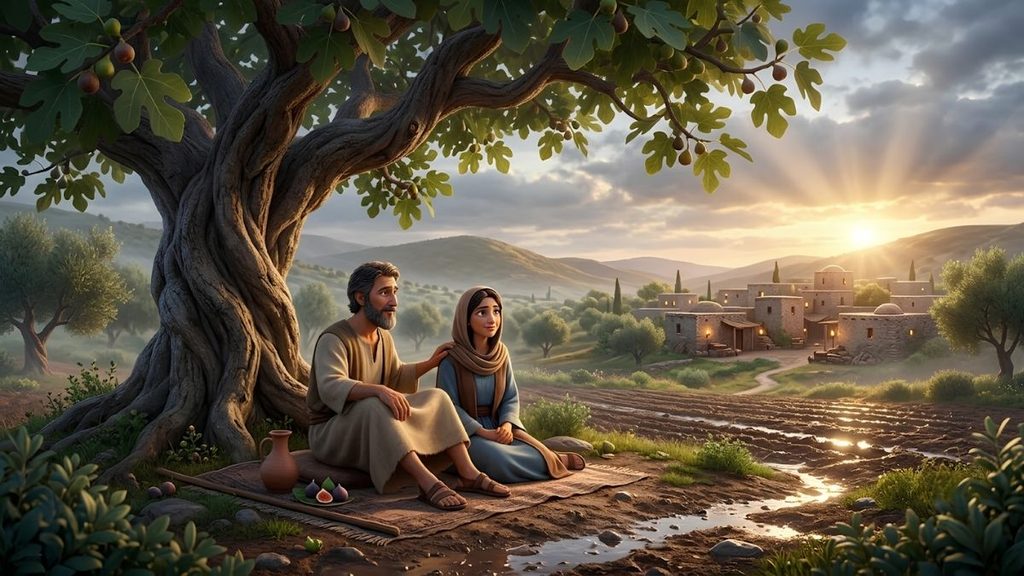
Type: Faith During Uncertainty
Core Themes: Faith, uncertainty, patience, trust, renewal, quiet hope
The village of Beth-Aram was surrounded by fields.
From a distance, especially in the early morning, the land appeared endless.
Low hills rose beyond the eastern fields, their slopes changing color with the seasons. In spring, they were green. By late summer, they had become pale beneath the hot sun.
The village itself was small.
There were stone houses with flat roofs, narrow paths worn smooth by generations of footsteps, a marketplace that became quiet during the hottest part of the afternoon, and a well where people gathered each morning.
At the far edge of the village stood an old fig tree.
It grew beside a field that had once belonged to a farmer named Eliab.
The tree was larger than most of the others in the area.
Its trunk twisted outward before rising toward the sky, and several of its branches had been supported with wooden poles for so many years that nobody remembered when the supports had first been placed there.
People called it the Old Fig Tree.
Some believed it had been planted by Eliab’s grandfather.
Others said it was even older.
Nobody knew for certain.
But everyone knew the tree.
Children played beneath it.
Travelers rested in its shade.
Farmers stopped there when returning from the fields.
And during the hottest part of the day, its broad leaves created a patch of coolness that seemed almost impossible beneath the summer sun.
There was only one problem.
For three years, the tree had produced very little fruit.
A man named Nathan often passed the tree.
He was thirty-six years old and worked a small field inherited from his father.
Nathan had never considered himself particularly impatient.
But the previous year had tested that belief.
The rains had come late.
Then they had stopped early.
His barley harvest had been poor.
The year before that, insects had damaged part of his crop.
And now another season had begun with clouds gathering over the hills without releasing enough rain.
Every morning, Nathan looked toward the sky.
Every evening, he looked at the fields.
He found himself doing the same thing repeatedly.
Looking.
Waiting.
Wondering.
One morning, his wife, Leah, noticed him standing outside their house before sunrise.
“You are watching the clouds again,” she said.
Nathan smiled faintly.
“Perhaps this time they will stay.”
Leah stood beside him.
The sky was gray.
A cool wind moved through the village.
For a moment, the air smelled of rain.
Then the wind changed direction.
The clouds moved eastward.
Nothing fell.
Nathan lowered his eyes.
Leah touched his arm.
“We cannot command the clouds.”
“I know.”
“But you keep asking them to come.”
Nathan looked toward the distant hills.
“I don’t know what else to do.”
Leah was quiet.
Then she said,
“Perhaps there are things we can do while we wait.”
Nathan did not answer.
But he remembered her words.
That afternoon, Nathan walked toward the edge of the village.
He had work to do in the field.
As he passed the Old Fig Tree, he stopped.
He examined the branches.
There were leaves.
Small green ones.
Healthy enough.
But no figs.
Nathan sighed.
“You again.”
The tree offered no answer.
He smiled despite himself.
His father had once told him that people often became attached to trees because trees gave them something people could not.
They stayed.
Through good seasons.
Through bad seasons.
Through years when nobody noticed them.
Nathan remembered asking his father when he was a child,
“How does a tree know when to grow?”
His father had laughed.
“It doesn’t know.”
“Then how does it know what to do?”
“It simply grows when the conditions are right.”
Nathan had forgotten the conversation for years.
Now, standing beneath the Old Fig Tree, he remembered it clearly.
That evening, Nathan sat with Leah and their children.
There was bread on the table.
A small bowl of lentils.
A few olives.
Their youngest daughter, Miriam, pushed an olive around her bowl.
“Will the rain come tomorrow?”
Nathan looked at her.
“I don’t know.”
“When will it come?”
“I don’t know that either.”
Miriam frowned.
“Then how do you know it will come?”
Nathan opened his mouth.
Then closed it.
He had no good answer.
Leah looked at him.
Nathan smiled at his daughter.
“We don’t always know what tomorrow will bring.”
“Does that mean we should be afraid?”
Nathan thought about the question.
“No.”
“Why not?”
“Because not knowing is not the same as knowing something bad will happen.”
Miriam considered this.
Then she ate her olive.
The conversation ended.
But Nathan continued thinking about it long after everyone went to sleep.
The next morning, Nathan returned to the Old Fig Tree.
He carried a small jar of water.
It was not much.
He needed every drop for his field.
Still, he poured some around the roots.
An elderly man named Ezra happened to be passing.
He stopped.
“You are watering that tree?”
Nathan nodded.
“It hasn’t given you fruit in three years.”
“I know.”
“Why bother?”
Nathan looked at the tree.
“I don’t know.”
Ezra smiled.
“That is an honest answer.”
Nathan laughed.
“I suppose it is.”
Ezra sat beneath the tree.
After a moment, Nathan joined him.
They remained silent.
A bird landed on one of the branches.
The two men watched it.
Eventually, Ezra said,
“My father used to bring me here.”
Nathan looked at him.
“Your father?”
Ezra nodded.
“Long before you were born.”
“What did he say?”
“Not much.”
Ezra smiled.
“He simply sat here.”
Nathan looked around.
“Why?”
“Because sometimes people think they need answers when what they really need is somewhere quiet enough to hear themselves think.”
Nathan considered that.
“Did it work?”
“Sometimes.”
They both laughed.
The days passed.
The rain still did not come.
Nathan worked harder.
He repaired a broken section of fencing.
He cleared stones from the field.
He checked the irrigation channel.
He saved seeds.
He traded for what he could not grow.
Every evening, he passed the Old Fig Tree.
And every evening, he noticed something new.
One day, it was a bird’s nest.
Another day, he saw tiny insects moving among the leaves.
A week later, he noticed that one branch had produced several small buds.
They were not figs.
Not yet.
But they were signs of growth.
Nathan touched the branch carefully.
“You are trying.”
He smiled.
“So am I.”
Then came the day when the village received bad news.
The messenger arrived from a nearby settlement.
The drought was worse farther south.
Several wells were beginning to weaken.
Travelers were being advised to conserve water.
The village elders gathered that evening.
People spoke in low voices.
Some wanted to leave temporarily.
Others wanted to remain.
Farmers worried about their crops.
Families worried about food.
Children sensed the adults’ anxiety even when nobody explained it.
Nathan returned home late.
Leah was waiting.
“What did they decide?”
“Nothing yet.”
She nodded.
Nathan sat down.
For a long time, neither spoke.
Finally, Nathan said,
“I don’t know how much longer I can do this.”
Leah sat beside him.
“Do what?”
“Wait.”
She looked at him.
“You think waiting means doing nothing.”
Nathan sighed.
“Doesn’t it?”
“No.”
“What does it mean, then?”
Leah smiled gently.
“Sometimes waiting means continuing to do what is right without knowing whether the result will come when you want it.”
Nathan looked toward the window.
He thought of the tree.
Its branches.
Its roots.
Its years.
Perhaps the tree did not spend winter wondering whether spring would actually arrive.
It simply remained rooted.
That night, Nathan could not sleep.
He stepped outside.
The village was silent.
Above him, the stars were bright.
He walked toward the Old Fig Tree.
The moon illuminated its branches.
Nathan sat beneath it.
He did not pray for rain.
Not immediately.
Instead, he sat.
He thought about his father.
His children.
His field.
His wife.
The people of the village.
The uncertain future.
And the strange comfort of the tree.
After a while, Nathan whispered,
“God, I don’t know what is coming.”
He paused.
“I don’t know if the harvest will survive.”
Another pause.
“I don’t know if the rain will come.”
He looked upward.
“But I want to keep going.”
The words surprised him.
He had been asking for certainty.
But perhaps certainty was not what he needed.
Perhaps faith was continuing without it.
Nathan remained beneath the tree until he became tired.
Then he returned home.
Several days later, something changed.
The wind became cooler.
The air felt different.
Birds flew lower.
Animals became restless.
People noticed.
Nobody wanted to say anything.
They had been disappointed too many times.
But clouds appeared over the western hills.
Dark clouds.
Heavy clouds.
Nathan stood outside his house.
Leah joined him.
“Do you think?”
Nathan smiled.
“I don’t know.”
Miriam ran outside.
“Is it going to rain?”
Nathan looked at the sky.
“I don’t know.”
She frowned.
“You always say that.”
Nathan laughed.
“I am learning.”
“Learning what?”
“That sometimes we can hope without knowing.”
The first drop landed on his hand.
Then another.
Then another.
Nobody moved.
For a moment, the entire village seemed to hold its breath.
Then the rain began.
People stepped into the streets.
Children laughed.
Doors opened.
Farmers stood beneath the rain with their faces turned toward the sky.
Some cried.
Others prayed.
Nathan simply stood there.
The rain soaked his clothes.
He didn’t care.
Leah took his hand.
Miriam danced beside them.
The dry earth darkened.
Water gathered in the paths.
The fields drank.
The trees moved gently in the wind.
And at the edge of the village, the Old Fig Tree stood beneath the rain.
The storm continued through the night.
By morning, the village had changed.
The well had risen slightly.
The fields were wet.
Small streams ran between the stones.
Nathan walked to the Old Fig Tree.
He expected to see nothing different.
But there they were.
Tiny green figs.
Hundreds of them.
Small enough to miss if you weren’t looking.
Nathan stood beneath the branches.
He touched one gently.
He smiled.
Ezra appeared behind him.
“Looks like the old tree finally decided to work.”
Nathan laughed.
“It was working all along.”
Ezra raised an eyebrow.
“Was it?”
Nathan nodded.
“Roots were growing.”
“Branches were growing.”
“Leaves were growing.”
“It simply wasn’t producing what we wanted yet.”
Ezra smiled.
“That sounds familiar.”
Nathan looked at him.
“To whom?”
“People.”
The harvest that year was not perfect.
Some crops had been damaged beyond recovery.
Some fields produced less than expected.
There were still difficult months ahead.
But the rain had given the village enough to continue.
Nathan learned something during that season.
He had spent so much time asking whether things would work out that he had forgotten to live while he waited for the answer.
The Old Fig Tree had taught him otherwise.
It had not promised fruit.
It had not explained the drought.
It had not told him when the rain would come.
It had simply remained rooted.
And perhaps faith was sometimes like that.
Not a guarantee that everything would happen according to one’s wishes.
Not freedom from uncertainty.
Not an explanation for every difficult season.
Perhaps faith was the decision to remain rooted while the future was still hidden.
Years passed.
Miriam grew older.
The village changed.
New houses were built.
Some old ones disappeared.
Nathan’s hair became gray.
The Old Fig Tree continued standing at the edge of the field.
Some years it produced abundant fruit.
Other years, very little.
But Nathan no longer judged it so quickly.
Whenever the tree had a difficult season, he remembered the drought.
He remembered sitting beneath its branches.
He remembered saying,
“I don’t know what is coming.”
And he remembered the answer he eventually discovered.
He didn’t need to know everything.
He only needed enough faith to take the next step.
One evening, many years later, Nathan’s daughter Miriam returned to the village.
She was now a young woman with a family of her own.
She walked with her father to the edge of the field.
The Old Fig Tree was still there.
Older.
Larger.
Its trunk had grown wider.
Several new branches had appeared.
Miriam touched the bark.
“Do you remember when this tree didn’t produce fruit?”
Nathan smiled.
“I remember.”
“You used to worry about it.”
“I worried about everything.”
She laughed.
“Not anymore?”
Nathan looked at her.
“Sometimes.”
They sat beneath the tree.
Miriam was quiet for a while.
Then she asked,
“How did you stop being afraid of uncertainty?”
Nathan thought about the question.
“I didn’t.”
She looked surprised.
“You didn’t?”
“No.”
He smiled.
“I simply learned that fear doesn’t have to decide what I do next.”
Miriam looked toward the fields.
“What do you do instead?”
Nathan pointed toward the branches.
“I stay rooted.”
The evening grew quiet.
A soft breeze moved through the leaves.
Somewhere in the distance, a shepherd called to his animals.
The village lights began appearing one by one.
Miriam leaned against the tree.
Nathan closed his eyes.
For a few moments, neither spoke.
There was no need.
The future remained uncertain.
Tomorrow might bring rain.
It might bring heat.
There might be a good harvest.
There might be another difficult season.
Nobody could know.
But beneath the old fig tree, Nathan no longer felt that uncertainty was an enemy.
It was simply part of being alive.
The tree had taught him that.
Faith did not always arrive as a dramatic miracle.
Sometimes it arrived quietly.
As a seed beneath the soil.
A branch growing when nobody was watching.
A person continuing to work.
A family sharing a meal.
A prayer whispered in the darkness.
A small decision to hope one more day.
Nathan opened his eyes.
The last light of sunset rested on the hills.
He looked at the tree.
Then at his daughter.
Then toward home.
“Shall we go?”
Miriam nodded.
They stood together.
Before leaving, Nathan placed one hand against the tree’s old trunk.
He smiled.
“Thank you.”
The tree, of course, said nothing.
It simply remained where it had always been.
Rooted in the earth.
Reaching toward the sky.
Waiting through every season.
And sometimes, when the time was right, offering fruit.
Why Read Bible Stories Before Bed?
Bedtime reading can serve as a transition between the demands of the day and the quiet of nighttime.
Bible stories can add a reflective dimension to that routine.
Instead of ending the day with constant news, social media, work messages, or entertainment, a person can spend a few minutes with a story centered on faith, hope, compassion, or perseverance.
This can make the evening routine feel more intentional.
A Chance to Slow Down
Modern life often encourages people to move quickly from one task to another.
Bedtime provides an opportunity to stop.
A peaceful biblical story can encourage slower reading and reflection.
There is no need to rush toward the ending.
The reader can pause over a sentence, think about a character’s decision, or simply enjoy the atmosphere of the narrative.
Reflection After a Busy Day
Adults often carry unfinished thoughts into the evening.
A biblical story can provide a different subject for the mind to consider.
Instead of thinking only about tomorrow’s responsibilities, the reader can reflect on ideas such as gratitude, forgiveness, patience, courage, or trust.
This doesn’t mean that reading a Bible story automatically produces sleep.
Rather, it can become one calming part of a consistent nighttime routine.
Spiritual Reflection
For Christian readers, bedtime can be an especially natural time for spiritual reflection.
The quiet of the evening may make it easier to consider questions that receive little attention during a busy day.
A person might reflect on:
- What am I grateful for today?
- Where did I need patience?
- Is there someone I need to forgive?
- What am I worried about?
- What can I place in God’s hands tonight?
- What did I learn today?
- Where did I see kindness?
A story can provide the starting point for these reflections.
Bible Stories Can Speak to Adults Too
Biblical narratives are sometimes introduced to children through simplified versions.
That can make people associate certain stories primarily with childhood.
But the original biblical narratives often contain complex emotional and moral questions.
Adults may notice aspects of familiar stories that they overlooked when they were younger.
A character who once seemed simply “brave” may now appear frightened but faithful.
A story that once seemed straightforward may raise questions about relationships, responsibility, loss, leadership, or forgiveness.
This is one reason biblical storytelling can remain meaningful throughout adulthood.
The reader changes.
The circumstances of life change.
And familiar stories can therefore take on new meanings.
Common Themes in Bible Bedtime Stories for Adults
A collection of Bible bedtime stories can become more engaging when it explores a variety of themes rather than repeating the same lesson.
Faith During Uncertainty
Uncertainty is a universal adult experience.
People may be uncertain about their careers, relationships, finances, family responsibilities, health, or future plans.
Biblical narratives frequently contain characters who must move forward without knowing exactly what will happen next.
These stories can provide a peaceful setting for reflecting on faith when circumstances are unclear.
The emphasis does not have to be on eliminating uncertainty.
It can instead explore how someone continues moving forward despite it.
Patience and Waiting
Waiting is another powerful theme.
Adults often want immediate answers.
They may want a problem resolved, a relationship repaired, an opportunity to arrive, or a difficult period to end.
Biblical stories contain many moments of waiting.
A bedtime retelling can slow down these moments and explore what happens emotionally when someone must remain patient.
This can make a story particularly suitable for quiet nighttime reading.
Forgiveness
Forgiveness is one of the richest themes for adult readers.
Relationships can become complicated over time.
People make mistakes.
Families experience disagreements.
Friendships change.
Old disappointments can remain surprisingly powerful.
Stories involving forgiveness can encourage readers to consider reconciliation, compassion, humility, and the difficulty of letting go of resentment.
A thoughtful retelling should avoid suggesting that forgiveness always means ignoring serious wrongdoing or immediately restoring a damaged relationship.
Instead, it can explore forgiveness with emotional nuance.
Hope
Hope is naturally suited to bedtime storytelling.
The evening can sometimes make worries feel larger.
A hopeful story can provide emotional contrast.
Biblical narratives involving difficult circumstances followed by restoration, guidance, courage, or renewed purpose can remind readers that difficult periods are not necessarily the entire story.
Hope doesn’t require pretending that problems do not exist.
It can simply mean believing that tomorrow can contain possibilities that today cannot yet see.
Courage
Courage does not always look dramatic.
An adult might need courage to apologize.
To begin again.
To tell the truth.
To leave an unhealthy situation.
To care for someone.
To accept responsibility.
Biblical stories about courage can therefore be presented in ways that connect with ordinary adult experiences.
Compassion
Compassion is another gentle theme for nighttime reading.
Stories can focus on helping strangers, caring for vulnerable people, welcoming outsiders, showing mercy, or responding to suffering.
These narratives can encourage readers to think about how kindness appears in everyday life.
Gratitude
Gratitude works particularly well at the end of the day.
A story can encourage readers to notice things they might otherwise overlook:
- A meal.
- A conversation.
- A friendship.
- A safe home.
- A beautiful sunset.
- A second chance.
- A quiet moment.
The theme doesn’t have to be complicated.
Sometimes the most peaceful stories are those that encourage appreciation for ordinary blessings.
Gentle Storytelling Versus Dramatic Storytelling
Not every biblical story needs to be turned into a dramatic adventure.
For bedtime reading, a quieter approach may be more appropriate.
A story can focus on atmosphere and emotional reflection rather than constant conflict.
For example, instead of emphasizing every dramatic event in a journey, a bedtime retelling might spend more time describing a character resting after a long day, looking at the night sky, remembering home, or speaking quietly with a companion.
This doesn’t mean changing the biblical message.
It means choosing a storytelling pace that fits the purpose of bedtime reading.
What Makes a Bible Bedtime Story Relaxing?
A relaxing Bible bedtime story generally benefits from several characteristics.
Slow Pacing
Short scenes and gradual transitions can make reading feel calmer.
There is no need to move rapidly from one event to another.
Peaceful Descriptions
Natural settings can create a soothing atmosphere.
Desert landscapes, quiet hills, nighttime skies, gardens, rivers, villages, fields, and ancient roads can provide beautiful settings.
Descriptions should remain relatively gentle rather than overly intense.
Emotional Warmth
Stories involving friendship, family, compassion, forgiveness, or hope can create an emotionally reassuring experience.
Limited Suspense
Some biblical narratives contain conflict, danger, or tragedy.
These elements are important and should not necessarily be erased.
However, bedtime adaptations can avoid unnecessarily sensationalizing them.
A Reflective Ending
A gentle conclusion can leave the reader with an idea to consider.
The ending might focus on:
- Hope
- Peace
- Gratitude
- Forgiveness
- Faith
- Patience
- Love
- Trust
The goal is to leave the reader emotionally settled rather than stimulated.
Retelling Biblical Stories Responsibly
There is an important distinction between a biblical text and a fictional retelling inspired by that text.
When creating Bible bedtime stories, writers should make that distinction clear.
A retelling may add dialogue, descriptions, thoughts, transitions, and other narrative details that aren’t explicitly recorded in Scripture.
Those additions can make a story more immersive, but they should not be presented as direct biblical quotations or historical facts when they are creative additions.
This is especially important when writing stories intended for Christian readers who may want to distinguish Scripture from imaginative storytelling.
A responsible approach can include a short note identifying the biblical passage or narrative that inspired the story.
The Importance of Hopeful Endings
A bedtime story does not necessarily need a perfectly happy ending.
Real life isn’t always resolved neatly.
But bedtime storytelling benefits from emotional steadiness.
A difficult story can still end with hope.
A character might not have all the answers.
They might still be waiting.
They might still have challenges ahead.
Yet the ending can emphasize faith, companionship, courage, or the possibility of another day.
This creates a more appropriate emotional landing point for nighttime reading.
How Long Should an Adult Bible Bedtime Story Be?
There is no universal ideal length.
Different readers have different preferences.
A short story may take five to ten minutes.
A medium-length story might take fifteen to twenty minutes.
Longer narratives can provide thirty minutes or more of reading.
For adults who enjoy immersive bedtime reading, longer stories can be particularly appealing because they allow the narrative to develop gradually.
However, length should serve the story.
Adding unnecessary events simply to increase word count can make a supposedly relaxing story feel tiring.
A good long bedtime story should have enough material to sustain interest while maintaining a calm rhythm.
Creating a Personal Bible Bedtime Reading Routine
Consistency can make bedtime reading more enjoyable.
Rather than reading randomly every night, some readers may prefer creating a simple routine.
For example:
- First: Prepare the room for sleep.
- Second: Put away work and distracting devices.
- Third: Read a Bible passage or a biblical bedtime story.
- Fourth: Spend a few minutes reflecting on its central theme.
- Fifth: Pray or sit quietly.
- Finally: Turn attention toward rest.
The routine doesn’t need to be complicated.
The goal is to create a predictable transition from the activity of the day toward nighttime quiet.
Bible Bedtime Stories for Different Adult Readers
Adults approach biblical stories from different perspectives.
- For Readers Seeking Comfort: Stories emphasizing hope, compassion, protection, and faith may feel especially meaningful.
- For Readers Experiencing Change: Stories about journeys, uncertainty, transformation, and new beginnings can offer opportunities for reflection.
- For Readers Thinking About Relationships: Stories involving forgiveness, friendship, family, and reconciliation may resonate strongly.
- For Readers Who Enjoy Long Stories: Extended biblical retellings can provide immersive journeys with historical settings, character development, and quiet descriptions.
- For Readers Returning to the Bible: A bedtime story can offer an accessible starting point before moving into direct Scripture reading.
The story can then encourage readers to explore the original biblical passage themselves.
Bible Bedtime Stories Should Encourage Reflection, Not Pressure
One important consideration is tone.
Bedtime content should feel welcoming rather than demanding.
Readers may come to a story after a difficult day.
They may be tired.
They may have unanswered questions.
They may be struggling with faith.
A thoughtful story can make room for those feelings.
It doesn’t have to tell readers that they should feel a particular way.
Instead, it can offer a peaceful narrative and allow each person to take from it what is meaningful to them.
Building a Collection of Bible Bedtime Stories for Adults
A strong collection can include a wide variety of subjects.
For example:
- Stories of faith
- Stories of forgiveness
- Stories about patience
- Stories about family
- Stories about friendship
- Stories about journeys
- Stories about courage
- Stories about compassion
- Stories about hope
- Stories about second chances
- Stories about gratitude
- Stories about wisdom
- Stories about waiting
- Stories about trust
- Stories about finding peace
This variety prevents the collection from becoming repetitive.
It also allows different readers to find stories that reflect their current circumstances.
Final Thoughts
Bible bedtime stories for adults can offer more than simple nighttime entertainment.
They can create a quiet space for reflection after a demanding day.
Through themes such as faith, patience, forgiveness, hope, courage, compassion, and gratitude, biblical narratives can invite adults to think about their own experiences in a slower and more thoughtful way.
The most effective bedtime stories don’t need to be loud or dramatic.
They can move gently.
They can spend time with characters and settings.
They can allow difficult questions to remain unanswered.
And they can end with a sense of hope, peace, or quiet reflection.
For readers who value both storytelling and faith, a Bible bedtime story can become a meaningful part of an evening routine: a few peaceful minutes to step away from the noise of the day, reconnect with timeless themes, and prepare the mind for a restful night.